The Curse of Skeleton Munroe

Category: Fawcett Comics

  • MINOR SUPER-VILLAIN 369: ILLYRIA, QUEEN OF SPIES

    (Master Comics 012-014, 016-017, 019-020; Minute-Man Comics 001-002, 1941)

    Illyria, Queen of Spies! (AKA Queen Spy, Spy Queen, Queen of All Spies, Queen of Foreign Spies, etc) Definitely in the running for my favourite of the “recurring femme fatale spymaster” subgenre of super-villain, particularly as she is a foe to Minute-Man, one of the most bland piles of wallpaper paste ever to wear a patriotic costume.

    Beyond merely distracting me from how bored I am by Minute-Man, Illyria provides interest via a fairly wide range of plots and schemes and thus is kind of hard to boil down into a pithy summary. So: a numbered list:

    1. In her first appearance Illyria wears a snazzy orange robe, the better to whip off when captured so as to take advantage of Minute-Man’s “won’t hit girls” policy and get away. She and her three distinctive henchmen spend the issue shooting down US Army aircraft on behalf of their unspecified nation using a special blindingly-bright plane (Master Comics 012, 1941)

    2.In her second outing, Illyria engages in the already-old gag of using war games as a cover to massacre soldiers with real bullets. The interesting aspect of the story is that she is established as an explicit Axis agent (though of a never-specified power) and recruits spies from the other Axis powers to aid her in her schemes (Master Comics 014, 1941)

    3. This one’s just an attempt to kidnap a scientist who has developed a new explosive. It is the origin of the “Queen of Spies” part of her moniker, though. This adventure also marks the first time that Illyria is actually captured, as she is just as slippery as any recurring femme fatale  (Master Comics 014, 1941)

    4. After precisely one issue in the hoosegow, Illyria breaks out (that poor nurse) and attempts to blow up a Fourth of July celebration. (Master Comics 016, 1941)

    5. In service to a pretty rote kidnapping, Illyria deploys both a remote-controlled bomber and X-33, an extremely cool robot soldier who is sadly (for him) not at all waterproof. (Master Comics 017, 1941)

    6. Master Comics 019 & 020 are concerned with boring old espionage focused on stealing bombers and bomber plans: ho hum. Illyria does step up the villainy to include slavery in the latter appearance, though.

    7. Minute-Man 001 features Illyria and her drum-playing chum in a scheme to cause a native uprising on the US-held island of Barracoon in the Gulf of Mexico. The main draw of the story is Illyria’s keen voodoo dance hat but if you want to read a comic that inadvertently highlights the evils of colonialism then this is the one for you, along with about 90% of all Golden Age comics set outside of Europe or North America. And some of the ones set in North America, too.

    8. Illyria’s final appearance in Minute-Man 002 retroactively establishes that the Queen of Spies has been working for the heretofore unmentioned Green Hood, who is tired of her getting foiled all of the time. It’s a bit of an anticlimax for her, as the story is much more concerned with the Green Hood than her. Still, she manages to get away at the end, joining the ranks of the surprisingly populous “recurring femme fatale spies who don’t end up getting caught by dint of not recurring that extra time.”

    (at least I reckon that was her last appearance. She was captured at the end of Master Comics 020, dated November 1941, while Minute-Man 002 was the Winter Issue, dated September to December 1941)

  • MINOR SUPER-VILLAIN 368: GENGHIS KHAN THE SECOND

    (Minute-Man 002, 1941)

    Genghis Khan the Second, like our poor deceased pal Stuporman, is a giant quasi-superhuman imported from far-off Mongolia by a gang boss for use as exotic muscle.

    The difference between Stuporman ad our guy here, however, is that he is not content to be anyone’s stooge. Genghis Khan the Second bumps off his would-be masters on page 2 of the story and promptly sets his Mongolian Horde to looting and pillaging the countryside using their mastery of horse-mounted archery (I assume). It’s honestly the gang boss’ own fault he gets it in the neck – imagine assuming that someone who chose the nae Genghis Khan the Second being content to act as second fiddle in what appears to be a two-person gang.

    Of course the Army eventually gets involves, and Minute-Man, as part of that army, ends up dropping a mountain on the whole lot of them. It’s fine. The real star of the story for me is the teen in the above image – I reckon that those middle three panels are one of the better bits of comedy I have seen in a Golden Age comic.

    ADDENDUM: forgot to mention that the guy who imports GKII and his Mongol Horde lives in one of the castles of California’s popular Castle District.

  • MINOR SUPER-VILLAIN 364: THE BLACK DRAGON SOCIETY

    (Master Comics 021, 1941)

    The Black Dragon Society is nothing new: a bog standard Yellow Peril spy and sabotage ring that has a couple of weeks of success before being trounced by Minute-Man.

    The one interesting thing about them is that they were based on an actual Japanese secret society that was still extant at the time the comic was published. Despite the fact that the story is just as disseminating as pre-Pearl Harbor comics usually are about the exact country of origin of the Society, the fact is that this is our first Japanese super-villain, even if it’s a bunch of spies and even if it’s a technicality. History!

  • MINOR SUPER-VILLAIN 364: THE BLACK DRAGON SOCIETY

    (Master Comics 021, 1941)

    The Black Dragon Society is nothing new: a bog standard Yellow Peril spy and sabotage ring that has a couple of weeks of success before being trounced by Minute-Man.

    The one interesting thing about them is that they were based on an actual Japanese secret society that was still extant at the time the comic was published. Despite the fact that the story is just as disseminating as pre-Pearl Harbor comics usually are about the exact country of origin of the Society, the fact is that this is our first Japanese super-villain, even if it’s a bunch of spies and even if it’s a technicality. History!

  • MINOR SUPER-VILLAIN 363: MR H

    (Master Comics 001 (behind the scenes) or Master Comics 007 (first mentioned) or Master Comics 008 (first appearance on-panel)-Master Comics 020, 1940-1941)


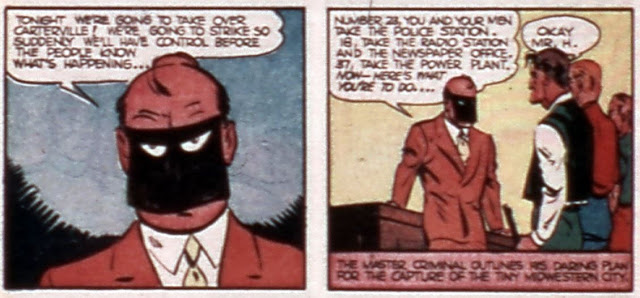
    Mr H, the mastermind behind all crime in the city of Carterville and its unnamed state, gets up to all kinds of schemes through his proxies. For example:

    -running an illegal casino in a hard-to-catch gambling blimp

    -robbing a munitions plant in order to outfit a small army of gangsters and enact a criminal takeover of Carterville

    -stealing an experimental bomber from the US Army and attempting to sell it to crypto-Nazis

    -having his gang murder random Carterville citizens in order to drive down confidence in the police

    -stealing an experimental paralysis gas in order to disable and rob the entire population of Carterville 

    -attempting to destroy all public transit in Carterville for unclear reasons

    -attempting to blow up the Carterville Dam for unclear reasons

    -sundry murders and robberies

    At first, Carterville’s major crime figure and the inspiration for regional super-hero the Devil’s Dagger is a guy by the name of Jeff Marlowe, but he falls off of a roof in Master Comics 007, necessitating the introduction of his boss, Mr H. Over the course of his 12-odd appearances Mr H has a variable amount of hair and a selection of different cloth masks. The consistent aspect of his adventures (aside from his orange suit) is his habit of getting away in some sort of motor vehicle at the last second.

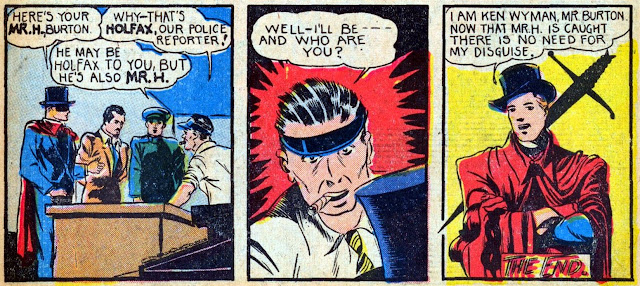
    Then, in Master Comics 018, Ken “Devil’s Dagger” Wyman gets a new coworker, police reporter Holfax. I won’t beat around the bush: Holfax is Mr H – introduced, I suspect, because the feature was coming to an end and they needed somebody to be the villain. The great thing about this is that Holfax/ Mr H thus becomes an evil equivalent to Wyman/ the Devil’s Dagger, something that I’m always excited to see.

    And the piece de resistance is of course the capture of Mr H and the subsequent retirement of the Devil’s Dagger in Master Comics 020, a rare ending not just for a Golden Age super-hero but for any super-hero ever.

    Mr H might not be terribly exciting in and of himself but I would still love to see a legacy Devil’s Dagger BRUNG BACK and who better to act as his foil than an ancient Holfax, out of prison and running Carterville once again.

    ADDENDUM: I almost forgot to highlight the fact that Mr H employs one of my favourite costume elements: the mask with attached bald cap.

    ADDENDUM II: I just read the long-unavailable Master Comics 006 and in it Mr H, through his proxy Jeff Marlowe, kidnaps the President of the United States for ransom. This is a very big crime not to have been aware of!

  • MINOR SUPER-HERO 362: THE SON OF COUNT DRACULA

    (Master Comics 020, 1941)

    The Son of Count Dracula: 100/100 for theming and commitment to the bit, 0/100 for practical planning. 

    So: a team of private detectives named Splithair and Undermeyer are hired to investigate a series of disappearances associated with Vampire Castle, located in the castle-rich hills of New York State. Splithair is quickly captured by the Son of Count Dracula (tSoCD) and Undermeyer is only saved by the timely intervention of a nosy Bulletman. TSoCD retreats from the dawn and Bulletman escorts a panicky Undermeyer home.

    The next day Bulletgirl, justifiably upset at being left behind on the first outing, does some investigating of her own and is promptly added to tSoCD’s collection of prisoners, and then Bulletman shows up to save the day.

    The Son of Count Dracula turns out to be Splithair, of course, and while I admire his imagination and sticktoitiveness I must note that it is entirely his fault that he was caught. Beyond even the question of whether he should have taken the job to investigate his own crimes there is the simple fact that he didn’t need to run a vampire-themed kidnapping ring out of Vampire Castle. Run a regular kidnapping ring somewhere inconspicuous, man! Make yourself at least a little hard to find!

  • MINOR SUPER-HERO 362: THE SON OF COUNT DRACULA

    (Master Comics 020, 1941)

    The Son of Count Dracula: 100/100 for theming and commitment to the bit, 0/100 for practical planning. 

    So: a team of private detectives named Splithair and Undermeyer are hired to investigate a series of disappearances associated with Vampire Castle, located in the castle-rich hills of New York State. Splithair is quickly captured by the Son of Count Dracula (tSoCD) and Undermeyer is only saved by the timely intervention of a nosy Bulletman. TSoCD retreats from the dawn and Bulletman escorts a panicky Undermeyer home.

    The next day Bulletgirl, justifiably upset at being left behind on the first outing, does some investigating of her own and is promptly added to tSoCD’s collection of prisoners, and then Bulletman shows up to save the day.

    The Son of Count Dracula turns out to be Splithair, of course, and while I admire his imagination and sticktoitiveness I must note that it is entirely his fault that he was caught. Beyond even the question of whether he should have taken the job to investigate his own crimes there is the simple fact that he didn’t need to run a vampire-themed kidnapping ring out of Vampire Castle. Run a regular kidnapping ring somewhere inconspicuous, man! Make yourself at least a little hard to find!

  • MINOR SUPER-VILLAIN 361: THE THROTTLER

    (Master Comics 019, 1941)

    Imagine my excitement when I saw that Zoro the Mystery Man was facing a guy called the Throttler so soon after his bout with the Choker: a theme! A villain theme! Huzzah!

    And imagine my disappointment when I discovered that the Throttler moniker was a fiction developed by two butlers to cover for their fairly inept kidnapping scheme. There wasn’t even any throttling!

    Still, I do have to tip my hat to them on one front: in a super-hero universe, pretending to be a guy with a special name and a gimmick is absolutely the way to give your ransom note a bit more gravitas. Too bad for them that it’s also absolutely the way to get beat up by a guy with a pet cheetah.

  • MINOR SUPER-VILLAIN 360: MISTER MASK

    (Master Comics 019, 1941)

    If you’re ever at a party and a guy shows up with a mysterious bequest for the host and then is murdered by an unseen party before he can hand over what turns out to be a huge diamond then take it from me: you are in a comic book. If there’s a guy named “Rajah Kohur” there to declare the diamond to be cursed, well that’s just what we call further evidence.

    Now you’re going to want to watch out for costumed crooks – in this case they’ve gone for a vague Indian/ religious theme to play up the cursed nature of the gem and are using a weird tube that shoots darts made of crystallized poison to kill people because simplicity and costumed villainy don’t mix.

    Anyway, you’re going to want to keep an eye on any guardians, uncles, family lawyers, that sort of folk. Mister Mask turns out to be the heiress’ foppish cousin Dariustrying to get her to sell the “cursed” diamond cheap (Rajah Kohur is of course a con artist). His biggest error was in trying all of this at an event attended by the Companions Three – there’s no reason to handicap your own attempt at an already difficult task.

  • MINOR SUPER-VILLAIN 359: THE UNHOLY THREE

    (Master Comics 017-019, 1941)

    The Unholy Three! A little guy (Nosey), a huge guy (Brutus) and a gorilla (Herbert)!

    Oh and of course we must not forget the fourth member of the Unholy Three, their boss “Doctor” J. Twiddley Fairchild (quotation marks his). Details in the actual story are sketchy but it seems as if Fairchild was jailed for larceny, escaped, assembled the other three as his minions and set out to get revenge on those who were responsible for his imprisonment – in other words an old fashioned Judge and Jury Revenge Killing scheme.

    This is where things get a bit annoying for me personally. JaJRK schemes are quantifiable based on the number of attempted slayings divided by the number of successful ones. The problem is that while we know that the Unholy Three end up killing all but one of their targets we do not in fact have any idea of how many targets there were – it’s more than three but up to something like twenty+ if the defense team and witnesses are included.

    Sadly then, JUDGE AND JURY REVENGE KILLING SCORE: n-1/n

    The Unholy Three (all four of them) end up getting caught by Bulletman and Bulletgirl before managing to finish off the last of their targets, but someone at Master Comics must have liked them because they returned for a two-issue story. Too bad for J. Twiddley Fairchild: he didn’t make it out of the initial jailbreak alive. Leadership of the group passed to Nosey and Bulletman became the new target for revenge.

    The actual action is whatever – the Unholy Three kidnap Bulletgirl and try to kill them both with a deathtrap and the second part opens with Bulletman thinking that Bulletgirl has died while the Unholy Three think that Bulletman has. This doesn’t really go anywhere interesting.

    Ultimately the Three attempt to flee the country and Bulletman kicks them off a cliff to their demise.

    OR DOES HE? Because the Unholy Three are collectively our second villain to be resurrected off-panel in time to sign the Crime Exchange petition. Like Mr Murder they never appear again but just knowing that two guys and a gorilla are out there somewhere is enough for me.