The Curse of Skeleton Munroe

Category: Fawcett Comics

  • MINOR SUPER-VILLAIN 358: THE BLACK HOOD

    (Master Comics 018, 1941) 

    Okay, I am a big fan of the Black Hood. Let’s count down the reasons:

    One: very exciting to see the classic super-suit being worn in the early days of suits and robes. This look won’t take long to become ubiquitous once it catches on but it’s still pretty rare in 1941.

    Two: not only is he a fashion pioneer but he is a thought leader in the field of henchman couture. Dressing your guys in a slightly worse version of your own costume (in this case bright rather than dark blue) is a surefire move in the villain game and it’s going to be a while before we see it with any kind of regularity.

    Three: The Black Hood is introduced as El Carim’s arch-enemy, despite never having appeared before’ and there are allusions to El Carim having broken up “four of his best rackets” etc. Implied lore is admittedly an easy way to build up a story’s interest but I guess I’m a sucker for it.

    About the only real criticism I have for the Black Hood is for all that he has experience battling El Carim (potentially years of experience, depending on the rate at which he sets up rackets) he is entirely unprepared to deal with Carim’s dank majiks. His approach is a completely straightforward trap and kill attempt and it goes very badly. A real shame.

    Nonetheless. regular costumed crooks like the Black Hood are the backbone any supercrime economy and he or his heirs should be BRUNG BACK post haste.

  • MINOR SUPER-VILLAIN 357: MUMBO JUMBO

    (Master Comics 016, 1941) 

    I always have an instinct to skip the really racist ones, but I think it’s better to acknowledge them? There’s lots of messed up shit in old (and new) comics, folks. 

    Anyway, Mumbo Jumbo is a guy named Graynor who poses as a voodoo god/ priest in classic (often quite racist) comics style and uses the believers at his command in order to… get revenge on his old boss. It’s a shocking lack of ambition on top of everything else – just as well that he gets murderated by Zoro the Mystery Man’s pet cheetah.

  • MINOR SUPER-VILLAIN 356: OLBAID THE GREAT

    (Master Comics 016, 1941)

    I almost missed the fact that this guy is an evil equivalent of El Carim! I somehow read that opening blurb and thought that his name was Diablo but it’s not, it’s Olbaid – he has a backward name like El Carim!

    What’s more, Olbaid has roughly equivalent magical powers to El Carim, and uses magical items to supplement them just like him. In Olbaid’s case, this involves the Snake Pool, a magical pool of water that turns humans into constrictor snakes, suitable for use as snakey minions.

    While Olbaid is not a stage magician like El Carim, he does have a show business tie via his stable of ex-circus performer henchmen, including cowboy Rifle Ralph, lariat artist Roper Pete and an unnamed knife thrower.

    Sadly for Olbaid, the similarities between him and El Carim end when it comes to power levels and their magical duel ends with Olbaid in jail and the snakes restored to humans who hopefully can’t remember being used to squash a bunch of people.

  • MINOR SUPER-VILLAIN 356: OLBAID THE GREAT

    (Master Comics 016, 1941)

    I almost missed the fact that this guy is an evil equivalent of El Carim! I somehow read that opening blurb and thought that his name was Diablo but it’s not, it’s Olbaid – he has a backward name like El Carim!

    What’s more, Olbaid has roughly equivalent magical powers to El Carim, and uses magical items to supplement them just like him. In Olbaid’s case, this involves the Snake Pool, a magical pool of water that turns humans into constrictor snakes, suitable for use as snakey minions.

    While Olbaid is not a stage magician like El Carim, he does have a show business tie via his stable of ex-circus performer henchmen, including cowboy Rifle Ralph, lariat artist Roper Pete and an unnamed knife thrower.

    Sadly for Olbaid, the similarities between him and El Carim end when it comes to power levels and their magical duel ends with Olbaid in jail and the snakes restored to humans who hopefully can’t remember being used to squash a bunch of people.

  • MINOR SUPER-VILLAIN 355: MR MURDER

    (Master Comics 015, 1941) 

    Mr Murder is your “pay or die” style of extortionist and a) has a pretty great name and b) is presumably in an early stage of his career as there is a lot more “die” going on than “pay”.

    Mr Murder also has a great understated costume: tunic, hat, cape, scarf, gloves. Just a bit off of what you might see someone actually wearing – nice and menacing in a Shadow sort of way.

    And of course Mr Murder turns out to be Reilly, the loudmouthed lawyer from the beginning of the story, presumably using his position to determine opportune targets for extortion and employing my fave the rubberoid mask to disguise his identity. It’s a fine outing over all but nothing special. The interesting stuff comes with Mr Murders further appearances:

    Mr Murder reappears in Master Comics 027, 1942 and there are several weird things going on. The least of these is his decision to incorporate the rubberoid mask into his costume despite his identity no longer being a secret, but I guess that’s no weirder than villains who continue to wear regular style masks in such circumstances.

    More interesting is the fact that there seems to have been a Mr Murder/ Bulletman clash some time in between, during which a) Mr Murder found out Bulletman’s secret identity and b) Bulletman was thought to have killed Mr Murder. As far as I can tell, this story was never published (I reckon that it’s equally likely that a story was produced but never published or someone misremembered Mr Murder being in a story he wasn’t), but the upshot of it is that Mr Murder is out for revenge and armed with the knowledge to do the deed. He kidnaps Jim Barr and almost succeds in bumping him off but has seemingly forgotten about the existence of Bulletgirl, leading to him getting his but kicked and dying for real.

    OR DID HE? This marks our first encounter with the CRIME EXCHANGE, an organization run by future Minor Super-Villain the Crime Broker, the details of which are not germane other than the fact that at one point the Exchange members petition the Crime Broker to bump off Bulletman, a petition consisting mostly of deceased Bulletman villains. It’s madness! A huge (dead) portion of Bulletman and Bulletgirl’s rogues gallery, returned to life (or, less incredibly, sprung from prison) in a single panel! Madness!

    Okay, maybe this is more exciting to me than anyone else but it is neat. And as someone whose official stance is that super-villains are more interesting when they’re still alive I heartily approve.

  • MINOR SUPER-VILLAIN 354: THE MASKED MAN

    (Master Comics 015, 1941)

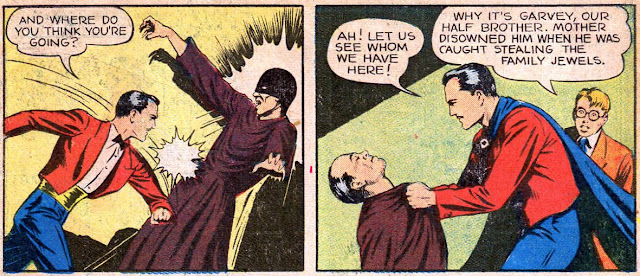
    This really illustrates how the life of a mysterious adventurer is different from that of the rest of us: while driving through Florida, Zoro the Mystery Man stops at a random mansion, is rebuffed when he seeks admittance, and decides to snoop around. While you or I might discover, say, a private birthday party or merely a normal family who don’t particularly want to entertain every stranger who knocks on their door, Zoro instead finds a masked figure who is busily mutating the mansions inhabitants into ape-men. I guess once it happens to you a couple of times you just get an instinct for it?

    Hi-jinks of course ensue, culminating in the revelation that the culprit is Garvey, the black sheep of the family who presumably chose the ape-man route of seeking revenge because it was cooler than merely shooting up the joint. The point is, his name is Garvey Rantrill.

  • HONOURS

    (Master Comics 015, 1941) 

    Minute-Man receives the “highest award for valor” from the South American nation of Rinaldo for stopping a load of Nazi stand-ins from blowing up their Washington embassy.

    (Master Comics 016, 1941)

    The Companions Three receive the Decoration for Valor of the European nation of Cabarro for facilitating and then stopping the theft of their crown jewels.

  • MINOR SUPER-VILLAIN 353: THE PURPLE HOODS

    (Master Comics 013-014, 1941) 

    I’m not going to lie: when I started reading this story I got excited for one of the more niche reasons I ever have. See, the prior Buck Jones story – the one with the Ghost Killer gang – was still wrapping up and I had a moment where I thought there would be some very exciting gang continuity if any of the former Ghost Killers, already relict of the White Arrow gang, had joined up with the Purple Hoods. That’s an unprecedented three gangs! Alas, Snake and Cope were sent to jail and the counter reset.

    Ephemeral hopes and dreams aside, the Purple Hoods are crass capitalist crooks: their big scheme involves kidnapping Mexican farm labourers and pressing them into slavery in a secret oil refinery. Ah, the romance of the Old West!

    And speaking of the Old West, this story is a perfect illustration of the weird liminal space that the West occupied in the 40s imagination: is Buck Jones an Old West marshal or a contemporary one? Does this issue offer any clues? The ascent of oil as a valuable resource does overlap with the Old West, and steel oil barrels of the kind pictured above are a 20th Century invention, but one of the major conflicts of the story is a business rivalry between two competing stagecoach lines and while I can find evidence of stagecoaches being used into the early 20th Century I doubt that they were such a going concern as that.

    What I’m getting at here is that I don’t know which way the anachronisms are going: is Buck Jones an Old West marshal with forward-thinking villains or a modern marshal in an overly romanticized setting? Who knows!

    (I must note that I do appreciate the Purple Hood leader getting his own special version of the gang costume)

    ADDENDUM:

    Two issues later (Master Comics 016, 1941), the story is clearly set in the Old West! Answers have been forthcoming at last!

  • MINOR SUPER-VILLAIN 352: THE CRYSTAL

    (Whiz Comics 015/ Master Comics 014, 1941)

    Basics first: the Crystal is nothing particularly special. He’s a businessman or something named Mr James who has a wealthy ward named Ronnie Keller and covets the money that he is charged with administering. It’s a pretty common turn of events in comics and Mr James is part of the significant minority of greedy guardians who decide to skip the simple embezzlement and advance straight to costumed thuggery. He’s got goons and everything!

    There are two other things about the Crystal, an annoying one and a tragic one. The annoying one is that due to the way that early anthology comics were shuffled around fairly frequently, the first of the two-part Companions Three story he appears in is in Whiz Comics 015 and the second is in Master Comics 014. Thus, 80-odd years later and reading books in a collated way rather than as they arrive on the shelves of your local newsagent you never ever end up reading them concurrently. It’s maddening! For me! About once every ten years!

    The tragic one is simply that the Crystal has a pretty great costume! Just look at that dome! But ten years later the Red Hood would really just blow this costume out of the water. It’s not even close! The Crystal’s good costume was doomed to obscurity in that moment.

  • MINOR SUPER-VILLAIN 351: THE CHOKER

    (Master Comics 013, 1941) 

    The long and the short of it is that the Choker is an old-fashioned escaped homicidal maniac of the sort who indiscriminately kills everyone who crosses his path – more akin to a rampaging monster than a villain, plot-wise. He gets into a couple of scrapes with Zoro the Mystery Man (who, by the way, proves susceptible to the worst little old lady disguise in comics history) before meeting a rare Death by Cheetah.

    Also: a seldom-seen shoeless villain!