The Curse of Skeleton Munroe

Category: Fawcett Comics

  • MINOR SUPER-VILLAIN 179: THE BEAST-RULER

    (Captain Marvel Adventures 003, 1941)

    The Beast-Ruler’s origin is simple: for reasons of his own, Dr Sivana builds a human out of animal parts – the muscles of a gorilla, the memory of an elephant and yes, the life-force of a thousand beasts – and that creation promptly rebels and runs off with the remaining beasts that have not had their life-forces squeezed out. A real rookie mistake on Sivana’s part if you ask me – this isn’t his first time toying in God’s domain and he should have lab procedures covering such as a rebellious super-powered humanoid.

    Speaking of super-powers, the Beast-Ruler has ’em (and speaking of names, that’s a bad one). He’s got the full suite of enhanced physical abilities, plus he can communicate with animals, a trait that he quickly uses to organize an army of beasts as a prelude to wiping out humanity. A pretty smart move on the part of the animals, honestly, but Captain Marvel ultimately prevails over this force with the help of other animals who choose to side with the human race.

    The breakdown of the animal armies is interesting: wild animals are all on the Beast-Ruler’s side, while Captain Marvel has dogs, cats and a selection of domesticated farm animals, but not all of them. Sheep are firmly on the side of the Beast-Ruler and the loyalty of pigs and horses seem to be split, with some representation in each army. If we’re honest, most of the pro-humanity animals were fooling themselves, but they manage to distract the more sensible beasts long enough for Captain Marvel to send the Beast-Ruler head first off a waterfall.

  • MINOR SUPER-VILLAIN 178: THE ARSON FIEND

    (Captain Marvel Adventures 002, 1941)

    The Arson Fiend! A simple villain conceptually: fire insurance salesman George D. Tweedle just can’t sell any fire insurance and so he starts what is nominally a protection racket but really seems to be an excuse for wholesale arson.

    The twist in this particular tale is that Tweedle has somehow developed or otherwise gotten his hands on a formula that transforms him into the fire-spewing and fireproof Arson Fiend. Legitimately super-powered crooks being a bit underrepresented at this point, I am delighted by this development! I had honestly expected the Fiend to be an asbestos outfit with a flamethrower concealed in each sleeve. The secondary twist is that Tweedle finds out that Billy is Captain Marvel seemingly without effort, which I love. Finally a comic book character is being held accountable for their poor infosec.

    Sadly, such a being cannot be long for a comics world. The Arson Fiend and Captain Marvel battle atop a large oil tank and it eventually turns out that however immune to fire you are, you still have to look out for the concussive force element of, say, an oil tank explosion if you want a long career in arson.

  • MINOR SUPER-VILLAIN 177: BRAM THIRLA

    (Captain Marvel Adventures 001, 1941)


    I waffled a bit on this guy – he’s just a regular-style vampire, after all. But a regular-style vampire is like a ninja or a xenomorph (or a knight, a pirate, a robot, etc): a deadly threat super-villain level singly, while also being easily killed when part of a group.

    So: Bram Thirla demonstrates a couple of important safety concerns specific to comic book science. Firstly: if you must combine the practices of science and sorcery, at least do so in proper laboratory conditions, as performing experiments e.g., in a cemetery at midnight not only introduces quite a lot of unintentional variables but limits the ability to pre-plan safety precautions such as escape routes.

    Secondly: when sourcing human remains or brains, go the extra mile and try to get ahold of a nice person’s corpse. Sure it’s easier to bribe the prison morgue attendant to release the body of a recently executed mass murderer to you but now you have a murderer’s brain in your gorilla and that spells trouble. Or in this case: you’ve resurrected the body of a “mysterious and evil man” because nobody would object and now you’re being eaten by a vampire.


    The best part of this story is presented above: Captain Marvel and Bram Thirla are incapable of hurting one another, so are locked in a race against time: can Captain Marvel do enough research on vampires to figure out how to bump off Thirla before Thirla catches him in his Billy Batson form?


    The comic isn’t called Bram Thirla Adventures, so thanks to HP Lovecraft’s seminal work The Vampire Legend, Billy prevails and Thirla is reinterred.

  • MINOR SUPER-VILLAIN 176: Z

    (Captain Marvel Adventures 001, 1941)

    Z is (spoilers) an android built by Dr Sivana to destroy Captain Marvel. He’s a cool guy and a fun villain: slick, full of attitude, almost powerful enough to do the job. Plus he doesn’t seem to know he’s a robot, which I find to be a fun feature in an android character – it allows for shocking reveals! Z should definitely be BROUGHT BACK, if only as disposable muscle for Sivana. We wuz robbed of a smug android thug slouched over a chair cleaning his nails in the background of every Dr Sivana scene from 1941 on, I say!

    The really interesting thing about Z is the fact that he and Captain Marvel fight three times and each time, Captain Marvel is explicitly trying to kill him. I came into my ongoing “read all comics” project a lot less familiar with the Fawcett end of things so I was pretty bought in to the modern conception of Captain Marvel as some sort of Pure Being of Childlike Innocence and thus it was a lot more jarring to come into the realization that in his early days he was just as likely to resort to deadly force as Batman or Superman, probably a bit less often than the former and more than the latter. Honestly interested to see just when each adopts a code against killing relative to one another.

  • MINOR SUPER-VILLAIN 176: Z

    (Captain Marvel Adventures 001, 1941)

    Z is (spoilers) an android built by Dr Sivana to destroy Captain Marvel. He’s a cool guy and a fun villain: slick, full of attitude, almost powerful enough to do the job. Plus he doesn’t seem to know he’s a robot, which I find to be a fun feature in an android character – it allows for shocking reveals! Z should definitely be BROUGHT BACK, if only as disposable muscle for Sivana. We wuz robbed of a smug android thug slouched over a chair cleaning his nails in the background of every Dr Sivana scene from 1941 on, I say!

    The really interesting thing about Z is the fact that he and Captain Marvel fight three times and each time, Captain Marvel is explicitly trying to kill him. I came into my ongoing “read all comics” project a lot less familiar with the Fawcett end of things so I was pretty bought in to the modern conception of Captain Marvel as some sort of Pure Being of Childlike Innocence and thus it was a lot more jarring to come into the realization that in his early days he was just as likely to resort to deadly force as Batman or Superman, probably a bit less often than the former and more than the latter. Honestly interested to see just when each adopts a code against killing relative to one another.

  • MINOR SUPER-VILLAIN 175: THE MAN WITHOUT A FACE

    (Bulletman 002, 1941) 

    Gangster Scar Malone was convicted of murder and sentenced to the electric chair. He swore revenge against the judge and jury, as you do. And once you’ve done that kind of thing, you only have a few options: fake your own death so you can come back as a fake ghost to kill your enemies; arrange for your body to be taken to a scientist or magic man for post execution revival so you can slay your enemies; have your secret twin pose as your vengeful spirit to kill your enemies, or do what Malone opts for: simply escape while on the way from trial to prison, (optionally searing your face off with hot steam while doing so) and come back months later to kill your enemies.

    If I’m to judge (haha) a judge and jury revenge killer’s relative quality, it’s going to be a numbers game – just how many of their self-assigned targets did they manage to take out. Even though he was a master of escape and disguise, the Man Without a Face managed a mere 2/13 or 15% before being thrown off a roof by Bulletman. A poor showing indeed.

  • MINOR SUPER-VILLAIN 174: THE LIMPING MUMMY

    (Bulletman 002, 1941)

    I cannot tell a lie: I love a fake mummy. I can’t help it – there’s something about a crook going to the trouble of wrapping themself up in old linen that is very endearing to me. And as with our friend here, they often have a modifier to distinguish them from the workaday mummies that you see everywhere. They’re a Golden Mummy or a Missing Mummy, or, as with our boy here, a Limping Mummy.

    The actual reason for mummying up is usually the same: disguise yourself so that you can rob a museum or steal some Egyptian artifacts or steal some Egyptian artifacts from a museum. The reason our guy is a limping mummy is that he decided to add another layer to his disguise and throw suspicion on Benhurst the museum director, who walks with a cane.

    And then, he attempts a third layer of obfuscation by using his civilian identity, newspaper editor Jason Hilder, to slam the police for not being able to deal with all these mummy crimes! This is actually a terrible idea, since Hilder wasn’t at all involved before and he actually ends up getting caught because he takes it too far and attacks Sergeant Kent of the police for… some reason? The Limping Mummy’s plot doesn’t really hold together is I guess what I’ve been trying to lay out here.

  • MINOR SUPER-VILLAIN 173: THE HUNCHBACK

    (Bulletman 002, 1941)

    There are many Hunchbacks, both actual and fake, in the ranks of the minor super-villain, alas. Victor Hugo has much to answer for. This Hunchback is a former actor whose back (and presumably mind) was injured in a fall and thereafter resolved to kill all leading men at a particular theatre via dart to the neck.

    The real standout of the story is not the Hunchback but rather red herring murder suspect Matt Benson, seen here being a completely unsuspicious witness:

    And here being careful not to make himself seem like he might have done it:

    I sincerely think that in all my years of reading this kind of story I have not seen a suspect with less chill. The man could not order a cup of coffee without implying that he had strangled someone for the cash he was using to pay for it.

  • MINOR SUPER-VILLAIN 172: THE LARGEST MAN IN THE WORLD

    (Bulletman 001, 1941)

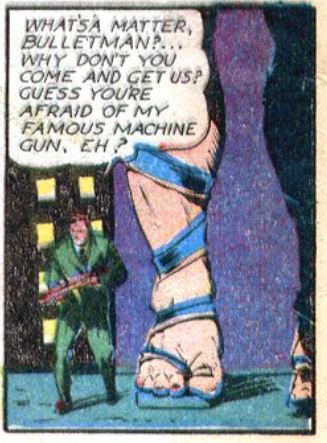
    The Largest Man in the World is exactly what it says on the tin: an unfeasibly enormous dude. By himself, not much of a threat so long as he gets a regular supply of molasses to eat. It’s just too bad for society that he is spotted by crooks and used as a living siege weapon to rob and kill.

    The really remarkable thing about the Largest Man in the World is that his gangster pal is Machine Gun Kelly. Like, the real guy – the actual real-world crook. This is completely wild to me for two reasons. Firstly, Machine Gun Kelly was jailed in 1933 and died in prison, so when this comic came out he had not been a real-world crime concern in over 8 years.

    Secondly, I think I’ve mentioned how Golden Age comics frequently went out of their way not to use actual country names, and with people, even criminal people, it’s even more pronounced. Al Capone isn’t going to show up in a comic, but Al Tyrone, Al Maloney or Andy Carpon will. Hell, Adolf Hitler largely appears under light pseudonyms before the US enters WWII. It’s weird and wild to see Machine Gun Kelly just running around talking about his machine gun, and that’s before they kill him – a man who will go on to live for another 13 years in prison, remember – off!

  • MINOR SUPER-VILLAIN 171: THE VOICE

    (Bulletman 001, 1940)

    There is a pretty broad swath of the super-villain community (and an even larger cohort of generic costumed villains) who have the common origin of being respectable members of society who need a second identity to head a gang or catburgle or do murders under the guise of.

    The gang leaders tend to stick to a few different styles of dress: there’s the domino mask wearers, the executioners-style hood guys and the more cautious head-to-toe robe wearers. The Voice here is part of a very specific type of these guys who only appear in silhouette – not particularly common, probably because it ends up tying them pretty thoroughly to a specific locale.

    The Voice doesn’t have too much to distinguish him: he’s running for district attorney and making a lot of political hay out of all the crimes being committed by the gang he himself is running. The really unusual thing about him is that he and his gang find out Bulletman’s secret identity over the course of the story and then… nothing. They go to jail, with none of the usual mind-wipes, elaborate deceptions or gruesome deaths that usually ensure that those who learn a hero’s secrets do not retain them. Just between 4 and 10 hardened crooks nursing that knowledge as they are taken away by the police. Remarkable stuff!