The Curse of Skeleton Munroe

Category: Fawcett Comics

  • GENERIC COSTUMED VILLAIN ROUND-UP 034

    Since we’re currently reading Whiz Comics for 1941, it’s time yet again for another load of unscrupulous people to get their hands on the Ibistick and then kill themselves with it. And here they are:

    the Widow Zorn:

    Ibis lends the Ibistick to old Professor Grubb  for scientific study after Grubb finds it outside of an exploded building and uses its magic to restore the building and everyone inside – which included both Ibis and Taia, along with their their young ward Tommy – to wholeness and life. This isn’t a bad idea per se, as Grubb is an honest man, but he is also in love with the scheming Widow Zorn, who vamps it away from him in about two seconds flat.

    Zorn’s main interest is in conjuring up hunks to fight for her attention, so the damage potential in her having the Ibistick is a bit lower than some (although she does vaporize poor old Prof Grubb when he kicks off about it). She does of course try to kill Ibis with his own wand and ends up on the Moon for her trouble, but fortunately for her the reconstituted Grubb advocates for not letting her explode or whatever and she ends up falling for him after all. (Whiz Comics 012, 1941)

    Trug: 

    Trug gets his own super-villain entry, the jerk. 

    the Chief: 

    The Chief isn’t a villainous figure per se, but his role in the comic is close enough that I’ll say that he counts. The leader of an Inuit group subjugated by Trug, the Chief recovers the Ibistick after Trug loses it in a magical air raid and turns the tables on the villain by imprisoning him in his own palace.

    The Chief lives through the process of confronting Ibis by simply being a fair fighter and not deigning to use magic where fists will suffice. Fair-ish, at least – he is nine or ten feet tall at the time. Still, Ibis manages to win their fight and reclaims his wand. The Chief and his people are returned to their original sizes (as the latter had been shrunk by Trug to ensure obedience) and get to keep Trug’s palace to boot. (Whiz Comics 014, 1941)

    A Spider: 

    When Ibis and Taia leave the Chief and his people they are given a stone as a gift, and after having it appraised and finding out that it is an enormous and valuable ruby Ibis decides to give it back. Rimson, the appraiser, objects to this and attempts to claim the ruby for himself, and to that end he shoots out the couple’s car tire, causing them to crash into a gorge.

    Ibis and Taia survive thanks to the magic of the Ibistick, but the wand is dropped in the shuffle and chanced upon by a colourful and anatomically dubious spider that manages to envision its desires well enough to become both enormous and intelligent. 

    The arch-cad Rimson soon falls to the spider’s fangs, and Ibis is forced to battle it lest he and Taia likewise be eaten. He manages to mortally wound it with an improvised spear and then it finishes itself off by wishing for Ibis to fade to nothingness. It’s a sad end for what I reckon might be our very first animal villain. (Whiz Comics 015, 1941)

    Mudge: 

    Mudge was already wanted for murder, minus a soul thanks to a deal with Satan (actually the villain Trug in disguise – not sure if that affects the validity of the soul sale) and afflicted with a donkeys ears thanks to Ibis when he acquires the Ibistick after it has been dropped in a a struggle. If any villain could use a break like this it’s him, but he immediately screws up his chance by trying to afflict Ibis with chains. (Whiz Comics 020, 1941)

    Unnamed Fascist:

    This unnamed officer in the army of the War Lord not only speed-runs the process of reckless Ibistick use leading to disaster but manages to take down an entire invasion force with him thanks to his grandstanding, as he tries to wipe out Ibis and the entire army he’s with all in one go.

    Please also note Ibis foe Half-Man in the above panels, who is remarkable for being the only villain to date to avoid this kind of thing by not using the Ibistick at all. Presumably he is wise enough to keep tabs on how other villains have met their downfalls. (Whiz Comics 024, 1941) 

  • SUPER-HERO 001 UPDATE: CAPTAIN MARVEL (1941)

    Just a few notes on developments in the character of Captain Marvel in 1941: 

    In Whiz Comics 014, Captain Marvel contends with a Dr Sivana who has worked out a mathematical formula for passing through solid matter, and thanks to the Wisdom of Solomon is able to replicate this feat. Even more remarkably this power turns up again in Whiz Comics 016 after Captain Marvel is sealed up in a pit by Smasher Spy. It’s virtually unprecedented to see something like this crop up again, even if it only happens once (though with this specific power it’s easy to see why one might refrain from using it too much, as it eventually took such a toll on Sivana’s physical form that he dissipated into a thin mist).

    Whiz Comics 022 introduces the character of Whitey Murphy to Captain Marvel’s supporting cast after making his initial debut in the Adventures of Captain Marvel movie serial, making him the first character to make their way into the comics after being introduced in another media, to my knowledge (the nameless office boy who would become Jimmy Olsen does already exist at this point but doesn’t gain his radio counterpart’s name and attributes for a few months yet).

    More unusually, Whitey is presented as being both the same character as in the movie serial and as having participated in the making of the movie in which that character debuted. I suppose that the events of the movie might have occurred and then been dramatized? Regardless, Whitey here is going to be in Captain Marvel’s orbit for the next year or so.

    Also in Whiz Comics 022, in not so much a new power but a new application of power, Captain Marvel reveals that thanks to the Wisdom of Solomon he is able to speak all languages. 

    And finally, a little name-dropping: Captain Marvel claims to be pals with cowboy stars Buck Jones and Gene Autry. (Whiz Comics 023, 1941)

  • MEMES OF YORE: GE-SPEAK

    Here’s an obscure one that I have only encountered in early Golden Age comics: the German or pseudo-German accent that includes a prominent use of the prefix “ge-” as a word modifier, in the same way that a bad French accent might append “la” or a bad Russian accent might add “-ski” to the end of words.

    How widespread was this? Did it exist outside of comics? No clue. How widespread was it within comics? That we can attempt to solve by gathering examples here. Perhaps some kind future cultural historian will be able to take the evidence thus presented and rediscover this lost stereotype. 

    (Whiz Comics 023, 1941)


  • MINOR SUPER-VILLAIN 909: THE SPIDER

    (Whiz Comics 022, 1941)

    In what turns out to be Dan Dare’s final recorded case, he is asked to protect a man named Dr Phoebus Weber from being murdered by a mysterious figure known only as the Spider.

    Upon entering Weber’s home, Dan and Carol are almost immediately attacked by the Spider, who I have to give partial credit to for the costume. Sure it appears to have a more beetle-like body plan and the head of a mosquito, but what’s more important is that it has the full eight limbs, including four useless ones hanging off the torso that surely must constantly be in the way. Accuracy be damned, I love a commitment to the bit.

    The Spider also has a third central eye that is supposedly able to emit a hypnotic light, but if it does there is no actual evidence of it in the text. Perhaps Dan Dare is merely a paragon of mental fortitude.

    The Spider’s attempt to kill Dan fails thanks to an over-reliance on a hypnotic eye/ stabbing proboscis combo that he never really manages to pull off and I can only imagine was further hindered by the extra arms. He is unmasked to reveal the in-retrospect-supiciously-named Dr Weber, but that’s not all, because…

    Weber is in turn unmasked to reveal that he is in fact Dan’s old enemy Hypno Harry! This has all been an attempt to kill Dan in revenge for his foiling Harry’s old racket of hypnotizing bank clerks with his gimmicked glass eye, and just imagine the impact that this story might have had if we had ever heard about any of this before the Spider reared his improbable head!

    Still, a costumed crook is a pretty good note for Dan and Carol to go out on after 20-odd issues of solving one mystery after another. Let’s hope that they were finally able to get that vacation. 

  • DIVINE ROUND-UP 026

    I’ve finally caught up on my god backlog so these are all piping fresh deities for you to peruse.

    Itzalotahui:

    On an expedition to Guatemala to locate their missing friend John Malcolm, Billy Batson and Whitey Murphy make camp in the lost temple of the monkey god Itzalotahui and are awoken from their slumber by the god himself, flaming and steaming and flailing about.

    After an initial panic and an in-retrospect-embarassing fistfight, Captain Marvel discovers the truth: Itzalotahui is not alive but is in fact a cunningly-designed ball and socket arrangement in which the lower torso/socket is connected to a natural gas source and periodically ignites and wiggles around thanks to gas pressure.

    This issue is real study in contrasts: though the name of the fictional god is literally It’s a Lot of Hooey (in keeping with 1940s contempt for non-Christian or Classical religion), Captain Marvel actually seems to respect the cultural value of the site rather than just smashing it up like so many characters might. Meanwhile, the presence of natural gas means the probability of oil as well, but both Malcolm and Marvel advocate for leaving the area free from the hell of oil extraction, even if they do so in the most patronizing/patriarchal language possible.

    God Style: Idol (Whiz Comics 022, 1941) 

    the Angry God: 

    The
    Angry God, aka the Dark Spirit, is a near-forgotten entity whose last
    remaining priest has thrown in with the villain Half-Man and his Hitler
    stand-in boss the War Lord to lend mystical power to the armies of the
    Axis forces. The Angry God requires not just human sacrifice but the
    sacrifice of “great men,” which might go some way toward explaining his
    low levels of worshipper-retention. Please also note the fun imp-swarm
    that seems to accompany the worship of this particular god – they must
    be very distracting. 

    The
    Angry God’s status as a real entity and current diminished circumstances are
    both illustrated in the fact that it animates its idol in an attempt Ibis the Invincible from killing its priest and then itself falls dead once it is deprived of that one last worshipper.

    God Style: Real (Whiz Comics 023, 1941)

    Balka: 

    Balka
    is the guardian tiger spirit of the ruling line of the Asian country of
    Balkania, and whether the country was named after the tiger or vice
    versa is left unexplored in-text. What is made clear is that the
    old legends about the statue of Balka coming to life to avenge the death
    of murdered Balkanian monarch are absolutely true, as experienced by regicidal
    dictator and fashion maven Carnov after he kills good King Banok.

    Alas,
    Carnov is not torn asunder by Balka but spared by rightful heir Kelo (aka the Jungle Prince) so
    that he can face more conventional justice. Balka then returns to statue form to await the next threat to Balkania. (The Arrow 003,
    1941) 

    Quetzalcoatl: 

    Jungleman
    and his lover Louise Carson stumble upon a hidden Aztec city while
    searching for Louise’s father. Jungleman is briefly worshipped as
    Quetzalcoatl as per the legend about Hernán Cortés, while Louise is slated for sacrifice by a jealous high
    priestess. They manage to extract themselves from this situation with minimal fuss, for a 1940s adventure comic, and even find Louise’s father just kind of hanging around the temple on their way out. (Champion Comics 012, 1941)

  • MINOR SUPER-VILLAIN 908: THE RATTLER

    (Whiz Comics 022, 1941)

    As we join the action, a passing stranger informs us and also Golden Arrow that the Rattler has broken jail! And he’s handing out calling cards! 

    Turns out that the Rattler, notorious outlaw of the West, is out to get the men who served on the jury at his trial (and, we must assume, the judge and prosecutor as well), and he’s being impressively proactive about it: the above scene takes place the morning after he breaks jail and he has already killed nine members of the jury.

    After the unnamed sheriff’s deputy quits in the face of the Rattler’s murderous machinations, Golden Arrow signs up for the job and is immediately pinned down by a hail of bullets. Bullets which are then revealed to be yet another calling card-type image! For an Old West character, the Rattler is surprisingly brand-conscious.

    The Rattler’s industriousness turns out to include planning super-hero contingency plans: by the time Golden Arrow gets ready to pursue and apprehend him, the villain’s men have already made off not only with Golden Arrow’s horse White Wind but his ladyfriend Carol Braddock. And he arranges for Golden Arrow to be attacked by a (jumping!) rattlesnake – more brand consciousness.

    I’m almost sad that the Rattler falls for Golden Arrow’s subsequent trap. He was doing so well! There’s a lesson here that I can’t quite articulate – perhaps something about the path of revenge laying even the most clever among us low. In any case, it’s back to jail for the Rattler, which will give him more time to come up with an even more extensive revenge list.

    JUDGE AND JURY REVENGE KILLER SCORE: 9/15+

  • MINOR SUPER-VILLAIN 908: THE RATTLER

    (Whiz Comics 022, 1941)

    As we join the action, a passing stranger informs us and also Golden Arrow that the Rattler has broken jail! And he’s handing out calling cards! 

    Turns out that the Rattler, notorious outlaw of the West, is out to get the men who served on the jury at his trial (and, we must assume, the judge and prosecutor as well), and he’s being impressively proactive about it: the above scene takes place the morning after he breaks jail and he has already killed nine members of the jury.

    After the unnamed sheriff’s deputy quits in the face of the Rattler’s murderous machinations, Golden Arrow signs up for the job and is immediately pinned down by a hail of bullets. Bullets which are then revealed to be yet another calling card-type image! For an Old West character, the Rattler is surprisingly brand-conscious.

    The Rattler’s industriousness turns out to include planning super-hero contingency plans: by the time Golden Arrow gets ready to pursue and apprehend him, the villain’s men have already made off not only with Golden Arrow’s horse White Wind but his ladyfriend Carol Braddock. And he arranges for Golden Arrow to be attacked by a (jumping!) rattlesnake – more brand consciousness.

    I’m almost sad that the Rattler falls for Golden Arrow’s subsequent trap. He was doing so well! There’s a lesson here that I can’t quite articulate – perhaps something about the path of revenge laying even the most clever among us low. In any case, it’s back to jail for the Rattler, which will give him more time to come up with an even more extensive revenge list.

    JUDGE AND JURY REVENGE KILLER SCORE: 9/15+

  • DIVINE ROUND-UP 025

    Gods gods gods. 

    Puni, God of Fire: 

    Sea-faring adventurer Lance O’Casey almost gets sacrificed to this fire god by the cannibalistic inhabitants of a tropical Antarctic island before escaping, entering the volcano in question and meeting the other Puni. Not sure how much the volcano-dwelling madman and the actual religion influenced each other, but it must have been at least a little. Also: cool idol.

    God Style: Idol (Whiz Comics 019, 1941) 

    the War God:

    This War God idol functions like one of those hollow dog statues you see at grocery stores, that you put your change in to help raise money for people to get seeing eye dogs (and if that’s not a thing where you live then sorry for the unrelatable analogy), only the money is meant to go to the defense of China against Japanese invasion, and instead of a dog it is a sick-ass god-monster. It’s never entirely clear if this is supposed to be a representation of an actual god or just a marketing gimmick.

    God Style: Idol (More Fun Comics 059, 1940)

     Wotan:

    As was established when he beat up Mars that one time, Merlin the Magician hates war, and seeing as he has a magic cloak and a can-do attitude he sets out to do something about it. His first step is to go back in time and save a couple of young Ancient Britons from being human sacrificed by some Druids. What does this have to do with ending war? No idea, but then again I don’t have a magic cloak so my perspective might just be too mundane to comprehend the intricacies.

    Having reviewed the plan, I must conclude that Merlin just needed a couple of people with no ties who would be grateful enough to him to do whatever he wanted and that Druidic sacrifices were his first thought. Specifically, he asks these young folk to act as peace ambassadors to an unnamed fascist nation in order to undermine the efforts of the war god Wotan, who has been roaming the Earth inciting men to war.

    (It would have been quite thematically satisfying if the two young people had been rescued from being sacrificed to Wotan, and while that might have implicitly been the intent, it’s just not there on the page) 

    The young people are somewhat successful, in that they are immediately killed by a similarly young and idealistic pair of enemy soldiers (and what a progressive fascist nation, to field female soldiers in 1941!) who then become overwhelmed with remorse and swear of war forever, at which point Merlin appears and restores his agents to life – an effective but painful strategy, it seems.

    All this talk of pacifism and understanding between nations draws the ire of Wotan himself, who shows up to kill Merlin and ends up on the end of a killing sword-blow from the magician, making the current score Gods: 0 Merlin the Magician: 4.

    God Style: Real (National Comics 011, 1941)

    Death: 

    This version of Death is bound to obey an artifact known as the Sceptre of Eternity, and as such has been commanded to replace the lost daughter of a guy called the Sheik of Kamroon in the 12th Century, and as such has made off with a present-day woman named Betty Jekil. I’m pretty sure that this was a calculated move, as Betty’s father turns to super-magician El Carim for help, which ultimately results in El Carim trading the Sceptre of Eternity for Betty’s life, which is a pretty good deal for Death.

    God Style: Anthropomorphic Personification (Master Comics 019, 1941)

  • DIVINE ROUND-UP 025

    Gods gods gods. 

    Puni, God of Fire: 

    Sea-faring adventurer Lance O’Casey almost gets sacrificed to this fire god by the cannibalistic inhabitants of a tropical Antarctic island before escaping, entering the volcano in question and meeting the other Puni. Not sure how much the volcano-dwelling madman and the actual religion influenced each other, but it must have been at least a little. Also: cool idol.

    God Style: Idol (Whiz Comics 019, 1941) 

    the War God:

    This War God idol functions like one of those hollow dog statues you see at grocery stores, that you put your change in to help raise money for people to get seeing eye dogs (and if that’s not a thing where you live then sorry for the unrelatable analogy), only the money is meant to go to the defense of China against Japanese invasion, and instead of a dog it is a sick-ass god-monster. It’s never entirely clear if this is supposed to be a representation of an actual god or just a marketing gimmick.

    God Style: Idol (More Fun Comics 059, 1940)

     Wotan:

    As was established when he beat up Mars that one time, Merlin the Magician hates war, and seeing as he has a magic cloak and a can-do attitude he sets out to do something about it. His first step is to go back in time and save a couple of young Ancient Britons from being human sacrificed by some Druids. What does this have to do with ending war? No idea, but then again I don’t have a magic cloak so my perspective might just be too mundane to comprehend the intricacies.

    Having reviewed the plan, I must conclude that Merlin just needed a couple of people with no ties who would be grateful enough to him to do whatever he wanted and that Druidic sacrifices were his first thought. Specifically, he asks these young folk to act as peace ambassadors to an unnamed fascist nation in order to undermine the efforts of the war god Wotan, who has been roaming the Earth inciting men to war.

    (It would have been quite thematically satisfying if the two young people had been rescued from being sacrificed to Wotan, and while that might have implicitly been the intent, it’s just not there on the page) 

    The young people are somewhat successful, in that they are immediately killed by a similarly young and idealistic pair of enemy soldiers (and what a progressive fascist nation, to field female soldiers in 1941!) who then become overwhelmed with remorse and swear of war forever, at which point Merlin appears and restores his agents to life – an effective but painful strategy, it seems.

    All this talk of pacifism and understanding between nations draws the ire of Wotan himself, who shows up to kill Merlin and ends up on the end of a killing sword-blow from the magician, making the current score Gods: 0 Merlin the Magician: 4.

    God Style: Real (National Comics 011, 1941)

    Death: 

    This version of Death is bound to obey an artifact known as the Sceptre of Eternity, and as such has been commanded to replace the lost daughter of a guy called the Sheik of Kamroon in the 12th Century, and as such has made off with a present-day woman named Betty Jekil. I’m pretty sure that this was a calculated move, as Betty’s father turns to super-magician El Carim for help, which ultimately results in El Carim trading the Sceptre of Eternity for Betty’s life, which is a pretty good deal for Death.

    God Style: Anthropomorphic Personification (Master Comics 019, 1941)

  • GENERIC COSTUMED VILLAIN ROUND-UP 033

    GENERIC COSTUMED VILLAIN ROUND-UP 033

    Just another buncha jerks.

    John Elton: 

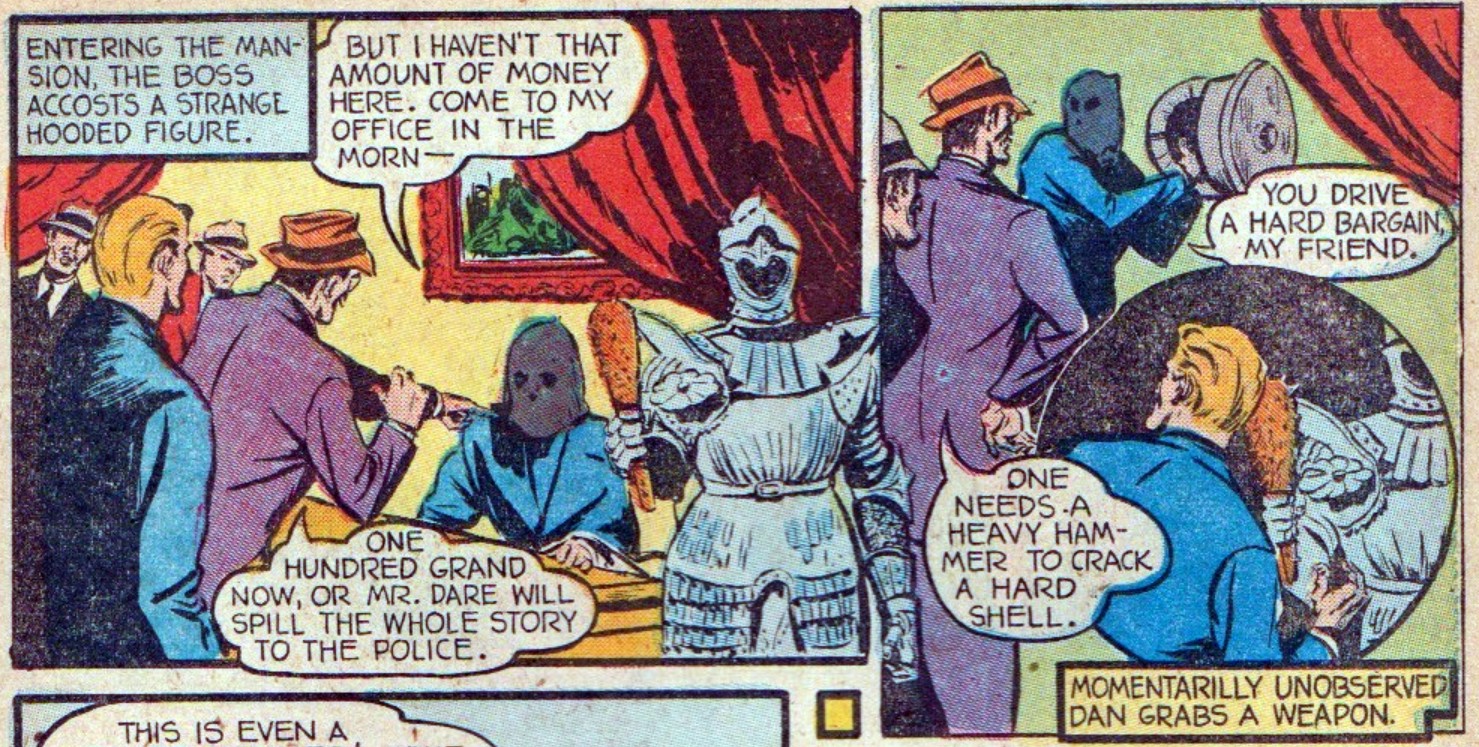
    This fellow brings us right back to the roots of the Generic Costumed Villain Round-Up, being a businessman who puts on a mask to run a gang and kill off the other officers of his company so that he can buy up all their shares and make a fortune. Plus, his name is John Elton, which doesn’t mean anything but is still a fun coincidence. Dan Dare gets ‘im. (Whiz Comics 016, 1941)

    the War Lord:

    Like the War Maniac before him, the War Lord is a generic and unseen stand-in for Adolf Hitler with a good enough villain name that I had to highlight it. A whole passel of his agents feature in the story in which Smasher Spy goes back to being Spy Smasher and get beaten up by Spy Smasher, Smasher Spy and Captain Marvel. 

    It’s not particularly germane to anything but this panel of Spy Smasher flying out a window into the arms of the War Lord’s agents after almost being blown up looks very nice and I had nowhere else to use it. (Whiz Comics 018, 1941)

    The War Lord returns to vex Spy Smasher in Whiz Comics 019, in a rare return appearance for a generic Axis dictator. In fact, he is also the power behind the fascist group the Blitzys and Ibis the Invincible foe Half-Man as well – he’s one of the most prolific Hitler stand-ins of the Golden Age!

    The War Lord finally shows up in person in Whiz Comics 024 and while he is clearly just a straight-up stand-in for Hitler his main character trait seems to be in expressing himself like a disappointed father. He sticks around just long enough to instill a deep sense of despair in the Half-Man, leaving him vulnerable to being turned to the side of good by a bit of kindness from Ibis the Invincible. Once again being a bad boss fails to pay off!

    Puni, God of Fire: 

    The above text box precedes the Lance O’Casey story in Whiz Comics 018 and let me tell you: none of that stuff happened in the prior issue. We are very much dropped in media res on the tropical Antarctic island populated by cannibals and also lost explorer Hiram T. Wallis – I don’t know if this is some remnant of a never-published story or just an attempt to shake things up again (EDIT: it happens, in fact, in Whiz Comics 019. The two-part story was just published in the wrong order).

    Lance and his ever-expanding supporting cast (including Hiram T. Wells, old-timey pirate Dan’l Doom and not one but two monkey sidekicks) are venturing into a volcano to get some gold that Wells had found there when they are confronted and menaced by the self-proclaimed Puni, God of Fire, who is in actuality Marino, a sailor shipwrecked at the same time as Wells and presumably driven insane by ten years of living in a volcanic cave. Puni/Marino never manages to get very close to killing the party but he does try in his way, and by gar can he belt out a villainous pronouncement.

    Everything ends up okay, as Marino has the kind of insanity that can be cured via a solid smack to the jaw and a dunk in the ocean. 

    This adventure also features a giant treasure-guarding parrot, just one of the many cool creatures that do their best to convince me to add the truly life-ending task of chronicling all comic book monsters to my already overloaded to-do pile. (Whiz Comics 018, 1941)

    Herculo Svenson: 

    This is Herculo Svenson, pirate, Doctor Voodoo antagonist for several issues and man in the running for best name in comics certainly for 1941 and possibly for all time. He kills a whole valley full of giants, kidnaps their regular-sized queen and makes off with magical McGuffin the Golden Flask before eventually getting killed by bigger villain Black Marco. (Whiz Comics 022, 1941)