The Curse of Skeleton Munroe

Category: Fawcett Comics

  • GENERIC COSTUMED VILLAIN ROUND-UP 033

    GENERIC COSTUMED VILLAIN ROUND-UP 033

    Just another buncha jerks.

    John Elton: 

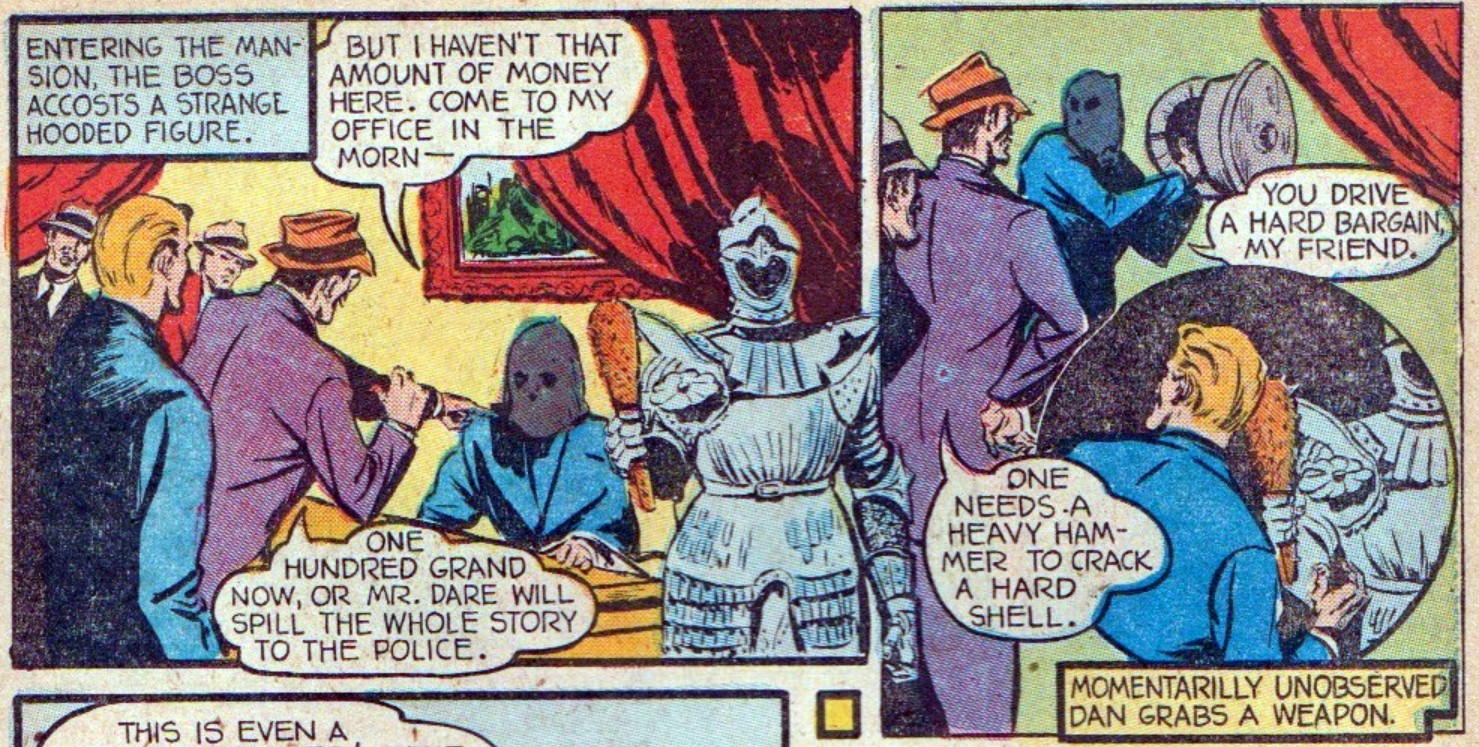
    This fellow brings us right back to the roots of the Generic Costumed Villain Round-Up, being a businessman who puts on a mask to run a gang and kill off the other officers of his company so that he can buy up all their shares and make a fortune. Plus, his name is John Elton, which doesn’t mean anything but is still a fun coincidence. Dan Dare gets ‘im. (Whiz Comics 016, 1941)

    the War Lord:

    Like the War Maniac before him, the War Lord is a generic and unseen stand-in for Adolf Hitler with a good enough villain name that I had to highlight it. A whole passel of his agents feature in the story in which Smasher Spy goes back to being Spy Smasher and get beaten up by Spy Smasher, Smasher Spy and Captain Marvel. 

    It’s not particularly germane to anything but this panel of Spy Smasher flying out a window into the arms of the War Lord’s agents after almost being blown up looks very nice and I had nowhere else to use it. (Whiz Comics 018, 1941)

    The War Lord returns to vex Spy Smasher in Whiz Comics 019, in a rare return appearance for a generic Axis dictator. In fact, he is also the power behind the fascist group the Blitzys and Ibis the Invincible foe Half-Man as well – he’s one of the most prolific Hitler stand-ins of the Golden Age!

    The War Lord finally shows up in person in Whiz Comics 024 and while he is clearly just a straight-up stand-in for Hitler his main character trait seems to be in expressing himself like a disappointed father. He sticks around just long enough to instill a deep sense of despair in the Half-Man, leaving him vulnerable to being turned to the side of good by a bit of kindness from Ibis the Invincible. Once again being a bad boss fails to pay off!

    Puni, God of Fire: 

    The above text box precedes the Lance O’Casey story in Whiz Comics 018 and let me tell you: none of that stuff happened in the prior issue. We are very much dropped in media res on the tropical Antarctic island populated by cannibals and also lost explorer Hiram T. Wallis – I don’t know if this is some remnant of a never-published story or just an attempt to shake things up again (EDIT: it happens, in fact, in Whiz Comics 019. The two-part story was just published in the wrong order).

    Lance and his ever-expanding supporting cast (including Hiram T. Wells, old-timey pirate Dan’l Doom and not one but two monkey sidekicks) are venturing into a volcano to get some gold that Wells had found there when they are confronted and menaced by the self-proclaimed Puni, God of Fire, who is in actuality Marino, a sailor shipwrecked at the same time as Wells and presumably driven insane by ten years of living in a volcanic cave. Puni/Marino never manages to get very close to killing the party but he does try in his way, and by gar can he belt out a villainous pronouncement.

    Everything ends up okay, as Marino has the kind of insanity that can be cured via a solid smack to the jaw and a dunk in the ocean. 

    This adventure also features a giant treasure-guarding parrot, just one of the many cool creatures that do their best to convince me to add the truly life-ending task of chronicling all comic book monsters to my already overloaded to-do pile. (Whiz Comics 018, 1941)

    Herculo Svenson: 

    This is Herculo Svenson, pirate, Doctor Voodoo antagonist for several issues and man in the running for best name in comics certainly for 1941 and possibly for all time. He kills a whole valley full of giants, kidnaps their regular-sized queen and makes off with magical McGuffin the Golden Flask before eventually getting killed by bigger villain Black Marco. (Whiz Comics 022, 1941)

  • MINOR SUPER-VILLAIN 907: HALF-MAN

    (Whiz Comics 021, 1941)

    Due to Allied concerns about the Nazis generic Axis use of black magic to ensure victory, Ibis the Invincible is recruited and sent to the front as a counter-sorcerer. His foe: the mysterious Half-Man, occultist and rumoured worshipper of an ancient evil god called the Dark Spirit.

    The Half-Man served with distinction in WWI, until an artillery shell cost him a leg, an arm and an eye and he was no longer able to lead troops in battle. He then turned to the study of black magic to make himself powerful and potentially whole again, and with the advent of WWII he has offered his services to the War Lord, Fawcett’s all-purpose late-1941 Hitler stand-in.

    Some further particulars: 

    In his first appearance, Half-Man has these pseudo-Gestapo occultist minions who are masterpieces to design. They could not more obviously be weird creep villains. They also receive planchette-writing intel from “the watchful ones,” which could be flowery language describing another set of occultist creeps in a lookout post somewhere but which I prefer to think is some sore of class of spirit. 

    Perhaps it’s the Ancient Egyptian in him coming through, but Ibis is unable to treat Half-Man with anything but pity and contempt, no matter how often he is proven to be a legitimate threat, as above when he completely is completely trounced by the guy.  

    Like I said, the first issue that Half-Man appears in contains a lot of talk of the ancient god called the Dark Spirit helping to ensure the Axis victories, and I had initially thought that his magical power was also derived from this being, like a D&D warlock, but Whiz Comics 023 includes a segment in which Ibis is almost sacrificed to the Dark Spirit, here called the Angry God, and manages to turn the tables and kill the god’s one remaining priest instead. This seems to kill the Angry God as well without noticeably diminishing Half-Man’s power, so I guess it’s more of a Hellboy situation in which all of the Evil Magic Guys are lumped together into a unit.

    Speaking of the military applications of mystical power, the final act of Half-Man’s villainous career takes place on the battlefield between the War Lord’s forces and those of an unnamed Allied nation that starts out on a back foot because someone is scrying their troop deployments with a crystal ball. 

    Once Ibis joins the fighting on the small nation’s side, Half-Man too is obligated to take the field, and while no mortal army is a mach for the power of the Ibistick, he manages to capture Taia and get away. The back-and-forth between them might have gone on indefinitely, but for the fact that the War Lord himself shows up and treats Half-Man with a sneering condescension instead of acknowledging his clear need for validation. This gives Ibis the chance to step up and be nice to the guy by restoring his lost body parts. Having finally achieved a feeling of wholeness again, from being literally whole rather than from magical accomplishment, the former Half-Man reforms. Hopefully he had some sort of plan in place to get to a neutral country, since he renounced his magics and presumably fascism at the end there and I doubt that the War Lord would be too understanding of that. 

  • ALIENS AND SO FORTH ROUND-UP 026

    There is a never-ending supply of aliens (and so forth) in comics, and here are some of them. 

    Giants: 

    When Doctor Voodoo is flung into the past by an old wizard, his only instruction is to find something called the Golden Flask, located somewhere called the Valley of Giants. Astonishingly, it only takes him about two issues worth of privation to get there, whereupon he and his pal Nero are immediately taken captive and frogmarched to the castle of the Queen of the Giants.

    As can be seen in the above panel, these are the less extreme kind of giant, being only ten or so feet tall (based on their sizes compared to Doctor Voodoo – probably a standard length of hero at six feet – and Nero – extra big and tall so at least seven). Hardly as dramatic as a forty-foot titan might be but at least you don’t spend the whole time wondering how their bodies hold together under the strain.

    The Queen of the Giants (Anita to her friends), by contrast, is a regular-sized lady who comes across as quite nice until Doctor Voodoo rejects her romantic advances and she has him thrown to Achilles, who turns out to be a giant python. Despite this, when the Valley of the Giants is depopulated by pirate raids, Docotr Voodoo rescues her and takes her along on the remainder of his adventures in the past. And since he never actually makes it back to the present on-panel, perhaps romance does eventually blossom, who knows? (Whiz Comics 020, 1941)

    Camurians: 

    Space hero Captain Venture and his companion Zyra, aka the Planet Princess, spend a lot of their early adventures just wandering around space and seeing what the cosmos has to offer. On one of these jaunts, they land on Planet Camur, where they find the native Camurians enslaved by another species called the Valhoes, and being righteous hero types they resolve to liberate them from bondage. 

    After being captured and enslaved themselves, Venture and Zyra lead an uprising and free the Camurians from the tyranny of the Valhoes, who were unprepared to face any resistance from their seemingly cowed slaves.

    Just where the Valhoes come from is not expanded upon in the story but just by looking at them we must reasonably assume that they also come from Camur, right? Millions of years ago some sleepy-eyed alien ape species’ population split along nerd/jock lines and the Camuriand and Valhoes were the end results. Nature is grand, really. (Nickel Comics 006, 1940)

    Catskill Dwarfs: 

    Thanks to a plane crash in the Catskill Mountains, super magician El Carim and his assistant/ love interest Gladys find themselves in the underground realm of the Catskill Dwarfs, aka the Little Men of the Mountain of Rip van Winkle fame.  

    It’s all pretty goofy until Galdys swats the Dwarfs’ Scared Flea, at which point the Little Men of the Mountain try to murder both her and El Carim in a fit of righteous ire. All is forgiven, however, by the time they return to the comic two issues later – I suppose sacred fleas are easy to come by. (Master Comics 020, 1941)

    Djungas: 

    Captain Venture and the Planet Princess’ wandering ways come to an end eventually when they crash on the far-off Asteroid Djung and are captured by the local Djunga people on behalf of their tyrannical leader King Leon. 

    The Djungas are that ever-popular combination of a high-tech society with medieval trappings, and Leon is very much a medieval tyrant figure who spends much of his time attempting to wed Zyra against her will while pitting Venture and his Djunga companion Tazon up against a series of deadly situations. These often involve the wide array of other intelligent species endemic to Asteroid Djung and its local system, so more on them later.

    The series eventually had to end, and King Leon with it, with the flick of a giant’s finger. Tazon is installed as the new King of Djung, and peace presumably reigns among the Djungas. (Master Comics 009, 1940)

  • MINOR SUPER-VILLAIN 906: THE VENGEFUL FOUR

    (Whiz Comics 021, 1941)

    The Vengeful Four is an example of a phenomenon that I am not sure is common enough that I need to come up with a special name for it: the big-name villain (in this case Dr Sivana) teaming up with a selection of nobodies as if they were equals. The Four Cards represent one other example of this, and the Penguin is a part of another called the Birds of a Feather that we will cover once we hit the year 1942. Are there more? Will I need to make up a term for this? We shall see.


    The non-Sivana members of the Vengeful Four include gang boss Biggy Brix, who crawls away from his busted-up getaway car and straight into an opportunity to get revenge on Captain Marvel for busting it up;

    Captain Death, a heavily cloak-based villain who I posited might be the same as the Captain Marvel foe and pirate submariner of the same name nearly three and a half years ago and I’m still not sure either way;

    And finally Herr Geyer, one of the not-quite Nazis from the end of the Smasher Spy saga, who seems to have taken Captain Marvel’s interference much harder than the several beatings he got from Spy Smasher both before and after he recovered his moral compass.

    Since Dr Sivana already knows that Captain Marvel is actually Billy Batson, he hits upon a plan that is brilliant in its simplicity: send his three compatriots out into the city to find and kidnap Billy. Honestly, he should be doing this constantly, and frequently is, come to think of it.

    (there is a part of me that objects to the concept of Sivana sharing this valuable information with just anyone, but I must acknowledge that this is as a result of decades of poisoning by comic book writing. Of course the best thing to do with a super-hero’s secret identity is to spread it far and wide, and jealously guarding it is something that only serves to keep the status quo. Still feels weird to read, though)

    Thanks to the fact that there is an unofficial Billy Batson convention going on in town, all three junior members of the Vengeful Four, though successful in grabbing a Billy Batson, do not get the Billy Batson. Though a setback, this does provide them with three ready-made hostages to draw the fourth Billy in and soon all available Billys Batson are loaded into a classic industrial deathtrap: the sawmill.

    The Vengeful Four, to their extremely small credit, don’t stick around to watch four teenage boys get bisected. This allows the Billys the opportunity to escape by pooling their voices and sending out a combined “SHAZAM” that is louder than the sawmill, thus not only allowing Original Billy to transform but incidentally transforming the other three into the Lieutenant Marvels thanks, presumably, to some lazy spell-writing on the wizard Shazam’s part. 

    The small aircraft that the Vengeful Four are travelling in is no match for four speeding super-guys and is soon nothing but a pile of smouldering wreckage – this is after all during the early part of Captain Marvel’s career when he has no problem with killing a sufficiently dangerous foe. Dr Sivana will of course return, but for Biggy Brix, Captain Death and Herr Geyer this is the end of the line.

  • MINOR SUPER-VILLAIN 906: THE VENGEFUL FOUR

    (Whiz Comics 021, 1941)

    The Vengeful Four is an example of a phenomenon that I am not sure is common enough that I need to come up with a special name for it: the big-name villain (in this case Dr Sivana) teaming up with a selection of nobodies as if they were equals. The Four Cards represent one other example of this, and the Penguin is a part of another called the Birds of a Feather that we will cover once we hit the year 1942. Are there more? Will I need to make up a term for this? We shall see.


    The non-Sivana members of the Vengeful Four include gang boss Biggy Brix, who crawls away from his busted-up getaway car and straight into an opportunity to get revenge on Captain Marvel for busting it up;

    Captain Death, a heavily cloak-based villain who I posited might be the same as the Captain Marvel foe and pirate submariner of the same name nearly three and a half years ago and I’m still not sure either way;

    And finally Herr Geyer, one of the not-quite Nazis from the end of the Smasher Spy saga, who seems to have taken Captain Marvel’s interference much harder than the several beatings he got from Spy Smasher both before and after he recovered his moral compass.

    Since Dr Sivana already knows that Captain Marvel is actually Billy Batson, he hits upon a plan that is brilliant in its simplicity: send his three compatriots out into the city to find and kidnap Billy. Honestly, he should be doing this constantly, and frequently is, come to think of it.

    (there is a part of me that objects to the concept of Sivana sharing this valuable information with just anyone, but I must acknowledge that this is as a result of decades of poisoning by comic book writing. Of course the best thing to do with a super-hero’s secret identity is to spread it far and wide, and jealously guarding it is something that only serves to keep the status quo. Still feels weird to read, though)

    Thanks to the fact that there is an unofficial Billy Batson convention going on in town, all three junior members of the Vengeful Four, though successful in grabbing a Billy Batson, do not get the Billy Batson. Though a setback, this does provide them with three ready-made hostages to draw the fourth Billy in and soon all available Billys Batson are loaded into a classic industrial deathtrap: the sawmill.

    The Vengeful Four, to their extremely small credit, don’t stick around to watch four teenage boys get bisected. This allows the Billys the opportunity to escape by pooling their voices and sending out a combined “SHAZAM” that is louder than the sawmill, thus not only allowing Original Billy to transform but incidentally transforming the other three into the Lieutenant Marvels thanks, presumably, to some lazy spell-writing on the wizard Shazam’s part. 

    The small aircraft that the Vengeful Four are travelling in is no match for four speeding super-guys and is soon nothing but a pile of smouldering wreckage – this is after all during the early part of Captain Marvel’s career when he has no problem with killing a sufficiently dangerous foe. Dr Sivana will of course return, but for Biggy Brix, Captain Death and Herr Geyer this is the end of the line.

  • MINOR SUPER-HERO ROUND-UP 069

    Mostly, but not all, updates. 

    Ibis the Invincible **UPDATE**:

    1941 sees Ibis the Invincible’s omnipotence tempered a bit via a slight limitation that is added to the Ibistick: it is not directly able to affect things created by or otherwise powered by evil magic, and it might not work at all in overtly magical areas such as a giant’s floating castle.

    This is balanced out somewhat by the fact that it gives Ibis the chance to demonstrate his lateral thinking skills by indirectly affecting these things, whether it be with a right hook or a summoned Egyptian god. (Whiz Comics 016, 1941)

    the Lieutenant Marvels:

    The Lieutenant Marvels are also the members of the Billy Batson Club, being three other kids with the name Billy Batson who all gather in New York Fawcett City to… share the pain of having the same name as a media figure with the figure in question? I guess that’s what they were doing? Turns out they all get along well enough to form a club, and to distinguish themselves they all choose a nickname: the lanky Westerner becomes Tall Billy, the squat Brooklynite is Fat Billy, the Southerner chooses to be Hill Billy and the famous one is acclaimed as Real Billy. This is the sort of nicknaming system that seems fine when you’re thirteen but can really fester over the years.

    The meetup is not all about comparing names and making friend, however, because these guys all have access to the comic books from our universe somehow and as such they all know about the link between yelling “SHAZAM!” while being named Billy Batson and becoming Captain Marvel, BUT ALSO are surprised when Real Billy does so and transforms. It’s a real pickle how they might have most of the info but not that last piece – perhaps the comics in this world that will eventually be designated Earth-S posit that Billy summons Captain Marvel by yelling for him. 

    Thanks to some name-based misunderstandings, the four all end up being captured by Dr Sivana and his group the Vengeful Four and tied to a deathtrap loud enough that all four Billys need to shout together to get the SHAZAM through to the lightning dispatcher. Surprisingly, the “any Billy Batson yelling SHAZAM = Captain Marvel” idea that they all had in their heads was accurate, and they all transform into equivalently powerful super-beings, with a ready-made names that are not actually used until their second appearance: Tall Marvel, Fat Marvel and Hill Marvel.

    (I have to admit here that I had for many years thought that the “Lieutenant” in Lieutenant Marvels was like when a villain’s top guy is called their lieutenant, like these guys are Captain Marvel’s helpers. I just now realized that it is in fact a straight military hierarchy joke) 

    The Lieutenant Marvels show up now and then to this day when Captain Marvel needs three other guys to help him do something, but given that they debut just a few months before Captain Marvel Jr and a year and a bit before Mary Marvel, their services aren’t as in-demand as one might expect.  (Whiz Comics 021, 1941) 

    Golden Arrow **Update**: 

    Though as previously noted the Golden Arrow strip essentially switched from a Modern West to Old West setting after about two or three issues, there has always been a bit of ambiguity as to the specific century the action was taking place in. Though some might point to the presence of a working stagecoach system or other anachronisms in earlier issues as evidence that Golden Arrow was firmly Old West, I have been burned before and it took something like this declaration of the train as a new-fangled arrival to convince me that the comic wasn’t suddenly going to feature Nazi fifth columnists. (Whiz Comics 021, 1941)

    the Arrow **Update**: 

    The Arrow finally gets an alter ego in his final comic book appearance, and it’s US Intelligence agent Ralph Payne. Is this an improvement over being an unnamed giant of a man? I leave that as an exercise for the reader. He also gets a more conventional super-hero cowl mask (with just a hint of the visible hairline that made his fellow Centaur character the Fantom of the Fair look so distinctive) and some cool boots at the same time. (The Arrow 003, 1941)

  • SUPER-VILLAIN 001 UPDATE: DR SIVANA (1941)

    Dr Sivana’s 1941 Whiz Comics appearances! What’s that lil’ scamp up to now?

    Sivana starts 1941 with a bang, by developing a liquid that can reduce someone’s age by up to 30 years. This is a surprisingly useful tool in the super-criminal’s arsenal, as a series of bank messengers, security guards, cops and Billy Batson soon find out.

    Dr Sivan’s ultimate goal is of course another attempt to take over the United States of America. He very reasonably assumes that, having dosed the bulk of the army and turned them into toddlers, he and his army of goons can just waltz in and take over. The flaw in his plan is revealed when Captain Marvel (Billy having found the antidote to the youth formula and escaped) rounds up a bunch of old Civil War vets and de-ages them to defend the country.

    (BONUS: there’s none of that “now return to the quiet dignity of being old” hogwash in this story: all of the youthened veterans stay young at the end and re-enlist to help with national defense in the face of WWII) (Whiz Comics 013, 1941)

    Dr Sivana’s next appearance features him being put on trial for repeatedly attempting to conquer the US. He is of course found guilty and sentenced to 77 consecutive life sentences totalling over 9000 years (and servable with the help of some of that youth serum). Two things happen at this trial: Dr Sivana demonstrates a new breakthrough in intangibility studies as he simply walks through a wall and away from his sentencing, but more importantly this is where we learn that his full name is Thaddeus Bodog Sivana!

    Unlocking the secrets of intangibility really seems to ignite Sivana’s love of the super-villain game. He embarks on a crime spree that includes bombings, espionage, the robbery of the “Fort Gnox” gold reserve and a series of kidnappings of high-level government officials that culminates in the capture of the dang President himself.

    He also kidnaps Billy Batson mid-radio broadcast, and transports him to a room hewn out of living granite, deep under a mountain before he can turn into Captain Marvel. 

    Capturing Captain Marvel turns out to be a classic case of villain’s hubris, as he is able to use the Wisdom of Solomon to work out just exactly how Sivana has been doing his intangibility trick: by mathematically calculating the positions of all of the atoms in a surface and then slipping his own atoms past them. While effective, this method of travel proves to be difficult to do properly when one is being chased by Captain Marvel, as Dr Sivana’s chin soon learns.

    This method of travelling through matter also turn out to have another drawback: every time you use it you end up leaving a little bit of yourself behind, and after an extended chase with Captain Marvel, Dr Sivana has lost so much of himself that he loses all molecular cohesion and dissipates. (Whiz Comics 014, 1941)

    A little thing like being turned into vapour can’t stop a guy like Dr Sivana, however. He returns, dressed in an extremely unfortunate Old Chinese Man outfit, and lures Billy Batson into his lair with the help of an unwitting Beautia. Billy is rendered powerless here by what I consider to be Sivana’s greatest invention: a little box that goes “ozzle ozzle” and drowns him out every time he tries to yell “Shazam.” It’s brilliant in its simplicity, and the kind of thing that only a villain who knows his enemy’s secret identity can come up with.

    Dr Sivana’s lastest scheme involves raising a horde of the froglike Venusian Glompers on Earth and then using them to take over not just the US but the entire planet.

    Billy eventually makes an escape attempt, and though he doesn’t get far the ozzlebox is broken. Dr Sivana attempts to counter Captain Marvel by unleashing his beefy son Magnificus, but this turns out to be a Bad Move, as their battle causes a rockslide and Sivana is beaned by a boulder that is the same size as him.

    Since Dr Sivana appears to be at death’s door, Beautia finally feels free to reveal his origin: he was once an idealistic scientist who wanted to improve the lot of all mankind but found himself hounded by greedy capitalists who benefited more from the current state of things. Bitter and disillusioned, he took his two young children – Beautia and Magnificus – and moved to Venus, where they grew into kind and decent physical paragons and he shrivelled up into the evil little scientist we all know and love.

    Sivana’s kids take him back to Venus, to die, presumably. (Whiz Comics 015, 1941)

    Dr Sivana returns without fanfare in the pages of Captain Marvel Adventures, and then back in his old stomping grounds of Whiz Comics he sets out to get revenge on Billy/Captain Marvel by mysteriously growing a big muscular body. Though he captures Billy without trouble, he again makes the classic villain’s mistake of leaving him tied up to deal with later rather than finishing him off without delay, which of course leaves an opening for a friendly organ grinder’s monkey to scuttle in and free him.

    This is the first instance of Sivana becoming physically as well as mentally powerful and he really gets into it with some local bullies. It’s a pattern that will reoccur throughout the years – becoming a big strong tough guy becomes almost as much of a preoccupation for Sivana as conquering the US is at some points, and he always seems to have a ball once he achieves his goal.

    This time around, Sivana has achieved beefcake status by building himself a robotic exoskeleton, but sadly for him no mere machine is a match for the world’s mightiest mortal. Better luck next time, Thaddeus. (Whiz Comics 020, 1941)

    Dr Sivana makes one more appearance in Whiz Comics in 1941, but since it’s as a part of a team, we will be covering it in a separate entry.

  • DIVINE ROUND-UP 024

    Not a lot of depth to this batch of gods.

    the Tiger God: 

    When the Tiger’s Eye Emerald, formerly installed as the eye in an idol of the Tiger God in India, is stolen, detective Dan Dare is brought in on the case and almost immediately captured by the tiger-worshippers who were responsible for the theft. As usual it is only the current and not historical owner of the stolen artifact who is considered legitimate and so after slaying the avatar of the Tiger-God pictured above, Dan returns the emerald.

    God Style: Idol (Whiz Comics 018, 1941)

    the Sun God:

    Samar of the Jungle gets into it with a local tribe and ends up captured and slated for sacrifice to their Sun God. Disappointingly, though this involves being burned, it is at a boring old stake rather than by the sun itself. Just as well that he manages to escape.

    God style: Animist (Feature Comics 049, 1941)

    Takal:

    The final adventure of the Bob Kane-created kid gang Rusty and His Pals concerns a hunt for lost treasure, specifically the Idol of Takal, stolen by a group of villainous ex-circus performers called the Unholy Four twenty years earlier. Takal doesn’t actually feature too prominently into Rusty and the Pals’ attempt to re-steal the idol for themselves, aside from being made to talk via ventriloquism to awe his worshippers. 

    God Style: Idol (Adventure Comics 049, 1940)

    Tanis: 

    In one of the two separate adventures in which the Three Aces find a remnant of lost Atlantis, they travel deep blow the Azores to settle a conflict over Atlantean succession caused by power-grasping courtiers. The ultimate solution: use surface world chemistry to simulate an intervention by the god Tanis by setting the throne room on fire. It’s unorthodox, but it works! 

    God Style: Invoked (Action Comics v1 038, 1941)

  • MINOR SUPER-VILLAIN 905: THE MISSING MUMMY

    (Whiz Comics 020, 1941)

    Racing to the Hayten Museum in New York City in response to a plea for assistance, super-detective Dan Dare discovers a body upon arrival and is immediately accused of being the murderer by what turns out to be his employers, once everything is cleared up.

    It turns out that these men are either archaeologists or the kind of genteel looters who supplied museums back in the day, and that they recently opened a cursed Egyptian tomb along with four others who have since been murdered. The murderer: someone claiming to be the former occupant of that tomb and calling themself the Missing Mummy, who is demanding the return of an emerald that was stolen by one of the expedition members.

    The Missing Mummy’s depredations are clearly designed to flush the emerald thief out of hiding, and it works, as that night one of the remaining four (named Stackley, fyi) retrieves the gem from its hiding place in the museum (did I mention that these guys all live in the museum? Because they do) and makes a break for it, only to be killed and relieved of his prize before he can get away. Meanwhile, assistant Carol Clews is kidnapped out from under Dan Dare’s nose while he is examining the mysterious return of the lower-case missing mummy, because the upper-case Missing Mummy is of course one of the remaining three expedition members.

    Dan manages to literally stumble into the Mummy’s secret lair and is forced to shoot him dead rather than allow him to kill Carol (and just why did he kidnap her in the first place? Love of the game I guess). Upon unmasking the Missing Mummy, he is revealed to be Hector Brown, the man who hired Dan in the first place, and as someone who has read all of the Dan Dare stories let me tell you: I was not shocked. I’d estimate that up to a quarter of all of Dare’s clients are actually the guilty party attempting to give themselves a veneer of innocence. It never works of course, but just like the fact that dressing up like a mummy and killing off the members of a group that you also belong to only serves to reduce the pool od suspects to a manageable level until you are caught, it’s the kind of lesson that you only learn after it’s too late.

    Terrific as always to see a fake mummy running around in a comic. No note, keep them coming.

  • MINOR SUPER-VILLAIN 904: THE BLACK MAGICIAN

    (Whiz Comics 019, 1941)

    This story’s conflict is precipitated by Billy Batson dedicating his radio time one day to the subject of black magic and the nonexistence thereof, and while this dovetails nicely with the 40s and 50s US cultural project of promoting the supremacy of both scientific rationality and Protestant Christianity over superstition (which includes all other world religion, natch), it’s a bit rich coming from someone who got super powers from a wizard who lives in a magic cave.

    Billy’s broadcast also has an unintended consequence: it is heard by an actual black magician living in the hill country near New York Fawcett City, who gets a bit upset on behalf of his profession. This fellow and his son/apprentice Nip are of course examples of the pop culture hillbilly that we continue to encounter to this day but was really in full flower in the 1930s and 40s.

    The Black Magician is so insulted by Billy’s disrespectful comments about magic, in fact, that he and  Nip make two separate attempts to murder him, the first on their own and the second with the help of thugs paid for with magically-created money. These attempts fail thanks to Billy’s timely transformations into Captain Marvel, and also provide a fine illustration of that poor opsec that I always accuse Billy of having. Surely you could make it a little less clear that you and Captain Marvel are one and the same, Billy!

    Undeterred, the Black Magician next turns to sympathetic magic to strike down his enemy, fashioning a wax likeness of Billy and disabling his limbs and, crucially, his mouth and thus allowing Nip to capture him. Note, however, that the mouth thing is accidental and that despite all my complaining the majority of Captain Marvel’s enemies fail to put two and two together re: the relationship between him and Billy Batson.

    The Black Magician then learns one of those life lessons that are very situationally important, even though they don’t have a lot of day-to-day applicability, and that lesson is: don’t use cheese in your great work of magic if you have a cat or you will suffer Consequences, in this case in the form of Captain Marvel. I suppose the more universally useful version of this lesson would be If You Value Your Cheese, Don’t Leave It Out or the Cat Will Get It.

    In a fun twist on the idea of sympathetic magic, the link between Billy and his effigy is strong enough that the wax figure is transformed into a miniature Captain Marvel at the same time as Billy becomes the real thing, and both proceed to lay into the father-son duo.

    Once the pair are subdued, Captain Marvel consigns their book of magic to the flames, and this has the (presumably) unintended consequence of rendering both the Black Magician and Nip completely insane, in your classic 1940s “thinks he’s Napoleon” kind of way. We can only theorize at the dark pacts they must have signed to gain power and the terrible toll that breaking them must have taken. Sadly, they appear to have never recovered or at least were uncommonly willing to forego the traditional attempt at revenge if they did.

    TROPHY ROOM ADDENDUM: Captain Marvel keeps the effigy, still transformed but no longer animate after the burning of the book, as a souvenir.