The Curse of Skeleton Munroe

Category: Fawcett Comics

  • REAL PERSON ROUND-UP 020

    Where would comic books be without real people, after all?

    Easter Island: 

    Lance O’Casey and his pal Dan’l Doom fight some wreckers on Easter island, and while I can’t tell if the place saw enough ship traffic in the 1940s to make shipwrecking a profitable enterprise, I will say that the concept of Lance and Dan’l just casually passing by one of the most isolated islands in the Pacific Ocean while travelling from place to place is an eyebrow raiser.

    The whole Easter Island aspect of the adventure honestly seems to just be a bit of set dressing, but I sure do love these extremely flat moai statues.(Whiz Comics 013, 1941) 

    Fort Knox: 

    As “Fort Gnox,” robbed by Dr Sivana. (Whiz Comics 014, 1940)

    FDR: 

    Spy Smasher saves the president from being assassinated by probable-Nazi spy the Dark Angel, leading to what I can only interpret as a very awkward meeting between the two. (Spy Smasher 001, 1941) 

    Fiorello La Guardia (Not): 

    Wow Comics 004 features not one but two mayors who are not Fiorello La Guardia in comics previously established to be set in New York City. I’d say poor guy for not getting elected in two different versions of Earth-S but neither of these guys are exactly having a good time. (Wow Comics 004, 1941)

    Harry “A” Chesler: 

    The Zip Comics 007
    Steel Sterling story involves a crooked moneylending firm called the
    Uwana Loan Company, and here we see the door of that company with H. “A”
    C. listed as president. Comic book publisher Harry “A” Chesler was a
    decent boss as far as I can tell, so once and future Chesler employee/
    “Steel Sterling” scribe Charles Biro is probably indulging in some
    classic comic book yuk-em-ups here rather than a trenchant skewering.
    (Zip Comics 007, 1940) 

    Henry L. Stimson: 

    US Secretary of State. As “Secretary Simpson,” almost gets assassinated and mummified by the Black Thorn. (America’s Greatest Comics 001, 1941) 

    J Edgar Hoover:

    As “FBI Chief Doover” almost gets assassinated by the Ghost. (am greatest 001 1941)

    Ken Crawford: 

    The Mask adopts a reporter alias as part of an attempt to find out the Spy Smasher’s secret identity, and there is no doubt in my mind that “Crawf Kenford” is a classic syllable-flip reference to venerable political correspondent Ken Crawford. (Whiz Comics 013, 1941)

    Mort Meskin: 

    You have to squint to read it, but that red sign says “M. Meskin, Fish” on it. (Zip Comics 007, 1940)

    William Tell: 

    Golden Arrow plays William Tell in a local school pageant, with love interest Carol Braddock as the apple-headed son. (Whiz Comics 012, 1941) 

  • MINOR SUPER-VILLAIN 899: THE BIG SHOT

    (Whiz Comics 012, 1941)

    The city of Watertown is under the thumb of a mysterious crime lord known only as the Big Shot, and Edward Lucas, the Special Prosecutor in charge of tracking the Big Shot down, has been shot and killed just before a meeting with Watertown District Attorney Harper. Enter super sleuth Dan Dare and his associate Carol Clews to pick up the trail and finish Lucas’ last case.

    The most obvious suspect is of course DA Harper, and since Dan Dare stories are a little too short for red herrings that is exactly who it turns out to be. I wouldn’t call the Big Shot the criminal mastermind of the century or even the week, but he does have the good (fashion) sense to have his minions dress in little domino masks so I must give him a small amount of credit.

  • FASCIST GOON CLEARING HOUSE 011

    The fools! The fascist fools.

    the Steel Guard: 

    The Steel Guard are a home-grown fascist group in the Balkan country of Murania, who plot to sell out their country and its oil wells to the Nazis. They fail to recognize the threat inherent in leaving a camera in the hands of crack magazine photographer Fran Frazer and she ruins their entire setup with a few evidence-heavy snaps. (Top-Notch Comics 010, 1940)

    the Redshirts: 

    The Redshirts are a homegrown US fascist group whose ideology is unexplored in their sole appearance, as some of their members have already been captured as the story begins and thus their focus is on freeing them via a quick gubernatorial kidnapping. The Dart, as can be seen above, does not take this lying down. (Weird Comics 006, 1940)

    the Termania Bund:

    Yet another German-American Bund stand-in, the Termania Bund has the temerity to appropriate the flag of Switzerland (or possibly the Red Cross) as their symbol before being destroyed by the Flame. (Wonderworld Comics 018, 1940)

    the Gnatzis: 

    It’s not quite the same as our usual collection of subversives and bundists, but I simply had to highlight one of the most dismissive stand-ins for the Nazi Party I have ever encountered. Gnatzis, heh. Plus a lot of them get beaten up by Captain Marvel, which you always like to see. (Whiz Comics 012, 1941)

  • FASCIST GOON CLEARING HOUSE 011

    The fools! The fascist fools.

    the Steel Guard: 

    The Steel Guard are a home-grown fascist group in the Balkan country of Murania, who plot to sell out their country and its oil wells to the Nazis. They fail to recognize the threat inherent in leaving a camera in the hands of crack magazine photographer Fran Frazer and she ruins their entire setup with a few evidence-heavy snaps. (Top-Notch Comics 010, 1940)

    the Redshirts: 

    The Redshirts are a homegrown US fascist group whose ideology is unexplored in their sole appearance, as some of their members have already been captured as the story begins and thus their focus is on freeing them via a quick gubernatorial kidnapping. The Dart, as can be seen above, does not take this lying down. (Weird Comics 006, 1940)

    the Termania Bund:

    Yet another German-American Bund stand-in, the Termania Bund has the temerity to appropriate the flag of Switzerland (or possibly the Red Cross) as their symbol before being destroyed by the Flame. (Wonderworld Comics 018, 1940)

    the Gnatzis: 

    It’s not quite the same as our usual collection of subversives and bundists, but I simply had to highlight one of the most dismissive stand-ins for the Nazi Party I have ever encountered. Gnatzis, heh. Plus a lot of them get beaten up by Captain Marvel, which you always like to see. (Whiz Comics 012, 1941)

  • MINOR SUPER-VILLAIN 898: THE DEATH BATTALION

    MINOR SUPER-VILLAIN 898: THE DEATH BATTALION

    (America’s Greatest Comics 001, 1941)

    Like Mr Skeleton before them (and possibly because I first encountered them both in the same comic), the Death Battalion is one of those super-villain concepts that really lodged itself in my brain and which I am glad to have finally appear here. Unfortunately, unlike Mr Skeleton, the Death Battalion isn’t quite as great as I’d remembered. For one thing, I’d long thought that they were a Mr Scarlet revenge squad, but despite the fact that he put them all in jail, they seem to bear him very little ill will. Comparatively.

    Instead, the six members of the Death Battalion are broken out of jail by a seventh fellow, the Brain, and enlisted into his plot to take over the US. Note the Nazi-ness of the Brain’s operation, but also that there is no real connection to the Nazi Party. Instead, the Brain and his Death Battalion appear to be independent Nazis, like your neo-Nazis and so forth will be later on. If it were just a few months later they’d be heiling Hitler, but as it stands we’re dealing with locally sourced indie hipster Nazis.

    Like I said, this isn’t a Mr Scarlet revenge squad – these just happened to be the six highest profile villains available to be broken out of El Catraz Penitentiary. But just what do they bring to the table?

    the Black Clown: Former circus owner. Murderer and bank robber. Circus connections.

    the Black Thorn: Fifth columnist. Murderer. Packs a mummy ray.

    Doctor Death: Former concert pianist. Murderer. Poisons.

    the Ghost: Former charity president. Embezzler. Sheet ghost costume.

    the Horned Hood: Academic. Jewel thief. No special equipment.

    the Laughing Skull: Former banker. Extortionist and murderer. Access to stone-cutting tools and shovels.

    A motley crew indeed. There’s a pretty wide range of skills and success levels on display here – like I said, the Brain seems to have prioritized breaking out the flashiest crooks over the most competent ones.

    The Brain’s plan is simple: murder six key men, thus setting in motion a destabilization of the US government that will allow the Death Battalion to swoop in and conquer the country. Let’s see how that goes. 

    Senator Hiram Dean: 

    Spoilers, but I must lead with the fact that Doctor Death is the only one of the six to successfully kill his target. Specifically, he appears to scare him to death? Regardless of how it was done, this is the event that puts Mr Scarlet onto the Death Battalion’s trail.

    Kudsen: 

    Kudson, head of a government defense program, comes very close to being killed by the Black Clown’s gorilla due to his refusal to turn around and see if the enormous gorilla-shaped shadow that is advancing on him might indicate some sort of danger. It’s only his dumb luck that his assistant is the one who gets aped first, and that Mr Scarlet shows up in time to prevent any further aping.

    FBI Chief Doover: 

    The Ghost is one the real odd men out in the Death Battalion. Consider that he was an embezzler whose main strength was the large group of men in spooky costumes in his employ and ask yourself just what chance he might have at assassinating the head of the FBI. It’s only due to Chief Doover’s nonexistent security that he almost manages to plant a knife in his back and only due to Pinky the Whiz Kid that he fails to do so.

    Secretary of State Simpson:

    The Black Thorn on the other hand, is quite a good choice when it comes to murder, particularly as he has somehow gotten his hands on another mummy ray. He comes pretty close to getting the Secretary of State but spends a bit too much time mummifying random committee members before Mr Scarlet turns up.

    General Dodd:

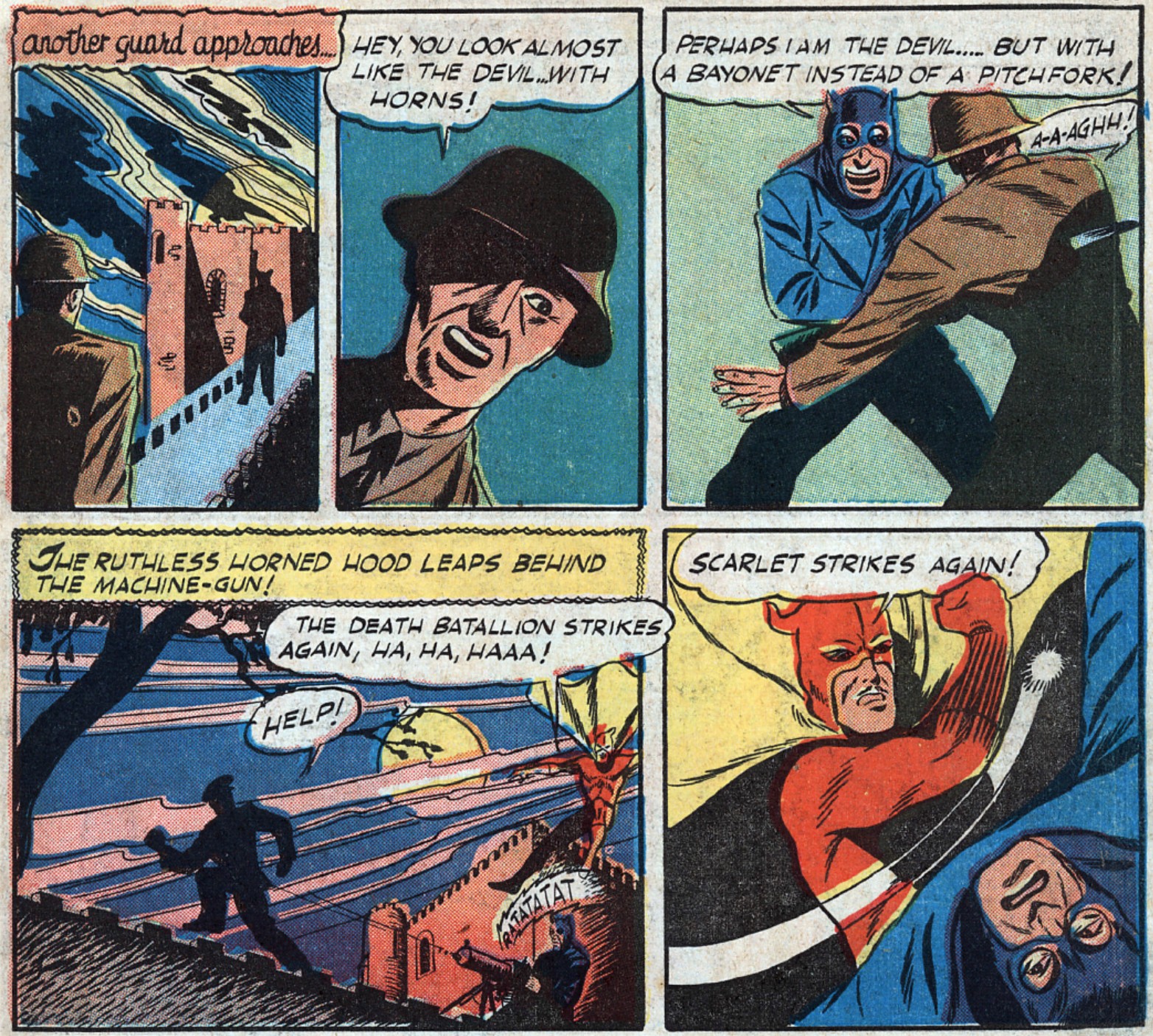
    The Horned Hood manages to screw up a simple murder while armed with a light machine gun from about ten feet away. This is absolutely on-brand for him as the biggest screw-up in the whole Battalion. The Hood’s presence on this team is proof of some sort of super-villain corollary to the Peter Principle.  

    Dollar-a-Year Man Phillips:

    Finally, the Laughing Skull is sent to kill dollar-a-year man Phillips, which leads to the question: what is a dollar-a-year man? Turns out that the term describes a wealthy person who takes a nominal salary in order to be counted as an employee while essentially doing government work for free, and Phillips is one of them. Lucky for him, the Laughing Skull insists that live burial is the only acceptable way to murder someone, which gives Mr Scarlet and Pinky enough time to show up and save the day.

    But what about the brain himself? What’s his deal? Well, aside from being the leader of the whole enterprise, the Brain has precisely two things going on: he has a weird mesh bubble helmet that makes the head inside look enormous, and he “deals in poisons,” which means that he tries to kill Mr Scarlet by dangling a tarantula at him on a stick in a display that is hilariously ineffectual looking even if you, like the creators of this comic, are working from the incorrect belief that the tarantula is massively venomous.

    Having foiled all of the Death Battalion’s attempted murders (but for that one), Mr Scarlet and Pinky make their way back to the group’s HQ by employing a little subterfuge and then beat all five of them (the Horned Hood and Laughing Skull already being in custody) to a pulp. And just who does the Brain turn out to be? Why, none other than ex-Warden Loomis, who so prominently retired after six costumed criminals escaped from his prison. Presumably he now gets to revisit his old workplace!

    The Death Battalion never needs to return, unless perhaps a flashback story needs a team of Nazi super-villains in it to be stomped, but as always I must whoop and cheer for the concept of a bunch of low-grade villains teaming up like this. It’s just fun!

  • MINOR SUPER-VILLAIN 897: MR SKELETON

    (America’s Greatest Comics 001, 1941)

    Mr Skeleton is one of the handful of minor super-villains who are
    foundational to this blog, the true weirdos who my mind turns to
    whenever the subject of obscure comic book characters comes up, and so
    it’s a real relief  to have him finally hsow his face here. This will
    keep happening at least until we reach 1978 and train-themed
    super-villain Casey Jones appears here.

    There are three really important aspects to Mr Skeleton that keep him in my thoughts:

    1. Appearance 

    He’s a chalk-white, twelve to eighteen foot tall man with an emaciated frame, huge hands and feet and a real pumpkin head with the face of a cartoon villain. It’s an extraordinary look, made even more so by his choice to dress in green trunks, a yellow halter top and a green cape. And he has eccentric facial hair!

    It’s a look that works well as both an over-the top campy cartoon villain and as a source of horror – just imagine that face looming out of the shadows at someone. 

    2. Plans and Methods 

    Mr Skeleton’s goal, as far as it is articulated, is to conquer the United States, but he doesn’t really get into the how and why of this because he is busy with step one: recruitment. 

    Specifically, Mr Skeleton needs generals to lead an army against the US, and he has what he seems to think is a surefire method of recruiting them: he kidnaps them and threatens to skeletonize them. This is a tactic that would probably work on me.

    Oddly, Mr Skeleton’s first step in his attempted conquest is to assassinate FDR, a task which he assigns to his most shifty aide. Who fails, by the way, and is skeletonized for his trouble. But why attempt to massively destabilize the US government when you’re still trying to recruit generals for your army of conquest? Honestly, MR Skeleton could probably benefit from a few kidnapped executive assistants. 

    3. DEATH 

    After being foiled by Minute-Man a couple of times, Mr Skeleton decides to get his recruitment program back on track in the most direct manner possible, by marching into the nearest Army camp and grabbing a fresh batch of generals. While he is doing so and simultaneously beating up the entire US Army, he is confronted by Minute-Man once again and ends up being smacked so hard that he turns into a kind of bone explosion. I guess he really was mostly just skeleton, however that works.

    Obviously I believe with all my heart that they should bring back Mr Skeleton – his mixture of goofy and horrifying is always welcome in comics, battling Batman or Wild Dog or somone. You don’t even have to stretch too far to have him come back since he was already some sort of skeleton-man: just put him back together. 

  • MINOR SUPER-HERO ROUND-UP 068

    MINOR SUPER-HERO ROUND-UP 068

    A few classic minor super-heroes. Bulletman and Bulletgirl in particular have just barely managed not to remain relevant – I suppose the pointy helmet is too much of a hurdle for the modern audience.

    Bulletman: 

    Jim Barr is perhaps the most thoroughly-motivated super-hero of the Golden Age. He is:

    a. from a long line of police officers

    b. the son of a famed police officer who was murdered for being too good a cop and who

    c. told the young Jim that he must become a police officer while on his death bed 

    d. and after all that he was too scrawny and bookish to be a cop and so had to settle for being a forensic scientist

    Jim ends up working in his father’s old station under the command of Sergeant Kent, a pro-torture bully who is often held up as the greatest of all the cops in the city, and who is also the father of love interest Susan Barr. 

    Jim’s personal project is a serum that will destroy “all germs and toxins” in the human body, including that which he believes to be the source of crime and violence. He chooses to test this serum out on himself and his body, freed from a variety of invisible ailments, develops into a physical paragon over the course of a night’s sleep.

    (Sergeant Kent really earns his reputation as a great police officer by failing to notice that his colleague has basically doubled in size over night. In his defense, Jim is wearing big clothes)

    Jim decides that the best way to use this new power is to operate outside of the law, probably due to all of his time hanging around with top cop Kent. He uses his now super intelligence to build the Gravity-Regulator Helmet, which allows him to fly and also generates a force field that augments his natural resilience to make him nigh-invulnerable and able to smash through things head-first (I swear that somewhere I read a story in which it was explained that it made him bulletproof by drawing the bullets to the helmet but danged if I can find it now.). His costume, yellow jodhpurs and all, is assembled out of things that were lying around at the police station, no mention of where. (Nickel Comics 001, 1940)

    If I had to classify Bulletman’s personality, I would go with “extremely no-nonsense” or maybe “wooden, which is why it is important that he is eventually joined by his female counterpart: 

    Bulletgirl: 

    Bulletgirl is the aforementioned Susan Kent, daughter to good cop/bad cop Sergeant Kent and member of Bulletman’s supporting cast from the beginning. For about the first year of Bulletman’s adventures she fills a low-effort version of the Lois Lane role: curious about the hero’s identity but not especially proactive about trying to uncover it. She also gets kidnapped and targeted for death a lot thanks to her father’s skill at making enemies. Then, in Master Comics 012, Bulletman is knocked out in a collision with Triple Threat’s super vehicle and Susan learns that he is actually Jim Barr. Jim obligingly tells Susan the secret of his origin but resolutely refuses to consider teaming up with her.

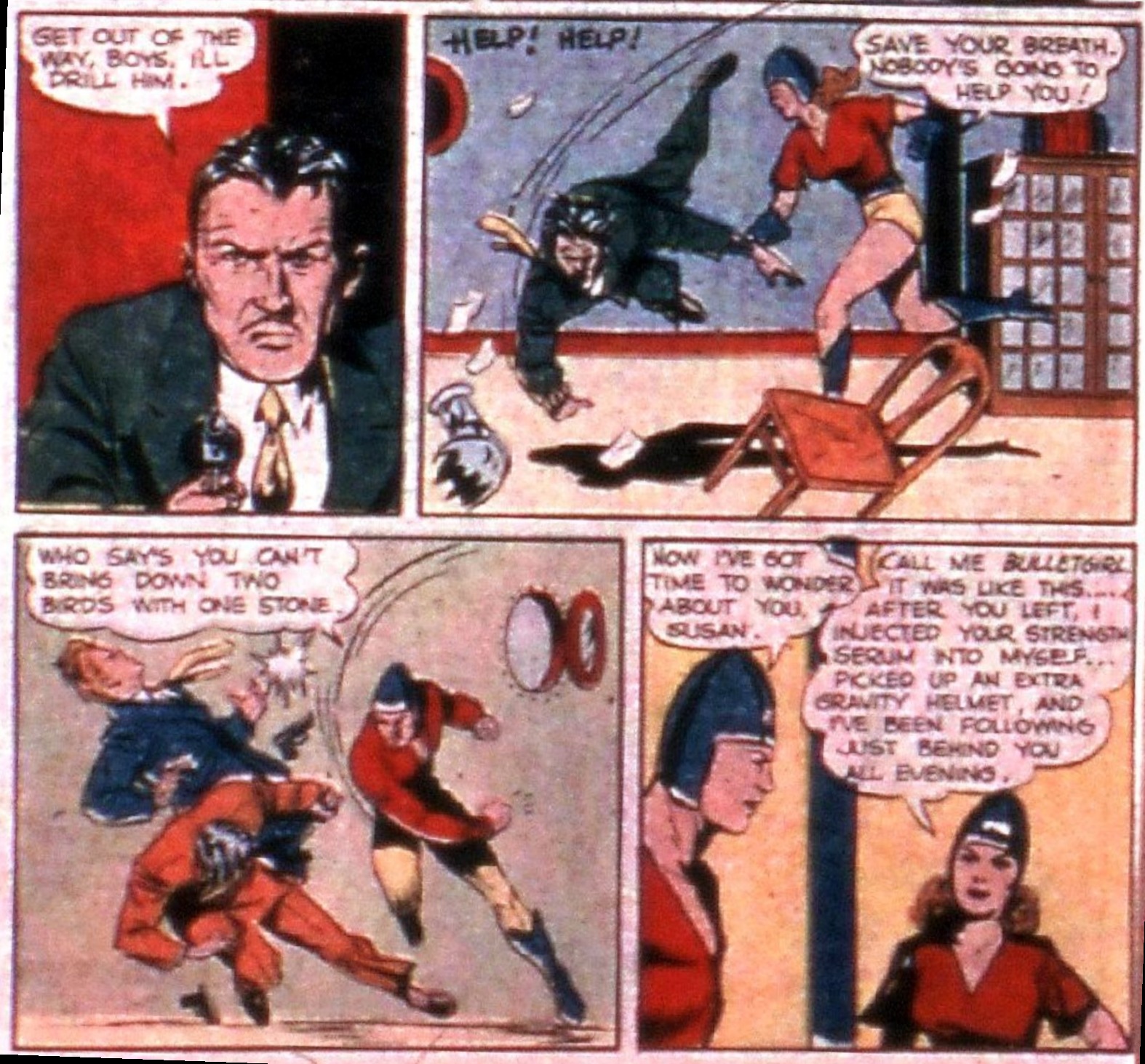
    Susan of course injects herself with the serum and crabs a spare Gravity-Regulator Helmet and costume (though she goes for hot pants over jodhpurs) the instant that Bulletman is out of the room, and This is a very good illustration of why I am so fond of Bulletgirl: she has all of the personality that Bulletman lacks. She’s scrappy and quippy and after an issue or two of “too dangerous for girls” chauvinism from Jim is a full partner in the superheroic exercise. She does get kidnapped and left behind a bit more than I’d like but that’s comic books in a nutshell. 

    In conclusion: Bulletgirl! (Master Comics 013, 1941)

    Minute-Man: 

    Like Jim Barr, Jack Weston is the son of a dead hero, though Jack’s father Robert Weston died during the Battle of Chateau-Thierry in World War I. We don’t get nearly as much background on Jack, other than the fact that he was raised by his father’s friend General Milton, but thanks to Milton, Jack becomes Minute-Man, a patriotic super-hero, in what is kind of presented as a draft.

    Jack is sent to join the Army as a lowly Private so that he can keep an eye out for sabotage and espionage affecting the armed forces. Despite having no super serum or particular special training, he proves to be physically near-superhuman as he engages a variety of costumed and non-costumed foes over the course of his mid-length career.

    Minute-Man also dabbles in leaving calling cards, which I always like to make note of. (Master Comics 011, 1941)

    Doctor Voodoo **UPDATE**: 

    In Whiz Comics 017, Doctor Voodoo returns home to find that Maxinya (the Heaven-Woman, natch) has gone missing. He tracks her abductors through the jungle until he comes across their destination: a European castle, smack in the middle of the Amazon. 

    The mystery deepens as Voodoo enters the castle and finds what seems to be an entire Medieval court, headed by the boorish King Richard, who seeks his aid in conquering the jungle. 

    Doctor Voodoo refuses to help King Richard, and so is forced to meet the knight Sir Ganal in combat. Voodoo prevails and wins Ganal over to his side, complete with a promise to reveal the origin of the castle’s presence in the jungle. Alas, this shall never come to pass, because the story does a hard pivot in the next issue. 

    King Richard plays the whole jungle conquest/attempted murder thing off as if it was some sort of test, and sends Doctor Voodoo off to meet with his court wizard. He. in turn, transports Voodoo back in time to the 1400s or thereabouts to retrieve a magical McGuffin called the Golden Flask, with another promise to explain what this whole affair is about once he returns.

    Unfortunately for all us completionists out there, the explanation never comes because Doctor Voodoo never returns. He bops around the oceans for about a year and actually does manage to get his hands on the Golden Flask but his feature is cancelled before he can return it to the wizard and find out just what the heck is going on. Maxinya is waiting for him still, presumably. (Whiz Comics 018, 1941)

  • MINOR SUPER-VILLAIN 896: THE INVISIBLE MAN

    (America’s Greatest Comics 001, 1941)

    An invisible killer is on the loose in New York City, robbing banks and hijacking gold shipments and murdering bank clerks, and while an invisible killer is a very scary thing to contemplate we must as ourselves: is armed robbery the best criminal use of the power of invisibility? If nothing else, a stealthier approach would have kept the involvement of an invisible man a secret for longer, since as it stands the poor gunned-down bank clerk in the above panels managed to survive long enough to tell the police about him.

    All of this criminal activity draws the attention of Bulletman and Bulletgirl, of course, and soon enough they are face to nothing with the Invisible Man in a deserted street. Sadly for the crime statistics, the Invisible Man seems to have the kind of invisibility that renders him completely uncatchable, even during a long conversation with Bulletman, a man wearing a hat that allows him to fly and who, crucially, can see him for part of the time. 

    Though the Invisible Man’s reign of terror continues for some time after this confrontation, his downfall comes after Bulletman realizes that invisibility is only a useful superpower in lighted areas and that battling him in darkness will level the playing field. Just why this is a more effective approach that simply flailing wildly at the sound of his voice is a mystery to me but I guess we must acknowledge success when it happens.

  • MINOR SUPER-VILLAIN 895: THE GHOST OF THE DEEP

    MINOR SUPER-VILLAIN 895: THE GHOST OF THE DEEP

    (America’s Greatest Comics 001, 1941)

    The Ghost of the Deep, a dastardly fellow indeed. As the comic opens, a captive scientist named Hugo has just completed a mysterious formula for him, only to be rewarded with murder.

    In the following days, the Ghost attacks US West Coast shipping, each time leaving behind a calling card in the form of a message in a bottle.

    The Ghost even tries to silence Billy Batson’s fairly routine reporting on the attacks (but why leave a calling card if you don’t want everyone to know you’re responsible?) by taking Billy and his boss Sterling Morris for a proverbial ride. When this is predictably foiled by Captain Marvel, the Ghost of the Deep shows up long enough to demonstrate that he is also a classic comic book Bad Boss by drowning his hapless Teutonic minions.

    There is a bit of radio-based taunting, since Billy is a radio guy. Again, this kind of thing brings into question just why the Ghost of the Deep wants to shut Billy up.

    So just what is the Ghost of the Deep’s plan? And what is this mysterious formula that poor Hugo died for? Why, it’s the recipe for making a transparent, invulnerable alloy called Z-Metal, and using a fleet of tank-submarines composed of the stuff, the Ghost intends on conquering the United States. First stop: blowing up the Panama Canal.

    As for the Ghost’s real identity, well, it’s not revealed until later, but any cagey comics reader will immediately peg this smarmy rival radio man named Spriggins as the top suspect the instant that he walks on-panel. Presumably his cover serves the same purpose as Billy Batson’s: as a way of gathering information and justifying a lot of globetrotting as being in pursuit of a story.

    Ultimately, Spriggins’ plan has one fatal flaw: it fails to account for the presence of a magically super-strong fellow like Captain Marvel, who succeeds where the might of the US Navy cannot and smashes the Z-Metal fleet to smithereens. And then does the same to the Ghost of the Deep’s cool Z-Metal chainmail.

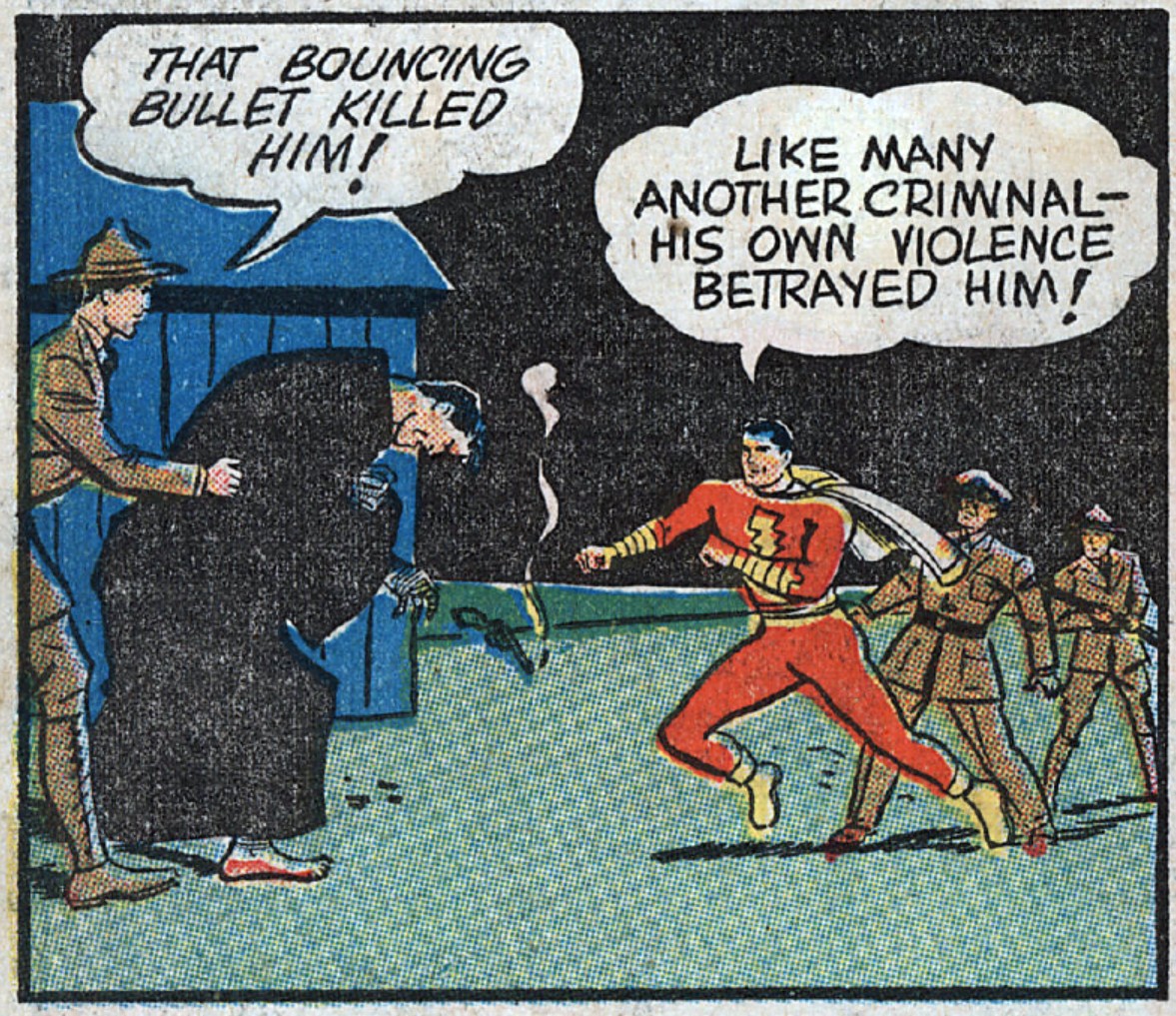
    The captured Spriggins makes one last attempt at striking out at the US by stealing an MP’s gun and taking out a nearby General, only to be intercepted by Captain Marvel and suffer the oft-joked-about but seldom-seen fate of the person who fires a bullet into an invulnerable super-hero’s chest only to have it bounce back and kill them instead. 

  • MINOR SUPER-VILLAIN 894: BLUEBEARD

    (Wow Comics 004, 1941) 

    The piratical Bluebeard and his gang of fake sea dogs crash the costume ball of the wealthy van Hoffs and make off with Mrs van Hoff, demanding a ransom of one hundred thousand dollars for her return.

    Since Bluebeard had already tried to do extortion on the van Hoffs by sending them threatening notes, Mr Scarlet and Pinky were already on hand to swiftly track down the kidnappers and beat them senseless. 

    The post-beating unmasking reveals that Bluebeard is in fact Tom, possibly van Hoff, cousin to one or the other of the couple (or… both? Are the van Hoffs that kind of rich?), who has fallen on hard times and turned to costumed kidnapping as a means to scare up some quick cash. Some notes for Cousin Tom:

    – It is a bold choice to choose a false chinstrap beard when you have a real mustache.

    – Running around going “THEY’RE PROBABLY NOT IN THE CASTLE” when they are, in fact, in the castle is a really good way to draw suspicion down on yourself. Better to not mention the castle at all.

    – It is very annoying to call yourself Bluebeard and hang out in a castle while sticking to a strict pirate theme when there is in fact a character called Bluebeard, famously castle-based, who is a direct threat to women, and who I personally think would make for a better theme.

    In other words: make better choices next time.