The Curse of Skeleton Munroe

Category: villains of the past

  • MINOR SUPER-VILLAIN 682: CLEA

    (OK Comics 001, 1940) 

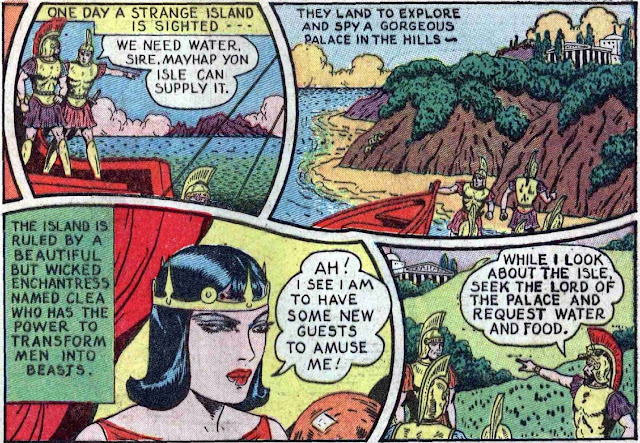
    “The Further Adventures of Ulysses” is a feature that posits that Ulysses/ Odysseus, after a gruelling twenty year journey home from Troy to Ithaca, immediately got bored and left again upon hearing a rumour that one of his men had been left behind on the island of the Cyclopes and still lived. This is a fun idea and very in keeping with both the lifestyles of the Greek heroes and a particular 1940s idea of manly disdain for settled domesticity. The only problem is that the one extant TFAOU story is all retellings of the greatest hits, from the return to Cyclops Island to Clea here, who is Circe in all but name.

    Specifically, Clea lives on an island and uses her magic wand to turn humans into beasts – Ulysses’ crew here all end up as tigers, so they must have had better table manners than the last bunch who all turned into pigs – and does not either provide Ulysses with information on how to enter the underworld or have between 2 and 5 children with him.

    Clea almost gets away with it too, but that meddling Mercury gives Ulysses a sprig of protective ivy and her weirdly long wand has no effect on him. Frankly embarrassing, Clea.

    BONUS: Just want to highlight this giant two-headed monster lady as the only novel concept in the adventure.

  • MINOR SUPER-VILLAIN 634: KING RATON

    (Fantastic Comics 012, 1940)

    King Raton is a fellow met by the Golden Knight and his companion/ lover Alice after the earth near a pool of water gives way and they are dropped into a cavern. He demands that they fetch a potion for him from Kataka, Witch of the Volcano, under threat of death – this is a source of conflict not only because of the threats but because he wants the potion in order to conquer Blackamoor Forest, home of their ally the Queen of Blackamoor.

    Kataka, Witch of the Volcano turns out to be Raton’s mom, which raises the question of why he has to send a couple of heroes up the volcano to get his precious potion. Families are complicated, I guess.

    On that note, Kataka goes completely off the rails and tries to kill Sir Richard and Alice as they exit her lair. Exactly why she does this is not elaborated on but it results in here death via magma pool, following which Our Heroes realize something that that seemed obvious to me: they are under no obligation or compulsion to complete this clearly evil quest.

    I had a whole thing written about how Sir Richard and Alice just took the word of this guy in a cave that he was a king and that they should be a bit less credulous about that sort of thing before embarking on hazardous quests but I’ll be danged if Raton doesn’t return in Fantastic Comics 013 with actual subjects!

    Raton’s plan to sneakily attack Queen Blackamoor and her Forest People using an Annihilating Potion (which is an explosive of some kind, I think) was a sound one because as it turns out, when they are ready for him the Forest people absolutely wipe the floor with his Sand People. 

    Raton must take after his mother, because like her he makes a poorly thought-out attack on the Golden Knight and his pals and ends up dying for it.

    (I’ve surely mentioned before that I try not to assign modern motivations etc to the characters in these comics but… the Queen of Blackamoor is explicitly into Sir Richard and I have to say that this reads like a proposition to me)

  • MINOR SUPER-VILLAIN 629: QUEEN SULIA

    (Fantastic Comics 011, 1940)

    We begin with the old comic book trope of Ignoring Bad Feelings When a Woman Has Them, as Alice senses something in the wind and Sir Richard tells her to shut up just before a giant bird gets them both.

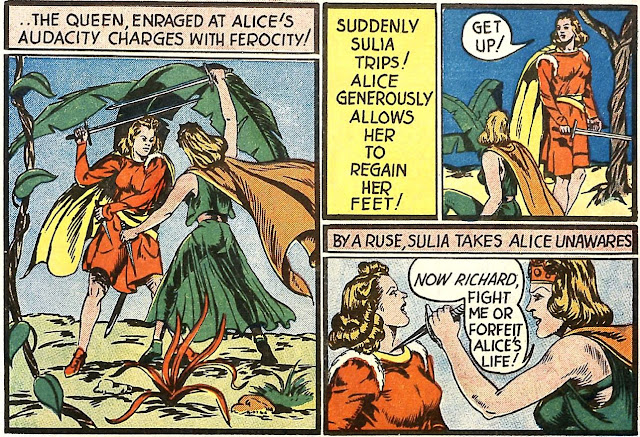
    They are flown to Soulless Isle and meet its ruler Queen Sulia, along with her coterie of beastly subjects. She wants a sword fight and Sir Richard of Warwick is who she wants it from. If this weren’t the 1940s I would suspect some double entendre was going on here. I kind of suspect it anyway.

    If this is an extended sex metaphor then things are heating up, as Alice jumps in to take over for her reluctant boyfriend only to be overwhelmed by Sulia’s technique, forcing Richard to join in. Phew!

    The prize for defeating Queen Sulia in battle is her hand in marriage and Sir Richard of Warwick seems weirdly okay with doing so. If the beastmen hadn’t sent a representative to him to reveal that they were in fact not just weirdos but regular folk transformed by Sulia’s dark majicks I reckon that the tale of the Golden Knight would have ended with him shacked up on Soulless Isle.

    But no, Sir Richard takes advantage of the beastmen’s intel re: Sulia having a magical clotting disorder and  employs a spiked wedding band to fatally wound her finger. Oddly enough, this underhanded trick doesn’t trigger his “thou shalt not fight women” chivalry. With Sulia slain and the beastmen restored to regular, Richard is free to return to Alice and I assume apologize to her.

  • MINOR SUPER-VILLAIN 616: THE HAG OF BLACKAMOOR

    MINOR SUPER-VILLAIN 616: THE HAG OF BLACKAMOOR

    (Fantastic Comics 007, 1940)

    We rejoin the European version of the Golden Knight as he and his ladyfriend Alice are having a bad time in Blackamoor Forest: both Alice and Sir Richard’s horse Whitey have broken their legs in a fall and so Richard and Alice are forced to hole up in a cave for the night (Whitey, sadly, did not make it). But who is this ominous form?

    It’s the Hag of Blackamoor and she isn’t messing around! In common with many villainous older women in comics, she wants to regain her lost youth and beauty and she’s willing to sacrifice others to do it. And because this is a Golden Knight comic, she has a proper quest for our hero to do: he must retrieve the Golden Stallion from Ice Mountain, for he alone can take the Hag to the Tree of Eternal Youth. That’s right: all the nouns are capitalized when you start talking about quest stuff.

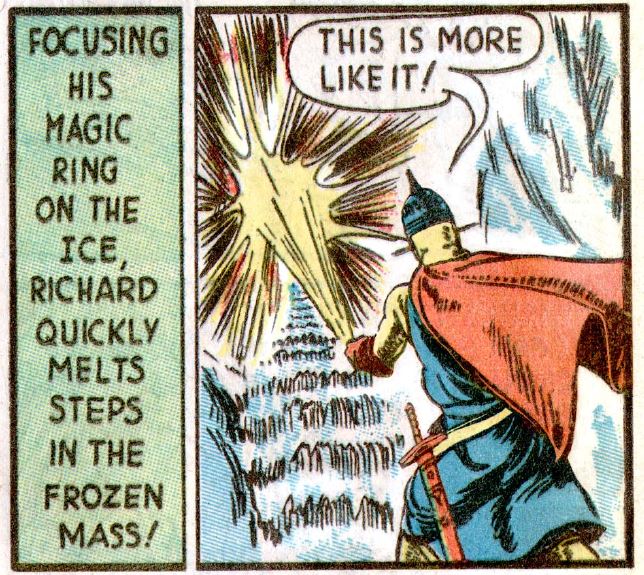
    The bulk of the story is all quest stuff with no Hag, so we’ll just run through it quickly. Sir Richard must climb the Ice Mountain (his magic ring turns out to have a heat ray setting)…

    … slay a fire-breathing dragon (his magic cloak is proof against its flames)…

    … and get past a guardian giant (his magic strength is up to the task of cleaving the giant’s head in twain).

    Golden Stallion successfully retrieved, the Golden Knight mounts up and returns to the Hag and his lady love, where it turns out that a) the Stallion doesn’t like the Hag very much and b) the Hag didn’t plan on that coming up and so does not protect herself from being trampled. Once she is dead, we learn c) that the Golden Stallion was in fact the enchanted Queen of Blackamoor. 

    This raises some questions! Like: what the hell was the point of that quest? If the Hag turned the Queen into a horse then why wasn’t she prepared for that horse to hate her? How did the Stallion get so well defended? If it was the Hag who put the Stallion there then why did she need a champion to go fetch it and if it wasn’t then who did? Does the Queen know where the Tree of Eternal Youth is or was that just a horse thing? None of these questions will ever be answered.

    As a reward, the Queen of Blackamoor gives Sir Richard a (presumably) magical horn that will summon her subjects to his aid if blown, because he certainly didn’t have enough magic items already.

  • MINOR SUPER-VILLAIN 610: ‘BDULA KHAN

    (Fantastic Comics 006, 1940)

    ‘bdula Khan is the capricious ruler of a mysterious oasis city in North Africa who offers the Golden Knight hospitality and then turns around and makes him battle monsters in an arena for his amusement. He’s not particularly notable and I’d likely have passed him over but for three things:

    1. The Name. ‘bdula is presumably short for Abdula and might be a unique name? Abdula is such an uncommon variant of Abdullah already, and it’s a bit tricky to search for a name starting with an apostrophe, but I’m reasonably certain that this is the only ‘bdula in comics.

    2. The Monsters. I love a good monster and these are suitably weird. Plus, ‘bdula Khan keeps them in line with his magical ability to place living beings in suspended animation, a good trick.

    3. The Solution to a Mystery. This is the most important one. I mentioned in the entry on the Black Death that Sir Richard and Alice are in Europe when they should be in North Africa somewhere, right? It’s not, as I had surmised, because the writer forgot, it’s because Golden Age comics and Fox Features in particular had a greater tendency than some of their competitors to swap out writers and artists, presumably for the sake of a deadline. Records of just who was on each feature are pretty spotty (and not helped by the use of a consistent house name no matter who was producing a particular feature) but I reckon that we’ve got two parallel Golden Knight timelines: one in which he’s in Europe with Alice and another in North Africa with a magic ring. I can hardly wait to see if the two timelines are merged (unlikely) or one is forgotten entirely (very likely).

    Oh also ‘bdula Khan is turned into a statue of a hyena for being a jerk.

  • MINOR SUPER-VILLAIN 606: THE BLACK DEATH

    (Fantastic Comics 005, 1940)

    In Fantastic Comics 004 Sir Richard of Warwick, aka the Golden Knight, seeking his Crusading companions, arrives in the small village of Namara and learns that it has been cursed for the past ten years after a young girl fell down a well and her father blamed everyone but himself for it and cursed the village. The Golden Knight of course heads down that well because where the heck did that girl go? After a few battles with giant spider-scorpions and the like he finds the now-adult Alice ruling a race of underground winged people and they fall in love.

    (side note: the reason that the Golden Knight couldn’t find his companions was that the writer forgot that he was in North Africa somewhere between Fantastic Comics issues 002 and 004 so he was teleported back to Europe)

    Sir Richard and Alice leave the city of the Winged People and are immediately set upon by a quartet of evil knights in service to the Black Death, owner of a nearby castle and dedicated jerk.

    The Black Death tosses Alice in a locked room and proceeds to torture the Golden Knight for information on the Winged People but hasn’t reckoned with just how proactive Alice is compared to your average Golden Age adventure heroine. For his underestimation of her he is rewarded with a dagger in the back.

    Amid all the chaos subsequent to Alice stabbing the Black Death it comes out that he is, in fact, her father Bawala. Rather than merely curse one village and move on from the mysterious disappearance of his daughter, Bawala instead settled down nearby and became a horrible murderous tyrant. Only now, as he is dying does he see the error of his ways in the person of the daughter he allowed to wander off and fall down a well. He was not, in fact, made into a horrible person by the circumstances of his life but was a horrible person all along.

    It’s a rare heroic patricide!

  • MINOR SUPER-VILLAIN 570: OO-LHAT

    (Champion Comics 003, 1940)

    There’s a lot to like about ol’ Oo-Lhat. He appears in a gross-sounding mist after explorer Walt Worthington and his aide Snowball (did you know that there was a whole category of racist nicknames for African American characters that has largely been forgotten and that involves naming them after something very black or very white? Well now you do) discover a lost Egyptian tomb containing a blazing scarab (the gem cut, not the insect) that drew them into a pocket dimension when touched.

    Oo-Lhat captures the duo and forces them to listen to his life story, employing a magical teevee called the Curtain of Ammon to do so.

    A priest of Osiris at Karnak, Oo-Lhat gives it all up and switches allegiances to Set in order to obtain gold, power and the love of a beautiful woman.

    This is where Oo-Lhat starts to make the transition from small-b to big-b Bad Guy. He makes his way to the Oasis of Memthet, where a cult had gathered to worship the same scarab encountered by Walt and pal. Oo-Lhat takes over by the simple expedient of murdering all of the other contenders.

    Discovering the pocket dimension accessible through the scarab, Oo-Lhat moved his cult into it and had them build a city, from which they raided caravans under the somewhat grandiose name of the League of Assassins – pretty sure just jumping out of a portal and stabbing someone is just regular murder, bro.

    The real appeal of the scarab dimension, though, was the fact that time essentially did not pass there and so the population was essentially immortal – even those killed by gross bodily trauma came back as weird ghosts. Possibly the best aspect of this is the fact that animals could not properly comprehend this state of being and so immediately died and came back, and as they presumably had an imperfect vision of themselves they came back wrong, leading to the city being full of weird lumpy camels.

    The timelessness of the scarab world eventually backfires on Oo-Lhat and his followers when the temple is buried in a sandstorm, trapping them for thousands of years with nothing to do but twiddle their thumbs.

    Oo-Lhat is all set to resume his ways as an “assassin” but his followers have other ideas. Presented with the choice of whether to leave or stay, every single one of them leaves. Including Oo-Lhat, after a little five-fingered persuasion from his lieutenant Kardak.

    The explorers eventually follow (along with some babes they found and fell in love with) and discover the final fate of Oo-Lhat and the League of so-called Assassins: time spent in the pocket dimension, it turns out, was not avoided so much as deferred: Oo-Lhat, the League and even the babes were reduced to skeletons the instant they exited.
  • GENERIC COSTUMED VILLAIN ROUND-UP 007

    The hits keep on coming:

    This Fellow’s name is Becker and he and his wife run a gang while pretending to be among its victims. An okay scheme, but not really up to foiling Bulletman and Bulletgirl. (Master Comics 014, 1941)

    This guy here is why I have such a hard time relegating masked Western bandits to the dregs of the generic costumed villains: he’s as by-the-numbers a bandit as they come, he robs one stagecoach total, he ends up dying because he falls off his horse… but he is frequently and consistently referred to a “Alkali, the Scourge of the Plains” which is as endearing as it is possible to be. (Master Comics 019, 1941)

    I’m overlooking the fact that this bundist-style not-exactly-German spy encountered by Miss America doesn’t actually wear a costume because a) he’s called the Leader, b) he lives in a wax museum and c) he has a pet gorilla named Gargo. (Military Comics 002, 1941)

    Captain Rajah, AKA the Master, was a jewel thief who ran up against Captain Desmo, in a story even more weirdly pro-colonial than Captain Desmo stories usually are – Captain Rajah is immediately suspicious for being an Indian officer in the Bengal Lancers, continued to be suspected throughout and then turned out to be the Master. The story is from before the invention of “defying expectations”. (More Fun Comics 065, 1941)

  • GENERIC COSTUMED VILLAIN ROUND-UP 007

    The hits keep on coming:

    This Fellow’s name is Becker and he and his wife run a gang while pretending to be among its victims. An okay scheme, but not really up to foiling Bulletman and Bulletgirl. (Master Comics 014, 1941)

    This guy here is why I have such a hard time relegating masked Western bandits to the dregs of the generic costumed villains: he’s as by-the-numbers a bandit as they come, he robs one stagecoach total, he ends up dying because he falls off his horse… but he is frequently and consistently referred to a “Alkali, the Scourge of the Plains” which is as endearing as it is possible to be. (Master Comics 019, 1941)

    I’m overlooking the fact that this bundist-style not-exactly-German spy encountered by Miss America doesn’t actually wear a costume because a) he’s called the Leader, b) he lives in a wax museum and c) he has a pet gorilla named Gargo. (Military Comics 002, 1941)

    Captain Rajah, AKA the Master, was a jewel thief who ran up against Captain Desmo, in a story even more weirdly pro-colonial than Captain Desmo stories usually are – Captain Rajah is immediately suspicious for being an Indian officer in the Bengal Lancers, continued to be suspected throughout and then turned out to be the Master. The story is from before the invention of “defying expectations”. (More Fun Comics 065, 1941)

  • MINOR SUPER-VILLAIN 353: THE PURPLE HOODS

    (Master Comics 013-014, 1941) 

    I’m not going to lie: when I started reading this story I got excited for one of the more niche reasons I ever have. See, the prior Buck Jones story – the one with the Ghost Killer gang – was still wrapping up and I had a moment where I thought there would be some very exciting gang continuity if any of the former Ghost Killers, already relict of the White Arrow gang, had joined up with the Purple Hoods. That’s an unprecedented three gangs! Alas, Snake and Cope were sent to jail and the counter reset.

    Ephemeral hopes and dreams aside, the Purple Hoods are crass capitalist crooks: their big scheme involves kidnapping Mexican farm labourers and pressing them into slavery in a secret oil refinery. Ah, the romance of the Old West!

    And speaking of the Old West, this story is a perfect illustration of the weird liminal space that the West occupied in the 40s imagination: is Buck Jones an Old West marshal or a contemporary one? Does this issue offer any clues? The ascent of oil as a valuable resource does overlap with the Old West, and steel oil barrels of the kind pictured above are a 20th Century invention, but one of the major conflicts of the story is a business rivalry between two competing stagecoach lines and while I can find evidence of stagecoaches being used into the early 20th Century I doubt that they were such a going concern as that.

    What I’m getting at here is that I don’t know which way the anachronisms are going: is Buck Jones an Old West marshal with forward-thinking villains or a modern marshal in an overly romanticized setting? Who knows!

    (I must note that I do appreciate the Purple Hood leader getting his own special version of the gang costume)

    ADDENDUM:

    Two issues later (Master Comics 016, 1941), the story is clearly set in the Old West! Answers have been forthcoming at last!