The Curse of Skeleton Munroe

Category: Novelty Press

  • PROBLEMATIC ROUND-UP 002

    Once again I present the worst that comics has to offer.

    The Great Green Turtle:

    The Great Green Turtle is just your standard Yellow Peril Chinatown ganglord, albeit one with a fantastic name. He does try to throw Sub-Zero, a man with ice powers, into a shark tank so we can safely say that he is not a villain with fantastic intelligence. His gem-smuggling ring gets thoroughly kiboshed. (Blue Bolt v1 004, 1940)

    The Lama:

    The Lama is a bandit chief, essentially, albeit one with a name from one religious tradition and henchmen – Thuggees, natch – from another. He hijacks a plantation and then gets beat up by aviator Captain Kidd. (Fantastic Comics 010, 1940)

    The Fire God:

    If there’s one thing that Captain Kidd likes, it’s finding lost explorers, so when a fellow named Benson goes missing he’s off like a shot. He finds Benson about to be sacrificed to the Fire God, a masked figure who a well-placed kick reveals to be a Hitler lookalike in a mask (the Hitler thing is either a coincidence or just kind of meant to indicate generic megalomania in the Fire God’s character). This one not only has a white guy easily convincing a group of credulous natives that he is a god but an instance of White People Vs Everyone else as Captain Kidd fruitlessly tries to get out of a sticky situation by playing the race card.

    The Fire God ultimately meets his end in the classic writer’s cop-out when they don’t want to make their guy do a murder: he falls and hits his head on a rock after a sock to the jaw. (Fantastic Comics 011, 1940)

    Mad Ming:

    Part of me wants to give Mad Ming some credit for not being as racist a Yellow Peril villain as someone like the Great Green Turtle, but he basically is and I am being tricked. Ming talks and dresses like a normal person and so all of his outrageous villainy is recontextualized, and maybe he would be worthy of reconsideration if all of his schemes and his henchmen and his nom de crime weren’t still mired in the muck of the Oriental pulp villain, but as it stands he’s just mildly better than his peers, racist stereotype-wise. (Funny Pages v4 001, 1940)

  • PROBLEMATIC ROUND-UP 002

    Once again I present the worst that comics has to offer.

    The Great Green Turtle:

    The Great Green Turtle is just your standard Yellow Peril Chinatown ganglord, albeit one with a fantastic name. He does try to throw Sub-Zero, a man with ice powers, into a shark tank so we can safely say that he is not a villain with fantastic intelligence. His gem-smuggling ring gets thoroughly kiboshed. (Blue Bolt v1 004, 1940)

    The Lama:

    The Lama is a bandit chief, essentially, albeit one with a name from one religious tradition and henchmen – Thuggees, natch – from another. He hijacks a plantation and then gets beat up by aviator Captain Kidd. (Fantastic Comics 010, 1940)

    The Fire God:

    If there’s one thing that Captain Kidd likes, it’s finding lost explorers, so when a fellow named Benson goes missing he’s off like a shot. He finds Benson about to be sacrificed to the Fire God, a masked figure who a well-placed kick reveals to be a Hitler lookalike in a mask (the Hitler thing is either a coincidence or just kind of meant to indicate generic megalomania in the Fire God’s character). This one not only has a white guy easily convincing a group of credulous natives that he is a god but an instance of White People Vs Everyone else as Captain Kidd fruitlessly tries to get out of a sticky situation by playing the race card.

    The Fire God ultimately meets his end in the classic writer’s cop-out when they don’t want to make their guy do a murder: he falls and hits his head on a rock after a sock to the jaw. (Fantastic Comics 011, 1940)

    Mad Ming:

    Part of me wants to give Mad Ming some credit for not being as racist a Yellow Peril villain as someone like the Great Green Turtle, but he basically is and I am being tricked. Ming talks and dresses like a normal person and so all of his outrageous villainy is recontextualized, and maybe he would be worthy of reconsideration if all of his schemes and his henchmen and his nom de crime weren’t still mired in the muck of the Oriental pulp villain, but as it stands he’s just mildly better than his peers, racist stereotype-wise. (Funny Pages v4 001, 1940)

  • GENERIC COSTUMED VILLAIN ROUND-UP 011

    Some say they’re not generic enough but I think they’re trying their best.

    This fellow is part of a gang looking to hijack a shipment of railway guns from train engineer Runaway Ronson. I really enjoy the look of the padded suit they use to help survive crashing a car into a high-speed train but I really really enjoy the fact that they immediately scramble off into the woods and are never seen again, as if they were completely unrelated to the criminal plot. (Blue Bolt v1 007, 1940)

    This fellow’s a pseudo-Nazi spy named Ketler who goes up against Sub-Zero in an attempt to influence the very specific Torpedo Workers Union into striking and hindering part of the US defense program. I feel like he overestimates the usefulness of the mask as he doesn’t change anything else about his appearance when not murdering people but that’s not what gets him caught so I guess I’m the fool here.(Blue Bolt v2 002, 1941)

    Colourful enemy aces are the best/ only tolerable part of the absurd number of Golden Age comics about pilot-adventurers, so my little ears pricked up when American-flying-for-the-French Loop Logan was challenged to a dogfight by a Nazi called the Blue Duke but… there’s nothing to him. He’s just a guy with a name who’s been sabotaging French planes and shooting them down. Waste of a good name, if you ask me. (several days later note: it took me an embarrassingly long time to realize that this guy’s name was a play on the Red Baron) (Blue Ribbon Comics 004, 1940)

    These guys briefly terrorize New York (possibly – we have another instance of a city that is Clearly New York City But the Mayor is Wrong) with a futuristic tank mounted with a death ray. If they a) had a name and b) weren’t completely demolished by Mr Justice in about three panels they might have made the leap to full Minor Super-Villain status but as it stands they’re an object lesson in why ultra-powerful ghosts need a tougher class of enemy to be really entertaining. (Blue Ribbon Comics 010, 1941)

  • REAL PERSON ROUND-UP 001

    REAL PERSON ROUND-UP 001

    I have a lot of these in a spreadsheet somewhere but we’ll get to those later. For now it’s as we encounter them: real people and versions of real people and analogs of real people and also the same but famous fictional people in comics.

    Admiral Dewey, John Paul Jones, Sir Francis Drake:

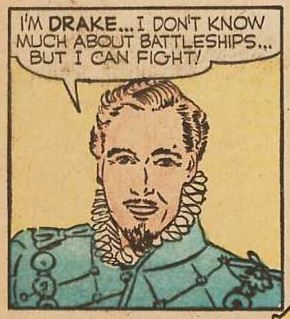
     Their ghosts all volunteer to help Sergeant Spook go pirate hunting (Blue Bolt v1 008, 1941)

    Adolf Hitler: 

    “Gustave Ritter” isn’t really very close to “Adolf Hitler” but I have a finely-honed sense for when someone is making a Hitler analog and this world-conquering barbarian from the year 2041 is just that. I think. (Blue Ribbon Comics 004, 1940)

    Clark Gable:

    As “Stark Brable” in Rang-a-Tang the Wonder Dog’s trip to Hollywood (Blue Ribbon Comics 005, 1940)

    Lana Turner:

    It’s a classic first letter switcheroo as actress Lana Turner shows up as “Tana Lurner” in a Rang-a-Tang the Wonder Dog comic. (Blue Ribbon Comics 005, 1940)

    Maid Marion:

    The “Green Falcon” feature, as far as I can tell, takes place in a Robin-Hood era England with no Robin Hood but with Lady Marion here occupying the Maid Marion role. (Blue Ribbon Comics 004, 1940)

    Orson Welles:

    “Nawson Swelles” is a troublesome “Boy Wonder” and the villain of Rang-a-Tang the Wonder Dog’s visit to Hollywood. (Blue Ribbon Comics 005, 1940)

    Prince John:

    Essentially playing the same part as he does in the Robin Hood stories in the Green Falcon’s adventures. (Blue Ribbon Comics 004, 1940)

    Richard the Lionheart:

    The key to Prince John’s villainry is that the good king is off being a dipshit in the Holy Land and this version of Richard I does not fail in that. (Blue Ribbon Comics 004, 1940)

  • MINOR SUPER-VILLAIN 520: THE HIGH PRIEST OF THOR

    (Blue Bolt v2 006, 1941) 

    We open on an aircraft factory. Suddenly, a strange vibration fills the air. After an initial moment of surprise, the workers all file out the door and into a cave in a nearby hillside. Inside?

    THIS MAN!

    This man is the self-proclaimed High Priest of Thor and before we get into what he’s up to I’d like to commend his commitment to the costume. Your average religious-type villain is not going to these lengths to look ceremonial and in fact are more likely to be in the Robe and Cloth Mask club. I particularly like the helmet, which looks like it must be obstructing his vision and crushing his nose at the same time but which manages to combine wings and horns in a single Platonic Fake Viking Helmet. Also note the mustache, which flies off the first time he is punched and just reaffirms his commitment to the bit.

    Of course the High Priest of Thor ends up being some sort of pseudo-Nazi spy looking to sabotage the US defense program. It’s never explicitly laid out but his vibration machine seems to put its subjects into a mentally receptive hypnotic state and the Thor stuff is all a way of getting them to do what he wants: if Thor is real and they are fanatical Thor cultists like this guy says then why not blow up an airplane factory? Too bad for the High Priest of Thor that the Twister had to show up and ruin things but at least he got to look cool with a tommy gun before it was all over.

    Bonus: this Thor explainer written by someone who did not have the gumption to look up anything about Thor.

  • MINOR SUPER-VILLAIN 519: THE GHOST OF THE CYCLOPS

    (Blue Bolt v2 004-005, 1941)

    We open on a bit of… not hubris but it’s often framed as hubris. I’m sure that TV Tropes has a name for it but danged if I’m going to go hunting for it. It’s the phenomenon in which a character in an ongoing fictional setting jokes about how they’re sure glad that *SPECIFIC THING* isn’t real etc and that thing is the focus of the next story. In this case, Sergeant Spook says he’s glad that mythology doesn’t real and so Ghost Town doesn’t have to contend with the ghosts of mythological characters and BAM the ghost of the Cyclops starts destroying Alaska.

    Although the human world sees these attacks as merely a bizarre and terrifying natural disaster the ghosts of Ghost Town know what’s up and dispatch Sergeant Spook northward. On arrival he is met and guided by several of the Cyclops’ recent victims – always a handy part of being a ghost cop.

    Spook’s encounter with the Cyclops follows a fairly predictable pattern: cornered in a cave, he anages to temporarily blind the other ghost and then trace him back to his lair by clinging to his cyclopean sandals. This encounter does serve to further muddy the waters of how ghosts workin Sergeant Spook comics, however: can a ghost hit another ghost with a corporeal snowball? Is Alaska covered in a layer of ghost snow? Or is the Cyclops just super-vulnerable to eye-damaging attacks like a video game boss?

    The second issue of this two-parter is a bit perfunctory: Spook arrives at the Cyclops’ lair where we learn that when not translucent to signify that he is a ghost in the corporeal world the Cyclops is green. He is also served by other, unidentified ghosts who are presumably being bullied into servitude with the threat of violence like the Ghost of King Tut’s slaves. He also captures Sergeant Spook with very little trouble. Things look bad, but then:

    HERCULES! Because of course if the Cyclops is real then there’s gotta be guys like Hercules (famous foe of the Cyclops) running around too. There’s a bit of a scuffle and then he plants a slobberknocker on the Cyclops that decisively concludes things.

    Hercules’ reward: eternal vigilance. His ghost pledges to guard the Cyclops’ ghost for the rest of time, which will presumably entail regular brawls whenever his charge wakes up and wants to cause more chaos. Maybe this is a good outcome for Hercules? I just hope that someone in Ghost Town thinks to ship him some ghost books or the like.

  • MINOR SUPER-VILLAIN 518: COMMANDER SOOKA

    (Blue Bolt v2 004-006, 1941)

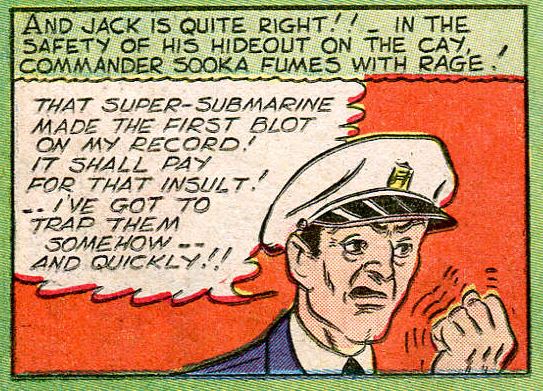
    There are hundreds if not thousands of antagonistic u-boat commanders in comics and very few of them are going to make the jump to super-villain. Commander Sooka, however… I did some cursory searching and it looks like the Axis forces sank around 1100 ships between 1939 and 1941, and the most successful u-boat captain of the entire war sank 47 ships total. What I’m saying is that if Commander Sooka’s count of 735 ships is accurate, he is some sort of latter-day Greek demigod rather than a man.

    Sooka ends his first encounter with the Phantom Sub with a declaration of vengeance (because they prevented him from blowing up a bunch of civilians, natch), but it is the Phantom Sub who strikes back first: accidentally stumbling upon Sooka’s submarine base, the Sub’s crew teams up with a lifeboat full of survivors of one of his sea raids to destroy the place.

    They manage to blow most of his operation to hell and gone but the issue ends with Sooka and his personal submarine still afloat and making their way through the secret underwater tunnel to the ocean to seek further vengeance. Will Commander Sooka be a persistent thorn in the Phantom Sub’s side going forward?

    The answer is no. Commander Sooka technically has a three issue run but the beginning of the third issue is this here especially-vengeful survivor successfully collapsing his own undersea tunnel on his head. In the end Commander Sooka was merely fodder for an easy but meaningless cliffhanger ending.

  • MINOR SUPER-VILLAIN 517: THE BULL

    (Blue Bolt v2 004, 1941)

    Community. That’s what the Bull’s all about. Specifically a crime community, one of the top kinds of communities (to read about at least – most of them don’t sound too great to live in). Situated in the Florida Everglades, the Bull’s nameless crime community consists of him, about five other guys and a pet crocodile living in a bunch of ramshackle shacks. It’s not much, but it’s home.

    There’s not much else to the Bull – if I’m honest he only gets the nod because I love crime communities and there aren’t enough of them. He does a kidnapping and tries to burn down a town and the Twister runs him in for his troubles. The real victim here is that poor crocodile who has to find its way down from that tree. And also that kidnapped woman, of course.

  • MINOR SUPER-HERO ROUND-UP 008

    MINOR SUPER-HERO ROUND-UP 008

    Some real highs and lows in this one.

    the Twister: 

    The Twister is a quite minor Golden Age super-hero – he managed more than one appearance but not more than seven – who has the distinction of having one of the most well-designed costumes of the era. Not my favourite costume, mind you, but boy oh boy, you can really tell that his creators (Ray Gill and Paul Gustavson as it happens) really sat down for a good think about how to evoke “tornado” via the medium of clothing.

    The Twister turns out to be Bob Sanders, and he turns out to be a descendant of perennial fave Greek hero Odysseus. It turns out that the story of Aeolus gifting Odysseus two bags of wind and his men opening the bag of storm winds thinking that it was full of treasure was more than just another delay in Odysseus’ Bad Voyage, it was akin to the opening of Pandora’s Box and Aeolus had charged Odysseus or his descendants to round up all of the evil violent winds and return the to captivity. 

    Evidently over the years the charge to gather up evil winds has expanded to fighting all evil, and the Twister’s power set allows him to run roughshod over just about anyone using wind control, a tornado form and invulnerability to anything that couldn’t harm actual wind. There is some attempt to establish that he is vulnerable to being locked up somewhere with no airflow but that proves even easier to defeat than all the times that Silver Age Aquaman is locked up and forced to source water from unexpected places.

    The Twister’s other claim to fame is that he was introduced as a mysterious tornado that appeared in the Blue Bolt, Sub-Zero and Dick Cole stories in the issue he first appears in, which is enough to be counted as a rare Golden Age crossover even though none of them shared words. (Blue Bolt v2 001, 1941)

    Freezum:

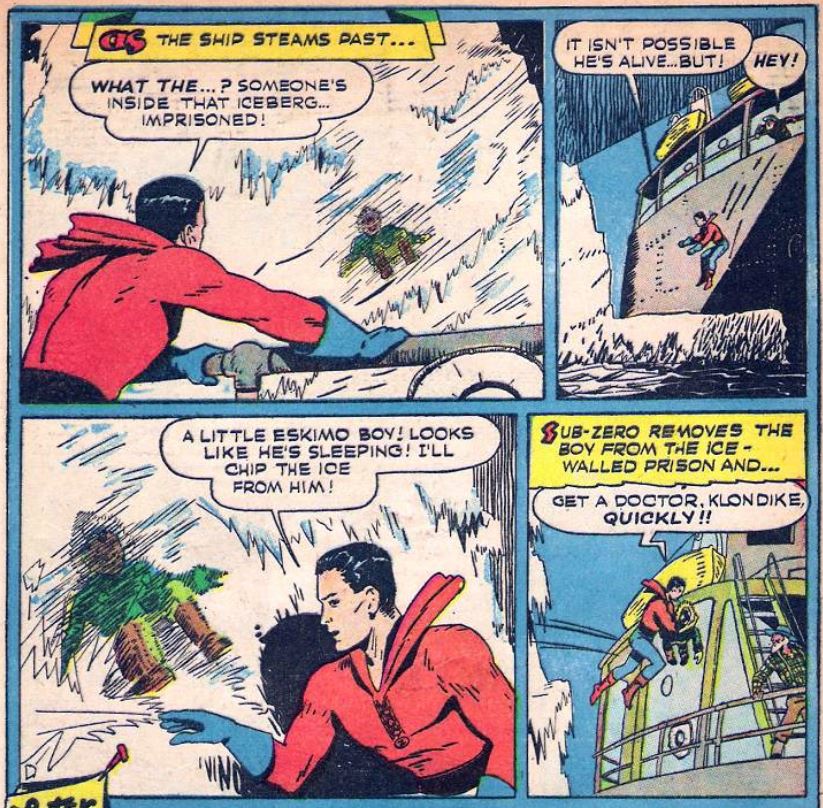
    On an adventure that takes him to Alaska, Sub-Zero happens upon a little Inuit or Aleut boy frozen in a glacier.

    Thawing the kid out and finding him to miraculously be alive, Sub-Zero (as well as an unfortunate doctor) is further astounded to discover that they share the same sort of cold-based powers due to their similar near-death freezing experiences. The kid names himself Freezum, and that’s just the first salvo of a barrage of tired comic relief sidekick shenanigans. Yes, we’ll be sighing and rolling our eyes for the remainder of Sub-Zero’s run – the joys of the Golden Age, friends! (Blue Bolt v2 005, 1941)

    Lois Blake:

    Lois Blake is a woman who Blue Bolt meets while attempting to take down a gang that was swindling immigrants using fake citizenship papers and decides to team up with. At some point when the gang is being particularly elusive he remembers that his pal Dr Bertoff down in the underground Kirby world has a viewscreen that can see virtually any location and so they head down there to use it. Bertoff then very helpfully offers to transfer some of Blue Bolt’s power to Lois and a new crimefighting team is born! (small aside: Golden Age comics don’t get a lot of praise for their art but I really enjoy both the small detail of Lois gripping Blue Bolt’s arm for comfort in the first panel above and her delighted expression in the third).

    Lois never gets a super-hero name and only really makes a handful of appearances before Blue Bolt ditches his costume and powers to become a regular if oddly-named soldier, but he’s such a nonentity post Simon and Kirby that I can’t help but love her for adding some life to the strip.(Blue Bolt v2 007, 1941)

    the Marvel:

    The Marvel is your classic mask-and-tuxedo vigilante, who specializes in showing up to bail reporter Scoop Cody out of the kind of jams you can get in when you’ve cracked a juicy crime story but not accounted for the possibility that the criminals involved might want to stop you from reporting on it.

    Three things about the Marvel: 

    1. The nose cutout never looks as cool as the full-face cowl does but I reckon it’s a heck of a lot more comfortable, so you have to give him some credit for choosing function over form.

    2. Scoop Cody and thus the Marvel only had two appearances and both of them had a teaser at the end promising that the Marvel’s identity would be revealed in the next issue. It’s always possible that they were planning on making the Marvel a completely new, never-before-seen guy but if they weren’t then literally the only suspect is this guy, Scoop Cody’s crusty old unnamed editor.

    3. Love a super-hero calling card, even in the rare cases when it’s a literal calling card.

    Also here is the Marvel’s second appearance in its entirety. (Blue Ribbon Coimcs 002, 1939)

  • MINOR SUPER-HERO ROUND-UP 008

    MINOR SUPER-HERO ROUND-UP 008

    Some real highs and lows in this one.

    the Twister: 

    The Twister is a quite minor Golden Age super-hero – he managed more than one appearance but not more than seven – who has the distinction of having one of the most well-designed costumes of the era. Not my favourite costume, mind you, but boy oh boy, you can really tell that his creators (Ray Gill and Paul Gustavson as it happens) really sat down for a good think about how to evoke “tornado” via the medium of clothing.

    The Twister turns out to be Bob Sanders, and he turns out to be a descendant of perennial fave Greek hero Odysseus. It turns out that the story of Aeolus gifting Odysseus two bags of wind and his men opening the bag of storm winds thinking that it was full of treasure was more than just another delay in Odysseus’ Bad Voyage, it was akin to the opening of Pandora’s Box and Aeolus had charged Odysseus or his descendants to round up all of the evil violent winds and return the to captivity. 

    Evidently over the years the charge to gather up evil winds has expanded to fighting all evil, and the Twister’s power set allows him to run roughshod over just about anyone using wind control, a tornado form and invulnerability to anything that couldn’t harm actual wind. There is some attempt to establish that he is vulnerable to being locked up somewhere with no airflow but that proves even easier to defeat than all the times that Silver Age Aquaman is locked up and forced to source water from unexpected places.

    The Twister’s other claim to fame is that he was introduced as a mysterious tornado that appeared in the Blue Bolt, Sub-Zero and Dick Cole stories in the issue he first appears in, which is enough to be counted as a rare Golden Age crossover even though none of them shared words. (Blue Bolt v2 001, 1941)

    Freezum:

    On an adventure that takes him to Alaska, Sub-Zero happens upon a little Inuit or Aleut boy frozen in a glacier.

    Thawing the kid out and finding him to miraculously be alive, Sub-Zero (as well as an unfortunate doctor) is further astounded to discover that they share the same sort of cold-based powers due to their similar near-death freezing experiences. The kid names himself Freezum, and that’s just the first salvo of a barrage of tired comic relief sidekick shenanigans. Yes, we’ll be sighing and rolling our eyes for the remainder of Sub-Zero’s run – the joys of the Golden Age, friends! (Blue Bolt v2 005, 1941)

    Lois Blake:

    Lois Blake is a woman who Blue Bolt meets while attempting to take down a gang that was swindling immigrants using fake citizenship papers and decides to team up with. At some point when the gang is being particularly elusive he remembers that his pal Dr Bertoff down in the underground Kirby world has a viewscreen that can see virtually any location and so they head down there to use it. Bertoff then very helpfully offers to transfer some of Blue Bolt’s power to Lois and a new crimefighting team is born! (small aside: Golden Age comics don’t get a lot of praise for their art but I really enjoy both the small detail of Lois gripping Blue Bolt’s arm for comfort in the first panel above and her delighted expression in the third).

    Lois never gets a super-hero name and only really makes a handful of appearances before Blue Bolt ditches his costume and powers to become a regular if oddly-named soldier, but he’s such a nonentity post Simon and Kirby that I can’t help but love her for adding some life to the strip.(Blue Bolt v2 007, 1941)

    the Marvel:

    The Marvel is your classic mask-and-tuxedo vigilante, who specializes in showing up to bail reporter Scoop Cody out of the kind of jams you can get in when you’ve cracked a juicy crime story but not accounted for the possibility that the criminals involved might want to stop you from reporting on it.

    Three things about the Marvel: 

    1. The nose cutout never looks as cool as the full-face cowl does but I reckon it’s a heck of a lot more comfortable, so you have to give him some credit for choosing function over form.

    2. Scoop Cody and thus the Marvel only had two appearances and both of them had a teaser at the end promising that the Marvel’s identity would be revealed in the next issue. It’s always possible that they were planning on making the Marvel a completely new, never-before-seen guy but if they weren’t then literally the only suspect is this guy, Scoop Cody’s crusty old unnamed editor.

    3. Love a super-hero calling card, even in the rare cases when it’s a literal calling card.

    Also here is the Marvel’s second appearance in its entirety. (Blue Ribbon Coimcs 002, 1939)