The Curse of Skeleton Munroe

Category: Mr Justice

  • MEDIA IN COMICS 006

    Now that’s entertainment. 

    Magazines: 

    Are magazine titles in comics more likely to be plays on real ones than other forms of media? Perhaps. We’ll just have to see how many variations on Life and Time we can find over the years. Pretending to work for Living has enough caché that it gets these fascists into a secure aircraft plant – how long has it been since magazines were so relevant? (Big Shot Comics 014, 1941)

    Movies:

    I never actually mentioned it in the entry on the Hunchback of Hollywood, but the anti-Nazi movie that incites the story’s action is called The Tyrant. Featuring Steve Rogers, Bucky Barnes and Sergeant Duffy in minor roles! (Captain America Comics 003, 1941)

    Rang-a-Tang the Wonder Dog’s boy companion Richy (the Amazing Boy) never seemed to be that impressive to me, but Hollywood disagreed and he was made both the star and subject of a film called Riverfront Richy with lots of animal stunts. (Blue Ribbon Comics 011, 1941)

    There’s never any real indication of what Scoopin’ Jive is about – music seems likely – but it’s such a baffling name for a movie that I must celebrate it (Crackajack Funnies 036, 1941)

    Similarly, we never really learn what Wings Aflutter is about, other than being a “new Navy Air smash hit” with a terrible name. (Jumbo Comics 034, 1941)

    Theatre:

    Minor super-villain the Black Death of course takes his costume and MO from a character in a stage production called The Black Death. There’s not quite enough of the play’s plot in the story to know if the fictional Black Death is supposed to be a metaphor or something or some sort of slasher movie killer as it appears. I sincerely hope it’s the latter. (Thrilling Comics 010, 1940)

    One of Professor X’s attempts to get Sub-Zero involves attacking him in the audience of a big stage musical that his girlfriend Mary is appearing in as part of the “Living Chandelier”. “George Whyte’s Sandels” is a very specific-seeming reference, but I am unable to easily connect it to a show of the era. (Blue Bolt v1 006, 1940)

    Fuller Spunk, former star of stage and now Holmes-inspired detective, starred in the evocatively-named shows Hector’s Last Gulp and The Gripes of Raft. (Hyper-Mystery Comics 001, 1940)

    Waltz of the Vampires is a ballet performance that is narratively used to set off vampire Carlos Hubbelo’s bloodlust, but more importantly, it kind of rules? Comic book media is so often a version of something from the real world that it’s always very fun to see something like this that (as far as I can tell) is just a sincere depiction of a vampire ballet. (Blue Ribbon Comics 011, 1941)

  • MINOR SUPER-VILLAIN 532: THE DEVIL

    (Blue Ribbon Comics 019, 1941)

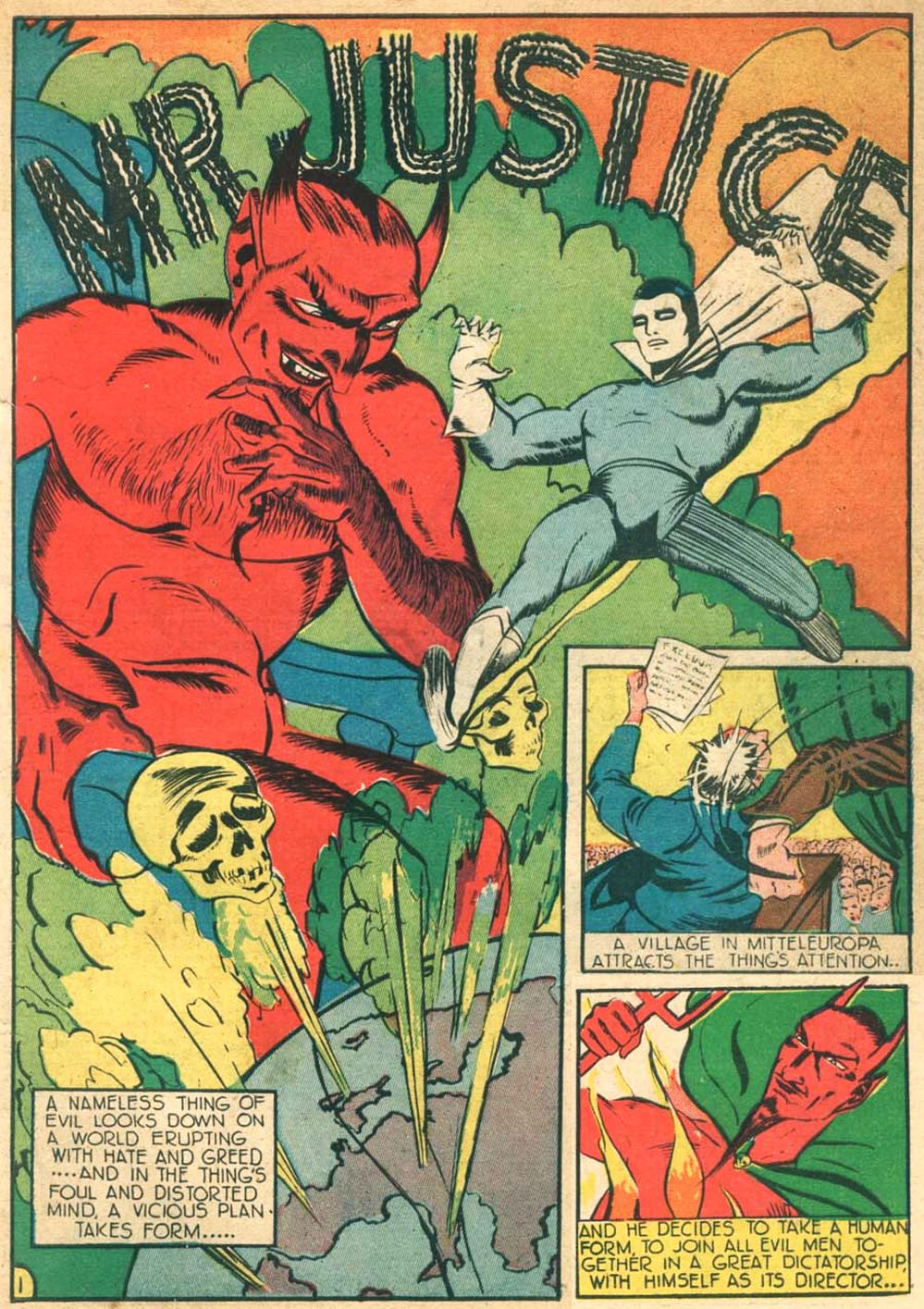
    This is the same guy as the Dictator but on his time off, I guess? Mr Justice kind of gave up on him after the Green Ghoul incident – maybe he just couldn’t get up the energy to keep running a Nazi Germany analog.

    I think he continues to pop up and empower Mr Justice foes but more importantly he has some very cute little trident-wielding imp goons. No hell-dimension is complete without them!

  • MINOR SUPER-VILLAIN 531: THE EVIL EYE

    (Blue Ribbon Comics 019, 1941) 

    I wonder if high schools in comic book universes hold some sort of assembly to teach kids not to yell about selling their souls to the Devil when life has them down? Because as far as I can tell it’s got a pretty high chance of working, like it does for weird little scientist Ribo here.

    Ribo does indeed get to see again but he also gets a demonic makeover – he’s even more of a little creep than before! This is because the devil who he made a deal with is the same guy as the Dictator and Ribo/ the Evil Eye is being set up to take out Mr Justice.

    This is probably why the Evil Eye sets out to bet on a boxing match and fix the outcome rather than stay at home and work on his “great invention” with his new power of sight, right? Or was he a degenerate gambler to begin with and the Devil knew that he couldn’t resist using his new power this way – his invention is never defined, so perhaps it was just some sort of odds-calculator or a device for hypnotizing athletes over the phone.

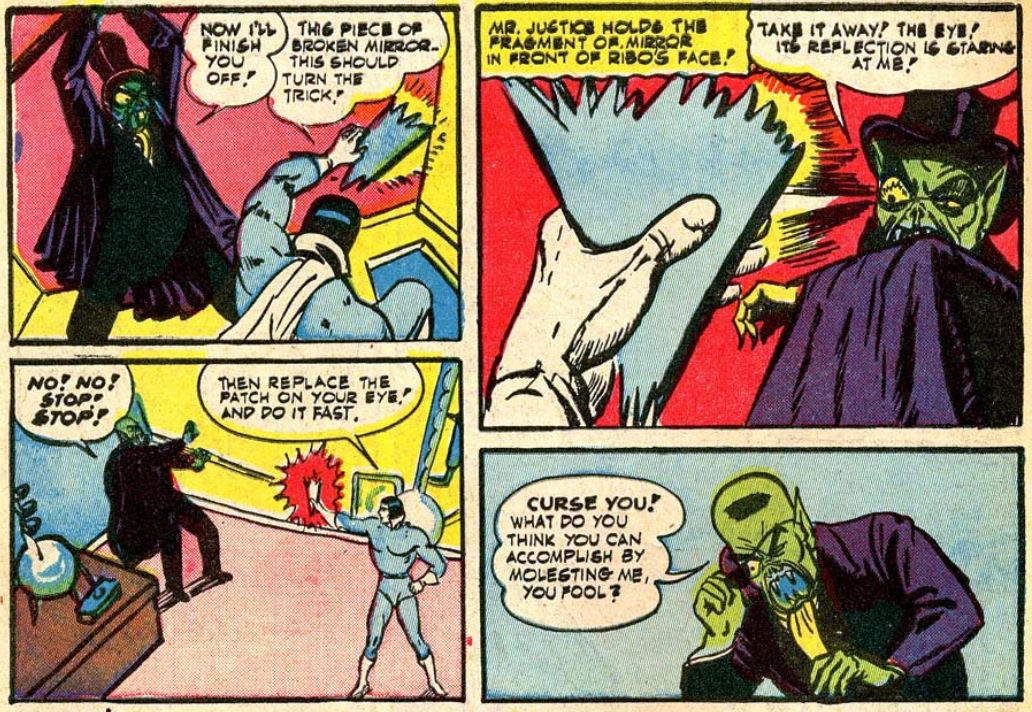
    The Evil Eye gives Mr Justice a run for his money when they do eventually meet up but too bad for him that he has eye-based powers and that the counter to eye-based powers has been a mirror since Ancient Greece.

    In one of the harsher punishments in comic books (particularly when the only crime has been a bit of crooked sports betting) Mr Justice immediately drags the Evil Eye down to Hell, where we get some more of that sweet sweet LORE: not only are minor demons powerless to affect an immortal such as Mr Justice but the souls of what I can only assume are the creme de la creme of the evil dead are chained up next to their own bodies. It’s a fun visual if a slightly underwhelming punishment, but it’s where we must leave Ribo AKA the Evil Eye.

  • MINOR SUPER-VILLAIN 531: THE EVIL EYE

    MINOR SUPER-VILLAIN 531: THE EVIL EYE

    (Blue Ribbon Comics 019, 1941) 

    I wonder if high schools in comic book universes hold some sort of assembly to teach kids not to yell about selling their souls to the Devil when life has them down? Because as far as I can tell it’s got a pretty high chance of working, like it does for weird little scientist Ribo here.

    Ribo does indeed get to see again but he also gets a demonic makeover – he’s even more of a little creep than before! This is because the devil who he made a deal with is the same guy as the Dictator and Ribo/ the Evil Eye is being set up to take out Mr Justice.

    This is probably why the Evil Eye sets out to bet on a boxing match and fix the outcome rather than stay at home and work on his “great invention” with his new power of sight, right? Or was he a degenerate gambler to begin with and the Devil knew that he couldn’t resist using his new power this way – his invention is never defined, so perhaps it was just some sort of odds-calculator or a device for hypnotizing athletes over the phone.

    The Evil Eye gives Mr Justice a run for his money when they do eventually meet up but too bad for him that he has eye-based powers and that the counter to eye-based powers has been a mirror since Ancient Greece.

    In one of the harsher punishments in comic books (particularly when the only crime has been a bit of crooked sports betting) Mr Justice immediately drags the Evil Eye down to Hell, where we get some more of that sweet sweet LORE: not only are minor demons powerless to affect an immortal such as Mr Justice but the souls of what I can only assume are the creme de la creme of the evil dead are chained up next to their own bodies. It’s a fun visual if a slightly underwhelming punishment, but it’s where we must leave Ribo AKA the Evil Eye.

  • MINOR SUPER-VILLAIN 527: THE GREEN GHOUL

    (Blue Ribbon Comics 016, 1941)

    The Green Ghoul is a demonic creature either summoned or created by the demon known as the Dictator as a very successful method of getting Mr Justice to leave him alone. He appears on a US beach and lays waste to an unfortunate couple before heading to the unnamed New York City-alike that Mr Justice calls home.

    Like I said, the Green Ghoul is a distraction, so it’s understandable that its plans lack nuance. To whit, his initial plan is just indiscriminate slaughter.

    Having lured Mr Justice back from Europe, the Green Ghoul now needs to occupy his attention, and having murdered and possessed Assistant Mayor Tracey Keen he sets his sights on conquering Unnamed City.

    Also, he LOOKS GREAT. There could e a conversation about how nobody noticed that Keen was obviously a possessed corpse but he is a previously unseen character created expressly for the purpose of being killed off in this story, so maybe he was just Like That already and the Green Ghoul got lucky.

    For a being of great if undefined infernal power, the Ghoul’s plans for municipal domination are surprisingly conventional: he wants to become the mayor. Granted, he wants to do so by killing and possessing the incumbent but it’s still fairly mundane as far as demonic power plays go. Fortunately for Mayor Clark he is unlike his assistant a member in good standing of Mr Justice’s supporting cast and so the various attempts on his life are foiled.

    There’s a bit of story padding in which Mr Justice and the Green Ghoul (plus Mr Justice love interest Pat Clark) duke it out in a dinosaur-infested subatomic world but things eventually come to a head in the space between the mundane world and the spiritual one, one of the few places that an immortal being can be killed, where the Ghoul hopes to do just that to Mr Justice. Unfortunately for the Ghoul, the immortal killing golden knife cuts two ways and he ends up as a cloud of green ocean pollutants.

    killed because he challenges mr justice to a battle to the death in the void between – cuts both ways

  • MINOR SUPER-VILLAIN 526: THE DICTATOR

    MINOR SUPER-VILLAIN 526: THE DICTATOR

    (Blue Ribbon Comics 013, 1941)

    I had two surprises coming to me when I read the first appearance of this fellow: 1) though there are a fair few Golden and Silver Age comics that posit some sort of supernatural element to the evils of the Axis power – deals with the Devil, influence by one or another god of war, etc – but this is the earliest example I’ve seen of one of their leaders actually being a supernatural evil.

    If I had previously said that the Dictator’s Shadow was about as close as you could get to someone being a Nazi without actually dipping over the line and just saying it, this comic has somehow elasticized the line and dragged it way over to the other side. The Dictator is Hitler in all but name, and they don’t even go to the trouble of replacing the swastika with another symbol or making up new names for the countries he invades. There are such a small number of changes, in fact, that I will list them now: Germany is referred to as Mitteleuropa (which is a term for Central Europe fairly closely associated with the German imperialism of both World Wars), the Bavarian Alps are instead the Vabarian Alps, and Goebbels is instead called Deenbee (a maddening name because it feels like I should be able to work out a meaning behind it).

    (later there are look-alike analogs of a lot of top Nazis, seen here)

    Mr Justice demonstrates the even-handed political neutrality that comics of the past were always known for and bursts into a staff meeting to give Hitler the Dictator “the most vicious beating a man ever experienced”, as you do.

    Again, this is all politically neutral stuff.

    This conflict continues for a few issues: first, the Dictator arms his nameless Himmler-analog with an anti-ghost potion and sets him the task of killing Mr Justice. This ends in not-Himmler’s  death but also in an important realization for Mr Justice: that the Dictator wields only temporal power in the world, that he can only act through agents. Accordingly, the net two Mr Justice stories concern him killing off analogs of Goering, Goebbels and von Ribbentrop t erode the Dictator’s power base.

    And that’s where it ends, kind of. After Mr Justice strikes, the Dictator returns fire by sending future entry the Green Ghoul to attack America. It take three issues to deal with that guy, and by the next time he shows up the Dictator is just the Devil again – whether or not he is still cosplaying as Hitler is not addressed. I guess that this is going to continue to be a thing when the villain in question is a cosmically evil being, right? They just pack up and go home at the end? A bit unsatisfying from a narrative perspective.

  • REAL PERSON ROUND-UP 002

    How did these real people come to be trapped in the 2D realm? We may never know

    Adolf Hitler:

    This one is more tenuous but Blitz Krieg here is Fuehrer of the pseudo-Nazi Bundonian forces in America. He’s not not a Hitler analog. (Blue Ribbon Comics 006, 1940)

    This is Boris Thorax, first foe of Rex Dexter of Mars, who collaborates with the Moon People in order to take over the Earth of 2000 AD. Look at that hair: that’s a Hitler analog. (Mystery Men Comics 001, 1939)

    Alexander the Great:

    Time traveller Stuart Taylor and pals visit Ancient Macedonia for a larf and get mixed up with Alexander and for some reason the Amazons in an adventure that will inspire much eye-rolling in the modern reader. (Jumbo Comics 017, 1940)

    Charlie Chaplin:

    A “Harly Shaplyn”, attacked by “Bundonians” for making a version of the Great Dictator. (Blue Ribbon Comics 006, 1940)

    Samuel Goldwyn: 

    The bald guy in the Harly Shaplyn panels above is named Sam Wyngold and it took me a concerningly long time to realize that he was an analog of Samuel Goldwyn, the G in MGM.

    Count Zaroff:

    Aristocrat Baron von Krasner wants a little of that “Most Dangerous Game” action, so he wrecks a ship and hunts adventurer Gypsy Johnson and his companions on his be-castled island (Blue Ribbon Comics 006, 1940)

    Heinrich Himmler:

    Unnamed head of secret police for Mr Justice foe and Hitler analog the Dictator. Ends up skewered by his own men. (Blue Ribbon Comics 014, 1941)

    Hermann Goering:

    As “Field Marshall Boreing” is manipulated into killing/ being killed by other Nazi analogs by Mr Justice. Boreing is the only survivor but Mr Justice gets him in the next issue. (Blue Ribbon 015, 1941)

    Kit Carson:

    It’s one of those “why did they bother obfuscating this” moments: “Kit Karston” here is probably meant to Kit Carson, formerly widely regraded as a hero of the Old West and now as a mass murderer. “Gravestone” is obviously Tombstone, Arizona. (Blue Ribbon Comics 007, 1940)

    Joachim von Ribbentrop:

    Nazi foreign minister. As “von Fibbenfop” is manipulated into killing/ being killed by other Nazi analogs by Mr Justice. (Blue Ribbon 015, 1941)

    Joseph Goebbels:

    The confusingly-named Deenbee serves as Minister of Propaganda for Mr Justice foe the Dictator (Blue Ribbon Comics 013, 1941) 

    Two issues later, Deenbee is out and “Gobbels” is manipulated into killing/ being killed by other Nazi analogs by Mr Justice. (Blue Ribbon 015, 1941)

    Mahatma Gandhi:

    Cast as “Mahatmama”, leader of a group of Italian-allied North African Arabs, a choice as baffling as it was racist (though it does fit with the sort of broad confusion between the Middle East and the Indian subcontinent I have noticed in other comics of the period) (Blue Ribbon Comics 013, 1941)

  • MINOR SUPER-HERO ROUND-UP 011

    Lotsa lil guys.

    Mr Justice: 

    Like the Spectre or the Wraith (or Sergeant Spook or the Gay Ghost or the Ghost Patrol…), Mr Justice is your classic restless spirit who remains on Earth to mete out justice to the wicked. Specifically, Mr Justice is the 200 year old ghost of the fictional English Prince James, cruelly slain by followers of Prince Richard during the Rogers Rebellion of the 1740s. Astute readers and students of history might have noticed a few things about the preceding sentence that all boil down to the fact that the 1740s were actually recent enough that we know a whole lot about what was going on then, including that people weren’t running around in Medieval armour even if they were sometimes still using swords and shields during the Jacobite Rebellion of 1745. Also, this is what the crown prince of England looked like in 1741. (they change it to the 11th Century later on, because that makes a lot more sense).
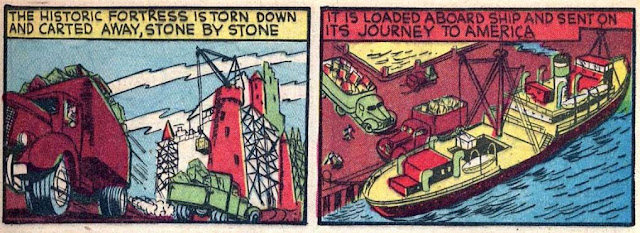
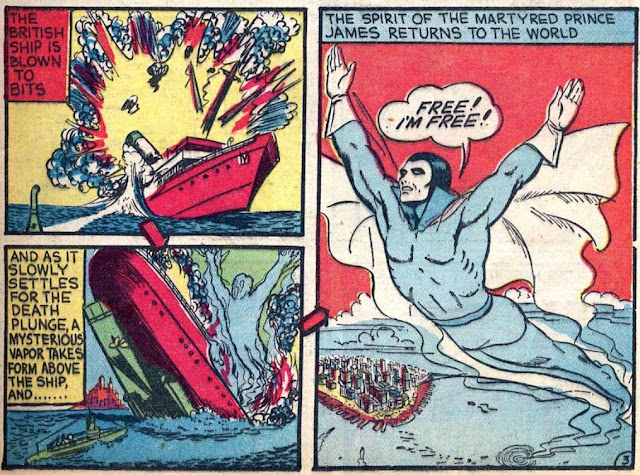
    Prince James’ ghost is tethered to the place of his death per the usual ghost rules but he manages to get around that in a fairly unprecedented way: due the the war, the British government decides to move the castle to America and it is sunk by the Nazis on the way there. And since a pile of stone on the bottom of the Atlantic is not a castle, James is free to go become Mr Justice, the ghost super-hero frequently compared to the Spectre but who doesn’t really get up to the sames sort of divine judgment stuff. He does fight the Devil/Satan a lot, though.
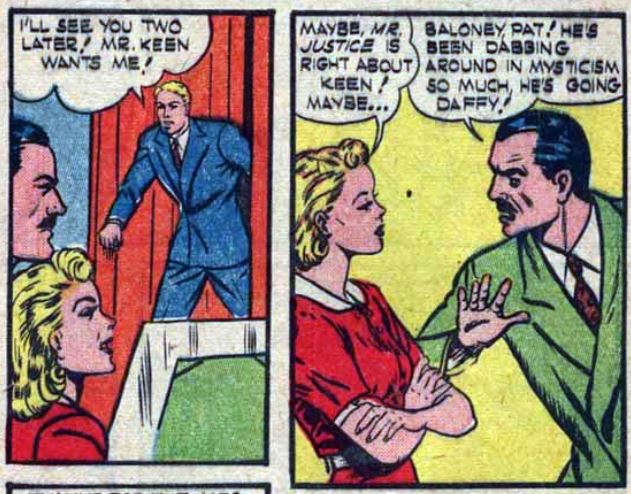
    Possibly my favourite thing about Mr Justice is the fact that his secret identity is a fellow named Mr Justice and nobody really calls any attention to that fact. Mr Justice (secret identity of Mr Justice) is attached to the office of Mayor Clark (city unnamed but very NYC-esque) as a sort of troubleshooter. He kind of has a love interest in mayor’s daughter Pat Clark and a rival in District Attorney Roy Winkler, above, but neither is explored very thoroughly. (Blue Ribbon Comics 009, 1941)

    Inferno:

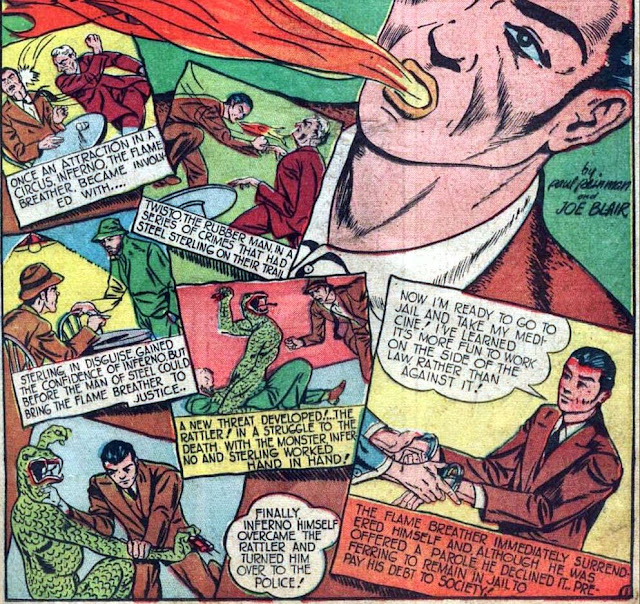
    Above is an abridged account of Inferno’s time as a super-villain, which we will treat separately because… well, because when you’re reading a lot of old comics in a somewhat systematic manner you have to have some sort of organizational method and I chose alphabetical by year, and Inferno’s time on the lists of crime happened in Zip Comics. I simply haven’t gotten there yet. Suffice to say that he was a crook who changed his ways due to the influence of Steel Sterling and opted to do his time.

    Despite his best efforts, Inferno is compelled to break jail to stop a group of prison escapees from murdering a judge and then is encouraged by that same judge to go on the lam because the authorities are going to try to murder Inferno. It’s a real reciprocal life-saving situation! Although I am tempted to think that that judge could possibly have just called someone and arranged for a stay of summary execution for Inferno.

    The rest of Inferno’s career as a Golden Age super-hero is kind of a fun twist on the old trope of the super-hero that everyone thinks is a crook, in that he doesn’t really have a secret identity per se so just travels around doing itinerant labour until he sees a crime go and changes outfits. The idea of this hobo existence kind of goes by the wayside after a couple of issues when Secret Service Agent Virginia Ames enters the picture, as Inferno’s stories were on the shorter side and just didn’t have the real estate for both a love interest and workplace drama.

    Inferno only managed seven adventures before trotting off to limbo to wait for Archie’s 1960s super-hero revival but don’t worry! He got a full pardon in his last adventure so the other heroes won’t be hassling him. (Blue Ribbon Comics 013, 1941)

    Captain Flag:

    On the one hand, Captain Flag is a regular-style patriotic hero but on a different, more entertaining hand he is a patriotic hero with a very fun origin. To whit: one day super-villain the Black Hand is attempting to wrest scientific secrets from inventor John Townsend when his playboy son Tom stumbles in half lit. The Black Hand is about to dispose of Tom using his horrible hand when a huge eagle just kind of… flaps into the room and ends up leaving with Tom Townsend in its talons.

    Thus saved, Tom just kind of lives with the eagle for a while and transforms from a dissipated youth to a lean, athletic man full of fish protein. And then the eagle comes back one day with an American flag! It’s a veritable sign from the heavens it what it is!

    And so, Tom Townsend becomes Captain Flag, who mostly fights the Black Hand. Which makes sense. Something else that would make a lot of sense: adding a belt to that costume. (Blue Ribbon Comics 016, 1941)

    The Red Mask:

    The Red Mask is very minor indeed! He appeared in four issues of Best Comics from Better Publications, of which only issue 2 appears to be available, which in turn was reprinting newspaper strips, of which only a handful are available. 

    What we have on the guy is this: he leads a tribe on the island of Kaukura, which is probably but not definitely in Oceania somewhere. Kaukura is chockablock with things like sacred grottoes, immortal monsters and hostile tribes and the Red Mask has assigned himself the task of protecting a bunch of clueless outsiders like Nina and Danny here who have blundered in looking for their friend and found themselves up to their neck in trouble.

    The most interesting thing about the Red Mask is that he is by a fair margin the first nonwhite super-hero, though thanks to colouring limitations and some inexact geography it’s a bit difficult to get more exact than that. (Best Comics 002, 1939)

  • MINOR SUPER-HERO ROUND-UP 011

    Lotsa lil guys.

    Mr Justice: 

    Like the Spectre or the Wraith (or Sergeant Spook or the Gay Ghost or the Ghost Patrol…), Mr Justice is your classic restless spirit who remains on Earth to mete out justice to the wicked. Specifically, Mr Justice is the 200 year old ghost of the fictional English Prince James, cruelly slain by followers of Prince Richard during the Rogers Rebellion of the 1740s. Astute readers and students of history might have noticed a few things about the preceding sentence that all boil down to the fact that the 1740s were actually recent enough that we know a whole lot about what was going on then, including that people weren’t running around in Medieval armour even if they were sometimes still using swords and shields during the Jacobite Rebellion of 1745. Also, this is what the crown prince of England looked like in 1741. (they change it to the 11th Century later on, because that makes a lot more sense).

    Prince James’ ghost is tethered to the place of his death per the usual ghost rules but he manages to get around that in a fairly unprecedented way: due the the war, the British government decides to move the castle to America and it is sunk by the Nazis on the way there. And since a pile of stone on the bottom of the Atlantic is not a castle, James is free to go become Mr Justice, the ghost super-hero frequently compared to the Spectre but who doesn’t really get up to the sames sort of divine judgment stuff. He does fight the Devil/Satan a lot, though.

    Possibly my favourite thing about Mr Justice is the fact that his secret identity is a fellow named Mr Justice and nobody really calls any attention to that fact. Mr Justice (secret identity of Mr Justice) is attached to the office of Mayor Clark (city unnamed but very NYC-esque) as a sort of troubleshooter. He kind of has a love interest in mayor’s daughter Pat Clark and a rival in District Attorney Roy Winkler, above, but neither is explored very thoroughly. (Blue Ribbon Comics 009, 1941)

    Inferno:

    Above is an abridged account of Inferno’s time as a super-villain, which we will treat separately because… well, because when you’re reading a lot of old comics in a somewhat systematic manner you have to have some sort of organizational method and I chose alphabetical by year, and Inferno’s time on the lists of crime happened in Zip Comics. I simply haven’t gotten there yet. Suffice to say that he was a crook who changed his ways due to the influence of Steel Sterling and opted to do his time.

    Despite his best efforts, Inferno is compelled to break jail to stop a group of prison escapees from murdering a judge and then is encouraged by that same judge to go on the lam because the authorities are going to try to murder Inferno. It’s a real reciprocal life-saving situation! Although I am tempted to think that that judge could possibly have just called someone and arranged for a stay of summary execution for Inferno.

    The rest of Inferno’s career as a Golden Age super-hero is kind of a fun twist on the old trope of the super-hero that everyone thinks is a crook, in that he doesn’t really have a secret identity per se so just travels around doing itinerant labour until he sees a crime go and changes outfits. The idea of this hobo existence kind of goes by the wayside after a couple of issues when Secret Service Agent Virginia Ames enters the picture, as Inferno’s stories were on the shorter side and just didn’t have the real estate for both a love interest and workplace drama.

    Inferno only managed seven adventures before trotting off to limbo to wait for Archie’s 1960s super-hero revival but don’t worry! He got a full pardon in his last adventure so the other heroes won’t be hassling him. (Blue Ribbon Comics 013, 1941)

    Captain Flag:

    On the one hand, Captain Flag is a regular-style patriotic hero but on a different, more entertaining hand he is a patriotic hero with a very fun origin. To whit: one day super-villain the Black Hand is attempting to wrest scientific secrets from inventor John Townsend when his playboy son Tom stumbles in half lit. The Black Hand is about to dispose of Tom using his horrible hand when a huge eagle just kind of… flaps into the room and ends up leaving with Tom Townsend in its talons.

    Thus saved, Tom just kind of lives with the eagle for a while and transforms from a dissipated youth to a lean, athletic man full of fish protein. And then the eagle comes back one day with an American flag! It’s a veritable sign from the heavens it what it is!

    And so, Tom Townsend becomes Captain Flag, who mostly fights the Black Hand. Which makes sense. Something else that would make a lot of sense: adding a belt to that costume. (Blue Ribbon Comics 016, 1941)

    The Red Mask:

    The Red Mask is very minor indeed! He appeared in four issues of Best Comics from Better Publications, of which only issue 2 appears to be available, which in turn was reprinting newspaper strips, of which only a handful are available. 

    What we have on the guy is this: he leads a tribe on the island of Kaukura, which is probably but not definitely in Oceania somewhere. Kaukura is chockablock with things like sacred grottoes, immortal monsters and hostile tribes and the Red Mask has assigned himself the task of protecting a bunch of clueless outsiders like Nina and Danny here who have blundered in looking for their friend and found themselves up to their neck in trouble.

    The most interesting thing about the Red Mask is that he is by a fair margin the first nonwhite super-hero, though thanks to colouring limitations and some inexact geography it’s a bit difficult to get more exact than that. (Best Comics 002, 1939)

  • MINOR SUPER-VILLAIN 525: RIALB

    MINOR SUPER-VILLAIN 525: RIALB

    (Blue Ribbon Comics 012, 1941)

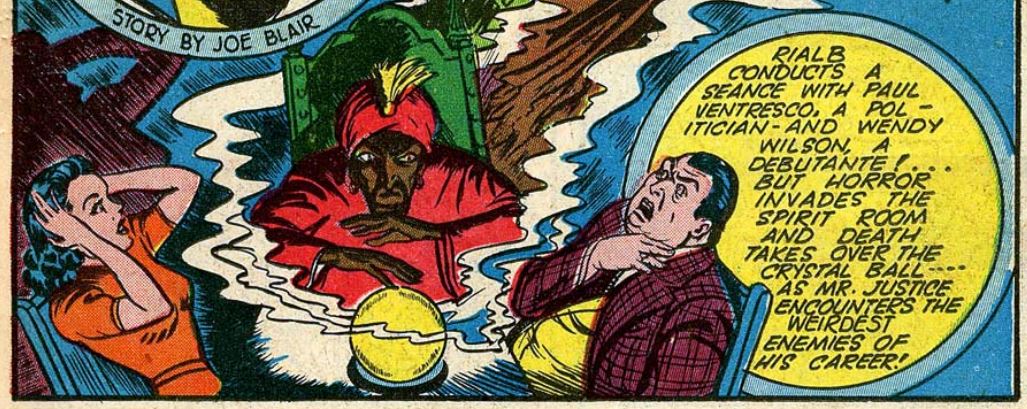
    Here’s a story about my powers of observation: I immediately noticed that our friend Rialb here had a backward name and spent a good half hour trying to figure out which Blair he might be named in reference to (a 1940s spiritualist? a famous skeptic?) before my eyes drifted slightly to the left and I took in the fact that the story was written by Joe Blair. I still have no idea why Joe Blair named the wet-rag villain of the story after himself, but let’s all be happy I figured it out before moaning about it here.

    Speaking of wet rags: let’s discuss Rialb. He’s a fake medium who accidentally discovers that he can actually summon the spirits of the dead but seems to have a knack for bringing back spirits who wish their descendants harm. Further, the first time he does so is witnessed by crooked politician Paul Ventresco, who puts the easily pushed-over Rialb to work as his personal ghost-powered hitman.

    The real stars of the story are the extremely grody ghosts that Rialb manages to conjure up. Just look at this gross old misogynist.

    Shadow imp, skull-faced spectre, pointillism lizard-man… this comic has it all!

    The real star is absolutely this skeleton-limbed hair-face who gets his bony ass kicked back to the netherworld he came from by Mr Justice before he can get up to any mischief. I really enjoy how the unchanging expression on his face reads as both menacing and sad depending on which side of the ass kicking he is.

    Just a regular ghost.

    It’s a bit of a letdown that the last ghosts we see are three sad sack victims of Ventrusco who Mr Justice calls up to cow the pair into surrendering, though he really only needed them for Ventrusco, given that Rialb shows no actual evidence of having a spine during the story – Mr Justice could have just thrown a sheet over a chair and gotten the same result.