The Curse of Skeleton Munroe

Category: undersea

  • MINOR SUPER-VILLAIN 608: KING KELPA

    (Fantastic Comics 005, 1940)

    Sub Saunders needs to investigate a series of sunken ships, so he has his fiance Peg given the same treatment as he got from the great “oceantalogist” Professor Foama so that they are both amphibious and can go on missions together. This is wildly progressive for a Golden (or Silver, or a lot of Bronze) Age comic book hero! They’re usually more likely to toe the “this is too dangerous for a woman” line – it’s probably because Sub Saunders is from the year 10 000.

    Somewhat predictably at this point, the problem stems from an irascible undersea ruler with a vaguely nautical name, in this case one King Kelpa. Unlike the rest of the sub-oceanic peoples from earlier Sub Saunders stories, Kelpa and the inhabitants of his unnamed city are actually amphibious, a huge advantage to people living at the bottom of the ocean! Flush with feelings of superiority, he has decided to invade the surfave world, where his people will have no advantage over regular soldiers. Problem is, he doesn’t actually know anything about the surface world and so has been sinking ships in hopes of getting intel, but up until Sub and Peg showed up all he got was a bunch of drowned sailors. What luck for him to encounter the only two amphibious surface dwellers!

    Only not so much. Sub Saunders defeats Kelpa’s pet swordfish, snaps off its bill and stabs him to death with it, then bombs his city for good measure.

  • MINOR SUPER-VILLAIN 604: PRINCE PIGZA

    (Fantastic Comics 004, 1940) 

    Is Prince Pigza a proper super-villain or just a jerk? His major crime as discovered by a newly-amphibious Sub Saunders on an exploratory jaunt under the ocean is in not caring that his process for extracting gold from seawater is (possibly) causing disturbances along the coast of the US. Would it be polite to check? Is it a dick move not to stop? Both yes. If he didn’t lock up Sub Saunders for suggesting that he stop and subsequently plan on dissecting him to learn the secret of his amphibiousness then I might not have been able in good conscience to include him here.

    Sub Saunders of course escapes his prison and calls in the US Navy to *squints* slaughter Pigza’s spear wielding guards and presumably declare the city of Crustacea an underwater protectorate of the United States.

    Prince Pigza himself is summarily exploded by Sub Saunders. What I’m saying, I guess, is check up on people or governments before you casually make them your enemies because they might have a tendency to respond to provocations with overwhelming and deadly force.

  • MINOR SUPER-VILLAIN 604: PRINCE PIGZA

    (Fantastic Comics 004, 1940) 

    Is Prince Pigza a proper super-villain or just a jerk? His major crime as discovered by a newly-amphibious Sub Saunders on an exploratory jaunt under the ocean is in not caring that his process for extracting gold from seawater is (possibly) causing disturbances along the coast of the US. Would it be polite to check? Is it a dick move not to stop? Both yes. If he didn’t lock up Sub Saunders for suggesting that he stop and subsequently plan on dissecting him to learn the secret of his amphibiousness then I might not have been able in good conscience to include him here.

    Sub Saunders of course escapes his prison and calls in the US Navy to *squints* slaughter Pigza’s spear wielding guards and presumably declare the city of Crustacea an underwater protectorate of the United States.

    Prince Pigza himself is summarily exploded by Sub Saunders. What I’m saying, I guess, is check up on people or governments before you casually make them your enemies because they might have a tendency to respond to provocations with overwhelming and deadly force.

  • MINOR SUPER-VILLAIN 599: POSEIDA

    (Fantastic Comics 003, 1940)

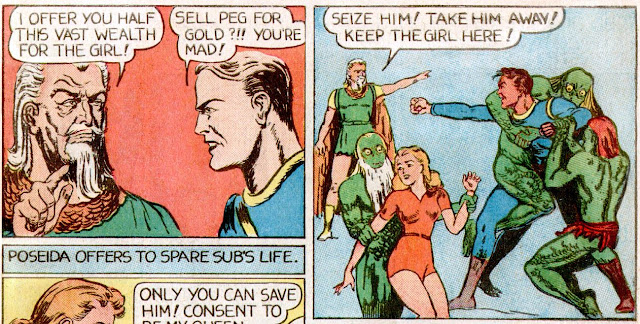
    Back to the adventures of Sub Saunders in the Year 10 000 CE! Naulus has been defeated and for their part in achieving that the US military, represented by Sub Saunders, have been promised untold subsea riches recovered from millennia of shipwrecks. The problem with this plan is that the riches are still just kind of out on the seafloor and more specifically that Poseida, ruler of the nearby city of Coralla, has decided to gather them up for himself.

    The impending diplomatic incident over the ownership of this treasure is forestalled by a different diplomatic incident as Poseida takes a shine to Sub Saunders’ fiancee Peg and attempts to woo her in the traditional manner of the villain: kidnapping and extortion. Is the fact that he seems to be the only human in a city of long-bearded Mermen any excuse for this? Not really but it does shed some light on his motivations.

    Poseida’s plan to win Peg’s love by placing Sub in danger fails when Sub utterly demolishes his giant spider crab foe and before long he has radioed Atlantis for help. The ensuing Frogman/ Merman battle is sadly only visible through the streaky windows of Poseida’s HQ. One good sock to the jaw and the treasure Peg is saved!

    There’s no follow-up on Poseida but as the leader of what seems to be a sovereign city-state he should be safe from prosecution for his crimes. He should count his lucky stars that he didn’t get blown up like Naulus.

  • MINOR SUPER-VILLAIN 569: NEPTINA

    (Champion Comics 002, 1939) 

    I can’t say for sure that whoever created Neptina sat down and said “I will make a lady version of Namor the Sub-Mariner” but it’s at least plausible. Neptina is the ruler of the undersea kingdom of Amloza, and has designs on a total conquest of the surface world as well as the depths.

    Neptina is, like Namor, a horny character. She captures US Navy Lieutenant Brad Fletcher early in her series and spends a considerable amount of mental, martial and political energy in subsequent installments in service of keeping him near her and away from other women.

    (note the little tuning fork thing that Neptina is holding – it works in concert with a telepathic receiver as a form of communication for the Fish-Men of Amloza. There are lots and lots of panels featuring characters who look like they’re playing with a toy from the 1920s when in fact they are talking to one another. It’s fun!)

    Neptina is shown to be a ruthless slaver with ranks of surface men pillaged from ships and equipped with gills in place of their human lungs. The reverse operation can be performed on Fish-Men to allow them to become fully amphibious, though the lungs involved must be harvested from a human. Neptina’s vanity is showcased when she demands that the lungs for her operation be harvested from a beautiful woman only. This also proves to be Neptina’s first major stumbling block, as Brad Fletcher immediately falls in love with movie star Norma Kane when she is brought to Amloza, and rescuing her is one of his major motivations for disrupting Neptina’s plans in early installments.

    More interesting than Neptina’s schemes is the biology of Amloza’s population. There appear to be at least two biological castes, with more humanoid Fish-Men Nobles like Brad Fletcher’s friend Gakk holding higher station than the fish-headed commoners (Neptina’s chief scientist Mogg is a regular Fish-Man and probably the most competent character in the comic, in a welcome nod to the foolishness of biological determinism).

    Complicating things further is the fact that the female population of Amloza appears to consist entirely of bodacious blonde babes in shell bras. If it were just Neptina I’d figure that she was a surface woman somehow elevated to the throne (the racial politics of the time would almost demand that a non-white/nonhuman group would instinctively subjugate themselves to a blonde bombshell), but this suggests the kind of sexual dimorphism we see in fantasy and sci-fi character design (mildly NSFW comic, but Oglaf as a whole is wildly NSFW).

    The other option, and the one I favour, is that the group represented by Neptina and the Fish-Men are two morphologically distinct but related species operating as a unified society – perhaps the Neptinans are naturally parthogenic (sp) which explains their seeming single gender, while the Fish-Men could lack any sexual dimorphism. The Fish-Men Nobles would thus represent hybrids of the two populations and thus their role as nobles could be seen as a bridge between the two.

    Speculative biology aside, here’s a timeline of Neptina’s deal:

    -after Brad Fletcher and Norma Kane escape, she acquires lungs from a second, less fortunate surface woman and makes her way to NYC.

    -while attempting to raise capital by selling some huge pearls, Neptina runs afoul of both the NYPD and a gang of crooks, who foolishly attempt to get rid of her via drowning and end up on the bottom of the harbour themselves.

    -the pearls in question are the sacred Tear Drops of Neptune and scientist Mogg, already a mite anti-monarchist in his leanings, embarks on a) a mission to recover them and b) an attempt to undermine Neptina’s plans of conquest.

    -also set against Neptina: Gakk the Fish-Man Noble and her own half-sister Mhersa, leader of a rebel group called the Maella.

    -Brad returns with a diplomatic envoy. Things are tense but civil until the surface folk help drive off an invasion by Dhakka Snail-Men. At this point, Neptina effectively reforms – Mogg has even seemingly forgiven her for making off with the sacred pearls. More dark: the US Government in the form of Brad Fletcher has forgiven her for the many crimes against its citizens in pursuit of a powerful alliance. 

    As 1940 closes, Brad, Norma, Neptina and Mogg are stranded mid-ocean and Mhersa has taken over Amloza. Will she be villainous enough to appear here? Find out when I make my way to the 1941 issues of Champ Comics!

  • MINOR SUPER-VILLAIN 569: NEPTINA

    (Champion Comics 002, 1939) 

    I can’t say for sure that whoever created Neptina sat down and said “I will make a lady version of Namor the Sub-Mariner” but it’s at least plausible. Neptina is the ruler of the undersea kingdom of Amloza, and has designs on a total conquest of the surface world as well as the depths.

    Neptina is, like Namor, a horny character. She captures US Navy Lieutenant Brad Fletcher early in her series and spends a considerable amount of mental, martial and political energy in subsequent installments in service of keeping him near her and away from other women.

    (note the little tuning fork thing that Neptina is holding – it works in concert with a telepathic receiver as a form of communication for the Fish-Men of Amloza. There are lots and lots of panels featuring characters who look like they’re playing with a toy from the 1920s when in fact they are talking to one another. It’s fun!)

    Neptina is shown to be a ruthless slaver with ranks of surface men pillaged from ships and equipped with gills in place of their human lungs. The reverse operation can be performed on Fish-Men to allow them to become fully amphibious, though the lungs involved must be harvested from a human. Neptina’s vanity is showcased when she demands that the lungs for her operation be harvested from a beautiful woman only. This also proves to be Neptina’s first major stumbling block, as Brad Fletcher immediately falls in love with movie star Norma Kane when she is brought to Amloza, and rescuing her is one of his major motivations for disrupting Neptina’s plans in early installments.

    More interesting than Neptina’s schemes is the biology of Amloza’s population. There appear to be at least two biological castes, with more humanoid Fish-Men Nobles like Brad Fletcher’s friend Gakk holding higher station than the fish-headed commoners (Neptina’s chief scientist Mogg is a regular Fish-Man and probably the most competent character in the comic, in a welcome nod to the foolishness of biological determinism).

    Complicating things further is the fact that the female population of Amloza appears to consist entirely of bodacious blonde babes in shell bras. If it were just Neptina I’d figure that she was a surface woman somehow elevated to the throne (the racial politics of the time would almost demand that a non-white/nonhuman group would instinctively subjugate themselves to a blonde bombshell), but this suggests the kind of sexual dimorphism we see in fantasy and sci-fi character design (mildly NSFW comic, but Oglaf as a whole is wildly NSFW).

    The other option, and the one I favour, is that the group represented by Neptina and the Fish-Men are two morphologically distinct but related species operating as a unified society – perhaps the Neptinans are naturally parthogenic (sp) which explains their seeming single gender, while the Fish-Men could lack any sexual dimorphism. The Fish-Men Nobles would thus represent hybrids of the two populations and thus their role as nobles could be seen as a bridge between the two.

    Speculative biology aside, here’s a timeline of Neptina’s deal:

    -after Brad Fletcher and Norma Kane escape, she acquires lungs from a second, less fortunate surface woman and makes her way to NYC.

    -while attempting to raise capital by selling some huge pearls, Neptina runs afoul of both the NYPD and a gang of crooks, who foolishly attempt to get rid of her via drowning and end up on the bottom of the harbour themselves.

    -the pearls in question are the sacred Tear Drops of Neptune and scientist Mogg, already a mite anti-monarchist in his leanings, embarks on a) a mission to recover them and b) an attempt to undermine Neptina’s plans of conquest.

    -also set against Neptina: Gakk the Fish-Man Noble and her own half-sister Mhersa, leader of a rebel group called the Maella.

    -Brad returns with a diplomatic envoy. Things are tense but civil until the surface folk help drive off an invasion by Dhakka Snail-Men. At this point, Neptina effectively reforms – Mogg has even seemingly forgiven her for making off with the sacred pearls. More dark: the US Government in the form of Brad Fletcher has forgiven her for the many crimes against its citizens in pursuit of a powerful alliance. 

    As 1940 closes, Brad, Norma, Neptina and Mogg are stranded mid-ocean and Mhersa has taken over Amloza. Will she be villainous enough to appear here? Find out when I make my way to the 1941 issues of Champ Comics!

  • MINOR SUPER-VILLAIN 536: NAULUS

    (Fantastic Comics 001, 1939)

    Naulus is an undersea noble who is attempting to usurp the throne of Atlantis from its rightful ruler, Queen Lantida, and do Atlantean aristocrats get up to any other activities? Atlantis needs more hobby stores, I reckon.

    FATE OF ATLANTIS: this version of Atlantis appears to be the standard ancient sunken city saved by super science – specifically a sealed dome city full of air. These aren’t your water breathing Atlanteans, folks. Since this is a Sub Saunders story set in the year 10 000 this is also a much older Atlantis than usual.

    Both Atlantis and Naulus are also unfortunately explicit slavers as they employ the services of these very cool but oppressed frogmen.

  • GENERIC COSTUMED VILLAIN ROUND-UP 010

    The thing is that they have some but not all of the attributes of a super-villain.

    A sea-raider who uses a stolen acid gun to build a psychically-controlled army of skeleton men? If only he had a name or had a bit more swagger! Alas for him the Shark puts him down before he could do enough to elevate himself out of this gathering of also-rans. (Amazing-Man Comics 021, 1941)

    This gang of guys dressed as mailmen don’t give the Blue Beetle much trouble even when wielding compressed air guns that fire explosive pellets. I admire the visual, though. (Big 3 005, 1941)

    The Scooby-Doo style “fake haunting to drive people away from treasure/natural resource/property” is of course super-villain adjacent, but there are so many instances of in comics that I tend to disregard them as generic criminality. This unnamed fellow, however… not only was he attempting to scare off a homeowner so that he could look for pirate treasure in her basement but he went and “I would have gotten away with it…” -ed at that meddling Marvelo, Monarch of Magicians. (Big Shot Comics 009, 1941)

    Just some nameless goons that take part in an usurpation attempt against Blue Bolt villain the Green Sorceress but they’re Jack Kirby goons so they look fantastic. (Blue Bolt v1 004, 1940)

  • MINOR SUPER-VILLAIN 487: THE EEL

    (Big 3 006, 1941) 

    Our story opens with Samson investigating a series of mysterious deaths and ship disappearances in naval yards across the country. Cut to beloved Samson supporting character J. Rembrandt Speedball hilariously painting camouflage on a Navy cruiser. He is briefly distracted by horniness, and when he manages to get ahold of himself *pow*, the ship has vanished.

    Speedball is arrested as a spy and spends the rest of the issue failing to commit suicide in his cell (a hilarious joke in the 40s, I guess), while Samson very convincingly disguises himself as a sailor. This smokes out the real criminal, the Eel, a saboteur of no stated or even implied affiliation who has been substituting the Navy’s ship paint with a variety that becomes acidic when opposed to an electric charge. It turns out that the Navy just wasn’t thinking to check if their ships had sunk! And also that J. Rembrandt Speedball was so horny for that lady that he completely missed any sight or sound of an entire cruiser sinking about three feet away from him. That’s some paint!

    Anyway, Samson goes ahead and drowns everyone at the end. Message to all aquatic-themed villains: be more amphibious.

  • MINOR SUPER-VILLAIN 455: THE DEVIL OF THE DEEP

    MINOR SUPER-VILLAIN 455: THE DEVIL OF THE DEEP

    (Mystic Comics v1 001, 1940)

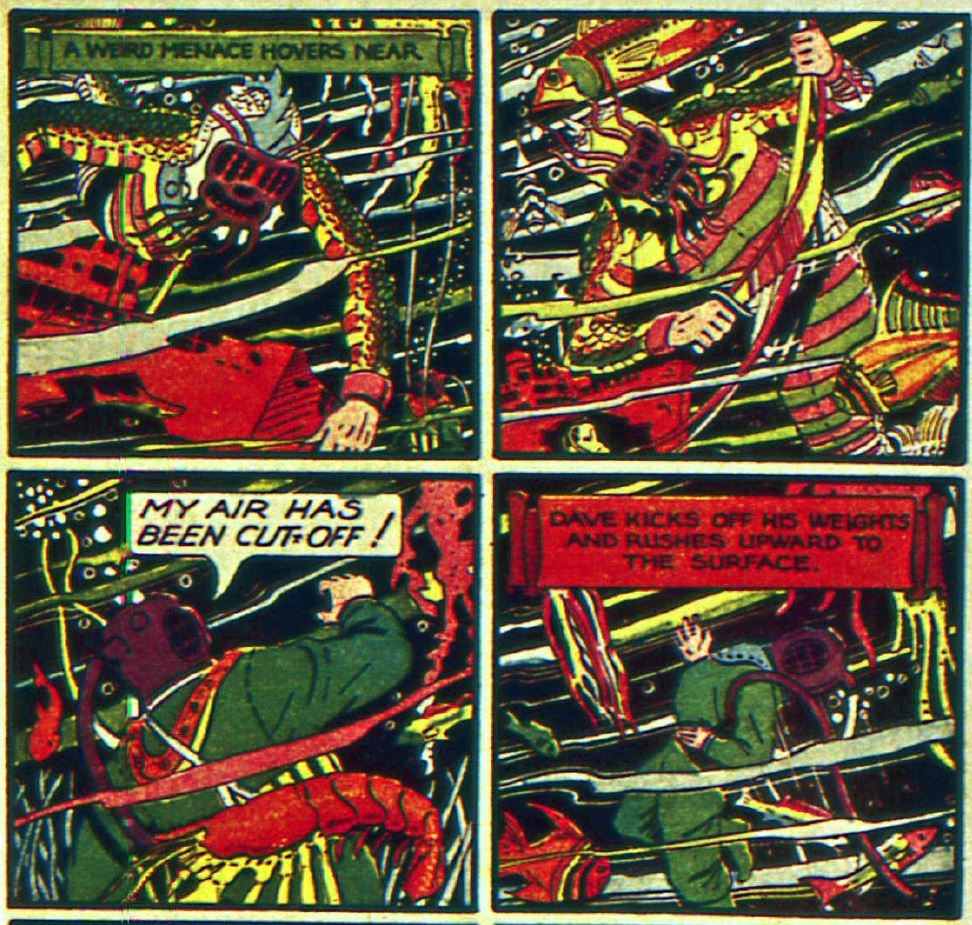
    The Devil of the Deep AKA the Deep Sea Demon AKA the Water Ghost, like the Sea-Devil before him, is a fellow who dresses up in a modified diving suit in order to scare pearl divers away from a particular oyster bed.

    Unlike the Sea-Devil, the Devil of the Deep costume is quite elaborate and convincing – you can’t, for example, clearly see the breathing apparatus strapped to his back. He’s also gone for a mermaid-style swimming setup, a frankly bold choice given that he’s theoretically killing everyone who sees him – why not have use of your legs?

    Also unlike the Sea-Devil, the Devil of the Deep has a pretty indefensible reason for his actions, in that he’s trying to scare people away from the oyster bed because that’s where all the evidence that he murdered his cousin in order to inherit the family fortune is. His lack of forward planning is everyone elses’ problem, apparently.

    (this is a good skeleton)

    UPDATE May 2024: this story originally appeared in Centaur comic Funny Pages v2 001, 1937, with a less-fun colouring job. The monster suit was a very disappointing grey throughout.