The Curse of Skeleton Munroe

Category: Dell

  • MINOR SUPER-HERO ROUND-UP 099

    Super-heroes. Like heroes, but super.

    Captain Midnight:

    Like the second, more popular (though still pretty obscure) Captain Midnight that will be published by Fawcett starting in 1942, this fellow is an adaptation of the radio character, and unlike the second Captain Midnight, this one is a pretty direct adaptation. It’s a bit abbreviated and you kind of have to keep referring to the Captain Midnight Wikipedia page to fill in the gaps where your assumed familiarity with the radio show lies, but it’s all there:

    Captain Midnight is an otherwise-unnamed pilot who gets his nickname after returning on the stroke of 12 after completing a secret mission to prevent Paris from being captured by the Germans during World War One. In the present day (1941) he is recruited to head a secret counter-espionage unit called the Secret Squadron by a mysterious government official who is implicitly Franklin Delano Roosevelt in disguise. 

    The Secret Squadron has hidden airbases and headquarters all over the United States and is comprised of a horde of agents referred to by alphanumeric designations starting at SS-1 (Captain Midnight) up to at least SS-85 (the guy who runs the elevator in one of the bases). The “SS” part of the names is quietly changed to “SQ” once the US enters WWII, but I don’t think that this comic book adaptation goes on long enough for that to be a concern.

    Finally, Captain Midnight’s flying clock insignia is very fun. (The Funnies 057, 1941)

    Categorized in: Generica (Captains), Locations (Temporal Locations), Origins (WWI Vets)

    the Great Zarro:

    The Great Zarro is otherwise nameless adventurer with the power of flight. He is also one of the most bland super-heroes in the history of the medium, personality-wise.

    A former circus acrobat, the Great Zarro lost his job, fiance and friends when a gang of extortionists burned the whole circus down and killed everyone but Rags, his lover’s kid brother. The two swear an eternal war on crime and Zarro gains his ability to fly by consuming some magical herbs given to him by the circus fortune teller, who was just good enough to fortell that he would need them but evidently failed to see why. 

    There are precisely two interesting things about this character: Firstly, that as a circus acrobat he was known as Eagle Man, while as a flying super-hero he goes by the Great Zarro. That’s a fun little inversion of naming conventions!

    Secondly, there’s Rags. Rags is an example of something that you occasionally get with comic relief characters, where they and only they are rendered as a full cartoon while everyone else is in a comic book. This is a particularly egregious clash of styles in a comic as full of stiff, human-proportioned figures as “The Great Zarro,” rendering Rags more of a figure of horror than comedy. Rags finally becomes a real boy in the third and final Zarro adventure, but it’s too little too late. (Great Comics 001, 1941)

    Categorized in: Day Jobs (Circus Acrobats), Language (Superlatives (Greats)), Powers (Flight)

    Madame Strange:

    On the one hand, Madame Strange is pretty great: she’s at least somewhat super fast and super strong, will throw a knife at the drop of a hat and prevents the Japanese destruction of Pearl Harbor in November 1941 (though not the one in December). Just like Ripley in Alien, she is an example of a character not being written as a “girl-version” of a default-male archetype but simply as that archetype, which is basically always the more entertaining option.

    On the other hand, Madam Strange suffers from the same lack of depth – including any sort of backstory – as so many of her peers. Sure she can throw a knife into a goon from a city block away, but is that enough? I also do not care for the combination of red top, pale blue bottoms, aesthetically.  (Great Comics 001, 1941)

    Categorized in: Abstract Concepts (Strangeness), Genrica (Madames), Powers (Enhanced Strength and Speed) 

    the Green Mask and Domino the Miracle Boy **Update**:

    I am reasonably certain that this is the first time that Domino is given a first name. Don! He’s Don! (Green Mask v1 006, 1941)

    The same issue that Don gets his name also marks the introduction of the Green Mask’s expanded supporting cast. Joining his reporter pal News Blake are heiress/ love interest Olivia Tracey and her chauffeur Peters, who serves as comic relief thanks to his two character traits of “enthusiastic tinkerer” and “very clumsy and hapless.” (Green Mask v1 006, 1941)

    I can’t find anywhere that it’s explicitly stated (which may be exacerbated by the fact that the only copy of this issue that I can find is missing 8 pages or so) but by Green Mask v1 008 Olivia Tracey seems to explicitly know that Michael Shelby and the Green Mask – and by extension Don and Domino – are the same.
  • ALIENS AND SO FORTH ROUND-UP 050

    ALIENS AND SO FORTH ROUND-UP 050

    All these fictional aliens and we don’t even get one other inhabited planet in our solar system.

    Moon-Men:

    These Moon-Men are encountered by Phantasmo (seen here in his less-nude human identity) and his pal Whizzer McGee during an impromptu trip to the Moon. They live deep beneath the satellite’s surface and appear to have a mining-based culture that is pretty hostile to outsiders, and that is all we know. While I must commend the “Phantasmo” team for not automatically making every alien race fluent English speakers or gifted telepaths, it does make for a more limited mode of storytelling. “Why are the Moon-Men mad at us, Phantasmo?” “No idea.” (The Funnies 060, 1941)

    Inhabitants of Ru:

    These very humanoid Martians are encountered by Flint Baker and his convict crew upon making the historic first second rocket voyage to Mars. They very specifically inhabit Ru, which is either the name of their country or the entire Light Side of Mars, and are a peaceful society in that sci-fi way that means that they are completely unable to deal with threats. Flint is thus required to save them from both the Earthman Sarko (late of the actual first manned mission to Mars) and then the diabolical Creature and his monster. (Planet Comics 001, 1940)

    One-Eyed Monster Men of Mars: 

    And speaking of Sarko, his plan to conquer Ru revolves around the One-Eyed Monster Men who inhabit the (non-existent) Dark Side of Mars. Though they are intensely fun-looking creatures, the One-Eyed Monster Men don’t get a lot of character development in the course of the story due to being mere foot soldiers and also possibly mind controlled.  (Planet Comics 001, 1940)

    Martians:

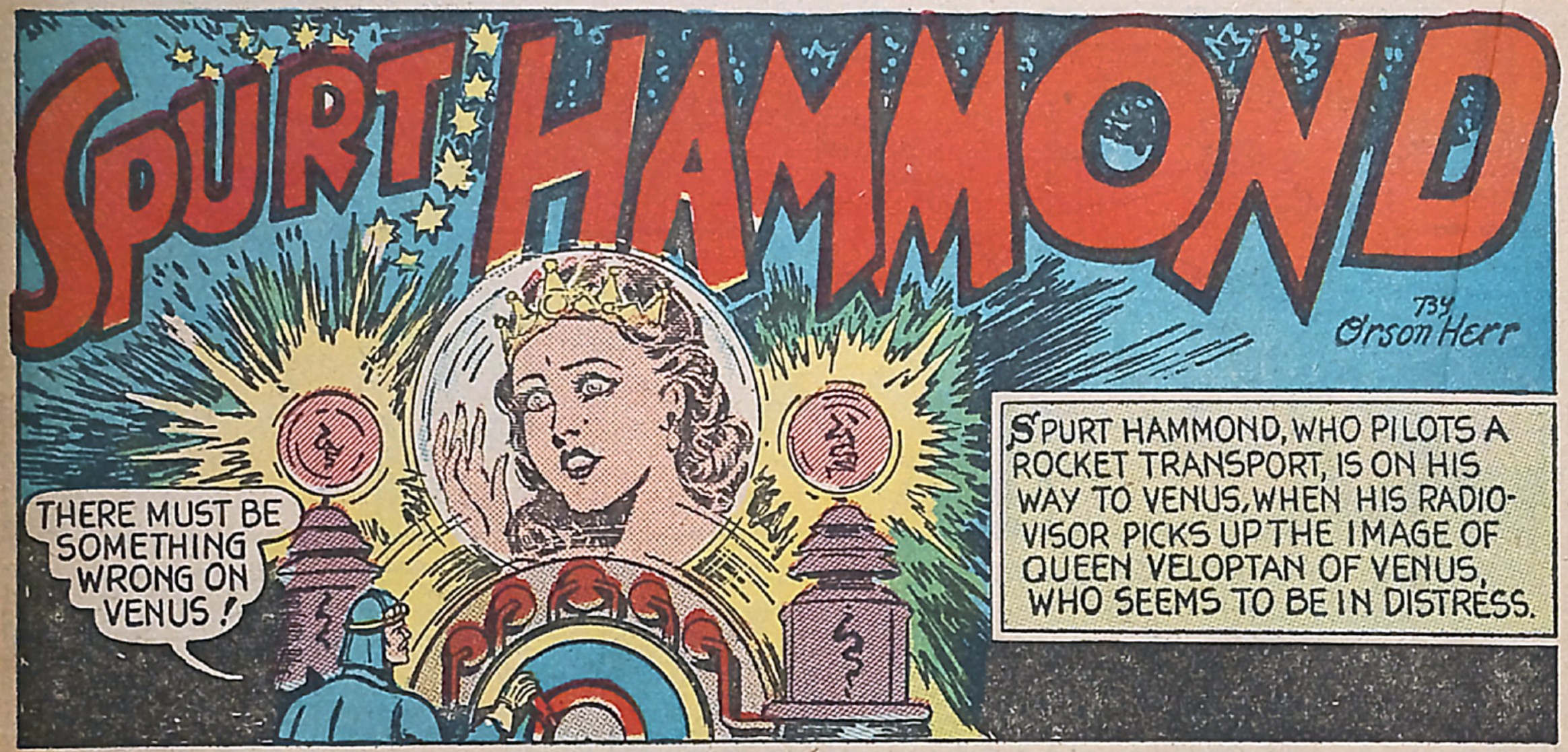
    As the “Spurt Hammond, Planet Flyer” series is at least initially set in the year 40 000 CE, there is a strong possibility that both the Martian and Venusian peoples pictured above are descended from some long-ago human colonists. Heck, that might just be the best backstory to explain a planet of warlike Martians or of peaceful Venusians who name their kids things like “Amoura:” because they have built their societies around the cultural assumptions and legends that tie into their planets. (Planet Comics 002, 1940)

    Despite the fact that Spurt Hammond managed to resolve the conflict between Prince Khangiz of Mars and Queen Amoura, Venus was clearly subject to some sort of political upheaval because just four issues later the planet is ruled by Queen Veloptan. Perhaps Amoura was determined to be just a bit to on-the-nose, even for Venus. (Planet Comics 006, 1940)

    Venus is another one of those conflict-averse pacifist societies, and just two issues later they are turning to Spurt Hammond once more. This time the entire planet is swiftly becoming uninhabitable and the population are forced to become refugees, prompting this array of Plutonian, Saturnian and Jovian rulers doing their best impressions of WWII 20th Century most world leaders throughout modern history. And as a bonus: a new Martian leader named Kaga! (Planet Comics 008, 1940)

  • MINOR SUPER-HERO ROUND-UP 098

    We’ve got no time for major super-heroes around here. We’re too busy with the minor ones.

    the Black Ace:

    The Black Ace, aka Captain McRae, is yet another American pilot serving in the RAF in advance of the US entrance into WWII. As such, he is not only a highly accomplished pilot and bombardier but fully versed in the arts of prison escape, hand-to-hand combat, impersonating German soldiers and leaping from plane to plane in mid-flight. (Four Favorites 002, 1941)

    Categorized in: Activities (Cards), Colours (Black), Team Memberships (RAF)

    Phantasmo **Update**:

    The thing about Phantasmo is that he does all of his super-heroing while in his super-huge astral form, and I guess that I had somehow gotten the impression that most of his powers were tied to that form, because I while reading his 1941 run of adventures I kept being surprised when he would do something like heal an old man (The Funnies 052) or kill a bunch of guys with a giant fish while in Phil Anson form (The Funnies 051). 

    I guess it’s pretty convenient to have the option of being an invulnerable giant but that getting your mortal hands dirty lends a certain thrill to the crimefighting – that’s probably why he tolerates the poor standard of care that he gets from Whizzer McGee as he guards the unconscious Anson-body, hey?

    In The Funnies 061, Phantasmo and Whizzer witness the murder of a crooked FBI filing clerk named Ted Bart and, partially because they are touched by his dying confession (“I only blackmailed a gang boss-turned politician to help my sister, honest!”) and partially due to this desire for more action in his life (life as an FBI filing clerk v. action packed), Phantasmo takes over his identity. The series ends before this development pays off beyond giving Phantasmo a few crime leads, but it’s still an interesting turn for the character to take.

    Whizzer McGee:

    Phantasmo’s young friend Whizzer McGee does not really qualify as a sidekick most if the time. He’s more of an employee, really, who watches over Phil Anson’s unconscious body while his mind is out terrorizing criminals. And he’s not even good at it! Whizzer and the body are always getting into scrapes because of Whizzer’s incompetence (and also because Phil is very bad at picking a convenient place to leave his mortal coil, in all fairness).

    Despite this, Phantasmo gives Whizzer McGee the opportunity to be a real-deal super-powered guy when he has to go out of town for a few days, in the form of an amulet that gives him invulnerability and super strength. I can only assume that Phil was worried that Whizzer would immediately walk out into traffic if someone wasn’t around to tell him not to and was trying to bump up the likelihood of his survival a bit.  

    Whizzer screws it all up of course – not only does he lose the amulet by trying to capture a smuggling gang single-handed, but he spills Phantasmo’s secrets – including his secret identity and home address! – to the gang boss after he does a low-effort impression of an FBI agent. Surprisingly, this leads to absolutely no consequences going forward: Whizzer keeps his job, the amulet doesn’t end up in the wrong hands… it’s not even a factor in Phantasmo changing secret identities. (The Funnies 056, 1941)

    Categorized in: Accessories (Amulets), Origins (Sidekicks)

    the Black Knight **Update**:

    In our initial look at the Black Knight, we spent a lot of time trying to nail down exactly when the series is supposed to take place, and we are not backing down from that challenge. We have determined that he lived in at least the early 12th Century CE, which the presence of Canterbury Cathedral (looking much as it does today, a form it took after being rebuilt and refurbished in the 11th and 12th Centuries) supports. This is comforting! All of our hard work paid off! Hold on to that feeling for a little while.

    The firmly 12th Century Black Knight’s 1941 adventures continue much as they had in 1940: the Black Knight travels the land slaying villains in the name of Good King Victor. Things get a bit less episodic with the introduction of a mysterious ring that the Knight is given by the King in The Funnies 053, that is then revealed to contain some mysterious drugs in issue 054.

    The Funnies 053 also introduces Peter, an archer who begins travelling with the Black Knight after helping him slay some bandits. He’s very serious about being a sidekick, is Peter.

    So we have: a reasonably firm grasp on the time period, an ongoing plot hook and a new friend. All of which is dumped in the trash as of The Funnies 055-056, when Good King Victor falls victim to an illness with only one known cure, a drug that is only available in Egypt.

    The ring is completely forgotten until the Black Knight need to escape a prison guard and the mysterious drugs turn out to be knockout drops. Peter is technically still around to the end, but he and the other members of the Black Knight’s party are all dressed like desert nomads and usually end up tagging behind him on camelback rather than actually participating in the story. As for the 12th Century… the artist’s vision of what Medieval North Africa looked like was not quite as precisely calibrated as it was for Medieval England, and so we start getting things like hookahs (15th-16th Century and even then in India) almost immediately.

    The transition to Egypt does come with a pretty good alternate costume unlock for the Black Knight, though there are also some weird Jesus overtones. (The Funnies 059)

    The Black Knight’s plan to get the drug involves appealing directly to the Queen of Egypt for aid, which is appropriate, as she is from the same lineage of fictional monarchs as Good King Victor. In actuality, Egypt was in the hands of a series of Muslim dynasties from the 650s through to the 1500s when the Ottomans took it. The plotters above, meanwhile, are all from Sudan, which was Nubian-controlled and matrilineal at the time, so the misogyny is weird.

    Once the Queen actually shows up (The Funnies 061) it is pretty clear that she is based on Cleopatra (died 30 BC), which is fine. One huge anachronism is much easier to deal with than a million mild ones, after all. The Black Knight is clearly set in an alternate timeline or a human zoo built by aliens with poor research skills.

    Finally, the Egyptian odyssey introduces a love interest for the Black Knight in the form of a Persian (?) woman named Zellah who he rescues from a harem in The Funnies 057. There isn’t too much to this relationship – it’s just kind of nice. The Black Knight does get this sick scorpion amulet from her, but it’s just before she and the Queen of Egypt are kidnapped in a cliffhanger ending that is never resolved, so overall, it’s a bummer.

  • MINOR SUPER-HERO ROUND-UP 098

    We’ve got no time for major super-heroes around here. We’re too busy with the minor ones.

    the Black Ace:

    The Black Ace, aka Captain McRae, is yet another American pilot serving in the RAF in advance of the US entrance into WWII. As such, he is not only a highly accomplished pilot and bombardier but fully versed in the arts of prison escape, hand-to-hand combat, impersonating German soldiers and leaping from plane to plane in mid-flight. (Four Favorites 002, 1941)

    Categorized in: Activities (Cards), Colours (Black), Team Memberships (RAF)

    Phantasmo **Update**:

    The thing about Phantasmo is that he does all of his super-heroing while in his super-huge astral form, and I guess that I had somehow gotten the impression that most of his powers were tied to that form, because I while reading his 1941 run of adventures I kept being surprised when he would do something like heal an old man (The Funnies 052) or kill a bunch of guys with a giant fish while in Phil Anson form (The Funnies 051). 

    I guess it’s pretty convenient to have the option of being an invulnerable giant but that getting your mortal hands dirty lends a certain thrill to the crimefighting – that’s probably why he tolerates the poor standard of care that he gets from Whizzer McGee as he guards the unconscious Anson-body, hey?

    In The Funnies 061, Phantasmo and Whizzer witness the murder of a crooked FBI filing clerk named Ted Bart and, partially because they are touched by his dying confession (“I only blackmailed a gang boss-turned politician to help my sister, honest!”) and partially due to this desire for more action in his life (life as an FBI filing clerk v. action packed), Phantasmo takes over his identity. The series ends before this development pays off beyond giving Phantasmo a few crime leads, but it’s still an interesting turn for the character to take.

    Whizzer McGee:

    Phantasmo’s young friend Whizzer McGee does not really qualify as a sidekick most if the time. He’s more of an employee, really, who watches over Phil Anson’s unconscious body while his mind is out terrorizing criminals. And he’s not even good at it! Whizzer and the body are always getting into scrapes because of Whizzer’s incompetence (and also because Phil is very bad at picking a convenient place to leave his mortal coil, in all fairness).

    Despite this, Phantasmo gives Whizzer McGee the opportunity to be a real-deal super-powered guy when he has to go out of town for a few days, in the form of an amulet that gives him invulnerability and super strength. I can only assume that Phil was worried that Whizzer would immediately walk out into traffic if someone wasn’t around to tell him not to and was trying to bump up the likelihood of his survival a bit.  

    Whizzer screws it all up of course – not only does he lose the amulet by trying to capture a smuggling gang single-handed, but he spills Phantasmo’s secrets – including his secret identity and home address! – to the gang boss after he does a low-effort impression of an FBI agent. Surprisingly, this leads to absolutely no consequences going forward: Whizzer keeps his job, the amulet doesn’t end up in the wrong hands… it’s not even a factor in Phantasmo changing secret identities. (The Funnies 056, 1941)

    Categorized in: Accessories (Amulets), Origins (Sidekicks)

    the Black Knight **Update**:

    In our initial look at the Black Knight, we spent a lot of time trying to nail down exactly when the series is supposed to take place, and we are not backing down from that challenge. We have determined that he lived in at least the early 12th Century CE, which the presence of Canterbury Cathedral (looking much as it does today, a form it took after being rebuilt and refurbished in the 11th and 12th Centuries) supports. This is comforting! All of our hard work paid off! Hold on to that feeling for a little while.

    The firmly 12th Century Black Knight’s 1941 adventures continue much as they had in 1940: the Black Knight travels the land slaying villains in the name of Good King Victor. Things get a bit less episodic with the introduction of a mysterious ring that the Knight is given by the King in The Funnies 053, that is then revealed to contain some mysterious drugs in issue 054.

    The Funnies 053 also introduces Peter, an archer who begins travelling with the Black Knight after helping him slay some bandits. He’s very serious about being a sidekick, is Peter.

    So we have: a reasonably firm grasp on the time period, an ongoing plot hook and a new friend. All of which is dumped in the trash as of The Funnies 055-056, when Good King Victor falls victim to an illness with only one known cure, a drug that is only available in Egypt.

    The ring is completely forgotten until the Black Knight need to escape a prison guard and the mysterious drugs turn out to be knockout drops. Peter is technically still around to the end, but he and the other members of the Black Knight’s party are all dressed like desert nomads and usually end up tagging behind him on camelback rather than actually participating in the story. As for the 12th Century… the artist’s vision of what Medieval North Africa looked like was not quite as precisely calibrated as it was for Medieval England, and so we start getting things like hookahs (15th-16th Century and even then in India) almost immediately.

    The transition to Egypt does come with a pretty good alternate costume unlock for the Black Knight, though there are also some weird Jesus overtones. (The Funnies 059)

    The Black Knight’s plan to get the drug involves appealing directly to the Queen of Egypt for aid, which is appropriate, as she is from the same lineage of fictional monarchs as Good King Victor. In actuality, Egypt was in the hands of a series of Muslim dynasties from the 650s through to the 1500s when the Ottomans took it. The plotters above, meanwhile, are all from Sudan, which was Nubian-controlled and matrilineal at the time, so the misogyny is weird.

    Once the Queen actually shows up (The Funnies 061) it is pretty clear that she is based on Cleopatra (died 30 BC), which is fine. One huge anachronism is much easier to deal with than a million mild ones, after all. The Black Knight is clearly set in an alternate timeline or a human zoo built by aliens with poor research skills.

    Finally, the Egyptian odyssey introduces a love interest for the Black Knight in the form of a Persian (?) woman named Zellah who he rescues from a harem in The Funnies 057. There isn’t too much to this relationship – it’s just kind of nice. The Black Knight does get this sick scorpion amulet from her, but it’s just before she and the Queen of Egypt are kidnapped in a cliffhanger ending that is never resolved, so overall, it’s a bummer.

  • CATALOGUE OF WOUNDS 010

    CATALOGUE OF WOUNDS 010

    I’m beginning to think that the super-hero scene is pretty hazardous.

    the Blue Bolt: 

    The Blue Bolt’s first outing against the Green Sorceress is marred by the fact that he gets near-fatally clawed by her vulturoid monsters. (Blue Bolt v1 001, 1940)

    the Cloak: 

    Jeff Cardiff, aka the Spy-Master, aka the Spay-Chief and the future Cloak, gets a classic skull crease. On purpose! This is the way that that goon chose to knock him out! Such confidence! (Big Shot 002, 1940)

    Jeff’s choice to adopt the Cloak identity comes after his identity as a government man gets around and enemy agents start gunning for him. Specifically, they gun him in the left shoulder. Twice! (Big Shot 015, 1941)

    Being a costumed super-hero is no guarantee that you won’t be shot, however, and Jeff gets his skull creased once more on his third outing as the Cloak. (Big Shot 018, 1941)

    the Flame:

    The Flame turns off his bullet-melting heat aura for just an instant to pick up a lady in need and gets his skull creased by a bullet. (The Flame 007, 1941)

    Phantasmo:

    Phantasmo is one of the last super-heroes who one would expect to get injured, seeing as how his whole deal is supposed to be sending out a huge, invulnerable astral form to fight crime. Nevertheless, he keeps on starting adventures in his very vulnerable human body, and so he inevitably gets shot in the left shoulder. (The Funnies 061, 1941)

    Skyman:

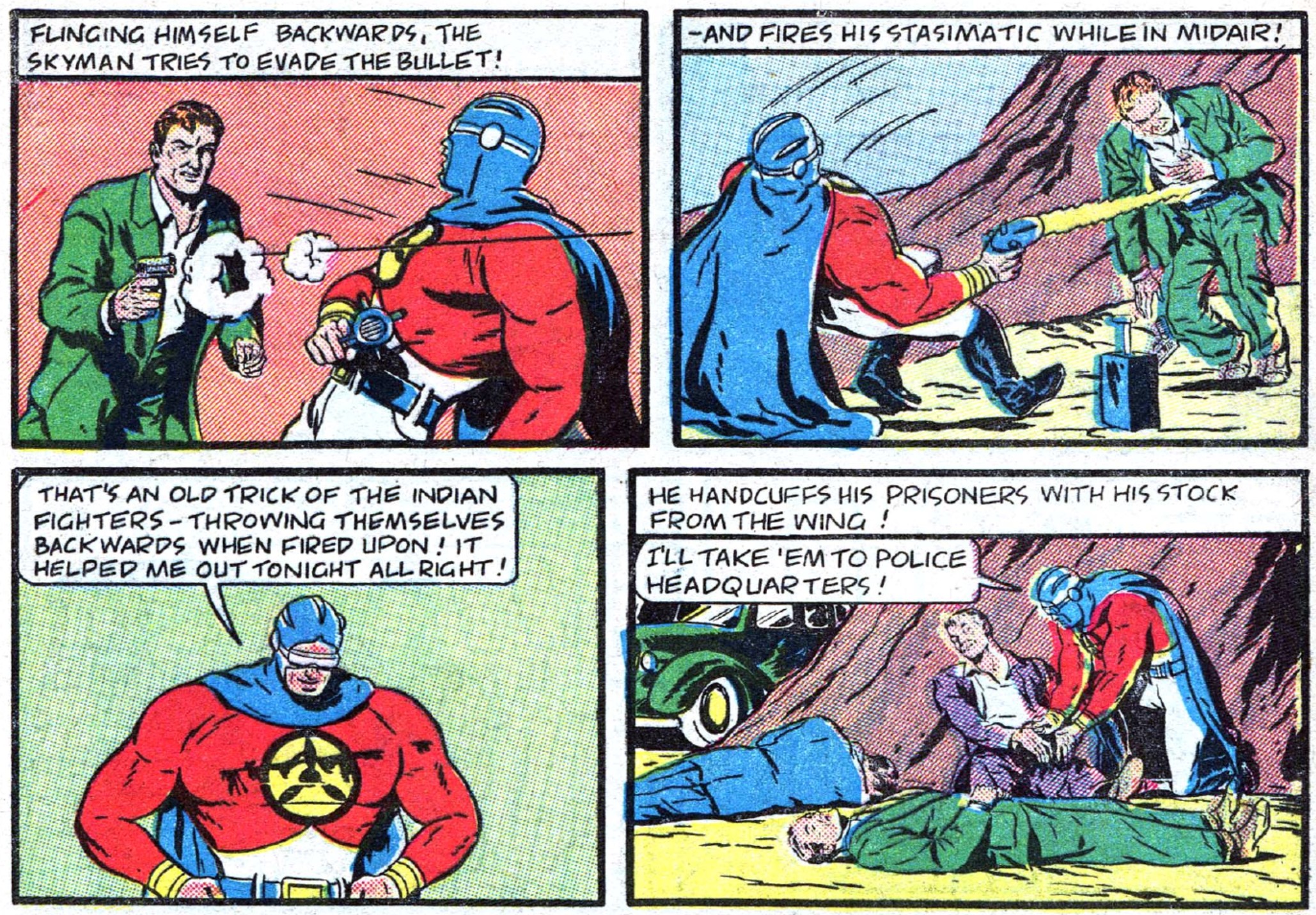
    Skyman dodges a bullet at close range – an impressive feat – but he still gets a bloody gash across his enormous chest. (Big Shot 003, 1940)

    Zanzibar the Magician:

    Zanzibar takes an arrow in the right shoulder courtesy of a dastardly Walrus Man. (Mystery Men Comics 005, 1939)

    A couple of years later but the same shoulder: Zanzibar is shot. (Mystery Men Comics 023, 1941)

     And what Golden Age super-hero goes very long without getting his head creased by a bullet? (The Flame 006, 1941)

  • REAL PERSON ROUND-UP 026

    Once again we point and go “Hey. It’s that guy.”

    Adolf Hitler:

    Captain Courageous has to deal with a few pseudo-Nazis working for Hitler-alike Hinkler. (Banner Comics 003, 1941) 

    Real Hitler takes a scheme-foiling by Vulcan pretty hard. (Four Favorites 001, 1941)

    Devil’s Island:

    Captain America and Bucky infiltrate Devil’s Island to free a prisoner who is not only a victim of carceral justice taken to unjust extremes but also as an arm of the Nazi government in France. (Captain America Comics 005, 1941)

    the Duke and Duchess of Windsor:

    The Duke of Windsor, aka the former King Edward VIII of England and his wife Wallis, Duchess of Windsor, welcome Speed Martin to the Bahamas in the Duke’s wartime role as the Governor General of that territory. (The Funnies 051, 1941)

    FDR:

    Super-American rescues the most obscured-by-shadow (and completely silent!) FDR we have yet seen from the evil Tyrannus. The usual shadowed-features treatment that he usually gets is so over the top in that it looks like the President is going to be dramatically revealed to be some sort of frog monster in the next panel. (Fight Comics 015, 1941)

    By contrast, here’s a very recognizable FDR congratulating newsreel cameraman Speed Martin on returning from Europe with some vital intel on the Axis war machine. (The Funnies 051, 1941)

    And by contrast with that, here’s “Mr Jones,” the mysterious government official who recruits Captain Midnight into his country’s service and who is heavily implied to be a disguised FDR, even though he lacks the President’s famously large head. (The Funnies 057, 1941)

    (don’t worry: someone thought about the big head issue and inflated it by The Funnies 058)

    the German-American Bund:

    Very rare appearance of the German-American Bund under it’s own name, even if the actual group was already in severe decline at the point this book was published. (Captain America Comics 005, 1941)

    Harold R. Stark:

    He’s not named, but the Chief of Naval Operations seen here sure looks like the man who held the position at the time, Harold R. Stark. Did they do a photo reference this one time? (The Funnies 055, 1941)

    Joe Dimaggio:

    “Joey Diraggio,” star player for the Brooklyn Badgers and victim of the Black Toad. (Captain America Comics 007, 1941)

    the Venus de Milo:

    The Venus de Milo is stolen by Zeus and brought back to Ancient Greece so that he can turn it into a human woman to be his wife. Zanzibar the Magician rescues the statue woman and brings her back to the present with him, but the question is never resolved: does he chop off her arms and turn her into a statue again? Is the Fox Features Universe minus one statue and plus one blonde lady? (Mystery Men Comics 002, 1939)

    Winston Churchill:

    Personally thanks Vulcan for escorting a convoy to England. (Four Favourites 001, 1941) 

  • NOTES – JUNE 2026

    Comics Crossovers:

    In one of Golden Age comics’ rare but casual crossovers, Judy Jackson, rival of reporter-hero Scoop Mason, is attending the same Governor’s ball in the Bahamas as Newsreel cameraman Speed Martin. (The Funnies 051, 1941)

    Then in the very next issue, Scoop Mason himself shows up to take in a football game! (The Funnies 052, 1941)

    ADDENDUM: I just realized that the team that they’re watching is Elmhurst College featuring star player Wally Williams, from his own feature in Popular Comics. Layers upon layers!

    the Looming Spectre of Death:

    Perhaps the most understated Looming Spectre of Death of all time, from the Philo Vance story “Murder Rings the Bell.” (The Funnies 059, 1941)

    Another, very cheeky Death, very appropriately wearing a mask. (The Funnies 062, 1941)

    Presented Without Comment: 

    (The Funnies 062, 1941)

    Honours:

    Both the Purple Zombie and Chico, creator of the Mechanized Skeleton(s) receive medals for defending an unspecified European nation from the death ray of an unspecified fascist nation, while Chico’s skeleton troops get a hero’s burial. (Reg’lar Fellers Heroic Comics 006, 1941)

  • MEDIA IN COMICS 002

    Fictional books, fictional movies, fictional stage shows: it’s media in comics time! 

    Books:

    Dexter, a friend of Ellsworth “the Sphinx” Forrester, has written a book titled Who’s Who in Murder which is one of those grand exposes that causes everyone in crimedom to attempt to kill the author before they can publish. That’s gotta be great publicity. (Exciting Comics 010, 1941)

    While Guns Make Dust is very plot relevant in this Ellery Queen mystery, as a doped-up stamp thief hides his prize in one of three copies in a local bookstore and subsequently murders several people in search of the right one, we never learn much about the book itself. I think it’s a Western, personally. (Crackajack Funnies 024, 1940)

    We learn even less about Life of Lee, the book that gives DA Tom Kerry the idea that solves a big murder case. Could this be a biography perhaps? Of Robert E. Lee? (Big Shot Comics 007, 1940)

    As we have established, there are many faux Hitlers in comics. Much more rare is the Hitler-alike who has written his own Mein Kampf analog, but such a one is Nargoff, aka the Leader, whose book The New Order is ultimately weaponized against him by the Spirit. (The Spirit, “The Leader,” 29 December, 1940)

    Magazines:

    Roving photographer Fran Frazer works for Strife magazine, an obvious play on LIFE but one which neatly justifies the action-packed lifestyle of the comic book photog. (Top-Notch Comics 009, 1940)

    Movies:

    Real-life animal trainer Clyde Beatty plays some role in the fictional film Jungle Drama, but what it is we cannot say, other than the fact that it involves a lion. (Crackajack Funnies 023, 1940)

    “Gabby Scoops” was a short-lived strip that was an awkward hybrid of goofy humour and crime action that ended after the titular hero went Hollywood and starred in the movie It’s a Scoop! (Crackajack Funnies 030, 1940)

    Shadow Devils, an espionage thriller with an unusual name, is one of those comic book movies that goes on shooting even after female lead Norda Noll is shot dead on-camera. Detective Charlie Chan eventually sorts it all out: it’s all about horse racing somehow. (Big Shot Comics 001, 1940)

    Dick Cole, aka the Wonder Boy, is roped into doing the stunts for a movie called Shining Star over his summer vacation. Interpersonal conflicts and murder attempts stretch the filming over a couple of issues, but it does eventually get made. It’s even well received, despite being an incoherent hodgepodge of action setpieces! (Blue Bolt v1 005, 1940)

    Theatre:

    Like the movie that finishes production despite death an calamity, the play that continues its run while actor after actor is killed on stage is a real staple of the Golden Age mystery comic. Espionage is such a play, albeit with only one murder and a series of near-misses as the show’s conductor fires poisoned darts out of his baton at those who he sees as standing between him and his love of the female lead. (Keen Detective Funnies v2 007, 1939)

  • MEDIA IN COMICS 001

    I’ve often mentioned how comics as a medium has a grand tradition of not using the real names for people (see about half the entries in our collection of Real Folk in comics) places (see the grand list of fictional countries on every continent of our list of Locations) and things, so I hope that it won’t surprise you when I say that they make up all the media, too. And since I have a big list of all the made-up books, newspaper columns, stage shows and movies sitting around already I figured I should share.

    Movies:

    Lover Mine (Funny Picture Stories v2 005, 1938)

    Flying Cadets, Colossal Pictures, stunts by the Four Aces (The Funnies 021, 1938)

    Star-Dust (Funny Picture Stories v3 002, 1939)

    War Eagles, Colossal Studios (Keen Detective Funnies v2 006, 1939)

    Pilots All, Mammoth Film Company (Keen Detective Funnies v2 010, 1939)

    The Mystery of the Creeping Spook, Superbo Pictures (Keen Detective Funnies v2 011, 1939)

    White Goddess (Funny Pages v3 008 1939) 

    Newspaper Columns:

    “On Broadway” by Walt “Bob Phantom” Whitney. (Blue Ribbon Comics 002, 1939)

    Plays:

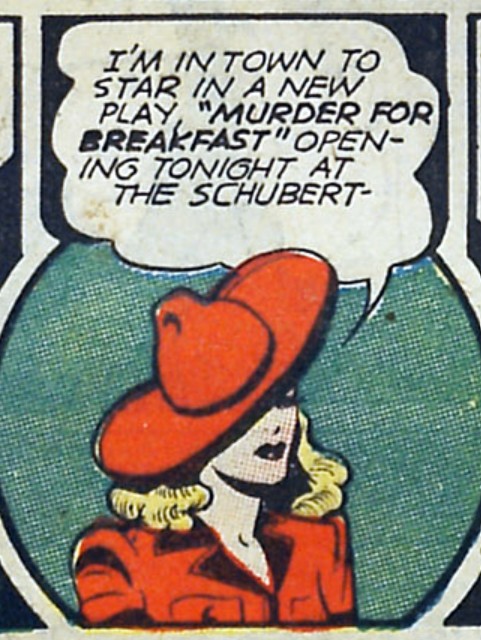
    “Murder for Breakfast”, starring Kay Kenyon, one of Presto Martin’s many Hollywood friends. (Silver Streak Comics 010, 1941)

    Songs:

    “Boogie-Woogie Blast” (Champion Comics 002, 1939)

  • MEDIA IN COMICS 001

    MEDIA IN COMICS 001

    I’ve often mentioned how comics as a medium has a grand tradition of not using the real names for people (see about half the entries in our collection of Real Folk in comics) places (see the grand list of fictional countries on every continent of our list of Locations) and things, so I hope that it won’t surprise you when I say that they make up all the media, too. And since I have a big list of all the made-up books, newspaper columns, stage shows and movies sitting around already I figured I should share.

    Movies:

    Lover Mine (Funny Picture Stories v2 005, 1938)

    Flying Cadets, Colossal Pictures, stunts by the Four Aces (The Funnies 021, 1938)

    Star-Dust (Funny Picture Stories v3 002, 1939)

    War Eagles, Colossal Studios (Keen Detective Funnies v2 006, 1939)

    Pilots All, Mammoth Film Company (Keen Detective Funnies v2 010, 1939)

    The Mystery of the Creeping Spook, Superbo Pictures (Keen Detective Funnies v2 011, 1939)

    White Goddess (Funny Pages v3 008 1939) 

    Newspaper Columns:

    “On Broadway” by Walt “Bob Phantom” Whitney. (Blue Ribbon Comics 002, 1939)

    Plays:

    “Murder for Breakfast”, starring Kay Kenyon, one of Presto Martin’s many Hollywood friends. (Silver Streak Comics 010, 1941)

    Songs:

    “Boogie-Woogie Blast” (Champion Comics 002, 1939)