The Curse of Skeleton Munroe

Category: Dell

  • MINOR SUPER-HERO ROUND-UP 053

    They really do just keep coming. 

    **Update** The Arrow:

    While the Arrow has always been portrayed as a mysterious seven-foot-tall physical prodigy, this particular adventure really goes all in on his being super-humanly strong. This seems significant somehow, even if it is is second-to-last appearance by my reckoning. (The Arrow 002, 1940)

    **UPDATE** the Flame: 

    This is the first actual version of the Flame’s origin that I’ve encountered in a comic book, so here it is. It is also the first time that I’ve encountered the notion of baby the Flame being proclaimed as the Grand High Lama. It’s a weird detail! (The Flame 001, 1940)

    Phantasmo: 

    And speaking of the ancient secrets of Tibet…

    Phantasmo! He spent 25 years in Tibet learning mystic secrets and now he’s returned to the US to mete out supernatural justice! Phantasmo! His main deal is that he can project his astral body and that in that form he is basically omnipotent! Phantasmo! He can grow, shrink, heal, kill, he is an invulnerable and infinitely strong magic man! Phantasmo! He does have one key weakness: while his astral form is out and about, his physical body is vulnerable, so teenaged Whizzer McGee tags along on his adventures to watch over it! Phantasmo!

    Thanks to a combination of an already fairly minimal costume combined with his transparent nature and some odd colour choices, Phantasmo is possibly also the nudest Golden Age super-hero, at least in his cover appearances. (The Funnies 045, 1940)

    Update 1941

    the Black Knight: 

    A young village blacksmith who first helps the Good King Victor of England when his leg is broken in a boar hunt and then goes on to foil several simultaneous attempts on the monarch’s life, the unnamed youth receives the customary reward for doing an excellent job: additional responsibilities. The Black Knight acts as a sort of state-sanctioned vigilante, rooting out evil among the chivalry of England.

    And speaking of England, the more history-minded of you might have noted that “Good King Victor of England” I mentioned as being very much not an actual British monarch. This raises the question of just when the Black Knight stories are set: it’s broadly Medieval (5th to 15th Centuries), operating under the Chivalric Code (12th to 15th Centuries), the King has a Damascus steel sword (post 10th to 11th Century), there is talk of doctors being fairly available (13th Century at earliest)… so what does all this add up to? Absolutely nothing. The Black Knight exists in a pastiche of knight-haunted England that is as historical as your average retelling of the Arthurian mythos, and in fact the whole thing would be a lot neater if Victor were actually Arthur. We must work with what we have, I suppose. (The Funnies 046, 1940) 

    ADDENDUM: I wrote this before I had read the last couple of Black Knight stories for 1940, and immediately after posting it I cracked open The Funnies 049, featuring a tale in which the Black Knight helps defend Cornwall (becomes part of England proper around the 10th to 11th Century) from a force of Huns (4th to 6th Centuries) and their enslaved Viking (8th to 11th Centuries) crew, and let me tell you I was relieved.

    Update 1941 

  • ALIENS AND SO FORTH ROUND-UP 004

    Now’s the time that we start pulling aliens from the vaults! So look out for a lot of A-names for the next while! Not the first one though, because something has to come up organically.

    Crillionites:

    Hailing from the planet Crillon (which boasts the majestic Crillion City, natch), the Crillionites are a caste-based society in which the Lords of Crillon (like from the title of the comic!) rule over a slave population via some sort of divine right. This societal order is threatened by Professor Wendall Keene and his crew of space explorers: Hugh, Celeste, and the also-titular Ken Craig, but whether this is due to some innate sense of justice on their part or for some other reason is never quite spelled out in their one extant appearance, as things start in media res and Mort Cowen there presumably thought he could go back and explain what was going on a bit later. No dice, Mort. (Circus, the Comics Riot 001, 1938)

    the Ancient Ones: 

    It’s that old staple of adventure, the ancient hidden civilization! Not all of them are different enough from regular humanity to qualify as an Alien and So Forth, but I reckon a society of prehistoric Antarcticans who retreated underground when the ice crept across their lands and have indefinite lifespans must surely count. The Ancient Ones are kind of boringly benevolent, but they do have a lot of gold, which inspires hero Rocky Ryan’s crew to mutiny and thus provides a bit of excitement.

    This also allows the Ancient Ones to show off their somewhat ghoulish hobby: collecting gold-hungry adventurers in suspended animation. Or possibly practicing human taxidermy. (Big Shot Comics 009, 1940)

    Antarenes: 

    The Antarenes, inhabitants of the planet Antar, have a problem: their sun has gone out. Their solution? Head underground and set out through the void of space with their whole dang planet to find a new one. Unfortunately for Earth, rather than one of the presumably many uninhabited stars in the galaxy the Antarenes have chosen Earth’s orbit as the coziest place to pull up their planet, and the Earth is just going to have to move out of the way (and into the Sun), whether they like it or not. Fortunately for Earth, Marvo 1○2 Go+ is on the case and Antar is rerouted back out of the Solar System to find somewhere elese to park.

    One small detail that I appreciate about the Antarenes: as a society that seems to mimic the eusocial nature of our world’s ants they of course have a Queen but we never see her, for the simple reason that she is way too important to let two weird randos just rock up and meet with her. (Superworld Comics 003, 1940)

    the Ants:

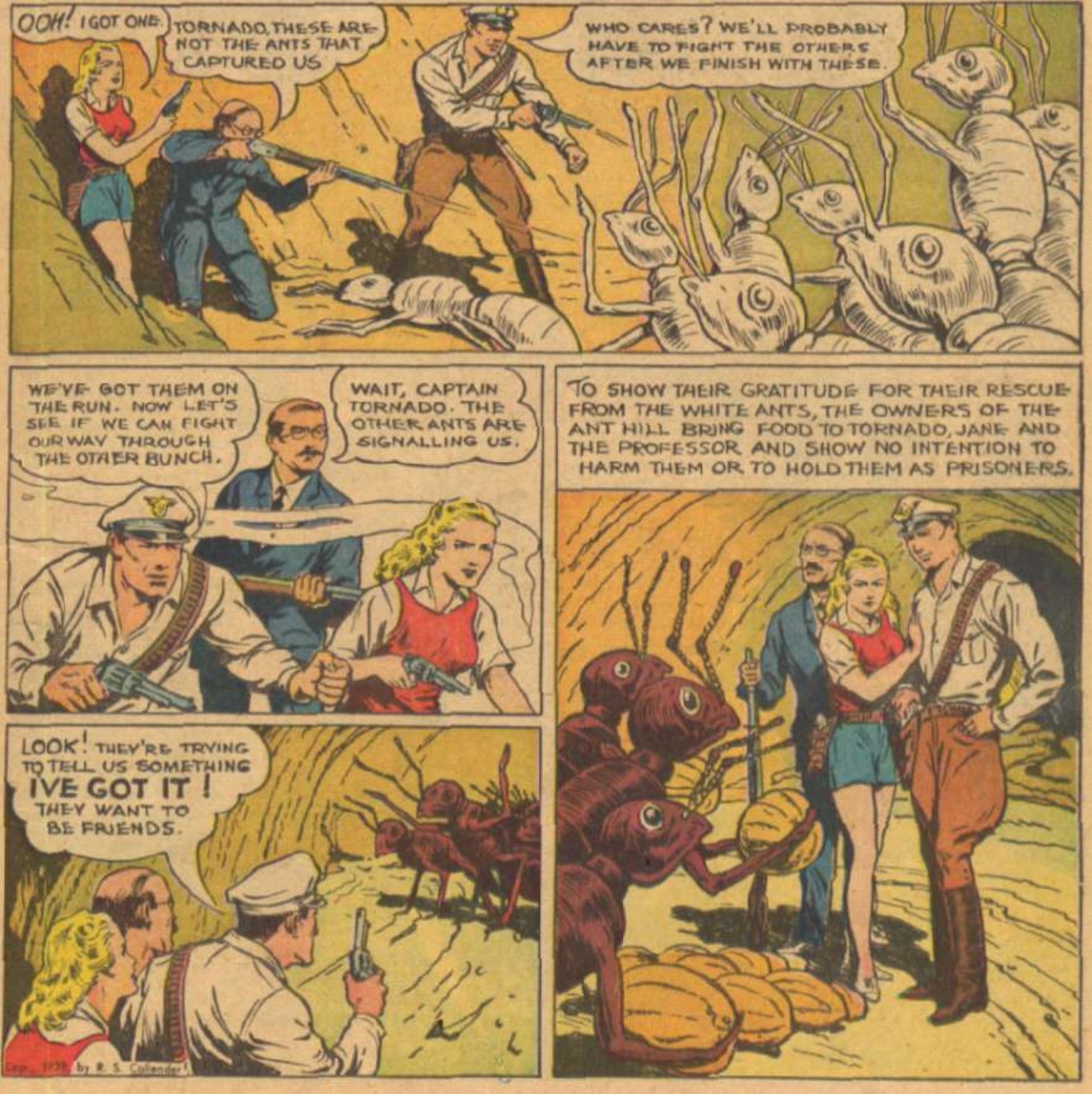
    Captain Tornado, along with Professor Bordani and his daughter Jane, are stranded on the extrasolar planet Barrang. They meet and shoot a variety of intelligent aliens while there, the first of which are these giant alien ants, who don’t figure too heavily into the plot but who do engage in intraspecies warfare and melon farming. (Popular Comics 046, 1939)

  • ALIENS AND SO FORTH ROUND-UP 004

    ALIENS AND SO FORTH ROUND-UP 004

    Now’s the time that we start pulling aliens from the vaults! So look out for a lot of A-names for the next while! Not the first one though, because something has to come up organically.

    Crillionites:

    Hailing from the planet Crillon (which boasts the majestic Crillion City, natch), the Crillionites are a caste-based society in which the Lords of Crillon (like from the title of the comic!) rule over a slave population via some sort of divine right. This societal order is threatened by Professor Wendall Keene and his crew of space explorers: Hugh, Celeste, and the also-titular Ken Craig, but whether this is due to some innate sense of justice on their part or for some other reason is never quite spelled out in their one extant appearance, as things start in media res and Mort Cowen there presumably thought he could go back and explain what was going on a bit later. No dice, Mort. (Circus, the Comics Riot 001, 1938)

    the Ancient Ones: 

    It’s that old staple of adventure, the ancient hidden civilization! Not all of them are different enough from regular humanity to qualify as an Alien and So Forth, but I reckon a society of prehistoric Antarcticans who retreated underground when the ice crept across their lands and have indefinite lifespans must surely count. The Ancient Ones are kind of boringly benevolent, but they do have a lot of gold, which inspires hero Rocky Ryan’s crew to mutiny and thus provides a bit of excitement.

    This also allows the Ancient Ones to show off their somewhat ghoulish hobby: collecting gold-hungry adventurers in suspended animation. Or possibly practicing human taxidermy. (Big Shot Comics 009, 1940)

    Antarenes: 

    The Antarenes, inhabitants of the planet Antar, have a problem: their sun has gone out. Their solution? Head underground and set out through the void of space with their whole dang planet to find a new one. Unfortunately for Earth, rather than one of the presumably many uninhabited stars in the galaxy the Antarenes have chosen Earth’s orbit as the coziest place to pull up their planet, and the Earth is just going to have to move out of the way (and into the Sun), whether they like it or not. Fortunately for Earth, Marvo 1○2 Go+ is on the case and Antar is rerouted back out of the Solar System to find somewhere elese to park.

    One small detail that I appreciate about the Antarenes: as a society that seems to mimic the eusocial nature of our world’s ants they of course have a Queen but we never see her, for the simple reason that she is way too important to let two weird randos just rock up and meet with her. (Superworld Comics 003, 1940)

    the Ants:

    Captain Tornado, along with Professor Bordani and his daughter Jane, are stranded on the extrasolar planet Barrang. They meet and shoot a variety of intelligent aliens while there, the first of which are these giant alien ants, who don’t figure too heavily into the plot but who do engage in intraspecies warfare and melon farming. (Popular Comics 046, 1939)

  • MINOR SUPER-VILLAIN 805: THE GREAT ONE

    (The Funnies 042, 1940)

    I had great hopes for the Great One, a pirate captain so mysterious that he wears a full-face hood (with nostril holes! The rarest hood hole!) even while hanging out on his own South Pacific island inhabited solely by his own fanatical crew. The black skull insignia alone inspired me to hope that there might be some fun mystery behind that hood for Bruce McKay, formerly Sky Master but now Sky Ranger, to solve when he and his companions are captured by one of the Great One’s lieutenants. 

    Alas, such is not the case. Bruce is pressed into service as a scout pilot for the Great One’s fleet and quickly betrays him to the first freighter captain he sees. His fleet is blown up thanks to the fact that the freighter in question was hauling a load of hand grenades and the Great One himself dies ignominiously and still masked, in a fall from a cliff. I should have known it was all over when they didn’t bother to colour his robe in the second issue.

  • NOTES – JUNE 2025

    NOTES – JUNE 2025

    Letters to the Editor: 

    I rag on Novelty Press and their horrible and possibly fictional readership every chance I get, but I think I need to start presenting the letters they print in their comics so that I have some evidence to back up my grumbling. Here’s Clarence Pool of Seattle Washington advocating for the nice sensible adventures of an Army Air Force cadet who manages to foil a Fifth Column plot ever week over the exploits of a magic robot. (Target Comics v1 011, 1940)

    Skeletons with Jobs: 

    Driver is a job, certainly. Onto the pile! (The Funnies 047, 1940) 

    Honours: 

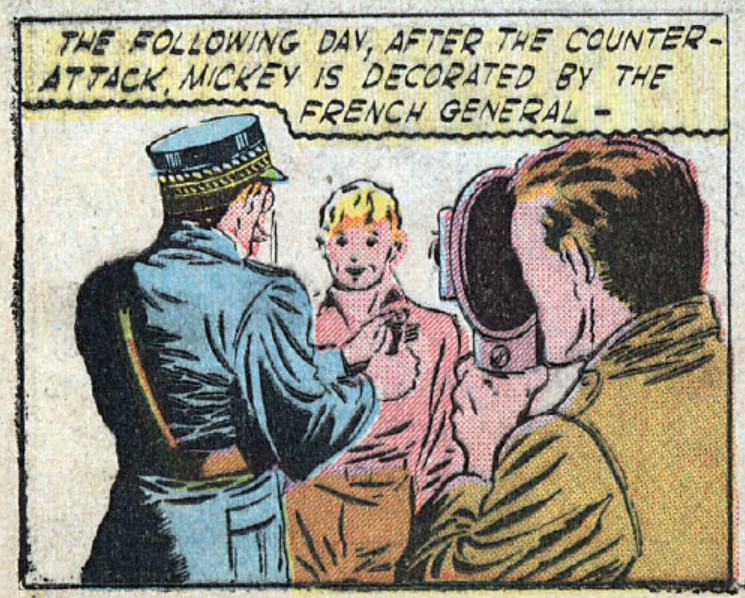
    Mickey Kelly, sidekick to swashbuckling newsreel cameraman Speed Martin, gets a medal from the French Army for foiling a spy. (The Funnies 048, 1940)

    Two issues later Mickey Riley (they forgot that he already had a last name, it seems) is decorated by the British for saving Gibraltar from the Axis. (The Funnies 050, 1940)

    Heroes Going to Costume Parties as Themselves: 

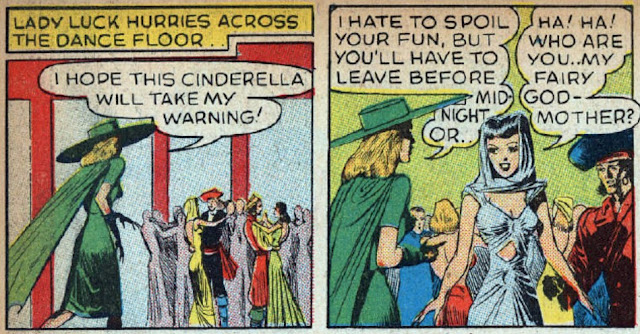
    Brenda Banks attends the Grand Costume Ball as Lady Luck, in an attempt to save a life. (The Spirit Section, “The Cinderella Murder Case”, 28 July, 1940)

    Mr Mystic also attends a costume party as himself in 1940, and a guy with no secret identity doing this might just be the most baffling thing I’ve read today, and this is the episode in which Mystic’s fiance is seduced by Death. (The Spirit Section, 22 December, 1940)

    Cops Shooting at Fleeing Suspects: 

    Sure, the Spirit has just confessed to a murder he did not commit for complicated reasons, but forgive me if I don’t agree with Mayor Aldrich here that that means that Commissioner Dolan has free license to shoot him in the back. (The Spirit “Eldas Thayer”, 21 July, 1940) 

    Interior Decoration: 

    This child’s ducky bed is just barely charming and not eerie. (The Spirit Section, 1 December, 1940) 

  • NOTES – JUNE 2025

    NOTES – JUNE 2025

    Letters to the Editor: 

    I rag on Novelty Press and their horrible and possibly fictional readership every chance I get, but I think I need to start presenting the letters they print in their comics so that I have some evidence to back up my grumbling. Here’s Clarence Pool of Seattle Washington advocating for the nice sensible adventures of an Army Air Force cadet who manages to foil a Fifth Column plot ever week over the exploits of a magic robot. (Target Comics v1 011, 1940)

    Skeletons with Jobs: 

    Driver is a job, certainly. Onto the pile! (The Funnies 047, 1940) 

    Honours: 

    Mickey Kelly, sidekick to swashbuckling newsreel cameraman Speed Martin, gets a medal from the French Army for foiling a spy. (The Funnies 048, 1940)

    Two issues later Mickey Riley (they forgot that he already had a last name, it seems) is decorated by the British for saving Gibraltar from the Axis. (The Funnies 050, 1940)

    Heroes Going to Costume Parties as Themselves: 

    Brenda Banks attends the Grand Costume Ball as Lady Luck, in an attempt to save a life. (The Spirit Section, “The Cinderella Murder Case”, 28 July, 1940)

    Mr Mystic also attends a costume party as himself in 1940, and a guy with no secret identity doing this might just be the most baffling thing I’ve read today, and this is the episode in which Mystic’s fiance is seduced by Death. (The Spirit Section, 22 December, 1940)

    Cops Shooting at Fleeing Suspects: 

    Sure, the Spirit has just confessed to a murder he did not commit for complicated reasons, but forgive me if I don’t agree with Mayor Aldrich here that that means that Commissioner Dolan has free license to shoot him in the back. (The Spirit “Eldas Thayer”, 21 July, 1940) 

    Interior Decoration: 

    This child’s ducky bed is just barely charming and not eerie. (The Spirit Section, 1 December, 1940) 

  • MINOR SUPER-VILLAIN 773: CAPTAIN DEATH

    (Super Comics 027, 1940)

    Pirate Captain Death comes into conflict with Jim Ellis and his brother Bud when the former, a dead ringer for Death, is shanghaied by the slightly less villainous Captain “Iron” Shard in an attempt to bluff his way onto Death’s Forbidden Island headquarters and steal his treasure.

    This “identical hero/villain duo” situation is hardly unprecedented in fiction, and there are broadly two ways that it plays out. In the first, the villain is not so bad as their reputation might suggest, and things play out like a classic comedy of errors. This is the other way, in which the villain is so over the top and evil that looking like him is almost a moral challenge to the hero.

    After being talked up as an evil dude for a fair number of issues, our first look at Captain Death is when he sails into the comic just as Jim Ellis and Captain Shard have come to terms and are about to leave for less perilous climes. Captain Death sets the tone by immediately sinking Shard’s ship and picking off the swimming survivors with a rifle. Evil stuff! Of course Jim and Bud manage to make their way to land and over the course of the next few issues Jim takes a tremendous amount of abuse but eventually switches places with Death and he and Bud skip town at the next available port. Weirdly Captain Death never returns, as far as I can tell. Maybe he’s not as big on vengeance as other pirates.

  • MINOR SUPER-VILLAIN 772: THE BARON

    (Super Comics 027, 1940)

    Monocle-wearing crypto-Nazi spy and major recurring foe of war correspondent Jack Wander, the Baron is one duelling scar away from being the quintessential Axis agent. Also he looks like he was designed by Paul Grist – just look at that little sneer.

  • MINOR SUPER-VILLAIN 771: CAPTAIN DAVY JONES JUNIOR

    (Super Comics 027, 1940)

    A tough-talking femme fatale pirate captain is a pretty good foil for super magic jungle guy Magic Morro – he might be able to walk through fire and juggle three grown men like rubber balls but one thing that he definitely can’t do is hit a lady, not even a pirate lady.

    And speaking of her being a lady, that sure is an interesting name for a 1940s lady pirate, I wonder where she got it? My initial thought was that it was just a cheeky reference to the sea spirit with the famous locker, but then one of Jones’ grizzled old pirate crew members mentions sailing with her father, which introduces the possibility that it is her literal name and that her dad performed a rare cross-gender junioring. Fun!

    In addition to having a dynamite name, Captain Davy Jones Junior just generally rules. She and Morro’s crew come into conflict over a treasure map that has been split into thirds and that they each have part of. They agree that whoever finds the third piece will get the whole treasure, at which point Jones begins trying to double cross Our Heroes: trying to steal their portion of the map, trying to seduce Magic Morro over to her side, preparing to steal the treasure anyway after Morro finds it, etc. Ultimately the question of just who is going to get the treasure is decided by a third party, a crazed hermit who blows up the island rather than let the others get their filthy hands on his precious gold. We last seen Captain Davy Jones Junior as she is stranded, presumed dead, on the smouldering wreckage of what was once a tropical paradise, but fret not! A little bird (in the form of me reading ahead) has informed me that she returns in 1941!

  • MINOR SUPER-HERO ROUND-UP 045

    Ah the super-hero.

    Ace Buckley: 

    Ace Buckley is a time traveller, a subgenre of comic book hero mostly notable for the fact that they have no one to blame for their troubles but themselves. Like most of his peers, Buckley (along with his intriguingly-named companion Toni Stark, whose role in the stories is to get captured and then swan around in minimal clothing while waiting for Buckley to rescue her) flings himself willy-nilly into the hotspots of human history and then murders his way free with barely a though to such things as “causality” or “the grandfather paradox” or “the integrity of the timestream”. (Startling Comics 003, 1940)

    Magic Morro: 

    Some time around 1922, young Jack Morrow and his father are shipwrecked on an uncharted Atlantic island. Proclaimed to be the next prophesied leader of local inhabitants the Utangos, Jack is raised to be a superhuman white jungle guy in the classic Tarzan style, only with all kinds of magical knowledge imparted to him by the former ruler, Tanta Talu. As Magic Morro, he is super strong, immune to fire, possibly bulletproof, can turn himself invisible and move objects with his mind, and those are just the abilities that he demonstrated in his first year worth of adventures!

    (Bonus Parenthetical: despite having a fully magical ruler who can do prophecy and summon lightning and stuff, the Utangos also have a standard issue treacherous witch doctor, who is named Mango! What’s with all the evil Mangos?) (Super Comics 021, 1940)

    Vulcan: 

    Vulcan, the Volcanic Man is the descendant of the Roman god of the same name and shares with him a broad dominion over fire, if not an inclination toward metalworking. He generates heat, can pick up and manipulate flame, is immune to heat and flame and also the forces involved in being blasted out of a volcano in the South Pacific and landing in the United States, is bulletproof in the sense that bullets melt before they can injure him, etc. He also has a radical fire-themed haircut.

    Like a lot of fire-based super-heroes, Vulcan ends up fighting a lot of hapless arsonists who waste all of their best fire-based deathtraps of a guy who can’t shut up about how he used to live in a volcano. (Super Mystery Comics v1 001)

    UPDATE 1 

    Magno:

    Control over magnetism is one of the classic comic book powers and Magno here (not our first Magno and certainly not our last) has the bargain basement version of it: he can pull things toward himself or pull himself toward things, a version of flight that requires enough admin work on the part of the artist that it is eventually rounded up to his just being able to fly outright. He also eventually gets a magnetic anti-bullet force field for a similar reason, I reckon: it’s no fun having to do the admin of Magno disarming every crook in every room he enters individually.

    Also unfortunately falling by the wayside over time is Magno’s power to project his face onto solid objects to vex and annoy crooks and cops alike. Was this meant to be an aspect of his magnetic abilities somehow or just a cool thing he could do? It is never specified.

    Finally, I must note that the somewhat abstract design on Magno’s chest is a representation of a bar magnet, in one of its few victories over the horseshoe magnet on the battlefields of graphic design. (Super-Mystery Comics v1 001, 1940)