The Curse of Skeleton Munroe

Category: Dell

  • MINOR SUPER-HERO ROUND-UP 045

    Ah the super-hero.

    Ace Buckley: 

    Ace Buckley is a time traveller, a subgenre of comic book hero mostly notable for the fact that they have no one to blame for their troubles but themselves. Like most of his peers, Buckley (along with his intriguingly-named companion Toni Stark, whose role in the stories is to get captured and then swan around in minimal clothing while waiting for Buckley to rescue her) flings himself willy-nilly into the hotspots of human history and then murders his way free with barely a though to such things as “causality” or “the grandfather paradox” or “the integrity of the timestream”. (Startling Comics 003, 1940)

    Magic Morro: 

    Some time around 1922, young Jack Morrow and his father are shipwrecked on an uncharted Atlantic island. Proclaimed to be the next prophesied leader of local inhabitants the Utangos, Jack is raised to be a superhuman white jungle guy in the classic Tarzan style, only with all kinds of magical knowledge imparted to him by the former ruler, Tanta Talu. As Magic Morro, he is super strong, immune to fire, possibly bulletproof, can turn himself invisible and move objects with his mind, and those are just the abilities that he demonstrated in his first year worth of adventures!

    (Bonus Parenthetical: despite having a fully magical ruler who can do prophecy and summon lightning and stuff, the Utangos also have a standard issue treacherous witch doctor, who is named Mango! What’s with all the evil Mangos?) (Super Comics 021, 1940)

    Vulcan: 

    Vulcan, the Volcanic Man is the descendant of the Roman god of the same name and shares with him a broad dominion over fire, if not an inclination toward metalworking. He generates heat, can pick up and manipulate flame, is immune to heat and flame and also the forces involved in being blasted out of a volcano in the South Pacific and landing in the United States, is bulletproof in the sense that bullets melt before they can injure him, etc. He also has a radical fire-themed haircut.

    Like a lot of fire-based super-heroes, Vulcan ends up fighting a lot of hapless arsonists who waste all of their best fire-based deathtraps of a guy who can’t shut up about how he used to live in a volcano. (Super Mystery Comics v1 001)

    UPDATE 1 

    Magno:

    Control over magnetism is one of the classic comic book powers and Magno here (not our first Magno and certainly not our last) has the bargain basement version of it: he can pull things toward himself or pull himself toward things, a version of flight that requires enough admin work on the part of the artist that it is eventually rounded up to his just being able to fly outright. He also eventually gets a magnetic anti-bullet force field for a similar reason, I reckon: it’s no fun having to do the admin of Magno disarming every crook in every room he enters individually.

    Also unfortunately falling by the wayside over time is Magno’s power to project his face onto solid objects to vex and annoy crooks and cops alike. Was this meant to be an aspect of his magnetic abilities somehow or just a cool thing he could do? It is never specified.

    Finally, I must note that the somewhat abstract design on Magno’s chest is a representation of a bar magnet, in one of its few victories over the horseshoe magnet on the battlefields of graphic design. (Super-Mystery Comics v1 001, 1940)

  • MINOR SUPER-HERO ROUND-UP 019

    Look at all these dang guys

    Lobo, the Flying Sleuth: 

    Lobo, the Flying Sleuth, aka the Lobo, had a pretty short run. But! He’s a cowboy and a pilot and a detective. That’s a lot of things! (Champion Comics 006, 1940)

    Doctor Miracle:

    We’ve seen guys like Dr Miracle before: the nigh-omnipotent magician with so much power at his fingertips that his only real challenge is in finding a foe tough enough that he doesn’t defeat them instantly. He’s even got the obligatory Huge Asian Manservant, a Nepalese man named Akim depicted with all of the racial sensitivity that one might expect from 1940s comics.

    Dr Miracle’s real mark of distinction is that he is also a scientific hero, as likely to be blasting a foe with disintegration rays as to be slinging spells. 

    It’s a neat bit of variation in his adventures and of course it gets dropped almost immediately, as his second appearance establishes him as a student of the Elders of the aptly-named City of the Elders in Tibet. After passing a test to show his magical aptitude, Dr Miracle is sent out into the world to battle injustice, with Akim coming along as a… gift? Unsettling. (Champion Comics 009, 1940)

    Doctor Hormone:

    Doctor Hormone exemplifies a particular sort of cultural ingestion/ regurgitation of scientific ideas that permeates all fiction but really found a home in the medium of comic books. Any sufficiently impressive scientific discovery can be reinterpreted as being tantamount to magic, the major example of which is of course the part that radiation would play as a catch-all origin in the Silver Age (and nanotech and genetic engineering in turn as time marched on) but as in any field there are many also-rans for every big hit: vitamins and radio waves and transistors (in the case of Silver Age Iron Man) as science-magic that can accomplish any task. With Doctor Hormone it’s hormones. Obviously.

    As we join the Doctor and his destined-to-be-bullied granddaughter Jane Hormone, he has just been saved from age-related death by a youthening hormone. He and Jane subsequently set out to help the beleaguered nation of Novoslavia defend themselves from the depredations of Germany/Russia analog Eurasia.

    Hormone’s first major antagonist is Rassinoff, aka Assinoff, a Novoslavian official secretly working for Eurasia and dosed with donkey hormones by Jane due to his initial bad vibes. Assinoff is exactly the jackass that his form reflects and is a very satisfying villain to see be repeatedly defeated and humiliated.

    Highlighting some of the more noteworthy hormone effects: the youth hormone (calibrated to make anyone who takes it 25 years old) is cool and fun when used on the elderly but the implications of using it on the young swiftly become horrific. At least the baby was turned into an adult man to save his life – these poor boy scouts are signing up to be adult child soldiers.

    It’s not particularly visually interesting but Hormones second appearance concerns his deploying a gas-based hormone that turns Eurasians into Novoslavians, which raises the question of just what they thought a hormone was over at Popular Comics.

    In Popular Comics 056, Assinoff tries to destroy Hormone’s credibility by injecting Novoslavian citizens with random samples from a captured selection of Hormone’s work, which completely backfires when it turns out that the Novoslavian national character is extremely okay with being turned into some random animal. It’s a nation of furries! 

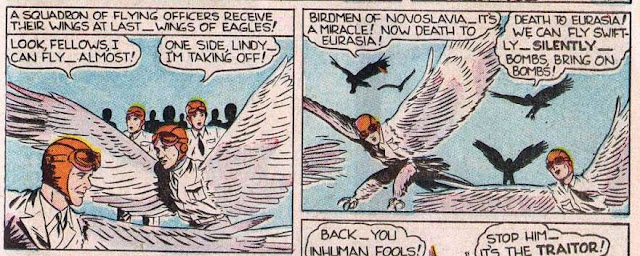
    These eagle-men pilots are the first of many Novoslavian animal-man hybrids, btw.

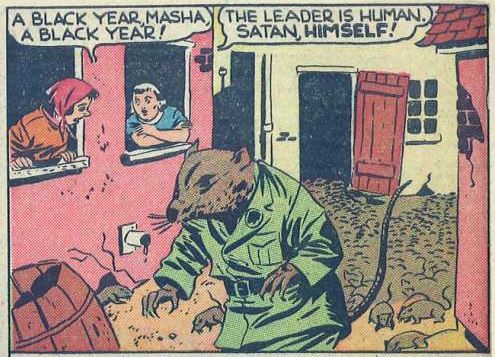
    Issue 57 of Popular Comics involves Novoslavian locust, wasp, termite and rat hybrids going out into the world to gather up plagues of their respective animals to unleash on Eurasia. Pictured here is the rat-man, my personal fave.

    The ultimate expression of Hormone’s hybridization efforts are these five Novoslavian volunteers who were turned into fleas and then restored to human form. Though they no longer look like fleas, they retain proportional jumping, flea-strength, etc, Spider-Man style. And the transformation is very gross-looking!

    So that’s Doctor Hormone in a nutshell: a bit light, plotwise, but full of charming characters and a cavalcade of new and interesting concepts in body horror. (Popular Comics 054, 1940)

    Martan the Marvel Man:

     I feel a bit bad making Martan follow Dr Hormone, honestly, because his adventures are at least as wild, but they aren’t as unique. In brief: Martan and his wife Vana are Antacleans, aliens from a super-advanced race a few million light years off. They kind of accidentally land on Earth and almost immediately get mixed up in the affairs of primitive humans. At first it’s regular old “they war amongst themselves, how foolish!” stuff but eventually they discover in incipient invasion by Antaclea’s ancient enemy the Martians and really throw their weight behind the Earth cause: supplying technology, setting up a world government etc. – Martan and Vana’s impact on the world is much greater than your typical comic book characters’. (Popular Comics 046, 1939)

  • REAL PERSON ROUND-UP 004

    More of those pesky real people have gotten into my comic books!

    Andrew Jackson:

    Character Keith Kornell, aka the West Pointer, is a descendant of Andrew Jackson, something you would perhaps be more proud of in 1939 than today. (Top-Notch Comics 001, 1939)

    Benito Mussolini:

    He’s a fairly oblique reference to Benito Mussolini but I reckon that up-and-coming Filipino dictator Remy Mussoni fits the brief. (Wonderworld Comics 008, 1939)

    Billy the Kid:

    Appears in a questionably true story told by character Windy Parks (Western Picture Stories 004, 1937)

    the Dionne Quintuplets:

    “Ad-Ventures at the Circus” was a recurring feature throughout the life of Star Comics (1937-1939), and it’s a fascinating artifact of the time that someone more qualified than me should write about some day. Long story short it was a twee little comic about advertising mascots going to the circus to watch other advertising mascots perform. There’s maybe a 75/25 split between the Surprisingly Familiar and Surprisingly Unfamiliar mascots with regular appearances by Surprisingly Racist ones. It’s a bit like a Neolithic Foodfight!. 

    Everything about this feature is weird, from the slightly uncanny valley illustrations by Raphael Astarita to the fact that it doesn’t really seem to be sponsored content (other than a command appearance by NRG, mascot of heavy Star Comics advertiser Baby Ruth). And then the final extant installment comes around and we get the weirdest advertising mascots of all as the Quaker Oats Man leads the Dionne Quintuplets onto stage – five living humans given the same status as the Crackerjack kid or Mr Peanut or some anthropomorphic orange who used to work for Sunkist. It’s a grim reminder of just how commodified those poor kids were, right down to their “act” being a pantomime of them going about their day, just like they did in the weird zoo they grew up in. (Star Comics v2 007, 1939)

    Gene Autry:

    An adventuring version of the singing cowboy in modern times (the Funnies 030, 1939)

    George VI of England:

    This here visit by King Arnold and his unnamed Queen is certainly meant to evoke the 1939 tour of Canada and the US by King George VI of England and Queen Elizabeth, the future Queen Mother. (Wonderworld Comics 005, 1939)

    George Washington:

    Not quite an appearance by Washington as adjacent to him, but the fact that one of the Wizard’s ancestors is given credit for a key part of the history of the American Revolution is worth noting. (Top-Notch Comics 001, 1939)

    FDR:

    Misc Minor Appearances: Thanks secret agent K-51 for saving foreign royals (Wonderworld Comics 005, 1939) 

    the Mona Lisa:

    As the “Lona Dizzi”, painted by “Lombardo da Ginki” (“Dixie Dugan” strip, 1931)

    Paul Revere:

    Ride witnessed – and hide saved – by American Revolution-era child-patriots the Liberty Lads. (Champion Comics 008, 1940)

    Robert E. Lee:

    Wizard ancestor Thomas Whitney accepts the surrender of Robert E Lee at Appomattox, whether in place of Grant or prior to his showing up cannot be said. (Top-Notch Comics 001, 1939)

    Tom Mix:

    Like Gene Autry, Tom Mix was a movie cowboy who starred in adventure comics as a larger-than-life version of himself having rootin’ tootin’ Wild West adventures. Unlike Autry, Tom Mix generally starred in stories set in the Old West, as himself but in the past. Tom Mix also holds the special distinction of appearing in comics from this earliest example (that I have found, at least) to at least the early 50s, long after he had died in October, 1940. (The Comics 001, 1937)

  • REAL PERSON ROUND-UP 004

    More of those pesky real people have gotten into my comic books!

    Andrew Jackson:

    Character Keith Kornell, aka the West Pointer, is a descendant of Andrew Jackson, something you would perhaps be more proud of in 1939 than today. (Top-Notch Comics 001, 1939)

    Benito Mussolini:

    He’s a fairly oblique reference to Benito Mussolini but I reckon that up-and-coming Filipino dictator Remy Mussoni fits the brief. (Wonderworld Comics 008, 1939)

    Billy the Kid:

    Appears in a questionably true story told by character Windy Parks (Western Picture Stories 004, 1937)

    the Dionne Quintuplets:

    “Ad-Ventures at the Circus” was a recurring feature throughout the life of Star Comics (1937-1939), and it’s a fascinating artifact of the time that someone more qualified than me should write about some day. Long story short it was a twee little comic about advertising mascots going to the circus to watch other advertising mascots perform. There’s maybe a 75/25 split between the Surprisingly Familiar and Surprisingly Unfamiliar mascots with regular appearances by Surprisingly Racist ones. It’s a bit like a Neolithic Foodfight!. 

    Everything about this feature is weird, from the slightly uncanny valley illustrations by Raphael Astarita to the fact that it doesn’t really seem to be sponsored content (other than a command appearance by NRG, mascot of heavy Star Comics advertiser Baby Ruth). And then the final extant installment comes around and we get the weirdest advertising mascots of all as the Quaker Oats Man leads the Dionne Quintuplets onto stage – five living humans given the same status as the Crackerjack kid or Mr Peanut or some anthropomorphic orange who used to work for Sunkist. It’s a grim reminder of just how commodified those poor kids were, right down to their “act” being a pantomime of them going about their day, just like they did in the weird zoo they grew up in. (Star Comics v2 007, 1939)

    Gene Autry:

    An adventuring version of the singing cowboy in modern times (the Funnies 030, 1939)

    George VI of England:

    This here visit by King Arnold and his unnamed Queen is certainly meant to evoke the 1939 tour of Canada and the US by King George VI of England and Queen Elizabeth, the future Queen Mother. (Wonderworld Comics 005, 1939)

    George Washington:

    Not quite an appearance by Washington as adjacent to him, but the fact that one of the Wizard’s ancestors is given credit for a key part of the history of the American Revolution is worth noting. (Top-Notch Comics 001, 1939)

    FDR:

    Misc Minor Appearances: Thanks secret agent K-51 for saving foreign royals (Wonderworld Comics 005, 1939) 

    the Mona Lisa:

    As the “Lona Dizzi”, painted by “Lombardo da Ginki” (“Dixie Dugan” strip, 1931)

    Paul Revere:

    Ride witnessed – and hide saved – by American Revolution-era child-patriots the Liberty Lads. (Champion Comics 008, 1940)

    Robert E. Lee:

    Wizard ancestor Thomas Whitney accepts the surrender of Robert E Lee at Appomattox, whether in place of Grant or prior to his showing up cannot be said. (Top-Notch Comics 001, 1939)

    Tom Mix:

    Like Gene Autry, Tom Mix was a movie cowboy who starred in adventure comics as a larger-than-life version of himself having rootin’ tootin’ Wild West adventures. Unlike Autry, Tom Mix generally starred in stories set in the Old West, as himself but in the past. Tom Mix also holds the special distinction of appearing in comics from this earliest example (that I have found, at least) to at least the early 50s, long after he had died in October, 1940. (The Comics 001, 1937)

  • MINOR SUPER-HERO ROUND-UP 018

    More of these guys and their antics.

    Johnny Fox:

    Johnny Fox is a guy* from the Florida Everglades who visits his grandfather one day to find him the victim of a treacherous murder. And what’s worse, the murderer, one Peter Pokane, did so in order to steal a supply of “sun-shots”, i.e., invisibility pills.

    *and by “guy” I mean “Native American guy of the Seminole Tribe of Florida” but it’s a tricky thing to work into a concise sentence. Also tricky: the racial politics of the Johnny Fox comic! Johnny is a college-educated Seminole and thus free of a lot of the overt stereotypical behaviour of the day but also is a near-superhuman even without the invisibility pills, explicitly due to his Noble Savagery. Plus Peter Pokane’s major villainous trait is that he’s a “half-breed” which… must I explain why that sucks? What I’m saying is that it’s complicated.

    Johnny gets the sun-shots back by yeeting Peter Pokane out a penthouse window and begins fighting crime, invisible-style. Keeping in mind, of course, that he has to take a pill to turn invisible and another to turn back. Unless he gets hurt, which will turn him back immediately. Which happens a lot, because Johnny may be invisible, but his shadow never is. As far as invisibility goes, this version might have the most caveats I have ever seen. At least he doesn’t have to be nude.

    After a while the writers seem to get tired of the invisibility gimmick and have Pokane return just long enough to take the sun-shots to a watery grave (and it’s a rare villain who gets killed by the same hero twice). Johnny Fox is now just a regular bow-wielding New York City Private Detective… for about two issues, after which Johnny’s grampa’s ghost returns to teach him how to make them again. (Champion Comics 006, 1940)

    the Human Meteor:

    Duke O’Dowd was just a regular Texan serving as a French Foreign Legionnaire until a couple of issues in, when his writers presumably realized that comics about the French Foreign Legion are boring, repetitive and usually pretty racist (though they probably cared more about the first two reasons). So they made Duke homesick, had him earn an honourable discharge and sent him on his way in a plane piloted by fellow Texan Kerry Flynn – an unlucky break for Flynn as it turned out, because somewhere over the Himalayas the two were caught up in a mysterious tornado and blown to the hidden city of Bayakura, a journey that only Duke O’Dowd survived.

    Hailed as the Great Deliverer, O’Dowd is introduced to Bayakuran scientist Dr Wah Le, who outfits him with the Wonder Belt, a superscientific device which provides him with super-strength, the power of flight and invulnerability to metal. Plus he gets a stun ray gun! And a very fun and goofy outfit!

    Duke puts down a rebellion by the very low-achieving heir to the throne of Bayakura (his aim was to take the riches of Bayakura to the outside world and live like a king but he decided to do so via a huge heist rather than the traditional and much safer option of embezzling from the kingdom while in power) and installs Wah Le in his place before heading to the outside world himself.

    Sadly, once O’Dowd rejoins the outside world he trades in the amazing Bayakuran national costume for a more traditional super-hero getup (though the Bayakurans seem to have varied up their outfits as well – perhaps their fashion industry was revitalized by O’Dowd’s fresh new looks). He also switches names from the Great Deliverer to the Human Meteor, which is admittedly more snappy. 

    The Human Meteor is also the first character we have encountered who will someday be done dirty by Roy Thomas in 1993’s Invaders v2. Briefly, Thomas had the idea to field a team of super-heroes who had defected to the Nazis against the Invaders and since he wasn’t allowed to use any actual Golden Age Marvel characters he instead opted for the public domain. 

    While my initial instinct is to reject this idea… I must admit that it’s not without merit. Plenty of otherwise rational people were also charmed by the fascists – it’s unreasonable to think that no superfolk would ever compromise one aspect of their morality for another (it is however a badly-written comic, because it’s a very 1990s comic). So what we’re going to do is not assume that we’ll get to it later (three years into this project and I still haven’t gotten to 1942, after all) and instead we’re going to evaluate just how much of a stretch it was for each character to end up as a Nazi.

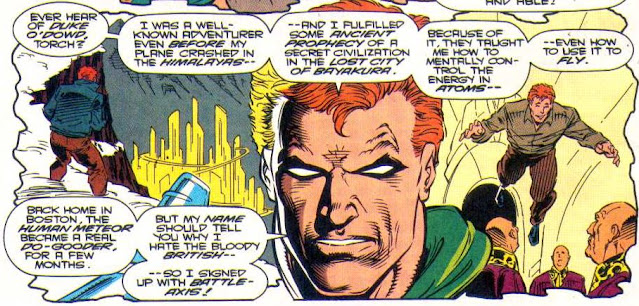
    While Duke O’Dowd is an adventurer and thrill-seeker who joined the French Foreign Legion for a larf and never really expresses complex morality as opposed to simple justice-seeking, his stated reason for joining the Battle-Axis is that his Boston Irish blood demanded it, which… is plausible as a motivation for attending a few meetings but a huge stretch when it comes to attempting to kill Captain America. (Champion Comics 008, 1940)

    Robinhood Jones:

    “Rich guy who gives it all up to become a do-gooder hobo” wasn’t the most popular trend in early comics but I can conjure up at least half a dozen examples. Robinhood Jones has the added distinction of being a pretty direct pastiche of – you guessed it – Robin Hood and his Merry Men. Some highlights:

    Robin Hood – Robert Harrison Jones III

    Friar Tuck – Fry Tucker

    Little John – Little Jack Lee

    Will Scarlet – Bill Scarlet

    Alan-a-Dale – some guy named Allen

    There’s also a fairly delightful swap of archery for horseshoes as an all-purpose solution. Funnily enough, though Robinhood Jones squared off against the same crooked Sheriff of Sherwood City on thereabouts on two separate occasions he never encountered a clear Prince John analog. Or a Maid Marion, for that matter. (Champion Comics 007, 1940)

    the Black Ghost:

    AKA the Black Rider, the Black Ghost was an alternate identity adopted by cowboy hero Bronc Peeler (himself the character prototype for the slightly less outlandishly-named Red Ryder) on one of the many occasions in which he was framed as a crook and had to prove his innocence. Of note mostly for his very cool outfit consisting of jet black cowboy gear with a white bandit mask. (Popular Comics 039, 1939*)

    *Originally a comic strip that was reprinted in Popular Comics, if you’re truly interested.

  • MINOR SUPER-VILLAIN 568: THE GORGON

    (The Comics 002, 1937)

    The Gorgon is not the most spectacular villain but does provide us with a couple of interesting contrasts to our last few entries. Firstly, we can contrast him with the Masked Czar and note how his lack of major identifying features enhances the anonymity afforded by a simple black mask.

    I assume that he was called the Gorgon because “anyone who has seen his face is now dead” but it would have been nice to have it in the text of the story.

    Indeed, the Gorgon’s disguise was effective enough that he was able to operate in his capacity as the Assistant State’s Prosecutor while also being a masked gang boss. It took fingerprint evidence for anyone to figure his game out.

    The Gorgon also provides a bit of contrast with the Falcon here, as his adventure was also abruptly cancelled before the resolution, but where the Doctor Doom feature probably would have continued as a cat-and-mouse game between Doom and the Falcon, the conventions of Crime Doesn’t Pay comics like Tom Beatty’s are such that the Gorgon was going to be rounded up in two issues, tops.

  • MINOR SUPER-VILLAIN 567: THE FALCON

    (The Comics 001, 1937)

    The Falcon is a mercenary spy and Doctor Doom’s opposite number in the conflict between the kingdoms of Returia and Merovia. It’s somewhat debatable whether a couple of spies-for-hire can be classified as either heroes or villains in such a situation, but the story certainly presents them as such, with Merovia being vaguely Nazi German and Doctor Doom being proudly American to underline things.

    The Falcon’s espionage is also a bit more dastardly than Doctor Doom’s, as well as being a bit more effective. In particular, the Falcon’s kidnapping of Doom’s son Stephen from a Swiss boarding school with egregiously poor security comes very close to spelling Returia’s end.

    Like the Masked Czar before him, the Falcon provides some insight into the ups and downs of serialized storytelling – in this case, it’s the all-too-often case of a serial being axed before it actually comes to a conclusion,leaving the Falcon in the ascendant. Don’t worry, though! This comic was evidently assembled out of the plot of a Big Little Book, so if you want to find out what happens and how exactly Doctor Doom comes out on top you can probably find out by buying the two extant Doctor Doom books for… looks like around $150 US plus shipping. Have fun!

  • MINOR SUPER-HERO ROUND-UP 016

    A pretty motley collection this time.

    the Ermine:

    A frontier vigilante who wears a reversible ermine skin outfit (white for winter wear, brown for regular), leaves an ermine tail as his calling card and can communicate/ is friends with with all the creatures of the forest (except for the ermine, presumably). The Ermine would be an interesting character if he wasn’t explicitly and murderously racist against Native peoples. He’s classed as a minor hero here because all of his recorded adventures involve him acting as the protector of two youths but I assume that he has a lot of hate crimes under his belt. (Star Ranger Funnies v1 015, 1938)

    the Lone Marshal:

    I have a strong suspicion that the Lone Marshal is a Lone Ranger knockoff. Obviously there’s no way to peer into the past and be sure, and admittedly the name was a really big influence on my opinion, but I’m sticking with it. He’s got a Sioux companion named Vajo and a horse named Lobo, so he’s just as not-technically-Lone as the Ranger is. (The Comics 001, 1937)

    Doctor Doom:

    Doctor Doom, “the Robin Hood of International Spies,” is some sort of freelance spy chief who we join as he works for the small Balkan nation of Returia as they fend off invasion plans by their rival, the similarly-small, not-as-Balkan Kingdom of Merovia. Doctor Doom and his double handful of associates are on the back foot for the entirety of their time battling the Falcon and never really manage to get the upper hand before the feature is cancelled but I assume that they would have come out on top eventually. (The Comics 001, 1937)

    Jungleman:

    Jungleman is your typical white-kid-raised-by-beasts jungle hero, in this case based out of Cambodia. He lives in a temple and collects treasure and repeatedly kidnaps a young woman named Louise until she falls in love with him – like I said, typical stuff. 

    The real thing that sets Jungleman apart from his peers is both the sheer number and variety of his animal companions and their tremendous attrition rate – he goes through two tigers in his first three appearances when most jungle heroes have to make one big cat last their entire career! 

    Eventually, Louise and her dad convince Jungleman to relocate to the US under the more civilized alias of “Mister Jay” and I was all set for a lot of the same kind of fish-out-of-water stuff that Ty-Gor spent a lot of his time on but no! Their ship gets wrecked and they just end up in a different jungle! It’s the old jungle switcherooo and I never saw it coming! (Champion Comics 002, 1939)

    **UPDATE** Bob Phantom **UPDATE**

    Star Comics 001, 1938 features a different guy named Bob Phantom, which only reinforces my paranoia vis-a-vis there being a joke or a reference that I’m missing about the last name Phantom. Also, given the slapdash nature of early comics and their record keeping, nobody actually knows who created this guy and so it’s entirely possible that he’s the same Bob Phantom and Harry Shorten and/or Irv Novick just took him from Centaur to MLJ and upgraded him from stage magician to super-hero.

  • MINOR SUPER-VILLAIN 566: THE MASKED CZAR

    (The Comics 001, 1937) 

    The Masked Czar is a very minor masked gang boss who provides an object example into why most masked gang bosses are fairly physically average specimens. Villains like the otherwise-unnamed Czar here – the tall, the short, the fat, the thin, the bald or the exceptionally hirsute – tend to go in for different ways of concealing their identities that might stand a better chance of working than a thin strip of fabric. Or they go all out, Penguin style, and lean into their appearance. What I’m saying is: this guy ain’t fooling nobody.

    The Masked Czar also provides an insight into the process of serialized storytelling, and particularly into the perils of reformatting it into a linear experience. Above are the final two panels of the G-Man Jim adventure in The Comics 001. G-Man Jim certainly is in a pickle, huh?

    And here are the first two panels of the G-Man Jim story in The Comics 002, in which we see that he is, in fact, not in a pickle. Say goodbye to the Masked Czar, kids!

  • MINOR SUPER-VILLAIN 566: THE MASKED CZAR

    (The Comics 001, 1937) 

    The Masked Czar is a very minor masked gang boss who provides an object example into why most masked gang bosses are fairly physically average specimens. Villains like the otherwise-unnamed Czar here – the tall, the short, the fat, the thin, the bald or the exceptionally hirsute – tend to go in for different ways of concealing their identities that might stand a better chance of working than a thin strip of fabric. Or they go all out, Penguin style, and lean into their appearance. What I’m saying is: this guy ain’t fooling nobody.

    The Masked Czar also provides an insight into the process of serialized storytelling, and particularly into the perils of reformatting it into a linear experience. Above are the final two panels of the G-Man Jim adventure in The Comics 001. G-Man Jim certainly is in a pickle, huh?

    And here are the first two panels of the G-Man Jim story in The Comics 002, in which we see that he is, in fact, not in a pickle. Say goodbye to the Masked Czar, kids!