The Curse of Skeleton Munroe

Category: Dell

  • GENERIC COSTUMED VILLAIN ROUND-UP 012

    Management not responsible if some of the villains are not technically costumed.

    This fellow, known as the Boss, was the masked publisher of a newspaper known as the Weekly Tattler which functioned as a vehicle for his blackmail business: pay up or get your secrets printed in the next edition. He turned out to be the husband of one of the paper’s victims, which makes little enough sense that I reckon that they got to the end of the story without adding any good suspects so went with the only possibility. Also he gets shot by his very gullible underling after the Fox barely implies that there’s a double cross on. (Blue Ribbon Comics 011, 1941)

    Inferno tangles with crook Jake the Fake and his henchmen as they make a break for the Mexican border disguised as a shipment of mummies, a top tier thing to pretend to be. (Blue Ribbon Comics 017, 1941)

    If you have to be a very generic pirate so hard up you have to kidnap guys from the US Navy to run your radio equipment in a mid-level (by Golden Age standards) racist adventure well then you’d better have a great name like the Scourge because that’s really all you have going for you. (Wonderworld Comics 003, 1939)

    Like the Scourge, the Obermaster here is a real waste of a good villain name on a real damp squib of a character. He is Samson Gorth, a criminal mastermind with no real plan. No, that’s not accurate. He has a plan to incite war between the US and Japan by attacking their respective shipping using planes with false insignia but beyond that his goals are a mystery. Is he hoping for plunder? A chance for war profiteering? No clue and thanks to special agent Bruce McKay, Sky Master, we’ll never find out. Because the Obermaster is dead. In case that wasn’t clear. (The Funnies 035, 1939)

  • MINOR SUPER-VILLAIN 565: THE BLACK WIDOW

    (The Funnies 030, 1939)

    The Black Widow is a sinister femme fatale spy chief in the classic mode, complete with cigarette holder, tight red dress and imperious attitude. A few things that make her fun:

    -the vague European country she works on behalf of is Bosylvania, a country about which nothing is revealed aside from the fact that it has the best geographical suffix: -sylvania

    -the Black Widow is in fact Princess Maxine of Bosylvania so her activities have an even greater potential for international incident than your typical spy, and certainly there’s an even greater risk than usual of tying her to her employers.

    -the Black Widow does not leave her castle HQ (located in the Castle District of the Northeastern US, presumably) for the duration of the story. This is because she knows how to delegate.

    When Secret Service agent Tom Beatty and his teen pal Danny show up despite the bomb the Black Widow had placed in their plane she takes another pass at killing them using an assassin’s teapot, which is always fun to see.

    Beatty is eventually captured and though it doesn’t turn out well for her I must say that any villain who takes the time for a bit of hero-taunting before their triumph gets a gold star in my book. Just stay well away from the bars!

    Beatty is of course recaptured because this is a serialized story and getting captured is good cliffhanger fodder. The Black Widow and her cronies come really close to getting away but instead she gets horribly killed just off panel. I guess exploding princess heads were too much even for the heady days of the pre-Code Golden Age – we’ll have to wait until the late 80s at earliest before we get an explosive decapitation in a mainstream comic if I’m any judge.

  • MINOR SUPER-VILLAIN 564: THE GHOST OF WINTER RANCH

    MINOR SUPER-VILLAIN 564: THE GHOST OF WINTER RANCH

    (The Funnies 030, 1939)

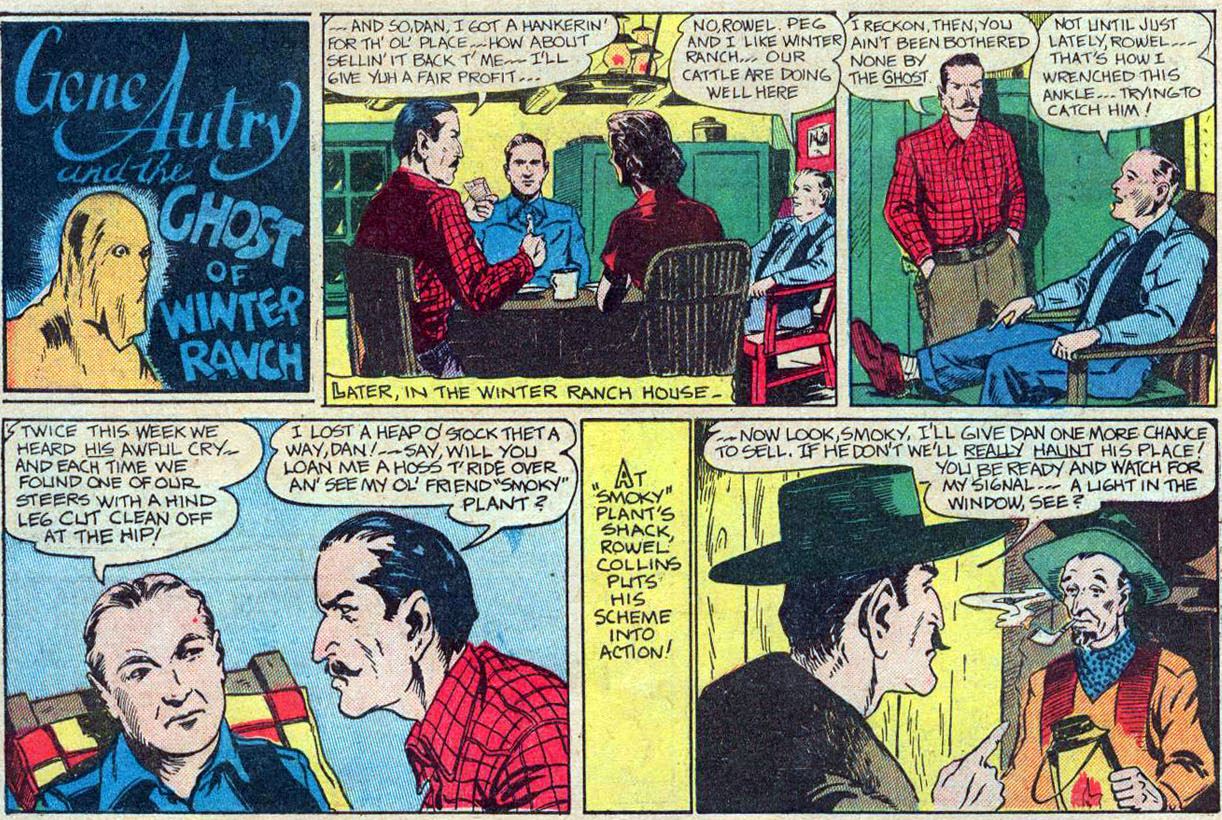
    This fellow is from a story starring Gene Autry, singing cowboy. It’s printed in a comic put out by Dell that mostly features reprints of comic strips and that’s probably what this is? Even though online sources suggest that the first Gene Autry comic strip started in 1940 and this came out in 1939? Ultimately, these are mere details. The important fact is that this is my most favourite style of putting a film cowboy actor in an adventure comic: the real Gene Autry is just riding around in the Western US – Montana, in this case – with some sixguns and a guitar, having adventures but also doing all of the singing and movies that are his bread and butter. It’s somehow slightly less plausible than when they just drop Tom Mix or Buck Jones into the Old West with no justification but the weirdness makes it fun.

    As for the comic itself, we find one “Rowel” Collins (I had to look this one up – a rowel is the pointy wheely bit on a spur, so this is just a more Western version of calling someone Spike) who has just discovered that the mine full of useless ore that he sold as part of his former ranch is in fact a mine full of extremely valuable pitchblende and since Rowel Collins is a dastardly character (just look at his evil mustache!) he vows to get the money that the mine is worth by hook or by crook.

    Lucky for Rowel, there are a lot of local superstitions for him to take advantage of: the ranch is situated on a piece of land called the Devil’s Ironing Board; the pitchblende is in the Devil’s Cave and crucially the ranch is supposed to be haunted (by a cow leg-stealing ghost?). Rowel immediately heads to a nearby shack to activate his old crony Smoky Plants.

    Smoky, as the glowing Ghost of Winter Ranch, only really takes one pass at scaring off ranch owners Dan and Peg Winters and since they have the moral support of Gene “ain’t scared of no ghosts” Autry Rowel has to resort to gunplay and kidnapping to force the sale.

    Rowel and Smoky almost get away with it, in fact, but it turns out that hatching a scheme to sell a mine full of radioactive ore and knowing anything about radiation are two different things and they both end up dropping dead of radiation poising due to the radium they used to make the Ghost’s glowing robes. It’s terrible, terrible poetic justice.

  • MINOR SUPER-VILLAIN 564: THE GHOST OF WINTER RANCH

    (The Funnies 030, 1939)

    This fellow is from a story starring Gene Autry, singing cowboy. It’s printed in a comic put out by Dell that mostly features reprints of comic strips and that’s probably what this is? Even though online sources suggest that the first Gene Autry comic strip started in 1940 and this came out in 1939? Ultimately, these are mere details. The important fact is that this is my most favourite style of putting a film cowboy actor in an adventure comic: the real Gene Autry is just riding around in the Western US – Montana, in this case – with some sixguns and a guitar, having adventures but also doing all of the singing and movies that are his bread and butter. It’s somehow slightly less plausible than when they just drop Tom Mix or Buck Jones into the Old West with no justification but the weirdness makes it fun.

    As for the comic itself, we find one “Rowel” Collins (I had to look this one up – a rowel is the pointy wheely bit on a spur, so this is just a more Western version of calling someone Spike) who has just discovered that the mine full of useless ore that he sold as part of his former ranch is in fact a mine full of extremely valuable pitchblende and since Rowel Collins is a dastardly character (just look at his evil mustache!) he vows to get the money that the mine is worth by hook or by crook.

    Lucky for Rowel, there are a lot of local superstitions for him to take advantage of: the ranch is situated on a piece of land called the Devil’s Ironing Board; the pitchblende is in the Devil’s Cave and crucially the ranch is supposed to be haunted (by a cow leg-stealing ghost?). Rowel immediately heads to a nearby shack to activate his old crony Smoky Plants.

    Smoky, as the glowing Ghost of Winter Ranch, only really takes one pass at scaring off ranch owners Dan and Peg Winters and since they have the moral support of Gene “ain’t scared of no ghosts” Autry Rowel has to resort to gunplay and kidnapping to force the sale.

    Rowel and Smoky almost get away with it, in fact, but it turns out that hatching a scheme to sell a mine full of radioactive ore and knowing anything about radiation are two different things and they both end up dropping dead of radiation poising due to the radium they used to make the Ghost’s glowing robes. It’s terrible, terrible poetic justice.

  • THE FATE OF ATLANTIS

    (Super Comics 002, 1938)

    This is just a regular account of some survivors of Atlantis (and their wives) setting up a colony somewhere – in this case the South Seas. The development of a priestly class obsessed with covering up their murder of one guy (to the extent that he is eventually made their god of Justice!) is pretty fun.

  • MINOR SUPER-VILLAIN 434: THE PHANTOM OF THE SKY

    (Popular Comics 046, 1939)

    The Phantom of the Sky (AKA the Phantom Sky Raider AKA the Black Phantom) is a mysterious pilot who has been flying around the American West, viciously attacking and shooting down civilian planes and painting a skull-and-crossbones calling card on them. He turns out to be a nameless French WWI flying ace, shot down and left for dead but actually just trapped in a delusion of an unending war in which he is essentially conducting guerrilla air combat. He proves elusive but eventually the Masked Pilot and his pal Tom shoot him down. He does manage to survive the crash, so hopefully he got some help for his nightmare existence.

    Here’s where I thought I might say something about the Masked Pilot but… he’s just a pilot hero. He flies around with Tom and solves problems with his plane. You might think that he wears a face-concealing mask because he’s horribly deformed but no, he wears a regular domino in his civilian getup so it’s just an affectation. I suppose a pilot with a gimmick is technically better than one without, but only just.

  • MINOR SUPER-VILLAIN 433: THE RED HOOD GANG

    (Popular Comics 046, 1939)

    Just a simple bank robbing gang operating out of New Orleans and rounded up by Special Agent John Winston but I dig their outfits.

  • MINOR SUPER-VILLAIN 421: THE RED-EYED KILLER

    (Jumbo Comics 020, 1940)

    What a cool-looking villain! Suit and cape combo? Blood-red eyes? Great stuff. He’s got a cool mask and a wavy dagger and he goes on an enormous spree killing in NYC while Our Hero Inspector Dayton tries to figure out just how he’s going to stop the Red-Eyed Killer.

    But they spend too much time in the setup! Dayton stumbles into a doctor’s office on the last page and the resolution happens in an instant – the Red-Eyed Killer is Dayton’s work pal, police scientist Doc Black and he gives up… pretty reasonably, I guess. Being pinned to a door by a half dozen of your own daggers will inspire compliance.

    So, the Red-Eyed Killer. Good but not great; a lesson in leaving enough room for the end of your story to have some stakes in it. Also: tell us how he get those red eyes!

  • MINOR SUPER-VILLAIN 417: THE SCARLET

    (Crackajack Funnies 021, 1940)

    Another Ed Tracer foe. The Scarlet is a freelance spy notable for a) his fantastic name and b) the fact that he uses a reverse disguise – a toupee to disguise his baldness in civilian life.

  • MINOR SUPER-VILLAIN 416: THE PIRANHA

    (Crackajack Funnies 010-017, 1939)

    The Piranha is a mysterious gang boss operating out of New York City and known for the gruesome way he dealt with his enemies, of which we will return to in a second.

    The Piranha is actually the wealthy Senõr Romez, a society luminary known for his fabulous parties and the many unsolved murders that happen at his fabulous parties. He also dresses exactly like the Piranha but with hair and a mask – a lot of the story involves G-Man Ed Tracer trying to find some way to link Romez and the Piranha.

    Back to that murder method. Somewhat predictably, the Piranha feeds his victims to piranhas, but it’s what he does next that really catches the old attention: he sends entire skeletons as warnings (side note – the character receiving the skeleton in the above panels is a radio celebrity named Jimmie Stewart. I don’t think that it’s supposed to be a version of Jimmy Stewart the actor [who was working in radio at the time] but it’s a weird coincidence).

    As predictable as the Piranha using piranhas as a murder method is, it’s even more predictable that he himself would end up on the wrong end of a skeletonization by the end of the story. Live by the piranha, die by the piranha, as they say.

    Now here’s the kicker: when I first read this story a few years back it was as a serial, spread out over eight issues. I didn’t notice then because it was a disjointed way to take in details but revisiting it just now all in a go… I don’t know if we ever learn the reason that the Piranha is killing wealthy partygoers and kidnapping the princess of the South American (?) country of Spanovia and so forth. He’s just generically evil and foreign? Presumably there’s money in it somewhere but as far as the facts on paper go he’s just into some sort of extreme roleplay.