The Curse of Skeleton Munroe

Category: espionage

  • GENERIC COSTUMED VILLAIN ROUND-UP 036

    Every one of them a disappointment to their parents. 

    Mr Axis: 

    He may just be a regular Nazi spy* lurking around Washington DC and disrupting trade deals between the US and the rubber-rich nation of Rumbia, but his name is Mr Axis! Such a perfect name for a fascist super-villain and yet one that seemingly was only used once**. Patriotic super-hero Miss Victory really puts the boots to him in her debut adventure. (Captain Fearless Comics 001, 1941)

    * Technically by my usual metrics I’d call this guy a crypto-fascist of no clear national origin but c’mon: his name is Mr Axis.

    **Except that he does reappear in Captain Aero Comics 011, in which this story is retold unchanged but with different art. Weird stuff.

    Categorized Under: Crime as Theme (Fascism), Generica (Misters)

    the Arson Ring:

    Considering the fact that his feature is called “Blaze Baylor and the Arson Ring” I really expected super arson investigator Blaze Baylor to be contending with the same group of arsonists – a ring, if you will – throughout his adventures. This is not in fact the case, or at least it is not supported in the text. Blaze does battle the Arson Ring in his first outing and they are heavily implied to be the ones who killed his dad Smoky Baylor, so that’s something. (Cat-Man Comics 001 1941)

    Categorized under: Crime as Theme (Arson), Generica (Rings), Narrative Footballs (Origin Guys)

    Igor and his Mother:

    This unnamed woman and her son Igor live in poverty on the outskirts of an unnamed city and come into conflict with the Black Widow after turning their inborn talents (Igor being very strong and his mother so ugly that she can stop a man’s heart) to crime. Igor ends up being shot by the Black Widow, while his mother dies in an attempt to burn their hovel down and kill the hero. (Cat-Man Comics 001 1941)

    Karl von Keilman: 

    Though you might think that Karl von Keilman is a mad or criminal scientist from the way he dresses, this is in fact stolen valour as it is Karl’s brother Abner who is the scientific mind of the family. Abner is the one responsible for creating the Dolls of Death, self-propelled and self-guided bombs that he had intended to turn over to the War Department before Karl showed up, killed him and started using them to blow up defense factories.

    Karl didn’t reckon, however, on the fact that his brother was friends with the Deacon and so a super-heroic nose would be poked into his business. He also never learned not to get into an indoor fight when your weapon of choice is exploding dolls. (Cat-Man Comics 002, 1941)

    Categorized under: Accessories (Little Robots), Murder (Fratricides)

  • MINOR SUPER-VILLAIN 910: HERR GLOOBELS

    (Whiz Comics 024, 1941)

    Herr Gloobels is a mysterious and somewhat gruesome figure who murders a motorcycle messenger in order to get ahold of some troop transport schedules and then murders a second one to get them again after Spy Smasher recovers them from the first theft. He does all of this using his Tornado Gun, a device that seems to be a ray gun but which actually fires beams of compressed air that can sink a ship as easily as perforate a hapless guard. 

    Herr Gloobels’ generally chaotic nature leaves us with a number of questions, the most narratively pressing of which is: is this guy a spy or what? There’s no real talk of the War Lord or any other Axis stand-in and Gloobels seems to be driven by scientific megalomania as much as any desire to advance the cause of world fascism. Maybe he’s just wacky.

    The second question is of course: what’s the deal with Gloobels’ assistant Hugo? Is he a trained gorilla? An ape-man? Something more racist? It’s never specified.

    Thirdly: just why does he look so much like a Basil Wolverton character in that last panel? Don’t get me wrong: it’s a good look! It’s just not quite what he looks like the rest of the time.

    After a spirited melee in Gloobels’ lighthouse HQ, Hugo ends up taking a Tornado Gun blast meant for Spy Smasher and is sent to his final reward. This seems to take the wind out of Gloobels’ sails and he surrenders without further incident – a surprising demonstration of affection for a henchman, particularly for a homicidal scientist type like Gloobels. The Tornado Gun is supposedly turned over to the US military for study, but as with all of these captured super-villain weapons they seemingly put their worst men on the job because the Allied forces continued to rely on plain old bullets.

  • MINOR SUPER-VILLAIN 889: THE BLACK THORN

    (Wow Comics 003, 1941)

    Inventor Phineas Cox has created a mummy ray, which is a device that fires a beam that instantly mummifies living tissue, a horrible thing that could only be used ethically by the mortuary and possibly the jerky industries. Cox intends for the weapon to be used in the defense of the United States, and to that end takes it not to the military but to something called the Defend America League, where he is somewhat predictably thrown out on his ear. 

    Phineas Cox vows to show America what he’s made of, and that very evening the Black Thorn makes his debut by desiccating an innocent woman. Why call yourself the Black Thorn when your main gimmick is a mummy ray? My guess is that the ray is a late addition to what was an already thought-out alter ego – I mean, just look at that costume! It’s not my favourite outfit of the Golden Age, but it definitely lacks some of the sense of just having been thrown together out of things that were already in the attic that some of them do.

    The Black Thorn’s schemes are, true to Cox’ pronouncement, decidedly anti-American: he steals defense funds from a bank and blows up an arsenal, leaving a trail of mummies in his wake. He’d have kept on going, too, only it is at this point that Mr Scarlet gets involved.

    Mr Scarlet himself almost gets mummified on two occasions but the Black Thorn shoots at the wrong prone figure in the dark the first time and falls for a decoy the second time, and since the both the misidentified target and decoy were the body of the slain bank guard, this means that the poor guy ends up being triple-mummified, which is a small consolation but has to be some kind of record.

    Please also note the Black Thorn using his horned headpiece as a weapon against Mr Scarlet. It’s nice to see something  seemingly purely ornamental like that see practical use. 

    In the end, the Black Thorn turns out not to be Phineas Cox but Henry Hawley, the leader of the Defend America League, which savvy readers might have already spotted as a fascist organization based on the ostentatiously patriotic name alone. Hawley had not, in fact thought Cox to be a nutjob but instead imprisoned him and stolen his invention for used in his campaign against America, and he would’ve gotten away with it if it hadn’t been for that pesky Mr Scarlet.

    Though Mr Scarlet busts up the mummy ray and tells Cox not to even think about building another one, the Black Thorn will return, and he will be mummifying his foes. Somehow.

  • MINOR SUPER-VILLAIN 883: AMERICA SMASHER

    (Spy Smasher 002, 1941) 

    There are a few different kinds of evil opposites. There are your classic elemental opposites, like when a fire guy fights a water guy or an ice guy, and your thematic opposites, like when the Flash goes up against Turtle Man. Then there are your literal Bizarro-style mirror image opposites, which is the closest to what America Smasher is, but not quite. Instead, he is a declared opposing force to Spy Smasher: “if you are going to smash spies, which includes me*, then I am going to smash America, which includes you.” Plus, since he is a super-villain, America Smasher has literalized the smashing concept by adopting a spiked mail glove as his thing.

    Spy Smasher is on a bit of a hot streak with regard to being able to locate his villains’ bases while they are still in the planning stages, but rather than simply use this as an information-gathering opportunity as he did when he found Dark Angel’s HQ, this time he gets cocky due to America Smasher’s diminutive size and attempts to take on the whole room, and he pays for that with a bop on the head from the mailed fist. 

    *Whether America Smasher would count as a spy in any way other than the fact that he is a Spy Smasher enemy is a conversation for another day.

    Spy Smasher gets out of this predicament thanks to the fact that America Smasher hit him so hard that everyone thinks that he’s dead. There’s the usual back and forth between the two before Spy Smasher and Eve Corby are caught and imprisoned in a mysterious humming building full of men and tanks. Just where could they be?

    Turns out: inside an incredibly huge plane (containing, for example, a full tank corps and hundreds if not thousands of soldiers) that is about to bomb the US in advance of a full invasion by the Nazis.

    The plane is so big, in fact, that Spy Smasher finds plenty of handholds on it to a) prevent himself from falling to his death and b) make is way to the cockpit so that he can start pitching pilots out the window willy-nilly. And as a plane is nothing without its pilots, it crashes, taking America Smasher and all his hundreds of minions to their demise with it.

    America Smasher does not in fact die in the crash, but instead establishes a sewer lair in what is probably NYC (Spy Smasher comics are often hard to pin down, geography-wise, even though the characters all live and work in named cities. The problem is in distinguishing whether the action of a particular issue is supposed to be taking place in Washington DC, where Admiral Corby works, or NYC, where he and his daughter Eve reside. Or sometimes Virginia, where Alan Armstrong lives. Or another place entirely). 

    America Smasher does get up to more recognizable spy activity in this issue, primarily centred around inducing a German American man to betray his Secret Service agent son, but he also spends a lot of effort attempting to get revenge for his prior foiled plan, by killing Eve Corby in particular. Why her in particular? That’s a good question.

    America’s Greatest Comics 001 was published in November or December of 1941 and this story shows it in one very particular way: by having America Smasher explicitly be a Nazi. Even very slightly in advance of Pearl Harbor and the US entering the war, publishers were starting to get a little bit brave about perhaps suggesting that all these bad guys with German accents and monocles that they had been populating their rogues galleries for for that last couple of years were in fact Nazis.

    As mentioned previously, this issue sees America Smasher in reduced circumstances as he’s living in a sewer rather than a flying war base. He hasn’t entirely given up on the finer things in villainy, however, as evidenced by the enormous Art Deco iron maiden that acts as both the centrepiece of his lair and the primary means by which he inspires cooperation in his victims. Also, it is the instrument of his downfall when Spy Smasher pushes it over onto him!

    Not his ultimate downfall, however. That comes when he floods sewer base in attempt to kill Spy Smasher and in a classic case of Bad Boss leaves his henchmen behind to die with him, only for one of them to go mad with fear and blow up the whole damn sewer and America Smasher with it. (America’s Greatest Comics 001, 1941)

    The rumours of America Smasher’s death are once again exaggerated it seems, as he recovers his gauntlet from his shattered lair almost immediately (though just whose arm it was on in that pile of rubble remains a mystery. For that matter, just who made the decision to leave a human corpse under a light coating of rubble in the New York City sewers?).

    This final 1941 adventure is a bit anticlimactic after the previous heights and even mediums of villainy that America Smasher had aspired to: he trails Alan Armstrong and Eva and Admiral Corby to Alaska in order to steal the Army’s new Ski Tank prototype and then gets his block knocked off by Spy Smasher. He doesn’t even appear to die at the end of the issue but instead suffers the ignominy and shame of arrest. 

    America Smasher will return in 1942 – will his career continue to spiral ever farther downward? Tune in and see! (Whiz Comics 025, 1941)

  • MINOR SUPER-VILLAIN 883: AMERICA SMASHER

    (Spy Smasher 002, 1941) 

    There are a few different kinds of evil opposites. There are your classic elemental opposites, like when a fire guy fights a water guy or an ice guy, and your thematic opposites, like when the Flash goes up against Turtle Man. Then there are your literal Bizarro-style mirror image opposites, which is the closest to what America Smasher is, but not quite. Instead, he is a declared opposing force to Spy Smasher: “if you are going to smash spies, which includes me*, then I am going to smash America, which includes you.” Plus, since he is a super-villain, America Smasher has literalized the smashing concept by adopting a spiked mail glove as his thing.

    Spy Smasher is on a bit of a hot streak with regard to being able to locate his villains’ bases while they are still in the planning stages, but rather than simply use this as an information-gathering opportunity as he did when he found Dark Angel’s HQ, this time he gets cocky due to America Smasher’s diminutive size and attempts to take on the whole room, and he pays for that with a bop on the head from the mailed fist. 

    *Whether America Smasher would count as a spy in any way other than the fact that he is a Spy Smasher enemy is a conversation for another day.

    Spy Smasher gets out of this predicament thanks to the fact that America Smasher hit him so hard that everyone thinks that he’s dead. There’s the usual back and forth between the two before Spy Smasher and Eve Corby are caught and imprisoned in a mysterious humming building full of men and tanks. Just where could they be?

    Turns out: inside an incredibly huge plane (containing, for example, a full tank corps and hundreds if not thousands of soldiers) that is about to bomb the US in advance of a full invasion by the Nazis.

    The plane is so big, in fact, that Spy Smasher finds plenty of handholds on it to a) prevent himself from falling to his death and b) make is way to the cockpit so that he can start pitching pilots out the window willy-nilly. And as a plane is nothing without its pilots, it crashes, taking America Smasher and all his hundreds of minions to their demise with it.

    America Smasher does not in fact die in the crash, but instead establishes a sewer lair in what is probably NYC (Spy Smasher comics are often hard to pin down, geography-wise, even though the characters all live and work in named cities. The problem is in distinguishing whether the action of a particular issue is supposed to be taking place in Washington DC, where Admiral Corby works, or NYC, where he and his daughter Eve reside. Or sometimes Virginia, where Alan Armstrong lives. Or another place entirely). 

    America Smasher does get up to more recognizable spy activity in this issue, primarily centred around inducing a German American man to betray his Secret Service agent son, but he also spends a lot of effort attempting to get revenge for his prior foiled plan, by killing Eve Corby in particular. Why her in particular? That’s a good question.

    America’s Greatest Comics 001 was published in November or December of 1941 and this story shows it in one very particular way: by having America Smasher explicitly be a Nazi. Even very slightly in advance of Pearl Harbor and the US entering the war, publishers were starting to get a little bit brave about perhaps suggesting that all these bad guys with German accents and monocles that they had been populating their rogues galleries for for that last couple of years were in fact Nazis.

    As mentioned previously, this issue sees America Smasher in reduced circumstances as he’s living in a sewer rather than a flying war base. He hasn’t entirely given up on the finer things in villainy, however, as evidenced by the enormous Art Deco iron maiden that acts as both the centrepiece of his lair and the primary means by which he inspires cooperation in his victims. Also, it is the instrument of his downfall when Spy Smasher pushes it over onto him!

    Not his ultimate downfall, however. That comes when he floods sewer base in attempt to kill Spy Smasher and in a classic case of Bad Boss leaves his henchmen behind to die with him, only for one of them to go mad with fear and blow up the whole damn sewer and America Smasher with it. (America’s Greatest Comics 001, 1941)

    The rumours of America Smasher’s death are once again exaggerated it seems, as he recovers his gauntlet from his shattered lair almost immediately (though just whose arm it was on in that pile of rubble remains a mystery. For that matter, just who made the decision to leave a human corpse under a light coating of rubble in the New York City sewers?).

    This final 1941 adventure is a bit anticlimactic after the previous heights and even mediums of villainy that America Smasher had aspired to: he trails Alan Armstrong and Eva and Admiral Corby to Alaska in order to steal the Army’s new Ski Tank prototype and then gets his block knocked off by Spy Smasher. He doesn’t even appear to die at the end of the issue but instead suffers the ignominy and shame of arrest. 

    America Smasher will return in 1942 – will his career continue to spiral ever farther downward? Tune in and see! (Whiz Comics 025, 1941)

  • MINOR SUPER-VILLAIN 882: THE EYE

    (Spy Smasher 002, 1941)

    Yet another not-quite Nazi spy for Spy Smasher to smash. I really like the Eye’s little “hey” pose in the splash panel, like even he knows that he’s not quite dynamic enough to be there.

    Like so many of his peers, the Eye is after Spy Smasher ally Admiral Corby (at least once mentioned as being chief of the US Secret Service but usually just generically Important), and ends up kidnapping his daughter (and Spy Smasher love interest) Eve as part of his scheme.

    The stated reason for Eve’s capture is to prevent her from telling Alan “Spy Smasher” Armstrong that the Eye is the one behind the latest round of espionage, and I’ll be honest: the Eye is such a weird and distinctive looking guy that I really thought that the reason for this secrecy would turn out to be that he was some other character in disguise, but no, he just Looks Like That.

    (“the Eye commands” is a great catchphrase. I think that they Eye should use it more)

    Spy Smasher foils the Eye’s men in their mission to assassinate Admiral Corby and it is only after that that we learn just why the Eye is called the Eye. It’s because he’s a hypnotism guy, as demonstrated on the unfortunate Major Johnson in the above sequence. He’s not a very good hypnotism guy, though. Sure he manages to kill Johnson by turning his own mind against him, but the only reason he does that is out of frustration after being unable to extract any secrets out of  him. And he had to keep him in a dark room for three weeks in order to soften him up – the Eye doesn’t even have enough confidence in his abilities to try them out on Spy Smasher in a moment of distraction.

    It’s possible that he’s also called the Eye because he only has the one, but the problem with a character who uses the brim of a hat in place of a more conventional eye patch is that they could also just be making a fashion choice and without a real clear look at that right eye area we’re just going to have to mark this one as unresolved. 

    Despite all his bluster, the Eye goes down without a fight once he meets Spy Smasher – perhaps this is why he was so keen to keep word getting out about his being involved. Yet again, Admiral and Eve Corby are saved!

  • MINOR SUPER-VILLAIN 881: THE TIGRESS

    (Spy Smasher 002, 1941)

    After the heady times of having an actual Nazi agent in the person of the Red Death last time, we are back in the realms of plausible deniability and no-name fascism in the person of the Tigress.

    Though the Tigress does indulge in some activities relating to her chosen theme, including somewhat gruesomely using her two trained tigers for corpse-disposal duties, her main line is in murdering US officials such as Senator Whitney here and then substituting her own disguised men for them.

    The Tigress’ latest plot involves replacing influential politicians such as  the aforementioned Senator Whitney and his co-Senator Burke here in order to influence the vote on something called the “South American Fortification Bill” and presumably then arrange an invasion of the US from the South. Luckily for Senator Burke, Spy Smasher was on hand for the assassination of Senator Whitney and where he failed to prevent that he is able to keep Burke from dying to an exploding cigar and having “Died due to Prank” engraved on his tombstone.

    Despite being prevented from murdering Senator Burke, the Tigress is still one step ahead of Spy Smasher, having had the foresight to station a couple of fake cops at the hotel where the assassination was to take place. They “take him into custody” right into the Tigress’ clutches, where she reveals that the next stage of her plan is to make up one of her guys into a fake Spy Smasher and use him to kidnap Admiral Corby, who will in turn be impersonated as part of the larger plot.

    Long-time readers may recognize where the Tigress’ plan goes awry: locking the hero in a supposedly inescapable deathtrap – in this case a room containing two tigers – and then failing to confirm that it worked is a sure-fire recipe for an alive hero.

    Having successfully escaped, Spy Smasher shows up in his Gyro-Sub just in time to save Admiral and Eve Corby from being flung to their dooms from a high cliff in what looks like a more public area than I personally would choose to murder someone who I hoped to replace with a double, but then again who am I to argue with the future… Dictatoress of America?

    Everything wraps up fairly quickly after this: the fake Spy Smasher meets the hero imposter’s frequent end as he is shot by mistake in the melee and the Tigress and her remaining men are rounded up (the Tigress’ vest also comes open in the scuffle and I have to assume that someone at Fawcett HQ declared the sight of her bare sternum to be too sexy, because that is clearly a retroactively-applied yellow shirt).

  • MINOR SUPER-VILLAIN 881: THE TIGRESS

    (Spy Smasher 002, 1941)

    After the heady times of having an actual Nazi agent in the person of the Red Death last time, we are back in the realms of plausible deniability and no-name fascism in the person of the Tigress.

    Though the Tigress does indulge in some activities relating to her chosen theme, including somewhat gruesomely using her two trained tigers for corpse-disposal duties, her main line is in murdering US officials such as Senator Whitney here and then substituting her own disguised men for them.

    The Tigress’ latest plot involves replacing influential politicians such as  the aforementioned Senator Whitney and his co-Senator Burke here in order to influence the vote on something called the “South American Fortification Bill” and presumably then arrange an invasion of the US from the South. Luckily for Senator Burke, Spy Smasher was on hand for the assassination of Senator Whitney and where he failed to prevent that he is able to keep Burke from dying to an exploding cigar and having “Died due to Prank” engraved on his tombstone.

    Despite being prevented from murdering Senator Burke, the Tigress is still one step ahead of Spy Smasher, having had the foresight to station a couple of fake cops at the hotel where the assassination was to take place. They “take him into custody” right into the Tigress’ clutches, where she reveals that the next stage of her plan is to make up one of her guys into a fake Spy Smasher and use him to kidnap Admiral Corby, who will in turn be impersonated as part of the larger plot.

    Long-time readers may recognize where the Tigress’ plan goes awry: locking the hero in a supposedly inescapable deathtrap – in this case a room containing two tigers – and then failing to confirm that it worked is a sure-fire recipe for an alive hero.

    Having successfully escaped, Spy Smasher shows up in his Gyro-Sub just in time to save Admiral and Eve Corby from being flung to their dooms from a high cliff in what looks like a more public area than I personally would choose to murder someone who I hoped to replace with a double, but then again who am I to argue with the future… Dictatoress of America?

    Everything wraps up fairly quickly after this: the fake Spy Smasher meets the hero imposter’s frequent end as he is shot by mistake in the melee and the Tigress and her remaining men are rounded up (the Tigress’ vest also comes open in the scuffle and I have to assume that someone at Fawcett HQ declared the sight of her bare sternum to be too sexy, because that is clearly a retroactively-applied yellow shirt).

  • MINOR SUPER-VILLAIN 880: THE RED DEATH

    (Spy Smasher 002, 1941)

    Spy Smasher occupies a niche in the crimefighting community: he smashes spies, and since he also stars in a comic book, the spies he smashes adopt increasingly baroque themes as time goes on. Take the Red Death, a master spy who also dresses like a skeleton man out of an Edgar Allen Poe story, and who also happens to be the only one of Spy Smasher’s 1941 foes to creep far enough over the line of plausible deniability that I’d call him an outright Nazi. It’s the swastika on the forehead what does it, even if that’s just an affectation for splash page drama.

    The Red Death is in fact such a feared figure in military/ espionage circles that a General Noosan calls a meeting to brief various high-ups about the possibility that he may have made his way to the US, which he certainly has because he crashes the get-together about one minute after it begins. 

    Both General Noosan and the Red Death himself do a little oblique name dropping (“just look what he did to France, Norway, Poland… and others!”) to indicate that the Red Death is responsible for the Nazi successes of World War II, though the Red Death throws in a reference to Russia that Noosan leaves out –  perhaps Noosan has a better idea of how the Siege of Moscow will turn out than the Read Death does.

    Oddly, though Noosan is the one who called the meeting to discuss the Red Death’s presence in the US he is also the one to be so skeptical about the identity of the skeleton-faced man who just burst into the room that he ends up serving as an example of the villain’s signature weapon: a deadly gas that is also called the Red Death and which turns its victims a stylish red as they die.

    It is at this point that Spy Smasher shows up and rescues the remaining officials, though the Red Death and his cronies get away.

    (bonus Looming Spectre of Death image featuring the Red Death as Death and also a reappearance of the telltale swastika)

    Spy Smasher attempts to infiltrate the Red Death’s organization and learn his plans by posing as a low-level henchman named Mousey. He is successful insomuch as he does learn that the Red Death is going to subject the population of NYC to his gas by bombing them with it, but this is leavened by the fact that he has to get himself captured along the way.

    Spy Smasher is left behind to suffer in the knowledge that he was unable to save NYC, only to be set free by an abused Red Death henchman named Hermann, proving once again that it doesn’t pay to be a bad boss, even in the supercrime game.

    Spy Smasher makes his way onto the Red Death’s bomber thanks to his Gyro-Sub’s superior airspeed and engages the entire plane in a fistfight that doesn’t have time to resolve before the rack of Red Death bombs break loose and start stinking up the joint. Spy Smasher escapes but the Red Death and his cronies die to their own gas as the bomber crashes just off the shore of Liberty Island, which is probably symbolic somehow.

  • MINOR SUPER-VILLAIN 879: THE DARK ANGEL

    MINOR SUPER-VILLAIN 879: THE DARK ANGEL

    (Spy Smasher 001, 1941)

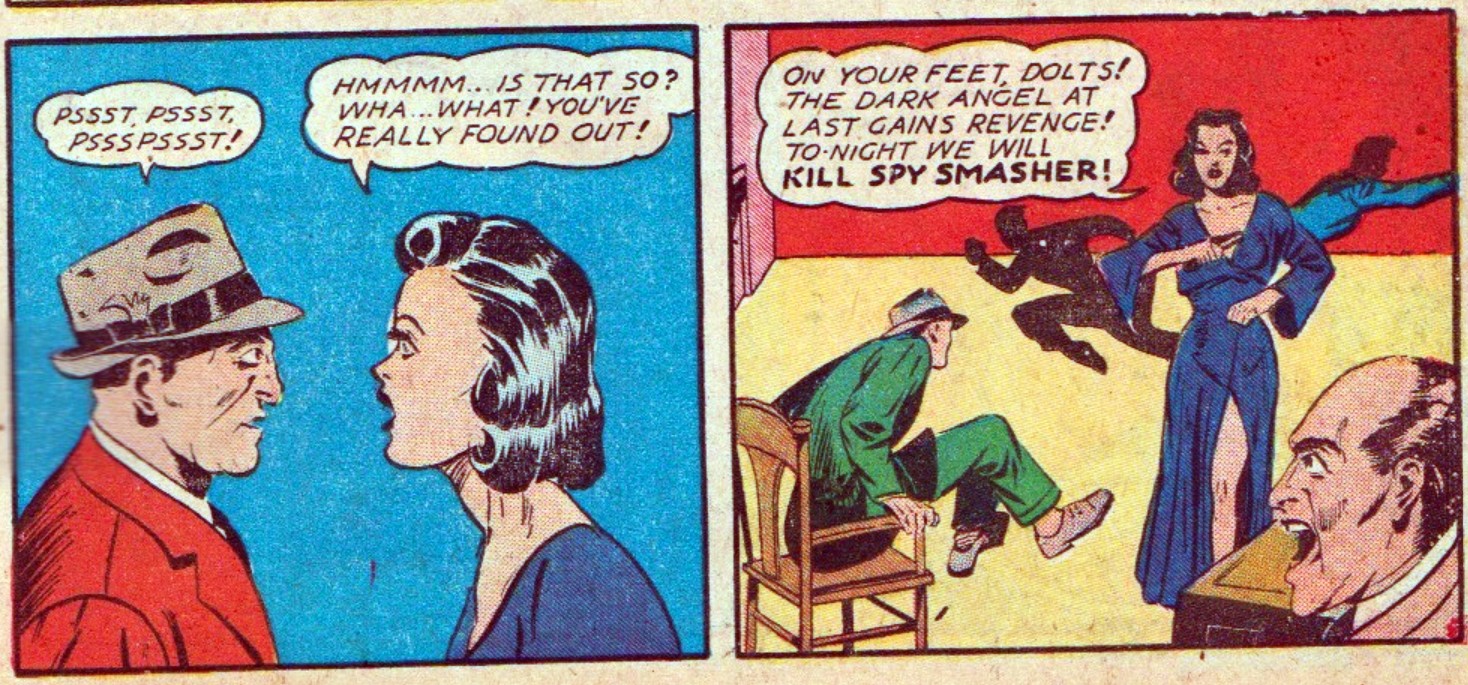
    We’ve entered 1941 and the crypto-fascist spies are getting closer and closer to being just plain old Nazis. Case in point: the Dark Angel, a classic femme fatale spy with just enough plausible deniability to satisfy comics’ compulsion to stay just barely technically politically neutral. 

    The Dark Angel’s name might be straight out of the mid-90s but her plans are 1941 all the way down. As the story opens she is sending two of her men to blow up a bridge and a factory and a bunch of soldiers, never imagining that Spy Smasher already has a comfortable vantage point to watch her give orders and thus is perfectly able to foil her schemes.

    Not one to wallow in defeat, the Dark Angel manages to turn the tables on Spy Smasher by discovering his secret identity* of Allan Armstrong and ambushing him in his own home. It’s honestly an impressive feat for a first-time-on-the-page villain!

    *well, technically one of her minions goes out and discovers it but if “employing competent henchmen” isn’t a key skill that many villains lack then what is it.

    A combination of sadism and unrequited love/lust inspires the Dark Angel to keep Spy Smasher alive with the knowledge that she and her men are off to assassinate the President rather than execute him immediately. Unfortunately for her/ luckily for Spy Smasher, she isn’t completely infallible in her choices of henchmen, as seen in the person of chosen Spy Smasher guard Fritzy, a drunken oaf who passes out almost immediately and whose body furnishes Spy Smasher with the knife he needs in order to escape.

    Though the Dark Angel and her guys get inside the White House with shocking ease, only to find not Franklin Delano Roosevelt but Spy Alan Smasher sitting in the President’s official comfy chair. Dark Angel and her guys are swiftly rounded up and chucked in jail and the fact that she and at least one of the guys knows his secret identity is just kind of ignored.