The Curse of Skeleton Munroe

Category: Harvey Comics

  • MINOR SUPER-VILLAIN 922: GENGHIS KHAN

    (Champ Comics 015, 1941)

    Okay, Genghis Khan. A lot of guys in comics like to call themselves Genghis Khan or claim to be his successor etc, and importantly they all seem to be into all the old Genghis Khan stuff like horse archers. Absolutely 100% stuff that Genghis was into at the time he was around of course, but I personally think that he would enjoy a machine gun if he had the chance. 

    Duke “the Human Meteor” O’Dowd is getting up to his usual day of driving cabs and palling around with his shoeshine boy pal Toby when suddenly the city is attacked by a mass of cavalry led by a shirtless giant wielding a flaming sword. This is Genghis Khan (a Genghis Khan, at least), and he is probably the Human Meteor’s only recurring foe, appearing in 3 (possibly 4, but Champ Comics 018 is currently AWOL) whole issues.

    A conquering giant cuts an intriguing figure, but the unfortunate thing about Genghis Khan is that the stories he appears in are pretty incoherent. There’s a plot, but everything other than the plot is just shiny bits glued on like sparkles. That said, here are the most interesting and intriguing things about him:

    1. Size and Origins

    Genghis Khan’s size remains fairly consistently enormous during his first two appearances – if anything, he might just be a bit bigger in the second one. His third appearance, however, shows him at a considerably reduced stature, from the third set of panel above in which he’s maybe ten feet tall to perhaps fifteen feet at maximum. Is this an indication that he can control his size or just a general disregard for continuity?

    The unanswered question of just what is up with this guy’s size is a symptom of the fact that he has no real origin. He just shows up one day, stomping around Manhattan. Is he even Mongolian? Not to put too fine a point on it, but I’ve read a lot of 1940s comics and I think that they would have drawn him differently if he was. 

    2. Technology

    The other major unanswered question about Genghis Khan is: just where did he get those wonderful toys? Such as… 

    His giant flaming sword that can also change its atomic structure on the fly, seemingly specifically so that the Human Meteor can’t pick it up.

    His cool dirigible base and its defensive screen of flamethrowers.

    The “sky road,” a transparent walkway that both men and horses can travel to and from the dirigible on, which need no support and must have some sort of crazy friction going on considering the angles that people are climbing it at.

    3. Goals

    Unsurprisingly, the self-declared successor of Genghis Khan, this fellow’s main goal is conquest. The attack on New York in his initial appearance is the first part of an attempted takeover of the US, for example.

    In Genghis Khan’s second appearance (Champ Comics 016, 1941), he is laying siege to the hidden, high-tech city of Bayakura, the place that Duke O’Dowd became the Human Meteor. 

    Though the Human Meteor drops a mountain on him at the end of that second appearance, Genghis Khan survives somehow (perhaps by shedding mass to allow himself to escape his mountain tomb? That’d be an interesting aspect of the character if it ever came up) and allies with the Japanese to harry the US fleet off China. The Human Meteor sinks the Khan’s entire fleet, and since he (probably) never appears again, drowning does what being crushed under a mountain failed to.

    Categorized in: Famous Figures (Genghis Khan), Real Folk (Genghis Khan), Supercrime (Attempted Conquest)

  • GENERIC COSTUMED VILLAIN ROUND-UP 037

    For the first time in a very long time: the generic costumed villains all have costumes! 

    Unnamed Costumed Gang: 

    This unnamed gang has gone to a heckuva lot of trouble to steal the Kalaka Emerald from millionaire Byron Nelson: they’ve dug out a secret lair under his weird mesa-top home, murdered several of his guests in order to create terror and of course dressed up like the background characters in a costume party scene, presumably also in order to create terror.

    Sadly for them, they have failed to reckon with two important facts: 1) that Nelson has already stolen his own gem in order to do a little insurance fraud and 2) that he has hired adventurer Lance Rand to protect the emerald and throw a bit of suspicion off of himself. Rand cleans up the costumed crew with ease, and bags Nelson to boot. (Cat-Man Comics 003, 1941)

    Puggsy Sloane: 

    When famed gorilla Monstro escapes from the Jenks Bros. Circus, the unnamed city is gripped with terror. And the terror is seemingly justified, as citizen after citizen is murdered by an ape and the police are unable to prevent it despite expending all of their manpower in order to do so. Lance Rand is once again on the case, however, and thanks to a tip-off that Monstro is in fact harmless from the circus owner is able to piece together the fact that it is not the gorilla doing the murders but gorilla-suited gang boss Puggsy Sloane. Why is he doing so? Why, to stretch the police force to the limit and distract them from all of the robbing that his gang was getting up to, of course. (Cat-Man Comics 004, 1941)

    Categorized in: Accessories (Style (Gorilla Costume)) 

    Dr Carl Resdale: 

    Dr Resdale, a famous plastic surgeon, has been operating a face-changing service for criminals out of the old disused family manor for the last twenty years and NOW the rest of the family is looking to use the manor and he has to scare them off by sneaking around in a mask and getting up to spookiness. And not only does he have to keep his young relatives from living in his place of work but he must conceal the fact that he killed his own brother in the manor twenty years before (this is why it’s disused). 

    Fear not for the younger Resdales, because Dr Miracle is on the case, the villain is soon deprived of his low-effort mask.  (Champion Comics 012, 1941)

    Brady: 

    A masked killer working for a gambling syndicate active in the Florida horse tracks, Brady’s signature weapon is a club with a horse shoe nailed to it to simulate a deadly horse kick to his victims’ heads. While a neat little murder weapon, this isn’t quite enough to help him when he comes up against Johnny Fox. (Champ Comics 015, 1941)

    Categorized in: Accessories (Weapons (Clubs)) 

  • MINOR SUPER-VILLAIN 921: THE SCALY DRAGON

    (Champ Comics 014, 1941)

    The Scaly Dragon is what I would consider to be a very by-the-book fascist saboteur with a better-than-average name. He does have a couple of noteworthy things about him though, including 1. the fact that he is a pseudo-Imperial Japanese spy rather than the much more common pseudo-Nazis that we usually see.

    2. Though the Scaly Dragon’s first couple of efforts were aimed at sabotaging the water supply of New York City (which is where the Human Meteor gets on his tail), his home base appears to be in Cincinnati, an oft-ignored city in comics.  

    3. After he is rounded up by the Human Meteor, we get a rare scene of the Scaly Dragon getting booked. Most of the time these guys end up dead or just dropped off directly at a prison courtyard, so this is a real treat – I suppose the next milestone we must look forward to is a super-villain mug shot.

    Categorized in: Animals (Dragons), Espionage (Saboteurs), Locations (Cincinnati)

  • MINOR SUPER-VILLAIN 920: MHERSA

    (Champion Comics 003, 1940/ Champ Comics 011, 1940)

    Half sister to the mercurial undersea tyrant Neptina, Mhersa originally appears as the head of the Maella, a rebel group comprised of female members of the same race of underwater beings as Neptina (I’m not going into that again). Mhersa and the Maella are isolationist but reasonable compared to Neptina’s capricious ways. (Champion Comics 003, 1940)

    The Maella help Lt Brad Fletcher off and on during his conflict with Neptina, but Mhersa’s next major move comes in Champ Comics 011, when she seizes the throne of Amloza while Neptina is out and about. Though this is a pretty reasonable act considering the way that the kingdom was being run, it is framed as villainous due to the fact that Neptina had just finished reforming her ways when she got the news. 

    Still, in my eyes Mhersa is still on the side of the angels, just trying to do right by the people of Amloza. Right up to the point that she surrenders the city to the fascistic King Walro of the Walrus Men in exchange for an easy life in his administration, that is. 

    Just why Mhersa does this is never explained – perhaps her opposition to her sister was less about justice and more about some sort of irrational rivalry and this is the best way that she can think of to spite her? (Champ Comics 013, 1941)

    Neptina and her allies (now including Prince Eon, former ruler of the Walrus Men and new Neptina love interest) prepare to take the fight to Mhersa, but before they get much further than their initial brainstorming session Neptina gets a psychic vision: Mhersa has left Amloza. It turns out that she was somehow less popular than her half sister and is now gone by popular demand. 

    Mhersa enlists the aid of King Walro in an attempt to murder Neptina outright that really cements my theory that this is all about sibling rivalry rather than differing opinions on good governance.

    Believing Neptina to be dead, Mhersa leads a force of Walrus Men to retake Amloza, only to be defeated, captured and jailed by her sister, never to be seen again. (Champ Comics 014, 1941)

    Categorized in: By Birth (Undersea Beings), Generica (Ends in A), Theft (Usurpers) 

  • MINOR SUPER-VILLAIN 920: MHERSA

    (Champion Comics 003, 1940/ Champ Comics 011, 1940)

    Half sister to the mercurial undersea tyrant Neptina, Mhersa originally appears as the head of the Maella, a rebel group comprised of female members of the same race of underwater beings as Neptina (I’m not going into that again). Mhersa and the Maella are isolationist but reasonable compared to Neptina’s capricious ways. (Champion Comics 003, 1940)

    The Maella help Lt Brad Fletcher off and on during his conflict with Neptina, but Mhersa’s next major move comes in Champ Comics 011, when she seizes the throne of Amloza while Neptina is out and about. Though this is a pretty reasonable act considering the way that the kingdom was being run, it is framed as villainous due to the fact that Neptina had just finished reforming her ways when she got the news. 

    Still, in my eyes Mhersa is still on the side of the angels, just trying to do right by the people of Amloza. Right up to the point that she surrenders the city to the fascistic King Walro of the Walrus Men in exchange for an easy life in his administration, that is. 

    Just why Mhersa does this is never explained – perhaps her opposition to her sister was less about justice and more about some sort of irrational rivalry and this is the best way that she can think of to spite her? (Champ Comics 013, 1941)

    Neptina and her allies (now including Prince Eon, former ruler of the Walrus Men and new Neptina love interest) prepare to take the fight to Mhersa, but before they get much further than their initial brainstorming session Neptina gets a psychic vision: Mhersa has left Amloza. It turns out that she was somehow less popular than her half sister and is now gone by popular demand. 
    Mhersa enlists the aid of King Walro in an attempt to murder Neptina outright that really cements my theory that this is all about sibling rivalry rather than differing opinions on good governance.

    Believing Neptina to be dead, Mhersa leads a force of Walrus Men to retake Amloza, only to be defeated, captured and jailed by her sister, never to be seen again. (Champ Comics 014, 1941)

    Categorized in: By Birth (Undersea Beings), Generica (Ends in A), Theft (Usurpers) 

  • DIVINE ROUND-UP 026

    I’ve finally caught up on my god backlog so these are all piping fresh deities for you to peruse.

    Itzalotahui:

    On an expedition to Guatemala to locate their missing friend John Malcolm, Billy Batson and Whitey Murphy make camp in the lost temple of the monkey god Itzalotahui and are awoken from their slumber by the god himself, flaming and steaming and flailing about.

    After an initial panic and an in-retrospect-embarassing fistfight, Captain Marvel discovers the truth: Itzalotahui is not alive but is in fact a cunningly-designed ball and socket arrangement in which the lower torso/socket is connected to a natural gas source and periodically ignites and wiggles around thanks to gas pressure.

    This issue is real study in contrasts: though the name of the fictional god is literally It’s a Lot of Hooey (in keeping with 1940s contempt for non-Christian or Classical religion), Captain Marvel actually seems to respect the cultural value of the site rather than just smashing it up like so many characters might. Meanwhile, the presence of natural gas means the probability of oil as well, but both Malcolm and Marvel advocate for leaving the area free from the hell of oil extraction, even if they do so in the most patronizing/patriarchal language possible.

    God Style: Idol (Whiz Comics 022, 1941) 

    the Angry God: 

    The
    Angry God, aka the Dark Spirit, is a near-forgotten entity whose last
    remaining priest has thrown in with the villain Half-Man and his Hitler
    stand-in boss the War Lord to lend mystical power to the armies of the
    Axis forces. The Angry God requires not just human sacrifice but the
    sacrifice of “great men,” which might go some way toward explaining his
    low levels of worshipper-retention. Please also note the fun imp-swarm
    that seems to accompany the worship of this particular god – they must
    be very distracting. 

    The
    Angry God’s status as a real entity and current diminished circumstances are
    both illustrated in the fact that it animates its idol in an attempt Ibis the Invincible from killing its priest and then itself falls dead once it is deprived of that one last worshipper.

    God Style: Real (Whiz Comics 023, 1941)

    Balka: 

    Balka
    is the guardian tiger spirit of the ruling line of the Asian country of
    Balkania, and whether the country was named after the tiger or vice
    versa is left unexplored in-text. What is made clear is that the
    old legends about the statue of Balka coming to life to avenge the death
    of murdered Balkanian monarch are absolutely true, as experienced by regicidal
    dictator and fashion maven Carnov after he kills good King Banok.

    Alas,
    Carnov is not torn asunder by Balka but spared by rightful heir Kelo (aka the Jungle Prince) so
    that he can face more conventional justice. Balka then returns to statue form to await the next threat to Balkania. (The Arrow 003,
    1941) 

    Quetzalcoatl: 

    Jungleman
    and his lover Louise Carson stumble upon a hidden Aztec city while
    searching for Louise’s father. Jungleman is briefly worshipped as
    Quetzalcoatl as per the legend about Hernán Cortés, while Louise is slated for sacrifice by a jealous high
    priestess. They manage to extract themselves from this situation with minimal fuss, for a 1940s adventure comic, and even find Louise’s father just kind of hanging around the temple on their way out. (Champion Comics 012, 1941)

  • MAD AND CRIMINAL SCIENTIST ROUND-UP 018

    I’m not sure that these guys all have degrees. 

    This fellow is known only as the Professor, and he conducts experiments in long- and short-range mind control on Lost Hope Island until Secret Naval Agent Spike Marlin shows up in search of a missing ship’s crew. (Speed Comics 009, 1940) 

    This unnamed scientist has developed a drug that puts people into indefinite comas and has used it to kidnap and store ten millionaires, presumably with the intent of ransoming them back to their families. Before he actually gets to the point of sending the ransom notes, however, he makes the mistake of allowing his gangster hirelings go out and use the drug to mug people on the street, thus leaving a trail of mysterious coma victims that the indomitable Detective Crane follows all the way to the scientist’s secret penthouse. (Superworld Comics 002, 1940)

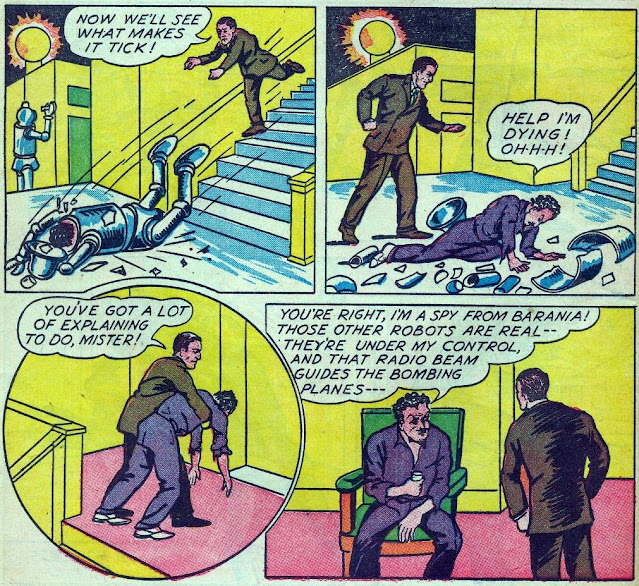
    Detective Crane is back to investigate the destruction of several West Virginian steel mills. It turns out that remote controlled drone bombers are responsible for the attacks, and he trails them back to a base near Pittsburgh filled with awesome robots, plus one Baranian spy who is merely dressed like a robot, presumably in case someone like Crane were to show up. The whole place gets absolutely annihilated.(Superworld Comics 003, 1940)

    Overworked and underappreciated Department Public Sanitation scientist Dr Sheldon might be justified in his workplace dissatisfaction but he expresses his negative emotions in an unproductive manner, by poisoning the city reservoir and killing thousands of people. It must be cathartic though, because the Arrow has to shoot him with one of his trademark arrows in order to prevent him from poisoning the reservoir even more than it was before. (The Arrow 002, 1940)

  • MAD AND CRIMINAL SCIENTIST ROUND-UP 018

    I’m not sure that these guys all have degrees. 

    This fellow is known only as the Professor, and he conducts experiments in long- and short-range mind control on Lost Hope Island until Secret Naval Agent Spike Marlin shows up in search of a missing ship’s crew. (Speed Comics 009, 1940) 

    This unnamed scientist has developed a drug that puts people into indefinite comas and has used it to kidnap and store ten millionaires, presumably with the intent of ransoming them back to their families. Before he actually gets to the point of sending the ransom notes, however, he makes the mistake of allowing his gangster hirelings go out and use the drug to mug people on the street, thus leaving a trail of mysterious coma victims that the indomitable Detective Crane follows all the way to the scientist’s secret penthouse. (Superworld Comics 002, 1940)

    Detective Crane is back to investigate the destruction of several West Virginian steel mills. It turns out that remote controlled drone bombers are responsible for the attacks, and he trails them back to a base near Pittsburgh filled with awesome robots, plus one Baranian spy who is merely dressed like a robot, presumably in case someone like Crane were to show up. The whole place gets absolutely annihilated.(Superworld Comics 003, 1940)

    Overworked and underappreciated Department Public Sanitation scientist Dr Sheldon might be justified in his workplace dissatisfaction but he expresses his negative emotions in an unproductive manner, by poisoning the city reservoir and killing thousands of people. It must be cathartic though, because the Arrow has to shoot him with one of his trademark arrows in order to prevent him from poisoning the reservoir even more than it was before. (The Arrow 002, 1940)

  • REAL PERSON ROUND-UP 013

    REAL PERSON ROUND-UP 013

    Yet again we have a selection of comic book appearances of real-style people for you to enjoy.

    Adolf Hitler:

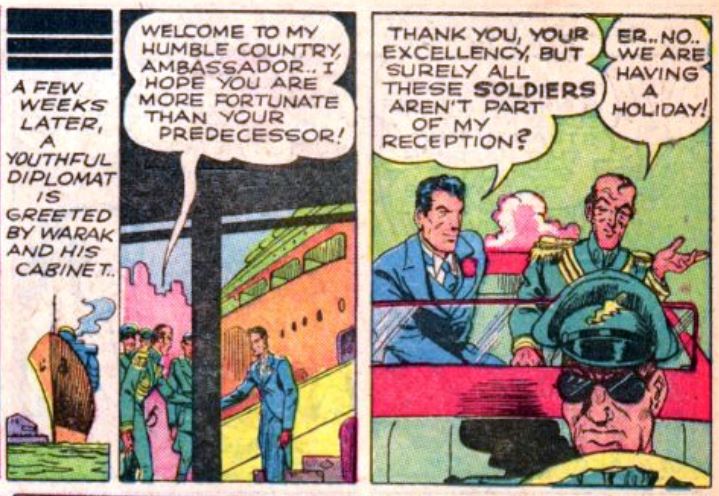
    Warak, dictator of Barbaria is a bit generic as far as pseudo-Hitlers go, but a pseudo-Hitler he is. (Smash Comics 017, 1940)

    Scraggs, leader of the Green Shirts, is very much a “make the leader look like Hitler as shorthand for These Guys Are Fascists” character, a subspecies that will nearly die out some time in 1941 but survives in small numbers to this day. (Startling Comics 001, 1940)

    Devil’s Island: 

    Black X has himself sent to, and then escapes from, Devil’s Island in order to secure a fellow prisoner with valuable US defense secrets in his head. (Smash Comics 013, 1940)

    FDR:

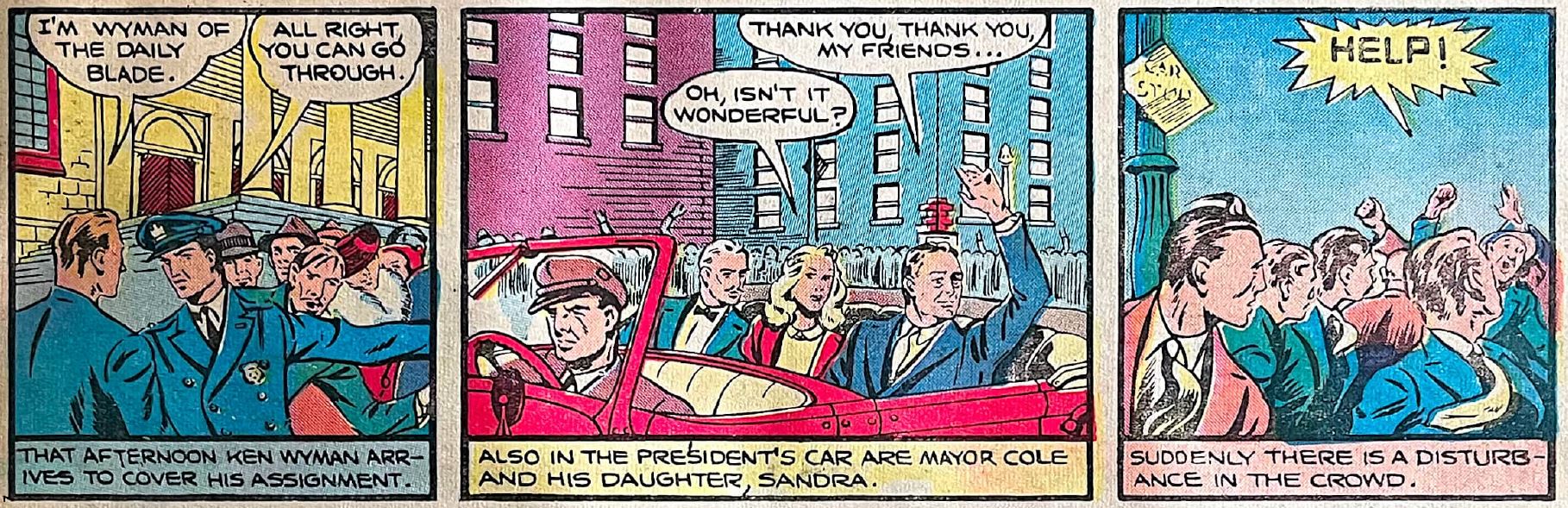
    An off-model Roosevelt visits Carterville and is kidnapped by Devil’s Dagger nemesis Jeff Marlowe (and thus retroactively by Marlowe’s boss Mr H). This is a wild move for a regional crime boss to pull! (Master Comics 006, 1940)

    Gill Fox:

    Probably a different guy to the last “Gil Fox” to appear in a Clip Chance comic – this one is just a small town baseball player. (Smash Comics 015, 1940)

    Groucho Marx:

    Goucho’s look lifted wholesale for this unnamed comedy character. (Star Comics 010, 1938)

    Hollywood:

    Autograph hound adds Shock Gibson to her collection along with “Cary Trooper” and “Glark Cable,” aka Gary Cooper and Clark Gable. (Speed Comics 009, 1940)

    Joe Devlin: 

    Given the prior instance of Joe Devlin being referenced in a Clip Chance story I must assume that the “John Devlin” mentioned here is another. (Smash Comics 014, 1940)

    Joseph Stalin:

    The Three Aces (but not the DC Comics Three Aces, the Harvey Comics ones) transport three anthropology-minded sisters to Paraguay to study the Guató people and stumble upon a plot by the sinister witch doctor Ni Lats to bring all under his sway via hypnotic mind control, for which crime he is drowned in a swamp.

    (slight aside: the Guató are a real people being used as set dressing for an exotic locale, and weirdly, in checking to see if that was the case I’m pretty sure I stumbled across the exact reference that Klaus Nordling drew from – every detail in the brief entry on the Guató in the 1911 Encyclopedia Britannica is reflected in the story. The mind control thing is added plot) (Speed Comics 010, 1940)

    Samuel Goldwyn:

    Is this movie producer named Sam meant to be Samuel Goldwyn or merely a lookalike reference to him? Regardless, this is clearly Samuel Goldwyn. (Speed Comics 010, 1940)

  • REAL PERSON ROUND-UP 013

    REAL PERSON ROUND-UP 013

    Yet again we have a selection of comic book appearances of real-style people for you to enjoy.

    Adolf Hitler:

    Warak, dictator of Barbaria is a bit generic as far as pseudo-Hitlers go, but a pseudo-Hitler he is. (Smash Comics 017, 1940)

    Scraggs, leader of the Green Shirts, is very much a “make the leader look like Hitler as shorthand for These Guys Are Fascists” character, a subspecies that will nearly die out some time in 1941 but survives in small numbers to this day. (Startling Comics 001, 1940)

    Devil’s Island: 

    Black X has himself sent to, and then escapes from, Devil’s Island in order to secure a fellow prisoner with valuable US defense secrets in his head. (Smash Comics 013, 1940)

    FDR:

    An off-model Roosevelt visits Carterville and is kidnapped by Devil’s Dagger nemesis Jeff Marlowe (and thus retroactively by Marlowe’s boss Mr H). This is a wild move for a regional crime boss to pull! (Master Comics 006, 1940)

    Gill Fox:

    Probably a different guy to the last “Gil Fox” to appear in a Clip Chance comic – this one is just a small town baseball player. (Smash Comics 015, 1940)

    Groucho Marx:

    Goucho’s look lifted wholesale for this unnamed comedy character. (Star Comics 010, 1938)

    Hollywood:

    Autograph hound adds Shock Gibson to her collection along with “Cary Trooper” and “Glark Cable,” aka Gary Cooper and Clark Gable. (Speed Comics 009, 1940)

    Joe Devlin: 

    Given the prior instance of Joe Devlin being referenced in a Clip Chance story I must assume that the “John Devlin” mentioned here is another. (Smash Comics 014, 1940)

    Joseph Stalin:

    The Three Aces (but not the DC Comics Three Aces, the Harvey Comics ones) transport three anthropology-minded sisters to Paraguay to study the Guató people and stumble upon a plot by the sinister witch doctor Ni Lats to bring all under his sway via hypnotic mind control, for which crime he is drowned in a swamp.

    (slight aside: the Guató are a real people being used as set dressing for an exotic locale, and weirdly, in checking to see if that was the case I’m pretty sure I stumbled across the exact reference that Klaus Nordling drew from – every detail in the brief entry on the Guató in the 1911 Encyclopedia Britannica is reflected in the story. The mind control thing is added plot) (Speed Comics 010, 1940)

    Samuel Goldwyn:

    Is this movie producer named Sam meant to be Samuel Goldwyn or merely a lookalike reference to him? Regardless, this is clearly Samuel Goldwyn. (Speed Comics 010, 1940)