The Curse of Skeleton Munroe

Category: thief

  • GENERIC COSTUMED VILLAIN ROUND-UP 003

    Yet another collection of also-rans and never-weres.

    Philip White: 

    Philip White here got exactly one panel into his career as a masked spy chief before Madam Fatal unmasked him. (Crack Comics 014, 1941)

    Basil: 

    An auctioneer named Basil ran an overly complicated scheme to steal the fabled Five Bloodstones of Mu. His plans were also undone by Madam Fatal and ended in his grisly demise. (Crack Comics 016, 1941)

    Unnamed Crook: 

    This unnamed thief almost got away with the Dare Diamond under the very nose of detective Larry Steele. (Detective Comics v1 049, 1941)

    Howard: 

    A baseball pitcher named Howard got up to some shady betting schemes and ended up a generic costumed villain. Let this be a lesson, kids. Also part of his big plan involved shooting himself in the arm with a gimmicked up baseball mitt-gun, which is an early sign that you might not be cut out for costumed villainy. (Detective Comics v1 052, 1941)

  • MINOR SUPER-VILLAIN 215: THE THREE DEVILS

    (Detective Comics v1 050, 1941) 

    The Three Devils are an early example of a fairly common minor super-villain archetype: the acrobat who turns their skill to criminal ends (and of course this is a subset of “circus folk who use their talents for crime” which itself is a subset of “talented professional turns their talent to crime” and then I guess above that is “criminals”). 

    I don’t think I’m going to bother calling it out every time it happens but they also appear in an early example of what will eventually be a staple of Batman story structure through the 60s, told in three acts:

    Act I: the villain’s novel methods allow them to triumph over Batman and Robin and get away with their goal – a lot of stories following this structure take place after the Comics Code, so usually this is a theft of some kind.

    Act II: Batman and Robin foil the villain’s scheme but they still get away.

    Act III: the villain is captured while attempting to achieve their goal.

    In this case, the Three Devils are flung to their deaths from a clock tower rather than being captured but like I said, it’s an early iteration of the format. It’s also a format that I noticed while reading Silver Age Batman stories, so it’ll be interesting to take note of how it develops and how much it is reflected in other super-hero comics of the time.

    The other interesting thing about the Three Devils is that despite falling to their deaths in 1941 they return in Batman Comics v1 107 in 1957 as the Daredevils:

    Now, I learned about this Three Devils/Daredevils connection on a fan wiki and so approached it with some skepticism but damned if they weren’t right about this one:

    They even use the same fence!

    Now 1957 is a tricky year – Barry Allen had just debuted as the Flash; Martian Manhunter is running around… this could just be an Earth-One retelling of the Three Devils story, scrubbed of some supernatural cruft. Or these could be the same characters, not actually dead after all – this is the kind of thing that inspired nerds to come up with stuff like Earth-Two-A and Earth-B and so forth.

  • MINOR SUPER-VILLAIN 215: THE THREE DEVILS

    (Detective Comics v1 050, 1941) 

    The Three Devils are an early example of a fairly common minor super-villain archetype: the acrobat who turns their skill to criminal ends (and of course this is a subset of “circus folk who use their talents for crime” which itself is a subset of “talented professional turns their talent to crime” and then I guess above that is “criminals”). 

    I don’t think I’m going to bother calling it out every time it happens but they also appear in an early example of what will eventually be a staple of Batman story structure through the 60s, told in three acts:

    Act I: the villain’s novel methods allow them to triumph over Batman and Robin and get away with their goal – a lot of stories following this structure take place after the Comics Code, so usually this is a theft of some kind.

    Act II: Batman and Robin foil the villain’s scheme but they still get away.

    Act III: the villain is captured while attempting to achieve their goal.

    In this case, the Three Devils are flung to their deaths from a clock tower rather than being captured but like I said, it’s an early iteration of the format. It’s also a format that I noticed while reading Silver Age Batman stories, so it’ll be interesting to take note of how it develops and how much it is reflected in other super-hero comics of the time.

    The other interesting thing about the Three Devils is that despite falling to their deaths in 1941 they return in Batman Comics v1 107 in 1957 as the Daredevils:

    Now, I learned about this Three Devils/Daredevils connection on a fan wiki and so approached it with some skepticism but damned if they weren’t right about this one:

    They even use the same fence!

    Now 1957 is a tricky year – Barry Allen had just debuted as the Flash; Martian Manhunter is running around… this could just be an Earth-One retelling of the Three Devils story, scrubbed of some supernatural cruft. Or these could be the same characters, not actually dead after all – this is the kind of thing that inspired nerds to come up with stuff like Earth-Two-A and Earth-B and so forth.

  • MINOR SUPER-VILLAIN 205: THE JACKAL

    (Crack Comics 017, 1941)

    Like the Cloak before him, the Jackal started out as a fictional villain: made up by promoter Paxton Forbes to obfuscate his own role in murdering sea Captain Bly and stealing his treasure map. But if you do the very things you say that a villain has done, I would contend that you are, in fact, that villain. And Madam Fatal agrees, so there.

  • MINOR SUPER-VILLAIN 205: THE JACKAL

    (Crack Comics 017, 1941)

    Like the Cloak before him, the Jackal started out as a fictional villain: made up by promoter Paxton Forbes to obfuscate his own role in murdering sea Captain Bly and stealing his treasure map. But if you do the very things you say that a villain has done, I would contend that you are, in fact, that villain. And Madam Fatal agrees, so there.

  • MINOR SUPER-VILLAIN 196: THE JESTER

    (Crack Comics 010, 1941) 

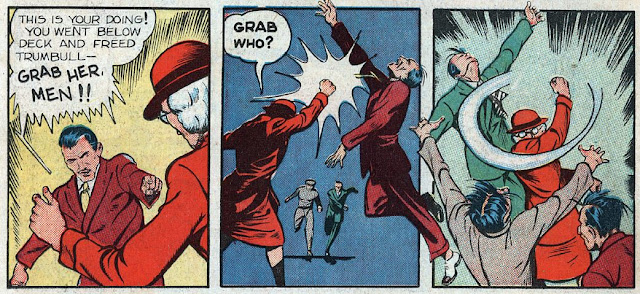
    The Jester is your standard costumed thief. He commits a series of daring robberies that would in the normal course of things land him in the slammer at the end of a super-hero’s fist.

    But before Madam Fatal, the hero of this particular feature, can get around to the business of stopping the Jester, the man himself shows up, knocks out Fatal’s civilian guise Richard Stanton and kidnaps his friend Professor Mason. OR DOES HE?

    No, he doesn’t. It turns out that a gang of crooks is framing the real Jester in order to avoid suspicion, but since the Jester is in actuality Professor Mason’s estranged son Robert, a rare hero-villain teamup ensues, Professor Mason is rescued and the usually absolutist morality of the Golden Age takes a break as the Jester is allowed to leave having fulfilled his filial duty.

  • MINOR SUPER-VILLAIN 188: THE SKULL GANG

    (Crack Comics 006, 1940)

    What makes them a super-villain (group)? They’re a gang of thieves who are so devoted to this generic hooded guy that they all take small doses of arsenic to give themselves an emaciated skeletal appearance! The penalty for not thieving enough is death! What a dumb thing to dedicate your life to! Absolutely they qualify as a team of very stupid super-villains.

    SKULL SCORE: 1/5 Bald guys with gritted teeth just don’t cut the mustard, I’m afraid.

  • MINOR SUPER-VILLAIN 186: THE JAY BIRD

    MINOR SUPER-VILLAIN 186: THE JAY BIRD

    (Crack Comics 005, 1940) 

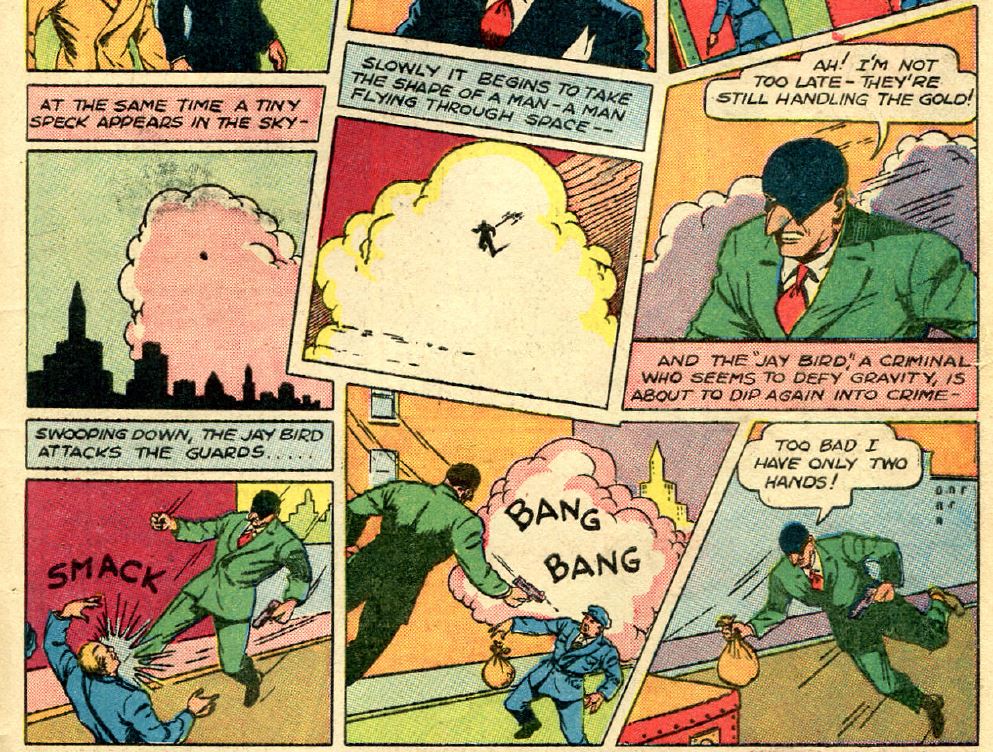
    The Jay Bird is one of my favourite minor super-villains of all time, I reckon. He’s just a guy in a bird mask with a gimmick that is simultaneously very simple and far too complex and dangerous: he simulates flight via a very long tether that is dangling him from a plane. Thus equipped, he swoops down and robs various targets on the streets of New York City, quipping all the time. He’s great!

    The real unsung hero here has to be his pilot, Spike, for managing to not smear the Jay Bird across a skyscraper the first time they tried this. What a guy! Sadly he was killed in the Jay Bird’s encounter with the Clock.

  • MINOR SUPER-VILLAIN 174: THE LIMPING MUMMY

    (Bulletman 002, 1941)

    I cannot tell a lie: I love a fake mummy. I can’t help it – there’s something about a crook going to the trouble of wrapping themself up in old linen that is very endearing to me. And as with our friend here, they often have a modifier to distinguish them from the workaday mummies that you see everywhere. They’re a Golden Mummy or a Missing Mummy, or, as with our boy here, a Limping Mummy.

    The actual reason for mummying up is usually the same: disguise yourself so that you can rob a museum or steal some Egyptian artifacts or steal some Egyptian artifacts from a museum. The reason our guy is a limping mummy is that he decided to add another layer to his disguise and throw suspicion on Benhurst the museum director, who walks with a cane.

    And then, he attempts a third layer of obfuscation by using his civilian identity, newspaper editor Jason Hilder, to slam the police for not being able to deal with all these mummy crimes! This is actually a terrible idea, since Hilder wasn’t at all involved before and he actually ends up getting caught because he takes it too far and attacks Sergeant Kent of the police for… some reason? The Limping Mummy’s plot doesn’t really hold together is I guess what I’ve been trying to lay out here.

  • MINOR SUPER-VILLAIN 167: ARMO

    (Blue Beetle v1 007, 1941)

    What makes them a super-villain? It’s the helmet! That kind of welder’s mask-looking helm is the key to my super-villain-appreciating heart. Otherwise, Armo is a gang boss who robs armoured cars and ends up launching himself into the sea while trying to run down the Blue Beetle.

    Honestly, Blue Beetle antagonists in this era are almost all guys in suits wearing masks but otherwise acting like standard gang bosses. If I didn’t include the filter of having to be just a leetle bit interesting this blog would be a parade of unnamed guys with brown/ white/ blue masks for weeks. Just chumps for days.