The Curse of Skeleton Munroe

Category: thief

  • MINOR SUPER-VILLAIN 912: COMMANDER DARKE

    MINOR SUPER-VILLAIN 912: COMMANDER DARKE

    (Bang-Up Comics 001, 1941)

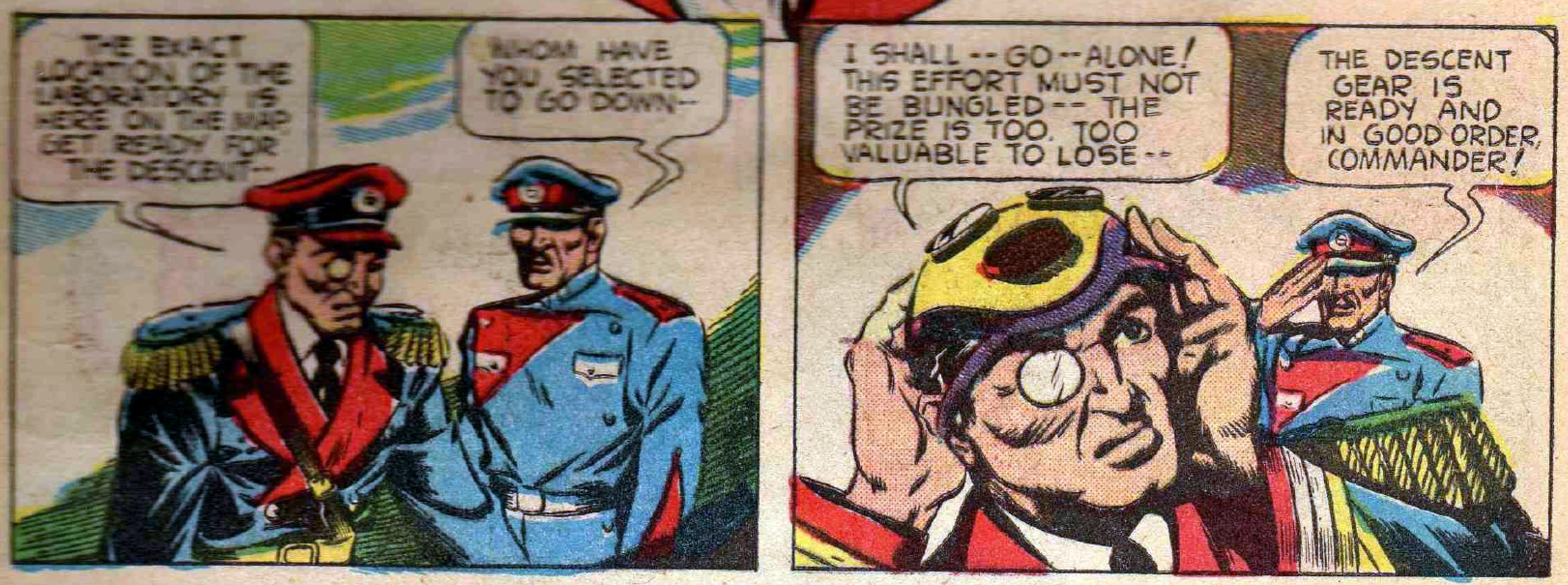
    Commander Darke, though ostensibly on a mission to invade the United States with his private military, is the arch-foe of scientist-adventurer Cosmo Mann and as such spends his entire career trying to Steal Those Gizmos. Perhaps things would be different if there had been more than three issues of Bang-Up Comics for Darke and Mann to clash, but as it stands all we get are the opening moves of their epic struggle.

    You probably already took note of the extreme ostentation on display in Commander Darke’s (almost certainly self-designed) uniform, but the seriousness with which he takes his wardrobe is really underscored in the above panels in which we can not only see that he took the care to screw in his monocle even when waking up in the middle of the night to take a call but that even his double-breasted pyjamas have epaulettes on them. 

    I was all ready to give Darke a bit of credit for undertaking the mission to secure Cosmo Mann’s Sun Ray Gun himself, but once he left his captured underlings behind to die in a cloud of poison gas I was forced to reevaluate: going himself is a part of his being a Bad Boss, an expression of his disdain for the ability of his minions to do even this simple task. He does have a cool-looking gas mask though.

    Commander Darke has a lot of villainous presence or potential, but never really gets a chance to show it off: he captures the Sun Ray and a man who he thinks is Cosmo Mann but turns out to be his assistant Archy and then spends his next appearance on the back foot as Mann attempts to recapture them from Darke as he escapes in his dirigible. His particular brand of bombastic villainy was lost to the vagaries of the comic book boom, alas.

  • MINOR SUPER-VILLAIN 905: THE MISSING MUMMY

    (Whiz Comics 020, 1941)

    Racing to the Hayten Museum in New York City in response to a plea for assistance, super-detective Dan Dare discovers a body upon arrival and is immediately accused of being the murderer by what turns out to be his employers, once everything is cleared up.

    It turns out that these men are either archaeologists or the kind of genteel looters who supplied museums back in the day, and that they recently opened a cursed Egyptian tomb along with four others who have since been murdered. The murderer: someone claiming to be the former occupant of that tomb and calling themself the Missing Mummy, who is demanding the return of an emerald that was stolen by one of the expedition members.

    The Missing Mummy’s depredations are clearly designed to flush the emerald thief out of hiding, and it works, as that night one of the remaining four (named Stackley, fyi) retrieves the gem from its hiding place in the museum (did I mention that these guys all live in the museum? Because they do) and makes a break for it, only to be killed and relieved of his prize before he can get away. Meanwhile, assistant Carol Clews is kidnapped out from under Dan Dare’s nose while he is examining the mysterious return of the lower-case missing mummy, because the upper-case Missing Mummy is of course one of the remaining three expedition members.

    Dan manages to literally stumble into the Mummy’s secret lair and is forced to shoot him dead rather than allow him to kill Carol (and just why did he kidnap her in the first place? Love of the game I guess). Upon unmasking the Missing Mummy, he is revealed to be Hector Brown, the man who hired Dan in the first place, and as someone who has read all of the Dan Dare stories let me tell you: I was not shocked. I’d estimate that up to a quarter of all of Dare’s clients are actually the guilty party attempting to give themselves a veneer of innocence. It never works of course, but just like the fact that dressing up like a mummy and killing off the members of a group that you also belong to only serves to reduce the pool od suspects to a manageable level until you are caught, it’s the kind of lesson that you only learn after it’s too late.

    Terrific as always to see a fake mummy running around in a comic. No note, keep them coming.

  • MINOR SUPER-VILLAIN 890: THE BLACK CLOWN

    (Wow Comics 003, 1940)

    The circus is in town! And in what must be a complete coincidence, a circus-themed villain murders a prominent banker using a python! And did I mention that the circus has a big box full of pythons as one of its attractions? 

    As someone who sincerely enjoys clown- and circus-themed villains despite having no particular affection for either in real life I have to say: do a bit better, the Black Clown. Like, try a bit harder to conceal just exactly who you are. Especially don’t leave a note on the body of the banker you just murdered that basically says “I did this because you didn’t give me, a clown-man, a business loan.” Plausible deniability, man.

    He does have a great Evil Clown costume, though.

    I’ll give the Black Clown this: at least he tries to rob the bank after revenge-killing the banker rather than merely exult in the downfall of his enemy. This robbery is also where we learn that the Black Clown has a whole circus of crime thing going on to match his theme, as he employs a sideshow thin man to slip through the bank’s bars and let the rest of the crew in.

    Though Mr Scarlet interrupts the robbery he is unable to prevent the Black Clown and his crew from escaping, as he is being crushed to death by a python at the time. Or is he? No, he is too strong.  

    The Black Clown next attempts to murder Petrie, the partner of the first victim, but at this point we are firmly in the part of the comic where the hero has the villain in his sights and none of his schemes shall profit. The Black Clown escapes with the help of some acrobats and Petrie lives on to deny loans another day.

    Probably the most interesting thing about this sequence is that the Black Clown gains entrance to Petrie’s apartment via a fellow named Tiny Tom who slips through the transom and opens the door. Given the name and the theme of the gang (and the initial shot of his legs as they slip out of sight) one would expect Tiny Tom to perhaps be little person of some kind, perhaps a sideshow performer, but he’s on-hand throughout the fight in Petrie’s apartment (that’s him in the blue suit) and he’s just about half a head shorter than everyone else. Is it just a particularly rough nickname or did the initial Tiny Tom concept get lost in the shuffle?

    Hearkening back to my initial critique of the Black Clown: it is in fact so obvious who this guy is that Mr Scarlet has to be interrupted twice in two different conversations over the course of three panels rather than learn it too early. And he doesn’t bother to ask Mr Petrie to shout it at him on the way out the door.

    After a final battle with a sideshow wild man and a chase through the trapezes the Black Clown is finally captured and OF COURSE it turns out to be Henry Parrish, the circus owner, who is OF COURSE mad about a rejected business loan. CHOOSE YOUR SUPER-VILLAIN THEME MORE WISELY is what I’m trying to get at.

    REVENGE KILLER SCORE: 1/2 

  • MINOR SUPER-VILLAIN 878: MR NIMBUS

    (Zip Comics 009, 1940)

    Mr Nimbus is a simple kind of crook: he has developed or otherwise acquired a liquid that creates a corrosive green gas and he is going to use that to kill people and steal riches from them. No dreams of world domination, no grand designs, just good old fashioned murder and robbery. But also no especial care taken, as he leaves behind a very big clue to the location of his next crime for the Scarlet Avenger and his Operative 1, Inez Courtney to find.

    Mr Nimbus dutifully shows up to gas the Metropolitan Opera House and steal all of the jewellery on display in the audience, but thanks to his carelessness the Scarlet Avenger is there to prevent any rich people from getting killed. Too bad about the performers, though. The downside to being a simple kind of crook, I guess, is that you are also quite predictable.  

    Everything comes to head on the Opera House roof, from which Mr Nimbus takes what should be a fatal fall, only to be missing when the Scarlet Avenger checks for his body, like a proverbial Michael Myers. Look out for him in the 1941 run of Zip Comics! Will my whole “simple guy” thesis hold up? Who knows!

    (Mr Nimbus also has a cool hypnotic ring but it didn’t fit the narrative I was building about him being a simple, one-trick villain. The thesis was already flawed) 

  • MINOR SUPER-VILLAIN 854: THE BEAST

    (Weird Comics 009, 1940)

    The Beast is the Eagle’s first and perhaps only recurring foe, and it’s unfortunate that he makes his first appearance at the very end of the 1940 run of Weird Comics because I really want to highlight the similarities between the Beast and his fellow Luis Cazaneuve creation the Rook, but danged if I have enough material for a real compare-and contrast on them yet. For now, we’ll just hit the obvious, such as the fact that they look very similar, right down to their staring eyes. Not the hair, though.

    The Beast’s focus in this story is on stealing a treasure map that just happens to be concealed in an ornamental box owned by Bill “the Eagle” Powers, which is as easy a way to involve the hero in the story as comics has come up with. His criminal tools of choice in this endeavour are a fairly gnarly clawed prosthetic hand from which he presumably derives his name and a poisoned blowgun which I am very interested to see if he keeps on using.

    The second point of comparison between the Rook and the Beast is the fact that they both have a criminal antagonist, in this case a gang boss known as the Gimp, who the Beast hires to retrieve the box initially and then double crosses once it’s time to pay for his services. The Gimp really comes into his own in 1941, when he starts using his signature weapon, an artificial leg with a knife on the end. For now we must simply assume that he’s kicking the Beast with a wooden foot.

    I’m calling this one based on very little evidence, but I reckon that the third commonality between the Rook and the Beast is going to be Seemingly Dying at the End of Each Adventure, based on the fact that the Beast does just that at the end of this one. See you next year, Beast!

  • MINOR SUPER-VILLAIN 837: THE SKULL

    (Top-Notch Comics 009, 1940)


    The Skull is the recurring foe of the Golden Age Black Hood, and as is common for such characters he is a kind of generalist super-villain willing to dabble in everything from theft to kidnapping to espionage to murder as circumstances dictate. He even indulges in a little housebreaking on occasion, and it is while doing so that he is interrupted by police officer Kip Burland, who he frames for the crime and then eventually attempts to have murdered when he refuses to give up on proving himself innocent. 

    This of course is the origin of the Black Hood, as Burland recovers and trains under the tutelage of one of the Skulls other victims. Accidentally creating your own nemesis is one of the occupational hazards of being a successful super criminal, after all, and the Skull is so successful as he kind of did it twice, as Kip Burland’s mentor is a different lawman who the Skull framed and ruined who swore revenge on him but then took too long preparing and had to be content with weaponizing another to do the deed.

    By the time that Kip Burland is prepared to go into action as the Black Hood, the Skull has devised the first of what I now recognize as his signature: an overcomplicated scheme. Specifically, he has targeted the debut/masquerade ball being held for wealthy socialite Barbara Sutton, and has not only informed all of the guests that they must show up in their best jewelry so that he can steal it but has also announced his plans in the papers. I think that the intent is to ensure compliance through fear, but it really seems like he’s just introducing ways that his scheme can go wrong.

    The Skull’s instructions are clear: he will steal the jewels off of the guests during the party and they are to keep quiet about it. None of them manage this, and each victim ends up being killed via a blowgun dart tipped with a poison that turns the human head all green and corpsey. Plus – and this is hard to see but trust me – the dart leaves a little skull-shaped mark at the point of contact.

    The Black Hood eventually works out how the Skull is doing all this: he has disguised himself as hostess Mrs Sutton and has been shooting the darts out of a blowgun shaped like a cigarette holder. One dunk in an oversized decorative vase later, the case is solved!

    (also please note that the Black Hood is in attendance in costume as himself. It still counts even if this is his first public appearance in costume) 

    After the Black Hood turns the Skull in to the police at the end of his first costumed adventure, his ally the Hermit predicts that they will be unable to hold him, and what do you know but he’s right. The Skull dramatically breaks jail and immediately puts another overly complicated scheme into action. Major Quentin Duff has invented the unspecified-but-presumably-valuable Iota Ray, and the Skull wants it, but is not prepared to do anything so simple as to steal the plans. Instead, he implements a simple three-part plan:

    Step One: ambush Major Duff at his house and murder him just after he hands the Iota Ray plans over to Mrs Duff for safekeeping. 

    Step Two: While Mrs Duff and Barbara Sutton are taking the plans from Washington DC via train, kidnap Duff and gaslight Sutton into believing that she was never there. This requires at least a half-dozen confederates as well as an appearance by the Skull as a Dr van Luks, a backward name so annoying that I audibly groaned when I worked it out.

    Step Three: Once the plan falls apart, just try to murder everyone and take the plans off of Mrs Duff’s body. Please note that this step was an option from the start, and that the theft could have been committed using the Major’s gruesome murder as cover.

    As 1940 draws to a close, the Skull is left shaking his fist after a speeding train as the Black Hood escapes with the plans. We will see him again in 1941!

    SKULL SCORE: A very generous 2/5, considering that this particular Skull isn’t actually missing any facial features. The combination of his emaciated face, sunken eyes and perpetual rictus goes a long way nonetheless. Plus he’s green.
  • MINOR SUPER-VILLAIN 828: THE BLACK TERROR

    (Thrilling Comics 006, 1940)

    The Central Art Museum has a problem: a cloaked figure who creeps through the halls at night, murdering the guards and making off with their bodies. To make things worse, the investigation is being led by the boorish Inspector Cavanaugh, the Woman in Red’s new and very annoying comic foil, who I regret to inform you is a permanent addition to her cast.

    But speaking of the Woman in Red, she is also on the case. As Peggy Allen, she works as secretary to the museum director Dr Grier while patrolling the museum at night in her costumed identity… while Cavanaugh gets in the way to the extent that he prevents her from saving the Black Terror’s second victim. 

    It’s not a particular surprise when the Black Terror turns out to be the assistant museum director, Mr Tyler, as the story has only two real suspects, him and Dr Grier. Tyler turns out to have adopted the Black Terror persona in order to cover for some jewel thefts that nobody had actually cottoned on to yet – I can only conclude that he had the (fairly elaborate) costume ready to go and was just looking for an excuse, because this is definitely the kind of crime that isn’t helped by a series of high-profile murders.

  • MINOR SUPER-VILLAIN 823: ELECTRU

    MINOR SUPER-VILLAIN 823: ELECTRU

    (Thrilling Comics 004, 1940) 

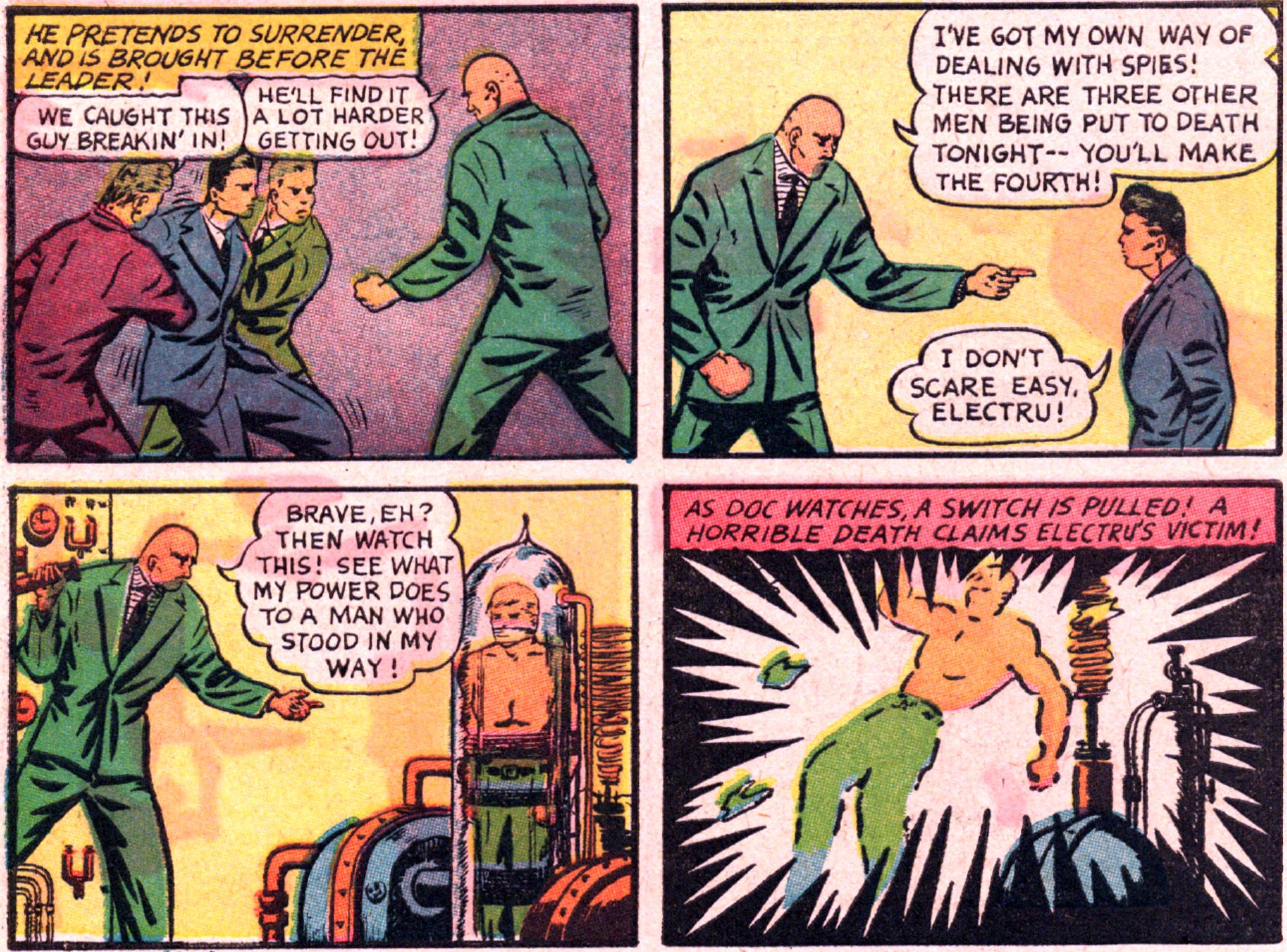
    Electru, aka the Giant Electru, is a giant guy with electrical powers. He also has a large gang armed with various electric ray guns and so forth. There’s not a lot to explore about him if I’m honest, but he does inspire a few questions:

    1. Just where did Electru come from? We never get an idea of how Electru acquired his great size, his incredible strength or his control over electricity. Are they as a result of his mastery of such things as electric ray guns and broadcast power or the inspiration for his research into them? Did Electru develop his gang’s technology at all or is there some poor uncredited criminal scientist somehwere? No answers are forthcoming. Also please note that Electru is robbing the NYC Subtreasury in the top set of panels.

    2. Just what was Electru up to? While the bulk of Electru’s efforts were directed at bank robbery, there is the possibility that he had some greater aim in mind, as his first act is to attack the Panama Canal and he eventually steals an entire cruiser from the US Navy. Is all this in aid of more plundering or was Electru setting his sights on conquest? No answers are forthcoming. (please also note the one glimpse we get of Electru’s cool electricity-themed island covered in power lines. This is some top-notch environmental theming)

    3. Why the heck does Doc Strange take so long to beat this guy up? I know that the real reason for this is “because of story pacing” but this is an especially egregious case of the hero just letting the villain go on with his day until the time seems right to sock him in the nose. I count four separate times that Doc Strange was within punching distance of Electru without taking his shot, only one of which is justified by a threat to Virginia Thompson’s life. Get your head in the game, Doc!

    Doc Strange does eventually get his dander up/ the story does eventually reach its required pagecount, and Electru ends up being ironically electrocuted when Doc punches him into his own equipment. Live by the electricity; die by the electricity, I guess.

  • MINOR SUPER-VILLAIN 812: PALYACHI, THE KILLER CLOWN

    (The Spirit, “Palyachi the Killer Clown”, 28 July, 1940)

    Ah, the crime clown. Always glad to see another one, and one with such an illustrious name, kind of! (I wanted to do some sort of riff on “but doctor, I am Palyachi” but a) it seems like the basic joke has existed jince the 1800s, the first place that Pagliacci was specifically named as the sad clown on the doctor’s couch might actually have been in Watchmen and b) I couldn’t think of one)

    This particular clown turns to crime at the urging of Nonspecific Circus Performer Marka, who puts off his marriage proposals with suggestions that he first kill her enemy Flipo the acrobat and then steal various riches for her. As is obvious to the reader but not to Palyachi, he will never actually do enough to win her heart, but that Palyachi, he just keeps on killing and trying.

    Marva does eventually see the danger of turning your unrequited suitor into an unstoppable killing machine, and so sells him out to the Spirit at the first opportunity. Unfortunately for her, while the Spirit is out hunting for Palyachi, Palyachi returns to where Marva is waiting for the Spirit (completely nude, by the way, because Marva is the horniest woman in a comic full of horny women). Palyachi finally goes completely mad and Marva meets her end at his hands.

    That’s a wrap on Palyachi, and despite the Spirit’s weird defense of him in the final panels, I have to say that no, I don’t think that it was all Marva’s fault. Call me a crank, but I don’t think that being really, really horny is a valid excuse for committing at least four murders, even if you sincerely believe that murdering people might help you get some.

  • GENERIC COSTUMED VILLAIN ROUND-UP 021

    Another truckload of half-baked mooks for your viewing pleasure.

    The otherwise-normal gangsters who have gotten ahold of a piece of superscience and are using it for crime are an important part of the super-hero comic ecosystem. Here is a wonderful example of such in the form of a gang who have access to disintegrator ray pistols and are using them like regular guns during a bank robbery. Fantastic stuff. The Invisible Avenger hits them with a train. (Superworld Comics 002, 1940)

    He may be a mere hold-up man in a bandit mask (surely the lowest tier of costumed villainy until the invention of putting a nylon stocking on your head) but I am very pleased to tell you that this fellow’s real name is Solo Mogart. Also that he eventually gets beaten up by the Raven. (Sure-Fire Comics 002, 1940)

    This fairly nondescript gang of generically foreign spies have access to an invisible fighter plane and the best thing they could think to use it for was smuggling people into the US. Baffling! They make the mistake of tangling with flying cadet Lucky Byrd and end up in the slammer. (Target Comics v1 003, 1940)

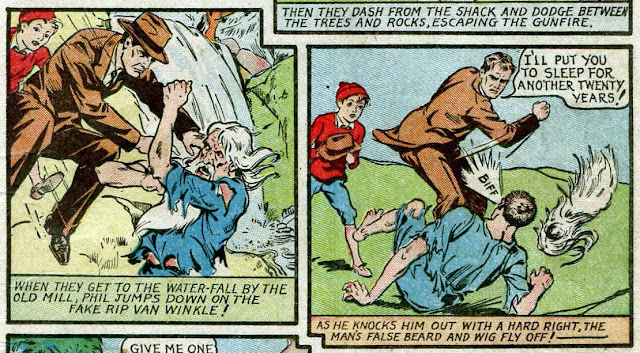
    This fellow is pretending to be Rip van Winkle or an analogous long-term sleeper for some reason related to moonshining. Maybe the full plot is interesting enough to be an entry on its own but sadly the extant copy of this comic is missing the first few pages of this story and so I have very little idea what is going on. He gets beat up and tossed in the clink thanks to crusading reporter Phil Manners. (Target Comics v1 003, 1940)