The Curse of Skeleton Munroe

Category: thief

  • MINOR SUPER-VILLAIN 781: DR ANDERSON

    (Super Spy 001, 1940)

    A series of bank robberies rock the community of Unnamed Comics Book City, USA. Witnesses place local physician Doc Anderson at the scene of each crime, but when detectives look into it they find that he has a terrible alibi for each one: he was home alone. It sounds like an open and shut case, but another robbery occurs while the police are at his house. Just what is happening? Could the fact that the title of this comic is “the Twin Terror Case” play into it?

    The cops give up on Dr Anderson as a suspect following the alibi thing, even though they subsequently capture a zombie-like double of him at the scene of one of the crimes. The alibi is just that good. Fortunately for the forces of law and order, while Anderson might have figured out the ultimate crime hack he did not reckon with boorish local jock Gary Ross and his dislike of being snubbed by a casual acquaintance. Ross follows Anderson to an old abandoned house, where he witnesses the creation and destruction of an Anderson duplicate (this seems to be the necessary process to destroy the Anderson in police custody too, if you’re wondering).

    Ross beats up Anderson until he spills the beans: while attempting to earn more money by inventing something cool, he figured out how to create a mentally-controlled duplicate of himself and immediately hit upon the idea of using it to rob banks. As is the custom, I now present my problems with this scheme:

    1. Obligatory screed about how this is a very poor use of this technology. Depending on just how organic and subject to human frailties these duplicates are they could represent either a significant or world-changing advance in human labour. Heck, even if they are 1:1 duplicates of the human body, a human body that can go into a dangerous situation with minimal concern for its safety would revolutionize mining, manufacturing, space travel if range was no impediment… so many industries.

    2. Anderson keeps the machine in an old abandoned house for some reason instead of his own basement. I know that for plot reasons it’s so that Gary Ross can follow him to a second location, but it’s still a very strange thing to do.

    3. The duplicates are so perfectly useful as alibi-generators that Anderson gets too invested in generating alibis rather than getting away with his crimes. If he’d only put a disguise on the duplicate and then made sure to establish an actual alibi rather than sitting at home while a double of him maches into a bank holding a sign that says “DOCTOR ANDERSON?” then he might just have gotten away with it.

    Unfortunately for humanity as a whole and people in high-risk jobs in particular, Gary Ross is a philistine and a thug and smashes up the duplication machine because it is “trouble-making.” Also I’m no fancy big city lawyer, but I think that this might mean that Anderson is going to walk free once the prosecution is asked to prove this wild duplication theory that they are advancing.

  • MINOR SUPER-VILLAIN 781: DR ANDERSON

    (Super Spy 001, 1940)

    A series of bank robberies rock the community of Unnamed Comics Book City, USA. Witnesses place local physician Doc Anderson at the scene of each crime, but when detectives look into it they find that he has a terrible alibi for each one: he was home alone. It sounds like an open and shut case, but another robbery occurs while the police are at his house. Just what is happening? Could the fact that the title of this comic is “the Twin Terror Case” play into it?

    The cops give up on Dr Anderson as a suspect following the alibi thing, even though they subsequently capture a zombie-like double of him at the scene of one of the crimes. The alibi is just that good. Fortunately for the forces of law and order, while Anderson might have figured out the ultimate crime hack he did not reckon with boorish local jock Gary Ross and his dislike of being snubbed by a casual acquaintance. Ross follows Anderson to an old abandoned house, where he witnesses the creation and destruction of an Anderson duplicate (this seems to be the necessary process to destroy the Anderson in police custody too, if you’re wondering).

    Ross beats up Anderson until he spills the beans: while attempting to earn more money by inventing something cool, he figured out how to create a mentally-controlled duplicate of himself and immediately hit upon the idea of using it to rob banks. As is the custom, I now present my problems with this scheme:

    1. Obligatory screed about how this is a very poor use of this technology. Depending on just how organic and subject to human frailties these duplicates are they could represent either a significant or world-changing advance in human labour. Heck, even if they are 1:1 duplicates of the human body, a human body that can go into a dangerous situation with minimal concern for its safety would revolutionize mining, manufacturing, space travel if range was no impediment… so many industries.

    2. Anderson keeps the machine in an old abandoned house for some reason instead of his own basement. I know that for plot reasons it’s so that Gary Ross can follow him to a second location, but it’s still a very strange thing to do.

    3. The duplicates are so perfectly useful as alibi-generators that Anderson gets too invested in generating alibis rather than getting away with his crimes. If he’d only put a disguise on the duplicate and then made sure to establish an actual alibi rather than sitting at home while a double of him maches into a bank holding a sign that says “DOCTOR ANDERSON?” then he might just have gotten away with it.

    Unfortunately for humanity as a whole and people in high-risk jobs in particular, Gary Ross is a philistine and a thug and smashes up the duplication machine because it is “trouble-making.” Also I’m no fancy big city lawyer, but I think that this might mean that Anderson is going to walk free once the prosecution is asked to prove this wild duplication theory that they are advancing.

  • MINOR SUPER-VILLAIN 776: THE BLUE SPARK

    (Super-Mystery Comics v1 002, 1940)

    In terms of crime, the Blue Spark is ambitious but not extraordinary: a little corporate extortion, some bank robbery, a few kidnappings. Nothing we haven’t seen a few hundred times by now.  When it comes to the trappings of super-villainy, however, the Blue Spark is on the cutting edge.

    Just look at that costume – it’s not quite the standardized super-villain getup we will eventually see on so many one-shot Batman villains but it’s pretty damn close, and particularly in an era in which most villains are still pairing a mask with a suit and tie or a robe. Even more impressive and ahead of its time is the Blue Spark’s choice to dress his henchmen in a simplified version of his own uniform. Just really impressive stuff.

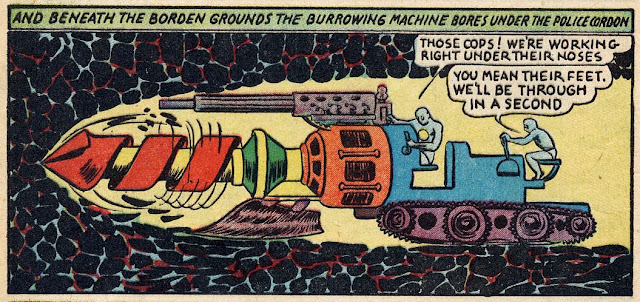
    The Blue Spark’s main gimmick, a heat ray cannon mounted on a truck, isn’t quite as remarkable but it is a pretty sweet bit of gear. Plus he has another one mounted on a cool-ass drilling machine!

    (it is somewhat unclear if the Blue Spark has a second ray that allows him to mind control people or if his heat ray doubles as a mind control ray, and determining this is not helped by the fact that he clearly has an aesthetic fondness for that particular style of scientific greebling on the outside of the rays. It’s a good clean visual on the mind control ray, I will say that)

    The Blue Spark’s henchmen (called the Blue Rubber Men at one point, btw) are not just well-dressed:  their costumes have  little nozzles in the chest that lets them be inflated like a balloon to render them immune to fisticuffs  – another idea that sounds like something out of a Silver Age comic, twenty years early.

    Technology or no, inflation fetish suits or no, the Blue Spark vs Magno is your classic case of a villain who is so little of an even match for the hero that the plotter’s concern must lie in keeping them apart for as long as possible because the instant they meet up, something like the above happens. Magno didn’t even give him a chance to blow up his suit, the poor guy.

  • MINOR SUPER-VILLAIN 776: THE BLUE SPARK

    (Super-Mystery Comics v1 002, 1940)

    In terms of crime, the Blue Spark is ambitious but not extraordinary: a little corporate extortion, some bank robbery, a few kidnappings. Nothing we haven’t seen a few hundred times by now.  When it comes to the trappings of super-villainy, however, the Blue Spark is on the cutting edge.

    Just look at that costume – it’s not quite the standardized super-villain getup we will eventually see on so many one-shot Batman villains but it’s pretty damn close, and particularly in an era in which most villains are still pairing a mask with a suit and tie or a robe. Even more impressive and ahead of its time is the Blue Spark’s choice to dress his henchmen in a simplified version of his own uniform. Just really impressive stuff.

    The Blue Spark’s main gimmick, a heat ray cannon mounted on a truck, isn’t quite as remarkable but it is a pretty sweet bit of gear. Plus he has another one mounted on a cool-ass drilling machine!

    (it is somewhat unclear if the Blue Spark has a second ray that allows him to mind control people or if his heat ray doubles as a mind control ray, and determining this is not helped by the fact that he clearly has an aesthetic fondness for that particular style of scientific greebling on the outside of the rays. It’s a good clean visual on the mind control ray, I will say that)

    The Blue Spark’s henchmen (called the Blue Rubber Men at one point, btw) are not just well-dressed:  their costumes have  little nozzles in the chest that lets them be inflated like a balloon to render them immune to fisticuffs  – another idea that sounds like something out of a Silver Age comic, twenty years early.

    Technology or no, inflation fetish suits or no, the Blue Spark vs Magno is your classic case of a villain who is so little of an even match for the hero that the plotter’s concern must lie in keeping them apart for as long as possible because the instant they meet up, something like the above happens. Magno didn’t even give him a chance to blow up his suit, the poor guy.

  • MINOR SUPER-VILLAIN 765: KILLRAYE

    (Speed Comics 007, 1940)

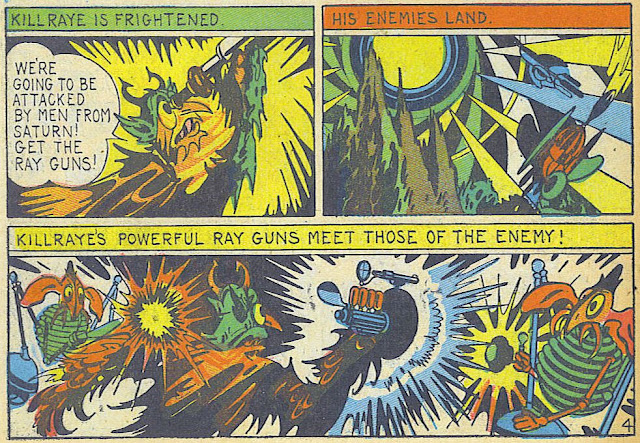
    Killraye is the leader of the extremely wild and wonderful looking Jupiter Men (courtesy of writer/artist/wild alien designer Munson Paddock) of an unspecified future, and leads them in an attempt to hijack plans for an advanced ray gun design from inter-planetary mail courier Mars Mason.

    (whether the Jupiter Men have a caste-based physiology and Killraye represents their ruling form or he is of a different species entirely is unclear. He certainly looks a lot different that them but on the other hand he does have the same furry legs and weird little round feet as they do)

    Mars Mason does not allow this violation of the sanctity of the mail to go unavenged, and not only blows up a considerable portion of the Jupiter Men’s city but send Killraye himself spinning off into space via what must have been a superhumanly powerful kick. Surely this is the end of Killraye!

    OR IS IT? 

    In fact, no, that was not the end of Killraye. In Speed Comics 008 it is revealed that the dastardly Jovian had not in fact been consigned to eternal exile in space but had landed on a comet complete with a population of Needle Men (related to and indistinguishable from Jupiter Men and just as willing to follow a guy like Killraye) as well as a weird super-powered skeleton alien. Rather than enjoy his second chance at life in peace, Killraye immediately resumes his piratical ways and inevitably ends up clashing with Mars Mason again.

    It seems like Killraye is finally going to get the upper hand, when the community-minded Saturn Men get involved and wreck house so thoroughly that Killraye himself does not actually get a death scene. Good night, sweet alien bastard.

    ADDENDUM: Killraye was a fine villain, but the real star of his second appearance was this unnamed hench-creature, whose host of positive attributes include:

    – amazing skeleton body

    – rare 1940s anime hair

    – a catch phrase: “Bah!”

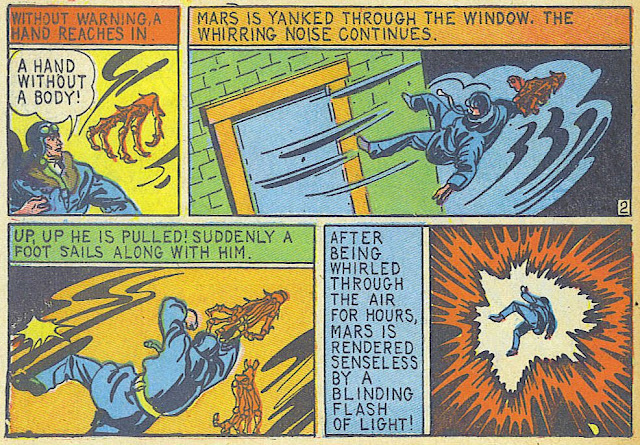
    – the power to send its skeletal hands and feet across interplanetary distances to snatch up people and loot

    – a boss ray gun

    Truly this is the villain I want to see in my space comics.

  • MINOR SUPER-VILLAIN 765: KILLRAYE

    (Speed Comics 007, 1940)

    Killraye is the leader of the extremely wild and wonderful looking Jupiter Men (courtesy of writer/artist/wild alien designer Munson Paddock) of an unspecified future, and leads them in an attempt to hijack plans for an advanced ray gun design from inter-planetary mail courier Mars Mason.

    (whether the Jupiter Men have a caste-based physiology and Killraye represents their ruling form or he is of a different species entirely is unclear. He certainly looks a lot different that them but on the other hand he does have the same furry legs and weird little round feet as they do)

    Mars Mason does not allow this violation of the sanctity of the mail to go unavenged, and not only blows up a considerable portion of the Jupiter Men’s city but send Killraye himself spinning off into space via what must have been a superhumanly powerful kick. Surely this is the end of Killraye!

    OR IS IT? 

    In fact, no, that was not the end of Killraye. In Speed Comics 008 it is revealed that the dastardly Jovian had not in fact been consigned to eternal exile in space but had landed on a comet complete with a population of Needle Men (related to and indistinguishable from Jupiter Men and just as willing to follow a guy like Killraye) as well as a weird super-powered skeleton alien. Rather than enjoy his second chance at life in peace, Killraye immediately resumes his piratical ways and inevitably ends up clashing with Mars Mason again.

    It seems like Killraye is finally going to get the upper hand, when the community-minded Saturn Men get involved and wreck house so thoroughly that Killraye himself does not actually get a death scene. Good night, sweet alien bastard.

    ADDENDUM: Killraye was a fine villain, but the real star of his second appearance was this unnamed hench-creature, whose host of positive attributes include:

    – amazing skeleton body

    – rare 1940s anime hair

    – a catch phrase: “Bah!”

    – the power to send its skeletal hands and feet across interplanetary distances to snatch up people and loot

    – a boss ray gun

    Truly this is the villain I want to see in my space comics.

  • MINOR SUPER-VILLAIN 758: THE WIZARD

    (Smash Comics 017, 1940)

    The Wizard is your classic big-headed smart guy gang boss (his head is on the smaller end of the bighead spectrum but he accentuates it perfectly with the most unpleasant hairstyle I have ever seen). He and his gang (the Wizard Gang, natch) have been lying low for long enough that one of them starts getting squirrely and talking about leaving, with deadly consequences. The Wizard shoots him, is what I’m saying. And what a shame, because the Wizard has just finished his master plan: put bombs in little remote controlled planes and then use them to do robberies. Not the most groundbreaking scheme in the world, but not bad.

    The plane bombs seem to be effective, as the Wizard Gang really cleans up on loot. Is there a major difference between a bomb mounted on a plane and one thrown by a guy? Evidently! 

    Even more impressively, the Wizard’s plan to just stay out of town for a while has had the intended effect of erasing all of his gang members from the collective police memory. It’s quite remarkable, though again the simpler answer might just be that they are managing to stay out of sight of the cops.

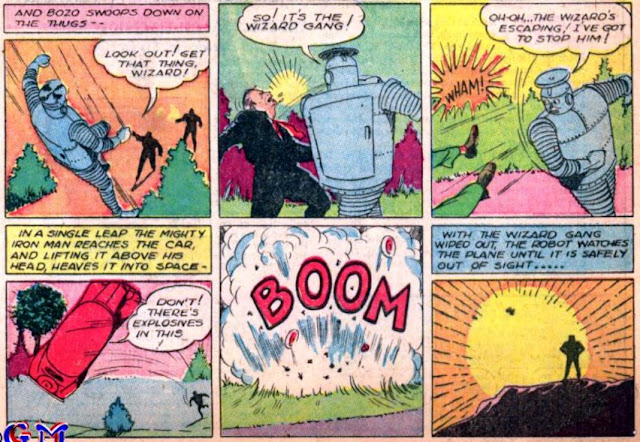
    All good things must come to an end, however, in this case in the form of Hugh Hazzard and his explosion-proof robotic exoskeleton. And of course once a superstrong robot is involved it’s just a matter of time before the Wizard meets his end in a recklessly-hurled car full of explosives.

  • MINOR SUPER-VILLAIN 758: THE WIZARD

    (Smash Comics 017, 1940)

    The Wizard is your classic big-headed smart guy gang boss (his head is on the smaller end of the bighead spectrum but he accentuates it perfectly with the most unpleasant hairstyle I have ever seen). He and his gang (the Wizard Gang, natch) have been lying low for long enough that one of them starts getting squirrely and talking about leaving, with deadly consequences. The Wizard shoots him, is what I’m saying. And what a shame, because the Wizard has just finished his master plan: put bombs in little remote controlled planes and then use them to do robberies. Not the most groundbreaking scheme in the world, but not bad.

    The plane bombs seem to be effective, as the Wizard Gang really cleans up on loot. Is there a major difference between a bomb mounted on a plane and one thrown by a guy? Evidently! 

    Even more impressively, the Wizard’s plan to just stay out of town for a while has had the intended effect of erasing all of his gang members from the collective police memory. It’s quite remarkable, though again the simpler answer might just be that they are managing to stay out of sight of the cops.

    All good things must come to an end, however, in this case in the form of Hugh Hazzard and his explosion-proof robotic exoskeleton. And of course once a superstrong robot is involved it’s just a matter of time before the Wizard meets his end in a recklessly-hurled car full of explosives.

  • MINOR SUPER-VILLAIN 756: THE MOLE

    (Smash Comics 017, 1940) 

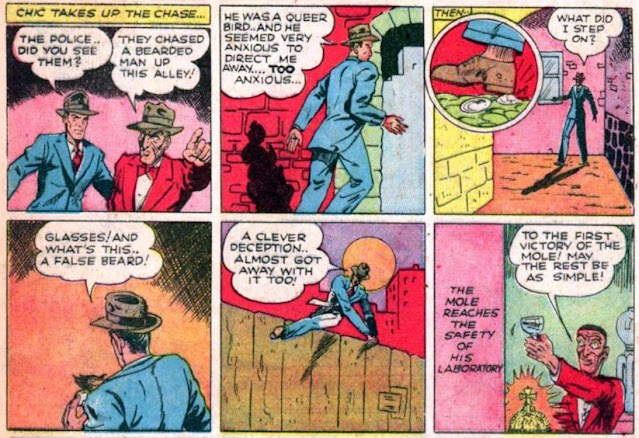
    The Mole is an eccentric inventor who has developed one of the all-time greatest examples of technology that would net more safe profit if marketed for industrial purposes than if used for crime: the drilling machine. Rather than approaching the mining or construction industreis, the Mole opts for the rush inherent in stealing high-value, hard-to-fence objects like the unspecified crown jewels on display in New York’s Maiden Lane.

    In addition to the sheer digging power of his boring machine, the Mole’s plan involved showing up at the crown jewels exhibition in disguise and casting a lot of suspicion on himself, thus leading to the police wasting their time in searching for a nonexistent bearded man. I was going to spend some time roasting him for going to all this trouble to establish a false identity while wearing a very distinctive red suit and bow tie, but a) it totally works and b) the far more roastable offense is including this ruse in the first place, as it’s the only thing that ties him to the actual crime.

    Even so, the Mole is on track to get away with his crimes, until  he compounds them by littering. Crack reporter Chic Carter gets the break that he’s looking for when he is reminded that false beards exist by literally stepping on one, and once that happens it’s all over: all Chic has to do is beat up a single nerd and he’s solved the case and netted a free drilling machine in the process.

  • MINOR SUPER-VILLAIN 755: STRADIVOUS

    MINOR SUPER-VILLAIN 755: STRADIVOUS

    (Smash Comics 017, 1940)

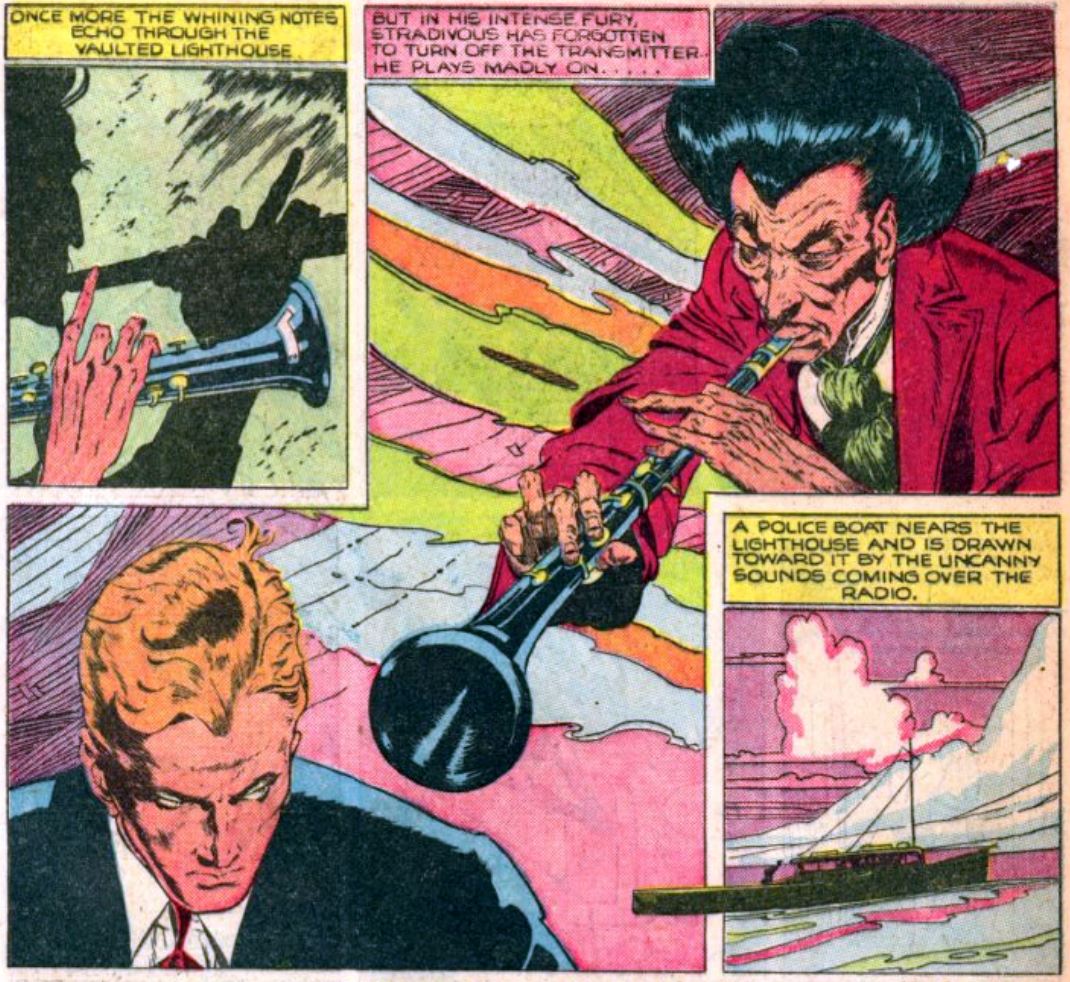
    There are a lot of comic book characters who derive their powers from or express them through music, but Stradivous here is the only one I know of who does so using a clarinet. This is going to be huge if we ever want to draft an all-star comics orchestra someday. He also has a really terrific look, with an eccentric choice in every single aspect of his head and facial hair – I’ll even grudgingly admit that he pulls off a fu manchu, traditionally my least favourite mustache.

    Like many other super musicians, Stradivous specializes in mind control: he can make the people dance and caper as he pleases with but a toot.

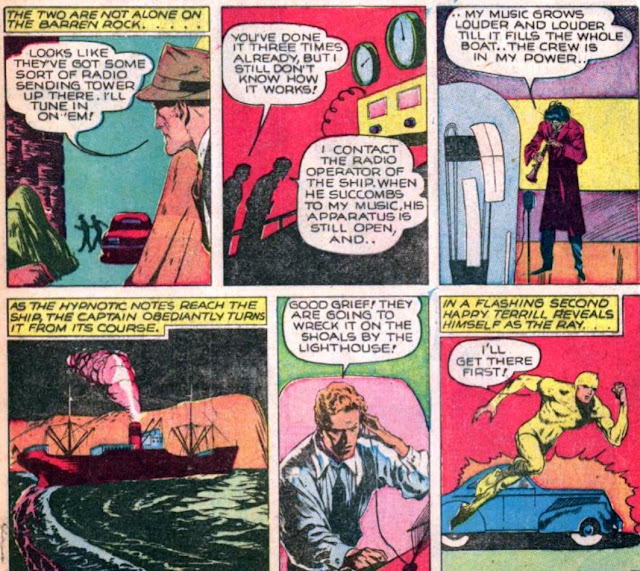
    More importantly to the plot, Stradivous can also enthrall the entire crew of a ship by broadcasting his music over the radio, and he and his employer Dock Commissioner Jennings have been doing just that from a nearby lighthouse. Jennings gets the info on valuable incoming shipments and Stradivous wrecks the ships and then the gather up the loot.

    The Ray is of course none too happy about all of this wanton wrecking and looting and steps in to put a stop to it. He approaches as Happy Terrill for some reason, and is thus vulnerable to Stradivous’ hypnotic music. This doesn’t stop Happy/the Ray for long, of course, but as he proceeds to beat the ass of every goon in the lighthouse a secondary drama plays out: two cops, drawn to the island by the hypnotic broadcast, spot Jennings and Stradivous fleeing the scene and summarily execute them for running. It’s like a dog with a ball – if they see someone moving fast enough they just can’t help themself.