The Curse of Skeleton Munroe

Category: thief

  • MINOR SUPER-VILLAIN 755: STRADIVOUS

    (Smash Comics 017, 1940)

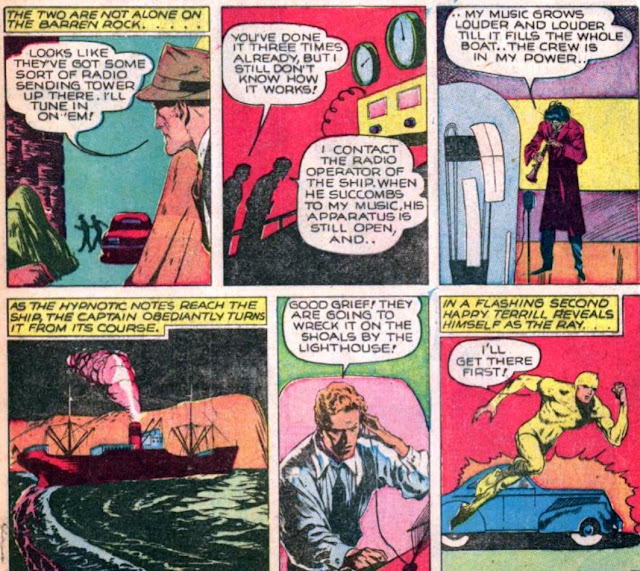
    There are a lot of comic book characters who derive their powers from or express them through music, but Stradivous here is the only one I know of who does so using a clarinet. This is going to be huge if we ever want to draft an all-star comics orchestra someday. He also has a really terrific look, with an eccentric choice in every single aspect of his head and facial hair – I’ll even grudgingly admit that he pulls off a fu manchu, traditionally my least favourite mustache.

    Like many other super musicians, Stradivous specializes in mind control: he can make the people dance and caper as he pleases with but a toot.

    More importantly to the plot, Stradivous can also enthrall the entire crew of a ship by broadcasting his music over the radio, and he and his employer Dock Commissioner Jennings have been doing just that from a nearby lighthouse. Jennings gets the info on valuable incoming shipments and Stradivous wrecks the ships and then the gather up the loot.

    The Ray is of course none too happy about all of this wanton wrecking and looting and steps in to put a stop to it. He approaches as Happy Terrill for some reason, and is thus vulnerable to Stradivous’ hypnotic music. This doesn’t stop Happy/the Ray for long, of course, but as he proceeds to beat the ass of every goon in the lighthouse a secondary drama plays out: two cops, drawn to the island by the hypnotic broadcast, spot Jennings and Stradivous fleeing the scene and summarily execute them for running. It’s like a dog with a ball – if they see someone moving fast enough they just can’t help themself.

  • MAD AND CRIMINAL SCIENTIST ROUND-UP 017

    The science is flying fast and loose in here.

    Professor Krauss’ theories about a method for passing matter through matter were scorned and laughed at, so he turned them to crime, killing three and robbing the New York subtreasury*. Unfortunately for him he also gave an interview about his theories, which really helped research-savvy reporter Chic Carter track down and capture him. (Smash Comics 011, 1940)

    *A Note on Subtreasuries: A frequent target for theft in the Golden Age or at least one that I’ve encountered 3-6 times, the New York Subtreasury was part of a US financial management system that distributed the storage of US gold reserves, but, critically, was phased out in 1920. I don’t know what all these guys were after in there but there sure wasn’t any gold.

    Professor Abbot, disgraced former physics instructor at Stamton College, has developed a machine capable of paralyzing the population of a small city long enough for his men to rob it blind, but since the device also disrupts electrical signals this draws the attention of lineman Tom Dalton, aka Magno, the Magnetic Man. Abbot proves to be unusually well-prepared for the appearance of the local super-hero at his hideout and disables Magno with a prepared dose of knockout gas, which is really, really impressive, I have to say. 

    Abbot’s downfall comes in the form of every villain’s worst enemy, the deathtrap. Sure, slinging Magno down a well to slowly drown is satisfying, in an evil kind of way, but it introduces the possibility of him escaping from the trap, and if he does that then you are screwed. Just stab him with a wooden stake or something if you need to avoid using metal!

    Anyway, Magno of course escapes from the trap and ends up blowing Abbot, his machine, his hideout and his gang to high heaven by the medium of some hastily smashed up mad science equipment. (Smash Comics 014, 1940)

    This unnamed scientist does a bit of old-fashioned grave robbing in order to get only the finest parts for his frankenstein (though the fact that he made sure to include the brain of a scholar doesn’t seem to have played out in the mentality of the creature) which he then uses a growth hormone on and makes huge, super strong and bulletproof. Dubbed Brutus and deemed unstoppable, this creation is sent out to loot and plunder.

    I always appreciate it when a character has to contend with a foe who is their rough equivalent from time to time – this is part of the appeal of Hellboy, for example – and Brutus offers just that opportunity for Bozo the Iron Man, being essentially a Bozo-shaped and-sized human of equivalent strength. Brutus manages to win the day in their first encounter by hitting Bozo over the head hard enough that Hugh Hazzard is knocked out through the armour of his robo-suit, but their second bout results in the deaths of both Brutus and his unnamed creator. (Smash Comics 014, 1940)

    Across the US, buildings, trains, planes and ships begin sailing off into the sky, accompanied by a totally radical visual effect of a giant green mummy that I’m not 100% certain is actually visible to regular non-comic-reading witnesses – it’s never commented on in any case, and if I saw a giant mummy carry a train off into the void I assure you that you would hear me speak of little else.

    The culprit turns out to be one Doctor Robb, an unscrupulous archaeologist who murdered his colleague Professor Hill in order to steal an ancient artifact called the Power of Tutkamen (named after original owner Ra Tutkamen, natch).

    Robb presumably refines his control over the power, as he seems to be using it to plunder passing shipping from his island base and that’s hard to do if you’re just blasting ships and planes into orbit. The party comes to an end once the Invisible Hood gets involved, as Robb discovers to his chagrin that having the power to levitate anything you see doesn’t help you very much in a confrontation with an invisible guy. Rather than be captured, Robb does a header out the window of his lighthouse HQ. (Smash Comics 016, 1940)

  • MINOR SUPER-VILLAIN 753: THE GHOST GANG

    (Smash Comics 015, 1940) 

    The Ghost Gang have a winning formula: commit a robbery and then high-tail it back to the Old Abandoned Peters Mansion (charmingly referred to a couple of times as the Haunted Hide-Out), where they transform into ghosts and can murder cops and/or drive them insane with impunity.

    It’s not a foolproof scheme, however. For one thing, you really have to complete that first step and actually get to the house, as evidenced by this poor fellow being bravely shot in the back by these two cops as he closes the garage door.

    For another and much more important thing, they aren’t actually turning into ghosts – it’s all a trick! This is important, because if there’s one real flaw to this plan it’s the “murdering cops” part. If all the gang was doing was driving them insane then maybe they could have gotten a few more days out of their arrangement but it’s just as well for them that Hugh Hazzard and Bozo the Iron Man show up to beat the tar out of them because there’s a pretty good chance that an NYPD bulldozer was already on its way to bring the whole house down around their ears, ghosts or no.

  • MINOR SUPER-VILLAIN 747: THE GREEN GHOST

    (Smash Comics 011, 1940) 

    If there’s one thing that Kent Thurston, aka the Invisible Hood, has in spades, it’s wealthy friends who are having crime problems. In this case, the friend is financier John Barr and the problem is the Green Ghost, a costumed thief who has been popping up all over the local area to rob the rich, even when they’re being extra sneaky about what they’re doing.

    Sure enough, the Green Ghost shows up to rob Barr of the wad of cash he’s packing for business purposes, and his powers are not limited to money-sensing, as Barr’s attorney Ward proves when he empties his pistol into him to absolutely no effect.

    Not to worry, though, because Barr’s next business deal is super-duper secret: he’s going next door to buy a big gem, for cash, and only Barr, his neighbour, his neighbour’s secretary Jack Gray, Kent Thurston and Ward know about it, and you know that old saying: five people can absolutely keep a secret. But despite all of these amazing precautions wouldn’t you know it, the Green Ghost shows up again and  not only steals the gem but kidnaps Barr as a hostage! I’m beginning to think that doing business deals for cash in private homes is a bad idea for some reason!

    Barr proves to be unusually plucky for a financier and manages to subdue the Green Ghost all on his own, at which point he learns the annoying secret: there are, in fact, two Green Ghosts! It’s a pretty good gag, and if they hadn’t kidnapped a guy and then revealed all their secrets to him I’d say that they were another mark in the “smart villains” column. As it stands, they’re going to have to do a murder at minimum to get things back on track.

    It is at this point that the Invisible Hood steps in and unmasks the Green Ghosts as 1. Barr’s attorney Ward and 2. his neighbour’s secretary Jack Gray, who have been using their rich guy-adjacent status to get the skinny on all the secret deals these guys have been doing to avoid paying taxes, and since the bulletproof thing was in retrospect a clear setup to boost the Green Ghost’s reputation they are easily apprehended by a gun-toting invisible man.

  • MINOR SUPER-VILLAIN 745: THE BAT

    (Smash Comics 010, 1940)

    I had a little intro to this entry all mapped out in my head, something along the lines of how in a super-hero universe, super crimes are just as obvious a choice as mundane ones, like hiring a scientist to mind control your political opponents instead of merely blackmailing them,  and so we shouldn’t judge super-villains for over-complicating things, but as a part of actually writing it out I had to go over the details of the Bat aka Graystone’s plan in my head and… he over-complicates it.

    I don’t think that I can lay this out properly in paragraph form, so we must once again turn to our old friend the bulleted list for aid. Here is the Bat’s basic plan:

    – systematically rob his neighbours

    – create a fake monster bat to terrify the countryside and draw suspicion away from himself by linking its appearances to the robberies

    – once everyone around him is poor and frightened enough, buy up all the local property for cheap.

    Up to this point, everything is fine. It’s a bit complicated but appropriately so for a comic book world in which there are people running around putting human brains into gorillas and so forth.

    Graystone’s downfall presumably begins when he realizes that being the only person in the area not targeted by the Bat is a bit suspicious. The obvious solution to this problem is simply to rob himself and join his neighbours in bemoaning their monster-haunted fate, but instead he:

    – fakes the kidnapping of his son (in on the scheme, flies the plane that the bat monster hangs off of, is arguably also the Bat)

    – calls in Scotland Yard and makes a bunch of noise

    – attempts to kill Captain Cook of Scotland Yard several times as he investigates the mystery

    – has the Bat demand that Cook deliver the ransom money so that Graystone can try to kill him again

    It’s like a list of things you shouldn’t do if you want to stay under the radar – heck, killing Cook would only raise the profile of the case! Even the operation of the bat monster involves both a secret airfield and a hidden image projector (that doubles as an engine-killing ray for some reason) so that the bat image can be projected onto a sheet that is being pulled by a plane. Have these fools never considered the humble kite?  

    Graystone, his son and various of their servants are of course bundled off to jail to think about wot they done.

  • MINOR SUPER-VILLAIN 736: LURIDA

    (Silver Streak Comics 005, 1940)

    I was just about to type that this was “a simple, straightforward super-hero comic story” and then immediately had to grapple with how to summarize the following: in the previous issue of Silver Streak Comics, adventurer Lance Hale set out to recover a treasure left by his uncle in an old mine in Rhodesia (now Zimbabwe). After helping the immortal Queen of the Underground Empire Aldia and her caveman subjects fight off a lizard man invasion (and incidentally becoming immortal himself, though this is never brought up again), Lance took the treasure with the stated intention of using it to help the needy back in America. Simple!

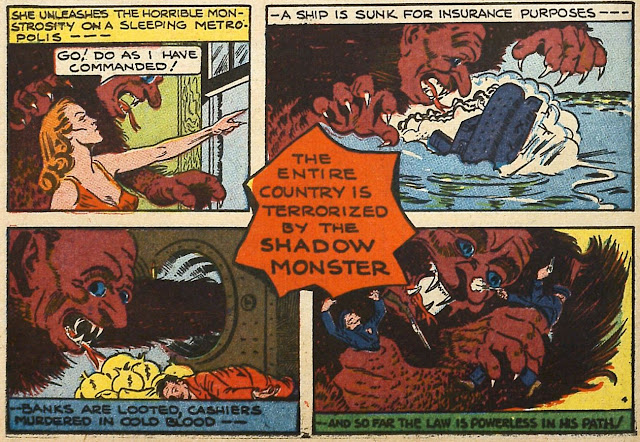
    This issue, we learn that this treasure includes an artifact known as the Gem of Evil and that a femme fatale named Lurida (very on-the-nose name) not only knows about it but somehow knows that Lance Hale has it. She steals the treasure with the help of some more-competent-than-usual henchmen and voila, summons herself the Shadow Monster.

    We don’t get a real run-down of the Shadow Monster’s abilities but on-panel it is at least physically invulnerable and able to grow to giant size, and so I must admit that I find Lurida’s use of it to commit bank robberies and insurance fraud to be a bit limited, imagination-wise. Not that I have any sort of Grand Scheme for what I would do with such a beast, mind, I just have a knee jerk sense that if you’re using magic or super science or mutant powers or whatever to do something as banal as insurance fraud then you’re Doing It Wrong.

    As a femme fatale, Lurida is obligated to make a stab at seducing Lance over to her side, just as Lance as a stalwart hero is obliged to insultingly turn her down, and after some monkey business with a fire-based deathtrap Lance manages to destroy both the Gem of Evil and the Shadow Monster, and Lurida completes the set by flinging herself into the same flame she had set for Lance. It’s not a great decision considering that no court in the land is equipped to prosecute somebody for shadow demon summoning, but it does tie up the episode in a real neat bow.

  • MINOR SUPER-VILLAIN 736: LURIDA

    (Silver Streak Comics 005, 1940)

    I was just about to type that this was “a simple, straightforward super-hero comic story” and then immediately had to grapple with how to summarize the following: in the previous issue of Silver Streak Comics, adventurer Lance Hale set out to recover a treasure left by his uncle in an old mine in Rhodesia (now Zimbabwe). After helping the immortal Queen of the Underground Empire Aldia and her caveman subjects fight off a lizard man invasion (and incidentally becoming immortal himself, though this is never brought up again), Lance took the treasure with the stated intention of using it to help the needy back in America. Simple!

    This issue, we learn that this treasure includes an artifact known as the Gem of Evil and that a femme fatale named Lurida (very on-the-nose name) not only knows about it but somehow knows that Lance Hale has it. She steals the treasure with the help of some more-competent-than-usual henchmen and voila, summons herself the Shadow Monster.

    We don’t get a real run-down of the Shadow Monster’s abilities but on-panel it is at least physically invulnerable and able to grow to giant size, and so I must admit that I find Lurida’s use of it to commit bank robberies and insurance fraud to be a bit limited, imagination-wise. Not that I have any sort of Grand Scheme for what I would do with such a beast, mind, I just have a knee jerk sense that if you’re using magic or super science or mutant powers or whatever to do something as banal as insurance fraud then you’re Doing It Wrong.

    As a femme fatale, Lurida is obligated to make a stab at seducing Lance over to her side, just as Lance as a stalwart hero is obliged to insultingly turn her down, and after some monkey business with a fire-based deathtrap Lance manages to destroy both the Gem of Evil and the Shadow Monster, and Lurida completes the set by flinging herself into the same flame she had set for Lance. It’s not a great decision considering that no court in the land is equipped to prosecute somebody for shadow demon summoning, but it does tie up the episode in a real neat bow.

  • MINOR SUPER-VILLAIN 735: THE SILVER-WORSHIPPERS

    (Silver Streak Comics 005, 1940)

    Comics book cults, am I right? They’ll worship anything. Case in point: the Silver-Worshippers, who believe that silver is sacred and are pretty dang mad that it is being profaned by its use in finance and currency. They also very frustratingly do not seem to have a name that they use for themselves, so the Silver-Worshippers will have to do.

    But just how to remove the sacred silver from the hands of the heathen financiers? Why via a series of bank robberies, of course! The Silver-Worshippers devise a system so foolproof that they use it upwards of thirty-five times: set off a big explosion and/or fire on the edge of town and then rob the town bank of all of its silver while the emergency services are busy.

    Of course, the Silver Streak is no slouch and so by the thirty-fourth or thirty-fifth silver robbery he is ready to get in on the action, zipping off to Easton, Ohio in time to help with the fire and in grand comics tradition almost catch the bank robbers so that it will be more satisfying when he gets ’em later.

    Now to reveal a little bit about the kind of person I am: I absolutely love when an old comic uses a real place (or even better: a real street address) due to the ease with which I can use modern mapping software to check out just where things supposedly happened, and of course I was overjoyed to discover that Easton, Ohio was a real place, but let me tell you, it does not have a downtown, or a bank, or indeed a fire department.

    Our adventure in geography continues, as the Silver Streak determines that the Silver-Worshippers have been writing the word DOOM in cursive across a map of the US (this is where my “thirty-five robberies” calculation comes from, by the way), and that Clayton, Ohio is the next likely stop to complete the M.

    (Clayton, Ohio is also a real place, by the way, and while it does have a small downtown that I can believe held a robbable bank in 1940 it is not directly South of Easton. What wild geography games was Jack Cole playing with us? did he just pick two names out of the air and get lucky?)

    The Silver Streak tracks the cultists sent to rob the Clayton bank back to their hidden temple and comes very close to being gruesomely killed in a wave of molten silver, but because he is a super speed character this only comes about because he clumsily knocks himself out with a bit of falling masonry.

    The Silver Streak recovers in time to not be fatally silvered and proves my usual point about speedster heroes vs regular crooks by taking on a whole temple-full of guys using only hand-thrown bricks of silver, only they turn out to actually be silvered bricks, substituted for the real thing by the cult’s leader Gregory Randil. “Just who is Gregory Randil?” I hear you cry. Why he is the owner of Randil Silver Co and he has been playing the Silver-Worshippers for chumps by having them steal for him so that he can cut down on overhead. And to forestall any further questions: no, Randil has never appeared or been mentioned in the comic prior to his unmasking. This is the definition of an unfair mystery!

    The Randil Silver Co. deception of course does not go down well with the room full of Silver-Worshippers, and the Silver Streak has to bop every one of them into unconsciousness before hauling them off to jail.

    NEXT DAY ADDENDUM: Okay, here is a bonus thing about me. Sometimes I get so excited and full of pride in myself for figuring something out that I overlook the obvious. Yes, Easton and Clayton are real places in Ohio, as I so smugly pointed out, but it’s a Golden Age comic book – if you see a place name one of the things you have to assume is that there is a simple substitution going on. Forget Easton and Clayton, I should have checked for a Weston and assumed that it was Dayton, and when I did in fact do so, the line between them was almost perfect for the finale of a cursive “m”. Weston even has a little downtown which, while it doesn’t appear to have many buildings over two stories, probably had a perfectly lootable bank in 1940. Just a reminder for me to stay humble.

  • MINOR SUPER-VILLAIN 735: THE SILVER-WORSHIPPERS

    (Silver Streak Comics 005, 1940)

    Comics book cults, am I right? They’ll worship anything. Case in point: the Silver-Worshippers, who believe that silver is sacred and are pretty dang mad that it is being profaned by its use in finance and currency. They also very frustratingly do not seem to have a name that they use for themselves, so the Silver-Worshippers will have to do.

    But just how to remove the sacred silver from the hands of the heathen financiers? Why via a series of bank robberies, of course! The Silver-Worshippers devise a system so foolproof that they use it upwards of thirty-five times: set off a big explosion and/or fire on the edge of town and then rob the town bank of all of its silver while the emergency services are busy.

    Of course, the Silver Streak is no slouch and so by the thirty-fourth or thirty-fifth silver robbery he is ready to get in on the action, zipping off to Easton, Ohio in time to help with the fire and in grand comics tradition almost catch the bank robbers so that it will be more satisfying when he gets ’em later.

    Now to reveal a little bit about the kind of person I am: I absolutely love when an old comic uses a real place (or even better: a real street address) due to the ease with which I can use modern mapping software to check out just where things supposedly happened, and of course I was overjoyed to discover that Easton, Ohio was a real place, but let me tell you, it does not have a downtown, or a bank, or indeed a fire department.

    Our adventure in geography continues, as the Silver Streak determines that the Silver-Worshippers have been writing the word DOOM in cursive across a map of the US (this is where my “thirty-five robberies” calculation comes from, by the way), and that Clayton, Ohio is the next likely stop to complete the M.

    (Clayton, Ohio is also a real place, by the way, and while it does have a small downtown that I can believe held a robbable bank in 1940 it is not directly South of Easton. What wild geography games was Jack Cole playing with us? did he just pick two names out of the air and get lucky?)

    The Silver Streak tracks the cultists sent to rob the Clayton bank back to their hidden temple and comes very close to being gruesomely killed in a wave of molten silver, but because he is a super speed character this only comes about because he clumsily knocks himself out with a bit of falling masonry.

    The Silver Streak recovers in time to not be fatally silvered and proves my usual point about speedster heroes vs regular crooks by taking on a whole temple-full of guys using only hand-thrown bricks of silver, only they turn out to actually be silvered bricks, substituted for the real thing by the cult’s leader Gregory Randil. “Just who is Gregory Randil?” I hear you cry. Why he is the owner of Randil Silver Co and he has been playing the Silver-Worshippers for chumps by having them steal for him so that he can cut down on overhead. And to forestall any further questions: no, Randil has never appeared or been mentioned in the comic prior to his unmasking. This is the definition of an unfair mystery!

    The Randil Silver Co. deception of course does not go down well with the room full of Silver-Worshippers, and the Silver Streak has to bop every one of them into unconsciousness before hauling them off to jail.

    NEXT DAY ADDENDUM: Okay, here is a bonus thing about me. Sometimes I get so excited and full of pride in myself for figuring something out that I overlook the obvious. Yes, Easton and Clayton are real places in Ohio, as I so smugly pointed out, but it’s a Golden Age comic book – if you see a place name one of the things you have to assume is that there is a simple substitution going on. Forget Easton and Clayton, I should have checked for a Weston and assumed that it was Dayton, and when I did in fact do so, the line between them was almost perfect for the finale of a cursive “m”. Weston even has a little downtown which, while it doesn’t appear to have many buildings over two stories, probably had a perfectly lootable bank in 1940. Just a reminder for me to stay humble.

  • MINOR SUPER-VILLAIN 733: THE PANTHER

    MINOR SUPER-VILLAIN 733: THE PANTHER

    (Silver Streak Comics 004, 1940)

    The Panther! A murderous thief with a very cool look and a vicious set of claws! Well, okay, he does compliment his cool panther mask, panther paw gloves and shoes and pantherskin shirt with a pair of brown slacks so I’ll amend that to a mostly cool look. 

    Moderately cool looking or not, the Panther has been doing his crimes in the nonspecific New York-esque city that Ace Powers calls home and so Ace is on the case!

    And Ace Powers turns out to be the guy for the job, because he immediately figures out the Panther is in fact an unnamed asylum escapee who went mad after his face was mangled in a car accident. What he fails to intuit, to his detriment, is that the panther mask isn’t just for show but is armour plated – in his surprised state after his best haymaker fails to make an impact, Powers is nearly slashed to death by the Panther’s also-functional claws. 

    The Panther’s reign of terror comes to an end when, after a rooftop chase across a flaming building, he proves that armour plating is not a good protection against fall damage by landing square on his armoured face and instantly dying.

    What’s this? Could it be that all of that “armour can’t protect you from a fall” talk was mere propaganda courtesy of Big Parachute? Evidently so, because in the next issue of Silver Streak Comics the Panther turns out to be Just Fine. Better, even, because he demonstrates some pretty advanced super-villain thinking by setting out to avoid the mistakes of the past by recruiting some manpower (fellow inmates at the same asylum he had previously escaped from) for backup the next time he had to face Ace Powers.

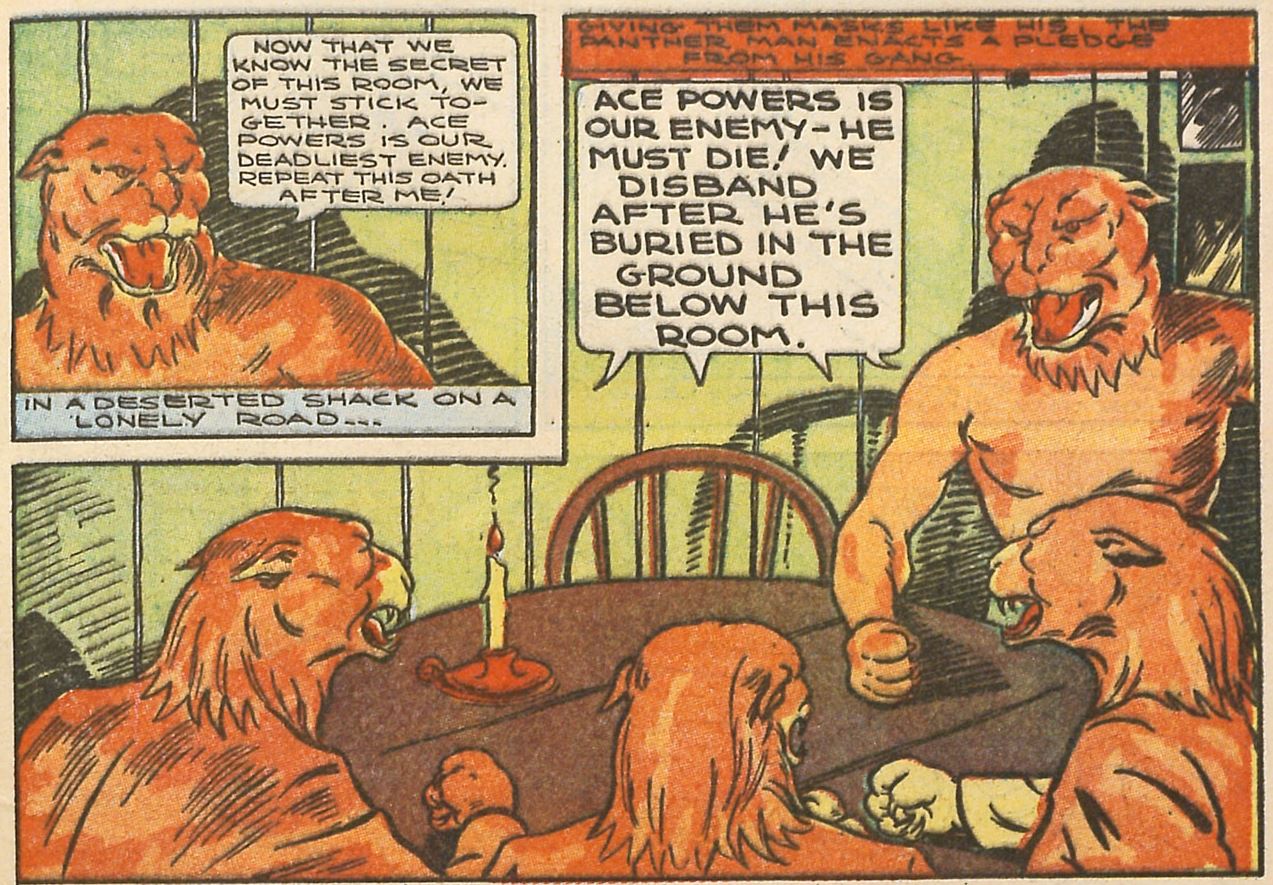
    The Panther Men (as they are called) are a terrific addition to the Panther’s operation. First of all, I love any group of henchmen who are dressed in a junior version of their boss’ outfit, though the colourist has obfuscated the fact that that is the case here by rendering what is pretty clearly still their inmates’ uniforms as a golden brown. More importantly, the Panther’s somewhat-goofy open-mouthed mask looks fantastic when quadrupled – just look at that panel where they’re all sneaking up on Ace Powers yet perfectly farmed in a mirror for proof.

    The Panther Men prove to be effective backup for the Panther (aka the Panther Man at this point) – they capture Ace Powers and take him back to their weird little shed HQ to dispose of him, and he only manages to escape being buried alive by surprising the lot of them and knocking them into his would-be grave.

    But the saga of the Panther is not quite over yet! When the police dig up the crooks (did I mention that the shed had collapsed on top of the hole after the various Panther Men had fallen in it? be cause it had) in Silver Streak Comics 006, they find only the bodies of the three Panther Men, with no sign of the Panther himself.

    Examining the hole, Powers discovers a secret door that leads to the underground lair of future subject the Spook, who turns out to be the Panther’s boss, which I suppose makes the Panther Men some sort of subcontractors? This is very fun! While having the villain turn out to be working for an even greater villain isn’t a guaranteed win as far as plot twists go, it works here, even if it was clearly 100% made up when *checks credits* Harry Anderson sat down to draw this comic. 

    This is, alas, the end for the poor Panther, as the Spook is one of those terrible super-villain bosses who murder their employees for failing them, in this case for not managing to kill Ace Powers. The Panther meets his end at the blades of a triple swinging pendulum deathtrap, and although that’s not a particularly rare style of comic book murder machine this might just be the first time I’ve seen one take someone out, so that’s a final achievement for out boy.