The Curse of Skeleton Munroe

Category: thief

  • MINOR SUPER-VILLAIN 731: THE PROFESSOR

    (Silver Streak Comics 002, 1940)

    The Professor sits right on that dividing line between “super-villain” and “gang boss with a cool nickname” and what pushed him over the line for me was the fact that he makes three absolutely classic comic book super-villain mistakes in this issue. MISTAKE #1: The Professor lures the Wasp and his aide Bill Barnes to an isolated area to eliminate them before they interfere with his plans as they have in the past, but they don’t even know that he’s out of jail, let alone planning a robbery. Don’t call attention to yourself.

    Just a brief action shot to show the Wasp really using that wing-cape he takes his name from before moving on to…

    MISTAKE #2: Despite the fact that Barnes and the Wasp escape from his trap and know that he’s about pull a big job, the Professor continues with his plans and ends up losing his loot to the Wasp. Don’t be predictable – change your plans if you need to.

    The Professor and his men set out in hot pursuit of the heroes and the loot, and this is where he commits MISTAKE #3: so intent is he on his goal that he ignores the risks involved in piloting his fragile speedboat too close to a freighter and gets everyone killed. The sunk cost fallacy can be deadly. Don’t forget that cutting and running is always an option.

    It’s a harsh world out there for the low-level super-villains, but you don’t have to go around making things harder for yourself.

  • MINOR SUPER-VILLAIN 731: THE PROFESSOR

    (Silver Streak Comics 002, 1940)

    The Professor sits right on that dividing line between “super-villain” and “gang boss with a cool nickname” and what pushed him over the line for me was the fact that he makes three absolutely classic comic book super-villain mistakes in this issue. MISTAKE #1: The Professor lures the Wasp and his aide Bill Barnes to an isolated area to eliminate them before they interfere with his plans as they have in the past, but they don’t even know that he’s out of jail, let alone planning a robbery. Don’t call attention to yourself.

    Just a brief action shot to show the Wasp really using that wing-cape he takes his name from before moving on to…

    MISTAKE #2: Despite the fact that Barnes and the Wasp escape from his trap and know that he’s about pull a big job, the Professor continues with his plans and ends up losing his loot to the Wasp. Don’t be predictable – change your plans if you need to.

    The Professor and his men set out in hot pursuit of the heroes and the loot, and this is where he commits MISTAKE #3: so intent is he on his goal that he ignores the risks involved in piloting his fragile speedboat too close to a freighter and gets everyone killed. The sunk cost fallacy can be deadly. Don’t forget that cutting and running is always an option.

    It’s a harsh world out there for the low-level super-villains, but you don’t have to go around making things harder for yourself.

  • MINOR SUPER-VILLAIN 725: THE SEA-WITCH

    (Science Comics 005, 1940)

    En route to the court of King Neptune to deliver a new invention to him, Navy Jones and Princess Coral find themselves the prisoner of a heinous-looking clarinet-playing mermaid who looks a lot like something out of a 19th Century political cartoon.

    I’ll be honest here: while the Sea-Witch is a notable-enough villain to cover here, the real attraction of this comic is that it all looks like an outsider art fever dream. The Grand Comics database says that the artist was Bert Whitman and that he did enough comics work in the 40s that I should have run into him, but either luck has conspired against me in that regard or this was just a more interesting assignment than usual for him, because it’s just really enjoyably weird.

    Navy Jones escapes the clutches of the One-Eyed Octopus when it turns out that it is fatally allergic to pepper, and he and Princess Coral are able to simply swim away under the cover of its dying ink-cloud. The Sea-Witch’s little imp minions give chase but are unable to contend with the sheer power of the “Speed Sea Tri-Motor” underwater jetapacks that the duo are wearing courtesy of Coral’s as-yet-unnamed father.

    Other weird and wonderful occurrences in this comic:

    An idyll with Queen Nina and her subjects in Mermaid City,

    This two-panel plot by a pair of incompetent undersea pirates,

    Navy Jones visiting the grave/locker of his great great great grandfather, Davy Jones (bah gawd, his name isn’t just a pun, it’s hereditary!),

    and the pomp, circumstance and wide array of weird sea creatures in King Neptune’s court. The question of whether this is the Neptune of myth or just some guy is overshadowed (and possibly answered) by the presence of, for example, a cutlass-wielding fish-man centaur in the background. Delightful!

  • MINOR SUPER-VILLAIN 719: THE PURPLE GANG

    (Science Comics 001, 1940)

    The Purple Gang, a bunch of guys in a gang who all wear purple suits and are getting up to no end of crime in whatever skyline-heavy city the Eagle calls home New York City, are a perfect opponent for a super-hero’s first adventure: organized enough to pose a challenge but not so tough that thy can’t really be stunted on to show how cool the Eagle is.

    They also quite noticeably do not all have purple suits on – of the six or seven Purple Gang members shown on panel, only one even comes close and his suit is more of a dark blue. And since the purple suit thing is mentioned not once but twice in the course of the story I must assume that the colourist simply did not give a care.

  • MINOR SUPER-VILLAIN 719: THE PURPLE GANG

    (Science Comics 001, 1940)

    The Purple Gang, a bunch of guys in a gang who all wear purple suits and are getting up to no end of crime in whatever skyline-heavy city the Eagle calls home New York City, are a perfect opponent for a super-hero’s first adventure: organized enough to pose a challenge but not so tough that thy can’t really be stunted on to show how cool the Eagle is.

    They also quite noticeably do not all have purple suits on – of the six or seven Purple Gang members shown on panel, only one even comes close and his suit is more of a dark blue. And since the purple suit thing is mentioned not once but twice in the course of the story I must assume that the colourist simply did not give a care.

  • MINOR SUPER-VILLAIN 705: ROCKO

    (Planet Comics 005, 1940)

    Rocko is a totally awesome alien (from a species called the Nethermen, a totally awesome name) who looks like a human with one great grandparent who was a toad and dresses in pulp sci-fi armour as he scours the spaceways for a star of sufficient heat to run all of his planet’s industry. Bad luck for humanity: the first adequate star that he manages to find while aimlessly noodling around in space (as opposed to picking one ahead of time and heading directly there) turns out to be our own.

    This comic is a real five-star example of the very muddy understanding of astronomical terminology at play in the comic book sci-fi writing community: the term “universe” is used consistently and with 100% confidence in place of “solar system” (though the other option, that Rocko did in fact come from another universe entirely and that he is so bad at finding stars that he flew right past entire other galaxies of them before bumping into ours, is a tempting one to entertain).

    Earth is of course placed in quite the pickle by the siphoning off of the Sun’s heat, and all of the planet’s hopes and dreams of future survival are placed in the hands of the heroic Space Admiral Curry, who proves that he his the right man for the job by getting into his spaceship and aimlessly noodling around in space hoping to bump into the solution to his problems, just as Rocko had before him. And it works! Curry tracks down the missing solar energy, beats up seemingly every Netherman on the planet and then… leaves without shutting off the heat siphoning machines. For some reason.

    Instead of, again, simply destroying or even turning off the machines that are dooming his planet, Curry comes up with a more complicated plan: he builds his own machines to siphon the energy of the Netherstar and give the Nethermen a taste of their own medicine. This goes pretty well, as all the Nethermen that can flee the planet (leaving the rest to freeze) and the rest are shot down by the Earth spacefleet as they try a last-second invasion. Rocko himself is the only one tomake it all the way to the solar siphons and he falls to a simple deathtrap. Earth is saved! Via genocide!

  • MINOR SUPER-VILLAIN 685: SATAN

    MINOR SUPER-VILLAIN 685: SATAN

    (Pep Comics 002, 1940)

    Dateline: Florida! A huge and monstrous face has begun appearing in the clouds across the state to demand fealty! Coincidentally, armoured cars have been disappearing up and down the peninsula at about the same time as the facial appearances.

    The Comet is of course intrigued by this coincidence and decides to investigate. Plotting out the robberies on a map, he proceeds to the swamp located at the central point, and I’ve just realized that it’s a good thing that he’s right because the first thing he does is kick a man into the water and steal his boat and that would be a very embarrassing thing for a super-hero to have done to ,e.g., an innocent game warden. It’s no problem, though, because the guy was in fact an agent of Satan.

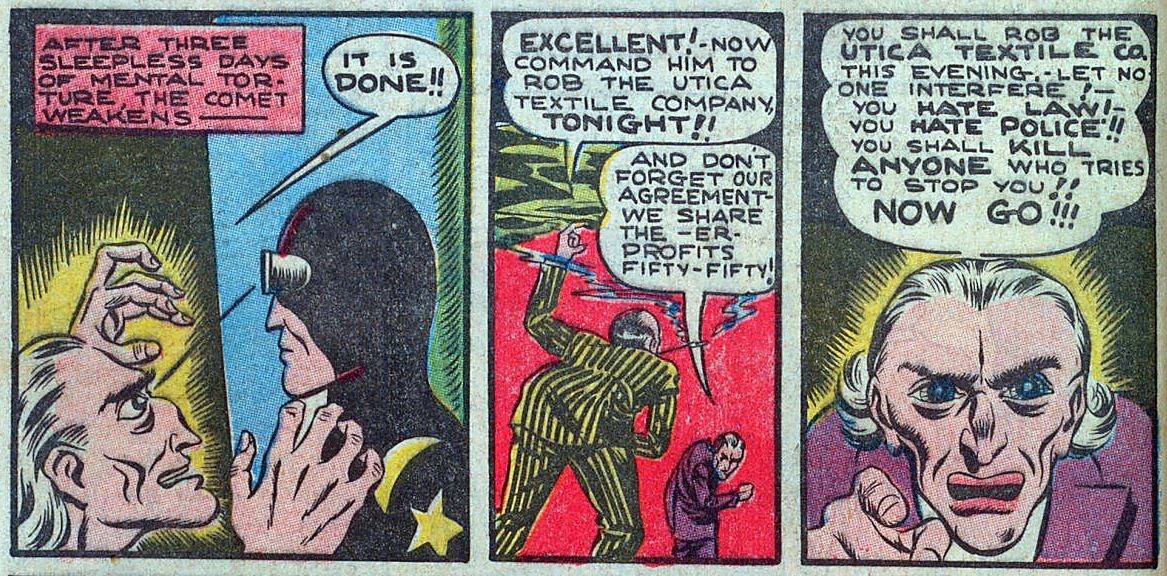
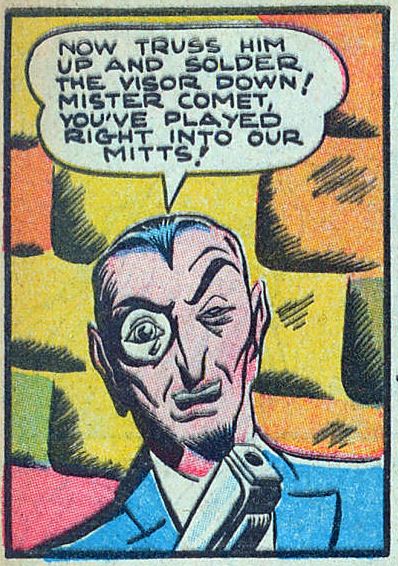
    Satan turns out to be a pretty cagey character: not only does he have a way of dealing with snoopers (dragging their boats through a whirlpool into his sub-swamp lair, as happens to the Comet) but he’s got an impressive level of knowledge of current super-hero news. He knows just who the Comet is and more importantly how to neutralize his major offensive ability, by welding his protective eye mask shut. And this is only the Comet’s second case!

    The mystery of both the monster in the clouds and the disappearing armoured cars, by the way, come down to the same thing: that old favourite, the mighty dirigible. One dirigible equipped with a high-powered projector and loudspeaker and a second with a powerful electromagnet, to be precise – as one is distracting everyone with a big face, the other is making off with the car and the cash (and the unfortunate driver and guards).

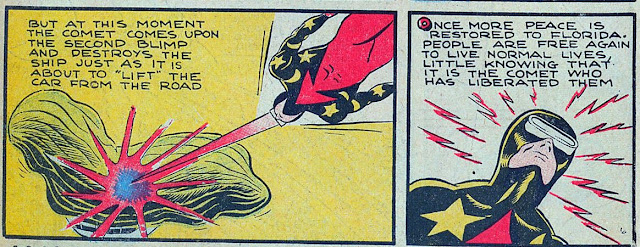
    Back to the Comet: Satan’s anti-super-hero savvy extends only so far. Despite his acumen in capturing the Comet and neutralizing his power, Satan has fallen prey to the super-villain’s hubris by leaving him to die in a deathtrap rather than merely shooting him in the head. You see, the really important thing about the Comet’s visor is that it’s just a sheet of glass and thus easily breakable, which the Comet does by the simple expedient of headbutting a rock. After that, it’s just a matter of utterly obliterating not only both dirigibles but the entire swamp base. Satan is toast.

    OR IS HE? In a shock twist, Satan returns in Pep Comics 003 and manages to capture the Comet again, this time taking the trouble to pop him into a glass tube and thus completely neutralizing his powers! (and also delighting me personally, because the name Satan is very ambiguously used in his first appearance and I really appreciated this confirmation that it really is his nom du crime. For my records).

    Satan’s got big plans for the Comet – no cheesy deathtrap this time, no sir. Instead, he brings in put-upon hypnotist Doc Zadar in order to put the Comet to work for him.

    And this isn’t your namby-pamby “can’t be forced to violate your deeply-held morals” hypnotism, this is the real hard-core shit. The Comet goes on a destructive and violent crime spree under Satan and Zagnar’s direction. Notably, this is when he kills a whole bunch of cops, which informs the rest of his Golden Age career by making him one of the few super-heroes who the police have some real justification for constantly trying to gun down (I mean, they still shouldn’t just be trying to execute him in the street, but it’s nice to see them doing it for a reason other than “he’s running away from me even though I’m threatening to kill him!”)

    Once again Satan is undone by his own hubris: this time his failure to see that cheating and abusing the man who controls the actions of a living death ray generator might be a bad idea, and he gets gruesomely dissolved for his mistake. Unfortunately for Zagnar, he forgets the first rule of owning a living death ray generator: always put the safety cap back on. He too is dissolved and the Comet is free to have cops try to gun him down in the street forevermore.

    BONUS: All this Comet talk had me feeling nostalgic and I looked up 1983’s The Comet 001, which I had as a kid. It’s a pretty maudlin book primarily concerned with the Comet castigating himself over what a violent and murderous vigilante he was, and the splash page reflects this via the floating ghosts of the dead who haunt him – note all the cops from Pep Comics 003 at the top there. But just who is that at the lower left?

    I am 75+% certain that this is the monster face that Satan was projecting onto the clouds in Pep 002, which is a pretty hilarious thing to be haunting a depressed 80s super-hero. “I contributed to the death of the airship as a viable mode of transport when I murdered those dirigibles!”

    (the real if boring answer is that it probably is the face from the clouds but, as Satan himself is never actually pictured in the severely abridged version of the story in this comic, the face is being retconned into being his)

  • MINOR SUPER-VILLAIN 681: BARON HOFF

    (National Comics 006, 1940)

    Here’s what Baron Hoff brings to the table: 1. Scale. Hoff’s goal in this comic is to rob one (1) bank, and as a distraction from that crime he sets the entire island of Manhattan on fire.

    2. Look. Not only does he have a striking face and a killer grin but Baron Hoff has a real flair for villainous fashion. Some might balk at accentuating an aviator’s outfit with a monocle and jodhpurs and big puffy sleeves but he really makes it work. The only real misstep in his look is the toothbrush mustache, which pairs misleadingly with the pseudo-military brown outfit to make you think he’s some sort of Hitler analog. Do not waste your time: Hoff is not fascist, he just has poor taste in facial hair.

    3. Ride. I love an auto-gyro, and the fact that Baron Hoff not only flies around in one but uses its blades as a deadly obstacle to those seeking to enter the bank while he’s robbing it is just a bit of a bonus.

    Anyway, Hoff is up against super-speedster Quicksilver and such things as whirling blades of death mean nothing to such a fast man. Hoff is jailed in record time.

  • MINOR SUPER-VILLAIN 681: BARON HOFF

    (National Comics 006, 1940)

    Here’s what Baron Hoff brings to the table: 1. Scale. Hoff’s goal in this comic is to rob one (1) bank, and as a distraction from that crime he sets the entire island of Manhattan on fire.

    2. Look. Not only does he have a striking face and a killer grin but Baron Hoff has a real flair for villainous fashion. Some might balk at accentuating an aviator’s outfit with a monocle and jodhpurs and big puffy sleeves but he really makes it work. The only real misstep in his look is the toothbrush mustache, which pairs misleadingly with the pseudo-military brown outfit to make you think he’s some sort of Hitler analog. Do not waste your time: Hoff is not fascist, he just has poor taste in facial hair.

    3. Ride. I love an auto-gyro, and the fact that Baron Hoff not only flies around in one but uses its blades as a deadly obstacle to those seeking to enter the bank while he’s robbing it is just a bit of a bonus.

    Anyway, Hoff is up against super-speedster Quicksilver and such things as whirling blades of death mean nothing to such a fast man. Hoff is jailed in record time.

  • MINOR SUPER-VILLAIN 663: THE JUNGLE DEMON

    (Jungle Comics 006, 1940) 

    The Jungle Demon starts out as an unnamed boy lost in the jungle and true to the old trope he is found and nurtured by a beast – we’ve seen it many times before. The beast in this case is a mind-bogglingly large constrictor snake, which is fun. Boy grows to man and he and the snake (charmingly named “Powerhouse”) are at peace with the people and animals of the jungle until one day the still-unnamed young man chows down on what turns out to be some AD&D Alignment-flipping berries and Nice Boy becomes the Jungle Demon.

    My memory had filled in some details and I was thinking of this fellow as one of the big Fantomah villains but in fact although he talks a big game about conquering the Jungle, mostly he just steals jewels and defrauds his workers.

    Fantomah steps in a couple of times throughout the story to warn the Jungle Demon away from pursuing his darker impulses (pulling down a city to build a palace, enslaving people with dark majicks, etc) but he just can’t help but be evil and eventually she is forced to feed him an antidote salad to reverse the effects of the berries (and she exiles him and his snake to an isolated plateau, which seems a bit mean). I hadn’t really thought about it before but this tendency of Fantomah’s to watch the unfolding action but not really step in until she does so decisively at the moment of crisis is the equivalent to Stardust the Super Wizard’s very long commute: a way for there to be a story with an effectively omnipotent protagonist in which anything actually happens.