The Curse of Skeleton Munroe

Category: thief

  • MINOR SUPER-VILLAIN 628: PROFESSOR DONALDSON

    (Fantastic Comics 011, 1940)

    Sometimes it’s nice to read a story about a straightforwardly criminal scientist, and that’s just what Professor Donaldson is. He’s invented an “electronic exploder” which can turn steel to dust and by gar if he isn’t going to use that to extort some money out of people with steel things that they would like to stay intact, such as the superstructure of a skyscraper.

    Donaldson is also prepared to pivot: when his original attempt to set up a protection racket fails he attempts to extort NYC itself. This also fails, because Samson is in the city and the Generic New York Mayor has a guy on staff who knows how super-heroes work. Why, they often don’t even ask to be paid!

    But Professor Donaldson just won’t stop pivoting! If extortion isn’t going to pay off then a steel-dissolving ray is the perfect thing for bank robbery!

    The bank robbery is, alas, Donaldson’s last pivot before Samson and David catch up to him. He puts up a very brave front but ultimately a pasty-faced lab rat, even armed with a fire axe, is no match for David, let alone Samson.

    At least Donaldson’s death is somewhat poetic, as he is run down, or “wrecked” by a train, just as he himself had wrecked a train in his earlier campaign to extort the city.

    Shout out also Professor Donaldson’s unusually large number of named henchmen. Good luck looking for new employment Buck, Butch, Silky, Mike, Slinky and Bill. Except not Buck because Samson killed him. Rest in peace, Buck.

  • MINOR SUPER-VILLAIN 628: PROFESSOR DONALDSON

    (Fantastic Comics 011, 1940)

    Sometimes it’s nice to read a story about a straightforwardly criminal scientist, and that’s just what Professor Donaldson is. He’s invented an “electronic exploder” which can turn steel to dust and by gar if he isn’t going to use that to extort some money out of people with steel things that they would like to stay intact, such as the superstructure of a skyscraper.

    Donaldson is also prepared to pivot: when his original attempt to set up a protection racket fails he attempts to extort NYC itself. This also fails, because Samson is in the city and the Generic New York Mayor has a guy on staff who knows how super-heroes work. Why, they often don’t even ask to be paid!

    But Professor Donaldson just won’t stop pivoting! If extortion isn’t going to pay off then a steel-dissolving ray is the perfect thing for bank robbery!

    The bank robbery is, alas, Donaldson’s last pivot before Samson and David catch up to him. He puts up a very brave front but ultimately a pasty-faced lab rat, even armed with a fire axe, is no match for David, let alone Samson.

    At least Donaldson’s death is somewhat poetic, as he is run down, or “wrecked” by a train, just as he himself had wrecked a train in his earlier campaign to extort the city.

    Shout out also Professor Donaldson’s unusually large number of named henchmen. Good luck looking for new employment Buck, Butch, Silky, Mike, Slinky and Bill. Except not Buck because Samson killed him. Rest in peace, Buck.

  • MINOR SUPER-VILLAIN 544: DR VON THORP & THE IRON MONSTER / MINOR SUPER HERO: HUGH HAZZARD & BOZO THE IRON MAN

    (Smash Comics 001, 1939)

    We open on a city (later established as almost certainly NYC) in the grip of terror. A robot known as the Iron Monster is wantonly robbing and murdering and also stealing one or more babies for reasons that are never made clear. Seriously, we never find out what the deal was with those babies.

    The Iron Monster is the creation of Dr von Thorp, your classic scientist rejected from society for his outre beliefs, though considering the man and his work he may have been ostracized for something other than believing that he might someday build a robot. Regardless of why he was rejected, he has expressed himself in the traditional way, by turning his invention back on society as revenge.

    The police have no hope of dealing with the Iron Monster or his boss, so Police Commissioner Hunt calls in private detective par excellence Hugh Hazzard, whose job is made considerably easier by the fact that von Thorp subscribes to the surprisingly common school of robot design that dictates that the robot contain a large, easily accessible space that a human can get inside and also take control of the robot from. Von Thorp’s capture is almost anticlimactic, in fact.

    The reason for this anticlimax is that this is not, in fact, the story of Dr von Thorp and his Iron Monster but the origin of Hugh Hazzard and the renamed Bozo the Iron Man. As introduced Hazzard is already one of those superhuman-adjacent comic book adventurers complete with a special method for the police commissioner to contact him and a love interest gamely resigned to spending most of her evenings alone. Bozo, despite eventually taking over the name of the strip entirely, is never more than a tool of Hazzard’s with no actual personality or volition (though Hazzard does eventually switch to mostly travelling around inside the robot like the other, later Iron Man and Bozo gets a considerable boost in personality once it seems to be spouting quips from its fixed grimace).

    In Smash Comics 002 Hazzard upgrades Bozo with both a considerably miniaturized controller (cellphone sized vs the old one’s desktop PC) and a weird disc on top of his head that allows him to fly, so I guess that also makes him one of those hobbyist polymath types you get in old comics

    Dr von Thorp returns exactly one more time in Smash Comics 018, wherein he and Hazzard battle for control of Bozo by blasting radio waves at him like two people trying to see who a puppy loves more. No surprise that Hugh Hazzard wins but killing von Thorp off-panel at the very end seems a bit mean.

    Like I said, Bozo’s role in the title of the strip if not as a character continued to grow until the end of their run in 1943. Since then Bozo occasionally turns up in a collection of DC Comics junk that some character has collected. Of Hugh Hazzard there has been no further sign.

  • MINOR SUPER-VILLAIN 540: THE WILL-O-WISP

    (Silver Streak Comics 001, 1939)

    As we open, simply everyone’s worried about the Will-o-Wisp, a mysterious crook who shows up at crime scenes and steals what other crooks were about to make off with. The police chief looks bad because he can’t catch the Will-o-Wisp! The gangs are mad because they keep getting robbed by the Will-o-Wisp!

    The Will-o-Wisp’s big mistake comes when he butts in on the mugging of Neal Carruthers III, aka Mister Midnite, which of course arouses his interest. I guess you could argue that that wasn’t precisely a mistake because the Will-o-Wisp didn’t know that he was making it, but what about the fact that his next move was to extort the police chief for $50 000? Even without knowing that the chief and Neal Carruthers were friends that’s just plain playing with fire.

    Mister Midnite of course crashes the cash handoff and manages to figure out the Will-o-Wisp’s secret: that he is not in fact a small ball of light capable of speech but a very gutsy ventriloquist who just saunters up and takes the loot while his victims are distracted by a light on a fishing line or some other apparatus. It’s a bold, bold plan, with one huge point of failure: the first time someone looks away from the light and says “who’s that guy?” you’re screwed.

    Speaking of “who’s that guy?”, one thing that never gets resolved is who exactly that guy is. I assume that he’s meant to be an unknown outsider but thanks to the ambiguity of the simple art combined with the spot colouring everyone looks very similar to one another. I honestly can’t say if one of the cops or crooks introduced in other scenes are supposed to also be the Will-o-Wisp. 

    All we can do is wait for someone to do a gritty reboot of Mister Midnite and give us a satisfying Will-o-Wisp origin (dark sorcerer who gained the ability to gorily eject a glowing orb from his nasal cavity in exchange for the souls of the innocent, I assume).

  • MINOR SUPER-VILLAIN 540: THE WILL-O-WISP

    (Silver Streak Comics 001, 1939)

    As we open, simply everyone’s worried about the Will-o-Wisp, a mysterious crook who shows up at crime scenes and steals what other crooks were about to make off with. The police chief looks bad because he can’t catch the Will-o-Wisp! The gangs are mad because they keep getting robbed by the Will-o-Wisp!

    The Will-o-Wisp’s big mistake comes when he butts in on the mugging of Neal Carruthers III, aka Mister Midnite, which of course arouses his interest. I guess you could argue that that wasn’t precisely a mistake because the Will-o-Wisp didn’t know that he was making it, but what about the fact that his next move was to extort the police chief for $50 000? Even without knowing that the chief and Neal Carruthers were friends that’s just plain playing with fire.

    Mister Midnite of course crashes the cash handoff and manages to figure out the Will-o-Wisp’s secret: that he is not in fact a small ball of light capable of speech but a very gutsy ventriloquist who just saunters up and takes the loot while his victims are distracted by a light on a fishing line or some other apparatus. It’s a bold, bold plan, with one huge point of failure: the first time someone looks away from the light and says “who’s that guy?” you’re screwed.

    Speaking of “who’s that guy?”, one thing that never gets resolved is who exactly that guy is. I assume that he’s meant to be an unknown outsider but thanks to the ambiguity of the simple art combined with the spot colouring everyone looks very similar to one another. I honestly can’t say if one of the cops or crooks introduced in other scenes are supposed to also be the Will-o-Wisp. 

    All we can do is wait for someone to do a gritty reboot of Mister Midnite and give us a satisfying Will-o-Wisp origin (dark sorcerer who gained the ability to gorily eject a glowing orb from his nasal cavity in exchange for the souls of the innocent, I assume).

  • MINOR SUPER-VILLAIN 528: THE BLACK HAND

    (Blue Ribbon Comics 016, 1941) 

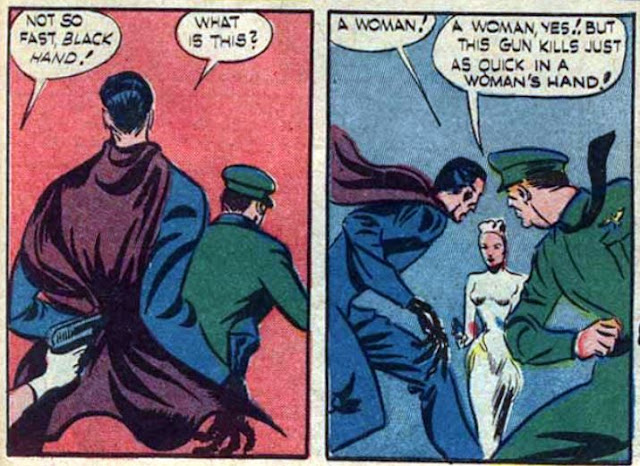
    There’s a quality that some comic book characters have and some do not and I never knew about it until I started writing this blog. That quality is called Standing in Clear View So That I Can Get a Screengrab of Them, and buddy, the Black Hand does not have it. This is about as good of a full look as you get of the guy in his first appearance.

    Enough complaining! The Black Hand is a spy of the Unaffiliated Freelancer subtype, which since he operates out of the US means that he steals US secrets for sale to the Nazis. Is a character who does business with Nazis better than one who is a Nazi? Marginally. The Black Hand is also the recurring villain of Captain Flag, who he is also responsible for becoming a super-hero due to his murder of Flag’s father and failure to proof his lair against narratively significant eagles.

    The Black Hand is called the Black Hand because of his black hand, which he usually conceals beneath a black glove and which is riddled with a deadly disease that the Black hand can transfer to a victim via a simple scratch of his horrible fingernails. It’s definitely a useful power (affliction?) for a villain to have but not one that has a chance of coming up in anyone’s super-power wishlist.

    Throughout his five appearances the Black Hand sports three distinct looks: the initial iteration (either afflicted with a deathly pallor or just overenthusiastic when applying foundation), a sort of suave mustachioed cat-burglar getup with no hint of the grave and then back to the deathly complexion with an added skull-like quality to the face. Realistically this can be put down to Captain Flag being a secondary character without a dedicated artist, but if that was the point of this blog then it would swiftly cease to be much fun.

    Notably, the suave version of the Black Hand wears his glove on the opposite side – could this indicate that he and the corpselike Black Hand are different characters? Perhaps the disease that gives them their name is also slowly killing them, which could account for the more ghoulish appearance of the original Hand over time?

    These questions will never be answered, sadly, as in-universe the Black Hand made a transition from spy the thief to pirate and Captain Flag was quick to invoke the Law of the Sea to hang him from the nearest yardarm. Out of universe, Captain Flag’s feature didn’t survive the cancellation of Blue Ribbon Comics and so the Black Hand had nobody to come back from the dead to torment.

  • GENERIC COSTUMED VILLAIN ROUND-UP 011

    Some say they’re not generic enough but I think they’re trying their best.

    This fellow is part of a gang looking to hijack a shipment of railway guns from train engineer Runaway Ronson. I really enjoy the look of the padded suit they use to help survive crashing a car into a high-speed train but I really really enjoy the fact that they immediately scramble off into the woods and are never seen again, as if they were completely unrelated to the criminal plot. (Blue Bolt v1 007, 1940)

    This fellow’s a pseudo-Nazi spy named Ketler who goes up against Sub-Zero in an attempt to influence the very specific Torpedo Workers Union into striking and hindering part of the US defense program. I feel like he overestimates the usefulness of the mask as he doesn’t change anything else about his appearance when not murdering people but that’s not what gets him caught so I guess I’m the fool here.(Blue Bolt v2 002, 1941)

    Colourful enemy aces are the best/ only tolerable part of the absurd number of Golden Age comics about pilot-adventurers, so my little ears pricked up when American-flying-for-the-French Loop Logan was challenged to a dogfight by a Nazi called the Blue Duke but… there’s nothing to him. He’s just a guy with a name who’s been sabotaging French planes and shooting them down. Waste of a good name, if you ask me. (several days later note: it took me an embarrassingly long time to realize that this guy’s name was a play on the Red Baron) (Blue Ribbon Comics 004, 1940)

    These guys briefly terrorize New York (possibly – we have another instance of a city that is Clearly New York City But the Mayor is Wrong) with a futuristic tank mounted with a death ray. If they a) had a name and b) weren’t completely demolished by Mr Justice in about three panels they might have made the leap to full Minor Super-Villain status but as it stands they’re an object lesson in why ultra-powerful ghosts need a tougher class of enemy to be really entertaining. (Blue Ribbon Comics 010, 1941)

  • MINOR SUPER-VILLAIN 516: THE GHOST CROOK

    (Blue Bolt v2 003, 1941) 

    Sergeant Spook’s actual jurisdiction as a ghost cop is both broad and vague, but when he opens up his presumably black market mortal paper one day and learns that a ghost is seemingly wreaking havoc among the living it’s a no-brainer: he’s on the case. And it seems that he’s up to the task of tracking the Ghost Crook down, because just about as soon as he steps foot in the mortal world he happens across a spooky mugging!

    It doesn’t take long for Sergeant Spook to discover that the Ghost Crook is not, in fact, a ghost but an invisible man of some kind. So not a criminal ghost but something just as bad: a criminal besmirching the good name of ghosts everywhere!

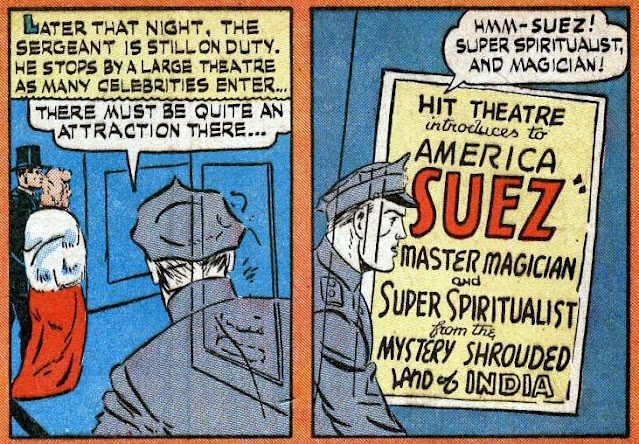
    Sergeant Spook seemingly just starts visiting all of the supernatural-adjacent locales in town and once more gets incredibly lucky as his first port of call is the theatre at which Suez, Master Magician and Super Spiritualist is performing and Suez is in fact the Ghost Crook. Why is he named the overwhelmingly-Egyptian-associated Suez when he is touted as being from “the mystery shrouded land of India”? My money is on him being a white guy who chose his name on vibes. My evidence? The history of entertainment.

    This is where things get a bit confusing. Once the Ghost Crook is revealed to be a stage magician there is some effort to reframe his invisibility as mere slight-of-hand, whether via trickery with mirrors and clouds of dust or the old standby explanation of mass hypnosis. But… we saw the Ghost Crook be fully invisible! He was running down a city street in broad daylight! And just like every time hypnosis is wheeled out in a Zatara story to explain all his wild powers, the sheer scope of what Suez could supposedly do (hypnotize everyone with eyes on him in a city street, including a ghost that he could not see and was not aware of who had just showed up while he was busy wresting a bag from a man’s hand) is so wildly over-the-top that merely turning invisible via magic is by comparison mundane.

    This question is not resolved, by the way. The Ghost Crook is felled with a spectral sock to the jaw and carted off by mortal police. Who then had to figure out if he really was an Indian citizen, presumably.

  • MINOR SUPER-VILLAIN 494: THE INVENTOR

    (Big Shot Comics 008, 1940) 

    It’s a very big stretch, even by the standards of my own Unofficial Name convention, to call this guy the Inventor but it’s literally the only thing he’s referred to as other than “the man” and I just can’t keep calling these guys “Unnamed Scientist.” I just can’t.

    So! The Inventor has invented a very cool remote-controlled humanoid robot with a special poison-spraying device in the chest. We’ll skip my usual speculation into the potential value that could be reaped by selling this design for industrial purposes rather than using it for mere bank robbery because the Inventor is in fact a mad scientist and thus cannot be held to the same fiscal standards as his more rational colleagues.

    Let’s take a second to appreciate the classic stylings of this robot: cylinder head, pincer claws, speaker ears… all the great robot features in one cool guy.

    This might be a Tom Kerry story but the real hero of the piece is this night watchman who chooses not to pointlessly die in an attempt to protect the bank he works at and instead lives to clue the two-fisted District Attorney in on the culprit’s identity as a robot. I appreciate you, fella.

    Tom Kerry tracks the robot back to its lair by the simple expedient of clinging to the underside of the remote-controlled auto-gyro used to ferry both it and the money back to the Inventor. There he takes advantage of the fact that like a surprising percentage of Golden and Silver Age robots, this one’s exterior shell is easily removed and repurposed as a costume.

    The Inventor is essentially epically pranked into signing a confession, Tom Kerry battles a knife-wielding maniac in his boxer shorts and the whole thing wraps up with a sock to the jaw. No word on what became of that poor nude robot, though.

  • MINOR SUPER-VILLAIN 494: THE INVENTOR

    (Big Shot Comics 008, 1940) 

    It’s a very big stretch, even by the standards of my own Unofficial Name convention, to call this guy the Inventor but it’s literally the only thing he’s referred to as other than “the man” and I just can’t keep calling these guys “Unnamed Scientist.” I just can’t.

    So! The Inventor has invented a very cool remote-controlled humanoid robot with a special poison-spraying device in the chest. We’ll skip my usual speculation into the potential value that could be reaped by selling this design for industrial purposes rather than using it for mere bank robbery because the Inventor is in fact a mad scientist and thus cannot be held to the same fiscal standards as his more rational colleagues.

    Let’s take a second to appreciate the classic stylings of this robot: cylinder head, pincer claws, speaker ears… all the great robot features in one cool guy.

    This might be a Tom Kerry story but the real hero of the piece is this night watchman who chooses not to pointlessly die in an attempt to protect the bank he works at and instead lives to clue the two-fisted District Attorney in on the culprit’s identity as a robot. I appreciate you, fella.

    Tom Kerry tracks the robot back to its lair by the simple expedient of clinging to the underside of the remote-controlled auto-gyro used to ferry both it and the money back to the Inventor. There he takes advantage of the fact that like a surprising percentage of Golden and Silver Age robots, this one’s exterior shell is easily removed and repurposed as a costume.

    The Inventor is essentially epically pranked into signing a confession, Tom Kerry battles a knife-wielding maniac in his boxer shorts and the whole thing wraps up with a sock to the jaw. No word on what became of that poor nude robot, though.