The Curse of Skeleton Munroe

Category: colonialism

  • MINOR SUPER-VILLAIN 378: THE THING

    (More Fun Comics 064, 1941)

    This is not a complicated one: Congo Bill is asked for help by his friend Jack Brent. Brent is trying to sell his plantation, one of the assets of which is his good relationship with the local labour pool. Just as he had found a buyer, a skull-headed goon called the Thing started murdering workers. It’s about par for course re: jungle comics portrayal of nonwhite folks and fairly standard otherwise and of course the Thing turns out to be Mr Tate the prospective buyer attempting to get a better price via wholesale slaughter. The one redeeming feature of the story is this:

    The Thing looks sick as hell. You’ll be hard pressed to find a better look than a skull in a hood and the cool dagger is a real bonus. The bulletproof vest is of course not visible but speaks to a thoughtfulness that is shamefully wasted in this grubby little scheme.

    And yes that is Congo Bill in blackface.

  • MINOR SUPER-VILLAIN 369: ILLYRIA, QUEEN OF SPIES

    (Master Comics 012-014, 016-017, 019-020; Minute-Man Comics 001-002, 1941)

    Illyria, Queen of Spies! (AKA Queen Spy, Spy Queen, Queen of All Spies, Queen of Foreign Spies, etc) Definitely in the running for my favourite of the “recurring femme fatale spymaster” subgenre of super-villain, particularly as she is a foe to Minute-Man, one of the most bland piles of wallpaper paste ever to wear a patriotic costume.

    Beyond merely distracting me from how bored I am by Minute-Man, Illyria provides interest via a fairly wide range of plots and schemes and thus is kind of hard to boil down into a pithy summary. So: a numbered list:

    1. In her first appearance Illyria wears a snazzy orange robe, the better to whip off when captured so as to take advantage of Minute-Man’s “won’t hit girls” policy and get away. She and her three distinctive henchmen spend the issue shooting down US Army aircraft on behalf of their unspecified nation using a special blindingly-bright plane (Master Comics 012, 1941)

    2.In her second outing, Illyria engages in the already-old gag of using war games as a cover to massacre soldiers with real bullets. The interesting aspect of the story is that she is established as an explicit Axis agent (though of a never-specified power) and recruits spies from the other Axis powers to aid her in her schemes (Master Comics 014, 1941)

    3. This one’s just an attempt to kidnap a scientist who has developed a new explosive. It is the origin of the “Queen of Spies” part of her moniker, though. This adventure also marks the first time that Illyria is actually captured, as she is just as slippery as any recurring femme fatale  (Master Comics 014, 1941)

    4. After precisely one issue in the hoosegow, Illyria breaks out (that poor nurse) and attempts to blow up a Fourth of July celebration. (Master Comics 016, 1941)

    5. In service to a pretty rote kidnapping, Illyria deploys both a remote-controlled bomber and X-33, an extremely cool robot soldier who is sadly (for him) not at all waterproof. (Master Comics 017, 1941)

    6. Master Comics 019 & 020 are concerned with boring old espionage focused on stealing bombers and bomber plans: ho hum. Illyria does step up the villainy to include slavery in the latter appearance, though.

    7. Minute-Man 001 features Illyria and her drum-playing chum in a scheme to cause a native uprising on the US-held island of Barracoon in the Gulf of Mexico. The main draw of the story is Illyria’s keen voodoo dance hat but if you want to read a comic that inadvertently highlights the evils of colonialism then this is the one for you, along with about 90% of all Golden Age comics set outside of Europe or North America. And some of the ones set in North America, too.

    8. Illyria’s final appearance in Minute-Man 002 retroactively establishes that the Queen of Spies has been working for the heretofore unmentioned Green Hood, who is tired of her getting foiled all of the time. It’s a bit of an anticlimax for her, as the story is much more concerned with the Green Hood than her. Still, she manages to get away at the end, joining the ranks of the surprisingly populous “recurring femme fatale spies who don’t end up getting caught by dint of not recurring that extra time.”

    (at least I reckon that was her last appearance. She was captured at the end of Master Comics 020, dated November 1941, while Minute-Man 002 was the Winter Issue, dated September to December 1941)

  • MINOR SUPER-VILLAIN 340: THE SEA-DEVIL

    (Master Comics 007, 1940)

    Let’s start with the good things about the Sea-Devil: he’s part of one of my favourite super-villain traditions: the guy who dresses up like a creature in order to play off of local superstitions. Nothing specific in this case – he’s just banking on the local oyster divers not wanting to contend with a mysterious horned humanoid while they’re trying to earn an already dangerous living. To that end, his costume isn’t the most elaborate fake sea monster in comics, though it does have a certain minimalist charm.

    The rest of the story is depressingly familiar. The Sea-Devil is a guy named Sam Mindoro, his motivation is to drive off the white guy who owns his ancestral lands and of course this makes him the worst kind of villain despite him not actually killing anyone while disrupting the extraction of wealth from the area. I mean he does try to kill Shipwreck Roberts and Deep Sea Doodle, which is a crime, but “wants his land back” and “inconveniences a white guy” are treated as much worse ones. Depressing stuff.

    ADDENDUM: Forgot to mention that this fellow is our first Filipino super-villain, for what it’s worth.

  • NOTES: JULY 2023

    Another “renegade white“:

    (Jumbo Comics 034, 1941)

  • MINOR SUPER-VILLAIN 276: THE INVISIBLE SLAYER

    (Marvel Mystery Comics v1 019, 1941)

    There’s a bit in the introductions to the Top 10 anthologies in which Neopolis mayor John Q. Public lays out the exponential propagation of super-heroes, -villains, -pets, -monsters and so forth that takes place in a comic universe that I think of often as I read through these old adventures. Heroes inspire sidekicks and imitators; their enemies build robots and create doppelgangers to counter them, etc, until you have superhumans everywhere. 

    There’s one thing that isn’t brought up in that intro that absolutely contributes to the proliferation of the extranormal in a super-hero universe: any friend, family member or acquaintance (and especially any old college classmate, for some reason) is highly likely to either become a super-villain or to be targeted by one. Out of universe, it is of course an easy way to bring the hero in on a case, but in-universe: what a wild series of coincidences!

    In this case, we find Professor Zog summoned to the side of his old college pal Sir John Chadwick, who has seen almost his entire family killed by a mysterious set of floating hands in recent weeks. Zog is of course a bro and immediately flies to England to solve this problem via Applied Robot Violence. The first battle between Electro and the Invisible Slayer ends in a robo-defeat, but Zog manages to shoot the killer and follows its trail of blood to…

    The nearby mansion of Basil Drake, who turns out to be behind the whole thing to such a degree that one must wonder about Sir Chadwick’s powers of observation. Drake’s mansion contains a herd of gorillas, for heaven’s sake. His motivation for five murders and many more attempteds is that Chadwick’s daughter sensibly rejected his marriage proposal, which is, I must say, a stupid reason to delve into super-villainy.

    And of course even after Drake bumps himself off rather than be captured we must deal with the Invisible Slayer itself, or himself, as it turns out, because the Slayer is in fact Drake’s servant Chandi, cast as a monster due to his size and race.

    A story featuring disembodied hands and herds of gorillas, ruined for me by racism and misogyny. I hope you’re happy, Basil Drake.

  • MINOR SUPER-VILLAIN 256: MORGAN CROOKES

    MINOR SUPER-VILLAIN 256: MORGAN CROOKES

    (Hit Comics 001, 1940)

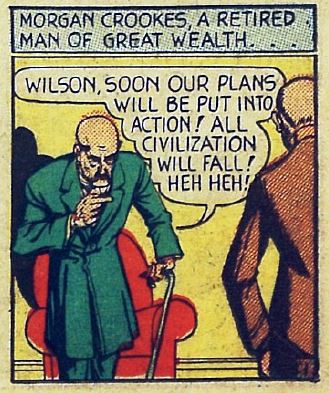
    Hey, it’s Morgan Crookes, a retired man of great wealth! He tries to take over the world and gets stomped by Neon the Unknown in his first adventure! It’s probably one of the most racist comics of the Golden Age! Which is saying something!

  • MINOR SUPER-VILLAIN 256: MORGAN CROOKES

    (Hit Comics 001, 1940)

    Hey, it’s Morgan Crookes, a retired man of great wealth! He tries to take over the world and gets stomped by Neon the Unknown in his first adventure! It’s probably one of the most racist comics of the Golden Age! Which is saying something!

  • MINOR SUPER-VILLAIN 242: THE WHITE RENEGADE

    (Flash Comics v1 010, 1940)

    I’ve alluded now and then to the colonialist assumptions that comics worked off of and that seemingly were endemic to the mindset of the American people. The White Renegade offers an example of the two major prongs of these assumptions, which boil down to the idea that the world is divided into White People and Everyone Else, and that:

    1. All offenses committed by Everyone Else against White people shall be repaid with great vengeance. 

    2. The greatest crime that a White Person can commit is to side with Everyone Else against White People.

    I’m only about 1/10 qualified to talk about this stuff, but I am an English major, so I’m fully qualified to notice it. Someone could probably work up an okay thesis by analysing Golden Age (and all other) comics set in colonized areas.

    So: the White Renegade. He’s called that because he’s a white person siding with South Pacific natives against other white people. The natives would have been in for it regardless, but whenever someone pulls this kind of thing in a comic you know that he’s not long for the world. And indeed, Cliff Cornwall tracks him down and takes him out. There’s not much to him to talk about really – he looks like a palate-swapped version of the Shadow, which is fun.

    The White Renegade! Racism! Colonialism! A cool outfit!

  • MINOR SUPER-VILLAIN 193: THE TIGER WOMAN

    (Crack Comics 009, 1941)

    The Tiger Woman is another in a long line of characters who are vilified for pushing back against colonialism – in this case, American explorers appropriating her peoples’ treasures. Or she would be if the way she was pushing back wasn’t murder, which tends to muddy the righteousness of any cause.

    She does have a really great costume, though. Top marks for style.

  • MINOR SUPER-VILLAIN 193: THE TIGER WOMAN

    (Crack Comics 009, 1941)

    The Tiger Woman is another in a long line of characters who are vilified for pushing back against colonialism – in this case, American explorers appropriating her peoples’ treasures. Or she would be if the way she was pushing back wasn’t murder, which tends to muddy the righteousness of any cause.

    She does have a really great costume, though. Top marks for style.