The Curse of Skeleton Munroe

Category: Wizard

  • MINOR SUPER-HERO ROUND-UP 039

    MINOR SUPER-HERO ROUND-UP 039

    We’re reading Shield-Wizard Comics, bay-bee, so here’s some stuff about the Shield and the Wizard.

    the Shield UPDATE:

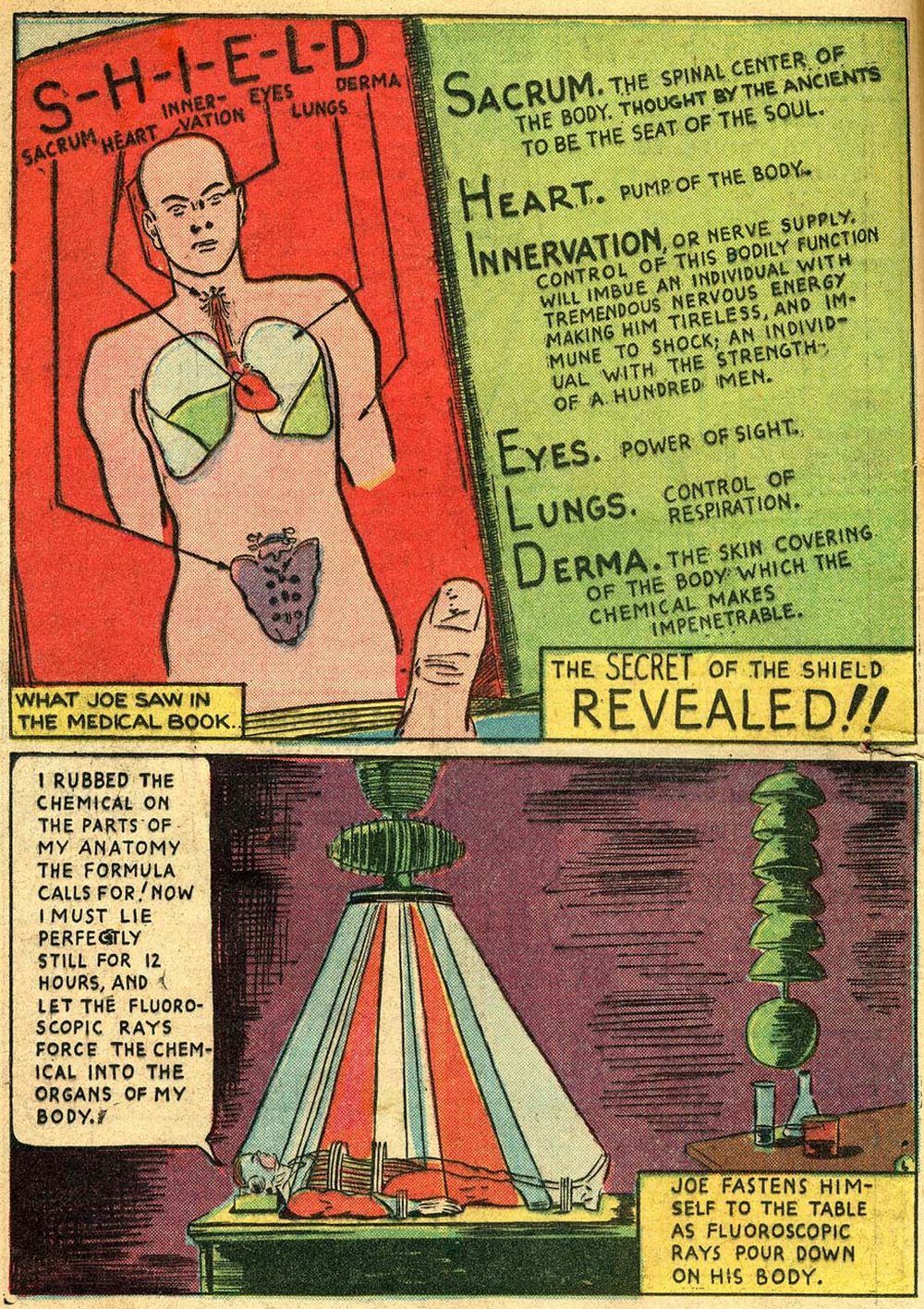
    In our original write-up of the Shield, we noted that the origin of his powers shifted from being solely down to his super-suit to being more of an ingrained thing over time, and the time is now! Yes, Shield-Wizard Comics 001 provides a slightly tweaked version of the Shield’s origin, in which Joe Higgins’ father Tom was not just a US Army Intelligence agent but a gifted scientist who discovered the secret of inducing superpowers but died juuuust before being able to tell Joe the full secret.

    Joe grows up to become a chemist himself but remains puzzled by his father’s last instructions to remember “anatomy formula S•H•I•E•L•D,” and with good reason, because it’s a nonsense jumble of anatomical parts that must have been put together only in the specific medical textbook that Joe eventually finds it in. But hey, he needed to find out where exactly to rub the chemical formula, and how would he otherwise know that it boiled down to “your eyes and skin, but especially the skin over your chest and groin” without that handy mnemonic device?

    The all-white costume that Joe is sporting before he settles down for a 12-hour session under the fluoroscopic ray shows up in at least a few retellings of the Shield’s origin going forward and I always thought that it was a pretty snappy look. Unfortunately, the rays dye his suit (and possibly his limbs?) in patriotic colours and so we get a red-white-and-blue Shield rather than merely a white one.
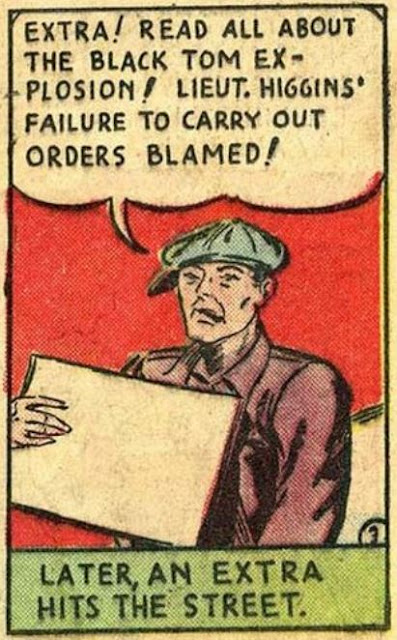
    The other tweak to the Shield’s origin is that rather than merely dying in the Black Tom Explosion of 1916, Tom Higgins is blamed for it, so the Shield now not only has a Batman-style motivation (spies killed my dad and now I must battle espionage) but also a Geoff Johns-Barry Allen-Flash one (I fight crime as part of my attempt to clear my father’s name). Thankfully, his first case involves rounding up the very German Hans Fritz and forcing him to confess, thus clearing Tom Higgins’ name without it becoming a whole thing. (Shield-Wizard Comics 001, 1940)

    the Wizard I:

    In the original account of the Wizard’s origin in Top-Notch Comics 001, the Whitney family’s close connection to American history is pretty thoroughly emphasized, with Whitneys present and getting things done at all major American wartimes. Well, Shield-Wizard Comics took up that gauntlet and ran with it: John Whitney organized the Mayflower expedition, and his son John Whitney organized the first Thanksgiving, and his son or grandson John Whitney thought up the idea of uniting the colonies. 

    But that wasn’t all: the third John Whitney’s son Blane (the main line of Whitneys only have time for three male names: John, Blane and Grover. All other named Whitneys are from dead end branches of the family tree, it seems) is just as super-human as his descendant, and in fact was the first of a line of Whitney family superhumans to call themself the Wizard (adopted as an ironic name after John Whitney was burned at the stake for witchcraft after acting on his son’s extrasensory visions to protect the colonies).

    The Wizard ends up making quite a big difference in the tides of the American Revolution, including:

    – informing Paul Revere that the British were approaching Concord and lighting the “one if by land, two if by sea” lanterns

    – showing up to participate in the fighting at Concord and turning the tide

    – wielding a cannon as a sidearm in the Battle of Bunker Hill and again at the Battle of Saratoga

    – saving Nathan Hale from being executed as a spy only not really because he chooses to die and be an inspiration instead

    – orchestrating the crossing of the Delaware and the surprise attack on the Hessian forces

    -very nearly getting Benedict Arnold before he gets away to join the British forces

    – proving instrumental in the capture of Major André

    – participating in several key battles, including the charge of Mad Anthony Wayne and the defeat of Cornwallis

    – orchestrating the support of the French for the revolution

     This original Wizard also creates a number of anachronistic inventions, including:

    – a glider that seems to function a bit more like a full-fledged airplane

    – a steam powered speedboat

    – something in between a deep sea diving rig and a scuba suit

    – a machine gun

    – radio communication

    – an electrified, battery-powered suit

    – a self-propelled sled

    – a tiny high-powered cannon

    All in all, the tale of the original Wizard holds up as a classic of the form, with the form being “super-heroes added to historical events.” Comics love to showcase the great moments of US history in particular, but as a comic book must prioritize action, any super-heroic character who is present must have an extraordinary amount of influence on history. It’s great! (Shield-Wizard Comics 001, 1940)

    the Wizard II:

    The second Wizard, like his father the original Wizard, is essentially a carbon copy of the modern character in appearance, name (Blane Whitney, natch) and abilities. Blane Whitney II also takes after his father in his commitment to inserting himself into important US historical events, including:

    – participating in various military engagements, including the defeat of the HMS Gurrierre, the Battle of Lake Erie, the Battle of the Thames (I think?) and the Battle of Bladensburg

    – saving William Henry Harrison from an assassination attempt

    – almost preventing the burning of the White House by the British

    – planning the defense of Fort McHenry and then participating in it

    – accidentally enabling Francis Scott Key to get inspired to write the Star-Spangled Banner

    This Wizard also has a lot of ahead of its time technology, including:

    – a version of his father’s glider

    – smoke (possibly tear gas) grenades

    – a dang tank

    The second Wizard obviously has less of a direct impact on the events of US history, if only because the War of 1812 has fewer Stand Up and Cheer moments than its predecessor. Still, he’s in there, and there’s every indication that we’d continue on to see a Civil War Wizard and a World War I Wizard and so forth, and the stated reason that we don’t see them is that as of Shield-Wizard Comics 003, the Wizard’s sidekick Roy the Super-Boy was too popular to not feature and so it was contemporary Wizard from then on out. (Shield-Wizard Comics 002, 1940)

    And speaking of Roy the Super-Boy:

    Tommy the Super-Boy:

    A part of any big project is choosing a methodology and then sticking to it and as my project is “reading all comics, in order” I had to figure out what “in order” meant. And while doing things in a month by month basis might be more true to the spirit of the experience, for my own sanity I opted to go alphabetical by year instead – the prep work alone for that other method hurts my head a bit to contemplate.

    All that is by way of explaining that Tommy, “the Original Super-Boy of History” (aka the original wonder-boy according to that one panel) is a retroactively created predecessor of the Wizard’s sidekick Roy the Super-Boy, who we will not meet until I have read the around 180 other comics between Shield-Wizard Comics 002 and Top-Notch Comics 008. He’s your classic orphan kid who gets to hang around a super-hero because he’s scrappy, and it turns out that that’s not unheard-of in historical youths.

    This particular scrappy kid, Tommy by name, is peeling potatoes when he meets an incognito Blane Whitney II and ends up discovering his secret identity after the Wizard participates in a sea battle and Tommy runs off afterward to berate Blane for cowardice, like a normal person does. And once you have discovered a super-hero’s identity, you get to become a super-hero! If you are a scrappy kid, of course. (Shield-Wizard Comics 002, 1940)

  • NOTES – DECEMBER 2024

    Drawn Without Reference: 

    The Rocket and the Queen of Diamonds find themselves facing a very off-model spider in the lad of the Batmen. (Pep Comics 003, 1940)
    Cops Shooting at Fleeing Suspects:

    I was briefly tempted to give the cops of the MLJ universe a pass on shooting at the Comet because he did after all kill a bunch of them while mind controlled but then I remembered that a) that’s still no excuse to gun someone down in the street, and b) it’s still bad that they’re just blazing away at a flying man in the middle of a large city full of other people. (Pep Comics 004, 1940)

     And they do it again… (Pep Comics 005, 1940)

     And again… (Pep Comics 006, 1940)

    … and again (in a crowded state legislature building!) (Pep Comics 008, 1940)

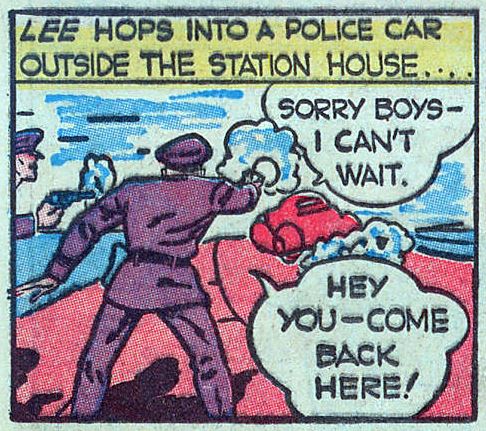
    Louisiana cops try to blow away Naval Academy Midshipman Lee Samson for escaping jail and stealing a police car. (Pep Comics 006, 1940)

    Crossovers:

    Oft touted as the first super-hero crossover in comics, the Shield shares a total of four panels with the Wizard as they both set out to foil some dastardly Mosconian spies. (Pep Comics 004, 1940)

    Less frequently mentioned are the brief encounters between the Wizard and Lee Samson, aka the Midshipman and the Shield and Keith Kornell, aka the West Pointer, two very similar and very dull military academy students from different branches of the military-industrial complex. And they are less interesting, so that makes sense.

    The next issue features another appearance by the Wizard, this one less highly touted as it’s the second time it happened plus he just shows up to loan the Shield a plane. I personally think that that’s remarkable, as Golden Age crossovers tended more toward the one-off. (Pep Comics 005, 1940)

    Minutia: 

    The Shield briefly pitches pro baseball under the name the Masked Marvel, as part of an investigation into a protection racket targeting players. (Pep Comics 007, 1940)

  • NOTES – DECEMBER 2024

    Drawn Without Reference: 

    The Rocket and the Queen of Diamonds find themselves facing a very off-model spider in the lad of the Batmen. (Pep Comics 003, 1940)

    Cops Shooting at Fleeing Suspects:

    I was briefly tempted to give the cops of the MLJ universe a pass on shooting at the Comet because he did after all kill a bunch of them while mind controlled but then I remembered that a) that’s still no excuse to gun someone down in the street, and b) it’s still bad that they’re just blazing away at a flying man in the middle of a large city full of other people. (Pep Comics 004, 1940)

     And they do it again… (Pep Comics 005, 1940)

     And again… (Pep Comics 006, 1940)

    … and again (in a crowded state legislature building!) (Pep Comics 008, 1940)

    Louisiana cops try to blow away Naval Academy Midshipman Lee Samson for escaping jail and stealing a police car. (Pep Comics 006, 1940)

    Crossovers:

    Oft touted as the first super-hero crossover in comics, the Shield shares a total of four panels with the Wizard as they both set out to foil some dastardly Mosconian spies. (Pep Comics 004, 1940)

    Less frequently mentioned are the brief encounters between the Wizard and Lee Samson, aka the Midshipman and the Shield and Keith Kornell, aka the West Pointer, two very similar and very dull military academy students from different branches of the military-industrial complex. And they are less interesting, so that makes sense.

    The next issue features another appearance by the Wizard, this one less highly touted as it’s the second time it happened plus he just shows up to loan the Shield a plane. I personally think that that’s remarkable, as Golden Age crossovers tended more toward the one-off. (Pep Comics 005, 1940)

    Minutia: 

    The Shield briefly pitches pro baseball under the name the Masked Marvel, as part of an investigation into a protection racket targeting players. (Pep Comics 007, 1940)

  • REAL PERSON ROUND-UP 004

    More of those pesky real people have gotten into my comic books!

    Andrew Jackson:

    Character Keith Kornell, aka the West Pointer, is a descendant of Andrew Jackson, something you would perhaps be more proud of in 1939 than today. (Top-Notch Comics 001, 1939)

    Benito Mussolini:

    He’s a fairly oblique reference to Benito Mussolini but I reckon that up-and-coming Filipino dictator Remy Mussoni fits the brief. (Wonderworld Comics 008, 1939)

    Billy the Kid:

    Appears in a questionably true story told by character Windy Parks (Western Picture Stories 004, 1937)

    the Dionne Quintuplets:

    “Ad-Ventures at the Circus” was a recurring feature throughout the life of Star Comics (1937-1939), and it’s a fascinating artifact of the time that someone more qualified than me should write about some day. Long story short it was a twee little comic about advertising mascots going to the circus to watch other advertising mascots perform. There’s maybe a 75/25 split between the Surprisingly Familiar and Surprisingly Unfamiliar mascots with regular appearances by Surprisingly Racist ones. It’s a bit like a Neolithic Foodfight!. 

    Everything about this feature is weird, from the slightly uncanny valley illustrations by Raphael Astarita to the fact that it doesn’t really seem to be sponsored content (other than a command appearance by NRG, mascot of heavy Star Comics advertiser Baby Ruth). And then the final extant installment comes around and we get the weirdest advertising mascots of all as the Quaker Oats Man leads the Dionne Quintuplets onto stage – five living humans given the same status as the Crackerjack kid or Mr Peanut or some anthropomorphic orange who used to work for Sunkist. It’s a grim reminder of just how commodified those poor kids were, right down to their “act” being a pantomime of them going about their day, just like they did in the weird zoo they grew up in. (Star Comics v2 007, 1939)

    Gene Autry:

    An adventuring version of the singing cowboy in modern times (the Funnies 030, 1939)

    George VI of England:

    This here visit by King Arnold and his unnamed Queen is certainly meant to evoke the 1939 tour of Canada and the US by King George VI of England and Queen Elizabeth, the future Queen Mother. (Wonderworld Comics 005, 1939)

    George Washington:

    Not quite an appearance by Washington as adjacent to him, but the fact that one of the Wizard’s ancestors is given credit for a key part of the history of the American Revolution is worth noting. (Top-Notch Comics 001, 1939)

    FDR:

    Misc Minor Appearances: Thanks secret agent K-51 for saving foreign royals (Wonderworld Comics 005, 1939) 

    the Mona Lisa:

    As the “Lona Dizzi”, painted by “Lombardo da Ginki” (“Dixie Dugan” strip, 1931)

    Paul Revere:

    Ride witnessed – and hide saved – by American Revolution-era child-patriots the Liberty Lads. (Champion Comics 008, 1940)

    Robert E. Lee:

    Wizard ancestor Thomas Whitney accepts the surrender of Robert E Lee at Appomattox, whether in place of Grant or prior to his showing up cannot be said. (Top-Notch Comics 001, 1939)

    Tom Mix:

    Like Gene Autry, Tom Mix was a movie cowboy who starred in adventure comics as a larger-than-life version of himself having rootin’ tootin’ Wild West adventures. Unlike Autry, Tom Mix generally starred in stories set in the Old West, as himself but in the past. Tom Mix also holds the special distinction of appearing in comics from this earliest example (that I have found, at least) to at least the early 50s, long after he had died in October, 1940. (The Comics 001, 1937)

  • REAL PERSON ROUND-UP 004

    More of those pesky real people have gotten into my comic books!

    Andrew Jackson:

    Character Keith Kornell, aka the West Pointer, is a descendant of Andrew Jackson, something you would perhaps be more proud of in 1939 than today. (Top-Notch Comics 001, 1939)

    Benito Mussolini:

    He’s a fairly oblique reference to Benito Mussolini but I reckon that up-and-coming Filipino dictator Remy Mussoni fits the brief. (Wonderworld Comics 008, 1939)

    Billy the Kid:

    Appears in a questionably true story told by character Windy Parks (Western Picture Stories 004, 1937)

    the Dionne Quintuplets:

    “Ad-Ventures at the Circus” was a recurring feature throughout the life of Star Comics (1937-1939), and it’s a fascinating artifact of the time that someone more qualified than me should write about some day. Long story short it was a twee little comic about advertising mascots going to the circus to watch other advertising mascots perform. There’s maybe a 75/25 split between the Surprisingly Familiar and Surprisingly Unfamiliar mascots with regular appearances by Surprisingly Racist ones. It’s a bit like a Neolithic Foodfight!. 

    Everything about this feature is weird, from the slightly uncanny valley illustrations by Raphael Astarita to the fact that it doesn’t really seem to be sponsored content (other than a command appearance by NRG, mascot of heavy Star Comics advertiser Baby Ruth). And then the final extant installment comes around and we get the weirdest advertising mascots of all as the Quaker Oats Man leads the Dionne Quintuplets onto stage – five living humans given the same status as the Crackerjack kid or Mr Peanut or some anthropomorphic orange who used to work for Sunkist. It’s a grim reminder of just how commodified those poor kids were, right down to their “act” being a pantomime of them going about their day, just like they did in the weird zoo they grew up in. (Star Comics v2 007, 1939)

    Gene Autry:

    An adventuring version of the singing cowboy in modern times (the Funnies 030, 1939)

    George VI of England:

    This here visit by King Arnold and his unnamed Queen is certainly meant to evoke the 1939 tour of Canada and the US by King George VI of England and Queen Elizabeth, the future Queen Mother. (Wonderworld Comics 005, 1939)

    George Washington:

    Not quite an appearance by Washington as adjacent to him, but the fact that one of the Wizard’s ancestors is given credit for a key part of the history of the American Revolution is worth noting. (Top-Notch Comics 001, 1939)

    FDR:

    Misc Minor Appearances: Thanks secret agent K-51 for saving foreign royals (Wonderworld Comics 005, 1939) 

    the Mona Lisa:

    As the “Lona Dizzi”, painted by “Lombardo da Ginki” (“Dixie Dugan” strip, 1931)

    Paul Revere:

    Ride witnessed – and hide saved – by American Revolution-era child-patriots the Liberty Lads. (Champion Comics 008, 1940)

    Robert E. Lee:

    Wizard ancestor Thomas Whitney accepts the surrender of Robert E Lee at Appomattox, whether in place of Grant or prior to his showing up cannot be said. (Top-Notch Comics 001, 1939)

    Tom Mix:

    Like Gene Autry, Tom Mix was a movie cowboy who starred in adventure comics as a larger-than-life version of himself having rootin’ tootin’ Wild West adventures. Unlike Autry, Tom Mix generally starred in stories set in the Old West, as himself but in the past. Tom Mix also holds the special distinction of appearing in comics from this earliest example (that I have found, at least) to at least the early 50s, long after he had died in October, 1940. (The Comics 001, 1937)

  • MINOR SUPER-HERO ROUND-UP 014

    Some real niche characters this time.

    the Lone Star Rider:

    An Old West hero so generic he only appeared once and never even got to track down the owlhoots who killed his parents in order to steal their land. Good gloves. (Smash Comics 002, 1939)

    Shock Gibson:

    Like Barry Allen after him, Charles (later Robert) Gibson is a young scientist working late into a stormy night when he is simultaneously struck by lightning and bathed in chemicals. Though he is called the Human Dynamo, for the first chunk of his career he functions as more of a Human Battery who stores an electrical charge that can be used to fuel various superhuman feats – super-strength, super-jumping (later full-on flight), and a shocking grasp.

    Shock Gibson goes through more than a few costume changes over the years – sadly this goofy helmet is axed during the first one – but one consistent element in his design is lotsa cool electricity crackle when he uses his powers. (Speed Comics 001, 1939)

    Shock Gibson UPDATE 1940: He loses the hat.

    the Man With 1000 Faces:

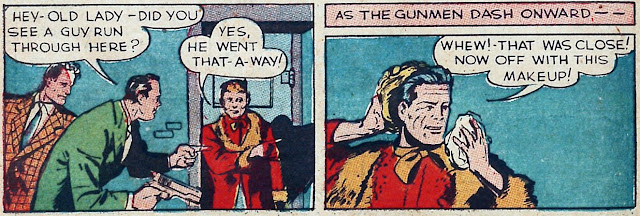
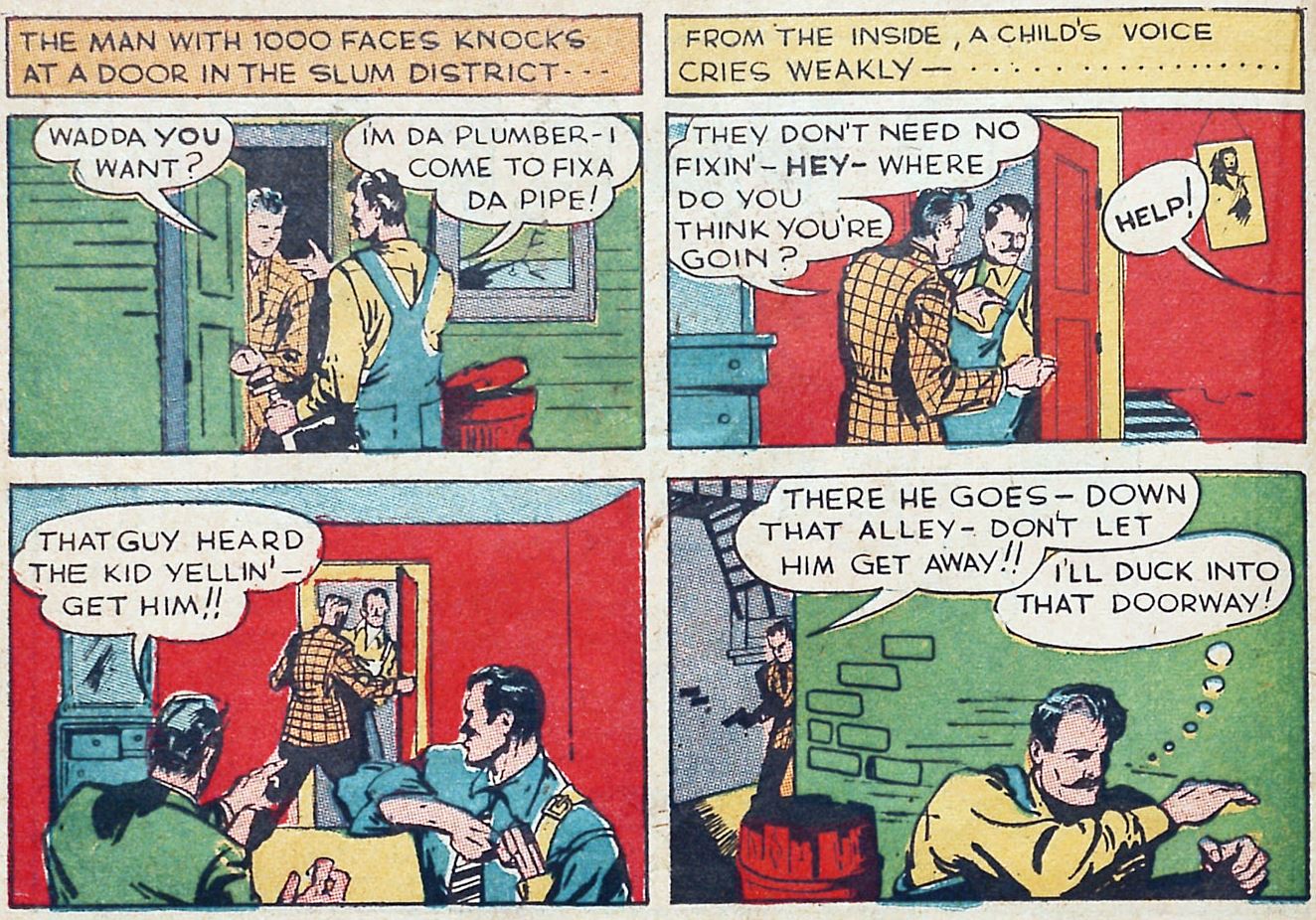
    Ted Parrish, famous film star, is bored with his humdrum life and so turns his considerable talent for quickchange artistry and disguise to the task of crimefighting. Just where he gets all of his accessories from is not elaborated on, so it’s equally likely that he scavenges them from the environment as it is that he just hauls around an enormous hockey bag full of clothing etc everywhere he goes.

    Parrish’s mission is obviously hampered somewhat by the fact that Los Angeles’ criminal fraternity knows that the Man With 1000 Faces exists and they should be on the lookout for him. How did they find out? Did Parrish blab to up the challenge and excitement of it all? (Speed Comics 001, 1939)

    the Wizard:

    Blane Whitney, AKA the Wizard, is the latest in seven generations of Whitneys (some of whom were also called the Wizard) to dedicate their lives in patriotic service to the USA. Plus he was a child prodigy who was charged to use his abilities to better mankind by Woodrow Wilson. Plus he’s an inventive genius in virtually all fields, particularly various forms of engineering. Plus he has nearly superhuman physical abilities and a mind so highly developed that it is superhuman in that he can employ remote viewing to locate dangers and clues.

    The Wizard was a pretty big player at MLJ in the 40s but has largely been abandoned in the various attempts to revive the MLJ characters at Archie and elsewhere – his biggest post-Golden Age appearance that I am aware of was as a super-villain fighting the Mighty Crusaders in the 60s. What does this say about the character – that he’s perfectly serviceable but not very conceptually exciting? Yes, I reckon that sums him up. (Top-Notch Comics 001, 1939)

    UPDATE 1940a

    UPDATE 1940b 

  • MINOR SUPER-HERO ROUND-UP 014

    MINOR SUPER-HERO ROUND-UP 014

    Some real niche characters this time.

    the Lone Star Rider:

    An Old West hero so generic he only appeared once and never even got to track down the owlhoots who killed his parents in order to steal their land. Good gloves. (Smash Comics 002, 1939)

    Shock Gibson:

    Like Barry Allen after him, Charles (later Robert) Gibson is a young scientist working late into a stormy night when he is simultaneously struck by lightning and bathed in chemicals. Though he is called the Human Dynamo, for the first chunk of his career he functions as more of a Human Battery who stores an electrical charge that can be used to fuel various superhuman feats – super-strength, super-jumping (later full-on flight), and a shocking grasp.

    Shock Gibson goes through more than a few costume changes over the years – sadly this goofy helmet is axed during the first one – but one consistent element in his design is lotsa cool electricity crackle when he uses his powers. (Speed Comics 001, 1939)

    Shock Gibson UPDATE 1940: He loses the hat.

    the Man With 1000 Faces:

    Ted Parrish, famous film star, is bored with his humdrum life and so turns his considerable talent for quickchange artistry and disguise to the task of crimefighting. Just where he gets all of his accessories from is not elaborated on, so it’s equally likely that he scavenges them from the environment as it is that he just hauls around an enormous hockey bag full of clothing etc everywhere he goes.

    Parrish’s mission is obviously hampered somewhat by the fact that Los Angeles’ criminal fraternity knows that the Man With 1000 Faces exists and they should be on the lookout for him. How did they find out? Did Parrish blab to up the challenge and excitement of it all? (Speed Comics 001, 1939)

    the Wizard:

    Blane Whitney, AKA the Wizard, is the latest in seven generations of Whitneys (some of whom were also called the Wizard) to dedicate their lives in patriotic service to the USA. Plus he was a child prodigy who was charged to use his abilities to better mankind by Woodrow Wilson. Plus he’s an inventive genius in virtually all fields, particularly various forms of engineering. Plus he has nearly superhuman physical abilities and a mind so highly developed that it is superhuman in that he can employ remote viewing to locate dangers and clues.

    The Wizard was a pretty big player at MLJ in the 40s but has largely been abandoned in the various attempts to revive the MLJ characters at Archie and elsewhere – his biggest post-Golden Age appearance that I am aware of was as a super-villain fighting the Mighty Crusaders in the 60s. What does this say about the character – that he’s perfectly serviceable but not very conceptually exciting? Yes, I reckon that sums him up. (Top-Notch Comics 001, 1939)

    UPDATE 1940a

    UPDATE 1940b 

  • REAL PERSON ROUND-UP 003

    Once more they ride: the REAL PEOPLE OF COMICS

    Abraham Lincoln:

    Lincoln’s shadow is used to symbolize the power of the US exerting a calming effect on the European belligerents. (Smash Comics 005, 1939)

    Adolf Hitler:

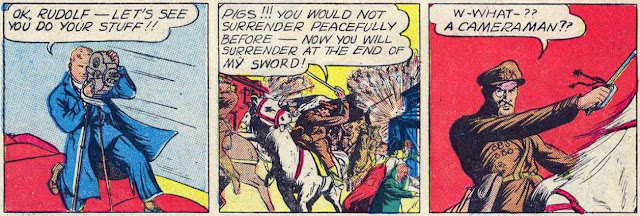
    Chancellor Rudolf of Wurtberg here is a more dynamic than usual Hitler analog (Smash Comics 004, 1939)

    Misc minor appearances:

    Getting some bad news about Nazi operations in Yugoslavia (Blue Ribbon Comics 015, 1941)

    Captain Kidd:

    For no particular reason this aviator/ adventurer is named after him. (Fantastic Comics 001, 1939)

    Franklin Delano Roosevelt:

    Discusses the threat of the Black Hand With J. Edgar Hoover (Blue Ribbon Comics 016, 1941)

    Misc Minor Appearances: appraised of the danger of invasion by Vlamir Koran (Smash Comics 001, 1939) 

    Seen ordering Americans in Europe to return home; meets Black Ace/X after he saves the transports that are returning them. (Smash Comics 003, 1939)

    Determines to defensively arm the US (Smash Comics 005, 1939)

    H.V. Kaltenborn:

    Radio commentator, appears as “H.V. Baltenhorn” (Blue Ribbon Comics 017, 1941)

    John Dillinger:

    Gangster “Jack Dilger” is vexed by Ty-Gor. (Blue Ribbon Comics 015, 1941) 

    Joseph Stalin:

    The same 3/4 perspective shot always used for FDR, now in Stalin form! (Smash Comics 002, 1939)

    Mahatma Gandhi:

    Aside from the pun name “Mohlasos Candhi”, this version of Gandhi is hitting a lot of the overt and casually racist checkmarks of the 1940s, including a disregard for the difference between India and the Middle East and a complete indifference for the distinction between Hindus and Muslims. Oh and also it’s another classic adventure based on propping up colonial rule. (Blue Ribbon Comics 017, 1941)

    Shirley Temple:

    As “Curley Semple” (“Dixie Dugan” comic strip, 1935)

    Sherlock Holmes:

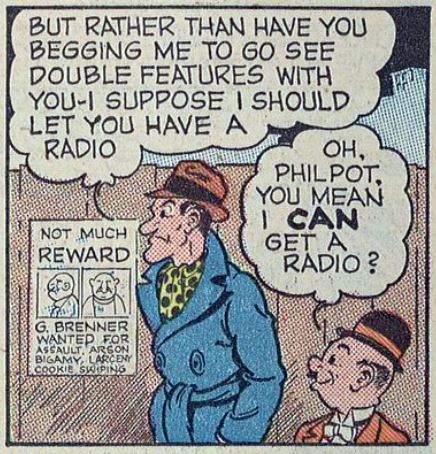
    Philpot Veep (along with his sidekick Waldo) was one of many humourous takes on Sherlock Holmes in Golden Age comics. Note also the wanted poster for G. Brenner, almost certainly referring to George Brenner, creator of the Clock. (Smash Comics 001, 1939)

    BONUS PHILPOT VEEP, DRUG FIEND

    COMIC BOOK DRAMA: in Smash Comics 005, George Brenner strikes back! Here’s Philpot Veep scribe Joe Devlin depicted AS A CLOWN! EPIC GOLDEN AGE BEEF SPOTTED

    Woodrow Wilson:

    Meets and gives sage advice to young Blane Whitney, who would grow up to become MLJ hero the Wizard. I am legitimately flabbergasted to see Wilson show up in this capacity. (Top-Notch Comics 001, 1939)

  • MINOR SUPER-VILLAIN 157: THE WIZARD

    (All-Star Comics 003, 1940)

    This is the kind of super-villain that you see magical heroes taking on a lot more often than other types: the preemptive striker. The likely cause of this is the status of so many magical heroes as the de facto head of Earth’s magical security, someone that a bad actor can take out and then be free to act with impunity.

    What’s interesting about this super-villain? The thing that appeals to me about this guy, who is primarily a user of illusion magic, is the variety of things he throws at Dr Fate: you got your crazed unicorns, some undead Egyptian warriors, a weird tentacle monster and the “Three Witches of Endor” who themselves cast spells at him. It’s a nice bit of variety!

  • MINOR SUPER-VILLAIN 097: THE WIZARD

    (More Fun Comics 052-054, 1940)

    The Wizard is the kind of guy you get in comics who develops a robot army and a few different types of rays, destructive and otherwise, and immediately turns around and takes over (what I assume to be) his home town. I do appreciate that he looks like someone who has been sitting in a basement or a cave soldering robot faces for twenty years, but it’s no excuse for incivility.