The Curse of Skeleton Munroe

Category: multiple appearances

  • MINOR SUPER-VILLAIN 837: THE SKULL

    (Top-Notch Comics 009, 1940)


    The Skull is the recurring foe of the Golden Age Black Hood, and as is common for such characters he is a kind of generalist super-villain willing to dabble in everything from theft to kidnapping to espionage to murder as circumstances dictate. He even indulges in a little housebreaking on occasion, and it is while doing so that he is interrupted by police officer Kip Burland, who he frames for the crime and then eventually attempts to have murdered when he refuses to give up on proving himself innocent. 

    This of course is the origin of the Black Hood, as Burland recovers and trains under the tutelage of one of the Skulls other victims. Accidentally creating your own nemesis is one of the occupational hazards of being a successful super criminal, after all, and the Skull is so successful as he kind of did it twice, as Kip Burland’s mentor is a different lawman who the Skull framed and ruined who swore revenge on him but then took too long preparing and had to be content with weaponizing another to do the deed.

    By the time that Kip Burland is prepared to go into action as the Black Hood, the Skull has devised the first of what I now recognize as his signature: an overcomplicated scheme. Specifically, he has targeted the debut/masquerade ball being held for wealthy socialite Barbara Sutton, and has not only informed all of the guests that they must show up in their best jewelry so that he can steal it but has also announced his plans in the papers. I think that the intent is to ensure compliance through fear, but it really seems like he’s just introducing ways that his scheme can go wrong.

    The Skull’s instructions are clear: he will steal the jewels off of the guests during the party and they are to keep quiet about it. None of them manage this, and each victim ends up being killed via a blowgun dart tipped with a poison that turns the human head all green and corpsey. Plus – and this is hard to see but trust me – the dart leaves a little skull-shaped mark at the point of contact.

    The Black Hood eventually works out how the Skull is doing all this: he has disguised himself as hostess Mrs Sutton and has been shooting the darts out of a blowgun shaped like a cigarette holder. One dunk in an oversized decorative vase later, the case is solved!

    (also please note that the Black Hood is in attendance in costume as himself. It still counts even if this is his first public appearance in costume) 

    After the Black Hood turns the Skull in to the police at the end of his first costumed adventure, his ally the Hermit predicts that they will be unable to hold him, and what do you know but he’s right. The Skull dramatically breaks jail and immediately puts another overly complicated scheme into action. Major Quentin Duff has invented the unspecified-but-presumably-valuable Iota Ray, and the Skull wants it, but is not prepared to do anything so simple as to steal the plans. Instead, he implements a simple three-part plan:

    Step One: ambush Major Duff at his house and murder him just after he hands the Iota Ray plans over to Mrs Duff for safekeeping. 

    Step Two: While Mrs Duff and Barbara Sutton are taking the plans from Washington DC via train, kidnap Duff and gaslight Sutton into believing that she was never there. This requires at least a half-dozen confederates as well as an appearance by the Skull as a Dr van Luks, a backward name so annoying that I audibly groaned when I worked it out.

    Step Three: Once the plan falls apart, just try to murder everyone and take the plans off of Mrs Duff’s body. Please note that this step was an option from the start, and that the theft could have been committed using the Major’s gruesome murder as cover.

    As 1940 draws to a close, the Skull is left shaking his fist after a speeding train as the Black Hood escapes with the plans. We will see him again in 1941!

    SKULL SCORE: A very generous 2/5, considering that this particular Skull isn’t actually missing any facial features. The combination of his emaciated face, sunken eyes and perpetual rictus goes a long way nonetheless. Plus he’s green.

  • MINOR SUPER-VILLAIN 830: ROBERT W MARSH

    (Thrilling Comics 010, 1940)

    Fifth column activities are wreaking havoc on the US! Why, it’s so bad that the new National Defense Building has been bombed! Doc Strange is called in along with a crack team of industrialists to help solve the problem, and is pointed toward fellow committee member Henry Dallas by yet another member, Robert W Marsh. Could this be so easy a problem to solve?

    Henry Dallas kills himself rather than own up to working with the Nazis against American interests, but Doc Strange is able to trace his business dealings to the defunct Mammoth Automobile factory in the South, where he discovers a fascist tank-manufacturing setup. He also takes an explosive anti-tank shell to the back of the head, which is immaterial to the story, but it is fun to occasionally highlight just how powerful a super-hero is.

    Strange finally comes face to face with the leader of this operation (conveniently called the Leader) after both he and Virginia Thompson are captured by them, and unmasks him within minutes, revealing him to be… Robert W Marsh, who is coincidentally also the only other named character in the comic. I gotta say, I wish that the Leader facade had been maintained for longer, both because I always prefer referring to a guy by a codename rather than by what’s on his birth certificate, but also because that mask is a pretty sweet little number and I wish that Marsh had a reason to keep wearing it.

    Doc and Virginia of course escape from Marsh and prevent his bid to take over the US by bombing Washington DC into dust, but the former Leader is pretty conspicuously not among the casualties of that battle. And well he shouldn’t be, because he is also the antagonist of the next Doc Strange story:

    In Thrilling Comics 011, Marsh takes over the… Central?… American nation of Panamela to use as a staging area for another attempt to take over the US.

    (side note: it is pretty remarkable that Marsh is just a straight-up Nazi in 1940, albeit one with a reversed swastika. I suppose it’s possible that this is a small-n nazi, as a stand-in for fascist) 

    Marsh’s plan revolves around attacking the US using the Panamelan fleet and some new super-explosive artillery shells, but he is foiled when Doc Strange sabotages the explosive at the production stage. Pop! Plink!

    Though his fleet is blasted into oblivion by the US Navy, Marsh lives to fight another day. 

    I’ll be honest, I’m tired of the guy and I almost included his third appearance here to get him out of the way, even though it takes place in 1941. But when I started reading it to do just that I was startled to find out that it’s fun! There isn’t even any naval combat! Thus, I’m going to leave it as a treat for myself in the future.

  • MINOR SUPER-VILLAIN 830: ROBERT W MARSH

    (Thrilling Comics 010, 1940)

    Fifth column activities are wreaking havoc on the US! Why, it’s so bad that the new National Defense Building has been bombed! Doc Strange is called in along with a crack team of industrialists to help solve the problem, and is pointed toward fellow committee member Henry Dallas by yet another member, Robert W Marsh. Could this be so easy a problem to solve?

    Henry Dallas kills himself rather than own up to working with the Nazis against American interests, but Doc Strange is able to trace his business dealings to the defunct Mammoth Automobile factory in the South, where he discovers a fascist tank-manufacturing setup. He also takes an explosive anti-tank shell to the back of the head, which is immaterial to the story, but it is fun to occasionally highlight just how powerful a super-hero is.

    Strange finally comes face to face with the leader of this operation (conveniently called the Leader) after both he and Virginia Thompson are captured by them, and unmasks him within minutes, revealing him to be… Robert W Marsh, who is coincidentally also the only other named character in the comic. I gotta say, I wish that the Leader facade had been maintained for longer, both because I always prefer referring to a guy by a codename rather than by what’s on his birth certificate, but also because that mask is a pretty sweet little number and I wish that Marsh had a reason to keep wearing it.

    Doc and Virginia of course escape from Marsh and prevent his bid to take over the US by bombing Washington DC into dust, but the former Leader is pretty conspicuously not among the casualties of that battle. And well he shouldn’t be, because he is also the antagonist of the next Doc Strange story:

    In Thrilling Comics 011, Marsh takes over the… Central?… American nation of Panamela to use as a staging area for another attempt to take over the US.

    (side note: it is pretty remarkable that Marsh is just a straight-up Nazi in 1940, albeit one with a reversed swastika. I suppose it’s possible that this is a small-n nazi, as a stand-in for fascist) 

    Marsh’s plan revolves around attacking the US using the Panamelan fleet and some new super-explosive artillery shells, but he is foiled when Doc Strange sabotages the explosive at the production stage. Pop! Plink!

    Though his fleet is blasted into oblivion by the US Navy, Marsh lives to fight another day. 

    I’ll be honest, I’m tired of the guy and I almost included his third appearance here to get him out of the way, even though it takes place in 1941. But when I started reading it to do just that I was startled to find out that it’s fun! There isn’t even any naval combat! Thus, I’m going to leave it as a treat for myself in the future.

  • MINOR SUPER-VILLAIN 825: PROFESSOR FENTON

    (Thrilling Comics 004, 1940) 

    A wave of kidnappings is sweeping the US! Important men are disappearing left and right! Never fear, however, for the Ghost is on the case, and thanks to his magical acumen he is able to trace the latest kidnappee to the mysterious mansion lair of the culprit: the pompadoured scientist known as Professor Fenton! 

    Professor Fenton’s plan turns out to be unusually, even impractically complicated. To whit: 

    1. kidnap all of America’s Important Men

    2. stash the Important Men in various historical periods using a time machine

    3. take over the US (though unstated, the lack of Important Men is probably part of the prep for this step)

    4. bring back the Important Men, who will be forced to serve Fenton in this new regime

    The Ghost is of course opposed to this plan, and proceeds to rescue the first batch of Important Men from the past. But there is a problem! The Ghost does not know where or when the other men are stashed, plus he suspects that Fenton would rather destroy his own time machine than see them rescued. This sets up the ongoing Ghost/Fenton dynamic for the next few issues, as the Ghost arranges various ruses and schemes in order to be sent in time to rescue Fenton’s victims while keeping Fenton himself in the dark.

    Some of Fenton’s temporal kidnap setups include:

    A prehistoric past rich with both dinosaurs and early man. The Ghost recruits a tribe of Piltdown Men to battle Professor Fenton’s Neanderthal followers. (Thrilling Comics 004, 1940)

    A castle in Arthurian England, that the Ghost storms with the help of the Knights of the Round Table, armed with magically-created machine guns. (Thrilling Comics 005, 1940)

    Just an inn in the middle of Commonwealth-era London. The innkeeper is clearly a local, so of course I am very curious about how the Fenton’s recruitment process goes – does he just appear in people’s houses until he finds one willing to hold prisoners for cash, no questions asked?  (Thrilling Comics 006, 1940)

    This issue is also the first time that Fenton tries to get his chosen nom de guerre, “Dictator F” going, but it never quite manages to get traction. He does keep trying!

    Fenton’s temporal hiding places have one important criteria: they act as a fixed point in time and space that he can target with his time beam. This is why this next one being in the ship, a notoriously mobile space, is strange. Sure, Professor Fenton has paid off the owners of the vessel not to go anywhere, but if he had bothered to take a look at the ship’s name he might have noted that it was in fact the Santa Maria, of Christopher Columbus fame, and concluded that he might be better off storing his victims elsewhere. 

    The Ghost and these two Important Men end up making the journey to the New World with Columbus before heading home. Considering the fact that Fenton-style time travel is depicted as if the same amount of time is taking place in the present as the past, this really throws the Ghost timeline out of whack with the real world. (Thrilling Comics 007, 1940)

    Fenton finally starts working toward his conquest of the present by stealing an electrical ray weapon that he stashes in Ancient Rome, c.64 CE, which inadvertently leads to the Great Fire of Rome. (Thrilling Comics 008, 1940)

    Fenton’s final foray into his kidnapping plan (for 1940, at least) involves hotshot bacteriologist Tom Rollins, who is stashed in Colonial America, 1776, while his stockpile of diseases is unleashed on the public in an attempt to blackmail Rollins’ home city of Duquesne. The Ghost not only rescues Rollins but helps Washington cross the Delaware and also meets his long-time love interest Betty Morris, a Revolutionary spy who decides to ditch the humdrum 1770s for the exciting 1940s. (Thrilling Comics 009, 1940)

    From Thrilling Comics 010 on, the Ghost basically just lets Professor Fenton, a multiple-time mass murderer and mass-kidnapper, remain at large so that he can sneak into Fenton’s lab and use his time machine whenever he wants. I’m sure that if someone pointed that out then the Ghost would say something about there still being some Important Men to be saved, but I’m not sure if they’re worth the body count.

  • MINOR SUPER-VILLAIN 779: THE CLOWN

    (Super-Mystery Comics v1 005, 1940)

    The Clown! One of the more prolific non-Marvel or DC/Fawcett/Quality super-villains of the Golden Age, and I’m kind of glad that he only made one appearance in 1940 because like his fellow crime clown the Joker, the Clown gets up to a wide variety of different schemes and plots and it’s nice to have the breathing room to just introduce his concept without having to detail a bunch of extra antics as well (and speaking of the Joker, I’ve never been sure if the various early-40s clown villains were all inspired by him or if there was something else in the zeitgeist that was responsible for there being so many of them running around).

    The Clown’s debut is as spectacular as it is inexplicable: Magno’s sidekick Davey is at the library checking out a book on chemistry and it just so happens that the Clown is there to get the same book. Faced with the fact that Davey got it first, how does he respond? By murdering the librarian, attempting to murder Davey and trashing the place. This is how one exemplifies the super-villain lifestyle, friends.

    And when Davey runs off and gets Magno, what do they return to find? Why, that the Clown has either burned down what appears to be the New York Public Library or merely set fire to enough of its stock  to make a roaring blaze out front, it’s hard to tell. Either way, it’s a heck of a debut and a real blow to the library sciences.

    Now, if you  know anything at all about the Clown it’s likely the fact that he is a Nazi, as is reported in Jeff Rovin’s Encyclopedia of Supervillains, but after scrubbing through a bunch of his appearances I don’t know if that’s entirely accurate. He certainly works for the Nazis once or twice but I also found a few instances of him in conflict with them – we shall have to see. What he certainly is, however, is vocally and aggressively anti-patriotic, to the point that he almost manages to burn an American flag before Magno and Davey butt in.

    This initial appearance also serve to show off the Clown’s scientific acumen: he performs super-leaps thanks to his “degravitating solvent,” deploys knockout gas to escape the two in their initial encounter, and even manages to whip up an “anti-magnetic compound” to prevent Magno and Davey from disarming him after experience that humiliation in their first encounter.

    Some more details from this lore-packed episode: the Clown has a secret lair in a mausoleum in a nearby cemetery, staffed by a suspiciously compliant lab assistant named Lydia. The Clown, having captured Magno and Davey, has plans to vivisect them and learn the secret of their powers.

    Though the Clown and Lydia have coated the entire lair in anti-magnetic compound they neglected to consider the pipes in the walls, and the whole place is soon awash (this is how Sub-Zero captured Professor X in their first encounter, too. Villains: look into PVC piping). The compound is washed away in the flood, allowing Magno and Davey to recommence the beating.

    The Clown is unsurprisingly not up-to-date on the latest lab safety guidelines and so the fight is only a couple of punches in before some shoddily-stored chemicals end up causing a huge explosion. Magno and Davey are fine, of course, as is Lydia, who – surprise, surprise – turns out to have been mind controlled into being the Clown’s lab assistant. And of course the Clown is fine. You simply don’t kill off a character like that after one appearance, after all. For our purposes, though, it’ll be some months until he returns.

  • MINOR SUPER-VILLAIN 762: THE DEVILFISH

    (Speed Comics 006, 1940)

    The Devilfish is a pseudo-Nazi mastermind who vexes Lieutenant Jim Cannon of the Royal British Navy for the first 2 or 3 of his handful of appearances in Speed Comics and I won’t lie: it’s all about that great name for me, although that same name is annoying the part of me that loves to put things into categories due to the fact that “devilfish” is such a loose term. People – especially in the first half of the 20th Century when we were really starting to poke around under water but didn’t really know anything about what was going on down there – love call any scary ocean being a devilfish, including rays, octopus, squid, some whales, all kinds of deep-sea monstrosities… it’s impossible to know just which devilfish this fellow was named for.

    So what is notable about the Devilfish aside from his wonderful and vexing name? In his debut, he’s directing attacks on British shipping and if I’m going to highlight anything it’s his wide range of vehicular transport, from ship to plane to submarine, all in one six-page adventure. This issue also establishes a bit where the Devilfish will send Cannon a taunting radio message after getting away, which is a fun bit of business.

    The Devilfish returns to plague shipping in Speed Comics 007, and regional pride compels me to point out that this issue begins in Halifax, Nova Scotia. Go, Windjammers!

    The Devilfish’s actual plan this issue is pretty incoherent: set a bunch of icebergs loose in the shipping lanes and also cover those same icebergs with nautical mines. But… what does this accomplish? Does the Devilfish think that ships just bump innocently and harmlessly into icebergs all the time and the mines are meant to spice things up? Is this a plot to distribute the mines into whichever random stretch of ocean the bergs pass through as they melt? Why not at least paint the mines white so that they aren’t so visible that someone (i.e., Lt Cannon) can’t just easily spot them and blow them up from a distance? It’s maddening to contemplate!

    As in his first appearance, this one ends with the Devilfish seemingly being killed but actually scuttling away in a submarine (this actually completes a second ship > plane > submarine sequence) only to taunt Lt Cannon via radio. While it’s entirely probable that the Devilfish returned again in Speed Comics 008, the only extant scan of that comic does not include the relevant story and I personally am not willing to pay $100+ for a physical copy to find out. Did the Devilfish return again? Did he die? Does he remain at large? We may never know.

  • MINOR SUPER-VILLAIN 733: THE PANTHER

    MINOR SUPER-VILLAIN 733: THE PANTHER

    (Silver Streak Comics 004, 1940)

    The Panther! A murderous thief with a very cool look and a vicious set of claws! Well, okay, he does compliment his cool panther mask, panther paw gloves and shoes and pantherskin shirt with a pair of brown slacks so I’ll amend that to a mostly cool look. 

    Moderately cool looking or not, the Panther has been doing his crimes in the nonspecific New York-esque city that Ace Powers calls home and so Ace is on the case!

    And Ace Powers turns out to be the guy for the job, because he immediately figures out the Panther is in fact an unnamed asylum escapee who went mad after his face was mangled in a car accident. What he fails to intuit, to his detriment, is that the panther mask isn’t just for show but is armour plated – in his surprised state after his best haymaker fails to make an impact, Powers is nearly slashed to death by the Panther’s also-functional claws. 

    The Panther’s reign of terror comes to an end when, after a rooftop chase across a flaming building, he proves that armour plating is not a good protection against fall damage by landing square on his armoured face and instantly dying.

    What’s this? Could it be that all of that “armour can’t protect you from a fall” talk was mere propaganda courtesy of Big Parachute? Evidently so, because in the next issue of Silver Streak Comics the Panther turns out to be Just Fine. Better, even, because he demonstrates some pretty advanced super-villain thinking by setting out to avoid the mistakes of the past by recruiting some manpower (fellow inmates at the same asylum he had previously escaped from) for backup the next time he had to face Ace Powers.

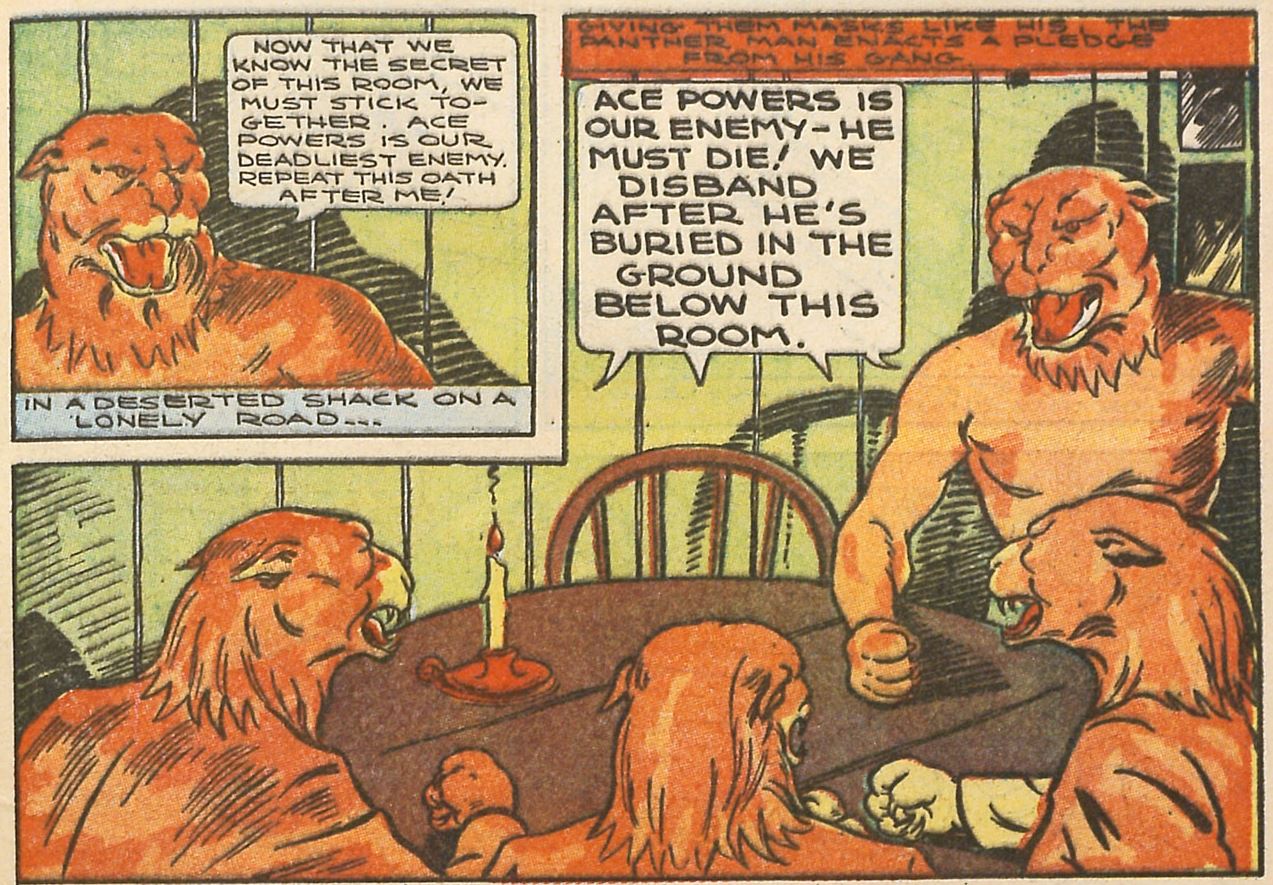
    The Panther Men (as they are called) are a terrific addition to the Panther’s operation. First of all, I love any group of henchmen who are dressed in a junior version of their boss’ outfit, though the colourist has obfuscated the fact that that is the case here by rendering what is pretty clearly still their inmates’ uniforms as a golden brown. More importantly, the Panther’s somewhat-goofy open-mouthed mask looks fantastic when quadrupled – just look at that panel where they’re all sneaking up on Ace Powers yet perfectly farmed in a mirror for proof.

    The Panther Men prove to be effective backup for the Panther (aka the Panther Man at this point) – they capture Ace Powers and take him back to their weird little shed HQ to dispose of him, and he only manages to escape being buried alive by surprising the lot of them and knocking them into his would-be grave.

    But the saga of the Panther is not quite over yet! When the police dig up the crooks (did I mention that the shed had collapsed on top of the hole after the various Panther Men had fallen in it? be cause it had) in Silver Streak Comics 006, they find only the bodies of the three Panther Men, with no sign of the Panther himself.

    Examining the hole, Powers discovers a secret door that leads to the underground lair of future subject the Spook, who turns out to be the Panther’s boss, which I suppose makes the Panther Men some sort of subcontractors? This is very fun! While having the villain turn out to be working for an even greater villain isn’t a guaranteed win as far as plot twists go, it works here, even if it was clearly 100% made up when *checks credits* Harry Anderson sat down to draw this comic. 

    This is, alas, the end for the poor Panther, as the Spook is one of those terrible super-villain bosses who murder their employees for failing them, in this case for not managing to kill Ace Powers. The Panther meets his end at the blades of a triple swinging pendulum deathtrap, and although that’s not a particularly rare style of comic book murder machine this might just be the first time I’ve seen one take someone out, so that’s a final achievement for out boy.

  • MINOR SUPER-VILLAIN 720: DR DOOM

    MINOR SUPER-VILLAIN 720: DR DOOM

    (Science Comics 001, 1940)

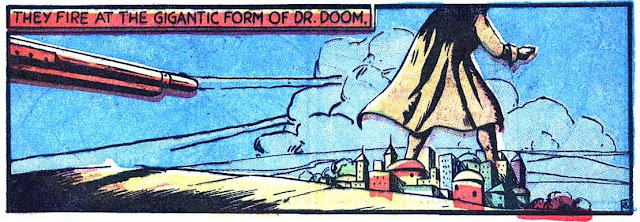
    Dr Doom, another super-villain with his own series (I swear that they’re rare over all but 1940 sure is a fertile year for them), lives in an unspecified future and is your classic mad science polymath, as demonstrated by his various schemes:

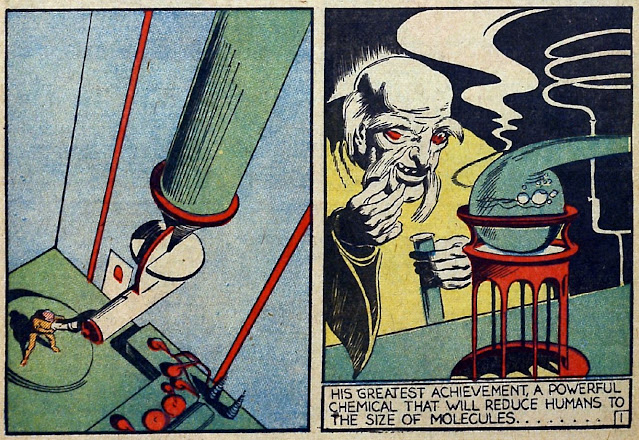
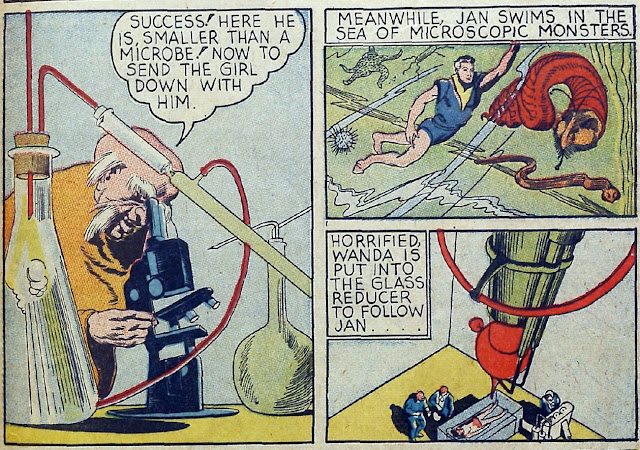
    In his very first outing, Dr Doom decides to do some extreme testing of his latest formula and uses it to shrink Jan and Wanda, two otherwise-nondescript youths who just happen to also be his recurring nemeses going forward. They escape of course and, after defeating a crab and regaining their former size, haul him back home to Jupiter with them to face justice.

    Of course Dr Doom also escapes and makes his way back to his laboratory. His next two schemes are also shrinking-based: in Science Comics 002 he kidnaps people (including Jan and Wanda) and forces them to battle insects to the death, while Science Comics 004 sees him shrinking Jan and Wanda’s home city of Daru on Jupiter to use as his personal playground. This adventure ends with Doom himself shrunk and on display in a museum of oddities, an event which seems to put him off the field of shrinking entirely going forward.

    In Science Comics 005, Dr Doom unleashes cosmic ray mutations from the depths of the Grand Canyon in a bid to conquer the US. Also the Grand Canyon is expanding for some reason? This is perhaps the most incoherent Dr Doom story and ends with his equipment just exploding out of nowhere.

    The shock of his last scheme failing so thoroughly seems to have had a profound effect on Dr Doom, because at this stage he enters his “revenge on humanity” period. To that end, in Science Comics 006, he develops and unleashes the Grey Mold Disease and sets it loose on the world until he is forced to reveal the antidote by Jan and Wanda when they threaten to inject him with the even more deadly Green Mold Disease.

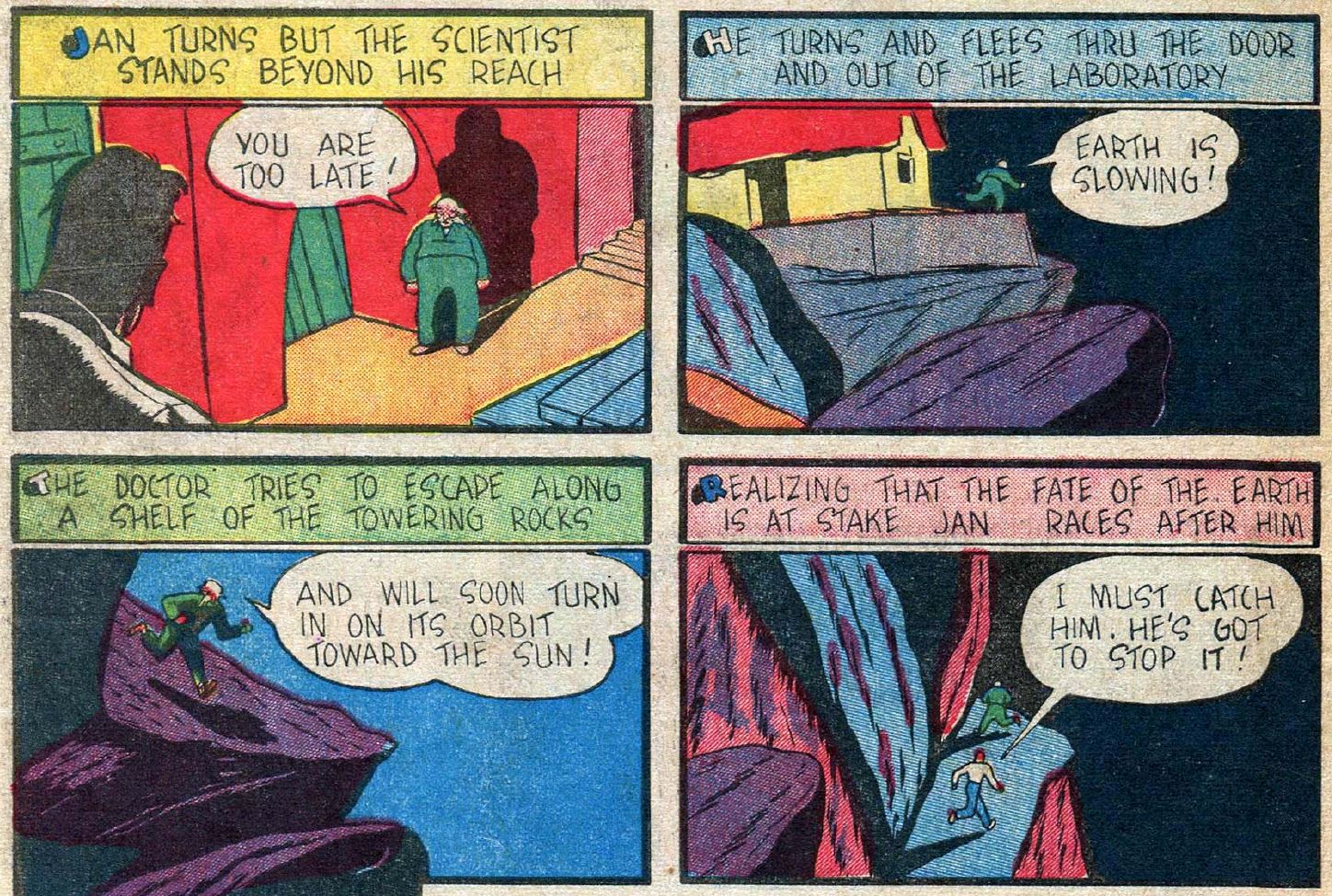
    Next, in Science Comics 007, Doom uses a magnetic ray in an attempt to throw the entire Earth off its orbit and into the Sun, but misjudges the gravity on his planetoid base and goes flying off into space himself while fleeing from Jan. As always there is no word on how he gets out of this seemingly inescapable doom, but this is the one I’m most curious about.

    Science Comics 008 is a bit of a break for Dr Doom, as he settles down in Long Island with his amazing screaming robot Lodi. Attempting to wipe out humanity is pretty hard work, so Doom and Lodi are taking it easy by merely blasting various humans into a hostile alternate dimension filled with cannibalistic ogres. 

    (this and the previous story also appear to be set in or around 1940, which likely means that they were either a) repurposed from some already-finished art or b) produced by someone who didn’t particularly care about continuity. See also: Jan and Wanda going from space adventurers to reporters for the New York Daily Star)

    Dr Doom’s appearance in Big 3 001 is another stab at destroying humanity, as he facilitates a Venusian invasion by producing deadly mists. Two notes about this one: 1) the Venusians are amazing looking little weirdos and 2) his attempted revenge on Jan and Wanda by making them but not their potential offspring immune to the mists so they must wander alone through a dead world is harsh as hell.

    Dr Doom’s final appearance (and only appearance in 1941) in Green Mask 004 involves him attacking passing space shipping from a base on Uranus. It’s a bit of a ho-hum scheme to go out on, but at least it features some weird little homunculus creatures that Doom makes out of cats. More villains need more little critters around just kind of being moderately useful.

    In a lot of previous adventures Jan and Wanda haul Dr Doom off to prison or just kind of leave him to rot in whatever bombed-out laboratory they just escaped from but this is the one where they genuinely attempt to kill him by bombing his lab from orbit. It’s pretty understandable after all of the trouble he’s caused them, but they don’t bother to confirm the kill and so we leave Dr Doom alive and stranded on Uranus. Did he ever get out of there to vex them again? We can never know.

  • MINOR SUPER-VILLAIN 713: MURDO

    (Prize Comics 005, 1940) 

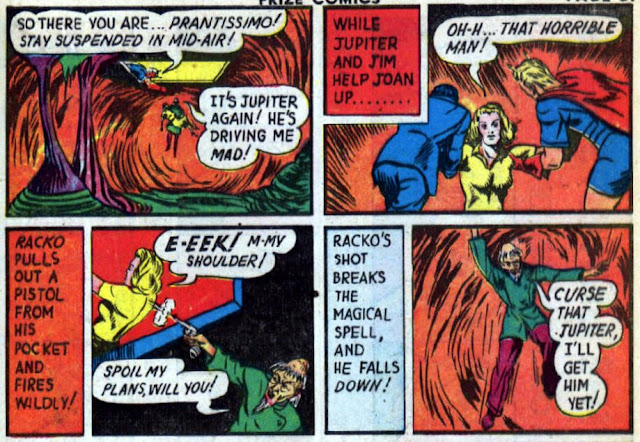
    Having defeated the mad Racko over the course of three adventures, Jupiter and his pal Jim Johnson are ready for some variety in their lives. Well, too bad, because Racko’s brother Murdo is out for revenge! His first move, kidnap Racko’s former victim and Jim’s current girlfriend Joan and put her in a test tube in her underwear.

    ASIDE: I had been operating under the assumption that Racko was a last name but now I have to revise my worldview to include a set of parents who would name their children “Racko” and “Murdo”.

    Over all, Murdo is a lot less interesting than his brother, possibly because of his focus on revenge instead of wacky ways of harming NYC. If he does share one thing with Racko, it’s a penchant for interesting hideouts – in his debut issue he is making his home under a lake in India that is stocked with octopuses, sharks and mermen. 

    Murdo manages to capture Jim as well (and notably leaves him fully clothed when he puts him in a test tube) but turns out to be even less able to cope with an alien wizard than Racko was.

    Jupiter doesn’t even bother blowing Murdo up. He just piles some stuff on top of him.

    Having not even been plausibly killed in his first appearance (and what an insult that is for the brother of the guy that Jupiter felt the need to blow up three separate times), Murdo is back next issue to try again, this time by using magnets to flip Jim Johnson’s cab into a ditch. This is actually very advanced for a Golden Age villain – Murdo has learned that his chances of taking on Jupiter are low and so is starting out by getting the much easier revenge kill on Johnson. Sadly for both Murdo and Johnson’s cab driver, the passenger compartment is the only part of the cab that survives.

    Jupiter shows up and easily captures Murdo, but Murdo has had the good sense to have a henchman dress up as a cop and lurk nearby to “take the villain into custody.” He then abandons his revenge plot entirely in favour of an attempt to take over the US by murdering the president. It’s an astonishing display in light of the single-minded obsession that governs most super-villainous behaviour, folks. Unless world domination was Murdo’s main thing to begin with and revenge was the distraction, of course.

    Jupiter does not stand idly by and allow Franklin Delano Roosevelt to be murdered, of course, though he makes the unusual choice to destroy Murdo’s henchmen and just… leave Murdo himself wandering around on the ground somewhere. It’s a calculated insult!

    The end-of-story blurb promises that next issue would see Murdo teaming up with his brother Racko and I for one think that that would be a fun time, as despite having chosen to go into the same field the two are actually quite different in their approaches to super-villainy, plus a little sibling rivalry never hurt the readability of any story. Sadly, though, Prize Comics 006 was Jupiter’s final appearance, so while Murdo remains at large poor Racko is in a limbo-state, reportedly not dead but not confirmed alive. Very sad stuff.

    REVENGE KILLING SCORE: 0/5 in two attempts each on Jupiter and Jim’s lives and one on Joan’s, Murdo got none of them. Abysmal.

  • MINOR SUPER-VILLAIN 709: RACKO

    (Prize Comics 002, 1940)

    Though he went unnamed in his first appearance, this tonsured fellow is Racko, alien magic man Jupiter’s most enduring foe at a whopping three encounters. Racko’s first outing involved a classic pyramid scheme structure as he sent mutated green humans with horn noses out into the New York streets to kidnap more humans to turn into more minions, and so on until he controlled the world. Ironically, this might be a slightly more ethical version of the typical pyramid scheme, as his minions were under no illusions that they might eventually become wealthy if they sold enough tights or what have you.

    A bunch of what turns out to be fairly dim-witted minions is just not enough to contend with a magic-using alien super-hero, even when bolstered by a paralysis ray cannon, and Racko is forced to restore his henchmen to human form before seemingly taking his own life via some handily exposed wires.

    Racko fans need not despair, as it turns out that he survived! His new plan: drain all of the reservoirs that supply NYC until the Governor of New York is forced to bow to his demands for some ray gun plans and the Governor’s daughter Joan.

    (just why the Governor has these plans is not explored in the text, so we must assume that they are associated with the office. A gubernatorial death ray, as it were)

    Perhaps in an overreaction to the poor showing that his monsterized henchmen put on in his last scheme, Racko uses the death ray on his own men after they secure it for him. They probably wouldn’t have offered much assistance when Jupiter and his pal Jim Johnson show up at the volcano base immediately afterward, but even a useless henchman can serve as a distraction. As it stands, Racko ends up falling to his death in the depth of a volcano that is subsequently blown up by Jupiter. Gone for good, I’d say.

    racko

    I have called it too soon, as Racko is in fact not dead yet again and is taking another pass at world conquest, this time by launching “boulder storms” from his hideout at the South Pole, and here I think that I have some constructive criticism for him: mad science or no, attempt to conquer the world or no… stop attacking New York City first. You’re sitting at the South Pole, man – chuck a few boulders at Australia to test out your equipment before you do the thing that you know will attract Jupiter’s attention because he live in New York.

    Jupiter sails through Racko’s defenses as easily as ever, despite the best efforts of some unaligned ice dragons, and the third time proves to be the charm as far as blowing him and his entire operations to smithereens with alien magic goes. Good by Racko;