The Curse of Skeleton Munroe

Category: multiple appearances

  • MINOR SUPER-VILLAIN 709: RACKO

    (Prize Comics 002, 1940)

    Though he went unnamed in his first appearance, this tonsured fellow is Racko, alien magic man Jupiter’s most enduring foe at a whopping three encounters. Racko’s first outing involved a classic pyramid scheme structure as he sent mutated green humans with horn noses out into the New York streets to kidnap more humans to turn into more minions, and so on until he controlled the world. Ironically, this might be a slightly more ethical version of the typical pyramid scheme, as his minions were under no illusions that they might eventually become wealthy if they sold enough tights or what have you.

    A bunch of what turns out to be fairly dim-witted minions is just not enough to contend with a magic-using alien super-hero, even when bolstered by a paralysis ray cannon, and Racko is forced to restore his henchmen to human form before seemingly taking his own life via some handily exposed wires.

    Racko fans need not despair, as it turns out that he survived! His new plan: drain all of the reservoirs that supply NYC until the Governor of New York is forced to bow to his demands for some ray gun plans and the Governor’s daughter Joan.

    (just why the Governor has these plans is not explored in the text, so we must assume that they are associated with the office. A gubernatorial death ray, as it were)
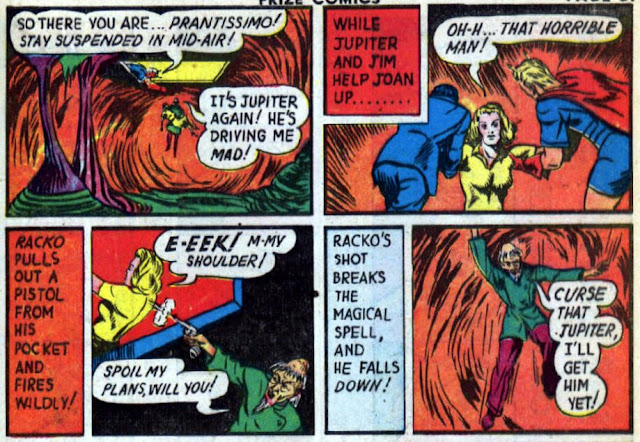
    Perhaps in an overreaction to the poor showing that his monsterized henchmen put on in his last scheme, Racko uses the death ray on his own men after they secure it for him. They probably wouldn’t have offered much assistance when Jupiter and his pal Jim Johnson show up at the volcano base immediately afterward, but even a useless henchman can serve as a distraction. As it stands, Racko ends up falling to his death in the depth of a volcano that is subsequently blown up by Jupiter. Gone for good, I’d say.

    racko

    I have called it too soon, as Racko is in fact not dead yet again and is taking another pass at world conquest, this time by launching “boulder storms” from his hideout at the South Pole, and here I think that I have some constructive criticism for him: mad science or no, attempt to conquer the world or no… stop attacking New York City first. You’re sitting at the South Pole, man – chuck a few boulders at Australia to test out your equipment before you do the thing that you know will attract Jupiter’s attention because he live in New York.

    Jupiter sails through Racko’s defenses as easily as ever, despite the best efforts of some unaligned ice dragons, and the third time proves to be the charm as far as blowing him and his entire operations to smithereens with alien magic goes. Good by Racko;

  • MINOR SUPER-VILLAIN 707: PRINCE BLAGA DARU

    (Planet Comics 005, 1940) 

    Gale Allen was a long-running feature of Planet Comics, which meant that she was a creation of many absent-minded hands. She is always an officer in a gendered space organization, but whether that is the Women’s Space Battalion, the Girl’s Patrol, the Girl’s Squadron and so forth varies from issue to issue. The story is set in the far-off year of 1990 but drifts farther into the future over time. She turns blonde eventually. You get the picture. 

    Early Gale Allen stories feature spaceman Jack North as a real pill of a sidekick who spends much of his on-panel time carping on about how women don’t belong in the space military. They also feature Prince Blaga Daru, a space pirate-turned-world conqueror who has the hots for Gale, possibly because she is semi-secretly a Venusian princess but possibly just because he likes a strong woman.

    In his first appearance, Daru has already conquered Europe and set his eyes on invading North America, with Step I of his plan involving taking control of the the Sub-Oceanic Transit Tube, aka the Trans-Atlantic Subway. Gale Allen and her Falcon Squadron set out to stop him, and shockingly don’t succeed! That is, they do succeed in driving off the initial attack and then get captured by the Prince’s special Gale Allen task force, for you see he loves her and wants to marry her. She of course tells him to go screw and gets away with the help of Jim North.

    (the Prince’s world domination scheme is kiboshed in the subsequent issue and Blaga Daru himself is punched in the eye for his trouble)

    Prince Blaga Daru makes two more spends his next two appearances, in Planet Comics 009 and 011, and in both he has shifted his focus almost entirely to the pursuit of Gale Allen’s hand in marriage. But not by reforming and being a cool guy and courting her on her terms, no. Prince Blaga Daru is a space pirate, and space pirates kidnap their love interests and marry them against their wills. It’s a real culture clash, and it ends up with the Prince unceremoniously falling out of a spaceship door to his demise.

  • MINOR SUPER-VILLAIN 707: PRINCE BLAGA DARU

    (Planet Comics 005, 1940) 

    Gale Allen was a long-running feature of Planet Comics, which meant that she was a creation of many absent-minded hands. She is always an officer in a gendered space organization, but whether that is the Women’s Space Battalion, the Girl’s Patrol, the Girl’s Squadron and so forth varies from issue to issue. The story is set in the far-off year of 1990 but drifts farther into the future over time. She turns blonde eventually. You get the picture. 

    Early Gale Allen stories feature spaceman Jack North as a real pill of a sidekick who spends much of his on-panel time carping on about how women don’t belong in the space military. They also feature Prince Blaga Daru, a space pirate-turned-world conqueror who has the hots for Gale, possibly because she is semi-secretly a Venusian princess but possibly just because he likes a strong woman.

    In his first appearance, Daru has already conquered Europe and set his eyes on invading North America, with Step I of his plan involving taking control of the the Sub-Oceanic Transit Tube, aka the Trans-Atlantic Subway. Gale Allen and her Falcon Squadron set out to stop him, and shockingly don’t succeed! That is, they do succeed in driving off the initial attack and then get captured by the Prince’s special Gale Allen task force, for you see he loves her and wants to marry her. She of course tells him to go screw and gets away with the help of Jim North.

    (the Prince’s world domination scheme is kiboshed in the subsequent issue and Blaga Daru himself is punched in the eye for his trouble)

    Prince Blaga Daru makes two more spends his next two appearances, in Planet Comics 009 and 011, and in both he has shifted his focus almost entirely to the pursuit of Gale Allen’s hand in marriage. But not by reforming and being a cool guy and courting her on her terms, no. Prince Blaga Daru is a space pirate, and space pirates kidnap their love interests and marry them against their wills. It’s a real culture clash, and it ends up with the Prince unceremoniously falling out of a spaceship door to his demise.

  • MINOR SUPER-VILLAIN 701: FELON

    (Planet Comics 003, 1940)

    In his first appearance Felon is a fairly ordinary space pirate captain, terrorizing the spaceways with a fleet of cool black delta-shaped ships and a device that intercepts and disrupts communications across the Solar System.

    In this capacity, Felon gets absolutely trounced by Captain Nelson Cole: his men are beaten up and then blown out of the sky by Cole and the Solar Force. The survivors are taken into custody – Felon is not specifically mentioned but he either crashed somewhere or ended up in jail.

    Whatever happened,  the defeat must have really stuck with Felon, because he returns for revenge in Planet Comics 004, blasting a ray gun wildly into a ballroom occupied by celebrating Solar Force officers, killing at least twenty people but completely failing to achieve his goal of murdering Captain Nelson Cole.

    It’s shaping up to be another extended narrative of space cops vs space crooks when Felon, Cole and the entire Solar Force fleet just kind of blunder through a time portal (well, a time beam, technically) into the 20th Century. What a twist!

    While Cole and his crew are taking in the historical sights, Felon weighs up his options and immediately allies himself with the Nazis the Axis the Aggressor Nations, leading a surprise attack on the US that destroys half of New York City but crucially yet again completely fails to kill Cole or his men.

    Once it’s no longer a matter of humans vs aerial bombardment but futuristic space fleet vs 1940s aircraft, things quickly turn against Felon and the Aggressor Nations. Cole and his men force a global peace by the simple expedient of paralyzing all of the armies until the treaties are signed, and then chase Felon around until he hops back through the time beam ex machina vulcano to the relative safety of the future.

    Now the comic turns into an extended outer space chase but honestly it was all over for Felon once the bombing of NYC failed to take out Cole. The two have a final confrontation in Felon’s old bombed-out asteroid base that ends with Felon in the hoosegow.

  • MINOR SUPER-VILLAIN 691: THE CLAW

    (Pep Comics 007, 1940) 

    The Press Guardian’s only recurring villain, the Claw has what can only be described as an eclectic career: In his first appearance he’s a sort of freelance spy chief working to aid the I-assume-European country of Shironia in its attempt to conquer neighbouring Lanfia by committing acts of sabotage in the US and framing Lanfia as the perpetrator so that America will withdraw its support of Lanfia. The Press Guardian exposes the scheme and sends the Claw and his henchmen to a presumed watery grave.

    Pep 008 drops a bombshell: the Claw could, in fact, swim. Instead of drowning, he made his way to the Central City docks and set up an insurance scam whereby he and his crew of rowdy sea dogs sunk their own ships for a tidy profit. The only flaw in the plan: the Claw kept on murdering nosy reporters who got too interested in all the shipwrecks going on, and you know that the Press Guardian is going to show up to check something like that out. The Claw ended up in the drink again, presumed dead but with more of a question mark than before.

    And that question mark was justified! Pep 009’s Press Guardian adventure begins with he and his aide Cynthia Blake investigating an extremely suspicious want ad for “young, healthy women with no living relatives” and wouldn’t you know it, it’s the Claw again. He’s been turning people into beast-men using animal hormone injections and he’s decided to finally branch out into making beast-women. The Press Guardian is even less into this scenario than the others and wastes little time in beating everyone up and forcing the Claw to reveal the antidote to beast-manism. When last seen the one-handed villain is being chased down by a mob of former beast-men, with murderous intent. Surely the Claw has finally met his end?

    No dice. The Claw returns one last time, in Pep Comics 010, with a knife-wielding green-skinned weirdo named the Goon in tow. The Goon and the Claw have been kidnapping women from a bit of cottage country called Rocky Point – has he gone back to making beast-women? Is he trying to ruin the Press Guardian’s home paper, the Daily Express, who are involved in the development of the region somehow? No, he’s trying to drive people off so that he can steal a radium deposit that’s located on the land.

    The Claw suffers a fairly ignominious defeat in the face of what can’t have been a very hard kick from Cynthia Blake. For all that he’s been tenacious, he’s also always been very easily defeated and while in a real-world way I know that that is because the Press Guardian was a second-tier character with a smaller pagecount than a headliner like the Shield, in my heart of hearts I prefer to believe that he’s just a scrawny little wiener. Or maybe it’s because he hangs out in radium-filled caves all the time, who can say.

    Though the Goon is captured, the Claw just scampers away, and since he isn’t in what turns out to be the Press Guardian’s final outing in Pep Comics 011, he’s just… at large when all is said and done (though again: radium cave. The Claw might not have been troubling humanity for much longer after this particular escapade).

  • MINOR SUPER-VILLAIN 685: SATAN

    MINOR SUPER-VILLAIN 685: SATAN

    (Pep Comics 002, 1940)

    Dateline: Florida! A huge and monstrous face has begun appearing in the clouds across the state to demand fealty! Coincidentally, armoured cars have been disappearing up and down the peninsula at about the same time as the facial appearances.

    The Comet is of course intrigued by this coincidence and decides to investigate. Plotting out the robberies on a map, he proceeds to the swamp located at the central point, and I’ve just realized that it’s a good thing that he’s right because the first thing he does is kick a man into the water and steal his boat and that would be a very embarrassing thing for a super-hero to have done to ,e.g., an innocent game warden. It’s no problem, though, because the guy was in fact an agent of Satan.

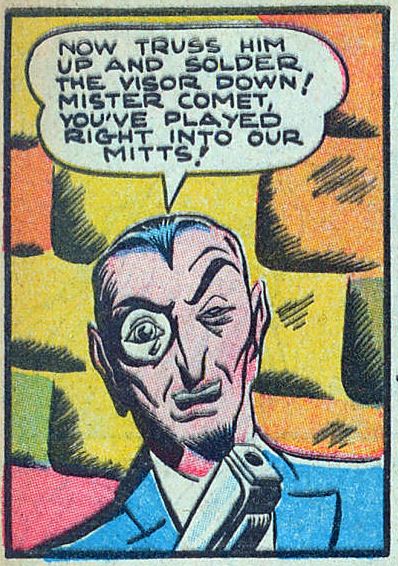
    Satan turns out to be a pretty cagey character: not only does he have a way of dealing with snoopers (dragging their boats through a whirlpool into his sub-swamp lair, as happens to the Comet) but he’s got an impressive level of knowledge of current super-hero news. He knows just who the Comet is and more importantly how to neutralize his major offensive ability, by welding his protective eye mask shut. And this is only the Comet’s second case!

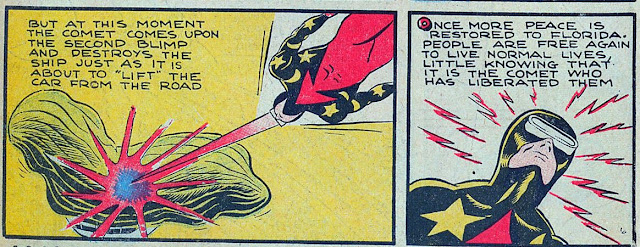
    The mystery of both the monster in the clouds and the disappearing armoured cars, by the way, come down to the same thing: that old favourite, the mighty dirigible. One dirigible equipped with a high-powered projector and loudspeaker and a second with a powerful electromagnet, to be precise – as one is distracting everyone with a big face, the other is making off with the car and the cash (and the unfortunate driver and guards).

    Back to the Comet: Satan’s anti-super-hero savvy extends only so far. Despite his acumen in capturing the Comet and neutralizing his power, Satan has fallen prey to the super-villain’s hubris by leaving him to die in a deathtrap rather than merely shooting him in the head. You see, the really important thing about the Comet’s visor is that it’s just a sheet of glass and thus easily breakable, which the Comet does by the simple expedient of headbutting a rock. After that, it’s just a matter of utterly obliterating not only both dirigibles but the entire swamp base. Satan is toast.

    OR IS HE? In a shock twist, Satan returns in Pep Comics 003 and manages to capture the Comet again, this time taking the trouble to pop him into a glass tube and thus completely neutralizing his powers! (and also delighting me personally, because the name Satan is very ambiguously used in his first appearance and I really appreciated this confirmation that it really is his nom du crime. For my records).

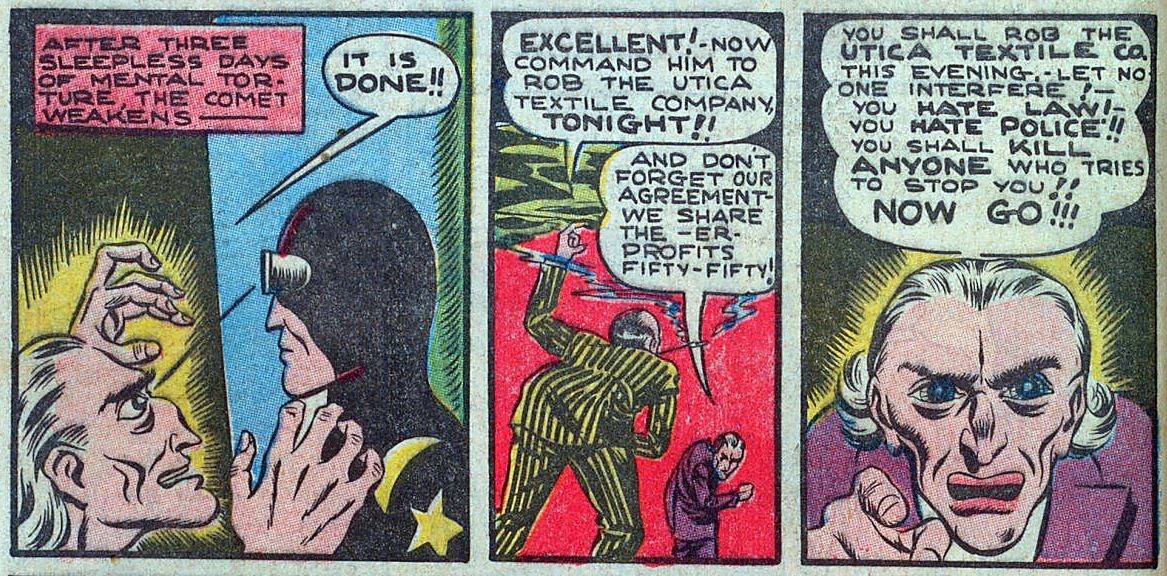
    Satan’s got big plans for the Comet – no cheesy deathtrap this time, no sir. Instead, he brings in put-upon hypnotist Doc Zadar in order to put the Comet to work for him.

    And this isn’t your namby-pamby “can’t be forced to violate your deeply-held morals” hypnotism, this is the real hard-core shit. The Comet goes on a destructive and violent crime spree under Satan and Zagnar’s direction. Notably, this is when he kills a whole bunch of cops, which informs the rest of his Golden Age career by making him one of the few super-heroes who the police have some real justification for constantly trying to gun down (I mean, they still shouldn’t just be trying to execute him in the street, but it’s nice to see them doing it for a reason other than “he’s running away from me even though I’m threatening to kill him!”)

    Once again Satan is undone by his own hubris: this time his failure to see that cheating and abusing the man who controls the actions of a living death ray generator might be a bad idea, and he gets gruesomely dissolved for his mistake. Unfortunately for Zagnar, he forgets the first rule of owning a living death ray generator: always put the safety cap back on. He too is dissolved and the Comet is free to have cops try to gun him down in the street forevermore.

    BONUS: All this Comet talk had me feeling nostalgic and I looked up 1983’s The Comet 001, which I had as a kid. It’s a pretty maudlin book primarily concerned with the Comet castigating himself over what a violent and murderous vigilante he was, and the splash page reflects this via the floating ghosts of the dead who haunt him – note all the cops from Pep Comics 003 at the top there. But just who is that at the lower left?

    I am 75+% certain that this is the monster face that Satan was projecting onto the clouds in Pep 002, which is a pretty hilarious thing to be haunting a depressed 80s super-hero. “I contributed to the death of the airship as a viable mode of transport when I murdered those dirigibles!”

    (the real if boring answer is that it probably is the face from the clouds but, as Satan himself is never actually pictured in the severely abridged version of the story in this comic, the face is being retconned into being his)

  • MINOR SUPER-VILLAIN 569: NEPTINA

    (Champion Comics 002, 1939) 

    I can’t say for sure that whoever created Neptina sat down and said “I will make a lady version of Namor the Sub-Mariner” but it’s at least plausible. Neptina is the ruler of the undersea kingdom of Amloza, and has designs on a total conquest of the surface world as well as the depths.

    Neptina is, like Namor, a horny character. She captures US Navy Lieutenant Brad Fletcher early in her series and spends a considerable amount of mental, martial and political energy in subsequent installments in service of keeping him near her and away from other women.

    (note the little tuning fork thing that Neptina is holding – it works in concert with a telepathic receiver as a form of communication for the Fish-Men of Amloza. There are lots and lots of panels featuring characters who look like they’re playing with a toy from the 1920s when in fact they are talking to one another. It’s fun!)

    Neptina is shown to be a ruthless slaver with ranks of surface men pillaged from ships and equipped with gills in place of their human lungs. The reverse operation can be performed on Fish-Men to allow them to become fully amphibious, though the lungs involved must be harvested from a human. Neptina’s vanity is showcased when she demands that the lungs for her operation be harvested from a beautiful woman only. This also proves to be Neptina’s first major stumbling block, as Brad Fletcher immediately falls in love with movie star Norma Kane when she is brought to Amloza, and rescuing her is one of his major motivations for disrupting Neptina’s plans in early installments.

    More interesting than Neptina’s schemes is the biology of Amloza’s population. There appear to be at least two biological castes, with more humanoid Fish-Men Nobles like Brad Fletcher’s friend Gakk holding higher station than the fish-headed commoners (Neptina’s chief scientist Mogg is a regular Fish-Man and probably the most competent character in the comic, in a welcome nod to the foolishness of biological determinism).

    Complicating things further is the fact that the female population of Amloza appears to consist entirely of bodacious blonde babes in shell bras. If it were just Neptina I’d figure that she was a surface woman somehow elevated to the throne (the racial politics of the time would almost demand that a non-white/nonhuman group would instinctively subjugate themselves to a blonde bombshell), but this suggests the kind of sexual dimorphism we see in fantasy and sci-fi character design (mildly NSFW comic, but Oglaf as a whole is wildly NSFW).

    The other option, and the one I favour, is that the group represented by Neptina and the Fish-Men are two morphologically distinct but related species operating as a unified society – perhaps the Neptinans are naturally parthogenic (sp) which explains their seeming single gender, while the Fish-Men could lack any sexual dimorphism. The Fish-Men Nobles would thus represent hybrids of the two populations and thus their role as nobles could be seen as a bridge between the two.

    Speculative biology aside, here’s a timeline of Neptina’s deal:

    -after Brad Fletcher and Norma Kane escape, she acquires lungs from a second, less fortunate surface woman and makes her way to NYC.

    -while attempting to raise capital by selling some huge pearls, Neptina runs afoul of both the NYPD and a gang of crooks, who foolishly attempt to get rid of her via drowning and end up on the bottom of the harbour themselves.

    -the pearls in question are the sacred Tear Drops of Neptune and scientist Mogg, already a mite anti-monarchist in his leanings, embarks on a) a mission to recover them and b) an attempt to undermine Neptina’s plans of conquest.

    -also set against Neptina: Gakk the Fish-Man Noble and her own half-sister Mhersa, leader of a rebel group called the Maella.

    -Brad returns with a diplomatic envoy. Things are tense but civil until the surface folk help drive off an invasion by Dhakka Snail-Men. At this point, Neptina effectively reforms – Mogg has even seemingly forgiven her for making off with the sacred pearls. More dark: the US Government in the form of Brad Fletcher has forgiven her for the many crimes against its citizens in pursuit of a powerful alliance. 

    As 1940 closes, Brad, Norma, Neptina and Mogg are stranded mid-ocean and Mhersa has taken over Amloza. Will she be villainous enough to appear here? Find out when I make my way to the 1941 issues of Champ Comics!

  • MINOR SUPER-VILLAIN 569: NEPTINA

    (Champion Comics 002, 1939) 

    I can’t say for sure that whoever created Neptina sat down and said “I will make a lady version of Namor the Sub-Mariner” but it’s at least plausible. Neptina is the ruler of the undersea kingdom of Amloza, and has designs on a total conquest of the surface world as well as the depths.

    Neptina is, like Namor, a horny character. She captures US Navy Lieutenant Brad Fletcher early in her series and spends a considerable amount of mental, martial and political energy in subsequent installments in service of keeping him near her and away from other women.

    (note the little tuning fork thing that Neptina is holding – it works in concert with a telepathic receiver as a form of communication for the Fish-Men of Amloza. There are lots and lots of panels featuring characters who look like they’re playing with a toy from the 1920s when in fact they are talking to one another. It’s fun!)

    Neptina is shown to be a ruthless slaver with ranks of surface men pillaged from ships and equipped with gills in place of their human lungs. The reverse operation can be performed on Fish-Men to allow them to become fully amphibious, though the lungs involved must be harvested from a human. Neptina’s vanity is showcased when she demands that the lungs for her operation be harvested from a beautiful woman only. This also proves to be Neptina’s first major stumbling block, as Brad Fletcher immediately falls in love with movie star Norma Kane when she is brought to Amloza, and rescuing her is one of his major motivations for disrupting Neptina’s plans in early installments.

    More interesting than Neptina’s schemes is the biology of Amloza’s population. There appear to be at least two biological castes, with more humanoid Fish-Men Nobles like Brad Fletcher’s friend Gakk holding higher station than the fish-headed commoners (Neptina’s chief scientist Mogg is a regular Fish-Man and probably the most competent character in the comic, in a welcome nod to the foolishness of biological determinism).

    Complicating things further is the fact that the female population of Amloza appears to consist entirely of bodacious blonde babes in shell bras. If it were just Neptina I’d figure that she was a surface woman somehow elevated to the throne (the racial politics of the time would almost demand that a non-white/nonhuman group would instinctively subjugate themselves to a blonde bombshell), but this suggests the kind of sexual dimorphism we see in fantasy and sci-fi character design (mildly NSFW comic, but Oglaf as a whole is wildly NSFW).

    The other option, and the one I favour, is that the group represented by Neptina and the Fish-Men are two morphologically distinct but related species operating as a unified society – perhaps the Neptinans are naturally parthogenic (sp) which explains their seeming single gender, while the Fish-Men could lack any sexual dimorphism. The Fish-Men Nobles would thus represent hybrids of the two populations and thus their role as nobles could be seen as a bridge between the two.

    Speculative biology aside, here’s a timeline of Neptina’s deal:

    -after Brad Fletcher and Norma Kane escape, she acquires lungs from a second, less fortunate surface woman and makes her way to NYC.

    -while attempting to raise capital by selling some huge pearls, Neptina runs afoul of both the NYPD and a gang of crooks, who foolishly attempt to get rid of her via drowning and end up on the bottom of the harbour themselves.

    -the pearls in question are the sacred Tear Drops of Neptune and scientist Mogg, already a mite anti-monarchist in his leanings, embarks on a) a mission to recover them and b) an attempt to undermine Neptina’s plans of conquest.

    -also set against Neptina: Gakk the Fish-Man Noble and her own half-sister Mhersa, leader of a rebel group called the Maella.

    -Brad returns with a diplomatic envoy. Things are tense but civil until the surface folk help drive off an invasion by Dhakka Snail-Men. At this point, Neptina effectively reforms – Mogg has even seemingly forgiven her for making off with the sacred pearls. More dark: the US Government in the form of Brad Fletcher has forgiven her for the many crimes against its citizens in pursuit of a powerful alliance. 

    As 1940 closes, Brad, Norma, Neptina and Mogg are stranded mid-ocean and Mhersa has taken over Amloza. Will she be villainous enough to appear here? Find out when I make my way to the 1941 issues of Champ Comics!

  • MINOR SUPER-VILLAIN 557: DEATH

    (Wonderworld Comics 003, 1939)

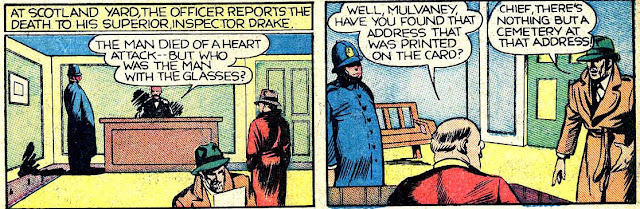
    Like I said in the Devil’s entry yesterday: Death and the Devil have teamed up as a sort of Yarko the Great Revenge Squad because Yarko saves so many live and souls, respectively. I also mentioned that Death did all of the legwork toward getting Yarko just where they wanted him, and here that is: Death kills a seemingly random London man then delivers him to the police, leaving only a calling card behind.

    The discovery that the calling card’s address was that of a cemetery is enough to convince Inspector Drake of Scotland Yard that this is a case for Yarko the Great, and… obviously Drake is right because even the most well-trained officer is going to have a hard time dealing with Death himself, but have some gumption, man. Try to track down where the card was printed or something before abdicating all responsibility.

    Yarko makes his way to Death and the Devil’s Limehouse lair, where he is promptly captured, put in a deathtrap, escapes and banishes the Devil back to the netherworld. Death takes more of a background role in this latter part of the adventure, but that’s okay because he looks great – mostly quite cool but a bit sleazy too, because this ain’t your regular Death, this is Bad Boy Death.

    In the end, the Devil having been vanquished, Death just leaves. Yarko can’t actually affect him, and there’s even some hinting that the man in the car was not killed so much as dies naturally and was just used as bait, which implies that Death has no way of affecting someone who isn’t about to die anyway. He does kill a reluctant henchman who refuses to go up against Yarko, but maybe he was about to die too – working for the Devil has to be a dangerous profession, right?

    Death returns in Wonderworld Comics 008 after a Madame Punjai finds the creatively-named Golden Amulet, which compels his service. Punjai is obsessed with her lost youth and beauty and because of this commands Death to kill the young and beautiful Carla Dennis, a former passing acquaintance. This is done seemingly on a whim? There’s no real exploration of Madame Punjai’s plans, whether toward regaining her lost youth or revenging herself on the beautiful women of the world.

    Yarko the Great of course becomes involved in these shenanigans and the more-hapless-than-evil Madame Punjai is tricked into trading her life for that of Carla’s. Death is again cheesed off about this. BUT WHY IS HE? He’s going to get basically everyone eventually, even in a comic book world with immortals and so forth. Why care? Is this a Discworld style Death who gets into human roles like hobbies? Maybe.

  • MINOR SUPER-VILLAIN 557: DEATH

    (Wonderworld Comics 003, 1939)

    Like I said in the Devil’s entry yesterday: Death and the Devil have teamed up as a sort of Yarko the Great Revenge Squad because Yarko saves so many live and souls, respectively. I also mentioned that Death did all of the legwork toward getting Yarko just where they wanted him, and here that is: Death kills a seemingly random London man then delivers him to the police, leaving only a calling card behind.

    The discovery that the calling card’s address was that of a cemetery is enough to convince Inspector Drake of Scotland Yard that this is a case for Yarko the Great, and… obviously Drake is right because even the most well-trained officer is going to have a hard time dealing with Death himself, but have some gumption, man. Try to track down where the card was printed or something before abdicating all responsibility.

    Yarko makes his way to Death and the Devil’s Limehouse lair, where he is promptly captured, put in a deathtrap, escapes and banishes the Devil back to the netherworld. Death takes more of a background role in this latter part of the adventure, but that’s okay because he looks great – mostly quite cool but a bit sleazy too, because this ain’t your regular Death, this is Bad Boy Death.

    In the end, the Devil having been vanquished, Death just leaves. Yarko can’t actually affect him, and there’s even some hinting that the man in the car was not killed so much as dies naturally and was just used as bait, which implies that Death has no way of affecting someone who isn’t about to die anyway. He does kill a reluctant henchman who refuses to go up against Yarko, but maybe he was about to die too – working for the Devil has to be a dangerous profession, right?

    Death returns in Wonderworld Comics 008 after a Madame Punjai finds the creatively-named Golden Amulet, which compels his service. Punjai is obsessed with her lost youth and beauty and because of this commands Death to kill the young and beautiful Carla Dennis, a former passing acquaintance. This is done seemingly on a whim? There’s no real exploration of Madame Punjai’s plans, whether toward regaining her lost youth or revenging herself on the beautiful women of the world.

    Yarko the Great of course becomes involved in these shenanigans and the more-hapless-than-evil Madame Punjai is tricked into trading her life for that of Carla’s. Death is again cheesed off about this. BUT WHY IS HE? He’s going to get basically everyone eventually, even in a comic book world with immortals and so forth. Why care? Is this a Discworld style Death who gets into human roles like hobbies? Maybe.