The Curse of Skeleton Munroe

Category: multiple appearances

  • MINOR SUPER-VILLAIN 552: BARON VON KAMPF

    (Speed Comics 001, 1939) 

    Baron von Kampf! Major recurring Shock Gibson villain and aspiring world conqueror. He’s exactly the sort of evil, sneering gloating villain that I love to see vex the heroes of yesteryear, and due to the fact that his appearances are concentrated in the early days of the super-hero medium that’s about all the characterization he gets. He wants to rule the world and he’s a dick about it.

    But who needs characterization when you’ve 1. got the appearance of a weird little goblin man and 2. employ the services of what are possibly the greatest henchmen of the Golden Age: the Zombies!

    “This Better Not Awaken Anything In Me”

    According to Baron von Kampf, the Zombies are radio-controlled creatures made out of animal parts. Just why they’re called zombies is a mystery – the idea of the zombie as a resurrected corpse or corpselike drugged (or mystically enthralled) person was very much in the cultural ether in 1939, so who the heck knows?

    Naming conventions aside the Zombies look terrific, particularly in a huge group – they’re like something that Steve Ditko might draw swarming out of a portal to beat up Dr Strange.

    Baron von Kampf’s second appearance in Speed Comics 002 sadly does not involve the Zombies but does feature that old favourite gizmo, the engine killing ray, which von Kampf is employing to bring down airplanes in order to conquer the South American nation of El Matador. 

    The real interesting thing about the Baron in this issue is that he still has on what I previously assumed to be some sort of surgical cap but might just be the top of his head? Like it’s a metal plate or something? Like all aspects of the Baron’s appearance it goes unmentioned in the text so we can only speculate on why exactly he is Like That.

    Baron von Kampf shows up maybe half a dozen times total but the real attraction is the Zombies, who get a bit weirder as time goes on. We”l be seeing them again, I assure you.

    UPDATE: Baron von Kampf 1940

  • MINOR SUPER-VILLAIN 552: BARON VON KAMPF

    (Speed Comics 001, 1939) 

    Baron von Kampf! Major recurring Shock Gibson villain and aspiring world conqueror. He’s exactly the sort of evil, sneering gloating villain that I love to see vex the heroes of yesteryear, and due to the fact that his appearances are concentrated in the early days of the super-hero medium that’s about all the characterization he gets. He wants to rule the world and he’s a dick about it.

    But who needs characterization when you’ve 1. got the appearance of a weird little goblin man and 2. employ the services of what are possibly the greatest henchmen of the Golden Age: the Zombies!

    “This Better Not Awaken Anything In Me”

    According to Baron von Kampf, the Zombies are radio-controlled creatures made out of animal parts. Just why they’re called zombies is a mystery – the idea of the zombie as a resurrected corpse or corpselike drugged (or mystically enthralled) person was very much in the cultural ether in 1939, so who the heck knows?

    Naming conventions aside the Zombies look terrific, particularly in a huge group – they’re like something that Steve Ditko might draw swarming out of a portal to beat up Dr Strange.

    Baron von Kampf’s second appearance in Speed Comics 002 sadly does not involve the Zombies but does feature that old favourite gizmo, the engine killing ray, which von Kampf is employing to bring down airplanes in order to conquer the South American nation of El Matador. 

    The real interesting thing about the Baron in this issue is that he still has on what I previously assumed to be some sort of surgical cap but might just be the top of his head? Like it’s a metal plate or something? Like all aspects of the Baron’s appearance it goes unmentioned in the text so we can only speculate on why exactly he is Like That.

    Baron von Kampf shows up maybe half a dozen times total but the real attraction is the Zombies, who get a bit weirder as time goes on. We”l be seeing them again, I assure you.

    UPDATE: Baron von Kampf 1940
  • MINOR SUPER-VILLAIN 548: MADAME DOOM

    (Smash Comics 004, 1939)

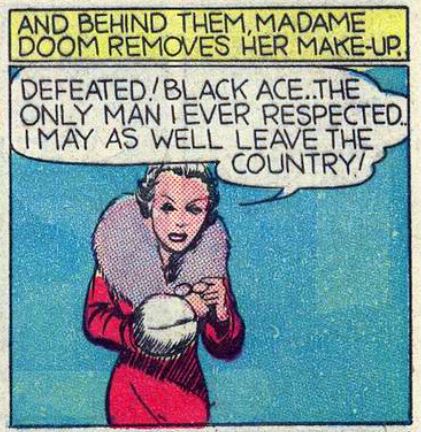
    We will be seeing more of Madame Doom, as she is Black X’s only real recurring foe (I think), but as far as 1939 goes she made one appearance and this is it. 

    Madame Doom, a freelance spy, is working for “the dictators” in an attempt to steal US defense plans and prevent the signing of a pretty vague treaty that acts as a deus ex machina reason for war not to have broken out yet (war with the US, that is).

    In this first appearance Madam Doom is a very by-the-book Will Eisner femme fatale: a ruthless lady with the hots for the hero (reciprocated).

    Black X doesn’t quite let her go on purpose but he certainly doesn’t try very hard to catch her. This is a mistake! The bloom definitely wears off the rose in this relationship later on.

    UPDATE: Madame Doom 1940

  • MINOR SUPER-VILLAIN 544: DR VON THORP & THE IRON MONSTER / MINOR SUPER HERO: HUGH HAZZARD & BOZO THE IRON MAN

    (Smash Comics 001, 1939)

    We open on a city (later established as almost certainly NYC) in the grip of terror. A robot known as the Iron Monster is wantonly robbing and murdering and also stealing one or more babies for reasons that are never made clear. Seriously, we never find out what the deal was with those babies.

    The Iron Monster is the creation of Dr von Thorp, your classic scientist rejected from society for his outre beliefs, though considering the man and his work he may have been ostracized for something other than believing that he might someday build a robot. Regardless of why he was rejected, he has expressed himself in the traditional way, by turning his invention back on society as revenge.

    The police have no hope of dealing with the Iron Monster or his boss, so Police Commissioner Hunt calls in private detective par excellence Hugh Hazzard, whose job is made considerably easier by the fact that von Thorp subscribes to the surprisingly common school of robot design that dictates that the robot contain a large, easily accessible space that a human can get inside and also take control of the robot from. Von Thorp’s capture is almost anticlimactic, in fact.

    The reason for this anticlimax is that this is not, in fact, the story of Dr von Thorp and his Iron Monster but the origin of Hugh Hazzard and the renamed Bozo the Iron Man. As introduced Hazzard is already one of those superhuman-adjacent comic book adventurers complete with a special method for the police commissioner to contact him and a love interest gamely resigned to spending most of her evenings alone. Bozo, despite eventually taking over the name of the strip entirely, is never more than a tool of Hazzard’s with no actual personality or volition (though Hazzard does eventually switch to mostly travelling around inside the robot like the other, later Iron Man and Bozo gets a considerable boost in personality once it seems to be spouting quips from its fixed grimace).

    In Smash Comics 002 Hazzard upgrades Bozo with both a considerably miniaturized controller (cellphone sized vs the old one’s desktop PC) and a weird disc on top of his head that allows him to fly, so I guess that also makes him one of those hobbyist polymath types you get in old comics

    Dr von Thorp returns exactly one more time in Smash Comics 018, wherein he and Hazzard battle for control of Bozo by blasting radio waves at him like two people trying to see who a puppy loves more. No surprise that Hugh Hazzard wins but killing von Thorp off-panel at the very end seems a bit mean.

    Like I said, Bozo’s role in the title of the strip if not as a character continued to grow until the end of their run in 1943. Since then Bozo occasionally turns up in a collection of DC Comics junk that some character has collected. Of Hugh Hazzard there has been no further sign.

  • MINOR SUPER-VILLAIN 529: RATZER

    (Blue Ribbon Comics 018, 1941)

    Ratzer is a Nazi agent who tangles with American-serving-in-the British-Army Corporal Collins a couple of times. There’s not a lot to say about him, honestly: the first time he meets Collins he’s trying to spring a load of Nazi prisoners and destroy a lot of British gun cotton in then-Bombay, while the second time he’s stealing oil in Iraq. He is not notably villainous, particularly in the ranks of Nazi super-villains.

    He does, however, have a certain style, so I’ll speak on that. Starting with his plane! I really like the question mark! Custom planes are absolutely the on the list of things that make aviator characters at least a bit interesting.

    I wouldn’t call Ratzer’s costume one of the greatest of all time but it does have some flair, particularly with the little scarf dangling off the top of his head. And as a bonus it doesn’t have any swastikas on it, which I appreciate a lot more than I did before I started posting pictures of super-villains online regularly.

    Ratzer’s second appearance doesn’t really involve flying and so he’s dressed in what I guess is his Desert Combat Costume – perhaps he has a whole closet full of slight variations on the theme, like a 1990s action figure line. Look out for Ocean Exploration Ratzer!

    In any case, I like this costume best – he looks a bit like a pro wrestler.

    At the end of his second appearance Ratzer gets away again and just… never returns. This is probably down to the end of Blue Ribbon Comics when Corporal Collins moved over to being a supporting character to MLJ’s other military hero Sergeant Boyle. No room for the secondary characters to have their own villains, after all.

  • MINOR SUPER-VILLAIN 529: RATZER

    (Blue Ribbon Comics 018, 1941)

    Ratzer is a Nazi agent who tangles with American-serving-in-the British-Army Corporal Collins a couple of times. There’s not a lot to say about him, honestly: the first time he meets Collins he’s trying to spring a load of Nazi prisoners and destroy a lot of British gun cotton in then-Bombay, while the second time he’s stealing oil in Iraq. He is not notably villainous, particularly in the ranks of Nazi super-villains.

    He does, however, have a certain style, so I’ll speak on that. Starting with his plane! I really like the question mark! Custom planes are absolutely the on the list of things that make aviator characters at least a bit interesting.

    I wouldn’t call Ratzer’s costume one of the greatest of all time but it does have some flair, particularly with the little scarf dangling off the top of his head. And as a bonus it doesn’t have any swastikas on it, which I appreciate a lot more than I did before I started posting pictures of super-villains online regularly.

    Ratzer’s second appearance doesn’t really involve flying and so he’s dressed in what I guess is his Desert Combat Costume – perhaps he has a whole closet full of slight variations on the theme, like a 1990s action figure line. Look out for Ocean Exploration Ratzer!

    In any case, I like this costume best – he looks a bit like a pro wrestler.

    At the end of his second appearance Ratzer gets away again and just… never returns. This is probably down to the end of Blue Ribbon Comics when Corporal Collins moved over to being a supporting character to MLJ’s other military hero Sergeant Boyle. No room for the secondary characters to have their own villains, after all.

  • MINOR SUPER-VILLAIN 528: THE BLACK HAND

    (Blue Ribbon Comics 016, 1941) 

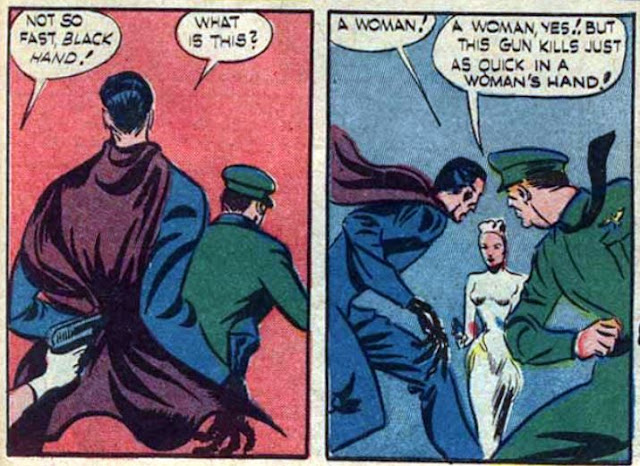
    There’s a quality that some comic book characters have and some do not and I never knew about it until I started writing this blog. That quality is called Standing in Clear View So That I Can Get a Screengrab of Them, and buddy, the Black Hand does not have it. This is about as good of a full look as you get of the guy in his first appearance.

    Enough complaining! The Black Hand is a spy of the Unaffiliated Freelancer subtype, which since he operates out of the US means that he steals US secrets for sale to the Nazis. Is a character who does business with Nazis better than one who is a Nazi? Marginally. The Black Hand is also the recurring villain of Captain Flag, who he is also responsible for becoming a super-hero due to his murder of Flag’s father and failure to proof his lair against narratively significant eagles.

    The Black Hand is called the Black Hand because of his black hand, which he usually conceals beneath a black glove and which is riddled with a deadly disease that the Black hand can transfer to a victim via a simple scratch of his horrible fingernails. It’s definitely a useful power (affliction?) for a villain to have but not one that has a chance of coming up in anyone’s super-power wishlist.

    Throughout his five appearances the Black Hand sports three distinct looks: the initial iteration (either afflicted with a deathly pallor or just overenthusiastic when applying foundation), a sort of suave mustachioed cat-burglar getup with no hint of the grave and then back to the deathly complexion with an added skull-like quality to the face. Realistically this can be put down to Captain Flag being a secondary character without a dedicated artist, but if that was the point of this blog then it would swiftly cease to be much fun.

    Notably, the suave version of the Black Hand wears his glove on the opposite side – could this indicate that he and the corpselike Black Hand are different characters? Perhaps the disease that gives them their name is also slowly killing them, which could account for the more ghoulish appearance of the original Hand over time?

    These questions will never be answered, sadly, as in-universe the Black Hand made a transition from spy the thief to pirate and Captain Flag was quick to invoke the Law of the Sea to hang him from the nearest yardarm. Out of universe, Captain Flag’s feature didn’t survive the cancellation of Blue Ribbon Comics and so the Black Hand had nobody to come back from the dead to torment.

  • MINOR SUPER-VILLAIN 526: THE DICTATOR

    MINOR SUPER-VILLAIN 526: THE DICTATOR

    (Blue Ribbon Comics 013, 1941)

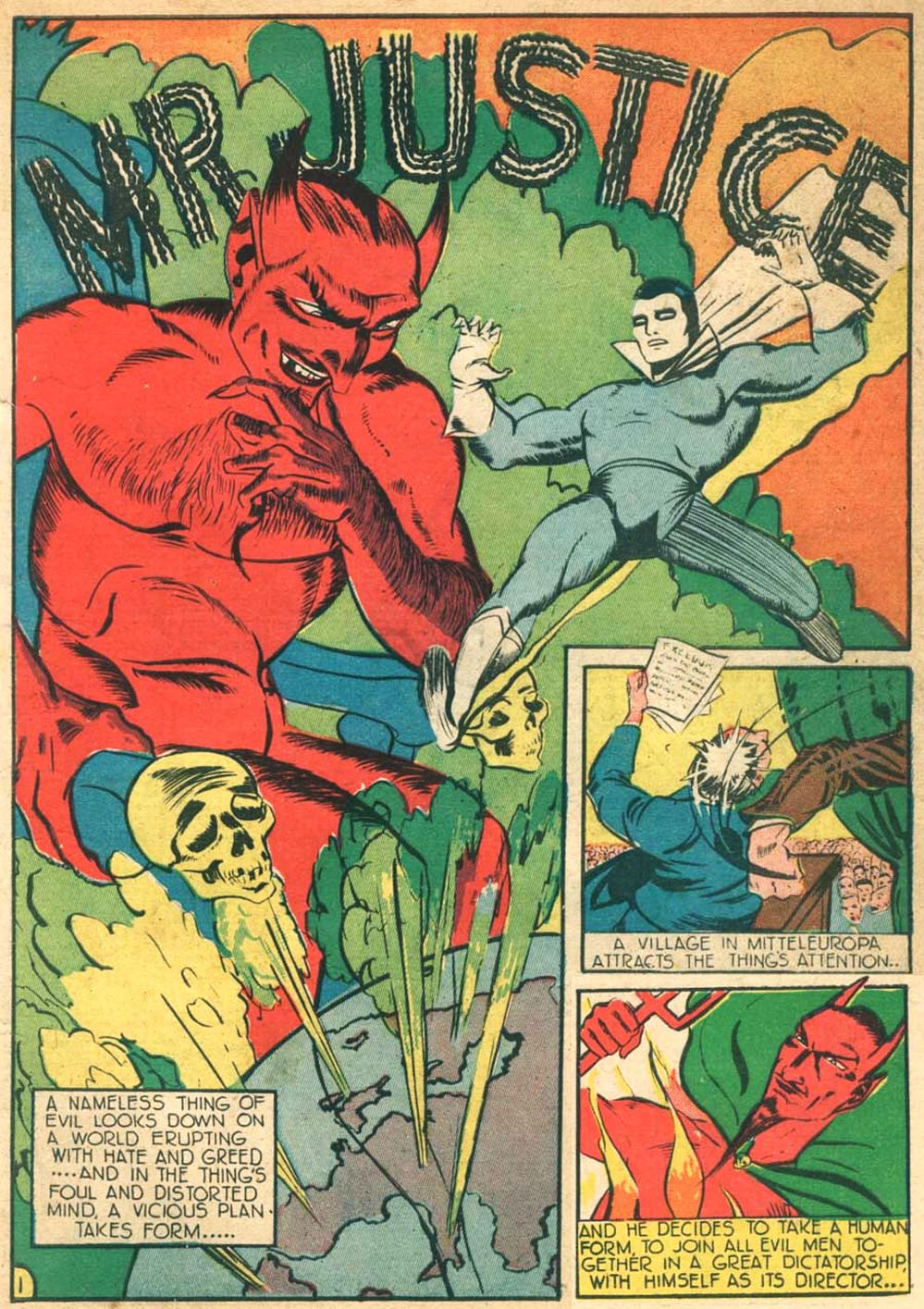
    I had two surprises coming to me when I read the first appearance of this fellow: 1) though there are a fair few Golden and Silver Age comics that posit some sort of supernatural element to the evils of the Axis power – deals with the Devil, influence by one or another god of war, etc – but this is the earliest example I’ve seen of one of their leaders actually being a supernatural evil.

    If I had previously said that the Dictator’s Shadow was about as close as you could get to someone being a Nazi without actually dipping over the line and just saying it, this comic has somehow elasticized the line and dragged it way over to the other side. The Dictator is Hitler in all but name, and they don’t even go to the trouble of replacing the swastika with another symbol or making up new names for the countries he invades. There are such a small number of changes, in fact, that I will list them now: Germany is referred to as Mitteleuropa (which is a term for Central Europe fairly closely associated with the German imperialism of both World Wars), the Bavarian Alps are instead the Vabarian Alps, and Goebbels is instead called Deenbee (a maddening name because it feels like I should be able to work out a meaning behind it).

    (later there are look-alike analogs of a lot of top Nazis, seen here)

    Mr Justice demonstrates the even-handed political neutrality that comics of the past were always known for and bursts into a staff meeting to give Hitler the Dictator “the most vicious beating a man ever experienced”, as you do.

    Again, this is all politically neutral stuff.

    This conflict continues for a few issues: first, the Dictator arms his nameless Himmler-analog with an anti-ghost potion and sets him the task of killing Mr Justice. This ends in not-Himmler’s  death but also in an important realization for Mr Justice: that the Dictator wields only temporal power in the world, that he can only act through agents. Accordingly, the net two Mr Justice stories concern him killing off analogs of Goering, Goebbels and von Ribbentrop t erode the Dictator’s power base.

    And that’s where it ends, kind of. After Mr Justice strikes, the Dictator returns fire by sending future entry the Green Ghoul to attack America. It take three issues to deal with that guy, and by the next time he shows up the Dictator is just the Devil again – whether or not he is still cosplaying as Hitler is not addressed. I guess that this is going to continue to be a thing when the villain in question is a cosmically evil being, right? They just pack up and go home at the end? A bit unsatisfying from a narrative perspective.

  • MINOR SUPER-VILLAIN 504: PROFESSOR X

    (Blue Bolt v1 005, 1940)

    Professor X has two of my favourite qualities in a minor super-villain: a famous name and a prior history. The first is the same kind of fun as when my friend named his cat after me. “What do you mean Professor X keeps getting up on the counter to steal ham?”

    I really love his Prohibition-Era villainy as well, particularly as I had it in my head that he specifically was a bootlegger and thus that all of his great inventions were in service of that – dirigibles full of Canadian whiskey? The axe-proof barrel? The mighty Beer-Bot? Fun stuff. The suicide vest, by contrast is a bit much and not particularly fun, but does establish his bona fides as a legitimate threat.

    Prof. X is on a classic Judge and Jury Revenge Killer tear, targeting Hogan, the cop who brought him in and Johnson, the lawyer who put him away, who since then has become the District Attorney of Centro and close personal friend of local super-hero Sub-Zero.

    Due to this last fact Professor X is forced to turn his genius to the creation of anti-Sub-Zero weaponry, including cold-proof cars, an unfreezable gun that fires superheated bullets and his iconic costume which – you guessed it – is insulated  and renders him immune to Sub-Zero’s freezing powers. And he almost manages to beat Sub-Zero! His only mistake is in having uninsulated water pipes in his secret lair and leads to him being sent to jail inside a large block of ice.

    Professor X returns in the next issue in an attempt to finish getting revenge on DA Johnson as well as new target Sub-Zero (he also tries to kill Sub-Zero’s girlfriend Mary but I don’t think he has a specific grudge against her), and this time he’s accompanied by a costumed henchman named Rat. Once again he very nearly pulls it off but this time his fatal flaw is a lot more fatal, as he misjudges a jump during his escape and does a header out a fourth story window. An ignominious end to be sure.

    JUDGE AND JURY REVENGE KILLER SCORE: 1/3

    But death is not the end for Professor X! Blue Bolt v1 007 features a gambler named Rocky Garret who has acquired the Professor’s anti-Sub-Zero tech as insurance against interference in his baseball-fixing scheme (and it’s a good idea for him to do so, as his scheme is Not Very Good – a lot of it is literally just putting the wrong numbers on the scoreboard which… isn’t good.  It’s a bad plan.)

    Sadly this is it as far as Professor X’s legacy goes. I was kind of hoping that Sub-Zero would be confronted with a guy in a mesh bodysuit every now and again going forward, but alas, it was not meant to be.

  • MINOR SUPER-VILLAIN 504: PROFESSOR X

    (Blue Bolt v1 005, 1940)

    Professor X has two of my favourite qualities in a minor super-villain: a famous name and a prior history. The first is the same kind of fun as when my friend named his cat after me. “What do you mean Professor X keeps getting up on the counter to steal ham?”

    I really love his Prohibition-Era villainy as well, particularly as I had it in my head that he specifically was a bootlegger and thus that all of his great inventions were in service of that – dirigibles full of Canadian whiskey? The axe-proof barrel? The mighty Beer-Bot? Fun stuff. The suicide vest, by contrast is a bit much and not particularly fun, but does establish his bona fides as a legitimate threat.

    Prof. X is on a classic Judge and Jury Revenge Killer tear, targeting Hogan, the cop who brought him in and Johnson, the lawyer who put him away, who since then has become the District Attorney of Centro and close personal friend of local super-hero Sub-Zero.

    Due to this last fact Professor X is forced to turn his genius to the creation of anti-Sub-Zero weaponry, including cold-proof cars, an unfreezable gun that fires superheated bullets and his iconic costume which – you guessed it – is insulated  and renders him immune to Sub-Zero’s freezing powers. And he almost manages to beat Sub-Zero! His only mistake is in having uninsulated water pipes in his secret lair and leads to him being sent to jail inside a large block of ice.

    Professor X returns in the next issue in an attempt to finish getting revenge on DA Johnson as well as new target Sub-Zero (he also tries to kill Sub-Zero’s girlfriend Mary but I don’t think he has a specific grudge against her), and this time he’s accompanied by a costumed henchman named Rat. Once again he very nearly pulls it off but this time his fatal flaw is a lot more fatal, as he misjudges a jump during his escape and does a header out a fourth story window. An ignominious end to be sure.

    JUDGE AND JURY REVENGE KILLER SCORE: 1/3

    But death is not the end for Professor X! Blue Bolt v1 007 features a gambler named Rocky Garret who has acquired the Professor’s anti-Sub-Zero tech as insurance against interference in his baseball-fixing scheme (and it’s a good idea for him to do so, as his scheme is Not Very Good – a lot of it is literally just putting the wrong numbers on the scoreboard which… isn’t good.  It’s a bad plan.)

    Sadly this is it as far as Professor X’s legacy goes. I was kind of hoping that Sub-Zero would be confronted with a guy in a mesh bodysuit every now and again going forward, but alas, it was not meant to be.