The Curse of Skeleton Munroe

Category: multiple appearances

  • MINOR SUPER-VILLAIN 446: THE ROOK

    (Mystery Men Comics 018, 1941)

    This here is the Rook, the only recurring antagonist of Golden Age duo the Lynx and Blackie the Mystery Boy. In terms of crime, he’s your basic thief and murderer with a sideline in opportunistic kidnapping and extortion. He does have several notable attributes, however:

    Tactics: The Rook has a hypnoray and he is going to use it, dammit. He’s not one of those fickle super-villains who blame their tools every time a plan doesn’t come together. The hypnoray is SOLID, it’s a VALUED MEMBER OF THE TEAM and it’s STAYING.

    The Rare Hate Triangle: In his first appearance, the Rook kills his henchman Killer Burke rather than split the take of their latest job with him. Killer’s brother Baldy Burke swears revenge and attempts to get it for the next four issues. It’s a very fun dynamic because Baldy also hates the Lynx, so his allegiance is fluid. Sometimes he teams up with the Lynx to get the Rook, sometimes the opposite. At least once, Baldy just pops up out of the Rook’s back seat and attempts to shoot him.

    More books should feature a wildcard antagonist! I can’t think of too many examples off the top of my head but those I can are terrific additions to the plot. Also, more super-villains should have non super-hero enemies given how they behave – if nothing else a guy like the Joker should be taking fire from opportunists any time he shows his face in public.

    Eyes: Not only does the Rook have really great staring eyes (and they just keep getting more intense – by the end of his appearances he’s got Muppet-style half ping pong balls going on) but the subjects of his hypnoray also have them. It’s a nice touch and I appreciate it.

    Physical Resilience (or Possibly a Series of Carefully-Planned Escape Routes): The Rook ends his first six appearances in the same way: missing, presumed dead. Specifically, he meets his theoretical end, in order, by fire, a fall, quicksand, drowning, explosion, and being thrown out a window onto sharp rocks and pounding surf far below. The Rook, in other words, operates on slasher movie villain rules – if he surely must have been killed but you don’t have a body then he isn’t dead. And the Lynx must have figured that out because in their final encounter he just breaks both of the Rooks legs rather than trying to kill him like he usually does.

    In conclusion: while the Rook himself isn’t the greatest villain in the world, virtually everything about him is worth incorporating into a villainous MO. Except for the part where he teamed up with literal Nazis. None of that.

  • MINOR SUPER-VILLAIN 443: THE UGLY QUEEN

    (Mystery Men Comics 022-023, 1941)

    The Ugly Queen is our first real foray into the heady world of societal beauty standards as motivation for evil (though there’s an element of that sort of thing in Setap’s first appearance and we’ve certainly encountered a fair few characters rejected by society for ugliness and deformity). Her status as a royal is called into question by the end of her appearances but she does cut a powerful figure, with an undersea castle full of weird snake-men that she draws Rex Dexter of Mars to.

    Two things about the Ugly Queen’s appearance:

    -the design of her face is amazing. 

    -if what she’s looking for is acceptance rather than universal acclaim then the Ugly Queen has absolutely been looking in the wrong places. I’m only moderately Extremely Online and I could name more than a few places where she could, as they say, Get It.

    So yes, it’s clear that the real villain was societal beauty standards all along. Wait. No, it was the Ugly Queen – she just dropped “thousands of atomic bombs” on a city to kill one beautiful woman.

    She also captures handsome men and swaps their heads out for those of animals when they refuse her marriage demands. And while writing all this out I realized just what I liked most about the Ugly Queen: she isn’t doing any of this because she feels the sting of societal rejection. She’s doing it because it’s fun and the social stuff is a flimsy excuse. Like all of the best villains, the Ugly Queen is having a great time.

    Her first appearance ends with a cow-headed man flooding her underwater palace and seemingly killing all within, but worry not because in the very next issue:

    She’s back, baby.

    Once again I am struck by how cool the Ugly Queen looks. And she knows it! She clearly wore that superfluous helmet so that she could take it off dramatically in front of… some snake men, I guess.

    This time, Rex Dexter brings his fiance Cynde along and the Ugly Queen undercuts my previous point a bit by caring enough about how she looks to set up a mind transfer between the two of them so that she can rock Cynde’s conventionally attractive face. Although she does start gloating about it to Rex Dexter the second that she thinks that she has gotten away with it, so maybe it’s more of a prank body swap than a desperate attempt to be something else.

    All’s well that ends well, however, as the Queen’s snake-man subjects, who turn out to be slaves, immediately revolt once they see the Ugly Queen tied to a chair, and then once she is stabbed by one of them it turns out that the mind-transfer tech she had used was the kind that switches the minds back when either of them dies. Seems to go against the spirit of the malicious mind switch, but what do I know.

    In conclusion, the Ugly Queen rules, long live the Ugly Queen. It’s unlikely that someone will ever BRING BACK the character but I know I’d love to see her again.

  • MINOR SUPER-VILLAIN 432: THE CONQUEROR

    (Keen Detective Funnies 011, 1939)

    The Conqueror is the major recurring foe of Dean Denton, Scientific Adventurer, about whom we will briefly aside: Dean Denton was created by Harry Campbell, who was also responsible for such characters as Ace of Space, Bruce Blackburn and the wretched Scarlet Seal, but also Wizard Wells and John Law, Scientiective, who form a kind of thematic triad of scientific detectives with Dean Denton.

    Dean Denton is definitely the most entertaining of the three to read (with the unfortunate caveat that his are the adventures that are most riddled with racial stereotypes. The Golden Age, folks!) due partially to his former occupation as a well-known ventriloquist but mostly to his archfoe the Conqueror, who beats John Law’s Avenger and Wizard Wells’ collection of no-name goons hands down.

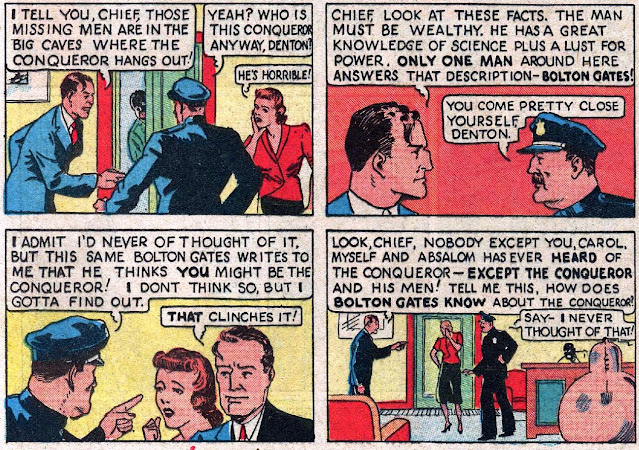
    The Conqueror is actually rich guy Bolton Gates and over the course of a couple of dozen appearances he has my favourite villainous character arc: the villain of means with vast resources is foiled several times by Our Hero and ends up scrabbling around doing comparatively petty crimes for chump change. 

    In his first few appearances the Conqueror has a lavish estate under which is a technologically advanced lair filled with brainwashed minions. After Dean Denton blows all that up it seems like the Conqueror is forever seeking to recreate it with schemes that place him in positions of high status: not only does he pose as divine figures to dupe tribal groups in both Central America and Africa but he founds somewhere between two to three cults:

    Somewhat surprisingly, the White Crusaders, over which the Conqueror presided as the Master Crusader/ the White Master, was not a racially problematic group.

    Meanwhile the Cult of Astra was mostly a way to flimflam flaky Hollywood types and blackmail their studios with the threat of religion-related work stoppages (a scheme that nets him a two-episode arc on the Villains of Old Hollywood podcast).

    The third example is somewhere between a cult and his old habit of minion recruitment through mind control: he takes advantage of the conflict between the countries of Namreg and Feltia (and in case “Namreg” was too subtle for you they clash near the “Tonigam Line”) to capture and brainwash both Namreg and Feltian forces. 

    Even though the Conqueror gets away as per usual at the end of this scheme, it’s his last appearance in comics (that I know of, natch). One can imagine his conflict with Dean Denton continuing indefinitely and why not. It’s more fun than most things that might logically happen to a lone civilian trapped in the midst of two armies that he recently made enemies of. after all.

  • MINOR SUPER-VILLAIN 408: MR WHO

    (More Fun Comics 073, 1941) 

    It’s Mr Who! You know, from comics! I was very excited for this guy to turn up, as he’s one of those comic book characters I had heard about but never really read about, and… he’s okay.

    See, Mr Who was born all scrawny and seems to have been a weird kid (and to have had a shitty dad, jeez), so he channelled all of his efforts into science, and more specifically into developing a way to be big and strong and handsome. He ended up with Solution Z, a super-power drug that allowed him to alter his size and shape seemingly without limit, to recover from any injury, camouflage himself like a chameleon, etc. It’s a cool suite of powers that are somewhat undercut by his all-brown wardrobe (including cape!) accessorized with a single dark green neckerchief.

    In his first outing, Mr Who is on a campaign to steal beautiful things such as paintings and gems to surround himself with so as to leave behind his own perceived ugliness. Dr Fate gets involved and seemingly drowns him in the Hudson River for his troubles.

    But of course you can’t keep a good man with complete control over his own biology down, and Mr Who is soon making his way to shore as a highly unsettling fishman. (More Fun Comics 074, 1941)

    This time out, Mr Who sets his sights on power rather than material beauty – he uses his shapeshifting abilities to kidnap and replace… a mayor. I’ll be honest: the prior issue was, like a lot of Dr Fate stories, very much set in NYC and this guy is almost certainly supposed to be a generic off-brand version of Mayor Fiorello LaGuardia, but they changed him just a little too much and he’s falling into the uncanny valley for me. I think this would only affect someone who spends a fair amount of time squinting at old pictures of politicians to see if they’re being alluded to in comics art but unfortunately I’m someone who does that.

    Dr Fate of course foils this plan as well but we’ll be seeing Mr Who again as the Golden Age progresses, and then he’s one of the villains that Roy Thomas brings back in All-Star Squadron. I like Mr Who – he’s a good foil for half-helmet era Dr Fate, who is more of a wisecracking roughneck than the full-face version, which means that a moderately crafty fella can outfox him for a while.

  • MINOR SUPER-VILLAIN 407: DR CLEVER

    (More Fun Comics 074, 1941)

    I have taken an immediate liking to Dr Clever. I mean, just look at the guy: the classic tuxedo-and-cape combo, the rictus grin, the bald pate with two little hair-horns, the tiny skull-and-crossbones pin… he’s really a triumph of design when you think about it. Lucky for us he’s a recurring foe of Johnny Quick so we’ll be seeing him again.

    Somewhat strangely for a man with such an overall villainous look, Dr Clever’s major line is in con artistry: he manages to pull off three schemes in short order in this issue and the only impediment to their success is the involvement of Johnny Quick. Maybe people just love a smiling man. In order then:

    1. Under a fairly flimsy pretense he gives away free food that contains a chemical that turns the eater blue, then sells an antidote for big bucks. This one might be a warm-up as he only seems to get about ten people.

    2. He advertises his new invention: a machine for extracting gold from seawater. Dr Clever sells the gold from this machine for 50 cents on the dollar, but really it’s just a way to launder stolen gold.

    3. He creates a service whereby he will register your patent for you but really he just keeps them for himself.

    It’s all almost wholesome, crime-wise. Don’t worry though: Dr Clever is actually an evil wretch of the highest order as evidenced by the above panel in which he murders two henchmen for essentially no reason.

  • MINOR SUPER-VILLAIN 406: CAPTAIN BLACK JACK

    (More Fun Comics 074, 1941)

    Captain Black Jack is your typical modern pirate, albeit a very charmingly-written one. He took a look at the nautical landscape of the early 40s and saw a niche that he could fill: that of the buccaneer. He raids a yacht and comes into conflict with Aquaman and almost comes out on top but makes the key mistake of trying to drown an amphibious man and ends up blown to Kingdom Come for his efforts.

    OR DOES HE? No, he doesn’t – he makes it to shore and swears revenge against Aquaman and actually carries through with it! I’m pretty sure that he’s Golden Age Aquaman’s major recurring foe! WE WILL SEE CAPTAIN BLACK JACK AGAIN!

  • MINOR SUPER-VILLAIN 359: THE UNHOLY THREE

    (Master Comics 017-019, 1941)

    The Unholy Three! A little guy (Nosey), a huge guy (Brutus) and a gorilla (Herbert)!

    Oh and of course we must not forget the fourth member of the Unholy Three, their boss “Doctor” J. Twiddley Fairchild (quotation marks his). Details in the actual story are sketchy but it seems as if Fairchild was jailed for larceny, escaped, assembled the other three as his minions and set out to get revenge on those who were responsible for his imprisonment – in other words an old fashioned Judge and Jury Revenge Killing scheme.

    This is where things get a bit annoying for me personally. JaJRK schemes are quantifiable based on the number of attempted slayings divided by the number of successful ones. The problem is that while we know that the Unholy Three end up killing all but one of their targets we do not in fact have any idea of how many targets there were – it’s more than three but up to something like twenty+ if the defense team and witnesses are included.

    Sadly then, JUDGE AND JURY REVENGE KILLING SCORE: n-1/n

    The Unholy Three (all four of them) end up getting caught by Bulletman and Bulletgirl before managing to finish off the last of their targets, but someone at Master Comics must have liked them because they returned for a two-issue story. Too bad for J. Twiddley Fairchild: he didn’t make it out of the initial jailbreak alive. Leadership of the group passed to Nosey and Bulletman became the new target for revenge.

    The actual action is whatever – the Unholy Three kidnap Bulletgirl and try to kill them both with a deathtrap and the second part opens with Bulletman thinking that Bulletgirl has died while the Unholy Three think that Bulletman has. This doesn’t really go anywhere interesting.

    Ultimately the Three attempt to flee the country and Bulletman kicks them off a cliff to their demise.

    OR DOES HE? Because the Unholy Three are collectively our second villain to be resurrected off-panel in time to sign the Crime Exchange petition. Like Mr Murder they never appear again but just knowing that two guys and a gorilla are out there somewhere is enough for me.

  • MINOR SUPER-VILLAIN 355: MR MURDER

    (Master Comics 015, 1941) 

    Mr Murder is your “pay or die” style of extortionist and a) has a pretty great name and b) is presumably in an early stage of his career as there is a lot more “die” going on than “pay”.

    Mr Murder also has a great understated costume: tunic, hat, cape, scarf, gloves. Just a bit off of what you might see someone actually wearing – nice and menacing in a Shadow sort of way.

    And of course Mr Murder turns out to be Reilly, the loudmouthed lawyer from the beginning of the story, presumably using his position to determine opportune targets for extortion and employing my fave the rubberoid mask to disguise his identity. It’s a fine outing over all but nothing special. The interesting stuff comes with Mr Murders further appearances:

    Mr Murder reappears in Master Comics 027, 1942 and there are several weird things going on. The least of these is his decision to incorporate the rubberoid mask into his costume despite his identity no longer being a secret, but I guess that’s no weirder than villains who continue to wear regular style masks in such circumstances.

    More interesting is the fact that there seems to have been a Mr Murder/ Bulletman clash some time in between, during which a) Mr Murder found out Bulletman’s secret identity and b) Bulletman was thought to have killed Mr Murder. As far as I can tell, this story was never published (I reckon that it’s equally likely that a story was produced but never published or someone misremembered Mr Murder being in a story he wasn’t), but the upshot of it is that Mr Murder is out for revenge and armed with the knowledge to do the deed. He kidnaps Jim Barr and almost succeds in bumping him off but has seemingly forgotten about the existence of Bulletgirl, leading to him getting his but kicked and dying for real.

    OR DID HE? This marks our first encounter with the CRIME EXCHANGE, an organization run by future Minor Super-Villain the Crime Broker, the details of which are not germane other than the fact that at one point the Exchange members petition the Crime Broker to bump off Bulletman, a petition consisting mostly of deceased Bulletman villains. It’s madness! A huge (dead) portion of Bulletman and Bulletgirl’s rogues gallery, returned to life (or, less incredibly, sprung from prison) in a single panel! Madness!

    Okay, maybe this is more exciting to me than anyone else but it is neat. And as someone whose official stance is that super-villains are more interesting when they’re still alive I heartily approve.

  • MINOR SUPER-VILLAIN 345: THE WHITE ARROW

    (Master Comics 008-011, 1940-1941)

    A regular-style Old West outlaw chief with the somewhat lyrical name of Santos Figaro, the White Arrow’s main distinction is that he was a multi-issue rather than one-off foe of Marshal Buck Jones.  

    Jones himself is far more interesting than poor Santos Figaro, being a real-life cowboy actor cast as an Old West lawman (probably – I think I’ve mentioned before that the media of the 1930s-40s doesn’t draw a lot of distinction between the Old West and the contemporary West and that sometimes the only way you find out that a series is one or the other is 50 instalments in when the protagonist hops a plane to Chicago). Jones replaced former marshal Bill Crane in Master Comics 006 in a sadly lost-to-history adventure that might contain clues as to whether he was the Buck Jones or just a Buck Jones. 

    Regardless, the “Buck Jones, Frontier Marshal” feature closed its doors after the real Buck Jones died in 1942. Given that, it is somewhat ironic that Master Comics was one of the books to eventually carry the adventures of Old West cowboy Tom Mix based on the Western actor who had died in 1940.

    UPDATE: I finally got to read Master Comics 006, in which Buck Jones takes over for Bill Crane, and it’s almost but not quite as unclear about the time period as the issues I already had access to. Buck Jones is a famous actor moving to what is effectively the past for a bit of a break from modern life and when Crane is wounded he is sworn in as the new marshal. Jones is simultaneously a recognizable celebrity and living in a place with no technology more modern than the steam engine. Baffling!

  • MINOR SUPER-VILLAIN 337: DR DROWN

    (Master Comics 001, 1940)

    Dr Drown is a paragon of his sub-category of super-villain. Unfortunately for him, that is not a particularly exalted position, as he belongs to the Association of Seagoing Criminal Scientists and the membership of that group is heavily diluted by decades of Aquaman and Sea Devils and even Challengers of the Unknown foes with wilfully bad schemes.

    Dr Drown’s schemes aren’t too bad! He as a submersible yacht that he uses to torpedo and loot ships, which is a lucrative if very evil business model, with the sole flaw being that he keeps doing it in exactly the same part of the ocean which makes him very easy for his foe Shipwreck Roberts to track him down.

    Drown’s other claim to fame is as a tamer of sea monsters and it’s here that things really get going for me. The “brontosauruses” above are pretty light fare but check this out:

    I follow a lot of horror artists on various social medias and it’s still been a while since I’ve seen anything quite as unsettling as the Giantocrab. Why does it have human arms, for heaven’s sake?

    By contrast the Colostopus is merely a fun dome-shaped friend with a good name.

    Drown also deployed this Mechanosaurus in a later adventure but as the name suggests it was actually a monster-shaped submarine (a classic move but always sad to miss out on a real monster).

    As stated above, Dr Drown is a great example of a generally mediocre lot – I’d be right chuffed if he or one of his descendants were ever brung back.