The Curse of Skeleton Munroe

Category: multiple appearances

  • MINOR SUPER-VILLAIN 332: THE HAND

    (Leading Comics 001, 1941)
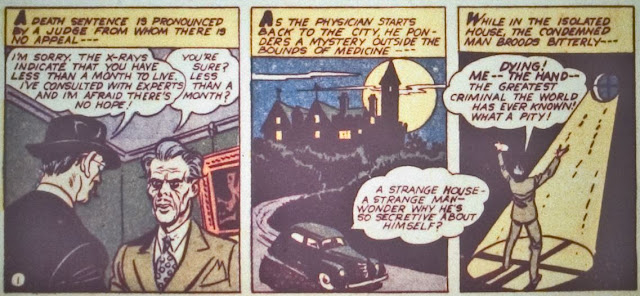
    The Hand holds the distinction of being both the first foe of the Seven Soldiers of Victory (all 9 or 10 of them) and the person who organized them as a team in the first place, and all as a way to get attention, essentially. As first presented, he is a master criminal so successful that he is unknown to the world at large who has just received word that he is dying with no hope of a reprieve.

    Somewhat understandably, the Hand decides to go out with a bang rather than a whimper, by recruiting five other super-villains to act as his “fingers” and carry out his most audacious crimes.

    We’ll get into the nitty gritty of the Five Fingers of the Hand in the next entry (because I have a system and I need to stick to it, okay?) but the long and the short of it is that the Hand gathers together pre-established supercrooks the Needle, Professor Merlin and the Red Dragon, never-before-seen supercrook the Dummy and lucky-to-be-considered schnook Big Caesar, outfits them with crime plans and sets them up in a classic Justice Society style “everyone split up and have a little adventure” adventure with what will become the Seven Soldiers of Victory.

    Though this might be the most reasonable reason for sending a taunting note to the forces of Law I have yet seen (after all, how greater the crime if it is actively opposed?), it remains a bad idea to do so, categorically, as evidenced by the fact that every one of the Five Fingers is summarily captured (or in the case of Professor Merlin, exploded) mid-caper, leading to the traditional final act of the JSA-style story wherein everyone comes together to beat up the mastermind.

    Who knows if the Hand could have handled them if he hadn’t been informed that his condition was, in fact, treatable just before the fight. Could he have taken on seven super-heroes if he still thought he was going to die? We will never know. Instead, he almost gets them with a lightning cannon but ends up being electrocuted by it, ironically dying just as he learned that he might have a chance to live.

    Or did he? No he didn’t, it turns out, because years later Len Wein wanted to bring back the Seven Soldiers of Victory and concocted a story wherein they were blasted through time, and who better to be responsible than their very first foe? And since that caper involved the Nebula Man, one of Grant Morrison’s favourite creeps, the Hand showed up in Seven Soldiers, too. He seems to have about a 30-year refractory period, so look for him on comic shelves sometime in 2036!

  • MINOR SUPER-VILLAIN 291: QUEEN JARNA

    (Marvel Mystery Comics v1 025-026)

    Jarna here is Queen of the Lavarites, a group of aliens from Venus who coordinate with the Nazis (shown here as a chunky guy in his pyjamas about to be punched out by the Sub-Mariner). This is all regular comics stuff but there’s some fun highlights:

    a) the main Lavarite force is composed of these little roughnecks who talk in their own untranslated language and are clearly having a ball at all times. If your aliens have to look like humans they should absolutely look like fun humans.

    b) Lavarites have some extremely fun sexual dimorphism going on! Some wags over at the Marvel Wiki are of the opinion that Jarna here is a member of a second Venusian species who has become ruler of these little guys but that removes the much more fun option of them being some sort of eusocial species like bees  and that these are all her worker drone children. Or that Lavarite women are just fifty times larger than Lavarite men!

    (this is the first of two times that we cross over into Sexual Kink That I Don’t Fully Get territory)

    As with any good story involving a bunch of little guys, Namor gets Lilliputianed. (and there’s the other one!)

    Jarna is also surprisingly merciless in her attempt to do away with Namor – it’s just her bad luck that he’s also amphibious.

    Despite the fact that Namor lets her off with a warning in her first outing, Jarna is immediately back to her old tricks in the subsequent issue She’s working with the Nazis to build an underwater staging area for the invasion of the US, but good news: she’s planning on turning on them just as soon as they do the dirty work for her. Attempted world domination I can forgive but Nazi collaboration is a harder pill to swallow.

    Unfortunately it’s just Jarna in this issue – the Lavarites all seem to have gone back to Venus and I guess she hasn’t had time to hatch out another generation of them. I miss them.

    For some reason probably related to her status as a pretty girl Namor lets Jarna go at he the end of this story as well, and she’s stayed away ever since, possibly because he came very close to killing her on a couple of occasions there. I of course would love to see her BRUNG BACK, particularly if she is actually portrayed as the queen of a eusocial species of little guys that she gives birth to, and particularly if they aren’t defaulted to the insect version of such but reflect something more like naked mole-rat society or some other, weirder, model. Have ’em come back for revenge on the Sub-Mariner some time when he’s vulnerable!

    BONUS: this is perhaps the most perfectly drawn “amused disbelief” face I have ever seen 

    (said in a room with two people who had been surgically altered to be amphibious by the Antarctic-dwelling people of lost Atlantis, by the way)

  • MINOR SUPER-VILLAIN 290: THE PARROT

    (Marvel Mystery Comics v1 024, 1941)

    There are two different comic book tropes that come together in the Parrot. The first is simple: the weird-looking guy adopts a criminal persona based on their appearance -. So: the Penguin, the Vulture, the Chicken, the Platypus, the Skull etc. This is basic stuff, but generally fun.

    The second thing has to do with the nature of super-powers, that by their very nature they require countering Just as every penny-ante gangster who faced Superman in the 50s seemed to have gotten their hands on a chunk of kryptonite, the well-informed criminal in a Human Torch story will at the very least have asbestos clothing and some form of fire-suppressing chemical liquid or spray. In extreme cases like the Kryptonite Man or the Torch’s own Asbestos Lady the counter-weapon becomes the entire theme, but the Parrot here represents an intermediate step that I find quite compelling.

    See, a while back the Human Torch encountered a Tibetan cult called the Fire-Men who had fire-powers that they used to fight fire-monsters. One of those Fire-Men, named Culflam, was a crook who got sent to jail at the end of the story, where he shared a cell with the Parrot and taught him all the secrets of the Fire-Men Cult (unfortunately for Culflam, as the last part of the Learn Mystical Secrets in Jail trick is to murder your teacher on the way out). 

    So the Parrot is fireproof. He’s also something like seven and a half feet tall and completely ruthless. All of this makes for a very fun villain, even if all he really does is try to rob an opera crowd. I was pretty jazzed to read his second appearance, two issues later!

    Very sad times had by all: all he does is escape from jail again and then accept a contract from a man with  a German accent to blow up a strategic sulphur supply – his flame immunity doesn’t even come up! And then he dies in a car crash! Truly this is an example of squandered potential.

    Clearly the Parrot should be BRUNG BACK in some form – unfortunately the only hook I can think of are his stolen Fire-Man powers perhaps coming with some sort of curse for shirking the duties of the cult and he comes back to haunt the California desert as a fiery ghost? Or a modern incarnation of the cult needs access to lost teachings and mistakenly resurrects him instead of Culflam?  Or maybe the US government just keeps the bodies of deceased super-villains in cold storage somewhere and he just gets mad scienced back from the dead, I don’t know.

  • MINOR SUPER-VILLAIN 279: THE CAT’S PAW

    (Marvel Mystery Comics v1 018-020, 1941)

    The Cat’s Paw gets a pretty classic intro: Dr Lin, the Angel’s old mentor and friend who was introduced in the previous issue, is ruthlessly murdered via high-speed application of poisoned dart. The Angel give chase, but fails to make the bust.

    The next day we see some of the Cat’s Paw’s scheme begin to emerge. She’s killing industrialists for some reason. But why?

    Here’s our first look at the villain in question, because I chose some odd images to clip. A couple of things about her stand out:

    -she’s our first example (if not necessarily Marvel’s first example – they’ve got a half-dozen other titles at this point) of a few things in a Marvel comic: a female super-villain, a proper costumed crook, themed weaponry in the form of a cat-claw launcher, and, kind of, a recurring villain.

    -on that last point: not really. Though the Cat’s Paw does appear in three issues worth of  Angel comics, it’s all one story, just decompressed a bit.

    -it is of course notable that she looks a bit like 90s Catwoman

    -most importantly: in the above image both the Cat’s Paw and the Angel are attending a costume party as themselves! A twofer! 

    Eventually, the Angel tracks the Cat’s Paw down to her HQ in one of the dozens of deserted castles that litter the mountains a short drive from NYC in any given comic book universe.

    Now for the disappointing news: the reason that the Cat’s Paw was killing all of those industrialists is that she was acting as a… catspaw for the Nazis in their bid to weaken US support for Britain (and here once more I must note that Marvel was really leading the pack on making Nazi villains for-real Nazis well before Pearl Harbor). She does rediscover her patriotism once her Nazi handler tries to bump her off, which is better than nothing, I suppose. 

    Here’s where I’d normally be decrying the comic for killing her off at the end, pointing out how ambiguous the “guess we’ll never find the corpse, oh well” nature of her death is, and call for her to be brung back as a legacy villain, but the Nazi collaboration is really sticking in my craw. Honestly if she hadn’t walked it back at the end I’d be all for the Cat’s Paw showing up as an Axis agent in period pieces going forward but as-is I reckon she can lie fallow.

  • MINOR SUPER-VILLAIN 279: THE CAT’S PAW

    (Marvel Mystery Comics v1 018-020, 1941)

    The Cat’s Paw gets a pretty classic intro: Dr Lin, the Angel’s old mentor and friend who was introduced in the previous issue, is ruthlessly murdered via high-speed application of poisoned dart. The Angel give chase, but fails to make the bust.

    The next day we see some of the Cat’s Paw’s scheme begin to emerge. She’s killing industrialists for some reason. But why?

    Here’s our first look at the villain in question, because I chose some odd images to clip. A couple of things about her stand out:

    -she’s our first example (if not necessarily Marvel’s first example – they’ve got a half-dozen other titles at this point) of a few things in a Marvel comic: a female super-villain, a proper costumed crook, themed weaponry in the form of a cat-claw launcher, and, kind of, a recurring villain.

    -on that last point: not really. Though the Cat’s Paw does appear in three issues worth of  Angel comics, it’s all one story, just decompressed a bit.

    -it is of course notable that she looks a bit like 90s Catwoman

    -most importantly: in the above image both the Cat’s Paw and the Angel are attending a costume party as themselves! A twofer! 

    Eventually, the Angel tracks the Cat’s Paw down to her HQ in one of the dozens of deserted castles that litter the mountains a short drive from NYC in any given comic book universe.

    Now for the disappointing news: the reason that the Cat’s Paw was killing all of those industrialists is that she was acting as a… catspaw for the Nazis in their bid to weaken US support for Britain (and here once more I must note that Marvel was really leading the pack on making Nazi villains for-real Nazis well before Pearl Harbor). She does rediscover her patriotism once her Nazi handler tries to bump her off, which is better than nothing, I suppose. 

    Here’s where I’d normally be decrying the comic for killing her off at the end, pointing out how ambiguous the “guess we’ll never find the corpse, oh well” nature of her death is, and call for her to be brung back as a legacy villain, but the Nazi collaboration is really sticking in my craw. Honestly if she hadn’t walked it back at the end I’d be all for the Cat’s Paw showing up as an Axis agent in period pieces going forward but as-is I reckon she can lie fallow.

  • MINOR SUPER-VILLAIN 234: THE WITCH

    (Flash Comics v1 005, 1940) 

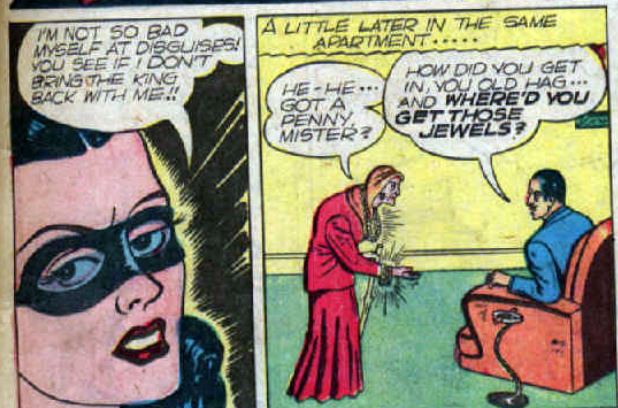
    Long-running foe/ally/love interest of Golden Age master of disguise the King (or King Standish, if you want to go by his full name), the Witch probably deserves a more thorough examination than I’m going to give her, but the fact is that though she is a good character and an admirable foil to the King, the King himself is a bit dull. Sorry, Witchie.

    I will say that the New Orleans-set King story in World’s Finest 002, in which the Witch is revealed to be a descendent of pirate Jean Lafitte and that her father was actually a crook who had kidnapped her as a baby to spite a different crook and in which she loses not one but two fathers… is a good time, will read again.

    ADDENDUM: I don’t know if she’s telling the truth here, but the idea tht the Witch’s criminal upbringing was messed up enough that she doesn’t even have a name is enough to make me like her 10x more. (Flash Comics v1 009, 1940)

  • MINOR SUPER-VILLAIN 227: FRAULEIN DOKTOR’S DAUGHTER

    (Feature Comics 046-055, 1941-1942) 

    If you, like me, aren’t familiar with WWI-era espionage figures, then this one will require some explanation. Fraulein Doktor was the only name that German spy Elsbeth Schragmüller was known by, even after the war had ended and up until German records were seized in 1945, in fact. And once Captain Bruce Blackburn’s adventures had wrung all of the interest they could out of the German-American Bund, a sexy spy nemesis was just the ticket! Thus: Sonya (presumably) Schragmüller, Fraulein Doktor’s Daughter!

    Sonya’s a fine foe for a regular-style espionage character like Bruce Blackburn, full of all of the staples of the genre: poisons, disguises, fake cults, horniness, etc., but she has three real features of interest aside from being the made-up child of a real person:

    -she has an enormous body count relative to her number of appearances, managing to knock off at least a couple of US intelligence agents per operation.

    -even though she refers to her country of origin as “the Homeland” as is standard in the Counterspy strip, she is presented as the daughter of a German intelligence agent – this is about as close to outright saying she’s a Nazi as you get in mid-1941! (I sometimes feel weird getting so excited for actual Nazis to show up in the books I’m reading, but if it’s so I can see them get beat up a bunch I guess it’s fine)

    -since she’s the major ongoing villain of the Bruce Blackburn strip, and since the industry standard way to keep an espionage villain around is to have them escape at the end of every story, she never really gets caught, and since the strip ends in mid-1942, she ends her time in comics at large, a rare fate.

    ADDENDUM: CARL

    In the first Fraulein Doktor’s Daughter story she has no henchmen. In the second, she has three, Carl, Fritz and Otto, all apprehended. In the third, a second Carl, probably also arrested. In the fourth, Karl, who ends up dead. What does this mean beyond the writers having a limited pool of German names to draw from? I have no idea!

  • MINOR SUPER-VILLAIN 227: FRAULEIN DOKTOR’S DAUGHTER

    (Feature Comics 046-055, 1941-1942) 

    If you, like me, aren’t familiar with WWI-era espionage figures, then this one will require some explanation. Fraulein Doktor was the only name that German spy Elsbeth Schragmüller was known by, even after the war had ended and up until German records were seized in 1945, in fact. And once Captain Bruce Blackburn’s adventures had wrung all of the interest they could out of the German-American Bund, a sexy spy nemesis was just the ticket! Thus: Sonya (presumably) Schragmüller, Fraulein Doktor’s Daughter!

    Sonya’s a fine foe for a regular-style espionage character like Bruce Blackburn, full of all of the staples of the genre: poisons, disguises, fake cults, horniness, etc., but she has three real features of interest aside from being the made-up child of a real person:

    -she has an enormous body count relative to her number of appearances, managing to knock off at least a couple of US intelligence agents per operation.

    -even though she refers to her country of origin as “the Homeland” as is standard in the Counterspy strip, she is presented as the daughter of a German intelligence agent – this is about as close to outright saying she’s a Nazi as you get in mid-1941! (I sometimes feel weird getting so excited for actual Nazis to show up in the books I’m reading, but if it’s so I can see them get beat up a bunch I guess it’s fine)

    -since she’s the major ongoing villain of the Bruce Blackburn strip, and since the industry standard way to keep an espionage villain around is to have them escape at the end of every story, she never really gets caught, and since the strip ends in mid-1942, she ends her time in comics at large, a rare fate.

    ADDENDUM: CARL

    In the first Fraulein Doktor’s Daughter story she has no henchmen. In the second, she has three, Carl, Fritz and Otto, all apprehended. In the third, a second Carl, probably also arrested. In the fourth, Karl, who ends up dead. What does this mean beyond the writers having a limited pool of German names to draw from? I have no idea!

  • MINOR SUPER-VILLAIN 215: THE THREE DEVILS

    (Detective Comics v1 050, 1941) 

    The Three Devils are an early example of a fairly common minor super-villain archetype: the acrobat who turns their skill to criminal ends (and of course this is a subset of “circus folk who use their talents for crime” which itself is a subset of “talented professional turns their talent to crime” and then I guess above that is “criminals”). 

    I don’t think I’m going to bother calling it out every time it happens but they also appear in an early example of what will eventually be a staple of Batman story structure through the 60s, told in three acts:

    Act I: the villain’s novel methods allow them to triumph over Batman and Robin and get away with their goal – a lot of stories following this structure take place after the Comics Code, so usually this is a theft of some kind.

    Act II: Batman and Robin foil the villain’s scheme but they still get away.

    Act III: the villain is captured while attempting to achieve their goal.

    In this case, the Three Devils are flung to their deaths from a clock tower rather than being captured but like I said, it’s an early iteration of the format. It’s also a format that I noticed while reading Silver Age Batman stories, so it’ll be interesting to take note of how it develops and how much it is reflected in other super-hero comics of the time.

    The other interesting thing about the Three Devils is that despite falling to their deaths in 1941 they return in Batman Comics v1 107 in 1957 as the Daredevils:

    Now, I learned about this Three Devils/Daredevils connection on a fan wiki and so approached it with some skepticism but damned if they weren’t right about this one:

    They even use the same fence!

    Now 1957 is a tricky year – Barry Allen had just debuted as the Flash; Martian Manhunter is running around… this could just be an Earth-One retelling of the Three Devils story, scrubbed of some supernatural cruft. Or these could be the same characters, not actually dead after all – this is the kind of thing that inspired nerds to come up with stuff like Earth-Two-A and Earth-B and so forth.

  • MINOR SUPER-VILLAIN 215: THE THREE DEVILS

    (Detective Comics v1 050, 1941) 

    The Three Devils are an early example of a fairly common minor super-villain archetype: the acrobat who turns their skill to criminal ends (and of course this is a subset of “circus folk who use their talents for crime” which itself is a subset of “talented professional turns their talent to crime” and then I guess above that is “criminals”). 

    I don’t think I’m going to bother calling it out every time it happens but they also appear in an early example of what will eventually be a staple of Batman story structure through the 60s, told in three acts:

    Act I: the villain’s novel methods allow them to triumph over Batman and Robin and get away with their goal – a lot of stories following this structure take place after the Comics Code, so usually this is a theft of some kind.

    Act II: Batman and Robin foil the villain’s scheme but they still get away.

    Act III: the villain is captured while attempting to achieve their goal.

    In this case, the Three Devils are flung to their deaths from a clock tower rather than being captured but like I said, it’s an early iteration of the format. It’s also a format that I noticed while reading Silver Age Batman stories, so it’ll be interesting to take note of how it develops and how much it is reflected in other super-hero comics of the time.

    The other interesting thing about the Three Devils is that despite falling to their deaths in 1941 they return in Batman Comics v1 107 in 1957 as the Daredevils:

    Now, I learned about this Three Devils/Daredevils connection on a fan wiki and so approached it with some skepticism but damned if they weren’t right about this one:

    They even use the same fence!

    Now 1957 is a tricky year – Barry Allen had just debuted as the Flash; Martian Manhunter is running around… this could just be an Earth-One retelling of the Three Devils story, scrubbed of some supernatural cruft. Or these could be the same characters, not actually dead after all – this is the kind of thing that inspired nerds to come up with stuff like Earth-Two-A and Earth-B and so forth.