The Curse of Skeleton Munroe

Category: Temerson

  • MINOR SUPER-VILLAIN 917: THE GHOST

    (Cat-Man Comics 004, 1941)

    The Upper New York Castle District appears to also exist in the Temerson/Helnit universe, because when NYC-based vigilante the Ragman is hired to investigate a supposed haunting at a place called Glascow Castle he hops in his car and drives there. Glascow Castle’s owner, Sir Wilkens Sidney, claims to have seen the ghost of 18th Century murder victim Duke Edgeroy wandering the halls of his home and believes that the Ragman is the man to get to the bottom of things before he flees into the night screaming.

    And it turns out that Sir Sidney is correct, because the Ragman isn’t in the castle for five minutes before he discovers a secret basement full of counterfeiting equipment and finds himself battling a very solid Ghost and his even less ghostly henchmen.

    After a bit of back and forth involving swordplay, deathtraps and a trained attack dog the Ghost is finally unmasked and revealed to be racketeer Marty Vance, who was so invested in the castle as a perfect location for his operation that he moved in despite the fact that Sir Sidney was already living there. Perhaps he was in it for the love of the haunting game as much as the counterfeiting, who knows.

    One thing I’ll say about this particular Ghost: he’s got one of the more horrifying masks that I’ve seen on one of his ilk.

    Categorized under: Accessories (Headquarters (Castle)), Extortion & Fraud (Counterfeiting/ Fake Ghost), Supranormal Beings (Ghosts) 

  • MINOR SUPER-VILLAIN 917: THE GHOST

    (Cat-Man Comics 004, 1941)

    The Upper New York Castle District appears to also exist in the Temerson/Helnit universe, because when NYC-based vigilante the Ragman is hired to investigate a supposed haunting at a place called Glascow Castle he hops in his car and drives there. Glascow Castle’s owner, Sir Wilkens Sidney, claims to have seen the ghost of 18th Century murder victim Duke Edgeroy wandering the halls of his home and believes that the Ragman is the man to get to the bottom of things before he flees into the night screaming.

    And it turns out that Sir Sidney is correct, because the Ragman isn’t in the castle for five minutes before he discovers a secret basement full of counterfeiting equipment and finds himself battling a very solid Ghost and his even less ghostly henchmen.

    After a bit of back and forth involving swordplay, deathtraps and a trained attack dog the Ghost is finally unmasked and revealed to be racketeer Marty Vance, who was so invested in the castle as a perfect location for his operation that he moved in despite the fact that Sir Sidney was already living there. Perhaps he was in it for the love of the haunting game as much as the counterfeiting, who knows.

    One thing I’ll say about this particular Ghost: he’s got one of the more horrifying masks that I’ve seen on one of his ilk.

    Categorized under: Accessories (Headquarters (Castle)), Extortion & Fraud (Counterfeiting/ Fake Ghost), Supranormal Beings (Ghosts) 

  • GENERIC COSTUMED VILLAIN ROUND-UP 036

    Every one of them a disappointment to their parents. 

    Mr Axis: 

    He may just be a regular Nazi spy* lurking around Washington DC and disrupting trade deals between the US and the rubber-rich nation of Rumbia, but his name is Mr Axis! Such a perfect name for a fascist super-villain and yet one that seemingly was only used once**. Patriotic super-hero Miss Victory really puts the boots to him in her debut adventure. (Captain Fearless Comics 001, 1941)

    * Technically by my usual metrics I’d call this guy a crypto-fascist of no clear national origin but c’mon: his name is Mr Axis.

    **Except that he does reappear in Captain Aero Comics 011, in which this story is retold unchanged but with different art. Weird stuff.

    Categorized Under: Crime as Theme (Fascism), Generica (Misters)

    the Arson Ring:

    Considering the fact that his feature is called “Blaze Baylor and the Arson Ring” I really expected super arson investigator Blaze Baylor to be contending with the same group of arsonists – a ring, if you will – throughout his adventures. This is not in fact the case, or at least it is not supported in the text. Blaze does battle the Arson Ring in his first outing and they are heavily implied to be the ones who killed his dad Smoky Baylor, so that’s something. (Cat-Man Comics 001 1941)

    Categorized under: Crime as Theme (Arson), Generica (Rings), Narrative Footballs (Origin Guys)

    Igor and his Mother:

    This unnamed woman and her son Igor live in poverty on the outskirts of an unnamed city and come into conflict with the Black Widow after turning their inborn talents (Igor being very strong and his mother so ugly that she can stop a man’s heart) to crime. Igor ends up being shot by the Black Widow, while his mother dies in an attempt to burn their hovel down and kill the hero. (Cat-Man Comics 001 1941)

    Karl von Keilman: 

    Though you might think that Karl von Keilman is a mad or criminal scientist from the way he dresses, this is in fact stolen valour as it is Karl’s brother Abner who is the scientific mind of the family. Abner is the one responsible for creating the Dolls of Death, self-propelled and self-guided bombs that he had intended to turn over to the War Department before Karl showed up, killed him and started using them to blow up defense factories.

    Karl didn’t reckon, however, on the fact that his brother was friends with the Deacon and so a super-heroic nose would be poked into his business. He also never learned not to get into an indoor fight when your weapon of choice is exploding dolls. (Cat-Man Comics 002, 1941)

    Categorized under: Accessories (Little Robots), Murder (Fratricides)

  • GENERIC COSTUMED VILLAIN ROUND-UP 036

    Every one of them a disappointment to their parents. 

    Mr Axis: 

    He may just be a regular Nazi spy* lurking around Washington DC and disrupting trade deals between the US and the rubber-rich nation of Rumbia, but his name is Mr Axis! Such a perfect name for a fascist super-villain and yet one that seemingly was only used once**. Patriotic super-hero Miss Victory really puts the boots to him in her debut adventure. (Captain Fearless Comics 001, 1941)

    * Technically by my usual metrics I’d call this guy a crypto-fascist of no clear national origin but c’mon: his name is Mr Axis.

    **Except that he does reappear in Captain Aero Comics 011, in which this story is retold unchanged but with different art. Weird stuff.

    Categorized Under: Crime as Theme (Fascism), Generica (Misters)

    the Arson Ring:

    Considering the fact that his feature is called “Blaze Baylor and the Arson Ring” I really expected super arson investigator Blaze Baylor to be contending with the same group of arsonists – a ring, if you will – throughout his adventures. This is not in fact the case, or at least it is not supported in the text. Blaze does battle the Arson Ring in his first outing and they are heavily implied to be the ones who killed his dad Smoky Baylor, so that’s something. (Cat-Man Comics 001 1941)

    Categorized under: Crime as Theme (Arson), Generica (Rings), Narrative Footballs (Origin Guys)

    Igor and his Mother:

    This unnamed woman and her son Igor live in poverty on the outskirts of an unnamed city and come into conflict with the Black Widow after turning their inborn talents (Igor being very strong and his mother so ugly that she can stop a man’s heart) to crime. Igor ends up being shot by the Black Widow, while his mother dies in an attempt to burn their hovel down and kill the hero. (Cat-Man Comics 001 1941)

    Karl von Keilman: 

    Though you might think that Karl von Keilman is a mad or criminal scientist from the way he dresses, this is in fact stolen valour as it is Karl’s brother Abner who is the scientific mind of the family. Abner is the one responsible for creating the Dolls of Death, self-propelled and self-guided bombs that he had intended to turn over to the War Department before Karl showed up, killed him and started using them to blow up defense factories.

    Karl didn’t reckon, however, on the fact that his brother was friends with the Deacon and so a super-heroic nose would be poked into his business. He also never learned not to get into an indoor fight when your weapon of choice is exploding dolls. (Cat-Man Comics 002, 1941)

    Categorized under: Accessories (Little Robots), Murder (Fratricides)

  • MINOR SUPER-VILLAIN 916: THE STINGER

    MINOR SUPER-VILLAIN 916: THE STINGER

    (Cat-Man Comics 003, 1941)

    The Stinger is in most respects an extremely generic masked gang boss of the kind that we have seen so frequently before, right down to the fact that he is wearing one of those hanging cloth face masks, an item only worn by generic masked gang bosses of the 1940s. The real difference between all those other guys and the Stinger is that the Stinger’s very first move was to send out some goons to ambush and murder local vigilante and only credible threat to his operations the Ragman. 

    This important step having been completed, the Stinger launches a massive crimewave, that includes four simultaneous bank robberies and the kidnapping of the police commissioner. Mayor Not La Guardia is not happy about all this, as he expresses to conspicuous named character police Lieutenant Burns.

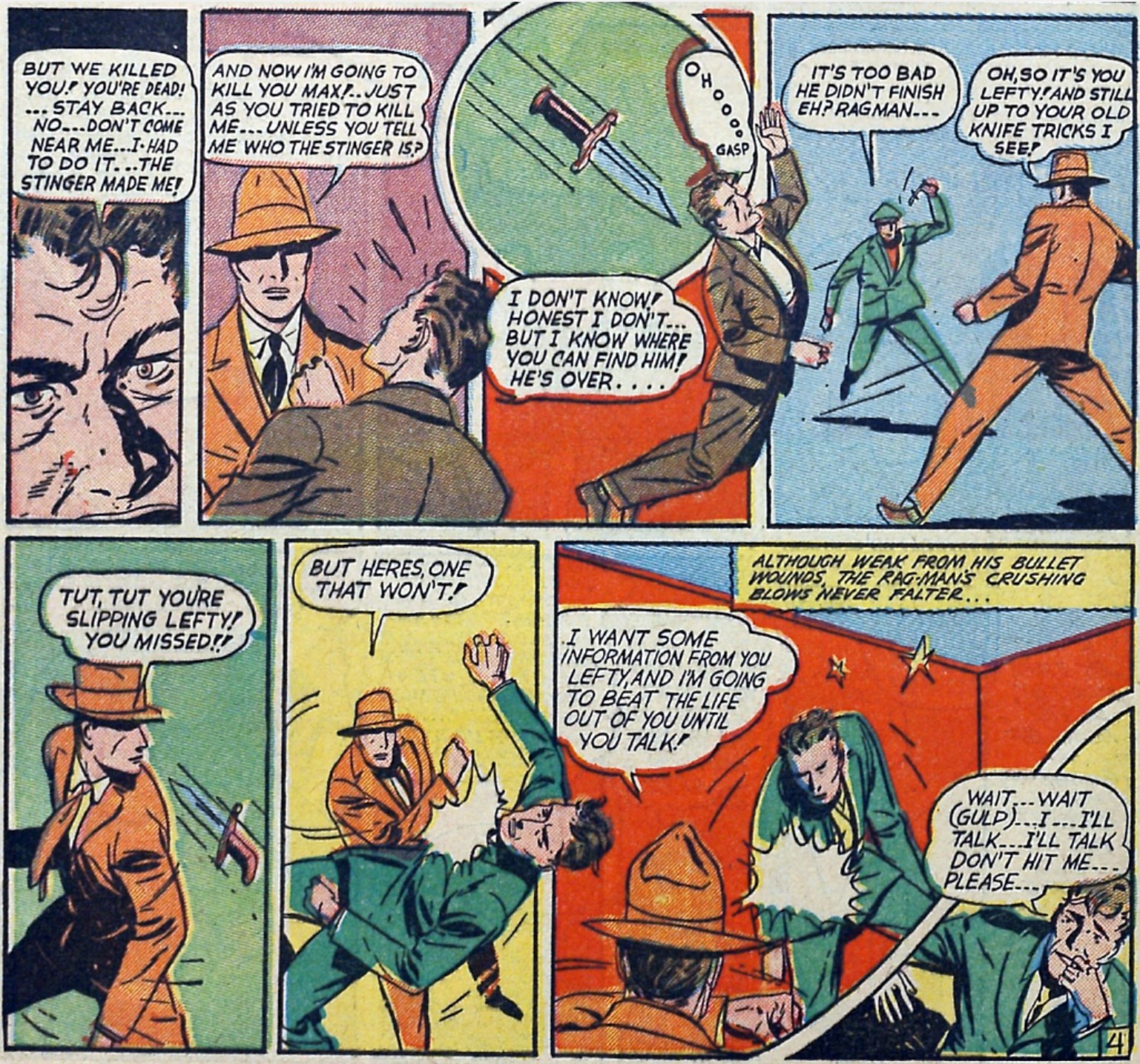
    The only major flaw in the Stinger’s plan is that his gang is made up of 1940s comic book gangsters who don’t think to check for a pulse when they are sent to murder someone. This is important because it turns out that the Ragman was wearing a bulletproof vest the whole time and was just playing dead when he was dumped in the river. 

    Having beaten up the Stinger’s entire operation, the Ragman is able to track him down and unmask him as, you might have guessed it, Lt, Burns, the only new named character in the story. It’s the old classic “crooked cop becomes masked crimelord” story again, though this is the first crooked police lieutenant we’ve seen. 

    Categorized under: Body (Nonhuman Body Parts), Location (NYC), Profession (Law Enforcement)

  • MINOR SUPER-VILLAIN 916: THE STINGER

    (Cat-Man Comics 003, 1941)

    The Stinger is in most respects an extremely generic masked gang boss of the kind that we have seen so frequently before, right down to the fact that he is wearing one of those hanging cloth face masks, an item only worn by generic masked gang bosses of the 1940s. The real difference between all those other guys and the Stinger is that the Stinger’s very first move was to send out some goons to ambush and murder local vigilante and only credible threat to his operations the Ragman. 

    This important step having been completed, the Stinger launches a massive crimewave, that includes four simultaneous bank robberies and the kidnapping of the police commissioner. Mayor Not La Guardia is not happy about all this, as he expresses to conspicuous named character police Lieutenant Burns.

    The only major flaw in the Stinger’s plan is that his gang is made up of 1940s comic book gangsters who don’t think to check for a pulse when they are sent to murder someone. This is important because it turns out that the Ragman was wearing a bulletproof vest the whole time and was just playing dead when he was dumped in the river. 

    Having beaten up the Stinger’s entire operation, the Ragman is able to track him down and unmask him as, you might have guessed it, Lt, Burns, the only new named character in the story. It’s the old classic “crooked cop becomes masked crimelord” story again, though this is the first crooked police lieutenant we’ve seen. 

    Categorized under: Body (Nonhuman Body Parts), Location (NYC), Profession (Law Enforcement)

  • MINOR SUPER-HERO ROUND-UP 075

    Every hero comes with a free sidekick! 

    the Deacon:

    An otherwise unnamed man headquartered in the disused Marshlands Church that is located in a kind of liminal space just outside of several urban areas (including but not limited to: Coast Town, Midland City and Central City), the Deacon was himself once a young criminal mastermind.

    Two years after his original gang is rounded up by the police, the future Deacon is still on the wrong side of the law as part of another crook’s gang, but he’s starting to have some doubts about the path his life is on, particularly the part where his boss Marty is going to murder a night watchman during their next job. He tips off the police and in return they shoot him in the arm as he runs away

    Making his way to the aforementioned abandoned Marshlands Church, the wounded ex-criminal puts on a suit of priest’s clothes that he finds there, and when Marty and his old gang track him down to extract some revenge for his betrayal he is able to muster up enough righteous vigour to beat them up and deliver them into the hands of the law.

    One thing about the  Deacon that might not be evident from my retelling is that despite the sort of gentle world-weariness that the character is portrayed with, based on the timeline presented in the story of his origin, he is at most about twenty-eight years old, and that is a pretty funny age to have already seen it all. (Cat-Man Comics 001, 1941)

    Mickey Matthews: 

    In common with his mentor, the Deacon’s sidekick Mickey Matthews is a former juvenile crook who decided that a life of crime was not for him and paid the price for it, in his case in the form of being beaten up and tossed out of a speeding car for dead. After the Deacon finds him and patches him up he decides to turn his life around and join his benefactor’s war on crime. (Cat-Man Comics 001, 1941)

    the Ragman:

    Millionaire newspaper columnist Jay Garson Jr has really been stirring up trouble with his column “Crime Does Not Pay,” so much so that he is lured into Central Park and murdered one night. Or so the criminal element think! What actually happens is that a nearby homeless man who looks exactly like Garson is accidentally killed instead of him, and so Garson swaps clothes with the corpse in order to fake his own death.

    Taking inspiration from his new wardrobe, Garson dubs himself the Ragman (also Rag Man and Rag-Man) and sets out to solve his own murder, and then decides to continue fighting crime rather than resuming his old life.

    Though Garson declines to inform his fiance Joan that he is in fact alive, he does continue to send his newspaper column to the Daily Star to get printed, much to the consternation of his editor. (Cat-Man Comics 001, 1941)

    Tiny: 

    Jay “Ragman” Garson might not have thought it necessary to loop in his fiance re: him being alive, but one person who he does make sure to inform is his chauffeur, Tiny, who immediately joins him as a sidekick. 

    Tiny is an annoying character to write about: he is a very good sidekick, especially by the standards of African American characters in 1940s comics, who tend to get assigned all kinds of stereotypes (laziness, superstition, cowardliness, stupidity) in the name of comic relief. Tiny doesn’t have any of those qualities – aside from a bit of understandable nervousness at meeting what he believes to be a dead man – but he certainly talks like a character who does. Various sources assure me that the accent is toned down eventually, but the 1941 version of the character makes it rough for someone (me) trying to find good pictures of him. (Cat-Man Comics 001, 1941)

    Categorized under: Minor Super-Heroes, Origin by Choice (Face Turn, Faking Your Own Death), Profession (Religious)

  • ALIENS AND SO FORTH ROUND-UP 025

    ALIENS AND SO FORTH ROUND-UP 025

    We got Fish-Men, we got Fishmen, we got other kinds of men.

    Fishmen:

    Adventurer Lance Rand has acquired a map showing the location of the sunken continent of Atlantis and so naturally he sets out to see if it’s accurate and more importantly to find out if there’s any ancient Atlantean treasure there for him to loot. Making his way to the ocean floor, Lance and his pal Tubby are almost immediately accosted by a Fishman riding on a sea monster. This is a good sign!

    The sunken city of Atlantis does indeed turn out to me right where the map said it was, complete with some monumental bare-assed statuary. Lance and Tubby are able to drive their submarine tractor right up to the base of what must have been an important Atlantean idol and pry the disco ball-sized diamond out of its forehead, upon which they have to deal with another squad of hostile Fishmen. Though the implication is of course that these fellows are the descendants of drowned Atlantis, the fact that they never say anything really makes it hard to confirm. Perhaps they are unrelated underwater humanoids who just disapprove of Lance and Tubby’s wanton looting. Whichever it is, I really dig the little wing-fins that grow out of their backs. (Cat-Man Comics 001, 1941)

    Fish-Men: 

    When oceanic adventurer Navy Jones’ submarine is lost at sea, he is rescued by an undersea race of aquatic humanoids who don’t really have an official name but who are more often than not called Fish-Men or something similar. Despite some early conflict engineered by the scheming Prime Minister, Jones soon becomes the Fish-Men’s champion.

    Fish-Men society is ruled over by a more humanoid nobility, represented here in the forms of their unnamed king and his daughter/ Navy Jones’ love interest, Princess Coral. As usual, the reasons for these morphological differences are not explained and likely boil down to “we didn’t want our hero to be romantically involved with a fish.”

    Like many Fiction House heroes, Navy Jones passed through a lot of hands over the course of his career, and the Fish-Men had a correspondingly large number of looks, each of them charming in its own way.(Science Comics 001, 1940)

    Fishmen:

    This Fishman is encountered by Tabu, Wizard of the Jungle in what is probably a prehistoric underground enclave that a group of explorers stumble across “far to the Southeast of the Congo”. I say probably because Tabu gasses on about how they have gone back in time, which might be meant literally and might just be a bit of excessively flowery exposition. 

    The above is virtually all of the on-panel time that the Fishmen get, as the narrative is much more focused on the drama of one of the explorers falling in love with a cave woman. (Jungle Comics 011, 1940) 

    Flame-Men: 

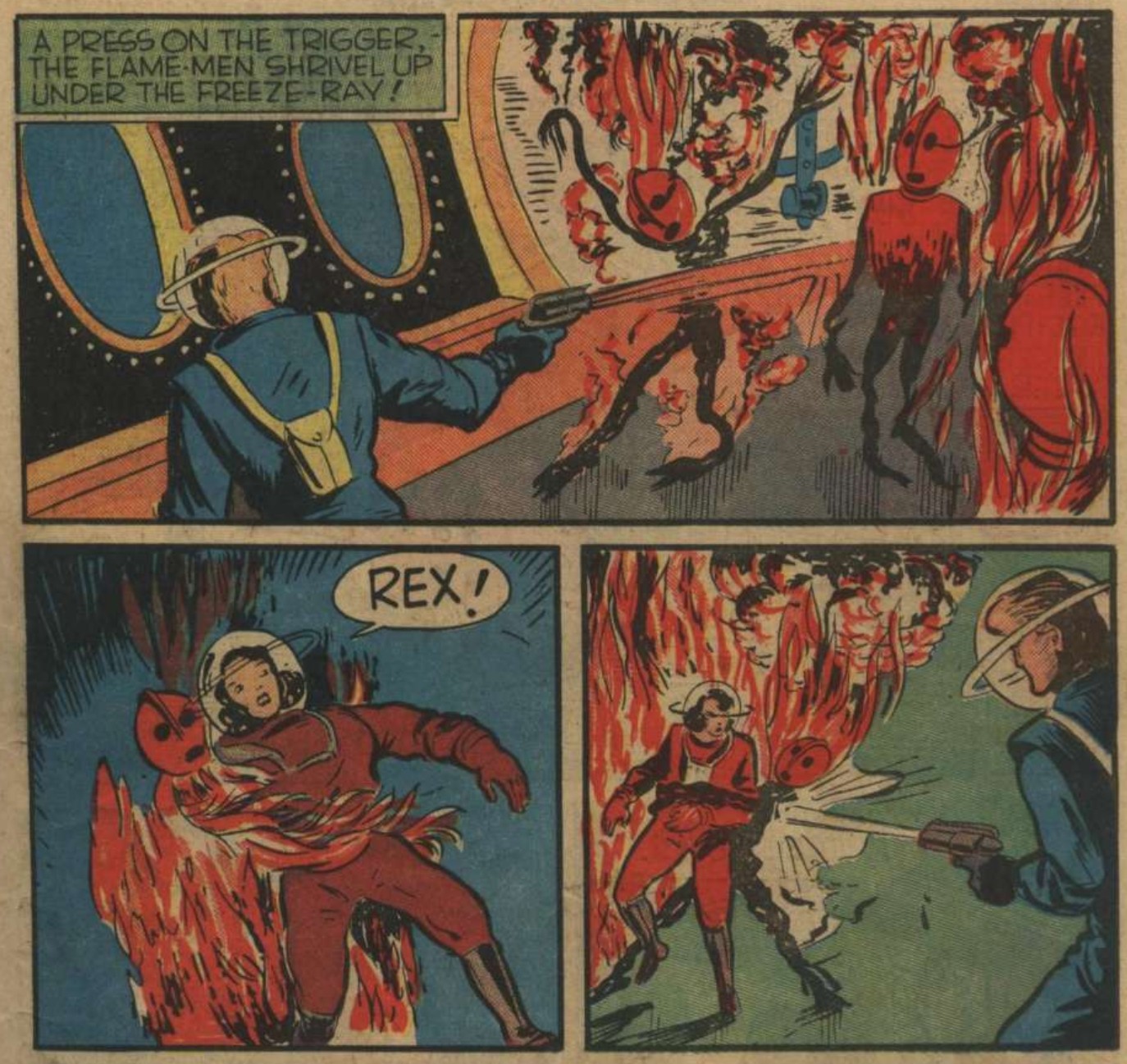
    Just as Rex Dexter of Mars and his companion Cynde are about to leave the planet Nexis and its friendly inhabitants, the Nexis as part of their never-ending attempt to reach Mars, the world is attacked by some sort of apocalyptic flame weapon.

    Rocketing into space to investigate, Rex and Cynde discover that the source of the attack is a fiery comet that is being directed by a massive spacecraft, by which they are swiftly captured. Inside they find the Flame-Men from Planet Emalf, who are attacking Nexis as the first move in their attempt to destroy the rest of the universe. Why are they doing this? No idea.

    The Flame-Men are unprepared for Rex’s freeze-ray gun, and shrivel up into little burnt matchstick men in a way that is as aesthetically pleasing as it is unsettling. (Mystery Men Comics 010, 1940) 

    Categorized under: Aliens, Animals (Fish), Elements (Fire), Generica (Men)

  • MINOR SUPER-VILLAIN 915: THE BAT

    (Cat-Man Comics 002, 1941)

    While rescuing the inhabitants of the mining town of Red Creek from the forest fire that threatens their town, Flying Legion leader Chute Harmon learns that the fire might in fact have been deliberately set and that the arsonist might be nearby. Donning his Asbestium suit, he sets off to investigate and soon finds himself in a confrontation with a masked man who calls himself the Bat.

    The Bat has a very succinct five-panel appearance, which is just long enough to explain his plan (burn down the town and then steal all of the miners’ gold after things cool down), get bopped on the head and flee into a raging inferno.

    There is some implication that the Bat might have lived to vex Chute Harmon and the Flying Legion another day, but as this was their only published adventure we must instead conclude that he was burned to a crisp.

  • MINOR SUPER-HERO ROUND-UP 074

    Some more of those “minor super-heroes” you like so much. 

    the Cat-Man **Update**:

    Hey, it’s the Cat-Man! As you may or may not recall, the Cat Man (sans hyphen) debuted in Crash Comics Adventures in 1940 and was the only survivor of that comics short run. The most obvious change to his character is his costume, which goes from its former jungle chic look through a blue-and-orange phase  before settling on the orange-and-darker orange look that he will stick with for the rest of his career.

    In addition to the costumes and the hyphen, Cat-Man got a slight tweak to his origin: rather than being orphaned by a hostile tribe in India, David Merrywether’s parents are now said to have been killed by bandits in Burma. David also has a job now: he’s a private detective for the first four issues of Cat-Man Comics, after which he enlists and becomes a lieutenant in the US Army.

    The Cat-Man also gets a couple of new powers in 1941: he is able to see otherwise-invisible radiation and displays some degree of super strength.

    Finally: his nine lives. Though he still has this power, David manages to only die once during the whole of 1941, bringing his total remaining lives down to six.

    the Kitten: 

    Actually, not quite finally, as this is also the year that the Cat-Man gets a sidekick. While en route to investigate a series of train explosions, Lt David “the Cat-Man” Merrywether picks up a hitchhiking man and his niece. The man turns out to be a real scumbag, but the girl, named Katie Conn, turns on her uncle rather than see him rob and possibly murder Merrywether. Once the uncle is tossed in the hoosegow it’s a classic case of a child just entering a super-hero’s orbit and getting auto-adopted.

    Katie turns out to be the orphaned child of a pair of circus acrobats, which as we know is a perfect background for a potential super-hero’s sidekick to have. She also appears to be a few years younger than your typical kid sidekick – if they average in at about 13-15 I’d call her 11 or 12, though as usual the limitations of Golden Age art make estimating the age of kids difficult at best.

    Merrywether does his best to conceal his dual identity from his new ward but doesn’t quite manage it, and her self-assigned new role as the Cat-Man’s sidekick is announced in the final panel of the last Cat-Man story of 1941. More specifics on her in action as a sidekick in 1942. I will say that it’s nice to see a kid sidekick with both a costume and a code name. (Cat-Man Comics 005, 1941)

    Blaze Baylor: 

    Blaze Baylor is the son of the famous fire chief Smoky Baylor, who was killed by arsonists, and who is now a very specific anti-arson crimefighter. Though the name of the strip is “‘Blaze’ Baylor and the Arson Ring,” there is no indication in any of his adventures that the arsonists he battles are connected to one another in any way. (Cat-Man Comics 001 1941)

    Dr Diamond: 

    Dr Drake Gorden is bound for the South Seas when the freighter he is travelling on is sunk by a waterspout. He passes out after washing up on a beach at the base of an unscaleable cliff and is carried off by an eagle that takes him to the home of a frankly weird guy who has dressed him in a generic super-hero costume.

    This never-named man explains that thirty years prior he had come into possession of a legendary black diamond that conferred great physical power to its wielder, and that he had retired to the island to await the arrival of someone worthy enough to receive it. Dr Gorden, a man who he just met and who has spoken all of thirty-three words to him, several of which were to refer to a pair of brown pants as his “American clothes,” is his pick.

    Whatever the opposite of the Refusal of the Call part of the Hero’s Journey is, that’s what Dr Gorden has. He immediately renames himself Dr Diamond and launches into a monologue about just how hard he’s going to bust up crime that is so over the top that it would make me personally reconsider giving him any sort of power whatsoever. Despite my misgivings, Dr Diamond does an adequate job of using the powers conferred by the gem (super strength, enhanced speed, some degree of invincibility) to battle crime for four issues before fading into the mists of obscurity. (Cat-Man Comics 001, 1941)