The Curse of Skeleton Munroe

Category: Temerson

  • MINOR SUPER-HERO ROUND-UP 074

    Some more of those “minor super-heroes” you like so much. 

    the Cat-Man **Update**:

    Hey, it’s the Cat-Man! As you may or may not recall, the Cat Man (sans hyphen) debuted in Crash Comics Adventures in 1940 and was the only survivor of that comics short run. The most obvious change to his character is his costume, which goes from its former jungle chic look through a blue-and-orange phase  before settling on the orange-and-darker orange look that he will stick with for the rest of his career.

    In addition to the costumes and the hyphen, Cat-Man got a slight tweak to his origin: rather than being orphaned by a hostile tribe in India, David Merrywether’s parents are now said to have been killed by bandits in Burma. David also has a job now: he’s a private detective for the first four issues of Cat-Man Comics, after which he enlists and becomes a lieutenant in the US Army.

    The Cat-Man also gets a couple of new powers in 1941: he is able to see otherwise-invisible radiation and displays some degree of super strength.

    Finally: his nine lives. Though he still has this power, David manages to only die once during the whole of 1941, bringing his total remaining lives down to six.

    the Kitten: 

    Actually, not quite finally, as this is also the year that the Cat-Man gets a sidekick. While en route to investigate a series of train explosions, Lt David “the Cat-Man” Merrywether picks up a hitchhiking man and his niece. The man turns out to be a real scumbag, but the girl, named Katie Conn, turns on her uncle rather than see him rob and possibly murder Merrywether. Once the uncle is tossed in the hoosegow it’s a classic case of a child just entering a super-hero’s orbit and getting auto-adopted.

    Katie turns out to be the orphaned child of a pair of circus acrobats, which as we know is a perfect background for a potential super-hero’s sidekick to have. She also appears to be a few years younger than your typical kid sidekick – if they average in at about 13-15 I’d call her 11 or 12, though as usual the limitations of Golden Age art make estimating the age of kids difficult at best.

    Merrywether does his best to conceal his dual identity from his new ward but doesn’t quite manage it, and her self-assigned new role as the Cat-Man’s sidekick is announced in the final panel of the last Cat-Man story of 1941. More specifics on her in action as a sidekick in 1942. I will say that it’s nice to see a kid sidekick with both a costume and a code name. (Cat-Man Comics 005, 1941)

    Blaze Baylor: 

    Blaze Baylor is the son of the famous fire chief Smoky Baylor, who was killed by arsonists, and who is now a very specific anti-arson crimefighter. Though the name of the strip is “‘Blaze’ Baylor and the Arson Ring,” there is no indication in any of his adventures that the arsonists he battles are connected to one another in any way. (Cat-Man Comics 001 1941)

    Dr Diamond: 

    Dr Drake Gorden is bound for the South Seas when the freighter he is travelling on is sunk by a waterspout. He passes out after washing up on a beach at the base of an unscaleable cliff and is carried off by an eagle that takes him to the home of a frankly weird guy who has dressed him in a generic super-hero costume.

    This never-named man explains that thirty years prior he had come into possession of a legendary black diamond that conferred great physical power to its wielder, and that he had retired to the island to await the arrival of someone worthy enough to receive it. Dr Gorden, a man who he just met and who has spoken all of thirty-three words to him, several of which were to refer to a pair of brown pants as his “American clothes,” is his pick.

    Whatever the opposite of the Refusal of the Call part of the Hero’s Journey is, that’s what Dr Gorden has. He immediately renames himself Dr Diamond and launches into a monologue about just how hard he’s going to bust up crime that is so over the top that it would make me personally reconsider giving him any sort of power whatsoever. Despite my misgivings, Dr Diamond does an adequate job of using the powers conferred by the gem (super strength, enhanced speed, some degree of invincibility) to battle crime for four issues before fading into the mists of obscurity. (Cat-Man Comics 001, 1941) 
  • GENERIC COSTUMED VILLAIN ROUND-UP 035

    GENERIC COSTUMED VILLAIN ROUND-UP 035

    Not every villain is super and they must learn to accept that.

    Miguel Greeze: 

    He may just be a regular style crooked gambler looking to murder Golden Arrow in order to win a bet, but Miguel Greeze here is decked out in too good a costume to just ignore. Plus it’s impressive that he can make his legs go like that. (Whiz Comics 023, 1941)

    Konrad Schtienker: 

    Fascist assassin Konrad Schtienker is all-in on a tobacco product theme: he uses a tobacco shop as his HQ, kills government agents via packets of the ominously-named Blood-Tipped brand cigarettes (not that the cigarettes do the killing – they just serve as a way to release a mosquito containing a serum that compels fatal bouts of sleepwalking into the targets’ rooms) and even employs single-shot cigar guns to get out of jams. Too bad for him that Spy Smasher doesn’t smoke. (Whiz Comics 023, 1941)

    Black Rufus: 

    There are three things to note about this fellow:

    1. His name is Black Rufus. It’s much more charming than menacing.

    2. I like his look. The hunched posture combined with the mantle/poncho/thing give him a real vulture-like air.

    3. He is the only villain faced by one-hit wonder the Rainbow, which I always find endearing. Did he ever get out of jail and take his revenge? We shall never know. (The Arrow 003, 1941)

    the Leader: 

    It’s time for yet another Nazi spymaster named the Leader! This Leader is a fellow named Phil Rogers, and he’s after a new super-bomb developed by one Professor Andrews for the US military, while wearing what I would describe as a charmingly homemade-looking hood if it didn’t have a swastika on the forehead. He fails of course, because he is entirely unprepared to deal with a completely invisible Solar, Master of Magic. (Captain Aero Comics 001, 1941)

  • CATALOGUE OF WOUNDS 001

    CATALOGUE OF WOUNDS 001

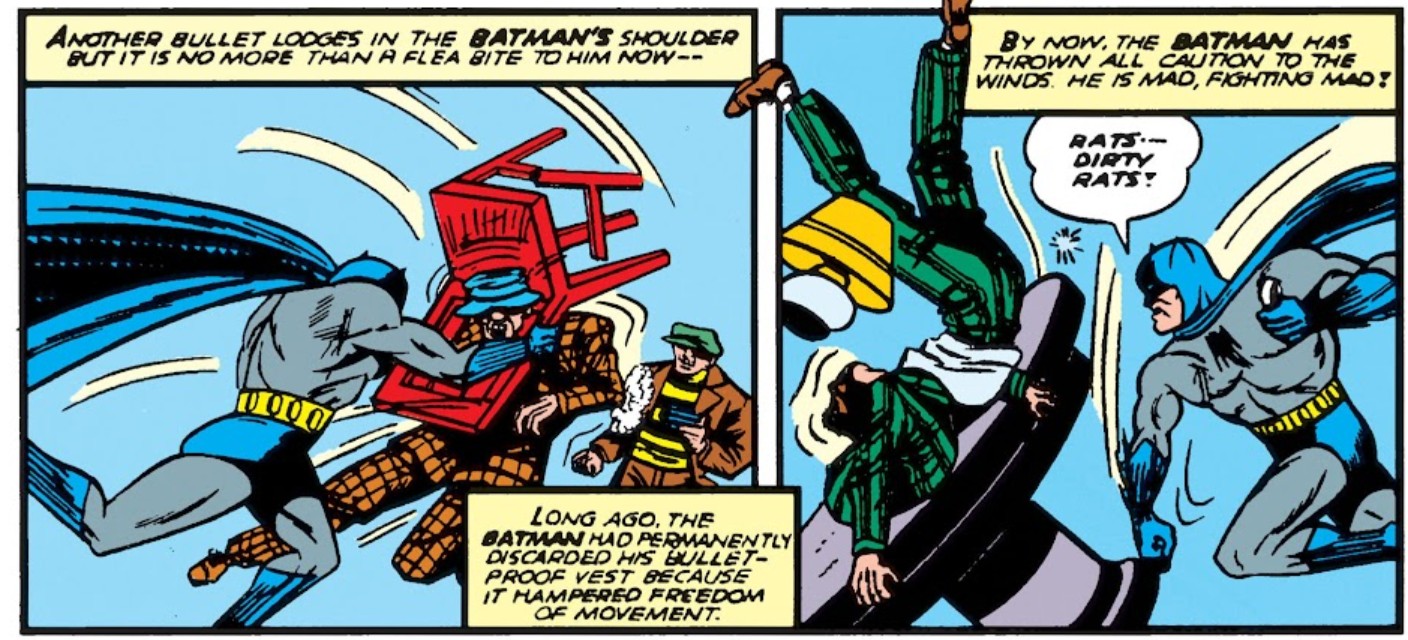
    Among the many things that I have found interesting enough to keep track of over the years is just how many times super-heroes get wounded while going about their business. What does a shoulder look like after it’s been shot a dozen times, for example? If I had been really on the ball I would have also been noting every time someone was knocked out with a blow to the head as well, but we can’t all be perfect.

    Full catalogue here, such as it is. 

    the Angel:

    The Angel chars his own hands at least a bit while escaping from some ropes. (Marvel Mystery Comics v1 008, 1940) 

    The Angel is wounded and probably shot while escaping from an ambush by the Cat’s Paw’s men (Marvel Mystery Comics v1 019, 1941)

    Batman:

    Batman is shot in the left shoulder during an altercation with the Wolf’s men. (Batman Comics v1 002, 1940)

    Shot in the right shoulder by a fleeing crook. (Batman Comics v1 004, 1940)

    While attacking a criminal hideout in a berserker rage, Batman is shot twice in the right shoulder and has a bullet glance off his ribs. (Batman Comics v1 005, 1941)

    Pirate Hook Morgan slashes Batman across the chest and hooks him in the left shoulder. (Detective Comics v1 054, 1941)

    Black Condor: 

    Black Condor is shot in the back by the Sapphire King’s men. (Crack Comics 005, 1940)

    Blackhawk:

    Blackhawk’s arm is non-specifically injured after an attack on Blackhawk Island. (Military Comics 001, 1941)

    the Deacon:

    The Deacon is shot in the right arm by the cops. (Cat-Man Comics 001, 1941) 

    Robin:

    Robin is beaten nearly to death by some gangsters (triggering Batman’s berserker attack above). (Batman Comics v1 005, 1941)

  • MINOR SUPER-HERO ROUND-UP 073

    It’s a fine day for a dose of minor super-heroes. 

    Alias X: 

    Alias, aka just X, is a mysterious master of disguise who has been cleaning up crime in NYC for the better part of a year and who, as of his first appearance, has now deigned to tell his origin story to Police Commissioner Malley and newspaper editor Hunch Armstrong.

    Turns out that X was a small-town taxi company owner who was railroaded and sent to prison for a crime he didn’t commit, and that after two years in prison he managed to escape, became a master of disguise by sheer willpower and set out to battle crime until he could track down the crooks who really committed the crimes he was convicted for and clear his name.

    The police commissioner must be a trusting guy, because he refrains from putting out an APB or whatever on Alias X after he hears this confession. 

    As far as I can tell from a skim of the 1942 portion of Alias X’s dozen or so adventures, he never catches up with the crooks who framed him – just one of the many loose ends of the comics. Please also note that Alias X is a calling card guy. (Captain Fearless Comics 001, 1941)

    Citizen Smith: 

    Citizen Smith! Plain old John Smith, who could be any one of us regular Americans! Just a regular guy! So why are we reading a comic book about him?

    Citizen Smith is in actuality John Smith, an aircraft factory worker in Washington DC and also an orphan consumed with the desire to know just who his parents were. While stewing on this after work one day he wanders up to the Tomb of the Unknown Soldier, where he receives both great news and a great shock as a ghostly figure appears and tells him that he, the Unknown Soldier, is Smith’s father.

    Smith’s new ghost dad charges him to keep America safe, with the promise that he will appear and aid his son if needed (sadly this does not occur in either of the two recorded Citizen Smith adventures). The newly-created Citizen’s Guardian of Liberty and Guardian of the American Way then sallies forth to whale on fifth columnists with his two good all-American fists.

    Now, I try to take comics as they are presented to me and not engage in a lot of “what if they were dead the whole time”-style fan theory nonsense but I will say that if I were writing a gritty early-2000s Citizen Smith reboot… all this ghost stuff would just be a hallucination brought on by his obsessions, right? Just a lonely man giving his life meaning by latching on to a powerful symbol to fill the hole in his life. But of course that is not who we are here. Citizen Smith is as he appears: a divinely ordained champion of the American Way. (Captain Fearless Comics 001, 1941)

    Miss Victory: 

    Miss Victory is Joan Wayne, a woman who works in Washington DC in secretarial and similar roles and who seems to have seen an opening for a two-fisted vigilante and filled it, no further origin necessary. There is some hint that her vigilantism is officially sanctioned in the first couple of panels of her first appearance, but if so she has very little oversight. She is much more willing to resort to violence than a lot of her female contemporaries, which is kind of refreshing.

    Miss Victory does share with our old friend the Eagle the inability to really settle on a costume design, so I’m sure that we’ll be revisiting her in that capacity. 

    Case in point: this revised version of her costume from her second appearance, in Captain Fearless Comics 002. As with most of her costume changes it’s a variation on the theme of her previous look and is probably explained by the fact that she  (Captain Fearless Comics 001, 1941) 

    Mr Miracle: 

    Mr Miracle is of course among the ranks of the obscure Golden Age characters who have the same name as a more well-known modern character, but he is also a member of a much more select fraternity: of characters whose origin involves a suicide attempt, though the precise reason that the unnamed man had for jumping is never given.

    The future Mr Miracle is pulled out of the water by a helpful stranger and brought to the great scientist Professor Rietz, who revives him via a twenty hour session under his “mind-ray,” only to be betrayed and shot by his assistant Sango at the final hour. Sango turns out to have been a foreign agent who was laying in wait for the mind-ray to be perfected, and now the hour has come.

    The still-unnamed man wakes to a ruined laboratory and a dying Rietz, who reveals to him in addition to saving his life, the mind-ray has given him great if unspecified powers. He then extracts a pledge from the man that he will use this power to aid mankind and promptly dies.

    The man creates a costume, renames himself Mr Miracle and sets out to use is vast array of abilities (transmutation, teleportation, telekinesis, intangibility, size control, flight, etc, etc. Though Mr Miracle is technically some sort of psychic mutate he is in effect a nigh-omnipotent comic book magic user) to bring Sango to justice. 

    Mr Miracle gets to honour the promise he made to Prof. Rietz precisely one more time (by sinking a u-boat) before fading into the mists of comic book obscurity. (Captain Fearless Comics 001, 1941)

  • MINOR SUPER-VILLAIN 914: THE BRIDGE-DESTROYERS

    (Cat-Man Comics 001, 1941)

    Some villains are puzzles, high-concept enigmas whose motivations and goals are a mystery that must be solved to understand them. The Bridge-Destroyers are not that. They are exactly what their name declares them to be: a couple of guys in a tower who destroy bridges using a long-range heat-ray cannon.

    But why the Bridge-Destroyers destroy bridges, that must be a mystery, yes? Perhaps it is, but the authorities are pretty certain that they are working for “some foreign power” to disrupt America’s ability to move troops and war materiel from place to place. Despite this, the official response to the group seems to be resigned acceptance as their defenses are so good that it is considered foolhardy to even try to stop them.

    Despite their fearsome reputation, Cat-Man is determined to face the Bridge-Destroyers head-on, which means that he meets their fist line of defense: a bunch of guys who live in a hole just outside the tower and suck up intruders using a giant vacuum. This might be enough to stop your every-day lawman, but the Cat-Man has all the powers of a cat, man. He simply avoids being battered to death by the whirling storm of debris and beats up the hole-dwellers when they come to retrieve his corpse.

    To their credit, the Bridge-Destroyers do manage to kill Cat-Man with a blast from their heat-ray as he makes his second approach to the tower but then they are treated to a lesson about how the “nine lives” part of his super-powers works. Stripped of their ray, their tower and their hole full of men, the masterminds between the war on America’s infrastructure are swiftly subdued.

  • MINOR SUPER-VILLAIN 914: THE BRIDGE-DESTROYERS

    (Cat-Man Comics 001, 1941)

    Some villains are puzzles, high-concept enigmas whose motivations and goals are a mystery that must be solved to understand them. The Bridge-Destroyers are not that. They are exactly what their name declares them to be: a couple of guys in a tower who destroy bridges using a long-range heat-ray cannon.

    But why the Bridge-Destroyers destroy bridges, that must be a mystery, yes? Perhaps it is, but the authorities are pretty certain that they are working for “some foreign power” to disrupt America’s ability to move troops and war materiel from place to place. Despite this, the official response to the group seems to be resigned acceptance as their defenses are so good that it is considered foolhardy to even try to stop them.

    Despite their fearsome reputation, Cat-Man is determined to face the Bridge-Destroyers head-on, which means that he meets their fist line of defense: a bunch of guys who live in a hole just outside the tower and suck up intruders using a giant vacuum. This might be enough to stop your every-day lawman, but the Cat-Man has all the powers of a cat, man. He simply avoids being battered to death by the whirling storm of debris and beats up the hole-dwellers when they come to retrieve his corpse.

    To their credit, the Bridge-Destroyers do manage to kill Cat-Man with a blast from their heat-ray as he makes his second approach to the tower but then they are treated to a lesson about how the “nine lives” part of his super-powers works. Stripped of their ray, their tower and their hole full of men, the masterminds between the war on America’s infrastructure are swiftly subdued.

  • MINOR SUPER-HERO ROUND-UP 072

    Extremely minor super-heroes? Don’t mind if I do!

    the Flag-Man:

    The Flag-Man is one standard unit of patriotic American super-hero: he loves the United States and is willing to put on a costume and punch guys until it is safe. And speaking of costumes: the Flag-Man and his pal Rusty are prime examples of how piggybacking off of the iconography of the American flag can really paper over some pretty bad costume design. I mean, tank-top and cape and flared gloves? Give me a break.

    The Flag-Man’s alter ego is Captain Hornet (occasionally Major Hornet), trouble-shooter for the President, who presumably knows about the whole Flag-Man thing.

    Since Captain Hornet/the Flag-Man seems the be dedicated to solving problems exclusively via the medium of hand-to-hand combat, he is in effect a fist that FDR can send to punch anyone he wants. Mostly Nazis, to his credit. (Captain Aero Comics 001, 1941)

    Rusty:

    Just as the Flag-Man is the elemental patriotic hero, his sidekick Rusty is the basic unit of kid sidekick: no last name, no alter-ego, just a scrappy teen who tags along on adventures. I do find him the most irritating of all the Golden Age sidekicks we have yet encountered, so that’s at least one distinction. (Captain Aero Comics 001, 1941)

    Solar, Master of Magic: 

    Solar, Master of Magic is as you might have guessed another of Golden Age comics’ many, many magic guys, which in practical terms means that he can do basically anything he wants to. In contrast to a lot of his peers, he chooses to use his fists as much or more than his magic. 

    Although Solar presents as a pure magic guy, he is in fact a magic item guy, with a magic cape of invisibility and a magic ring of doing everything else. It’s a minor distinction but it introduces the possibility of the source of his powers being stolen from him, which does in fact happen during the final of his four appearances. (Captain Aero Comics 001, 1941)

    Captain Fearless:

    Comics love to tie their characters to history, usually by making them the descendant of someone famous but often by inserting their ancestors into real events, as can be seen in the case of the Wizard. This might be the first time I’ve seen it done to this extent, however, as John Fearless here is not only the instigator of the Boston Tea Party, but a member of the First and probably Second Continental Congresses and could reasonably be expected to be a signatory of the Declaration of Independence. In other words, he’s a whole-ass made-up Founding Father!

    John Fearless goes on to die in one of the opening battles of the Revolutionary War, upon which… well, the speech balloon placement is annoying, but either he ascends into heaven as an otherworldly voice tells him that his patriotism will live on in his family line or an angelic being from the newly-formed United States of Heaven descends in full uniform to collect his soul and tell him the same. I prefer the latter, but who can tell.

    Regardless of the otherworldly voice’s source, its words prove true, as evidenced when young John Fearless VI, latest member of a family of patriots, visits his ancestor’s grave and then gets to meet that very ancestor.

    The ghost of John Fearless I relates the glorious history of the other four Captains John Fearless, fighting to protect the American values of justice and liberty for all (and also in the Mexican- and Spanish-American Wars) and gasses on for a while about patriotism and so forth.

    In contrast to his forebears, John Fearless VI’s assignment is not military but vigilante in nature, as the ghost of John Fearless I is concerned about the threat of fifth columnists and is of the opinion that a costumed crimefighter is the best way to root them out. To that end, his great-great-great grandson is outfitted with a not-great costume and sent off to battle.

    He also gets an antique powder horn that doubles as a musical one, and annoyingly does not blow it during his first case. Once he finally gets around to trying it out, it summons the ghost of the original Captain Fearless to help him out by invisibly beating people up and flying him around in his ghost arms.  (Captain Fearless Comics 001, 1941)

  • MINOR SUPER-HERO ROUND-UP 072

    Extremely minor super-heroes? Don’t mind if I do!

    the Flag-Man:

    The Flag-Man is one standard unit of patriotic American super-hero: he loves the United States and is willing to put on a costume and punch guys until it is safe. And speaking of costumes: the Flag-Man and his pal Rusty are prime examples of how piggybacking off of the iconography of the American flag can really paper over some pretty bad costume design. I mean, tank-top and cape and flared gloves? Give me a break.

    The Flag-Man’s alter ego is Captain Hornet (occasionally Major Hornet), trouble-shooter for the President, who presumably knows about the whole Flag-Man thing.

    Since Captain Hornet/the Flag-Man seems the be dedicated to solving problems exclusively via the medium of hand-to-hand combat, he is in effect a fist that FDR can send to punch anyone he wants. Mostly Nazis, to his credit. (Captain Aero Comics 001, 1941)

    Rusty:

    Just as the Flag-Man is the elemental patriotic hero, his sidekick Rusty is the basic unit of kid sidekick: no last name, no alter-ego, just a scrappy teen who tags along on adventures. I do find him the most irritating of all the Golden Age sidekicks we have yet encountered, so that’s at least one distinction. (Captain Aero Comics 001, 1941)

    Solar, Master of Magic: 

    Solar, Master of Magic is as you might have guessed another of Golden Age comics’ many, many magic guys, which in practical terms means that he can do basically anything he wants to. In contrast to a lot of his peers, he chooses to use his fists as much or more than his magic. 

    Although Solar presents as a pure magic guy, he is in fact a magic item guy, with a magic cape of invisibility and a magic ring of doing everything else. It’s a minor distinction but it introduces the possibility of the source of his powers being stolen from him, which does in fact happen during the final of his four appearances. (Captain Aero Comics 001, 1941)

    Captain Fearless:

    Comics love to tie their characters to history, usually by making them the descendant of someone famous but often by inserting their ancestors into real events, as can be seen in the case of the Wizard. This might be the first time I’ve seen it done to this extent, however, as John Fearless here is not only the instigator of the Boston Tea Party, but a member of the First and probably Second Continental Congresses and could reasonably be expected to be a signatory of the Declaration of Independence. In other words, he’s a whole-ass made-up Founding Father!

    John Fearless goes on to die in one of the opening battles of the Revolutionary War, upon which… well, the speech balloon placement is annoying, but either he ascends into heaven as an otherworldly voice tells him that his patriotism will live on in his family line or an angelic being from the newly-formed United States of Heaven descends in full uniform to collect his soul and tell him the same. I prefer the latter, but who can tell.

    Regardless of the otherworldly voice’s source, its words prove true, as evidenced when young John Fearless VI, latest member of a family of patriots, visits his ancestor’s grave and then gets to meet that very ancestor.

    The ghost of John Fearless I relates the glorious history of the other four Captains John Fearless, fighting to protect the American values of justice and liberty for all (and also in the Mexican- and Spanish-American Wars) and gasses on for a while about patriotism and so forth.

    In contrast to his forebears, John Fearless VI’s assignment is not military but vigilante in nature, as the ghost of John Fearless I is concerned about the threat of fifth columnists and is of the opinion that a costumed crimefighter is the best way to root them out. To that end, his great-great-great grandson is outfitted with a not-great costume and sent off to battle.

    He also gets an antique powder horn that doubles as a musical one, and annoyingly does not blow it during his first case. Once he finally gets around to trying it out, it summons the ghost of the original Captain Fearless to help him out by invisibly beating people up and flying him around in his ghost arms.  (Captain Fearless Comics 001, 1941)

  • MINOR SUPER-VILLAIN 913: CAPTAIN HOOD

    (Captain Aero Comics 001, 1941) 

    Captain Hood is your classic fascist of indeterminate allegiance, who has been holed up with a crew of pseudo-Nazis and pseudo-Imperial Japanese agents in a cave underneath Easter Island for four long years working on an “undersea tractor” designed to haul a cargo of explosives to the Panama Canal and then blow it up. Just why he requires a mask in order to oversee this operation is an exercise left for the reader – I prefer to imagine that he got into cosplay as a way to while away the long hours.

    Captain Hood makes two glaring errors over the course of this issue, the biggest of which is the fact that he is so punchy as the culmination of his plan approaches that he has his men open fire on the tramp steamer Suzy Q for merely approaching the island, with no indication that they are going to land. This of course enrages the ship’s captain and only survivor, adventurer Grit Grady. 

    The fact that Grady takes his revenge on Captain Hood by storming the cave and ultimately blowing the entire place, undersea tractor and all, to high heaven means that Hood never has to face up to his other, much larger error: choosing to set up shop on Easter Island.

    I feel like I’m going to be talking about this a lot, because Easter Island is a beloved exotic setting in comic books, but it is so far away from everything else. Once that undersea tractor was completed, the next step was going to be to drive it five thousand kilometres across the bottom of an ocean that was virtually unmapped at the time but speaking as someone with an Internet connection and thus a collection of maps at my disposal: it’s not a smooth path. I, personally, would not place a bet on Captain Hood making it there with his twenty thousand tons of explosives in one piece, no matter how good his tractor is.

  • MINOR SUPER-VILLAIN 913: CAPTAIN HOOD

    (Captain Aero Comics 001, 1941) 

    Captain Hood is your classic fascist of indeterminate allegiance, who has been holed up with a crew of pseudo-Nazis and pseudo-Imperial Japanese agents in a cave underneath Easter Island for four long years working on an “undersea tractor” designed to haul a cargo of explosives to the Panama Canal and then blow it up. Just why he requires a mask in order to oversee this operation is an exercise left for the reader – I prefer to imagine that he got into cosplay as a way to while away the long hours.

    Captain Hood makes two glaring errors over the course of this issue, the biggest of which is the fact that he is so punchy as the culmination of his plan approaches that he has his men open fire on the tramp steamer Suzy Q for merely approaching the island, with no indication that they are going to land. This of course enrages the ship’s captain and only survivor, adventurer Grit Grady. 

    The fact that Grady takes his revenge on Captain Hood by storming the cave and ultimately blowing the entire place, undersea tractor and all, to high heaven means that Hood never has to face up to his other, much larger error: choosing to set up shop on Easter Island.

    I feel like I’m going to be talking about this a lot, because Easter Island is a beloved exotic setting in comic books, but it is so far away from everything else. Once that undersea tractor was completed, the next step was going to be to drive it five thousand kilometres across the bottom of an ocean that was virtually unmapped at the time but speaking as someone with an Internet connection and thus a collection of maps at my disposal: it’s not a smooth path. I, personally, would not place a bet on Captain Hood making it there with his twenty thousand tons of explosives in one piece, no matter how good his tractor is.