The Curse of Skeleton Munroe

Category: Temerson

  • MINOR SUPER-HERO ROUND-UP 071

    It’s time for another round of aviator-heroes, most of whom hail from Air Fighters Comics 001, a distinguished publication that was home to many storied characters. None of those characters appear here.

    the Black Commander: 

    A little while ago I covered the character Spitfire Ace and posited that he had one of the most complicated origins in comic books, and while the origin of the Black Commander doesn’t quite manage to take the crown away from its predecessor it is written as if creators Kermit Jaediker & Harry Anderson had read my comment and taken it as a challenge. Some notes:

    • Barry Haynes, an American pilot commanding an RAF squadron, agrees to go undercover to infiltrate a Nazi spy network for one Commander Northrup. He does so by getting caught selling information to a German spy, then effecting an escape on the morning of his scheduled execution.
    • Haynes flies a stolen plane across the English channel to “defect” to the Nazis, but is spotted by the Luftwaffe and shot down over France. His body shattered and near-dead, he is rebuilt with a completely different appearance by a surgeon named Dr Gort.
    • As Barry Haynes is believed dead, the Nazis send him back over the Channel to infiltrate the RAF and pave the way for a big air raid, under the new identity of Ronald Joyce.
    • Haynes/Joyce attempts to report the Nazi’s plans to Colonel Northrup, only to discover that he had been captured by the Axis some time earlier. Since Northrup was the only one who knew that Haynes was innocent and nobody in England knows Joyce, he steals an experimental plane called the Commander (but it’s painted black, see, hence the Black Commander) and foils the attack himself. Now he’s wanted by both sides while trying to help one.

    Presumably future adventures of the Black Commander would have seen him embarking on a quest to prove his innocence and/or rescue Commander Northrup but since he never returned we must assume that he never moved on from the last place we saw him: crashing on his aunt’s couch. (Air Fighters Comics v1 001, 1941)

    the Black Sheep Squadron: 

    The Black Sheep Squadron is your classic gang of highly-skilled misfits brought together and forged into a greater whole by a charismatic leader, in this case RAF Captain Logan Black. Only replace “charismatic” with “huge jerk.”

    Aside from Black’s odious personality, main problem with the Black Sheep Squadron is that we only really get to see one misfit, the girl-crazy Gunner Wilson, who’s always sneaking off to party. The whole appeal of a set-up like this is the eccentricities of the various squad-mates, and Reclining Redhead, Smoker and Bald are just not compelling enough personality traits to carry a series. (Air Fighters Comics v1 001, 1941)

    the Mosquito: 

    The Mosquito, aka Steve Stanton, is the rare entry in the “pilot with a cool name” brand of super-hero who kind of actually has a super-power. Raised on the slopes of Chile’s Mt Aconcagua, the highest mountain in the Americas (by an American father, as the text is at great pains to point out), Stanton has a much greater tolerance for high altitudes than other pilots. He’s also a short king, which is the origin of his name. Stanton is recruited from the US Border Patrol by Army Intelligence to deal with airplane based espionage in the US. (Air Fighters Comics v1 001, 1941)

    Captain Aero: 

    Our only recurring character for today is Captain Aero, a pretty standard two-fisted pilot-adventurer who is at least loosely affiliated with the US military and whose adventures tend to veer into the fantastic, as seen above as he discovers an artificial Nazi island that has been capturing Allied bombers using a super magnet and a fog generator.

    The most intriguing thing about Captain Aero is of course his name: is it a code name or one of comics’ many cases of nominative determinism?  (Captain Aero Comics 001, 1941) 

  • NOTES – DECEMBER 2025

    Nova Scotia: 

    As I always have to note when Nova Scotia pops up in a comic book: here’s Captain Aero taking in the sights on the featureless green plain that is the Halifax Airfield. (Captain Aero Comics 001, 1941)

    the Looming Spectre of War: 

    Less popular than our old friend the Looming Spectre of Death, the Looming Spectre of War nonetheless deserves recognition as a potent allegorical image. (Cat-Man Comics 002, 1941)

     And speaking of the Looming Spectre of Death, here’s a fine example of such. (Cat-Man Comics 003, 1941)

    Trophy Room – Blaze Baylor:

    Blaze Baylor, costumed arson-fighter, has a whole bookshelf full of incendiary devices. (Cat-Man Comics 002, 1941) 

  • DIVINE ROUND-UP 004

    Can you ever have enough made-up gods? 

    the Goddess of Fire: 

    Crooks Raoul and Victor Ladron hatch a scheme while hiding out on the South Pacific island of Kumoni: since the idol of the local Goddess of Fire looks identical to former super-villain Elena they will engineer her kidnapping, hypnotize her into impersonating the goddess and then kill her to prove that they are more powerful than her and thus deserve to make off with the temple gold. This plan is of course complicated by the fact that Elena is engaged to the nigh-omnipotent super-hero Mr Mystic, and the Ladrons meet a fiery end. 

    God style: idol only (The Spirit Section, 3 November, 1940)

    the Gansha:

    Adam Starr of the Space Legion is on the hunt for space pirate extraordinaire Black Michael, and no mealy-mouthed warning about a “water-god” who has “destroyed all who ventured near his cursed waters” for “untold ages” is going to stop him from searching the Martian canals.

    Starr’s manly skepticism doesn’t pay off this time, as Gansha the Water-God turns out not only to be real but to be a monstrous carnivorous fish that almost devours both him and his submersible without even needing to chew.

    Sadly for monster fans and fish fans alike, Gansha is unceremoniously blown to smithereens when Black Michael attempts to use it as a deathtrap to get rid of Starr without checking to see if he might have a ludicrously overpowered atomic sidearm on his person. Presumably the Martians are happy – the ones who like boat rides and don’t belong to any kind of Gansha-worshipping sect, at least.

    God style: animist (Crash Comics Adventures 003, 1940) 

    Golo:

    We get little in the way of detail on Golo, save that they are worshipped “from Ubangi to the Sudan” and that displaying a Golo fetish can grant safe passage in those areas. And that adventurer Ted Crane thinks it’s all poppycock, of course.

    God style: idol only (Exciting Comics 005, 1940) 

    the Ice Gods: 

    Stuart Taylor and his pals have been time travelling again, and this time they’ve ended up in the clutches of a prehistoric trip at the surprisingly rapid dawn of the last Ice Age, the environmental effects of which have been personified as the malevolent Ice 

    God style: animist (Jumbo Comics 028, 1941)

  • DIVINE ROUND-UP 003

    More gods for you to worship.

    Goddess of the Jungle: 

    The Goddess of the Jungle is an idol stolen by an adventurer named Stero while he was roving around Africa. Returning to America with it, he attains some fame and success as a film director, which he attributes to the influence of the Goddess on his life. Is the Goddess of the Jungle really real, or can the whole affair be blamed on the fact that Stero has apparently spent the decade or so that he’s had her whacked out of his gourd on jungle potions courtesy of his servant and Kailo, an acolyte of the Goddess?

    Stero attempts to bring the idol back to where he got it and assume the role of high priest or possibly king, but ultimately he ends up as sacrifice for his sacrilege.

    God style: idol, possible real powers. (The Arrow 001, 1940)

    Dong, God of War:

    Science adventurer Stuart Taylor spent the bulk of his early career being flung back in time by the mad scientist Ali Pasha, and on this particular jaunt he ends up in ~50 BCE helping to defend the Tibetan city of Manchung from invaders, and the key to his eventual success is that the people of Manchung (including Manchung, King of Manchung, natch) have seemingly accidentally invented gunpowder for use as a part of the ritual prayers to Dong, God of War. Thanks, Dong!

    God style: idol (Jumbo Comics 009, 1939)

    Eterno: 

    The comic series “Shangra”, in brief, is about a pair of newspaper correspondents, Joan Joyce and Jack Flynn, who crash their plane in the remote Tibet-adjacent country of Shangraland and get mixed up in the affairs of Shangraland ruler Shangra and his great-great-great granddaughter Lonna. Specifically, the super-powered, 200-year-old Shangra wants Jack to take his place and Lonna wants to marry Jack and murder Joan.

    Eterno here is the fun-looking and very specialized God of Eternal Life who bestows such on the rulers of Shangraland. Like I said, very specialized. 

    God style: idol, some real power (Crash Comics Adventures 003, 1940) 

    The Fire Monster: 

    Just some cavemen fearfully trying to appease a volcano, as you do.

    God style: animist (The Funnies 004, 1937) 

  • DIVINE ROUND-UP 001

    As long as we’re dipping into the aliens of comics, we might as well go all the way and dig out all the various gods etc that people have made up too. Comic book divinities fall into a few broad styles:

    -real objects or creatures worshipped animistically but which do not display any real divine power

    -idols, verbal invocations or other trappings of religious worship without any indication that the being being represented is really real

    -actual supernatural beings, including:

    –versions of actual deities

    –new additions to real-world pantheons 

    –gods made up out of whole cloth

    Obviously there is some overlap between these categories. The idol that bestows curses or good luck, the invocation that does the same. Is a sacred tree an idol or animism or both? What if it delivers blessings on the faithful? 

    The other thing to mention about comic book representations or religion is that huge swathes of them are being presented through the triple lenses of Smug 40s Rationalism, Default Christianity and White Supremacy in a real racist trifecta. Barring the odd exception we’re going to see a lot of It’s Silly to Believe in a Non-Christian God and All Non-Christian Religions are Actually Long Cons by Priestly Classes along with some If There is a Real Entity Behind This Then They are Actually a Horrible Evil. Plus a lot of elder god-monsters and culturally safe classical deities and so forth.

    So: on we go! 

    the Guardian of the Grotto of Jewels: 

    Though the Red Mask is the leader of some or all of the peoples of the island of Kakura, he doesn’t seem to have much regard for their culture (as befits a proper 1940s rationalist hero, I suppose), as in quick succession he a) brings a girl to the sacred Grotto of Jewels, b) gives her some of the eponymous jewels and c) kills the grotto’s guardian god-monster with a boat. 

    God-style: animistic worship of a real beast (Best Comics 001, 1939)

    Akrifa: 

    Akrifa here is the god worshipped by the evil King Tongo. He’s some sort of fire god who Tongo does human sacrifice to, but before he really gets a chance after building Akrifa a shiny new temple, Kaänga ends up smashing the idol to flinders and Tongo is killed by an elephant. 

    God-style: idol only (Jungle Comics 009, 1940)

    Ailus the Flamingo God: 

    He may just be another idol that a hapless white lady almost gets sacrificed to to you, but Ailus the Flamingo God has a certain whimsy that is lacking in most of his ilk. 

    God-style: idol (Jungle Comics 011, 1940)

    Baako: 

    There’s not a lot of detail given here but who cares. Baako is a Martian god, and you know I’m going to be into something like that. And just in case you need a bit more sauce to get excited about a Martian deity, this one was created by Jack Kirby!

    God-style: invoked (Crash Comics Adventures 003, 1940)

  • MAD AND CRIMINAL SCIENTIST ROUND-UP 010

    We have mad scientists at criminal scientist prices.

    Dr Koch is one of the many people hungry to get their hands on the secret vitamin supplement that turned the Champ (derogatory) into the Champ (aspirational) after its creator Dr Marlin is murdered. Koch’s mild claim to fame is the fact that he’s the first one to get ahold of the formula long enough to do anything with it. What he did, specifically, was to mix up a big batch and pump it directly into a poor guy named Cris, thus turning him into a lumpy rage-filled monster-man.

    Koch gets away at the end of his encounter with the Champ and his little pal Henry (Cris sadly does a header off a cliff) but characters later in the story talk about him as if he’s dead. Dead or hiding out in a cave in Mexico: either way he’s not bothering the Champ any more. (Champ Comics 011, 1940)

    Dr Bolms (excuse me, Doktar Bolms) here is a mere gangland plastic surgeon, which was enough to draw the attention of Secret Agent Z-2 here but not necessarily enough to draw ours. What really sets him apart from his peers is the fact that he has captured a government agent named Monty Wood and has been practising facial surgeries on him. Horrible! (Crash Comics Adventures 001, 1940)

    Dr Sax is a doctor/spy who needs Tornado Tom’s good good blood to rejuvenate his spy chief, but since he’s an evil man he is determined to take all of his blood instead of just some of it. (Cyclone Comics 005, 1940)

    These youngsters are the Space Rovers, Jane and Ted, a coupla youths who were forced to flee in Jane’s father’s spaceship rather than have it and its ray cannons fall into the hands of enemy spies and now just kind of ping pong around the Solar System in the hopes of getting home. Their first port of call is Mercury, where they have the misfortune of meeting the Mercurians of Thian, who only live twenty years, are mad about it and thanks to their head scientist Flaedo here have exactly one proposed solution: capture longer-lived beings and vivisect them.

    I love his little mustache! Don’t worry, he gets electrocuted in the Space Rovers’ escape. (Exciting Comics 002, 1940)

  • REAL PERSON ROUND-UP 005

    REAL PERSON ROUND-UP 005

    You can’t deny that they were real people.

    Adolf Hitler:

    This unnamed leader of the unnamed forces that the Flying Trio are battling on behalf of the little nation of Sylvania is a real Hitlerian fellow (Crash Comics Adventures 005, 1940) 

    Amelia Earhart:

    Two variations on a theme: using the story of the disappearance of Amelia Earhart as fodder for a damsel-in-distress story. The first (Amazing-Man Comics 018, 1940) involves the Shark rescuing Amelia Reinhardt from an old man who has her trapped in the jungle in hopes that she will fall for him. The second (Big Shot Comics 019, 1941) features aviator Rocky Ryan and his pal rescuing Amy Every from cartoonishly racist cannibals.

    Captain Kidd:

    Crooks try to pull a fast one by purchasing Captain Kidd’s authentic treasure chest and then “discovering” it after filling it with stolen gold (Cyclone Comics 001, 1940)

    Ethan Allen: 

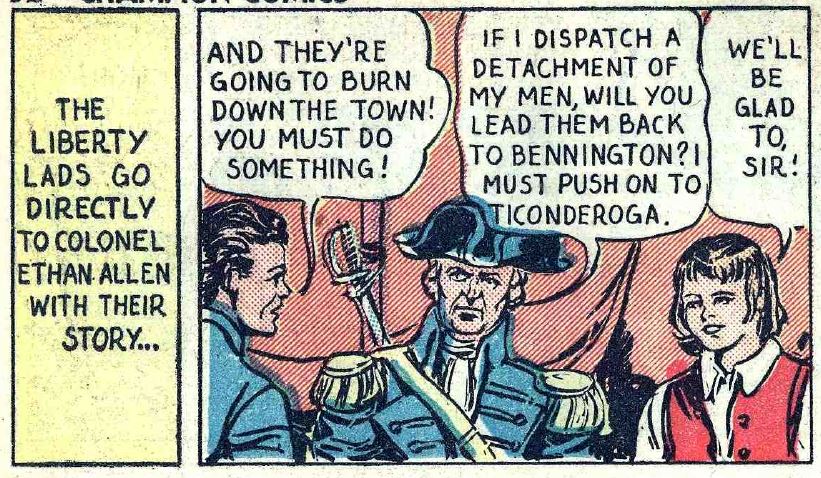
    The Liberty Lads are back at it, getting their grubby mitts all over the American Revolutionary War. This time they meet Ethan Allen and the Green Mountain Boys on the eve of the capture of Fort Ticonderoga. (Champion Comics 009, 1940)

    John Hancock and Samuel Adams:

    More Liberty Lads shenanigans. This time they’re saving Samuel Adams and John Hancock from capture by the British, something that as far as I can tell almost happened in our timeline. (Champ Comics 011, 1940)  

    Joseph Stalin:

    “Nilats,” leader of “Aissur” is tracked to his office in “Wocsom” by Strongman, who objects to the Aissurans’ invasion of the Balkan country of Rutania (Crash Comics Adventures 003, 1940)

    Orson Welles:

    For a while, Orson Welles’ ‘War of the Worlds’ broadcast is used as a shorthand for a reason that the cops blithely ignore multiple calls about some fantastic threat, only they certainly never do more than allude to the real thing. This time it’s giant mutant ivy plants and the dumb police are talking about a broadcast by “Worsen Welds”. (Amazing-Man Comics 006, 1939)

    Saladin:

    Makes a one-panel appearance in the otherwise undistinguished Crusades comic “Reynard the Fox”. (Cyclone Comics 005, 1940)

    Tecumseh:

    Whether “Metumseh” is a stand-in for Shawnee leader Tecumseh or they just mushed around his name to make up one for this fellow I cannot say, but they were certainly thinking of him while they did it. (Champion Comics 010, 1940)

  • MINOR SUPER-HERO ROUND-UP 021

    They’re just these guys, you know?

    the Solar Legion:

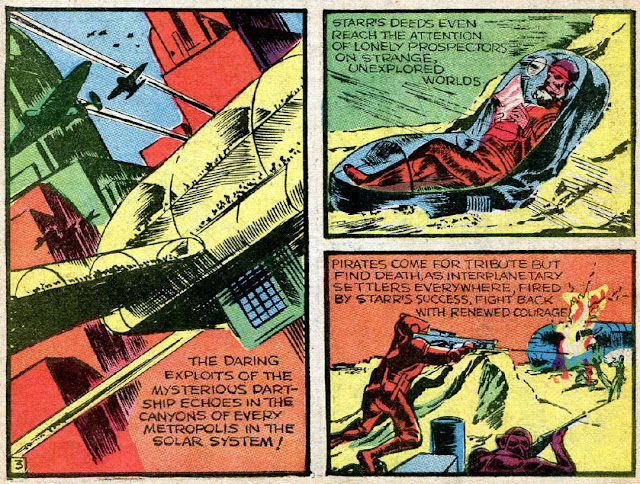
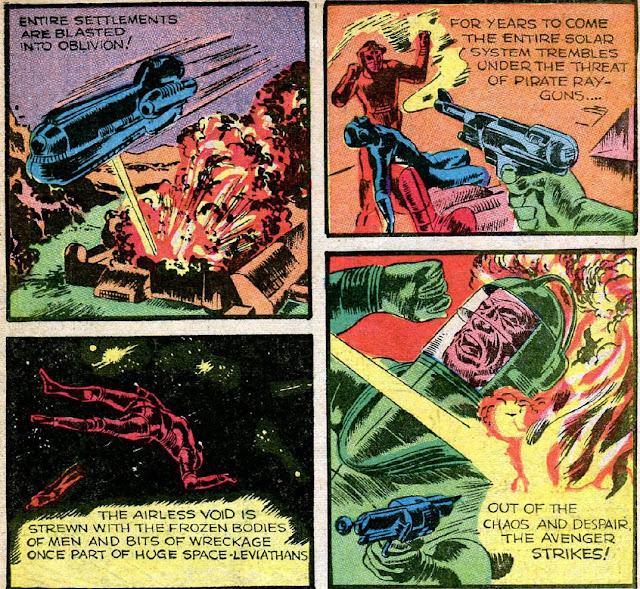
    The Solar Legion is the brainchild of Adam Starr, a 23rd Century man about whom very little is ever revealed. Emerging from a concealed base on Io, he sets out to rid the Solar System of the scourge of space piracy via the most direct route possible: blowing up all of the space pirates.

    Starr’s exploits have their intended effects: 1. many pirates are blown up and 2. the authorities are convinced of the need for an interplanetary peacekeeping force, aka the Solar Legion, with Starr as the head.

    Despite his new position of authority, the remaining four Solar Legion stories feature Adam Starr as a solo operator, hunting down pirates and settling factional disputes with his ray gun and two-fisted attitude. (Crash Comics Adventures 001, 1940)

    the Cat Man:

    The Cat Man is David Merrywether, who is orphaned in India after his father William brings his entire family along on a scientific expedition to collect butterflies and they run afoul of a hostile tribe (no word on whether William did something to draw their ire or if they were universally hostile to intruders – in either case the question of just why he would have his wife and two young children along on such a dangerous endeavour remains unaddressed). David, the only survivor, ends up being adopted by a tiger and spends his youth with her in an expository caption.

    (I really appreciate this “yadda yadda yadda” version of the Raised by Animals origin story. You’ve heard it all before, folks: he lived among the tigers and now he has tiger powers. He’s back in civilization because he saved a tiger’s life and that tiger’s mother owed him a favour. Now let’s get to the costumed antics!)

    Cat Man has all of the expected cat-related superpowers – enhanced dexterity, strength, speed and jumping ability – plus a few less common ones like the ability to speak to tigers and the ability to fall any distance and land on his feet without harm. He also has a cat’s enhanced night vision, which takes the form of literal beams of light that emit from his eyes. Fun!

    The Cat Man’s most striking power is that of having nine lives, bestowed on him by his adoptive tiger mama when he saved her cub. The problem with the “multiple lives” superpower has always been that it’s not interesting if it’s not used, with the result being that after two 1940 appearances Cat Man is down to seven lives. Surely this cannot be sustained going forward.

    Speaking of going forward, we will be hearing more out of Cat Man, one of the minor successes of the Golden Age. Changes are afoot once he has his own title in 1941, starting with a revisions to his much-derided original costume (personally, I like this costume. It very much feels like the sort of thing that someone who had spent their youth alone in a jungle might put together). See you then! (Crash Comics Adventures 004, 1940)

    UPDATE 1941

    Tornado Tom:

    Like the word-box says: Tornado Tom is just some guy who was sucked up by a tornado one day and when he came down again he was inhumanly strong, fast and durable. He also had amnesia, so even though he shares the name Tom Kenny with the famous voice actor of such characters as Spongebob Squarepants, he himself did not know that.

    Tornado Tom’s origin is never really explored and the two hints we get about the nature of his powers are a bit contradictory:

    Possible Mystical Origin: in Cyclone Comics 002, Tom battles some thugs in a stuffy apartment and is drained of vitality by the lack of fresh breezes. In a moment of desperation he calls out to Boreas, “God of Wind” and is revived and re-energized by a gust of air that blasts through the window. Talking points: was it a mystic tornado sent by the gods? Is Tom Kenny a descendant of Boreas or another Greco-Roman figure?

    Possible Biological Origin: In Cyclone Comics 005* Tornado Tom’s blood is asserted to have miraculous healing properties, possibly as  a result of his being some sort of mutant or mutate. Talking points: was it a radioactive tornado?

    This is all ultimately clutching at straws because Tornado Tom is a classic Golden Age cipher, much as I would like to know otherwise. (Cyclone Comics 001, 1940)

    * his blood is reportedly transfused into a dying man in Cyclone Comics 004 but that issue is currently unavailable.

    Mister Q:

    Your typical master of disguise style hero, with a manservant named Ying and a dog named Satan. I quite like Mister Q because I’m pretty sure that his name is derived from the idea of wartime Q-Ships, ie, warships disguised as harmless merchant vessels. It’s a neat name for a disguise-based crimefighter! (Cyclone Comics 001, 1940)

  • MINOR SUPER-VILLAIN 580: BLACK MICHAEL

    (Crash Comics Adventures 001, 1940)

    Black Michael is the leader of a band of space pirates based on Pluto and beginning in the year 2140 he terrorizes the solar system, killing and plundering at will.

    It’s unclear in the original story how long this state of affairs persists for, but a later installment of “the Solar Legion” takes place in 2260, suggesting that Black Michael and his crew might have been going strong for upwards of 120 years. That’s a lot of piracy!

    All good things must come to an end, however. Black Michael and his entire crew (and a decent chunk of the Plutonian surface) are blown to smithereens by Adam Starr, founder of the Space Legion and real hard-ass.

    OR WAS HE? In Crash Comics Adventures 003 Adam Starr searches Mars for a missing heiress and finds not only her but his old enemy Black Michael in a new base under the famed canals of Mars (and of course Jack Kirby loved the concept of the Martian canals – it’s evocative!).

    Black Michael attempts to feed Starr (and his hostage, for some reason?) to the great Martian god/monster/fish Gansha but makes the fatal error of leaving him armed and both he and the Gansha meet their ends via the muzzle of Starr’s extremely over-powered ray gun. Do not take this man target shooting, folks.

    Bonus image of the Gansha, the real star of the adventure.

  • MINOR SUPER-VILLAIN 580: BLACK MICHAEL

    (Crash Comics Adventures 001, 1940)

    Black Michael is the leader of a band of space pirates based on Pluto and beginning in the year 2140 he terrorizes the solar system, killing and plundering at will.

    It’s unclear in the original story how long this state of affairs persists for, but a later installment of “the Solar Legion” takes place in 2260, suggesting that Black Michael and his crew might have been going strong for upwards of 120 years. That’s a lot of piracy!

    All good things must come to an end, however. Black Michael and his entire crew (and a decent chunk of the Plutonian surface) are blown to smithereens by Adam Starr, founder of the Space Legion and real hard-ass.

    OR WAS HE? In Crash Comics Adventures 003 Adam Starr searches Mars for a missing heiress and finds not only her but his old enemy Black Michael in a new base under the famed canals of Mars (and of course Jack Kirby loved the concept of the Martian canals – it’s evocative!).

    Black Michael attempts to feed Starr (and his hostage, for some reason?) to the great Martian god/monster/fish Gansha but makes the fatal error of leaving him armed and both he and the Gansha meet their ends via the muzzle of Starr’s extremely over-powered ray gun. Do not take this man target shooting, folks.

    Bonus image of the Gansha, the real star of the adventure.