The Curse of Skeleton Munroe

Category: patriotic hero

  • MINOR SUPER-HERO ROUND-UP 089

    Just when you think that there couldn’t be any more super-heroes, another batch appears.

    Major Victory:

    After an unnamed soldier stationed at US Army Camp Courage dies in an attempt to prevent the camp’s arsenal from being bombed, his body is hauled away by angelic figures and ushered into the presence of a star-spangled old man.

    This, it turns out, is Father Patriot, a new and legally distinct anthropomorphic personification of the spirit of the United States. Were the folks at Chesler concerned about using Uncle Sam due to the fact that Quality Comics was already doing so? Perhaps! Regardless of his origin, Father Patriot revives the soldier as an exemplar of the self-sacrificing military hero. Unusually for a character who has been restored to life by a mystical force, Major Victory (as he is dubbed) does not come back with any powers but is instead gifted with a costume, an airfield base complete with high-powered radio receiver and an airplane and just told to have at it.

    Major Victory is not entirely without supernatural enhancement, however: if he’s ever in a big enough jam then Father Patriot can ring the Liberty Bell to give him a rush of strength sufficient to snap a steel chain.  (Dynamic Comics 001, 1941)

    Categorized in: Generica (Majors), Origin (Patriotic Heroes), Origin (Resurrected)

    Dynamic Man:

    I’m really kicking myself here. Back when I started this blog I was focusing on super-villains and only really talking about the weirder super-heroes, and while I eventually realized my error and started talking about every super-hero at least a little (hence the round-up framework – if I only have a small amount to say about any one hero there are three more to bulk out the post) I’m still playing catch-up. This is all to say that if I’d done things right to start with I’d already have an entry on the Marvel Comics Dynamic Man to point to instead of an assertion that one is coming up in a few month when Mystic Comics comes back around in my reading list.

    This is especially galling because both the Marvel and the Chesler Dynamic Mans are androids who emerge from their birthing tubes as their creators are dying in front of them. This is a fun coincidence, probably! There are of course plenty of differences between the two: the Chesler Dynamic Man is created specifically to combat the villainous Yellow Spot, while the Marvel one is more of an exercise in creation for its own sake. Chesler Dynamic Man is also possibly a magical construct rather than a humanoid robot. My evidence for this amounts to the fact that he was created by “authority on ancient black magic” Dr Moore, who talks about giving him “the power of steel, the speed of an eagle and the wisdom of the sages,” which is pretty poetic if you’re talking about an android and might be literal if you’re growing some sort of super-homunculus.

    Dynamic Man is a hero of the Superman variety, with the powers of flight, super strength and a general invulnerability to harm. He also wears these gloves that I find very distracting – sure, that long point that extends up the forearm is an interesting addition to the costume, but how does it stay in place? Does Dynamic Man have to apply a little spirit gum to his arm every time he gets dressed?

    Finally, Dynamic Man flies with every limb maximally akimbo, and continues to do so throughout his super-heroic career. It’s honestly kind of charming. (Dynamic Comics 001, 1941)

    Categorized in: Generica (Mans), Language (Superlatives – Dynamic), Origins (Magical Constructs)

    Hale the Magician:

    It’s 1541 and the young Englishman Hale (no first name given) and his father are the only two good – though still fairly racist – Europeans in South America and thus object to the brutal treatment of the indigenous peoples by the Spanish. They head up into the mountains to pledge their support to Chief Xingu of the Maoni Indians and soon find themselves locked in battle with a group of angry conquistadors. It’s a short-lived battle, as Xingu reveals himself to be a master of science and magic by producing a lightning storm from his spear. The Spanish sensibly flee, but not before killing Hale Sr.

    Thanks to his selfless heroism (and after passing a series of challenges), Hale the Younger is essentially adopted by Xingu, who teaches his new ward all the technomagical secrets of the Maoni. Together, they create the Magic Spearhead, an artifact that contains the sum of all those powers, but before they can test it out Hale is struck down by a jealous rival. Xingu places Hale’s body in a special tomb with the promise that he will return to life one day

    Cut to 1941, the prophesied time of Hale’s revival, and scientist Henry Starrett and his daughter Lois are on-hand to witness the grand event. After waiting for months, they run out of food and Starrett makes the oafish decision to smash open the tomb with a big stick. This vandalism must have been part of the prophecy, because smashing the tomb kills Starrett and restores Hale to life in what is possibly some sort of inadvertent sacrifice.

    Thanks to the Magic Spearhead, Hale has all of the limitless power of his fellows in the fraternity of comic book magicians and he returns to the States with Lois to use those powers for the good of mankind. In an extremely frustrating development, Hale never sees fit to attach the Magic Spearhead to a spear body, making it more like a weird magic knife, but maybe it’s just me and nobody else is bothered by this. I mean, Xingu had his magic coming out of a full-sized spear, Hale. (Dynamic Comics 001, 1941)

    Categorized in: Accessories (Spears), Magical Professions (Magicians), Origins (Resurrected)

    the Black Cobra:

    The Black Cobra is a standard unit of costumed vigilante. In day-to-day life he is Jim Hornsby, son and office clerk of District Attorney Hornsby, but when danger looms he suits up and starts slinging fists. It’s not a great costume, mind you, both because it’s too busy and, importantly not black. Plus I checked out his other appearances and that is the best that that cowl is ever going to look.

    The Black Cobra also has the one variation on the meek alter ego that is more grating than the disappointed love interest: the emotionally abusive disappointed parent. Hornsby Senior in contention for Worst Father in Comics. (Dynamic Comics 001, 1941)

    Categorized in: Animals (Cobras), Colours (Black), Day Jobs (Clerks)

  • MINOR SUPER-HERO ROUND-UP 082

    Lotta visually striking characters this time, plus Pioneer. 

    Pioneer: 

    Pioneer is a man of limited education and experience (and possibly intellect) who has seemingly lived his entire life at the bottom of the inescapable Death Gorge in Yellowstone Park. He comes into contact with the outside world when a trio of fleeing gangsters crash their car near his home and he nurses them back to health. The three then take Pioneer with them once they manage to attract help from outside of the gorge, with little real justification other than to use him as cover if they attract fire from police.

    Pioneer’s morality is simple enough that his disdain for killing cannot be alleviated with the promise of cash, and he captures his three erstwhile companions when they commit a murder while robbing a bank. Our final view of him is as he wanders into New York City traffic while clutching five thousand dollars in reward money, and since he never appears again I suppose we must assume that he was immediately flattened by a car. This is where my “Pioneer might be a stupid” theory comes from, as the man had just completed a car trip from Yellowstone to NYC, which takes at least 33 hours today. You’re telling me that he didn’t take in the fact that you might want to stay out of the way of these things in all that time?

    As presented, Pioneer is not really a super-hero. He’s presented as one, but his one adventure is taken up almost entirely with origin stuff, which in itself is interesting because we don’t actually learn just how he came to be in that gorge in the first place. I suppose he would have worked like a more benevolent version of the Incredible Hulk, travelling from town to town dispensing rough justice and broken English. If he hadn’t been hit by all those cars, that is. (Daredevil Comics 002, 1941)

    Categorized in: Origin (Unknown) 

    the Bronze Terror: 

    After his father is railroaded into a murder sentence in the corrupt Western town of Redfield, athletic wunderkind and hotshot lawyer Jeff Dixon returns home to help prove his innocence.

    Despite his legal background, Jeff turns to vigilante justice almost immediately, presumably due to the fact that all of the town’s officials are in the pocket of Scar Thornton, the real killer. Dixon’s chosen identity, the Bronze Terror, probably deserves a spot in the next Problematic Round-Up, but I’m giving him a reprieve because this comic is the definition of a well-meaning attempt to have a non-white character star in a comic that is still bogged down in all the tropes of in this case the Western genre (the name of the strip is “Real American No. 1,” for gosh sakes) and if I banished characters for that I recon that this space would feature a non-white super-hero some time in the 70s. If then.

    So, while on the plus side the Bronze Terror is a an entertaining and highly competent character who looks terrific (and is detail-oriented enough to get a mask for his horse so that it can also look cool), the negatives include:

    – all of the other Native American characters other than Jeff’s love interest Lilly being broad ethnic caricatures

    – Jeff’s status as a super-hero hanging on the fact that he went off and got a white man’s education, which is a pretty frequent trope in comics with Native American protagonists and stands as a counterpart to that of the white adventurer bringing his expertise to the jungle

    – yes, the costume looks great but I think that the broad objection that Native peoples have to the cultural appropriation of things like the war bonnet probably also applies to their use by comic book super-heroes. This one is going to keep coming up – American Eagle debuts at Marvel in 1981, and he’s wearing one

    (Daredevil Comics 002, 1941)

    Categorized in: Body (Emotions – Terror), Elements (Alloys – Bronze), Problematic Characters

    London: 

    London is a masked vigilante dedicated to stymieing the forces of Nazi Germany as they attempt to conquer Great Britain. Conceptually, he seems to have been built around the catch phrase “London can take it!” and while the name is certainly unique it does introduce some confusion as the character London is based out of the city of London.

    I appreciate London’s costume: while the combination of a mask and a suit or tuxedo is nothing new in comics, this might just be the first time I’ve seen a suit paired with a cape and cowl. Plus the cursive “L” symbol is cute.

    London is in actuality radio broadcaster Marc Holmes, who reports on his own costumed exploits as an employee of the BBC. He works closely with the British military and London law enforcement in both his civilian and costumed identities. (Daredevil Comics 002, 1941)

    Categorized in: Locations (Specific), Origin (Patriotic Characters)

    Pat Patriot: 

    Another in the seemingly endless parade of patriotic WWII super-heroes, Pat Patriot has the requisite flag based costume and dedication to Truth, Justice and the American Way, plus the clunky and also ominous-if-you-know-history sobriquet “America’s Joan of Arc.”

    An aircraft factory worker who kicks up a bit too much fuss about plant conditions and gets fired, Pat proceeds to unearth a conspiracy by her foreman to send aircraft engines to the Axis, all while wearing a patriotic costume from a play that she was in earlier in the evening. She has a mean right hook and a variety of skills (airplane piloting, marksmanship, etc) that see her through.

    In a truly American moment, Pat gets her super-hero name because her coworkers cannot conceive of someone being called the outlandishly foreign Patricia Patrios, and so rename her on the spot. (Daredevil Comics 002, 1941)

    Although Pat starts out as a worker in an airplane factory in an unidentified part of the US her career as a patriotic vigilante renders her unfit for a typical 9-5 job. By Daredevil Comics 006 she appears to be working as a newspaper reporter but whether that will continue to be her occupation as 1942 rolls around is anyone’s guess.

    Categorized in: Abstract Concepts (Patriotism), Origin (Patriotic Characters) 

  • MINOR SUPER-HERO ROUND-UP 080

    It’s a sidekick-heavy brew this time, chums.

    the Silver Streak **UPDATE**:

    It’s been a gradual thing but the Silver Streak has been getting closer and closer to not just going real fast and jumping far but actually flying. I don’t know if you can actually pinpoint the moment he made the transition but he is definitely on the “is flying” side of the equation by Silver Streak Comics 010, 1941. 

    Mercury:

    Although Whiz, King of Falcons is an exemplary sidekick to the Silver Streak, comic books are nothing if not prone to trends, and the trend for 1941 was for super-heroes to get kid sidekicks. And although there is only so much you can do to stand out among an army of gee-whillikering blonde boys, Mercury, aka the Boy Streak, aka Mickey O’Toole, does have a couple of aspects worth highlighting:

    The first of these things is his origin story. Mickey O’Toole is the appropriately hard-hitting son of the late boxer Slugger O’Toole, who was murdered mid-match because he wouldn’t take a dive. Mickey now shines shoes in order to provide for his widowed mother and disabled sister Mary. A sad tale indeed.

    The remarkable thing about Mickey’s sad backstory and struggling family the fact that it and they never come up again. Mickey starts hanging out with the Silver Streak and his family woes go right out the window. There’s even a hint at the end of his debut appearance that he will get the chance to bring the man who killed his father to justice, but writing duties on “Silver Streak” transfer from Bob Wood to Don Rico with the probably-pseudonymous Rex Richards in between and Mercury’s backstory gets lost in the shuffle.

    The second thing to note about Mercury is the origin of his powers: Silver Streak gives him a shot of secret super juice. Not anything to write home about in and of itself – every third super-hero is on some sort of serum or powder or elixir, after all – but because the common knowledge about this kid is that he got his powers from a Silver Streak blood transfusion. I myself asserted this in my entry on the guy! I mean, it’s not like we’re out there getting the origin of the Flash wrong or something but it is an interesting example of how misinformation can become more prevalent than fact (also this kind of clears up the mysterious origin of the Silver Streak’s own powers: he took the juice!) (Silver Streak Comics 011, 1941)

    Meteor:

    The third thing about Mercury is the fact that after two issues he is replaced by Meteor, the Boy Speed-King and no two of the half dozen nerds who care about this kind of thing can agree on whether Mercury and Meteor are the same kid with two different names or two different kids with no explanation of where the first one went or the second one came from, with the argument fr the second position boiling down to the fact that they never say that the two are the same. 

    Personally, I lean toward the “one kid, two names” hypothesis, as it’s slightly cleaner. Why invent a whole new kid? (Silver Streak Comics 013, 1941)

    Categorized in: Elements (Mercury), Locations (Space Places), Origins (Sidekicks) 

    Whiz, King of Falcons **UPDATE**: 

    Whiz, King of Falcons, the Silver Streak’s original sidekick, in perhaps his final appearance before he is supplanted by one or more flying kids, demonstrates the heretofore-unseen ability to talk. And to be an annoying smartass, if I’m honest. Whiz returns later on in Silver Streak’s career, so it’ll be interesting to see if he retains this ability. (Daredevil Comics 001, 1941) 

    Captain Battle:

    Captain Battle: patriotic hero, scientist, former soldier and in fact World War One veteran, in which conflict he lost his left eye. Lest we think him too old, the text is at pains to reassure us that he was in fact the youngest person to fight in the Great War, which I think is supposed to make him seem tough but mostly instills a deep horror in my being. Particularly after I looked it up and found that that would make him something like seven years old, at least until a few issues later when they clarify that he was the youngest member of the American Expeditionary Forces, making him a comparatively venerable 12 or so.

    Like many patriotic heroes there isn’t a lot going on with Captain Battle beyond his love of country, but here are all of the interesting trappings of his character:

    1. His assistant, Jane Lorrain: she’s got a rhyming name and she’ll push back on sexist language. Like many potentially interesting female supporting cast members she is pretty thoroughly sidelined once Battle gets a sidekick.

    2. His patriotism. Not only is he dedicated to the defense of the US but he has sworn to only defend the US. He helps save a British fleet in his first appearance explicitly because they act as a buffer between the Axis Axian Powers and America. Presumably he would otherwise let them be destroyed. Every once in a while when he is not directly helping an American he gets kind of huffy about it.

    3. His gadgets, while not unique, have very cool names, including the Curvoscope (remote viewer), the Dissolvo (death ray pistol) and the Luceflyer (jetpack). The Dissolvo is also really disgusting, as it melts its target into a quivering pile of goo. (Silver Streak Comics 010, 1941)

    Captain Battle gets a couple of issues of his own comic in 1941 and for precisely one story he makes an extremely feeble attempt at having a secret identity with no consideration for the fact that a) there aren’t a lot of guys running around with eye patches in any given area, which makes the usual secret id excuses appear even more ridiculous and b) Captain Battle’s real name is in fact Captain Battle. “You know, I never see Captain Battle and Captain Battle in the same room together…” Ridiculous.

    If I’m honest the story in question has a couple of indications that it originally starred another character and Captain Battle was a late addition, and if that is the case then the secret identity stuff is just a holdover from that. (Captain Battle Comics 001, 1941)

    Categorized in: Accessories (Various), Origins (Patriotic Heroes), Origins (WWI Vets)

    Hale Battle:

    The prevailing trend in 1941 was for super-heroes to have sidekicks and so Captain Battle eventually gets a sidekick. But just how does he acquire a boy? Very simply! See, Battle’s recurring foe the Black Dragon (tune in tomorrow for that jerk) had a thing where he turned people into giant bird-man minions called Deaglos, and the final Captain Battle/Black Dragon confrontation the surviving Deaglos were all restored to their human forms. Most of them were adult men who had lives to return to, but among them was one unclaimed boy.

    Note that the boy gives his name as “Nathan Hale” and Captain Battle immediately renames him “Hale Battle.” This is weird. It’s a weird thing to do. Particularly as “Nathan Hale” is a very patriotic American name, which Battle should totally be into! Also note just how small this kid is. This doesn’t last long, as he is definitely around the thirteen to fifteen year-old range that most Golden Age sidekicks fall into and is drawn to look more like it as time passes.

    Hale Battle is among the minority of Golden Age sidekicks who aren’t recruited as sidekicks but who insist upon becoming them. Not that Captain Battle puts up much resistance – once Hale gets this poor war refugee to sew him a uniform he’s got the job.

    Aside from these small points of interest, Hale Battle is one of the most generic sidekicks in comics. He does have a minor obsession with collecting souvenirs of his adventures, which is something I in turn enjoy writing about, but if I’m honest he approaches it without joy. It feels like an attempt to have more of a personality than a hobby. (Silver Streak Comics 012, 1941)

    Categorized in: Origins (Amnesiacs), Origins (Sidekicks) 

  • MINOR SUPER-HERO ROUND-UP 073

    It’s a fine day for a dose of minor super-heroes. 

    Alias X: 

    Alias, aka just X, is a mysterious master of disguise who has been cleaning up crime in NYC for the better part of a year and who, as of his first appearance, has now deigned to tell his origin story to Police Commissioner Malley and newspaper editor Hunch Armstrong.

    Turns out that X was a small-town taxi company owner who was railroaded and sent to prison for a crime he didn’t commit, and that after two years in prison he managed to escape, became a master of disguise by sheer willpower and set out to battle crime until he could track down the crooks who really committed the crimes he was convicted for and clear his name.

    The police commissioner must be a trusting guy, because he refrains from putting out an APB or whatever on Alias X after he hears this confession. 

    As far as I can tell from a skim of the 1942 portion of Alias X’s dozen or so adventures, he never catches up with the crooks who framed him – just one of the many loose ends of the comics. Please also note that Alias X is a calling card guy. (Captain Fearless Comics 001, 1941)

    Citizen Smith: 

    Citizen Smith! Plain old John Smith, who could be any one of us regular Americans! Just a regular guy! So why are we reading a comic book about him?

    Citizen Smith is in actuality John Smith, an aircraft factory worker in Washington DC and also an orphan consumed with the desire to know just who his parents were. While stewing on this after work one day he wanders up to the Tomb of the Unknown Soldier, where he receives both great news and a great shock as a ghostly figure appears and tells him that he, the Unknown Soldier, is Smith’s father.

    Smith’s new ghost dad charges him to keep America safe, with the promise that he will appear and aid his son if needed (sadly this does not occur in either of the two recorded Citizen Smith adventures). The newly-created Citizen’s Guardian of Liberty and Guardian of the American Way then sallies forth to whale on fifth columnists with his two good all-American fists.

    Now, I try to take comics as they are presented to me and not engage in a lot of “what if they were dead the whole time”-style fan theory nonsense but I will say that if I were writing a gritty early-2000s Citizen Smith reboot… all this ghost stuff would just be a hallucination brought on by his obsessions, right? Just a lonely man giving his life meaning by latching on to a powerful symbol to fill the hole in his life. But of course that is not who we are here. Citizen Smith is as he appears: a divinely ordained champion of the American Way. (Captain Fearless Comics 001, 1941)

    Miss Victory: 

    Miss Victory is Joan Wayne, a woman who works in Washington DC in secretarial and similar roles and who seems to have seen an opening for a two-fisted vigilante and filled it, no further origin necessary. There is some hint that her vigilantism is officially sanctioned in the first couple of panels of her first appearance, but if so she has very little oversight. She is much more willing to resort to violence than a lot of her female contemporaries, which is kind of refreshing.

    Miss Victory does share with our old friend the Eagle the inability to really settle on a costume design, so I’m sure that we’ll be revisiting her in that capacity. 

    Case in point: this revised version of her costume from her second appearance, in Captain Fearless Comics 002. As with most of her costume changes it’s a variation on the theme of her previous look and is probably explained by the fact that she  (Captain Fearless Comics 001, 1941) 

    Mr Miracle: 

    Mr Miracle is of course among the ranks of the obscure Golden Age characters who have the same name as a more well-known modern character, but he is also a member of a much more select fraternity: of characters whose origin involves a suicide attempt, though the precise reason that the unnamed man had for jumping is never given.

    The future Mr Miracle is pulled out of the water by a helpful stranger and brought to the great scientist Professor Rietz, who revives him via a twenty hour session under his “mind-ray,” only to be betrayed and shot by his assistant Sango at the final hour. Sango turns out to have been a foreign agent who was laying in wait for the mind-ray to be perfected, and now the hour has come.

    The still-unnamed man wakes to a ruined laboratory and a dying Rietz, who reveals to him in addition to saving his life, the mind-ray has given him great if unspecified powers. He then extracts a pledge from the man that he will use this power to aid mankind and promptly dies.

    The man creates a costume, renames himself Mr Miracle and sets out to use is vast array of abilities (transmutation, teleportation, telekinesis, intangibility, size control, flight, etc, etc. Though Mr Miracle is technically some sort of psychic mutate he is in effect a nigh-omnipotent comic book magic user) to bring Sango to justice. 

    Mr Miracle gets to honour the promise he made to Prof. Rietz precisely one more time (by sinking a u-boat) before fading into the mists of comic book obscurity. (Captain Fearless Comics 001, 1941)

  • MINOR SUPER-HERO ROUND-UP 072

    Extremely minor super-heroes? Don’t mind if I do!

    the Flag-Man:

    The Flag-Man is one standard unit of patriotic American super-hero: he loves the United States and is willing to put on a costume and punch guys until it is safe. And speaking of costumes: the Flag-Man and his pal Rusty are prime examples of how piggybacking off of the iconography of the American flag can really paper over some pretty bad costume design. I mean, tank-top and cape and flared gloves? Give me a break.

    The Flag-Man’s alter ego is Captain Hornet (occasionally Major Hornet), trouble-shooter for the President, who presumably knows about the whole Flag-Man thing.

    Since Captain Hornet/the Flag-Man seems the be dedicated to solving problems exclusively via the medium of hand-to-hand combat, he is in effect a fist that FDR can send to punch anyone he wants. Mostly Nazis, to his credit. (Captain Aero Comics 001, 1941)

    Rusty:

    Just as the Flag-Man is the elemental patriotic hero, his sidekick Rusty is the basic unit of kid sidekick: no last name, no alter-ego, just a scrappy teen who tags along on adventures. I do find him the most irritating of all the Golden Age sidekicks we have yet encountered, so that’s at least one distinction. (Captain Aero Comics 001, 1941)

    Solar, Master of Magic: 

    Solar, Master of Magic is as you might have guessed another of Golden Age comics’ many, many magic guys, which in practical terms means that he can do basically anything he wants to. In contrast to a lot of his peers, he chooses to use his fists as much or more than his magic. 

    Although Solar presents as a pure magic guy, he is in fact a magic item guy, with a magic cape of invisibility and a magic ring of doing everything else. It’s a minor distinction but it introduces the possibility of the source of his powers being stolen from him, which does in fact happen during the final of his four appearances. (Captain Aero Comics 001, 1941)

    Captain Fearless:

    Comics love to tie their characters to history, usually by making them the descendant of someone famous but often by inserting their ancestors into real events, as can be seen in the case of the Wizard. This might be the first time I’ve seen it done to this extent, however, as John Fearless here is not only the instigator of the Boston Tea Party, but a member of the First and probably Second Continental Congresses and could reasonably be expected to be a signatory of the Declaration of Independence. In other words, he’s a whole-ass made-up Founding Father!

    John Fearless goes on to die in one of the opening battles of the Revolutionary War, upon which… well, the speech balloon placement is annoying, but either he ascends into heaven as an otherworldly voice tells him that his patriotism will live on in his family line or an angelic being from the newly-formed United States of Heaven descends in full uniform to collect his soul and tell him the same. I prefer the latter, but who can tell.

    Regardless of the otherworldly voice’s source, its words prove true, as evidenced when young John Fearless VI, latest member of a family of patriots, visits his ancestor’s grave and then gets to meet that very ancestor.

    The ghost of John Fearless I relates the glorious history of the other four Captains John Fearless, fighting to protect the American values of justice and liberty for all (and also in the Mexican- and Spanish-American Wars) and gasses on for a while about patriotism and so forth.

    In contrast to his forebears, John Fearless VI’s assignment is not military but vigilante in nature, as the ghost of John Fearless I is concerned about the threat of fifth columnists and is of the opinion that a costumed crimefighter is the best way to root them out. To that end, his great-great-great grandson is outfitted with a not-great costume and sent off to battle.

    He also gets an antique powder horn that doubles as a musical one, and annoyingly does not blow it during his first case. Once he finally gets around to trying it out, it summons the ghost of the original Captain Fearless to help him out by invisibly beating people up and flying him around in his ghost arms.  (Captain Fearless Comics 001, 1941)

  • MINOR SUPER-HERO ROUND-UP 072

    Extremely minor super-heroes? Don’t mind if I do!

    the Flag-Man:

    The Flag-Man is one standard unit of patriotic American super-hero: he loves the United States and is willing to put on a costume and punch guys until it is safe. And speaking of costumes: the Flag-Man and his pal Rusty are prime examples of how piggybacking off of the iconography of the American flag can really paper over some pretty bad costume design. I mean, tank-top and cape and flared gloves? Give me a break.

    The Flag-Man’s alter ego is Captain Hornet (occasionally Major Hornet), trouble-shooter for the President, who presumably knows about the whole Flag-Man thing.

    Since Captain Hornet/the Flag-Man seems the be dedicated to solving problems exclusively via the medium of hand-to-hand combat, he is in effect a fist that FDR can send to punch anyone he wants. Mostly Nazis, to his credit. (Captain Aero Comics 001, 1941)

    Rusty:

    Just as the Flag-Man is the elemental patriotic hero, his sidekick Rusty is the basic unit of kid sidekick: no last name, no alter-ego, just a scrappy teen who tags along on adventures. I do find him the most irritating of all the Golden Age sidekicks we have yet encountered, so that’s at least one distinction. (Captain Aero Comics 001, 1941)

    Solar, Master of Magic: 

    Solar, Master of Magic is as you might have guessed another of Golden Age comics’ many, many magic guys, which in practical terms means that he can do basically anything he wants to. In contrast to a lot of his peers, he chooses to use his fists as much or more than his magic. 

    Although Solar presents as a pure magic guy, he is in fact a magic item guy, with a magic cape of invisibility and a magic ring of doing everything else. It’s a minor distinction but it introduces the possibility of the source of his powers being stolen from him, which does in fact happen during the final of his four appearances. (Captain Aero Comics 001, 1941)

    Captain Fearless:

    Comics love to tie their characters to history, usually by making them the descendant of someone famous but often by inserting their ancestors into real events, as can be seen in the case of the Wizard. This might be the first time I’ve seen it done to this extent, however, as John Fearless here is not only the instigator of the Boston Tea Party, but a member of the First and probably Second Continental Congresses and could reasonably be expected to be a signatory of the Declaration of Independence. In other words, he’s a whole-ass made-up Founding Father!

    John Fearless goes on to die in one of the opening battles of the Revolutionary War, upon which… well, the speech balloon placement is annoying, but either he ascends into heaven as an otherworldly voice tells him that his patriotism will live on in his family line or an angelic being from the newly-formed United States of Heaven descends in full uniform to collect his soul and tell him the same. I prefer the latter, but who can tell.

    Regardless of the otherworldly voice’s source, its words prove true, as evidenced when young John Fearless VI, latest member of a family of patriots, visits his ancestor’s grave and then gets to meet that very ancestor.

    The ghost of John Fearless I relates the glorious history of the other four Captains John Fearless, fighting to protect the American values of justice and liberty for all (and also in the Mexican- and Spanish-American Wars) and gasses on for a while about patriotism and so forth.

    In contrast to his forebears, John Fearless VI’s assignment is not military but vigilante in nature, as the ghost of John Fearless I is concerned about the threat of fifth columnists and is of the opinion that a costumed crimefighter is the best way to root them out. To that end, his great-great-great grandson is outfitted with a not-great costume and sent off to battle.

    He also gets an antique powder horn that doubles as a musical one, and annoyingly does not blow it during his first case. Once he finally gets around to trying it out, it summons the ghost of the original Captain Fearless to help him out by invisibly beating people up and flying him around in his ghost arms.  (Captain Fearless Comics 001, 1941)

  • MINOR SUPER-HERO ROUND-UP 068

    MINOR SUPER-HERO ROUND-UP 068

    A few classic minor super-heroes. Bulletman and Bulletgirl in particular have just barely managed not to remain relevant – I suppose the pointy helmet is too much of a hurdle for the modern audience.

    Bulletman: 

    Jim Barr is perhaps the most thoroughly-motivated super-hero of the Golden Age. He is:

    a. from a long line of police officers

    b. the son of a famed police officer who was murdered for being too good a cop and who

    c. told the young Jim that he must become a police officer while on his death bed 

    d. and after all that he was too scrawny and bookish to be a cop and so had to settle for being a forensic scientist

    Jim ends up working in his father’s old station under the command of Sergeant Kent, a pro-torture bully who is often held up as the greatest of all the cops in the city, and who is also the father of love interest Susan Barr. 

    Jim’s personal project is a serum that will destroy “all germs and toxins” in the human body, including that which he believes to be the source of crime and violence. He chooses to test this serum out on himself and his body, freed from a variety of invisible ailments, develops into a physical paragon over the course of a night’s sleep.

    (Sergeant Kent really earns his reputation as a great police officer by failing to notice that his colleague has basically doubled in size over night. In his defense, Jim is wearing big clothes)

    Jim decides that the best way to use this new power is to operate outside of the law, probably due to all of his time hanging around with top cop Kent. He uses his now super intelligence to build the Gravity-Regulator Helmet, which allows him to fly and also generates a force field that augments his natural resilience to make him nigh-invulnerable and able to smash through things head-first (I swear that somewhere I read a story in which it was explained that it made him bulletproof by drawing the bullets to the helmet but danged if I can find it now.). His costume, yellow jodhpurs and all, is assembled out of things that were lying around at the police station, no mention of where. (Nickel Comics 001, 1940)

    If I had to classify Bulletman’s personality, I would go with “extremely no-nonsense” or maybe “wooden, which is why it is important that he is eventually joined by his female counterpart: 

    Bulletgirl: 

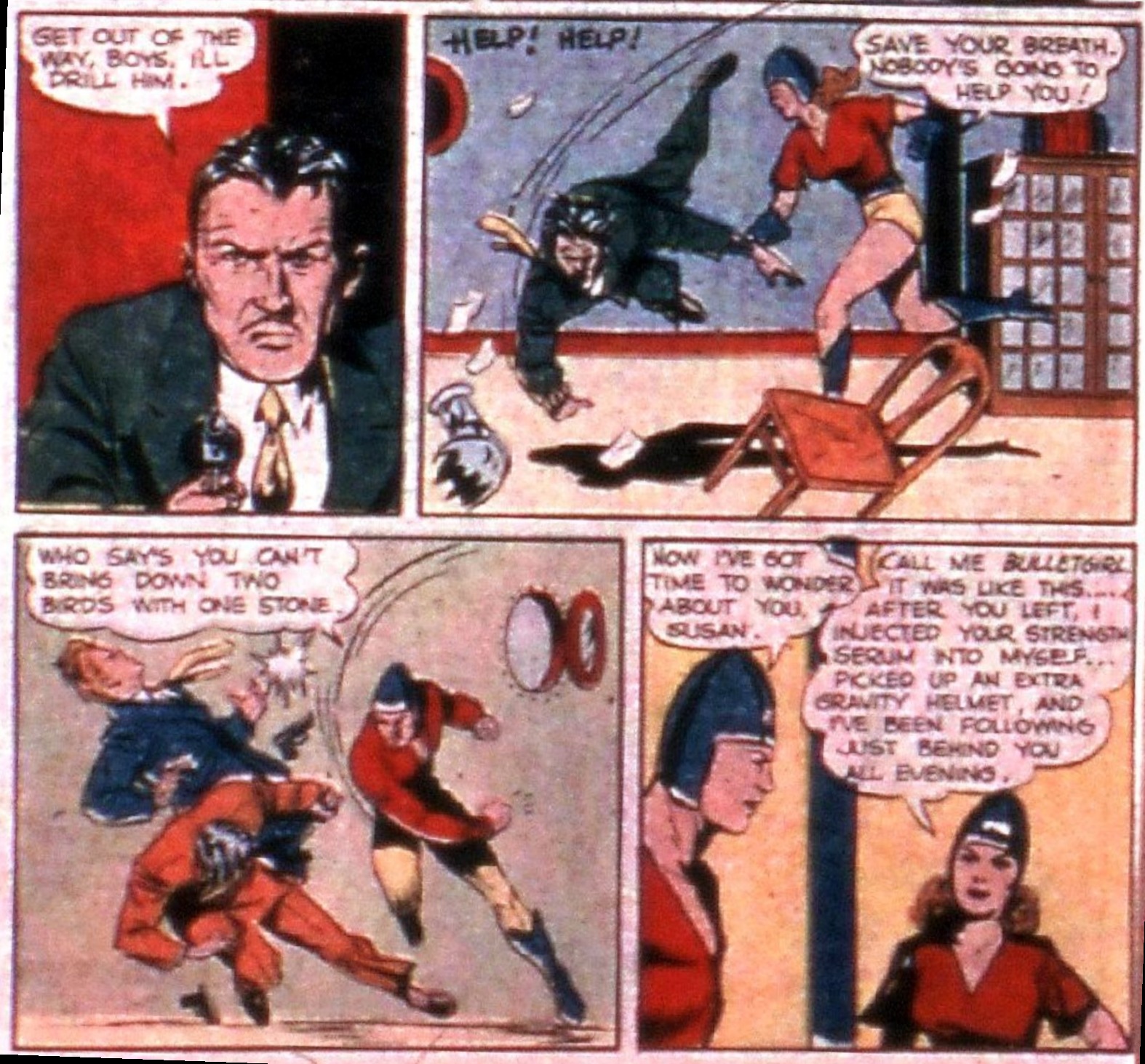
    Bulletgirl is the aforementioned Susan Kent, daughter to good cop/bad cop Sergeant Kent and member of Bulletman’s supporting cast from the beginning. For about the first year of Bulletman’s adventures she fills a low-effort version of the Lois Lane role: curious about the hero’s identity but not especially proactive about trying to uncover it. She also gets kidnapped and targeted for death a lot thanks to her father’s skill at making enemies. Then, in Master Comics 012, Bulletman is knocked out in a collision with Triple Threat’s super vehicle and Susan learns that he is actually Jim Barr. Jim obligingly tells Susan the secret of his origin but resolutely refuses to consider teaming up with her.

    Susan of course injects herself with the serum and crabs a spare Gravity-Regulator Helmet and costume (though she goes for hot pants over jodhpurs) the instant that Bulletman is out of the room, and This is a very good illustration of why I am so fond of Bulletgirl: she has all of the personality that Bulletman lacks. She’s scrappy and quippy and after an issue or two of “too dangerous for girls” chauvinism from Jim is a full partner in the superheroic exercise. She does get kidnapped and left behind a bit more than I’d like but that’s comic books in a nutshell. 

    In conclusion: Bulletgirl! (Master Comics 013, 1941)

    Minute-Man: 

    Like Jim Barr, Jack Weston is the son of a dead hero, though Jack’s father Robert Weston died during the Battle of Chateau-Thierry in World War I. We don’t get nearly as much background on Jack, other than the fact that he was raised by his father’s friend General Milton, but thanks to Milton, Jack becomes Minute-Man, a patriotic super-hero, in what is kind of presented as a draft.

    Jack is sent to join the Army as a lowly Private so that he can keep an eye out for sabotage and espionage affecting the armed forces. Despite having no super serum or particular special training, he proves to be physically near-superhuman as he engages a variety of costumed and non-costumed foes over the course of his mid-length career.

    Minute-Man also dabbles in leaving calling cards, which I always like to make note of. (Master Comics 011, 1941)

    Doctor Voodoo **UPDATE**: 

    In Whiz Comics 017, Doctor Voodoo returns home to find that Maxinya (the Heaven-Woman, natch) has gone missing. He tracks her abductors through the jungle until he comes across their destination: a European castle, smack in the middle of the Amazon. 

    The mystery deepens as Voodoo enters the castle and finds what seems to be an entire Medieval court, headed by the boorish King Richard, who seeks his aid in conquering the jungle. 

    Doctor Voodoo refuses to help King Richard, and so is forced to meet the knight Sir Ganal in combat. Voodoo prevails and wins Ganal over to his side, complete with a promise to reveal the origin of the castle’s presence in the jungle. Alas, this shall never come to pass, because the story does a hard pivot in the next issue. 

    King Richard plays the whole jungle conquest/attempted murder thing off as if it was some sort of test, and sends Doctor Voodoo off to meet with his court wizard. He. in turn, transports Voodoo back in time to the 1400s or thereabouts to retrieve a magical McGuffin called the Golden Flask, with another promise to explain what this whole affair is about once he returns.

    Unfortunately for all us completionists out there, the explanation never comes because Doctor Voodoo never returns. He bops around the oceans for about a year and actually does manage to get his hands on the Golden Flask but his feature is cancelled before he can return it to the wizard and find out just what the heck is going on. Maxinya is waiting for him still, presumably. (Whiz Comics 018, 1941)

  • MINOR SUPER-HERO ROUND-UP 033

    Minor super-heroes, we got ’em.

    Little Giant: 

    Professor Rednow has some inventions to test and he has secured an orphan boy named Rusty for that purpose. Rusty is first given a serum that is supposed to turn him into a big hunk of beefcake but instead he becomes a kid with super strength. He then gets an outfit with anti-gravity properties that allow him to leap around like a small Hulk and finally is coated in “impurvogen,” a high-tech chemical that renders him invulnerable.

    In case you were having some doubts about Professor Rednow’s devotion to scientific ethics: I don’t think that he has any. It’s just lucky for young Rusty that all of this stuff works or he might end up buried in the Professor’s back yard alongside half a dozen other orphan boys.

    Rusty and the Professor end up moving to NYC and becoming special deputies in the NYPD but, as with the Phantom Knight before him, the Little Giant only really had a couple of adventures and the second one continues to be out of my price range. (OK Comics 001, 1940)

    the Shield:

    The Shield is Joe Higgins, “G-Man Extraordinary,” an FBI agent who battles threats to the US using a super-suit of his own design (a design that supposedly was the reason for Captain America switching from his original shield to the round one so as not to look too much like his patriotic counterpart, by the way). 

    Over the years the Shield’s status is subject to the usual comic drift: his powers go from being solely derived from his suit to involving some sort of super serum or ray or two of those, or all three. We’re talking about the 1940 version of the character, though, and he was all suit, baby. The suit itself did slim down considerably from the first issue to the second, but we can chalk that up to a refinement of the technology (and to the more form-fitting top being a bit more flattering than the big chunky breastplate look).

    One thing about the Shield that I had never known prior to reading his first appearance was that his motivation for becoming a costumed crimefighter was that his father died in the Black Tom Explosion as a result of German sabotage during WWI. Thus, the Shield has the Batman origin but for espionage!  (Pep Comics 001, 1940)

    UPDATE (Shield-Wizard Comics 001, 1940)

    the Comet:

    John Dickering is a scientist who invents a gas that when injected gives him super jumping abilities. Too late he learns the reason that so many scientists do extensive testing before trying out serums etc on themselves, as the gas also gives him disintegrating ray vision that can only be held in check by a glass visor, Cyclops-style. Thus, he becomes the Comet.

    There are a number of remarkable things about the Comet over the years but the only ones relevant to the 1940 version of the character are 1. the fact that he has one of the truly great Golden Age costumes and 2. just how very willing he is to kill his foes. I guess when all you have is a disintegrating ray every problem looks like a disintegratable nail. (Pep Comics 001, 1940)

    the Rocket:

    The Rocket is your classic example of an explorer coming to a lost/hidden/alien world and becoming its greatest champion. The most common example of this is your garden-variety jungle adventurer, with “modern man transported into an effete future” and “guy falls through hole into underground world” being other common examples.

    The Rocket’s adventures, on the other hand, happen… somewhere. He
    arrives via his namesake rocket ship – is the Diamond Empire located in
    the future? on an alien world? on a lost mesa or in a hidden valley? No
    idea, never addressed. He just shows up because he heard there was a hot
    queen running the joint and that’s all we get.

    After a rocky start, the Rocket manages to win over the titular Queen of Diamonds, going from her slave to her bodyguard to eventually becoming her lover/ adventuring companion. And if you read the above panels you might have noticed how very racist the Queen’s origin story is, another thing that is extremely in keeping with this man-in-a-strange-land style comic: white guy exceptionalism. (Pep Comics 001, 1940)

  • MINOR SUPER-HERO ROUND-UP 011

    Lotsa lil guys.

    Mr Justice: 

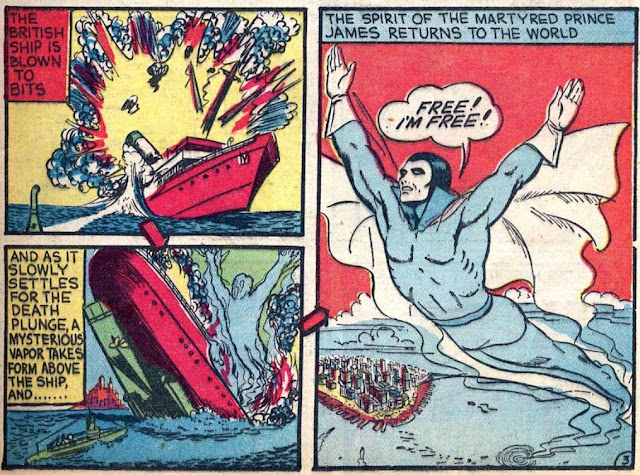
    Like the Spectre or the Wraith (or Sergeant Spook or the Gay Ghost or the Ghost Patrol…), Mr Justice is your classic restless spirit who remains on Earth to mete out justice to the wicked. Specifically, Mr Justice is the 200 year old ghost of the fictional English Prince James, cruelly slain by followers of Prince Richard during the Rogers Rebellion of the 1740s. Astute readers and students of history might have noticed a few things about the preceding sentence that all boil down to the fact that the 1740s were actually recent enough that we know a whole lot about what was going on then, including that people weren’t running around in Medieval armour even if they were sometimes still using swords and shields during the Jacobite Rebellion of 1745. Also, this is what the crown prince of England looked like in 1741. (they change it to the 11th Century later on, because that makes a lot more sense).

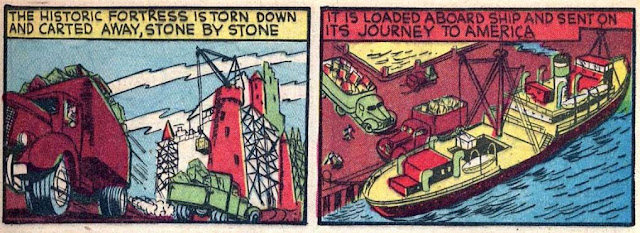
    Prince James’ ghost is tethered to the place of his death per the usual ghost rules but he manages to get around that in a fairly unprecedented way: due the the war, the British government decides to move the castle to America and it is sunk by the Nazis on the way there. And since a pile of stone on the bottom of the Atlantic is not a castle, James is free to go become Mr Justice, the ghost super-hero frequently compared to the Spectre but who doesn’t really get up to the sames sort of divine judgment stuff. He does fight the Devil/Satan a lot, though.

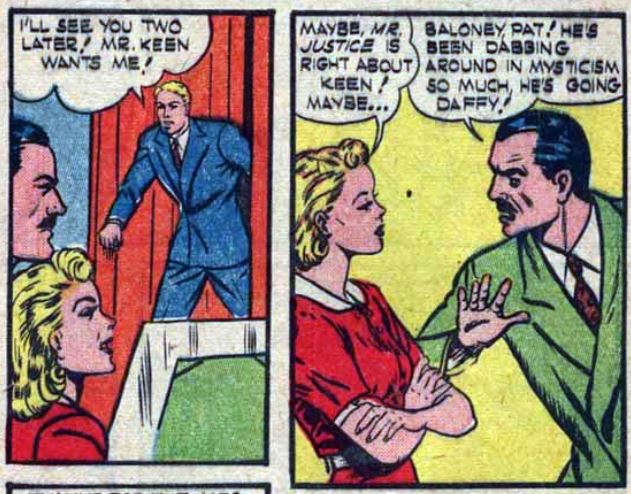
    Possibly my favourite thing about Mr Justice is the fact that his secret identity is a fellow named Mr Justice and nobody really calls any attention to that fact. Mr Justice (secret identity of Mr Justice) is attached to the office of Mayor Clark (city unnamed but very NYC-esque) as a sort of troubleshooter. He kind of has a love interest in mayor’s daughter Pat Clark and a rival in District Attorney Roy Winkler, above, but neither is explored very thoroughly. (Blue Ribbon Comics 009, 1941)

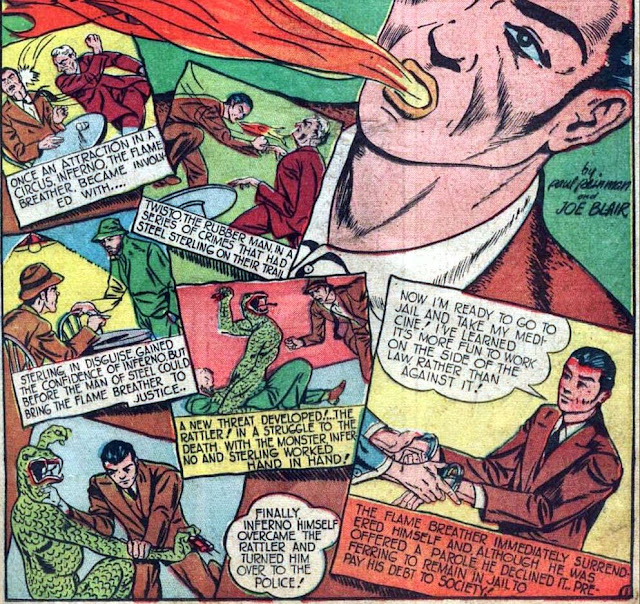
    Inferno:

    Above is an abridged account of Inferno’s time as a super-villain, which we will treat separately because… well, because when you’re reading a lot of old comics in a somewhat systematic manner you have to have some sort of organizational method and I chose alphabetical by year, and Inferno’s time on the lists of crime happened in Zip Comics. I simply haven’t gotten there yet. Suffice to say that he was a crook who changed his ways due to the influence of Steel Sterling and opted to do his time.

    Despite his best efforts, Inferno is compelled to break jail to stop a group of prison escapees from murdering a judge and then is encouraged by that same judge to go on the lam because the authorities are going to try to murder Inferno. It’s a real reciprocal life-saving situation! Although I am tempted to think that that judge could possibly have just called someone and arranged for a stay of summary execution for Inferno.

    The rest of Inferno’s career as a Golden Age super-hero is kind of a fun twist on the old trope of the super-hero that everyone thinks is a crook, in that he doesn’t really have a secret identity per se so just travels around doing itinerant labour until he sees a crime go and changes outfits. The idea of this hobo existence kind of goes by the wayside after a couple of issues when Secret Service Agent Virginia Ames enters the picture, as Inferno’s stories were on the shorter side and just didn’t have the real estate for both a love interest and workplace drama.

    Inferno only managed seven adventures before trotting off to limbo to wait for Archie’s 1960s super-hero revival but don’t worry! He got a full pardon in his last adventure so the other heroes won’t be hassling him. (Blue Ribbon Comics 013, 1941)

    Captain Flag:

    On the one hand, Captain Flag is a regular-style patriotic hero but on a different, more entertaining hand he is a patriotic hero with a very fun origin. To whit: one day super-villain the Black Hand is attempting to wrest scientific secrets from inventor John Townsend when his playboy son Tom stumbles in half lit. The Black Hand is about to dispose of Tom using his horrible hand when a huge eagle just kind of… flaps into the room and ends up leaving with Tom Townsend in its talons.

    Thus saved, Tom just kind of lives with the eagle for a while and transforms from a dissipated youth to a lean, athletic man full of fish protein. And then the eagle comes back one day with an American flag! It’s a veritable sign from the heavens it what it is!

    And so, Tom Townsend becomes Captain Flag, who mostly fights the Black Hand. Which makes sense. Something else that would make a lot of sense: adding a belt to that costume. (Blue Ribbon Comics 016, 1941)

    The Red Mask:

    The Red Mask is very minor indeed! He appeared in four issues of Best Comics from Better Publications, of which only issue 2 appears to be available, which in turn was reprinting newspaper strips, of which only a handful are available. 

    What we have on the guy is this: he leads a tribe on the island of Kaukura, which is probably but not definitely in Oceania somewhere. Kaukura is chockablock with things like sacred grottoes, immortal monsters and hostile tribes and the Red Mask has assigned himself the task of protecting a bunch of clueless outsiders like Nina and Danny here who have blundered in looking for their friend and found themselves up to their neck in trouble.

    The most interesting thing about the Red Mask is that he is by a fair margin the first nonwhite super-hero, though thanks to colouring limitations and some inexact geography it’s a bit difficult to get more exact than that. (Best Comics 002, 1939)

  • MINOR SUPER-HERO ROUND-UP 011

    Lotsa lil guys.

    Mr Justice: 

    Like the Spectre or the Wraith (or Sergeant Spook or the Gay Ghost or the Ghost Patrol…), Mr Justice is your classic restless spirit who remains on Earth to mete out justice to the wicked. Specifically, Mr Justice is the 200 year old ghost of the fictional English Prince James, cruelly slain by followers of Prince Richard during the Rogers Rebellion of the 1740s. Astute readers and students of history might have noticed a few things about the preceding sentence that all boil down to the fact that the 1740s were actually recent enough that we know a whole lot about what was going on then, including that people weren’t running around in Medieval armour even if they were sometimes still using swords and shields during the Jacobite Rebellion of 1745. Also, this is what the crown prince of England looked like in 1741. (they change it to the 11th Century later on, because that makes a lot more sense).

    Prince James’ ghost is tethered to the place of his death per the usual ghost rules but he manages to get around that in a fairly unprecedented way: due the the war, the British government decides to move the castle to America and it is sunk by the Nazis on the way there. And since a pile of stone on the bottom of the Atlantic is not a castle, James is free to go become Mr Justice, the ghost super-hero frequently compared to the Spectre but who doesn’t really get up to the sames sort of divine judgment stuff. He does fight the Devil/Satan a lot, though.

    Possibly my favourite thing about Mr Justice is the fact that his secret identity is a fellow named Mr Justice and nobody really calls any attention to that fact. Mr Justice (secret identity of Mr Justice) is attached to the office of Mayor Clark (city unnamed but very NYC-esque) as a sort of troubleshooter. He kind of has a love interest in mayor’s daughter Pat Clark and a rival in District Attorney Roy Winkler, above, but neither is explored very thoroughly. (Blue Ribbon Comics 009, 1941)

    Inferno:

    Above is an abridged account of Inferno’s time as a super-villain, which we will treat separately because… well, because when you’re reading a lot of old comics in a somewhat systematic manner you have to have some sort of organizational method and I chose alphabetical by year, and Inferno’s time on the lists of crime happened in Zip Comics. I simply haven’t gotten there yet. Suffice to say that he was a crook who changed his ways due to the influence of Steel Sterling and opted to do his time.

    Despite his best efforts, Inferno is compelled to break jail to stop a group of prison escapees from murdering a judge and then is encouraged by that same judge to go on the lam because the authorities are going to try to murder Inferno. It’s a real reciprocal life-saving situation! Although I am tempted to think that that judge could possibly have just called someone and arranged for a stay of summary execution for Inferno.

    The rest of Inferno’s career as a Golden Age super-hero is kind of a fun twist on the old trope of the super-hero that everyone thinks is a crook, in that he doesn’t really have a secret identity per se so just travels around doing itinerant labour until he sees a crime go and changes outfits. The idea of this hobo existence kind of goes by the wayside after a couple of issues when Secret Service Agent Virginia Ames enters the picture, as Inferno’s stories were on the shorter side and just didn’t have the real estate for both a love interest and workplace drama.

    Inferno only managed seven adventures before trotting off to limbo to wait for Archie’s 1960s super-hero revival but don’t worry! He got a full pardon in his last adventure so the other heroes won’t be hassling him. (Blue Ribbon Comics 013, 1941)

    Captain Flag:

    On the one hand, Captain Flag is a regular-style patriotic hero but on a different, more entertaining hand he is a patriotic hero with a very fun origin. To whit: one day super-villain the Black Hand is attempting to wrest scientific secrets from inventor John Townsend when his playboy son Tom stumbles in half lit. The Black Hand is about to dispose of Tom using his horrible hand when a huge eagle just kind of… flaps into the room and ends up leaving with Tom Townsend in its talons.

    Thus saved, Tom just kind of lives with the eagle for a while and transforms from a dissipated youth to a lean, athletic man full of fish protein. And then the eagle comes back one day with an American flag! It’s a veritable sign from the heavens it what it is!

    And so, Tom Townsend becomes Captain Flag, who mostly fights the Black Hand. Which makes sense. Something else that would make a lot of sense: adding a belt to that costume. (Blue Ribbon Comics 016, 1941)

    The Red Mask:

    The Red Mask is very minor indeed! He appeared in four issues of Best Comics from Better Publications, of which only issue 2 appears to be available, which in turn was reprinting newspaper strips, of which only a handful are available. 

    What we have on the guy is this: he leads a tribe on the island of Kaukura, which is probably but not definitely in Oceania somewhere. Kaukura is chockablock with things like sacred grottoes, immortal monsters and hostile tribes and the Red Mask has assigned himself the task of protecting a bunch of clueless outsiders like Nina and Danny here who have blundered in looking for their friend and found themselves up to their neck in trouble.

    The most interesting thing about the Red Mask is that he is by a fair margin the first nonwhite super-hero, though thanks to colouring limitations and some inexact geography it’s a bit difficult to get more exact than that. (Best Comics 002, 1939)