The Curse of Skeleton Munroe

Category: patriotic hero

  • MINOR SUPER-HERO ROUND-UP 004

    the Lone Warrior (and Dicky): 

    The Lone Warrior and Dicky are Stan and Dicky Carter, son of the now-deceased “world’s greatest scientist” and recipients of his Power Elixir injections, leaving them generically physically enhanced and well-equipped to battle pseudo-Nazi forces seeking to wreck America’s military. Plus he made them a land/ air/ sea plane/tank called the Wonder Ship which is very useful.

    There is of course a knee-jerk impulse to snidely point out that a guy called the Lone Warrior is never seen without his sidekick, but… I think it’s on purpose? They don’t explore it well but I reckon that it’s meant to be a joke: big tough dude calls himself the Lone Warrior and can’t avoid being tailed everywhere by his little brother? It’s not a bad joke! Too bad they only had 4 or so appearances and never really explored it. (Banner Comics 003, 1941)

    Samson:

    Samson from the comics is, unsurprisingly, based off of Samson from the Bible. In fact, he’s a descendant of the Biblical Samson, which seems hard to prove. Like his supposed ancestor, Samson possesses superhuman strength as long as his hair remains uncut, which in his case means that he must maintain a sort of shoulder-length mullet. His hair of course frequently gets cut for dramatic effect but luckily for Samson his other super power is that it will grow back preternaturally fast and always into the same style, like Wolverine’s.

    At some point in a comic I have not yet read Samson finds and adopts a boy named David. David has no super-powers and is in constant peril. He also has a scientist pal named Professor Brun who acts as a sort of Samson dispatcher using advanced surveillance tech to find trouble and a teleporter with the fun nmae of the “demoleculing ray” to send Samson and David to the scene.

    Finally, Samson is a stone cold killer. He wipes out crooks by the dozen with a frankly concerning lack of care for the legal process. (Fantastic Comics 001, 1939)

    Late in 1941, Samson got a bit of sprucing up. I don’t know if this was a deliberate attempt on the part of Fox Features to rectify the formulaic nature of Samson comics or it was a simple case of a new artist/ writer shaking things up but suddenly Samson had a supporting cast beyond David: namely a gal pal with the incredibly on-the-nose name of Lila Dee and a comic relief artist named J. Rembrandt Speedball. 

    The best addition, however, was… not exactly a secret identity for Samson but an Incognito Mode in which he dressed in street clothes, but since he was an enormous, long-haired guy what this entails is his wearing a huge overcoat buttoned to the neck with the collar flipped up over his mullet. Truly great. Sadly, this revamped Samson only appeared in a handful of issues before Fox Features had the troubles that lead to them halting production for a few years. Like most of their characters, he was never seen again.

    UPDATES: He really is the descendant of the Biblical Samson (Samson 001, 1940)

    Update 1941 

    the Flame:

    Found by Tibetan lamas as a baby and taught their mystic secrets, the Flame has a lot of the standard flame powers – immunity to fire and heat (and explosions), control over flame, a high enough body temperature that bullets melt on contact with him – a few more unusual ones – the ability to walk and climb on sheets of flame as if they were solid, the weirdly common Golden Age super power of appearing suddenly in the element that they embody, in this case any size flame down to a match – and surprisingly no actual ability to produce flame. Instead, he carries a pistol-sized flamethrower (over time, the amount of heat and flame produced by his body does increase, but he’s never at Human Torch level). The Flame’s enemies of course frequently attempt to set fire to him.

    While I appreciate the Flame’s classic costume stylings, he is ultimately a pretty generic guy. Plus he’s at least as bloodthirsty as his fellow Fox Features alum Samson. (Wonderworld Comics 003, 1939)

    (the Flame also has a very cool car, as seen in Big 3 002, 1940)

    Like Samson, the Flame eventually gets a more fleshed out world just in time for Fox Features to go to heck for a few years and then fail to bring him back. In the Flame’s case he does adopt a secret identity: as Gary Preston, private investigator. He is joined by former boxer and general goofball Pug and future Flame Girl (watch for future round-ups, I guess) Linda Dale.

    Flame UPDATE 1

    Flame UPDATE 2 

    Flame UPDATE 3

    Flame UPDATE 4 

    Stardust the Super Wizard:

    Stardust the Super Wizard is an enormous, nigh-omnipotent fellow who lives in a star and deals out bizarre and ironic punishments to a cartoonishly evil rogues gallery with incredible ease – the only real obstacle that he faces in an average adventure is the travel time between him and his villains. The second-greatest creation of outsider comics artist Fletcher Hanks (after Fantomah, of course), Stardust is well-known enough that I don’t really need to go into much detail on him here but it seemed weird to leave him out. (Fantastic Comics 001, 1939)
  • MINOR SUPER-HERO ROUND-UP 003

    King of Darkness: 

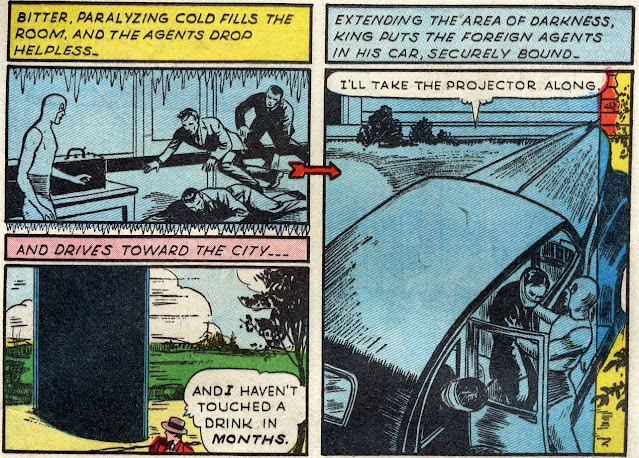
    Radio engineer Bruce King develops the amazingly-named Black Zero Transmitter that selectively allows him to negate light and/or heat in its range of operation, plus an insulated costume and night-vision goggles so that he is immune to its effects. He ends up dealing with nosy reporters and spies inadvertently egged on by said nosy reporters and so adopts the alias of the King of Darkness. Probably the best thing about him is the fact that he will just drive around with the Black Zero Transmitter in his car (or boat! or plane!), with a column of darkness travelling at highway speeds and presumably giving people religious experiences. (Amazing-Man Comics 024, 1941)

    The Blue Lady:

    The Blue Lady is Lucille Martin, who gets mixed up in an attempt to smuggle gold out of China to aid the war effort and ends up gaining super strength from a weird gas released from inside an ancient ring. And since the ring had a bird on it, she has a bird on her hat! Delightful! Unfortunately, this comic came out in 1941 and involved Chinese people, so while it doesn’t indulge in every racist Yellow Peril storytelling trope it does hit a lot of them, including multiple instances of yellowface by the Blue Lady herself. Far less delightful! (Amazing-Man Comics 024, 1941)

    Nightshade:

    Howard Hall is Nightshade, who has the power to control, see, speak etc via his own shadow, with his strength increasing proportional to the shadow’s size. This is, frankly, much cooler than most shadow powers in comics. He’s got little ankle-mounted spotlights to throw shadows with! (Amazing-Man Comics 024, 1941)

    Captain Courageous:

    It’s not especially clear from the couple of appearances I have access to but Captain Courageous seems to be the Uncle Sam kind of patriotic hero – a guy made up of free-floating patriotism. He has the standard array of superpowers – flight, enhanced strength, invulnerability to small arms fire – and I would classify him as a medium-level annoying patriot. He also has a mask that looks very annoying to wear. (Banner Comics 003, 1941)

  • MINOR SUPER-HERO ROUND-UP 003

    King of Darkness: 

    Radio engineer Bruce King develops the amazingly-named Black Zero Transmitter that selectively allows him to negate light and/or heat in its range of operation, plus an insulated costume and night-vision goggles so that he is immune to its effects. He ends up dealing with nosy reporters and spies inadvertently egged on by said nosy reporters and so adopts the alias of the King of Darkness. Probably the best thing about him is the fact that he will just drive around with the Black Zero Transmitter in his car (or boat! or plane!), with a column of darkness travelling at highway speeds and presumably giving people religious experiences. (Amazing-Man Comics 024, 1941)

    The Blue Lady:

    The Blue Lady is Lucille Martin, who gets mixed up in an attempt to smuggle gold out of China to aid the war effort and ends up gaining super strength from a weird gas released from inside an ancient ring. And since the ring had a bird on it, she has a bird on her hat! Delightful! Unfortunately, this comic came out in 1941 and involved Chinese people, so while it doesn’t indulge in every racist Yellow Peril storytelling trope it does hit a lot of them, including multiple instances of yellowface by the Blue Lady herself. Far less delightful! (Amazing-Man Comics 024, 1941)

    Nightshade:

    Howard Hall is Nightshade, who has the power to control, see, speak etc via his own shadow, with his strength increasing proportional to the shadow’s size. This is, frankly, much cooler than most shadow powers in comics. He’s got little ankle-mounted spotlights to throw shadows with! (Amazing-Man Comics 024, 1941)

    Captain Courageous:

    It’s not especially clear from the couple of appearances I have access to but Captain Courageous seems to be the Uncle Sam kind of patriotic hero – a guy made up of free-floating patriotism. He has the standard array of superpowers – flight, enhanced strength, invulnerability to small arms fire – and I would classify him as a medium-level annoying patriot. He also has a mask that looks very annoying to wear. (Banner Comics 003, 1941)

  • MINOR SUPER-HERO 043: MISS AMERICA

    (Military Comics 001-007, 1941-1942) 

    I am not the first to note this by a country mile but it must be said every time she comes up: she wishes to have all of the powers of the Statue of Liberty and then the Statue of Liberty visits her in a dream and gifts them to her. If USA didn’t exist then this would be a shoe-in for “most outlandish patriotic hero concept” but as it stands I reckon that they’re tied.

    Those powers, by the way, aren’t “being enormous and made of bronze” like you might expect but rather a host of generic Golden Age magical abilities such as teleportation, telekinesis and transmutation – particularly of goons into birds and trees and such.

    Miss America gets brought back every once in a while but the most noteworthy thing about her, her wild origin, was retconned in the Eighties. Now instead of wishing for the powers of the Statue of Liberty and then getting them (absurd, laughable) she wished for the powers of the Statue of Liberty near the entrance to a secret government project underneath the statue and was given powers by them (high concept, realistic).

    In conclusion: I quite like Golden Age Miss America but find it hard to get excited about her later incarnations.

  • MINOR SUPER-HERO 033: THE GHOST OF FLANDERS

    (Hit Comics 018-025, 1941-1942)

    I know I talk about how wild the origins of various characters are a lot on here, and I don’t think that I can justify declaring one or another “the most wild” anymore, but the Ghost of Flanders would absolutely have to appear on any reasonably comprehensive Top Ten Characters Who Will Amaze and Befuddle You With Their Wild Origins list.

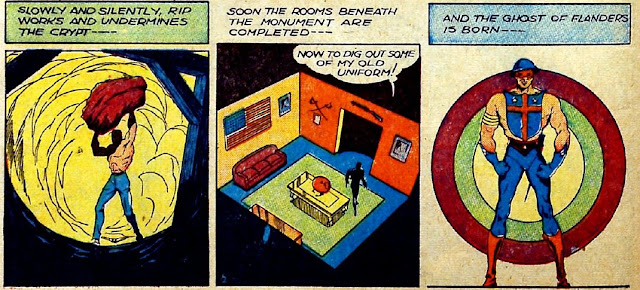
    The Ghost of Flanders is in reality Rip Graves, who enlisted in the US Army during WWI and was basically immediately captured (as the Battle of the Marne took place in July 1918) and spent the rest of the war in a prison camp. This is not especially wild, although it does allow us to know that Graves is 37, a bit older than your typical super-hero (and of course if some enterprising comics writer decides to bring back the Ghost of Flanders for some reason he will automatically be the oldest living WWI veteran)

    The first really wild thing about Rip Graves is this: he is the Unknow Soldier, as in Tomb of the. Now, I looked up the Tomb of the Unknown Soldier the first time I read this story, and checked again just now, and not only is there, you know, a human corpse buried in it but it’s one that they went to reasonable lengths to make sure was, you know, unknown (in short, they located six unidentified US casualties and then had someone choose one at random). “This guy who we know the identity of but don’t have a body for” is almost exactly the opposite of that, in fact.

    Wanting to serve his country but not wanting to own up to being alive because for some reason he believes that the powerful symbolism of the Unknown Soldier will be ruined if it isn’t him specifically, Rip does a normal comics thing and decides to become a costumed vigilante. And what does every costumed vigilante need?

    A secret HQ under a solemn national war monument! Yes, the first thing that Rip Graves does is dig himself out a little man cave underneath the Tomb of the Unknown Soldier, because it’s his.

    Other things about the Ghost of Flanders include:

    -he is the only WWI-themed super-hero that I know of

    -his calling card is a red poppy (natch)

    -he uses WWI-era equipment including bayonets and a biplane, in a kind of natural extrapolation of something like the archer-hero and other users of archaic weaponry

    -I can’t say why he chose the unwieldy Ghost of Flanders name over the excellent Unknown Soldier, but it would take nearly thirty years for someone to take advantage of the excelent name that was just laying there.

    In conclusion: the Ghost of Flanders, a bog-standard 1940s super-hero boom character in most ways, but one that makes me feel crazy to think about too much.

  • NOTES – MARCH 2023

    New Powers:

    An injured Hawkman is tended to by birds and learns to speak their language. (Flash Comics v1 023, 1941)

    Just some of my favourite alien designs ever: the Kriglo AKA Martian Spider-Men (Flash Comics v1 024, 1941)

    Super Hero Costume Party:

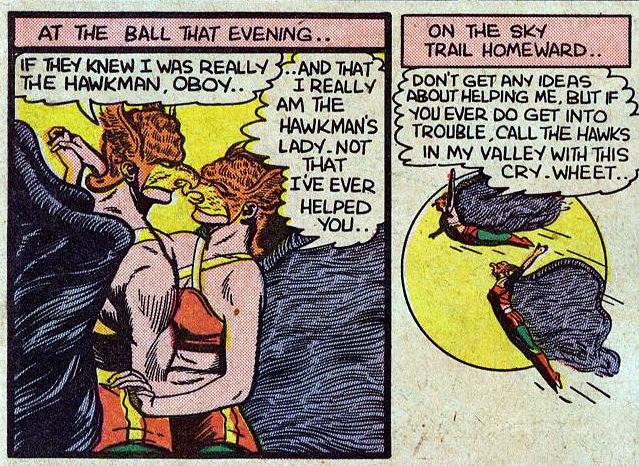
    Hawkman attends a costume party with Shiera Sanders as Hawkgirl. Though not the first time she wore the costume, this does mark the start of the two as a crime-fighting duo ongoing, no matter what stinky ol’ Hawkman says. (Flash Comics v1 024, 1941)

    Rick Raleigh might have intended to attend this party as the Red Bee in that classic cheeky move, but ended up getting mixed up in a murder and attending as a different guy dressed as the Red Bee. (Hit Comics 014, 1941)

    Really enjoy the selection of creature that inhabit the inner earth in the year 50029 CE: Mud Men, Rock Men, hot ladies, and down at the very bottom: guys with beards. (Hit Comics 003, 1940)

    Quality comics with another entry for the list of increasingly unhinged patriotic heroes: Don Glory, the xenophobic jingoist former boxer (Hit Comics 008, 1941)

  • NOTES – MARCH 2023

    New Powers:

    An injured Hawkman is tended to by birds and learns to speak their language. (Flash Comics v1 023, 1941)

    Just some of my favourite alien designs ever: the Kriglo AKA Martian Spider-Men (Flash Comics v1 024, 1941)

    Super Hero Costume Party:

    Hawkman attends a costume party with Shiera Sanders as Hawkgirl. Though not the first time she wore the costume, this does mark the start of the two as a crime-fighting duo ongoing, no matter what stinky ol’ Hawkman says. (Flash Comics v1 024, 1941)

    Rick Raleigh might have intended to attend this party as the Red Bee in that classic cheeky move, but ended up getting mixed up in a murder and attending as a different guy dressed as the Red Bee. (Hit Comics 014, 1941)

    Really enjoy the selection of creature that inhabit the inner earth in the year 50029 CE: Mud Men, Rock Men, hot ladies, and down at the very bottom: guys with beards. (Hit Comics 003, 1940)

    Quality comics with another entry for the list of increasingly unhinged patriotic heroes: Don Glory, the xenophobic jingoist former boxer (Hit Comics 008, 1941)

  • MINOR SUPER-HERO 029: THE BOYVILLE BRIGADIERS

    (Feature Comics 045, 1941)

    It’s a tale as old as time, by which I mean about a year: noncostumed adventurers adopting costumed identities to keep up with the oncoming juggernaut that is the Golden Age super-hero boom. In this case, it’s Rusty Ryan and the other unusually muscular teens of the Boyville orphanage, who up until now were more of a high school sports type of bunch, dealing with the plague of unscrupulous gamblers betting on local hockey games and catching the occasional band of counterfeiters.

    As the Boyville Brigadiers, Ryan and his cohorts are even more dull than what I just described. Rather than the Kirby-style boy gang dynamic of making every member their own distinct style of weirdo, the Brigadiers barely have names, let alone personalities. The only really interesting thing about them, in fact, is how weirdly similar their costumes are to Captain America’s. 

    Still, they go on the list of patriotic heroes. Hooray!

  • RANKING PATRIOTIC HEROES BY DEGREE OF UNHINGED PATRIOTISM INHERENT TO THEIR CONCEPT

    Thinking about this thanks to USA, the Spirit of Old Glory. Will probably add to this as time rolls on: 

    TOP UNHINGED PATRIOTISM

    –Inherently tied to the Myth of their Nation: USA, the Spirit of Old Glory

    –Embodies the spirit of their nation: Uncle Sam, John Bull, Captain Britain

    –Draws power from a symbol of their nation: Liberty Belle, Miss America (Quality)

    –Obnoxiously talks about patriotism all the time and is a jingoistic xenophobe: Don Glory, the Ghost of Flanders

    –Inspired to embody the values of a nation: Wonder Woman

    –Obnoxiously talks about patriotism all the time: Secret Stamp

    –Dresses in patriotic colours to advance patriotism: Captain America, Minute-Man, Mr America, Miss America (Marvel), Star Spangled Kid and Stripesy, the Boyville Brigadiers, the Patriot, the Defender and Rusty

    REGULAR COMIC BOOK PATRIOTISM

  • MINOR SUPER-HERO 028: USA, THE SPIRIT OF OLD GLORY

    (Feature Comics 042-048, 1941)

    USA, the Spirit of Old Glory might just be the most overtly patriotic super-hero concept ever, which is saying something. Especially as she is a Quality Comics character, a company that also featured Uncle Sam (the literal Spirit of America) and Miss America (literally given her powers by the Statue of Liberty) in their roster.

    USA was originally a little girl who saw Betsy Ross sew the first American flag and was just so friggin’ jazzed about the whole thing (and by that locket full of threads) that she immediately ran out into the rain and died. Betsy Ross dropping that last stitch was so metaphorically powerful that an anime dust ring blew out from it and knocked that kid into the Spirit Realm.

    Then, in 1941, she returns! Conspicuously aged up about a decade so that she can fly around with her back arched all the time without it being weird! And she uses her magic flag and torch of liberty to kill lots of spies and traitors!

    Cards on the table: I’m a Canadian, so I’m always looking at American patriotism through an anthropological lens – Canadian patriotism is mostly about being quietly smug about not being American. Like I said before: this is possibly the most ultrapatriotic origin story of all time: the creation myth of America, as it is happening, is so powerful that it creates this super-human. Uncle Sam might be the spirit of America, but the other countries all have spirits too – John Bull shows up once or twice to help beat ass and all of the Nazi-occupied countries languish in a sort of mystic otherworld waiting to be liberated. Uncle Sam being an unstoppable juggernaut is just American exceptionalism, while this here is the mythologization of America.

    ADDENDUM:

    USA’s second appearance introduces perhaps the most on-the-nose weakness for a patriotic hero:

    Yes, all one must do to thwart her is to literally hide behind the flag. These men are kidnapping a man’s child in order to prevent him from testifying about their spy activities, and she knows that. Remarkable!

    ADDENDUM II:

    Surprising nobody, when USA adopts a secret identity in order to do defense work, she goes by the name Usa.