The Curse of Skeleton Munroe

Category: saboteur

  • SUPER-VILLAIN 002 UPDATE: CAPTAIN NAZI (1941)

    SUPER-VILLAIN 002 UPDATE: CAPTAIN NAZI (1941)

    Our second full-fledged super-villain is the odious Captain Nazi, and he had a short but busy run in 1941:

    After being deployed by Adolf Hitler himself as a foil to the threat of the American super-hero, Captain Nazi makes a very public appearance in Times Square in order to issue a challenge to Bulletman. This also attracts the attention of Captain Marvel, leading to the second Fawcett Comics character meetup of 1941 as they decide to team up and kick his ass together.

    In contrast to the bluster of his challenge, Captain Nazis’ activities in NYC are more sneaky sabotage than high-stakes public super-combat. Specifically, an attempt to derail a subway car is foiled by Captain Marvel, while an attempted Ferris Wheel disaster is effectively countered by Bulletman.

    Loathe as I am to praise Captain Nazi  I must admit that he is an effectively ruthless villain – if he didn’t have the misfortune of being pitted against two of the more powerful superhumans available he would be riding roughshod over US infrastructure instead of taking child-hostages and escaping into the shadows.

    After attempt to blow up the Brooklyn Naval Yards – foiled by Captain Marvel, natch – Captain Nazi demonstrates the trademark Fawcett character semi-awareness that he is in a comic book and leaves a note declaring his intent to come over to Whiz Comics to make life difficult there. (Master Comics 021, 1941)

    Sure enough, Captain Nazi returns as promised and continues his campaign of sabotage against a dam and an experimental aircraft.

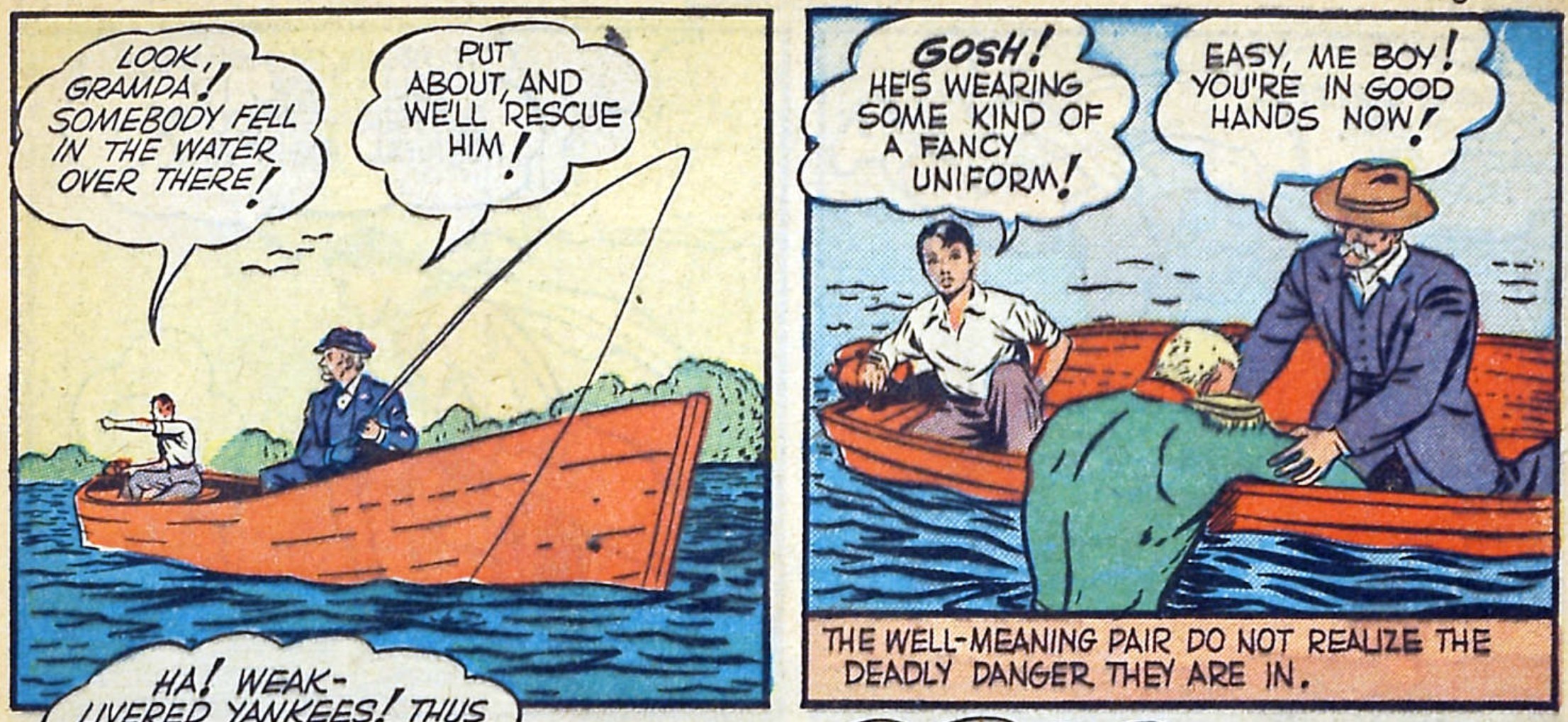
    After being hurled into the ocean by Captain Marvel, Captain Nazi commits the act that he is most well known for as he repays the kindness of young Freddy Freeman’s grandfather by murdering him and making off with his boat, leaving Freddy himself for dead. This of course is the origin of Captain Marvel Junior, as the only way that Freddy survives is by being imbued with a fraction of Captain Marvel’s own power.

    Thus, the villain once again creates his own nemesis.

    (Whiz Comics 025, 1941)

    BODY COUNT: 3+

    END-OF-YEAR STATUS: At Large 

  • MINOR SUPER-VILLAIN 895: THE GHOST OF THE DEEP

    MINOR SUPER-VILLAIN 895: THE GHOST OF THE DEEP

    (America’s Greatest Comics 001, 1941)

    The Ghost of the Deep, a dastardly fellow indeed. As the comic opens, a captive scientist named Hugo has just completed a mysterious formula for him, only to be rewarded with murder.

    In the following days, the Ghost attacks US West Coast shipping, each time leaving behind a calling card in the form of a message in a bottle.

    The Ghost even tries to silence Billy Batson’s fairly routine reporting on the attacks (but why leave a calling card if you don’t want everyone to know you’re responsible?) by taking Billy and his boss Sterling Morris for a proverbial ride. When this is predictably foiled by Captain Marvel, the Ghost of the Deep shows up long enough to demonstrate that he is also a classic comic book Bad Boss by drowning his hapless Teutonic minions.

    There is a bit of radio-based taunting, since Billy is a radio guy. Again, this kind of thing brings into question just why the Ghost of the Deep wants to shut Billy up.

    So just what is the Ghost of the Deep’s plan? And what is this mysterious formula that poor Hugo died for? Why, it’s the recipe for making a transparent, invulnerable alloy called Z-Metal, and using a fleet of tank-submarines composed of the stuff, the Ghost intends on conquering the United States. First stop: blowing up the Panama Canal.

    As for the Ghost’s real identity, well, it’s not revealed until later, but any cagey comics reader will immediately peg this smarmy rival radio man named Spriggins as the top suspect the instant that he walks on-panel. Presumably his cover serves the same purpose as Billy Batson’s: as a way of gathering information and justifying a lot of globetrotting as being in pursuit of a story.

    Ultimately, Spriggins’ plan has one fatal flaw: it fails to account for the presence of a magically super-strong fellow like Captain Marvel, who succeeds where the might of the US Navy cannot and smashes the Z-Metal fleet to smithereens. And then does the same to the Ghost of the Deep’s cool Z-Metal chainmail.

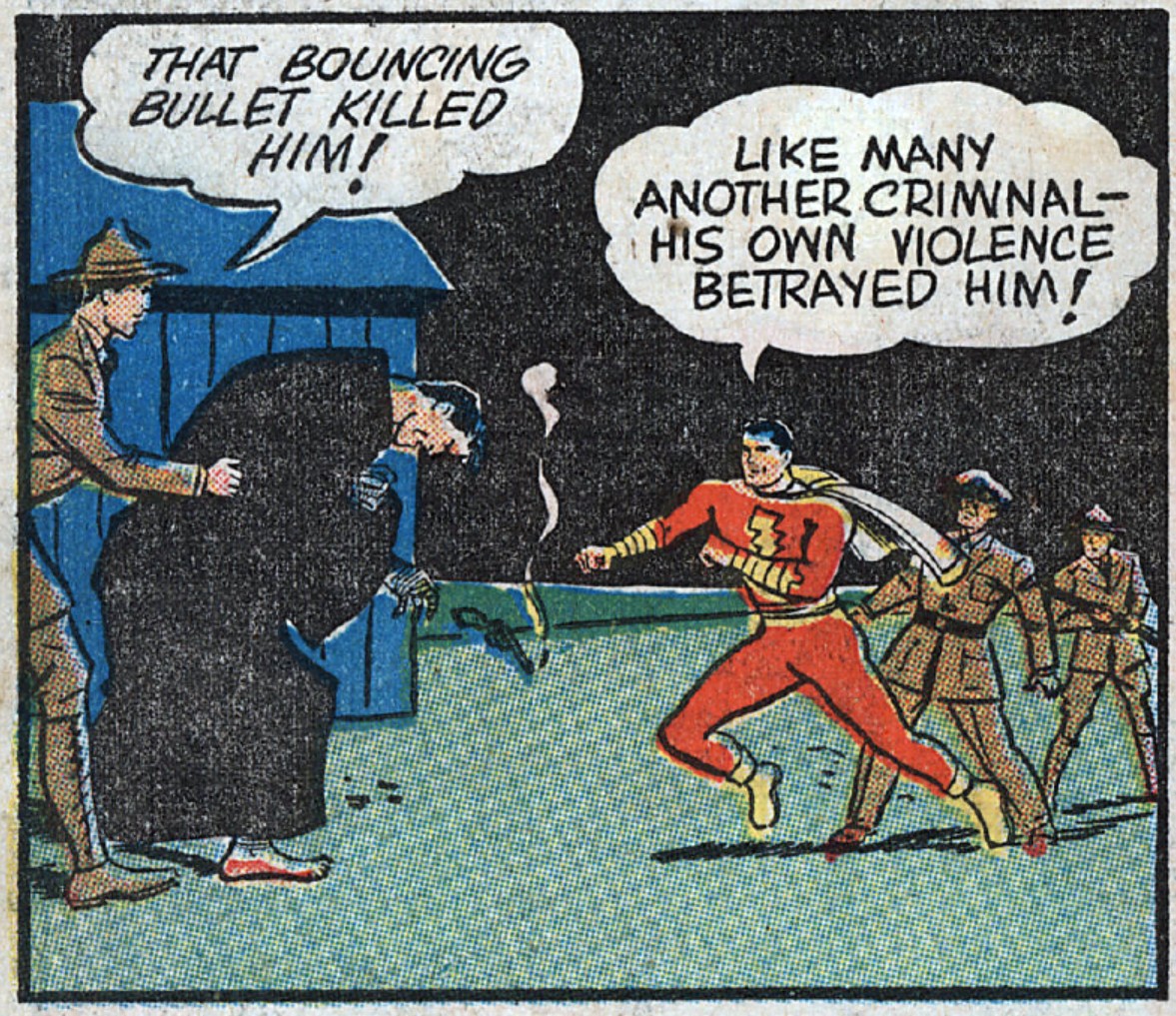
    The captured Spriggins makes one last attempt at striking out at the US by stealing an MP’s gun and taking out a nearby General, only to be intercepted by Captain Marvel and suffer the oft-joked-about but seldom-seen fate of the person who fires a bullet into an invulnerable super-hero’s chest only to have it bounce back and kill them instead. 

  • MINOR SUPER-VILLAIN 869: THE BLACK KNIGHT

    (Zip Comics 001, 1940)

    Shortly after giving himself super powers, Steel Sterling gets word of a brutal bank robbery in the town of Beeville and sets out to bring the culprits to justice. Determining that the crooks must have been guided by a mastermind of some sort, he trails their plane to a mountaintop fortress.

    The bow-wielding guards outside the Black Knight’s fortress (spoiler: it’s the Black Knight’s fortress, but what were you expecting) are notable for being the one time that he has anything related to his chosen theme around, and even they are supposedly only there to prevent… mountain cops?… from hearing the sound of gunfire. Inside, it’s plain old gangsters.

    Gangsters armed with ordinary machine guns are of course no match for a man with all the properties of steel, and Steel Sterling quickly makes his way to the Black Knight’s throne room, where he is immediately dropped into a deep pit full of rats.

    I’d just like to take a second here to appreciate the fact that the Black Knight’s costume is a) 100% brown and yellow with no black at all and b) a pretty conventional super-person getup aside from what appears to be a leather jerkin or similar. Historical, yes, but not particularly knightly. 

    A pit full of rats is also not enough to stop Steel Sterling, and he makes his way out, causes the Black Knight himself to fall in, and sets out after the fleeing gangsters just in time to avoid a secondary deathtrap as the fortress explodes behind him. The Black Knight is finished, it seems.

    The Black Knight is not, in fact, finished, and is soon (Zip Comics 002) hard at work robbing gold and fur shipments coming out of Alaska. Though he manages to capture Steel Sterling when he infiltrates the villain’s fake iceberg base he does a bad job of coming up with a suitable deathtrap for the hero and ends up in the hands of the US Navy.

    Steel Sterling’s next case brings him to the South American nation of Brazonia, where a man called Dr Yar has taken the famous scientist Walter Cummings in order to force him to develop weapons of war and help conquer the gold-rich country. 

    Dr Yar is of course eventually revealed to be an alias (or possibly the real identity?) of the Black Knight. Just why he has abandoned his old moniker is unstated but perhaps it is as simple as a desire not to attract the attention of Steel Sterling again. His new look is at least still visually interesting – particularly the periscopiscopes, which are of course goggles which allow 360 degree vision.

    Dr Yar really leans into the scientist aspect of his new identity, and deploys gadgets such as: flying tanks, oil bombs, electric rays and various viewscreens and visualizers.

    Plus: he not only has Alligator Men at his disposal but also a swarm of giant mosquitoes straight out of an ad for a pest control company (being big does not help them bate through steel skin, alas). 

    Once again the Black Knight/Dr Yar apparently meets his end, and this time it’s explicitly at the hands of Steel Sterling, who stuffs him into the barrel of his own super-howitzer before it fires. A truly brutal end, even for a dedicated super-villain. (Zip Comics 003, 1940)

    Steel doesn’t have to live with any guilt he might feel for long, however, as the Black Knight returns in the next issue, this time climbing the rungs of the aristocracy from mere knighthood to become the Radium King. His new plan is simple: steal the entire US radium supply and then ransom it back for 30 million dollars.

    The Radium King has appropriately impressive digs: an underwater base in Lake Superior that would probably be pretty hard to find if one of his minions hadn’t blabbed under threat of a beating from Steel Sterling.

    The Radium King costume turns out to borrow heavily from the original Black Knight getup, although without a lot of the yellow elements. I’d say that it’s better than the Dr Yar outfit but not as composed as the original, and that the half-mask/mustache combo is particularly unpleasant. Speaking of Dr Yar, the Radium King reveals that he survived Steel’s attempted cannon execution by simply crawling back out of the cannon.

    Not to be robbed of a kill, Steel Sterling uses the Radium King’s own submarine to blow him and his base to high heaven. Surely he’s dead this time! (Zip Comics 004, 1940)

    Not quite! The Black Knight’s fifth and final appearance (under the original name, this time) is probably his most ignominious, though it does feature his cool underground city headquarters, seen above. In it, he engages in a campaign of sabotage, kidnapping and extortion against his former kidnap victim/current minor member of Steel Sterling’s supporting cast Walter Cummings, who has gone into the munitions manufacturing game and has gotten the contract to produce the mysterious Zeta Ray for the US government. Somehow, if the Black Knight can delay production of the US Zeta Ray for long enough then his own scientists can produce one for him and that will be good, and if that description seems vague to you then I must assure you that it is 100% accurate to the comic. I don’t even know what the Zeta Ray does, for heaven’s sake.

    Though Cummings’ first factory is destroyed and his second collapses due to some sabotaged cement, Steel Sterling steps in and has almost completed a third when the Black Knight decides to take a personal hand and ram a tanker truck full of TNT into it. Now here’s the embarrassing part: not only does Steel Sterling handily prevent the truck from destroying the factory, but the first time that he is even aware that the Black Knight is involved in the plot against Dr Cummings is when he spots him just one fraction of a second before he is atomized in the explosion. It’s not even as dignified an end as being shot out of your own cannon would have been. (Zip Comics 005, 1940) 
  • MINOR SUPER-VILLAIN 866: THE SCAR

    (Wonderworld Comics 014, 1940)

    The Scar is a fairly ordinary crypto-fascist spy chief – in his first appearance he is leading a gang of incompetents in a plot to blow up a Europe-bound supply ship, for example – but I’ll be danged if he isn’t well suited to his nickname. Most guys named Scar in 1940s comics are maybe rocking one big facial scar, while our friend here not only has three, but is missing at least one ear! Whatever happened to this guy, he earned that nickname.

    The Scar’s other remarkable property is that he manages to return to vex super-spy K-51 on three separate occasions. In his second appearance, in Wonderworld Comics 015, he spearheads a plan to disrupt the burgeoning US air forces by sabotaging the training program and thus discouraging future applicants. K-51 of course foils this plan as well, but not before the Scar scampers off into the undergrowth and escapes.

    During the Scar’s final appearance, in Wonderworld Comics 016, he is attempting to secure some super-power-inducing powders invented by a Dr Barrow but is unable to do so before Barrow gives them to K-51. When K-51 then decides to use the powders to hunt down the Scar, the spy is so alarmed by the sight of a tiny man wielding a machine gun that he loses all control of his body and topples through a window to his doom. Truly an ignominious end for a slightly better-than-average spy.

  • MINOR SUPER-VILLAIN 866: THE SCAR

    (Wonderworld Comics 014, 1940)

    The Scar is a fairly ordinary crypto-fascist spy chief – in his first appearance he is leading a gang of incompetents in a plot to blow up a Europe-bound supply ship, for example – but I’ll be danged if he isn’t well suited to his nickname. Most guys named Scar in 1940s comics are maybe rocking one big facial scar, while our friend here not only has three, but is missing at least one ear! Whatever happened to this guy, he earned that nickname.

    The Scar’s other remarkable property is that he manages to return to vex super-spy K-51 on three separate occasions. In his second appearance, in Wonderworld Comics 015, he spearheads a plan to disrupt the burgeoning US air forces by sabotaging the training program and thus discouraging future applicants. K-51 of course foils this plan as well, but not before the Scar scampers off into the undergrowth and escapes.

    During the Scar’s final appearance, in Wonderworld Comics 016, he is attempting to secure some super-power-inducing powders invented by a Dr Barrow but is unable to do so before Barrow gives them to K-51. When K-51 then decides to use the powders to hunt down the Scar, the spy is so alarmed by the sight of a tiny man wielding a machine gun that he loses all control of his body and topples through a window to his doom. Truly an ignominious end for a slightly better-than-average spy.

  • MINOR SUPER-VILLAIN 858: THE FROST

    (Wham Comics 002, 1940)

    Just after Blue Fire gets his powers and vows to use them to beat up “criminals, racketeers and foreign spies” he is served a chance to do so on a silver platter when his local newspaper carries an account of a ship at sea being sabotaged by a very cold man who just stood around in the engine room until everything broke. 

    Making his way to the ship in question, Blue Fire uses his intangibility power to invade the passengers’ privacy by searching every stateroom until he finds some orders written in “a foreign language” that prove the saboteur’s identity, just in time for the man himself to make an appearance. One hastily-gulped-down pill later, the man is revealed to be the Frost, which is a very good name for a cold guy. More importantly, the Frost might just be the best look for a cold-based character that I have ever seen – the heavy shading combined with the thick coat of clear ice is dynamite.

    Since Blue Fire is not actually a fire guy but an intangibility guy, he and the Frost are purely thematic and not elemental opposites, and it in fact turns out that thanks to the always-on nature of Blue Fire’s powers they are hilariously unable to do any harm to one another (though thanks to the Frost’s motor mouth we do learn his precise weight, a bit of a rare occurrence in the days before the likes of the Official Handbook of the Marvel Universe). 

    Blue Fire ends up retreating after the fight drags on long enough that he is at risk of becoming tangible again, and the Frost is able to make a getaway while his foe is rounding up the ship’s crew to deal with him. And since Blue Fire never makes another appearance, the Frost is yet another super-crook left at large by default. Damn you, whims of the early comics industry!

    (someone should absolutely steal the Frost’s look for another cold cguy. It’s dynamite, I tell you!

  • MINOR SUPER-VILLAIN 833: THE MASTER

    (Top-Notch Comics 005, 1940) 

    The Mosconians, stand-ins for Nazi-allied Russia (or possibly just Russian-flavoured stand-ins for Nazi Germany) have a lot more stick-to-itiveness than your typical gang of foreign espionage agents, to the extent that they manage to not only bedevil the Wizard for three whole issues but also the Shield over in Pep Comics, leading to what is touted as the first super-hero crossover in comics (as previously seen here). The Master is the shadowy figure behind the Mosconian schemes and as seen above he even managed to kidnap the Wizard’s brother Grover! A decent showing for a crypto-fascist, considering how ephemeral they usually are.

    The actual crossover-precipitating plan is an attempt to blow up the military academies at Annapolis and West Point, thus shutting off the supply of officers to the US armed forces and incidentally killing off a portion of the country’s political officials as they attend a ceremony at the latter. The actual crossovers between the Wizard and the two students is fairly ships-in-the-night – he basically waves at them as he leaves to beat up Mosconians at a second location.

    The Mosconians and their Master return in Top-Notch Comics 006 with an attempt to blow up Boulder Dam*, which is one of those plots that would be pretty horrifying in real life but is not so exciting or unusual in a comic book. This is also the point at which the Mosconians start to get really German.

    *Hoover Dam, which I just learned was in a state of naming limbo for years and only officially became Hoover in 1947! 

    The Mosconians next plot, in Top-Notch Comics 007, involves an attack on the Golden Gate Bridge. The Wizard manages to track them down to their staging area in British Columbia, where the Master is finally unmasked and revealed to be the Mosconian ambassador to the United States (not much of a surprise). This is also the point at which the Wizard is chemically blinded, leading him to change his costume to a more standard super-heroic one with no noticeably different eye protection. So attired, he rounds up the plotter in San Francisco with the aid of the Shield.

  • MINOR SUPER-VILLAIN 833: THE MASTER

    (Top-Notch Comics 005, 1940) 

    The Mosconians, stand-ins for Nazi-allied Russia (or possibly just Russian-flavoured stand-ins for Nazi Germany) have a lot more stick-to-itiveness than your typical gang of foreign espionage agents, to the extent that they manage to not only bedevil the Wizard for three whole issues but also the Shield over in Pep Comics, leading to what is touted as the first super-hero crossover in comics (as previously seen here). The Master is the shadowy figure behind the Mosconian schemes and as seen above he even managed to kidnap the Wizard’s brother Grover! A decent showing for a crypto-fascist, considering how ephemeral they usually are.

    The actual crossover-precipitating plan is an attempt to blow up the military academies at Annapolis and West Point, thus shutting off the supply of officers to the US armed forces and incidentally killing off a portion of the country’s political officials as they attend a ceremony at the latter. The actual crossovers between the Wizard and the two students is fairly ships-in-the-night – he basically waves at them as he leaves to beat up Mosconians at a second location.

    The Mosconians and their Master return in Top-Notch Comics 006 with an attempt to blow up Boulder Dam*, which is one of those plots that would be pretty horrifying in real life but is not so exciting or unusual in a comic book. This is also the point at which the Mosconians start to get really German.

    *Hoover Dam, which I just learned was in a state of naming limbo for years and only officially became Hoover in 1947! 

    The Mosconians next plot, in Top-Notch Comics 007, involves an attack on the Golden Gate Bridge. The Wizard manages to track them down to their staging area in British Columbia, where the Master is finally unmasked and revealed to be the Mosconian ambassador to the United States (not much of a surprise). This is also the point at which the Wizard is chemically blinded, leading him to change his costume to a more standard super-heroic one with no noticeably different eye protection. So attired, he rounds up the plotter in San Francisco with the aid of the Shield.

  • MINOR SUPER-VILLAIN 552 UPDATE: BARON VON KAMPF (1940)

    Making his triumphant return to comics, the dome-headed goblin of crime: Baron von Kampf!

    Baron von Kampf’s initial return in Speed Comics 004 involves him heading a sabotage ring for an unnamed European nation that is probably meant to be Nazi Germany, and it’s possible that this is a relationship that were were meant to understand was behind his actions all along, but frankly it seems to me to be beneath him.

    The Baron’s schemes on behalf of his fascist overlords bring him to a secret submarine base, which is how he ends up stranded in the middle of the Atlantic after a final confrontation with Shock Gibson. Will he survive?

    Indeed he will, and does! The Baron returns in Speed Comics 006, and I could not tell you if he’s still working for the fascists or if he just likes a uniform. The Baron spends much of this issue employing the services of a bunch of crooks called the Palooka Gang to hijack trucks, and though he claims that this is in aid of a larger world conquest scheme I’d be tempted to call it a bit low-rent as far as super-villainy is concerned. Fortunately for his reputation, he still knows how to accessorize, and his headquarters (Mammoth Cave, Kentucky) and minions (the Zombies, making their long-awaited reappearance) really save the day.

    How can I complain about truck hijacking when they’re being done with such style?

    The coolness of living in a cave, of course, is offset by the ever-present threat of being crushed to death in a cave-in, and doubly so when you’re doing battle with a guy like Shock Gibson on the regular. Baron von Kampf manages to sneak out a side passage, but the Palooka Gang and this batch of Zombies are all toast, and the Harvey Comics version of Mammoth Cave is certainly the worse for wear.

    Baron von Kampf’s final appearance is in Speed Comics 011, in which he teams up with pseudo-Soviet spy and future entry Comrade Ratski, in what is probably a reference to the then-ongoing Soviet-Nazi nonaggression pact. What is certain about this alliance, however, is that Comrade Ratski is in charge – he seems to have taken von Kampf on as a partner mainly because he wants to use the Zombies as henchmen.

    Speaking of the Zombies, this is their final appearance, and while that is disappointing there is a silver lining, as we get a final bit of lore about the top band of henchcreatures of the 1940s: they can speak, and they speak in backward sentences. Fun!

    Like I said the scheme in this comic is basically all down to Comrade Ratski so we’ll cover it in his entry, but suffice to say it does not go well once Shock Gibson gets wind. Ratski and von Kampf make their escape into the depths of the Florida Everglades and end up as alligator chow.

  • MINOR SUPER-VILLAIN 749: THE SABOTEURS

    (Smash Comics 015, 1940)

    Sometimes all you need is a group of mercenary saboteurs dressed in matching cloaks and gas masks to zazz up a story – Black X and his comic book contemporaries have faced and defeated hundred of sabotage plots in front of my now-jaded eyes over the course of my comics-reading career, and so it takes a bit more than your basic pseudo-Nazi in a suit and tie to get my attention. That there is a suit-and-tie pseudo-Nazi behind the scheme to blow up a city that is technically never called New York is irrelevant, as it’s the cloak-and-gas mask guys who matter.

    Black X and Batu do not of course let this campaign of destruction stand, and despite some unusually acrobatic fighting moves on behalf of the Saboteurs the whole bunch of them are brought to justice after only a moderate amount of infrastructure is exploded.