The Curse of Skeleton Munroe

Category: calling card

  • MINOR SUPER-HERO ROUND-UP 093

    Fox Features, you burned hot and bright and brought us so many minor super-heroes.

    the Black Fury:

    The Black Fury, like Bob Phantom before him, is a newspaper gossip columnist who moonlights as a costumed vigilante. What are the chances that we would have two of those? I enjoy his costume even if it is somewhat generic even for 1941, though I am a bit upset that the glowing gemstone on his and his sidekick’s foreheads is never addressed. For instance: is it really glowing or is that a stylistic choice?

    As of his first appearance, John has already been the Black Fury for an unspecified amount of time, having adopted the mantle after his father was killed by gangsters for writing “anti-crime editorials” in the newspaper, a thing that comic book criminals react to like they are a farm lobby trying to influence government nutritional guidelines. (Fantastic Comics 017, 1941)

    Categorized in: Day Job (Newspaper Columnists), Origin (Crime Orphans), Supranormal Beings (Mythological – Furies)

    Chuck:

    John Perry relates his origin as the Black Fury to young Chuck Marley after Chuck’s own father, Police Sergeant Marley, is killed by henchmen of the evil Fang. Chuck is essentially bequeathed to Perry as the elder Marley lies dying, which is a very straightforward way for a hero to acquire a boy for sidekick duties.

    Chuck does not get his own super-hero name, alas (at least not right away, spoilers for some comics from 1942), but he does get his own costume, which is more than a lot of sidekicks can say. The fact that his costume is exactly the same as the Black Fury’s does make it a bit difficult to tell them apart at times but that’s a small price to pay for the peace of mind of knowing that Chuck’s identity is at least somewhat protected. (Fantastic Comics 017, 1941)

    Categorized in: Day Job (High School Students),  Origin (Crime Orphans), Origin (Sidekicks)

    the Banshee:

    The origin story of the Banshee involves a remarkable number of steps. First, Irishman Jim O’Donnell finds that his step-father has been murdered out on the moors by the evil Scorpion, who is only prevented from bumping off Jim as well because he is extremely superstitious, mistakes a wailing wind for the cry of a banshee and runs off.

    Jim discovers that the Scorpion has set out for the United States and, unable to secure a visa (“I am seeking vengeance on my step-father’s killer” seemingly not good enough. Probably they would have let him in if it was his full-on father, though) stows away on a steamship. He is spotted disembarking in New York, making him one of the small group of super-heroes whose civilian rather than super identities are wanted by the authorities and the only one that I am aware of who is wanted for entering the country illegally.

    But just why is the Scorpion in America? Why, to murder Jim’s step-father’s niece, who, as his only remaining blood relative, will inherit some land that is rich in gold and which the Scorpion is trying to get his mitts on. Just why Jim is out of the picture is unexplained – he and his step-dad have a relationship that is at the very least strong enough for a vengeance quest, so why shouldn’t Jim be in the will?

    Jim once again benefits from the Scorpion’s banshee-focused superstitions after he falls through a load of bedsheets and onto the villain’s head, with an assist by a distant police siren. This might just be the rarest and dumbest of super-hero costume origins, the Dressed by Slapstick approach.

    Having enacted his vengeance, Jim decides to remain in the US and continue his fight against crime as the Banshee. He throws together a more super-heroic version of his accidental costume and crashes on Joan’s couch while he figures out what to do about work, and it’s okay that Joan kind of becomes his love interest because she is only his step-cousin. 

    All this just to have an Irish guy fighting crime in NYC.  (Fantastic Comics 021, 1941)

    (from Fantastic Comics 022 on, Jim adopts a simpler version of his initial pass at the super-hero look. He also adopts the “banshee wail” as his calling card rather than simply relying on it to happen diegetically as needed)

    Categorized in: Accessories (Style – Calling Cards, Costume Origins),  Origin (Crime Orphans), Supranormal Beings (Banshees)

    Samson **UPDATE**:

    Some time in mid-to-late 1941, Fox Features presumably decided to round out a few of their more prominent characters such as the Flame, the Green Mask and Samson and give them a supporting cast so that they weren’t just ping-ponging from adventure to adventure without any sense of continuity. In Samson’s case, he gained a love interest with the very on-the-nose name of Lila Dee, along with a moderately annoying comic relief character in the form of perpetually-horny artist J. Rembrandt Speedball.

    The same issue marks the very first time that someone thought to have David use a sling instead of just going around lassoing people the whole time. Credit to Al Carreño for that one. (Fantastic Comics 022, 1941)

    This is also when Samson takes a stab at having a secret identity, but since he still has to have his trademark shoulder-length hair and that is a Huge Giveaway in 1941, this involves wearing a Very Big Coat with a Very Big Collar that he can pull up around his ears. Did he even try a wig before going coat shopping, you reckon? (Fantastic Comics 023, 1941)

  • MINOR SUPER-HERO ROUND-UP 093

    Fox Features, you burned hot and bright and brought us so many minor super-heroes.

    the Black Fury:

    The Black Fury, like Bob Phantom before him, is a newspaper gossip columnist who moonlights as a costumed vigilante. What are the chances that we would have two of those? I enjoy his costume even if it is somewhat generic even for 1941, though I am a bit upset that the glowing gemstone on his and his sidekick’s foreheads is never addressed. For instance: is it really glowing or is that a stylistic choice?

    As of his first appearance, John has already been the Black Fury for an unspecified amount of time, having adopted the mantle after his father was killed by gangsters for writing “anti-crime editorials” in the newspaper, a thing that comic book criminals react to like they are a farm lobby trying to influence government nutritional guidelines. (Fantastic Comics 017, 1941)

    Categorized in: Day Job (Newspaper Columnists), Origin (Crime Orphans), Supranormal Beings (Mythological – Furies)

    Chuck:

    John Perry relates his origin as the Black Fury to young Chuck Marley after Chuck’s own father, Police Sergeant Marley, is killed by henchmen of the evil Fang. Chuck is essentially bequeathed to Perry as the elder Marley lies dying, which is a very straightforward way for a hero to acquire a boy for sidekick duties.

    Chuck does not get his own super-hero name, alas (at least not right away, spoilers for some comics from 1942), but he does get his own costume, which is more than a lot of sidekicks can say. The fact that his costume is exactly the same as the Black Fury’s does make it a bit difficult to tell them apart at times but that’s a small price to pay for the peace of mind of knowing that Chuck’s identity is at least somewhat protected. (Fantastic Comics 017, 1941)

    Categorized in: Day Job (High School Students),  Origin (Crime Orphans), Origin (Sidekicks)

    the Banshee:

    The origin story of the Banshee involves a remarkable number of steps. First, Irishman Jim O’Donnell finds that his step-father has been murdered out on the moors by the evil Scorpion, who is only prevented from bumping off Jim as well because he is extremely superstitious, mistakes a wailing wind for the cry of a banshee and runs off.

    Jim discovers that the Scorpion has set out for the United States and, unable to secure a visa (“I am seeking vengeance on my step-father’s killer” seemingly not good enough. Probably they would have let him in if it was his full-on father, though) stows away on a steamship. He is spotted disembarking in New York, making him one of the small group of super-heroes whose civilian rather than super identities are wanted by the authorities and the only one that I am aware of who is wanted for entering the country illegally.

    But just why is the Scorpion in America? Why, to murder Jim’s step-father’s niece, who, as his only remaining blood relative, will inherit some land that is rich in gold and which the Scorpion is trying to get his mitts on. Just why Jim is out of the picture is unexplained – he and his step-dad have a relationship that is at the very least strong enough for a vengeance quest, so why shouldn’t Jim be in the will?

    Jim once again benefits from the Scorpion’s banshee-focused superstitions after he falls through a load of bedsheets and onto the villain’s head, with an assist by a distant police siren. This might just be the rarest and dumbest of super-hero costume origins, the Dressed by Slapstick approach.

    Having enacted his vengeance, Jim decides to remain in the US and continue his fight against crime as the Banshee. He throws together a more super-heroic version of his accidental costume and crashes on Joan’s couch while he figures out what to do about work, and it’s okay that Joan kind of becomes his love interest because she is only his step-cousin. 

    All this just to have an Irish guy fighting crime in NYC.  (Fantastic Comics 021, 1941)

    (from Fantastic Comics 022 on, Jim adopts a simpler version of his initial pass at the super-hero look. He also adopts the “banshee wail” as his calling card rather than simply relying on it to happen diegetically as needed)

    Categorized in: Accessories (Style – Calling Cards, Costume Origins),  Origin (Crime Orphans), Supranormal Beings (Banshees)

    Samson **UPDATE**:

    Some time in mid-to-late 1941, Fox Features presumably decided to round out a few of their more prominent characters such as the Flame, the Green Mask and Samson and give them a supporting cast so that they weren’t just ping-ponging from adventure to adventure without any sense of continuity. In Samson’s case, he gained a love interest with the very on-the-nose name of Lila Dee, along with a moderately annoying comic relief character in the form of perpetually-horny artist J. Rembrandt Speedball.

    The same issue marks the very first time that someone thought to have David use a sling instead of just going around lassoing people the whole time. Credit to Al Carreño for that one. (Fantastic Comics 022, 1941)

    This is also when Samson takes a stab at having a secret identity, but since he still has to have his trademark shoulder-length hair and that is a Huge Giveaway in 1941, this involves wearing a Very Big Coat with a Very Big Collar that he can pull up around his ears. Did he even try a wig before going coat shopping, you reckon? (Fantastic Comics 023, 1941)

  • MINOR SUPER-HERO ROUND-UP 091

    Have a few mid-tier minor super-heroes, for a change.

    the Black Terror:

    Pharmacist Bob Benton is the kind of guy who will step in when a little kid is being roughed up by thugs, but despite this he is pretty relentlessly bullied by city Comptroller Rodney Clark* and (in a less overt but still insidious way) their mutual love interest Jean Starr.

    * Clark is such a bully, in fact, that I assumed that he was going to eventually turn out to be crooked but instead he gets murdered** after a couple of issues.

    ** In fact I was wrong when I wrote this: he is merely almost  murdered and seemingly never recovers sufficiently to return to the comic. I guess I was just hoping that he would get murdered because he is, again, such a bully.

    Perhaps because of this, Benton spends his spare time working on a “tonic for run-down people,” or so he says. I assume that he’s going for something closer to anabolic steroids, and thanks to his new assistant Tim Roland (the kid who was getting beaten up earlier), he stumbles upon the formula for something even better: formic ether! 

    Thanks to those sweet sweet formic ether fumes, Benton becomes a super-human and in a real break for society decides to keep on being a decent guy rather than setting out for revenge on all those people who pushed him around when he was weak (though he does take the opportunity to give Rodney Clark a black eye every issue until he’s murdered he retires). He gets his super suit in the most efficient way possible: by sending Tim down to the costume shop to see what they have in stock.

    The formic ethers give Benton tremendous strength and a sort of mid-tier invulnerability: he can shrug off a sock on the jaw no problem, and eventually proves to be bulletproof, but he gets knocked around and knocked out an awful lot. (Exciting Comics 009, 1941)

    Tim Roland:

    Though Bob tells Tim that he can’t join him on his quest for vigilante glory, he also just kind of leaves a smoking bottle of super power serum sitting out where anyone can get it – frankly he’s lucky not to have to team up with Rodney Clark. Instead, Tim – who has had the foresight to pick up a second costume for himself, but not to pick a super-hero name – huffs a little formic ether and gets straight to busting heads.

    Tim is the rare Golden Age sidekick who appears to be legitimately around eight to ten years old, instead of a stocky thirteen to fifteen like so many of his peers. Even more remarkably, he stays roughly in this age bracket for a couple of years, as far as can be ascertained (multiple artists mean that his height fluctuates quite a lot, but he pretty consistently wears short pants in his civilian identity). He’s also one of those orphan boys who just kind of falls into a super-guy’s orbit and becomes adopted by default. (Exciting Comics 009, 1941)

    The Black Terror dabbles in the common practice of leaving a calling card in his first appearance, and makes the baffling decision to go with his domino mask as a design, rather than the cool skull-and-crossbones on his chest.

    Categorized in: Accessories (Calling Cards), Body (Emotions – Terror), Origins (Chemical Mutates), Origins (Sidekicks)

    the Sphinx **UPDATE**:

    The Sphinx adopts the identity of the Domino Kid in order to have a very brief boxing career. (Exciting Comics 012, 1941)

    Categorized in: Origins (Secondary Identities)

    the Liberator:

    Like many super-heroes, the Liberator starts out as a weedy nerd. Specifically, he is Dr Nelson Drew, lecturer in Chemistry at Claflin College. He is, troublingly, in love with Annabel, one of his students, who also serves as one of his major bullies – she is not only bored by chemistry (but you chose to take the course, Annabel!) but also scornful of Drew for caring about it when so much is afoot in the world, but… I don’t actually know what her problem is? Like, chemistry was wildly consequential to the US war effort? Perhaps if he taught a social science I could see her point of view, if not agree with it. 

    While doing a little light research into Ancient Egyptian poisons (okay, this is arguably inconsequential), Drew discovers the lost formula for a drug called Lamesis which will supposedly make one into their physical ideal. Though skeptical, he brews up a batch and since his lab safety appears to be nonexistent (troubling indeed for a guy who is researching poisons) he immediately gets a snootful of the stuff, and  turns into a big ol’ hunk. I really enjoy how viscerally unpleasant the transformation process looks here – sadly this transformation conceit doesn’t last more than a couple of issues.

    This unexpected transformation isn’t a dream come true for Drew, and he spends his first outing in his new body – the Lamesis turns out to be a temporary thing, you see – trying to figure out how to turn back, and engages in his first bout of super-heroism after discovering that the scientist he was trying to consult with had been murdered by fascists. 

    I also enjoy the origin of the Liberator’s costume: there are plenty of super-heroes going around in their old Halloween costumes, but he might be the only one who gets his outfit by stealing someone else’s. Would he have become such an explicitly patriotic hero if he hadn’t ended up in a star-spangled shirt? (Exciting Comics 015, 1941)

    Categorized in: Accessories (Drugs), Day Jobs (College Professors), Origins (Patriotic Heroes)

    VERY MINOR UPDATES:

    John Thesson, aka the Son of the Gods, after being a character of no fixed address for his first several appearances, finally settles down: he was in Washington DC in Exciting Comics 006, but it wasn’t until 007 that it became clear that that is where he chose to hang his hat and offer his services to the US Government.

    The Mask sheds two of his assistants, Silk and Butch, as of Exciting Comics 007, and becomes of interest to the law somewhere between 009 and 010. 

  • MINOR SUPER-VILLAIN 958: THE YELLOW HOOD

    (Dynamic Comics 002, 1941)

    In probably the cheekiest campaign of terror ever, American defense officials are being murdered and then their shrunken skulls are being sent along to places where people are waiting for them with notes reading “Don’t wait for me any longer, here I am.”

    You may have noticed that all of the skull deliveries involved a man named Professor Curran, and being seasoned comics readers you rightly would have suspected that he was involved in the scheme somehow. It can’t be him, however, as Curran is one of the victims, murdered just out of sight of a captured Major Victory.

    Just kidding: the Yellow Hood and Professor Curran are one and the same, and the murder was staged to throw suspicion off of him. Curran’s role as a Chief Air Warden meant that he was in a prime position to facilitate a Nazi invasion of the United States, and the murders were designed to weaken US defenses further. It’s a high risk/ high reward endeavour, as evidenced by the fact that Curran chucks himself off a cliff rather than be captured by Major Victory.

    Categorized in: Accessories (Calling Cards), Colours (Yellow), Objects (Hoods)

  • MINOR SUPER-HERO ROUND-UP 086

    In contrast to the last group of minor super-heroes, 3/4 of these guys have a teeny-tiny chance of appearing in a modern comic. Like, 5% more.

    Mister E: 

    Mister E, aka “wealthy sportsman Victor Jay,” is a masked vigilante of the suit-and-cape type, and is remarkable mainly for the fact that Marvel Comics doesn’t really have that many of those kind of guy. In his one recorded adventure he battles the very entertaining Vampire to a stalemate. After this singular adventure, Mr E is not seen again until J. Michael Straczynski’s The Twelve, in which he mainly exists to be emotionally crushed as an object lesson in how being a super-hero can have an impact on your real life, you guys. (Daring Mystery Comics 002, 1941)

    Categorized in: Alphanumeric (E)*, Day Jobs (Wealthy Socialites), Generica (Misters)

    *we’re up to 12 out of 26 letters! 

    the Laughing Mask:

    Dennis Burton, assistant district attorney and latest in a long line of Burton lawmen, is also one of the many, many comic book law officers who adopt a costumed identity in order to enact justice via fist and gun. Burton’s real spin on the concept of vigilantism is in his choice of costume: a simple red-and-yellow number topped off with a theatrical comedy mask. Eerie! 

    The Laughing Mask is a calling card leaver of the ominous school, and while this is not exactly groundbreaking stuff I do enjoy seeing how he sets it all up. Someone like the Blue Beetle must be doing all this creeping around in crawlspaces to achieve this kind of effect too, but we never get to see it. (Daring Mystery Comics 002, 1940)

    Categorized in: Accessories (Calling Card Leavers), Activities (Laughing), Day Jobs (Assistant District Attorneys) 

    the Purple Mask:

    Nothing gold can stay, as Ponyboy, or possibly Sodapop, said, and quirky Golden Age super-heroes are no exception. For the second and third of his three appearances, Dennis Burton sets aside his golden mask to adopt a far more generic costume. At least it’s a new mask colour for us. (Daring Mystery Comics 003, 1940)

    Categorized in: Colours (Purple), Objects (Masks) 

    Breeze Barton:

    Breeze Barton is more of a science fiction adventurer than a super-hero, but the particulars of his story are weird enough that I want to talk about them. Breeze is a US soldier fighting in World War II, only not our World War II but a near future version of the war (1945 CE) in which American and Japanese forces are clashing in South Africa and the US Army Air Force has instituted a furry-shouldered look in their pilots’ uniforms. Shot down while on a scouting flight, Breeze crashes his plane in the Sahara Desert (a truly staggering distance to travel between being shot down and crashing – the entire length of Africa, essentially!). 

    While wandering around the desert, Breeze then falls through a dimensional portal called the Spot and finds himself in Miracle City, which is populated by people from across the breadth of human history who have fallen through the Spot and who now do not age thanks to the properties of the Spot Dimension. There are also dinosaurs running around, plus the hostile Demon Folk, who are native to the dimension and who want to invade the Earth for some reason. To finally know death, I guess? 

    Breeze eventually figures out the trick to going back through the Spot and returns to Earth to find that it is now 1995 and that the war has been going on for the entire 50 years that he was away. Thanks to the relentless grind of the war humanity has reverted to a state ranging between medieval and stone age. The exception to this is a small remnant of the military forces, who have now banded together as the last bastion of civilization. This is all very interesting, especially if you consider the intermediate period in which society is starting to stagnate but the military is still organized and powerful enough to maintain the former state of things within its ranks. Now, as the military forces finally start to fall, Breeze Barton emerges to rally them and rebuild a non-war-based society.

    In conclusion, Breeze Barton is a fellow from a near-future alternate history and then a moderate-future alternate history (but both in the past as far as we’re concerned) with a bit of dimensional travel in between. Also he is eventually and inexplicably brought back to die in a 2012 Marvel Zombies book. (Daring Mystery Comics 003, 1940)

    Categorized in: Day Jobs (Military), Origin (Heroes of the Future)

    the Phantom Reporter:

    The Phantom Reporter is actually Dick Jones, smart alec cub reporter for the Daily Express, and like his fellow news-themed super-hero the Press Guardian I really must stress that making such a clear link between your secret and public identities is a bad idea in the long run. Why, if Clark Kent had chosen “Super-Reporter” as his nom de geurre, Lois Lane would’ve been on him like a hawk.

    There are no shortage of suit-wearing mystery men in comics (though as mentioned in the Mister E entry, not so many in Marvel Comics) and they all trend toward the mildly superhuman in their physical prowess. The Phantom Reporter goes a bit farther than that, with a punch so powerful that he straight-up kills his first three opponents with his bare mitts. There was only the one Golden Age adventure for the Reporter, so we cannot say if this trend would have continued or not but it definitely would have set him apart from the regular vigilante crowd.

    Dick “the Phantom Reporter” Jones is of course eventually brought back in The Twelve just like Mr E and the Laughing Mask, in his case as the audience surrogate. One thing that falls by the wayside in the course of this is the fact that newspaper reporter Dick “the Phantom Reporter” Jones is also a wealthy socialite named Mr van Ergen, with the implication being that van Ergen is the real, original guy and that Jones and the Reporter are both alternate identities. Interesting, but not particularly conducive to being an everyman character. (Daring Mystery Comics 003, 1940)

    Categorized in: Day Jobs (Newspaper Reporters), Professions (Journalism), Supranormal (Phantoms)

  • MINOR SUPER-HERO ROUND-UP 083

    MINOR SUPER-HERO ROUND-UP 083

    Oh boy! Minor super-heroes!

    13: 

    13 (aka Thirteen, although the numerical version of the name is the official one) is the alias of Harold Higgins, whose life has been haunted by a series of misfortunes related to the number thirteen. A timeline of some of them:

    February 13, 1940: Harold’s brother Bob dies in a plane crash.

    March 13, 1940: Harold loses his life savings in the stock market.

    May 13, 1940: Harold’s sister Margy is paralyzed in a car accident.

    July 13, 1940: Harold’s father is lost at sea.

    September 13, 1940: Harold’s fiance is killed in a hit and run.

    April 13, 1941: Harold loses his job as a reporter to a crooked editor looking to cover up a story. 

    All of this (and more! A text story in Daredevil Comics 005 adds the facts that he was born on Friday the 13th, that minor tragedies like a broken leg or academic failure had frequently befallen him on the 13th of any given month and that at his thirteenth birthday party his childhood sweetheart Helen was killed by a falling chandelier) has clearly preyed on Harold’s mind, to the point that he is finding the number everywhere including his own name.

    Rather than, say, moving to a small shack in the woods to keep others safe from his constant misfortune, Harold decides to weaponize his bad luck by bringing it to criminals via his fists. Does this work, logically? Not really, but it’s a decent enough comic book origin.

    Like many super-heroes and villains, 13 flirts with the idea of leaving a calling card in his first adventure but doesn’t maintain the practice. In this case, it’s a calendar page with the 13th of the month circled. (Daredevil Comics 003, 1941)

    Finally, a couple of minor things about 13: In Daredevil Comics 004 we learn that like many of his peers he wears his costume under his clothes for quick-change action. Intriguingly, the above panel seems to imply that this includes his mask, which appears to be either acting as a liner for his hat or worn as a kind of bandana under it.

    Finally, in Daredevil Comics 006, 13 moves from the super-hero crammed streets of NYC to the lesser-served Boston.

    Categorized in: Abstract Concepts (Luck), Accessories (Calling Cards), Alphanumeric (Thirteen)

    Jinx: 

    Recently orphaned Darrel Creig has just inherited the family steel fortune, something that rankles his guardian, uncle and the only other potential heir Moldon Creig. Thus, a family outing to the Statue of Liberty, where Moldon and Darrel’s tutor Travers expedite the inheritance process by tossing him off the statue’s torch.

    Luckily for young Darrel, 13 happens to be present to stop an unrelated attempt to bomb the statue, and after saving the lad the two of them beat up Moldon and Travers and hand them over to the authorities.

    As we all know, if a costumed vigilante happens across an orphaned boy who can throw a punch they are allowed to keep them, which is just what happens with 13 and Darrel, and though Darrel’s connection to the bad luck theme is much more tenuous than Higgins (he is an orphan, if a wealthy one, and he is the very spooky age of thirteen years old) he is promptly given a slightly worse costume than 13’s and anointed as his sidekick Jinx. (Daredevil Comics 005, 1941)

    Categorized in: Abstract Concepts (Luck), Day Job (High School Students), Origin (Sidekicks)

    the Ghost: 

    The Ghost is a super-hero who seemingly exists solely to combat the menace of the Claw as he troubles America’s shores once more, Daredevil having moved on to less stressful pursuits.

    Though presented as a normal human man, the Ghost not only has the acrobatic prowess necessary to fight a giant across the rooftops of New York City but enough stamina to do so for seven hours straight. In their first encounter he manages to drive the Claw away by simply punching him thousands of times.

    The Ghost’s origin is unrevealed as of his final 1941 appearance but rest assured: we will learn it in 1942 (spoiler: it is not very interesting). (Daredevil Comics 005, 1941)

    Categorized in: Origin (Unknown), Supranormal Beings (Ghosts)

    the Fiery Mask: 

    The Fiery Mask! A hero whose modern depictions have consistently involved a morning star despite only ever actually wielding on on this cover. I’m not complaining, mind you – it’s just interesting to note where things come from.

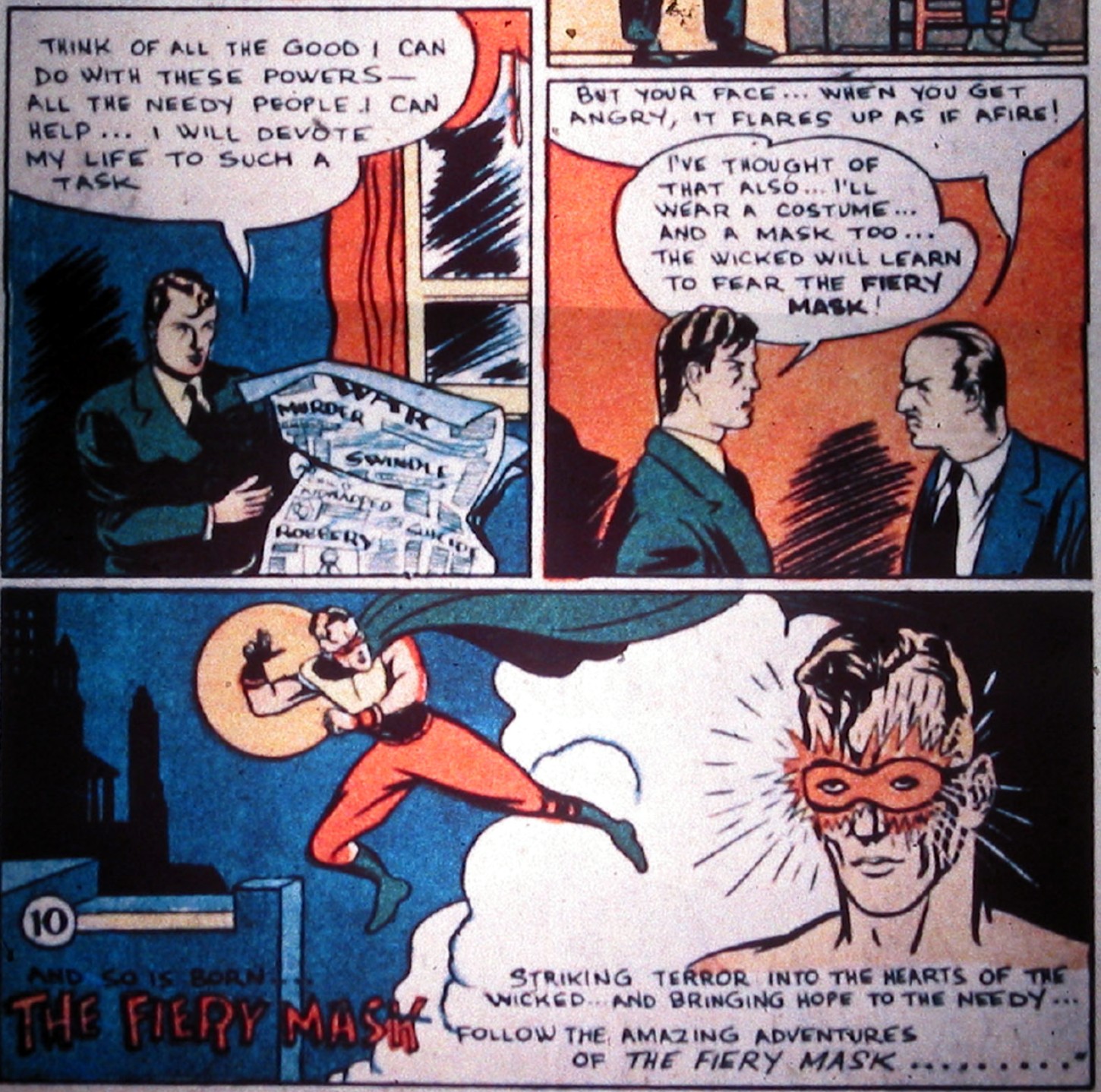
    The Fiery Mask is in reality Jack Castle, a young doctor who accidentally tracks down the lair of the villainous Zombie Master and is in quick order captured and subjected to the fiend’s mind control device. Jack manages to resist the device long enough to enrage the Zombie Master, and in an effort to boost the power and overcome this resistance he causes it to explode.

    The strange energies given off by the device cause Jack to develop strange abilities, the most striking of which is a fiery glow that plays around his face when he is worked up, and which gives him his super moniker. He also has an invulnerability to heat and flame, a fiery touch and a range of non-heat-related powers like super strength, super breath and a hypnotic gaze. Also his origin is later heavily revised, but we can save that for the hundred years or so it will take to get to The Twelve. (Daring Mystery Comics 001, 1940)

    Categorized in: Elements (Fire), Objects (Masks), Origin (Radioactive Mutate)

  • MINOR SUPER-HERO ROUND-UP 083

    MINOR SUPER-HERO ROUND-UP 083

    Oh boy! Minor super-heroes!

    13: 

    13 (aka Thirteen, although the numerical version of the name is the official one) is the alias of Harold Higgins, whose life has been haunted by a series of misfortunes related to the number thirteen. A timeline of some of them:

    February 13, 1940: Harold’s brother Bob dies in a plane crash.

    March 13, 1940: Harold loses his life savings in the stock market.

    May 13, 1940: Harold’s sister Margy is paralyzed in a car accident.

    July 13, 1940: Harold’s father is lost at sea.

    September 13, 1940: Harold’s fiance is killed in a hit and run.

    April 13, 1941: Harold loses his job as a reporter to a crooked editor looking to cover up a story. 

    All of this (and more! A text story in Daredevil Comics 005 adds the facts that he was born on Friday the 13th, that minor tragedies like a broken leg or academic failure had frequently befallen him on the 13th of any given month and that at his thirteenth birthday party his childhood sweetheart Helen was killed by a falling chandelier) has clearly preyed on Harold’s mind, to the point that he is finding the number everywhere including his own name.

    Rather than, say, moving to a small shack in the woods to keep others safe from his constant misfortune, Harold decides to weaponize his bad luck by bringing it to criminals via his fists. Does this work, logically? Not really, but it’s a decent enough comic book origin.

    Like many super-heroes and villains, 13 flirts with the idea of leaving a calling card in his first adventure but doesn’t maintain the practice. In this case, it’s a calendar page with the 13th of the month circled. (Daredevil Comics 003, 1941)

    Finally, a couple of minor things about 13: In Daredevil Comics 004 we learn that like many of his peers he wears his costume under his clothes for quick-change action. Intriguingly, the above panel seems to imply that this includes his mask, which appears to be either acting as a liner for his hat or worn as a kind of bandana under it.

    Finally, in Daredevil Comics 006, 13 moves from the super-hero crammed streets of NYC to the lesser-served Boston.

    Categorized in: Abstract Concepts (Luck), Accessories (Calling Cards), Alphanumeric (Thirteen)

    Jinx: 

    Recently orphaned Darrel Creig has just inherited the family steel fortune, something that rankles his guardian, uncle and the only other potential heir Moldon Creig. Thus, a family outing to the Statue of Liberty, where Moldon and Darrel’s tutor Travers expedite the inheritance process by tossing him off the statue’s torch.

    Luckily for young Darrel, 13 happens to be present to stop an unrelated attempt to bomb the statue, and after saving the lad the two of them beat up Moldon and Travers and hand them over to the authorities.

    As we all know, if a costumed vigilante happens across an orphaned boy who can throw a punch they are allowed to keep them, which is just what happens with 13 and Darrel, and though Darrel’s connection to the bad luck theme is much more tenuous than Higgins (he is an orphan, if a wealthy one, and he is the very spooky age of thirteen years old) he is promptly given a slightly worse costume than 13’s and anointed as his sidekick Jinx. (Daredevil Comics 005, 1941)

    Categorized in: Abstract Concepts (Luck), Day Job (High School Students), Origin (Sidekicks)

    the Ghost: 

    The Ghost is a super-hero who seemingly exists solely to combat the menace of the Claw as he troubles America’s shores once more, Daredevil having moved on to less stressful pursuits.

    Though presented as a normal human man, the Ghost not only has the acrobatic prowess necessary to fight a giant across the rooftops of New York City but enough stamina to do so for seven hours straight. In their first encounter he manages to drive the Claw away by simply punching him thousands of times.

    The Ghost’s origin is unrevealed as of his final 1941 appearance but rest assured: we will learn it in 1942 (spoiler: it is not very interesting). (Daredevil Comics 005, 1941)

    Categorized in: Origin (Unknown), Supranormal Beings (Ghosts)

    the Fiery Mask: 

    The Fiery Mask! A hero whose modern depictions have consistently involved a morning star despite only ever actually wielding on on this cover. I’m not complaining, mind you – it’s just interesting to note where things come from.

    The Fiery Mask is in reality Jack Castle, a young doctor who accidentally tracks down the lair of the villainous Zombie Master and is in quick order captured and subjected to the fiend’s mind control device. Jack manages to resist the device long enough to enrage the Zombie Master, and in an effort to boost the power and overcome this resistance he causes it to explode.

    The strange energies given off by the device cause Jack to develop strange abilities, the most striking of which is a fiery glow that plays around his face when he is worked up, and which gives him his super moniker. He also has an invulnerability to heat and flame, a fiery touch and a range of non-heat-related powers like super strength, super breath and a hypnotic gaze. Also his origin is later heavily revised, but we can save that for the hundred years or so it will take to get to The Twelve. (Daring Mystery Comics 001, 1940)

    Categorized in: Elements (Fire), Objects (Masks), Origin (Radioactive Mutate)

  • MINOR SUPER-VILLAIN 952: WOLF CARSON

    (Daredevil Comics 006, 1941)

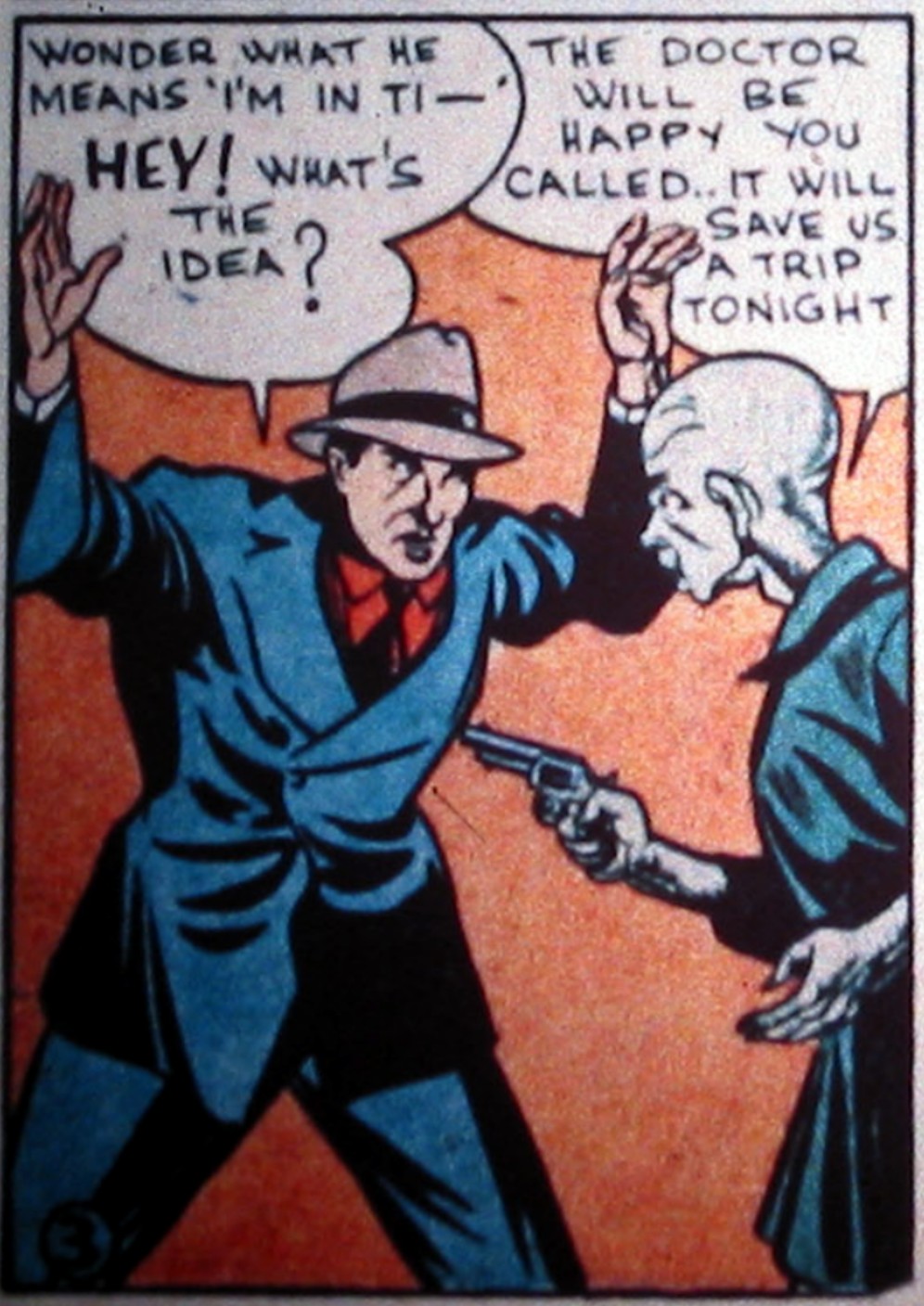
    Wolf Carson, gang boss, is in the hospital after being gunned down by his own traitorous associates. Faced with a choice between 1) dying of his wounds or 2) recovering so that the authorities can scoop him up and take him to jail, Carson takes the ever-popular option 3) take the nearby unethical doctor up on his offer to help cheat death via experimental science, in this case a total brain transplant!

    True to his word, the never-named doctor digs up Carson’s corpse that night and extracts its brain, then in a feat of pure super science (particularly given the state the brain must been in after sitting in a corpse for 12+ hrs) transplants it into…

    … A WOLF BODY! Now, just why the doctor chose to do this is never actually stated but I have a couple of theories that boil down to either him doing so as a way to control Carson with the promise of a human body later etc or doing so because he was a terrible guy with a bad sense of humour. Either way, he pays for his choice of donor body with his life. In retrospect, I reckon that his mistake was in leaving Carson unrestrained and then pissing him off severely.

    With nothing else to live for, Carson turns to revenge as his motivation and systematically hunts down the members of the gang that betrayed him. Each murder is accompanied by a trademark “death howl,” which I am counting as a calling card.

    Major complication: Carson has been found, mistaken for a regular dog and taken in by Bart “Daredevil” Hill’s fiance Tonia Saunders, which means that a jealous wolf is now after both Bart and the Daredevil and also Tonia once she realizes just where her dog has been sneaking off to at night. 

    Wolf or not, Carson is no match for the Daredevil and is soon captured. In a rare addendum, we get to see the villain’s trial (and please note the use of the term “brain wolf” to describe him in that newspaper headline – I dearly wanted to use that as his villain name but it’s clearly being used as a description of what he is rather than a moniker). Bart Hill actually manages to put two and two together and determine that the wolf is Carson, upon which the judge sets what I personally would consider a troubling precedent for a super-hero universe by ordering that the brain wolf be summarily sent to the pound and put down. I mean, I’m not a lawyer but that seems bad – some super-intelligent ape c.1976 is going to have to go to the Supreme Court to argue that he shouldn’t be summarily destroyed over a parking ticket.

    Revenge Killer Score: 4/7 (counting Bart and Daredevil as two separate targets)

    Categorized in: Animals (Wolves), Murder (Revenge Killers), Origin (Human Brain in Animal Body) 

  • MINOR SUPER-VILLAIN 539 UPDATE: THE CLAW (post-Daredevil, 1941)

    MINOR SUPER-VILLAIN 539 UPDATE: THE CLAW (post-Daredevil, 1941)

    In keeping with my decision to split the Claw updates for 1941 by heroic foe, here are the details of his three-issue dalliance with engineer Bill Hopkins.

    When last we saw the Claw… he was in the Pacific, roughing up Adolf Hitler. But before that, at the end of his long back-and-forth with the Daredevil, there was the small matter of his asking Lucifer for aid and getting it, with the caveat that if he still lost in his next encounter with Daredevil he would be “banished into Asia forever!” And since he did lose, that means that he can’t return to America, right?

    Evidently not, because in  Daredevil Comics 002, the Claw kidnaps a train filled with 2000 soldiers as it passes through Pennsylvania, then sends a note to the president (note the custom signature) to ask for the complete US gold supply in ransom.

    Meanwhile, the Claw is showing his prisoners home movies designed to bend them to his will. Note the Hitler impression: in 1941 this is shorthand for being a megalomaniac rather than a genocidal megalomaniac (though in all cases it marks you as being a bit of an uninspired hack). Whether he gets the gold or not, the Claw intends to use these men in yet another attempt to conquer the US.

    One of these soldiers, Dick Hopkins, has a brother named Bill Hopkins, who has the radical idea to retrace the path of the original train in a second one and see if anything happens, which it does. This really erodes my confidence in the authorities of this fictional reality, frankly. You’d think “take a couple of lads and check the tracks between here and where the train disappeared” would be the logical first step to take but Bill seems to be the first one to think of it. 

    Perhaps the Claw was able to return to America by sacrificing some of his power to Lucifer, because Bill Hopkins’ thrown rocks and pistol shots are much more effective than such things as artillery and machine guns have been in the past.

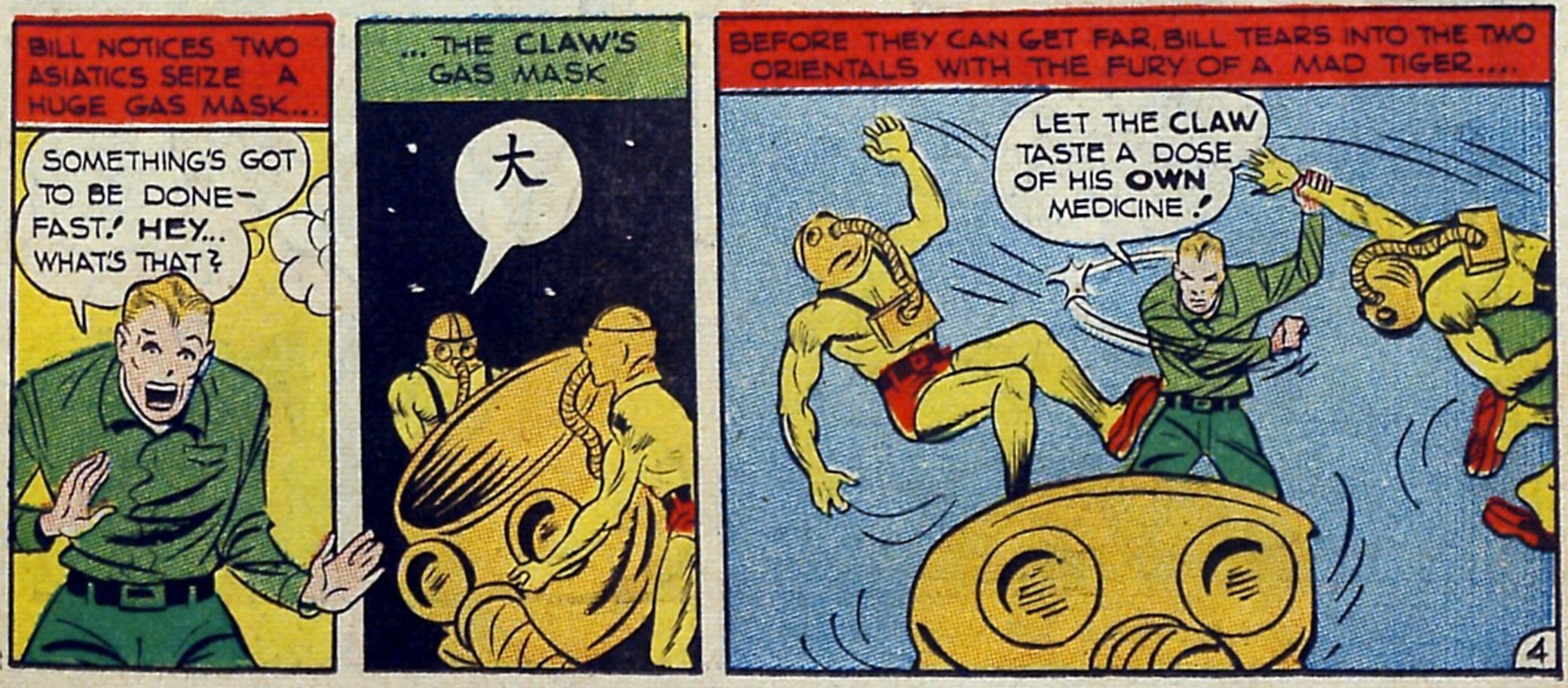
    The second part of Bill’s plan, after “find out where the Claw has stashed 2000 men” is “come find me if I disappear” and accordingly, in Daredevil Comics 003, the US Army locates the Claw’s base by following the extra set of train tracks that split off the main trunk and head directly into a cliff face. Once again, the Claw seems weaker than usual and the Army is pushing his forces back successfully enough that he orders his men to flood the base with poison gas. It is at this point that Bill has his best idea yet, as he steals the Claw’s enormous gas mask and chucks it down a convenient bottomless pit.

    The Claw is more affected by poison gas than the regular-sized humans in the room thanks to the fact that his big body needs more oxygen and thus are breathing in more gas, and while I love a well-rationalized weakness in a character it does call into question all future Claw foes for not immediately tear gassing him on sight.

    What I don’t love is that the Claw, already a distillation of Yellow Peril tropes, is one-upping himself by adopting what I just learned is called a wonton font in his speech bubbles. I think that it’s supposed to be adding emphasis when he is yelling but at this point he is almost always yelling.

     Daredevil Comics 004: The Claw brought into NYC in chains/in triumph. He almost instantly escapes.

    Seeking vengeance on Bill Hopkins, the Claw fords the Hudson River and in so doing becomes the first-ever super-villain to enter Hoboken.

    Bill doesn’t take this aggression lying down, and meets the Claw on a handy rooftop with a can of kerosene and a match, and this is a pretty good illustration of a though I have had while writing this: the Claw battling super-heroes is all well and good, but what I really enjoy is seeing him get it from regular folks. Bill Hopkins and his Home Alone energy might just be the best that the “Claw” feature ever gets, and it’s a real shame that this is the last we will be seeing of him.

    The Claw very reasonably exits via the river. So long forever, Bill. Next time: the Ghost!

  • MINOR SUPER-VILLAIN 539 UPDATE: THE CLAW (post-Daredevil, 1941)

    In keeping with my decision to split the Claw updates for 1941 by heroic foe, here are the details of his three-issue dalliance with engineer Bill Hopkins.

    When last we saw the Claw… he was in the Pacific, roughing up Adolf Hitler. But before that, at the end of his long back-and-forth with the Daredevil, there was the small matter of his asking Lucifer for aid and getting it, with the caveat that if he still lost in his next encounter with Daredevil he would be “banished into Asia forever!” And since he did lose, that means that he can’t return to America, right?

    Evidently not, because in  Daredevil Comics 002, the Claw kidnaps a train filled with 2000 soldiers as it passes through Pennsylvania, then sends a note to the president (note the custom signature) to ask for the complete US gold supply in ransom.

    Meanwhile, the Claw is showing his prisoners home movies designed to bend them to his will. Note the Hitler impression: in 1941 this is shorthand for being a megalomaniac rather than a genocidal megalomaniac (though in all cases it marks you as being a bit of an uninspired hack). Whether he gets the gold or not, the Claw intends to use these men in yet another attempt to conquer the US.

    One of these soldiers, Dick Hopkins, has a brother named Bill Hopkins, who has the radical idea to retrace the path of the original train in a second one and see if anything happens, which it does. This really erodes my confidence in the authorities of this fictional reality, frankly. You’d think “take a couple of lads and check the tracks between here and where the train disappeared” would be the logical first step to take but Bill seems to be the first one to think of it. 

    Perhaps the Claw was able to return to America by sacrificing some of his power to Lucifer, because Bill Hopkins’ thrown rocks and pistol shots are much more effective than such things as artillery and machine guns have been in the past.

    The second part of Bill’s plan, after “find out where the Claw has stashed 2000 men” is “come find me if I disappear” and accordingly, in Daredevil Comics 003, the US Army locates the Claw’s base by following the extra set of train tracks that split off the main trunk and head directly into a cliff face. Once again, the Claw seems weaker than usual and the Army is pushing his forces back successfully enough that he orders his men to flood the base with poison gas. It is at this point that Bill has his best idea yet, as he steals the Claw’s enormous gas mask and chucks it down a convenient bottomless pit.

    The Claw is more affected by poison gas than the regular-sized humans in the room thanks to the fact that his big body needs more oxygen and thus are breathing in more gas, and while I love a well-rationalized weakness in a character it does call into question all future Claw foes for not immediately tear gassing him on sight.

    What I don’t love is that the Claw, already a distillation of Yellow Peril tropes, is one-upping himself by adopting what I just learned is called a wonton font in his speech bubbles. I think that it’s supposed to be adding emphasis when he is yelling but at this point he is almost always yelling.

     Daredevil Comics 004: The Claw brought into NYC in chains/in triumph. He almost instantly escapes.

    Seeking vengeance on Bill Hopkins, the Claw fords the Hudson River and in so doing becomes the first-ever super-villain to enter Hoboken.

    Bill doesn’t take this aggression lying down, and meets the Claw on a handy rooftop with a can of kerosene and a match, and this is a pretty good illustration of a though I have had while writing this: the Claw battling super-heroes is all well and good, but what I really enjoy is seeing him get it from regular folks. Bill Hopkins and his Home Alone energy might just be the best that the “Claw” feature ever gets, and it’s a real shame that this is the last we will be seeing of him.

    The Claw very reasonably exits via the river. So long forever, Bill. Next time: the Ghost!