The Curse of Skeleton Munroe

Category: calling card

  • MINOR SUPER-HERO ROUND-UP 068

    MINOR SUPER-HERO ROUND-UP 068

    A few classic minor super-heroes. Bulletman and Bulletgirl in particular have just barely managed not to remain relevant – I suppose the pointy helmet is too much of a hurdle for the modern audience.

    Bulletman: 

    Jim Barr is perhaps the most thoroughly-motivated super-hero of the Golden Age. He is:

    a. from a long line of police officers

    b. the son of a famed police officer who was murdered for being too good a cop and who

    c. told the young Jim that he must become a police officer while on his death bed 

    d. and after all that he was too scrawny and bookish to be a cop and so had to settle for being a forensic scientist

    Jim ends up working in his father’s old station under the command of Sergeant Kent, a pro-torture bully who is often held up as the greatest of all the cops in the city, and who is also the father of love interest Susan Barr. 

    Jim’s personal project is a serum that will destroy “all germs and toxins” in the human body, including that which he believes to be the source of crime and violence. He chooses to test this serum out on himself and his body, freed from a variety of invisible ailments, develops into a physical paragon over the course of a night’s sleep.

    (Sergeant Kent really earns his reputation as a great police officer by failing to notice that his colleague has basically doubled in size over night. In his defense, Jim is wearing big clothes)

    Jim decides that the best way to use this new power is to operate outside of the law, probably due to all of his time hanging around with top cop Kent. He uses his now super intelligence to build the Gravity-Regulator Helmet, which allows him to fly and also generates a force field that augments his natural resilience to make him nigh-invulnerable and able to smash through things head-first (I swear that somewhere I read a story in which it was explained that it made him bulletproof by drawing the bullets to the helmet but danged if I can find it now.). His costume, yellow jodhpurs and all, is assembled out of things that were lying around at the police station, no mention of where. (Nickel Comics 001, 1940)

    If I had to classify Bulletman’s personality, I would go with “extremely no-nonsense” or maybe “wooden, which is why it is important that he is eventually joined by his female counterpart: 

    Bulletgirl: 

    Bulletgirl is the aforementioned Susan Kent, daughter to good cop/bad cop Sergeant Kent and member of Bulletman’s supporting cast from the beginning. For about the first year of Bulletman’s adventures she fills a low-effort version of the Lois Lane role: curious about the hero’s identity but not especially proactive about trying to uncover it. She also gets kidnapped and targeted for death a lot thanks to her father’s skill at making enemies. Then, in Master Comics 012, Bulletman is knocked out in a collision with Triple Threat’s super vehicle and Susan learns that he is actually Jim Barr. Jim obligingly tells Susan the secret of his origin but resolutely refuses to consider teaming up with her.

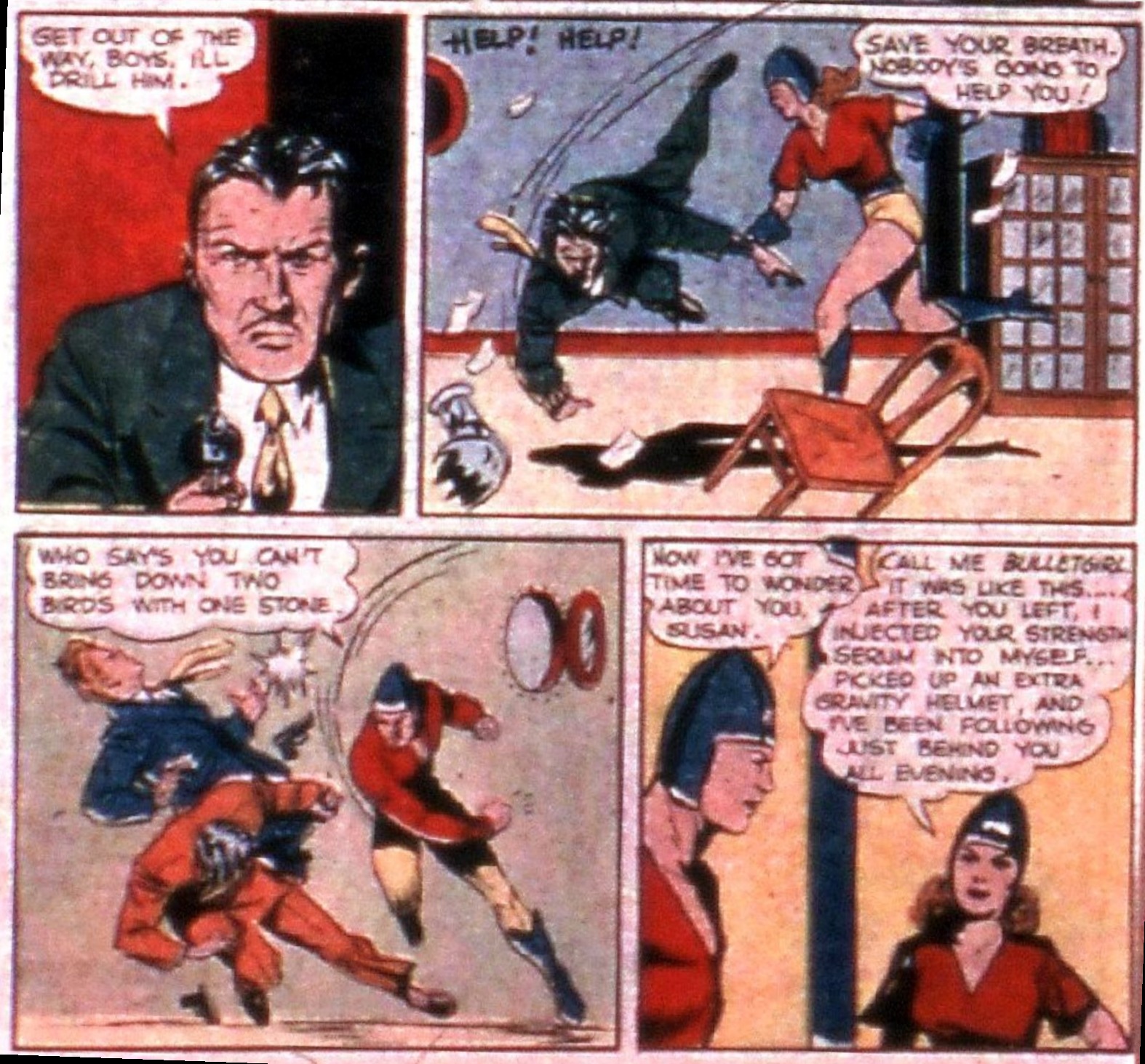
    Susan of course injects herself with the serum and crabs a spare Gravity-Regulator Helmet and costume (though she goes for hot pants over jodhpurs) the instant that Bulletman is out of the room, and This is a very good illustration of why I am so fond of Bulletgirl: she has all of the personality that Bulletman lacks. She’s scrappy and quippy and after an issue or two of “too dangerous for girls” chauvinism from Jim is a full partner in the superheroic exercise. She does get kidnapped and left behind a bit more than I’d like but that’s comic books in a nutshell. 

    In conclusion: Bulletgirl! (Master Comics 013, 1941)

    Minute-Man: 

    Like Jim Barr, Jack Weston is the son of a dead hero, though Jack’s father Robert Weston died during the Battle of Chateau-Thierry in World War I. We don’t get nearly as much background on Jack, other than the fact that he was raised by his father’s friend General Milton, but thanks to Milton, Jack becomes Minute-Man, a patriotic super-hero, in what is kind of presented as a draft.

    Jack is sent to join the Army as a lowly Private so that he can keep an eye out for sabotage and espionage affecting the armed forces. Despite having no super serum or particular special training, he proves to be physically near-superhuman as he engages a variety of costumed and non-costumed foes over the course of his mid-length career.

    Minute-Man also dabbles in leaving calling cards, which I always like to make note of. (Master Comics 011, 1941)

    Doctor Voodoo **UPDATE**: 

    In Whiz Comics 017, Doctor Voodoo returns home to find that Maxinya (the Heaven-Woman, natch) has gone missing. He tracks her abductors through the jungle until he comes across their destination: a European castle, smack in the middle of the Amazon. 

    The mystery deepens as Voodoo enters the castle and finds what seems to be an entire Medieval court, headed by the boorish King Richard, who seeks his aid in conquering the jungle. 

    Doctor Voodoo refuses to help King Richard, and so is forced to meet the knight Sir Ganal in combat. Voodoo prevails and wins Ganal over to his side, complete with a promise to reveal the origin of the castle’s presence in the jungle. Alas, this shall never come to pass, because the story does a hard pivot in the next issue. 

    King Richard plays the whole jungle conquest/attempted murder thing off as if it was some sort of test, and sends Doctor Voodoo off to meet with his court wizard. He. in turn, transports Voodoo back in time to the 1400s or thereabouts to retrieve a magical McGuffin called the Golden Flask, with another promise to explain what this whole affair is about once he returns.

    Unfortunately for all us completionists out there, the explanation never comes because Doctor Voodoo never returns. He bops around the oceans for about a year and actually does manage to get his hands on the Golden Flask but his feature is cancelled before he can return it to the wizard and find out just what the heck is going on. Maxinya is waiting for him still, presumably. (Whiz Comics 018, 1941)
  • MINOR SUPER-VILLAIN 895: THE GHOST OF THE DEEP

    MINOR SUPER-VILLAIN 895: THE GHOST OF THE DEEP

    (America’s Greatest Comics 001, 1941)

    The Ghost of the Deep, a dastardly fellow indeed. As the comic opens, a captive scientist named Hugo has just completed a mysterious formula for him, only to be rewarded with murder.

    In the following days, the Ghost attacks US West Coast shipping, each time leaving behind a calling card in the form of a message in a bottle.

    The Ghost even tries to silence Billy Batson’s fairly routine reporting on the attacks (but why leave a calling card if you don’t want everyone to know you’re responsible?) by taking Billy and his boss Sterling Morris for a proverbial ride. When this is predictably foiled by Captain Marvel, the Ghost of the Deep shows up long enough to demonstrate that he is also a classic comic book Bad Boss by drowning his hapless Teutonic minions.

    There is a bit of radio-based taunting, since Billy is a radio guy. Again, this kind of thing brings into question just why the Ghost of the Deep wants to shut Billy up.

    So just what is the Ghost of the Deep’s plan? And what is this mysterious formula that poor Hugo died for? Why, it’s the recipe for making a transparent, invulnerable alloy called Z-Metal, and using a fleet of tank-submarines composed of the stuff, the Ghost intends on conquering the United States. First stop: blowing up the Panama Canal.

    As for the Ghost’s real identity, well, it’s not revealed until later, but any cagey comics reader will immediately peg this smarmy rival radio man named Spriggins as the top suspect the instant that he walks on-panel. Presumably his cover serves the same purpose as Billy Batson’s: as a way of gathering information and justifying a lot of globetrotting as being in pursuit of a story.

    Ultimately, Spriggins’ plan has one fatal flaw: it fails to account for the presence of a magically super-strong fellow like Captain Marvel, who succeeds where the might of the US Navy cannot and smashes the Z-Metal fleet to smithereens. And then does the same to the Ghost of the Deep’s cool Z-Metal chainmail.

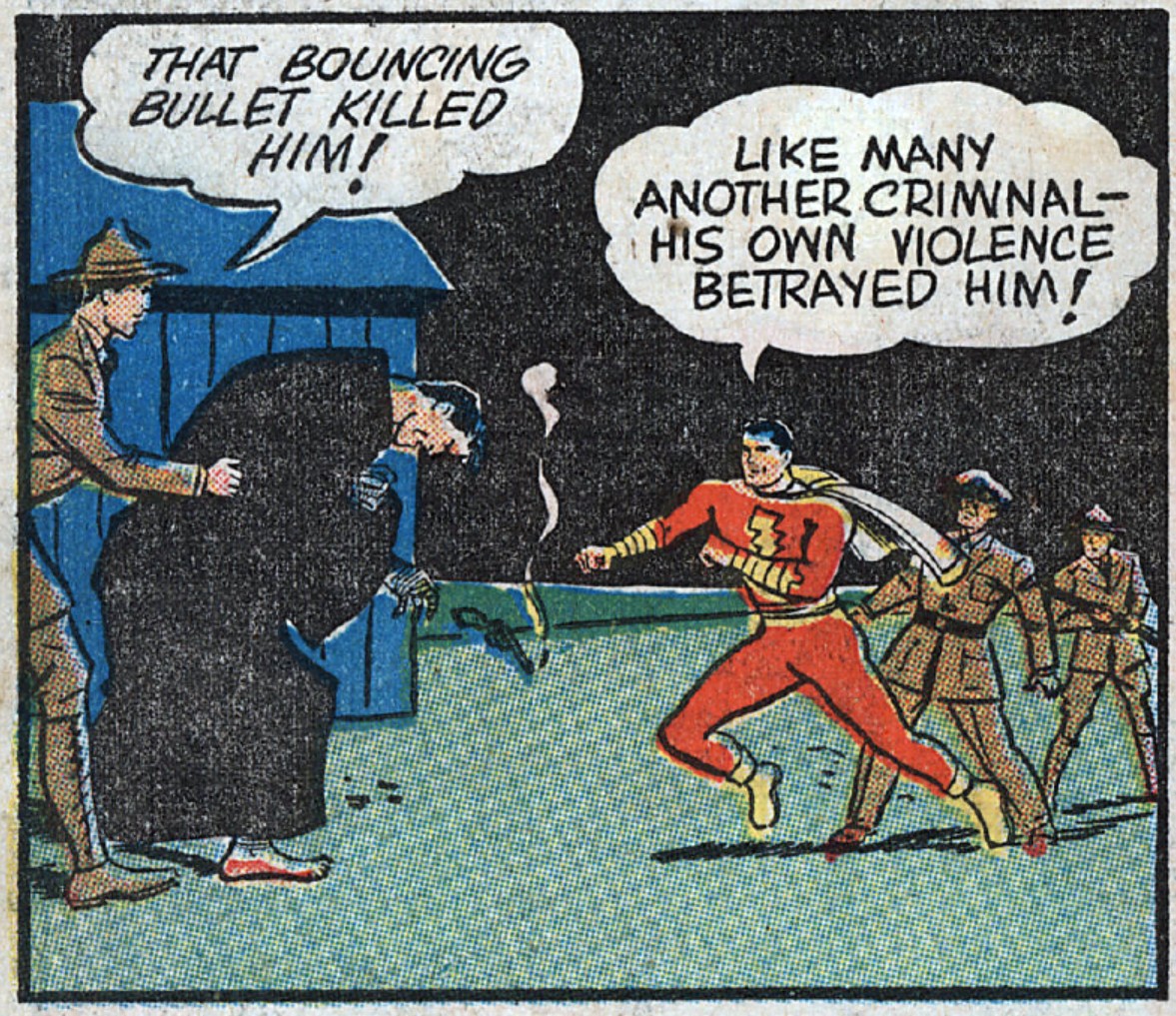
    The captured Spriggins makes one last attempt at striking out at the US by stealing an MP’s gun and taking out a nearby General, only to be intercepted by Captain Marvel and suffer the oft-joked-about but seldom-seen fate of the person who fires a bullet into an invulnerable super-hero’s chest only to have it bounce back and kill them instead. 

  • MINOR SUPER-VILLAIN 891: THE LAUGHING SKULL

    (Wow Comics 003, 1941)

    The Laughing Skull specializes in extortion. They call it blackmail and it is kind of framed as being blackmail but over the course of the story it becomes clear that he has no concrete dirt on any of his victims and is just counting on carrying the day with vague threats and eventually by being able to point to all the people who he killed for not paying him. Straight-up threats-of-violence extortion, in other words. 

    To make sure that word gets out about the consequences of ignoring his demands, the Laughing Skull kills his victims by burying them alive and leaving cheeky tombstones on their graves. Horrible! 

    While very public murders might make for good business in the extortion industry they do come with a pretty specific workplace hazard in the form of super-heroes – in this case Mr Scarlet – knowing where and when to find you on most nights. We must assume that it’s a huge cemetery, however, because somehow Mr Scarlet is too late to save the Laughing Skull’s second victim even though he was already inside when they started digging. Or perhaps those henchmen are the world’s greatest gravediggers.

    Not that the Laughing Skull is a total pushover: his announced third victim is in fact a cover for a trap set for Mr Scarlet, and one that works well enough that Scarlet has to be rescued from his immanent burial by Miss Wade.

    Not to buck the greater super-villain trend by adjusting his methods after clashing with a super-hero, the Skull is finally captured while in the process of burying the actual third victim. Unmasked via a tombstone to the head, he turns out to be banker John Dodd, aka the false third victim, who used his insider knowledge to select the wealthiest targets for his extortion attempts. But there’s more! The Laughing Skull/ John Dodd is also revealed to be…

    … this guy, who has been popping up throughout the issue and confessing to being the Laughing Skull to both DA Brian Butler and Mr Scarlet! This is kind of a smart move? It definitely allows the Laughing Skull to misdirect Mr Scarlet on at least one occasion as that guy was always just lurking around waiting for his chance to confess. The risk is very high, however, particularly as John Dodd is at least theoretically a witness to the attempted murder of Mr Scarlet – did the Laughing Skull have a plan for when DA Brian Butler came to ask him for a statement or was he just going to keep burying lawmen until they stopped trying to arrest him?

    Anyway, the whole gang ends up dumped in a grave with a custom tombstone of their own (that opens up a whole world of questions about whether Mr Scarlet has stonecarving chops or is packing some sort of 1940s Sharpie in his belt). A dose of your own medicine, Laughing Skull!

    SKULL SCORE: 3/5 

    (this ish also feature Mr Scarlet having a smoke while in costume – a real rarity!)

  • MINOR SUPER-VILLAIN 891: THE LAUGHING SKULL

    (Wow Comics 003, 1941)

    The Laughing Skull specializes in extortion. They call it blackmail and it is kind of framed as being blackmail but over the course of the story it becomes clear that he has no concrete dirt on any of his victims and is just counting on carrying the day with vague threats and eventually by being able to point to all the people who he killed for not paying him. Straight-up threats-of-violence extortion, in other words. 

    To make sure that word gets out about the consequences of ignoring his demands, the Laughing Skull kills his victims by burying them alive and leaving cheeky tombstones on their graves. Horrible! 

    While very public murders might make for good business in the extortion industry they do come with a pretty specific workplace hazard in the form of super-heroes – in this case Mr Scarlet – knowing where and when to find you on most nights. We must assume that it’s a huge cemetery, however, because somehow Mr Scarlet is too late to save the Laughing Skull’s second victim even though he was already inside when they started digging. Or perhaps those henchmen are the world’s greatest gravediggers.

    Not that the Laughing Skull is a total pushover: his announced third victim is in fact a cover for a trap set for Mr Scarlet, and one that works well enough that Scarlet has to be rescued from his immanent burial by Miss Wade.

    Not to buck the greater super-villain trend by adjusting his methods after clashing with a super-hero, the Skull is finally captured while in the process of burying the actual third victim. Unmasked via a tombstone to the head, he turns out to be banker John Dodd, aka the false third victim, who used his insider knowledge to select the wealthiest targets for his extortion attempts. But there’s more! The Laughing Skull/ John Dodd is also revealed to be…

    … this guy, who has been popping up throughout the issue and confessing to being the Laughing Skull to both DA Brian Butler and Mr Scarlet! This is kind of a smart move? It definitely allows the Laughing Skull to misdirect Mr Scarlet on at least one occasion as that guy was always just lurking around waiting for his chance to confess. The risk is very high, however, particularly as John Dodd is at least theoretically a witness to the attempted murder of Mr Scarlet – did the Laughing Skull have a plan for when DA Brian Butler came to ask him for a statement or was he just going to keep burying lawmen until they stopped trying to arrest him?

    Anyway, the whole gang ends up dumped in a grave with a custom tombstone of their own (that opens up a whole world of questions about whether Mr Scarlet has stonecarving chops or is packing some sort of 1940s Sharpie in his belt). A dose of your own medicine, Laughing Skull!

    SKULL SCORE: 3/5 

    (this ish also feature Mr Scarlet having a smoke while in costume – a real rarity!)

  • MINOR SUPER-VILLAIN 890: THE BLACK CLOWN

    (Wow Comics 003, 1940)

    The circus is in town! And in what must be a complete coincidence, a circus-themed villain murders a prominent banker using a python! And did I mention that the circus has a big box full of pythons as one of its attractions? 

    As someone who sincerely enjoys clown- and circus-themed villains despite having no particular affection for either in real life I have to say: do a bit better, the Black Clown. Like, try a bit harder to conceal just exactly who you are. Especially don’t leave a note on the body of the banker you just murdered that basically says “I did this because you didn’t give me, a clown-man, a business loan.” Plausible deniability, man.

    He does have a great Evil Clown costume, though.

    I’ll give the Black Clown this: at least he tries to rob the bank after revenge-killing the banker rather than merely exult in the downfall of his enemy. This robbery is also where we learn that the Black Clown has a whole circus of crime thing going on to match his theme, as he employs a sideshow thin man to slip through the bank’s bars and let the rest of the crew in.

    Though Mr Scarlet interrupts the robbery he is unable to prevent the Black Clown and his crew from escaping, as he is being crushed to death by a python at the time. Or is he? No, he is too strong.  

    The Black Clown next attempts to murder Petrie, the partner of the first victim, but at this point we are firmly in the part of the comic where the hero has the villain in his sights and none of his schemes shall profit. The Black Clown escapes with the help of some acrobats and Petrie lives on to deny loans another day.

    Probably the most interesting thing about this sequence is that the Black Clown gains entrance to Petrie’s apartment via a fellow named Tiny Tom who slips through the transom and opens the door. Given the name and the theme of the gang (and the initial shot of his legs as they slip out of sight) one would expect Tiny Tom to perhaps be little person of some kind, perhaps a sideshow performer, but he’s on-hand throughout the fight in Petrie’s apartment (that’s him in the blue suit) and he’s just about half a head shorter than everyone else. Is it just a particularly rough nickname or did the initial Tiny Tom concept get lost in the shuffle?

    Hearkening back to my initial critique of the Black Clown: it is in fact so obvious who this guy is that Mr Scarlet has to be interrupted twice in two different conversations over the course of three panels rather than learn it too early. And he doesn’t bother to ask Mr Petrie to shout it at him on the way out the door.

    After a final battle with a sideshow wild man and a chase through the trapezes the Black Clown is finally captured and OF COURSE it turns out to be Henry Parrish, the circus owner, who is OF COURSE mad about a rejected business loan. CHOOSE YOUR SUPER-VILLAIN THEME MORE WISELY is what I’m trying to get at.

    REVENGE KILLER SCORE: 1/2 

  • MINOR SUPER-VILLAIN 888: THE SCORPION

    (Wow Comics 002, 1940)

    The Scorpion is mostly a regular gang boss, but with just enough extra oomph to take him over the edge into super-villainy. First thing: he is a very Bad Boss in that particular “execute under-performing employees as an example to the others” kind of way that all corporate overlords wish that HR would let them be.

    Secondly, he is perhaps the closest thing to a super-villain was faced by Allan Lanier, aka the Hunchback, seen here in his civilian guise rushing to investigate the defenestration of the Scorpion’s poor minion and inadvertently getting his fiance Betty kidnapped in the process.

    The Scorpion also has a true super-villain’s lack of subtlety, seen here as he successfully fools Lanier into believing that Betty has gone to visit her uncle by means of a simple telegram but then is unable to resist sending a more explicit threat (signed with a cute lil’ scorpion!) and undoing his previous work. 

    Finally, the Scorpion has a cool hideout: just like the Ninja Turtles he lives in an abandoned subway station, to which he is tracked by the vengeful Hunchback.

    After that, it’s all over. The Hunchback doesn’t play around, he just breaks the Scorpion’s neck. I would say that this is a case of someone choosing their enemies poorly, but the Scorpion didn’t actually know he was dealing with the Hunchback until it was too late. I guess the lesson is “don’t kidnap women.”

  • MINOR SUPER-VILLAIN 884: DOCTOR DEATH

    (Wow Comics 002, 1941)

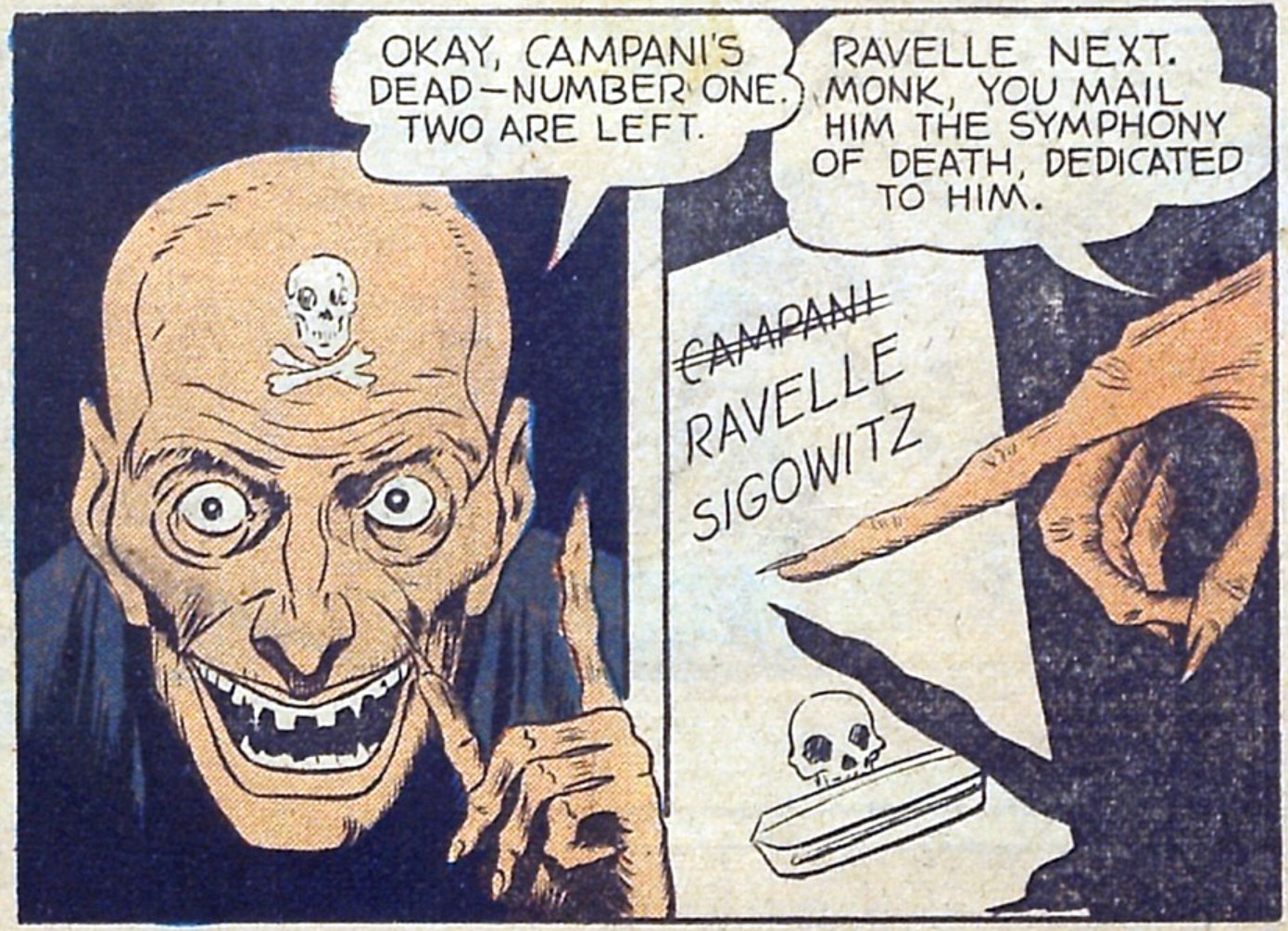
    We open as concert pianist Campani plays the “Symphony of Death,” a piece of music anonymously dedicated to him, only to die at its conclusion. What will eventually become clear is that the sheet music he was reading from was coated in poison and slightly stuck together so that Campani would need to lick his finger in order to turn the pages, thus poisoning himself in the process.

    This is a pretty good plan! If pulled off carefully, it might even be done so anonymously that the perpetrator would be effectively untraceable. There’s no chance of that, however, because said perpetrator is in fact a comic book super-villain who calls himself Doctor Death and who has all of the subtlety of his kind. Not only does he have a goon conspicuously parked outside Campani’s apartment to report back on the whether the scheme has worked, but the day before he sent a threatening note to Campani, complete with signature and little skull and coffin illustrations.

    (as can be seen in the note above, even though Doctor Death does music-based crimes and is kind of dressed like a concert musician his actual theme is that of a medical doctor. It’s a bit of a muddle)

    Doctor Death’s next stated target is another musician, Ravelle, and though Mr Scarlet prevents Ravelle’s copy of the “Symphony of Death” from being mailed to him this doesn’t stop Doctor Death; he just goes to Ravelle’s house, and when Mr Scarlet shows up there he gets captured and slated to die as well.

    Doctor Death of course does not contend with the fact that while Mr Scarlet is technically not a super-human he is nonetheless a super-hero and thus able to, for instance, lift a grand piano over his head and throw it at Doctor Death’s body. Among other things, this splits the Doctor Death mask asunder, revealing that the villain is in fact… Ravelle! 

    It turns out that Ravelle was recently fired and presumably replaced by Campani and his response to this insult was to turn to elaborate murder plots for solace. The attempt on Ravelle’s own life was a bluff designed to draw suspicion away from himself that was repurposed into a trap for Mr Scarlet. But what of Sigowitz, the third name on the revenge list? Alas, we shall never know.

  • MINOR SUPER-VILLAIN 884: DOCTOR DEATH

    MINOR SUPER-VILLAIN 884: DOCTOR DEATH

    (Wow Comics 002, 1941)

    We open as concert pianist Campani plays the “Symphony of Death,” a piece of music anonymously dedicated to him, only to die at its conclusion. What will eventually become clear is that the sheet music he was reading from was coated in poison and slightly stuck together so that Campani would need to lick his finger in order to turn the pages, thus poisoning himself in the process.

    This is a pretty good plan! If pulled off carefully, it might even be done so anonymously that the perpetrator would be effectively untraceable. There’s no chance of that, however, because said perpetrator is in fact a comic book super-villain who calls himself Doctor Death and who has all of the subtlety of his kind. Not only does he have a goon conspicuously parked outside Campani’s apartment to report back on the whether the scheme has worked, but the day before he sent a threatening note to Campani, complete with signature and little skull and coffin illustrations.

    (as can be seen in the note above, even though Doctor Death does music-based crimes and is kind of dressed like a concert musician his actual theme is that of a medical doctor. It’s a bit of a muddle)

    Doctor Death’s next stated target is another musician, Ravelle, and though Mr Scarlet prevents Ravelle’s copy of the “Symphony of Death” from being mailed to him this doesn’t stop Doctor Death; he just goes to Ravelle’s house, and when Mr Scarlet shows up there he gets captured and slated to die as well.

    Doctor Death of course does not contend with the fact that while Mr Scarlet is technically not a super-human he is nonetheless a super-hero and thus able to, for instance, lift a grand piano over his head and throw it at Doctor Death’s body. Among other things, this splits the Doctor Death mask asunder, revealing that the villain is in fact… Ravelle! 

    It turns out that Ravelle was recently fired and presumably replaced by Campani and his response to this insult was to turn to elaborate murder plots for solace. The attempt on Ravelle’s own life was a bluff designed to draw suspicion away from himself that was repurposed into a trap for Mr Scarlet. But what of Sigowitz, the third name on the revenge list? Alas, we shall never know.

  • MINOR SUPER-HERO ROUND-UP 065

    Our themes today are “scarlet,” “family tragedy,” and “inadvisable human experimentation.”

    Mr Scarlet: 

    Brian Butler, NYC* district attorney,** is frustrated by the limitations inherent in working within the law and so like so many of his peers adopts a costumed identity in order to get the better of crime via acrobatics and punching. A classic origin, but Mr Scarlet’s real claim to fame is in being created by Jack Kirby (with Ed Herron) and thus starting off with a real dose of comic book charisma that subsequent artist Jack Binder manages to keep going – both, for example, illustrate his acrobatic explots with such flair that to this day people assume that he’s meant to be flying.

    * although it’s referred to as “Gotham City” in the one caption that names his location, I simply must assume that it’s meant to be the NYC nickname rather than some Earth-S version of Batman’s hometown, earlier than both concepts even exist.

    ** he’s pretty consistently called a “special prosecutor”, but there’s just enough evidence to clarify that he’s a DA rather than an impartial lawyer brought in to prosecute cases involving possible conflicts of interest, which I just learned is what a special prosecutor is.

    Brian Butler’s secretary/love interest Cherry Wade learns his secret in Mr Scarlet’s first published adventure, and I must say as always that I appreciate a Golden Age comics with a straightforward hero romance to contrast with the widespread aping of the Clark Kent/Lois Lane situation. Even if it is an HR nightmare. (Wow Comics 001, 1940)

    Atom Blake, Boy Wizard: 

    Atom Blake, a youngster attending Lincoln High in Collegetown, USA, is curious about why he has a different last name than the people who are raising him, and perhaps more pointedly, why his is physically and mentally superhuman. His foster father, Professor Joseph Page, has the answer in the form of a note left for Atom by his biological father, Stuart Blake. Written in a mathematical code that Atom is instinctively able to read, the note tells of the elder Blake’s experiments in creating a super-element composed of all 93 known regular elements* and how the infant Atom was given treatments to make him super-human enough to utilize the power of the super-element (called sun-metal in later Atom Blake stories but not here) without evaporating like Blake Sr’s poor experimental orangutan.

    *always a good bit when it crops up. I just looked up the history of the discovery of elements to see how long the count of 93 was good for and it looks like about 4 years, though plutonium was discovered in 1941 but kept secret until 1948. More impressive is the fact that at least four of the elements known in 1940 weren’t yet discovered in 1923 when Blake did his work!

    An encounter between Atom and some bank robbers soon reveals that the super-element was stored in the ring that Stuart Blake left with Atom as a baby, and he gains access to a suite of deus ex machina powers. Will this sixteen or seventeen year old boy be able to deal with unlimited power in a healthy way? Stay tuned! (Wow Comics 001, 1940)

    UPDATE 1941 

    Steel Sterling: 

    John Sterling is your classic crime orphan: after losing his father to gangsters at a young age, he devotes his life to battling crime. But rather than become a living weapon through intense training, Sterling takes a note from his father’s death by gunfire and spends his formative years developing a chemical treatment that will give his body the properties of steel, dramatically catalyzed by a dip into a vat of molten metal in a sequence with more on-panel male nudity than you usually see. Please also note the final panel above, which showcases Sterling’s weird riveted metal briefs.

    And Sterling isn’t just blowing smoke about having all the properties of steel: in addition to being bulletproof and super strong thanks to his new density, he also has the magnetic properties of the alloy, which he, like many of his magnetic brethren, employs to fly around by “magnetizing himself to” various things. Later this is rounded up to simply being able to fly and thank goodness for that.

    Finally, Steel Sterling has one of the better secret identities, as he establishes private detective John Sterling as his own twin brother (and also as a sort of cowardly jerk so that he can establish the usual Lois Lane/Clark Kent dynamic with love interest Dora Cummings). (Zip Comics 001, 1940)

    the Scarlet Avenger: 

    I know I bagged on the Defender for just being the Avenger with the serial numbers filed off, but dang it if the Scarlet Avenger doesn’t feel even more like someone just took Richard Benson out back and slapped a little red paint on him. Real name Jim Kendall, the Scarlet Avenger loses his wife and child as a result of a gold robbery on the airplane they are riding in. Kendall alone survives the subsequent crash but loses the ability to form facial expressions, leading to his nickname as The Man Who Never Smiles. 

    The Scarlet Avenger’s calling card, seen above making the text box hard to read, is a flaming arrow for no discernible or stated reason. Later on it is often depicted with a decorative skull.

    The Scarlet Avenger lacks the ability to reshape his facial features that his inspiration possessed, and instead of being a master of disguise is more of a gadgeteer, variously employing a paralysis ray, bulletproof cloak, electrically wired suit that allows him to deliver lethal shocks, mind reading device, compact miniature parachute, shoe knife, personal smokescreen, rocket car and rocket ship in his pursuit of justice. 

    The other point of similarity between the Scarlet and regular Avengers is the extensive network of agents that both employ, though the Scarlet Avenger’s narrows somewhat over time as he begins a romantic relationship with Inez Courtney, aka Operative 1. More trouble for HR.  (Zip Comics 001 1940)

  • MINOR SUPER-VILLAIN 868: THE HOOD

    (Wonderworld Comics 019, 1940)

    The Hood, a mysterious figure (who leaves a note with an unfortunately cut-off symbol that I can only assume/hope is a hood-and-crossbones) is terrorizing an unnamed city with a series of murders – eight in one week! 

    Going by the old wisdom that the murderer always returns to the scene of the crime, the Flame waits at the site of the latest murder and is rewarded when the Hood does just that. He is however unsuccessful in capturing the fiend due to the twin facts that a) the Hood thought to bring some guys along with him and b) an unfortunate woman happens by just in time to be taken hostage. 

    The Flame and the never-named woman are taken prisoner and spend some time escaping while the Hood lines up his next victim, a store owner who lives near the Sea Clock mentioned in his taunting note. This is when we finally get some inkling of the Hood’s motivations: far from being an ordinary homicidal maniac, he is instead forcing his victims to sign over their property to him before murdering them.

    (I would just like to take a second here to roast the Unnamed City authorities for the sheer amount of consternation they evince at the notion of a “sea clock” when they live in a town that has such a large clock tower located on its waterfront)

    The Hood is finally unmasked and turns out to be the Unnamed City Mayor’s personal secretary, Jenkins, who the Flame had held in deep suspicion for the entire issue for using the word “extraordinary” to describe the killer. This sort of thing is always highlighted when it pays off, but how many times does a crime go unsolved because of such unwarranted suspicion of a person with a weird vocabulary or a tendency for malapropisms, hmm?