The Curse of Skeleton Munroe

Category: calling card

  • MINOR SUPER-VILLAIN 868: THE HOOD

    (Wonderworld Comics 019, 1940)

    The Hood, a mysterious figure (who leaves a note with an unfortunately cut-off symbol that I can only assume/hope is a hood-and-crossbones) is terrorizing an unnamed city with a series of murders – eight in one week! 

    Going by the old wisdom that the murderer always returns to the scene of the crime, the Flame waits at the site of the latest murder and is rewarded when the Hood does just that. He is however unsuccessful in capturing the fiend due to the twin facts that a) the Hood thought to bring some guys along with him and b) an unfortunate woman happens by just in time to be taken hostage. 

    The Flame and the never-named woman are taken prisoner and spend some time escaping while the Hood lines up his next victim, a store owner who lives near the Sea Clock mentioned in his taunting note. This is when we finally get some inkling of the Hood’s motivations: far from being an ordinary homicidal maniac, he is instead forcing his victims to sign over their property to him before murdering them.

    (I would just like to take a second here to roast the Unnamed City authorities for the sheer amount of consternation they evince at the notion of a “sea clock” when they live in a town that has such a large clock tower located on its waterfront)

    The Hood is finally unmasked and turns out to be the Unnamed City Mayor’s personal secretary, Jenkins, who the Flame had held in deep suspicion for the entire issue for using the word “extraordinary” to describe the killer. This sort of thing is always highlighted when it pays off, but how many times does a crime go unsolved because of such unwarranted suspicion of a person with a weird vocabulary or a tendency for malapropisms, hmm?

  • MINOR SUPER-VILLAIN 808: THE BLACK QUEEN

    (The Spirit, “The Black Queen”, June 16, 1940)

    We first meet the Black Queen as the otherwise-unnamed defense lawyer in the murder trial of gangster Slot Gorgan. She already has a reputation for being brilliant, and that reputation proves to be accurate, as Gorgan is acquitted despite the evidence against him.

    Upon returning to the Black Queen’s penthouse, we learn that she is in fact the very first in the Spirit’s long line of female villains, as it turns out that she is the brains behind Gorgan’s gang. Unfortunately for Gorgan and the Black Queen, the Spirit has been engaging in the long-standing comic book tradition of getting mad about not-guilty trial results, and so has preceded them to the apartment. Now he knows about about the Black Queen’s crime ties and that Slot was actually guilty.

    The Spirit manages to wrangle a confession out of Slot in the presence of the District Attorney, which results in a retrial for the same murder he was originally accused of (and while I am not even remotely a lawyer I reckon that this is exactly what double jeopardy is supposed to be about? Or is it one of those things where he was tried for second degree murder the first time and first degree the second?). This time, the Black Queen’s brilliant legal mind is merely able to get his sentenced reduced from death to life imprisonment, but importantly she herself is still running the gang when the episode concludes.

    The Black Queen returns a few weeks later having made the astonishing decision to move from being the secret head of her gang (smart, secure) to personally leading them in a raid on the New York Sub-Treasury building* (dumb, risky). Why do this when her prior setup was so good that she got to the end of a “crime doesn’t pay” comic with her crime career still intact? Since she talks about taking 25 million dollars for herself and splitting town, I can only assume that she has grown tired of the admin of running a gang while being a successful attorney and just wants to retire.

    *this might be the fifth time I have read a story in which crooks try to rob the New York Sub-Treasury, and having looked it up to see if it was a thing I have found that a) it was – the US used to keep stores of cash and gold in a few major cities, presumably due to longer travel times in the past and b) the sub-treasury system was phased out in the 1920s. The Black Queen and her fellows are actually trying to break into a building now known as Federal Hall, administered by the National Park Service, and in 1940 occupied by exhibits relating to the New York World’s Fair. This raises the question: is the major divergence of the various super-hero universes from our own in fact the passing of the Independent Treasury Act of 1920?

    Though the Black Queen’s gang are captured before they can get away with either fifty million dollars or some dioramas about the history of finance, she alone manages to escape in her private yacht. Thanks to a timely intervention by the Governor’s island defense batteries, the yacht is disabled (a very rare artillery-based entry in my collection of cops shooting fleeing suspects), but the Black Queen herself remains at large for a second appearance in a row thanks to a frankly amazing hand grenade throw that disables the Spirit’s flying car. 

    The Black Queen’s third and final appearance is also the one in which she makes the jump to being a full-fledged femme fatale in the (eventual) grand Spirit tradition, and I say that not just because she has started wearing hot pants and a bustier as her everyday outfit.

    No, what really puts the fatale into this femme is the fact that she is going around giving men the literal kiss of death via some poisoned lip gloss. I’m not even sure why she kills this guy – just for the hell of it, I suppose, as he seems to be totally okay with working for her.

    But just what was that guy killed for? Why a formula for creating artificial diamonds, which means that along with the sub-treasury thing from earlier, the Black Queen has engaged in two of the biggest non-crimes in comics history!

    The Black Queen has also seduced a jeweller named Abner Ames into acting as a fence for her. The Spirit goes pretty far out of his way to rescue this guy from getting the Kiss of Death and make sure that he isn’t held criminally responsible, and while I commend him for being nice to Ames’ poor wife in this way I would humbly suggest that she would be better off without him.

    (the above panels also reveal that the Black Queen’s calling card is the queen of spades, and as someone who loves categorizing things I am just pleased as punch to have confirmation on exactly which black queen she was going for with than name) 

    Ames having been saved, there is a thrilling chase that culminates in a fight on the superstructure of a bridge. Though the Black Queen almost gets him, the Spirit manages to take her in. Sadly for those of us who enjoy her style, the Black Queen chooses to take her own life rather than face trial, even though she might have been the first person in history for whom self-representation was a good idea.

  • MINOR SUPER-HERO ROUND-UP 054

    Whoops there are two more super-heroes in the Spirit Section. Should have included them with the Spirit himself, tsk tsk. 

    Lady Luck: 

    The Spirit’s home, the “Spirit Section” of newspaper comics also included two other Will Eisner-created but not -written or -drawn characters, the first of whom is Lady Luck. In actuality wealthy socialite Brenda Banks, Lady Luck is a costumed vigilante out of boredom with the day-to-day of high society. She is wanted by the law and specifically by her civilian life love interest Police Chief Hardy Moore, a cop so dumb that not only is he about to send a woman to the electric chair for the murder of her still-living husband in the above set of panels but he also is unable to recognize the object of his affections under the brim of a big hat (in fairness to him he does mention that Brenda and Lady Luck are very similar looking but then turns out to be cartoonishly easy to fool). Lady Luck does a bit of globetrotting here and there, but her focus is mainly on high society crimes. Her adventures are a bit lighter than the Spirit’s, but not by too much. (The Spirit Section, 2 June, 1940) 

    Mr Mystic: 

    The thing about the Spirit Section is that people love the Spirit and so his two companions tend to be overshadowed, particularly when it comes to widely-available archival work: the Spirit was reprinted while Lady Luck and our new friend here Mr Mystic languished in obscurity, and while Lady Luck’s adventures were eventually reprinted in Smash Comics, the archival record of Mr Mystic is much spottier.

    Mr Mystic is supposedly a retooling of Eisner’s prior effort Yarko the Great, and I can see it – luckily for him he got the look of Yarko rather than the terrible naming sensibility. Mystic is (or was, presumably) an American diplomat who, like so many characters before and after him, acquired great mystical powers from the mysterious and spiritual residents of Tibet, specifically a “council of seven Lamas,” and brought them back to the US to be put to use in beating up ne’er-do-wells. 

    Mr Mystic is a magic-using super-hero, which means that he is a nigh-omnipotent force of nature only occasionally slowed down by a lucky bop on the bean from a crook. His major mark of distinction from his peers is a literal one: a mystic tattoo on his forehead, which would mean that he’s almost certainly the first person to have to field a lot of well-meaning concern over the effect that that sort of thing would have on his employability. (The Spirit Section, 2 June, 1940)

    ADDENDUM:

    After all my talk about how a lot of the non-Spirit related parts of the Spirit Section were unavailable I thought to double check, and I had forgot that yes, they are. Granted, it’s as medium-quality photocopies, but that’s better than nothing, right?

    Having rediscovered that fact, I went back and read the first Mr Mystic story, and was shocked and surprised to learn that rather than being a student of the occult who spent long years studying in Tibet, our unnamed hero is a cultural attache serving somewhere in presumably-Eastern Europe when he is blown very off-course while fleeing an Axis invasion force. He crashes in Tibet and is given the forehead brand/tattoo that I did not realize was the sole source of his power while still unconscious. The whole thing is a pretty far cry from what I had imagined his origin to be!

  • MINOR SUPER-HERO ROUND-UP 054

    Whoops there are two more super-heroes in the Spirit Section. Should have included them with the Spirit himself, tsk tsk. 

    Lady Luck: 

    The Spirit’s home, the “Spirit Section” of newspaper comics also included two other Will Eisner-created but not -written or -drawn characters, the first of whom is Lady Luck. In actuality wealthy socialite Brenda Banks, Lady Luck is a costumed vigilante out of boredom with the day-to-day of high society. She is wanted by the law and specifically by her civilian life love interest Police Chief Hardy Moore, a cop so dumb that not only is he about to send a woman to the electric chair for the murder of her still-living husband in the above set of panels but he also is unable to recognize the object of his affections under the brim of a big hat (in fairness to him he does mention that Brenda and Lady Luck are very similar looking but then turns out to be cartoonishly easy to fool). Lady Luck does a bit of globetrotting here and there, but her focus is mainly on high society crimes. Her adventures are a bit lighter than the Spirit’s, but not by too much. (The Spirit Section, 2 June, 1940) 

    Mr Mystic: 

    The thing about the Spirit Section is that people love the Spirit and so his two companions tend to be overshadowed, particularly when it comes to widely-available archival work: the Spirit was reprinted while Lady Luck and our new friend here Mr Mystic languished in obscurity, and while Lady Luck’s adventures were eventually reprinted in Smash Comics, the archival record of Mr Mystic is much spottier.

    Mr Mystic is supposedly a retooling of Eisner’s prior effort Yarko the Great, and I can see it – luckily for him he got the look of Yarko rather than the terrible naming sensibility. Mystic is (or was, presumably) an American diplomat who, like so many characters before and after him, acquired great mystical powers from the mysterious and spiritual residents of Tibet, specifically a “council of seven Lamas,” and brought them back to the US to be put to use in beating up ne’er-do-wells. 

    Mr Mystic is a magic-using super-hero, which means that he is a nigh-omnipotent force of nature only occasionally slowed down by a lucky bop on the bean from a crook. His major mark of distinction from his peers is a literal one: a mystic tattoo on his forehead, which would mean that he’s almost certainly the first person to have to field a lot of well-meaning concern over the effect that that sort of thing would have on his employability. (The Spirit Section, 2 June, 1940)

    ADDENDUM:

    After all my talk about how a lot of the non-Spirit related parts of the Spirit Section were unavailable I thought to double check, and I had forgot that yes, they are. Granted, it’s as medium-quality photocopies, but that’s better than nothing, right?

    Having rediscovered that fact, I went back and read the first Mr Mystic story, and was shocked and surprised to learn that rather than being a student of the occult who spent long years studying in Tibet, our unnamed hero is a cultural attache serving somewhere in presumably-Eastern Europe when he is blown very off-course while fleeing an Axis invasion force. He crashes in Tibet and is given the forehead brand/tattoo that I did not realize was the sole source of his power while still unconscious. The whole thing is a pretty far cry from what I had imagined his origin to be!

  • MINOR SUPER-HERO SPECIAL: THE SPIRIT

    For almost two years, this blog had a huge post buffer thanks to its origins as a Twitter thread. At it’s height, the buffer was almost two months long, but for most of its life there were somewhere between two weeks and a month of pre-written posts sitting at my fingertips, and that meant that I could establish certain habits, like trying to make sure that a Minor Super-Hero Round-Up containing the relevant protagonist was published before talking about the villains that they had faced off against, stuff like that. But over time the buffer eroded, as do all things, to the point that now I’m posting about comics that I just finished reading, like some sort of animal.

    All this is to say that I don’t have the usual four super-heroes required for a proper Minor Super-Hero Round-Up but the villains are piling up in my now days-long buffer so here’s a special one-hero one-shot:

    the Spirit: 

    Yeah, yeah, I hear you: we all know who the Spirit is. Why, he’s got to be a median super-hero at least, right? Well, tough. I have too many categorizations to keep track of as it is, and as influential as the Spirit is odds are that your parents don’t have a clue about him, so he fits the brief as specified by yours truly.

    The Spirit is ambitious young private detective Denny Colt, who attempts to bring in criminal scientist Dr Cobra and is doused in suspended animation fluid for his trouble. Believed dead, Colt is buried in Wildwood Cemetery and upon waking decides to become a spooky vigilante, with a lot more emphasis on the “spooky” in the early days. 

    “The Spirit” might just be the perfect synthesis of the nascent super-hero genre and the established newspaper adventure comics. It also has a large barrier to entry for the modern reader in the form of Ebony White, the Spirit’s driver/sidekick/ethnic stereotype African American comic relief character. Frankly, I don’t really want to spend a lot of time talking about Ebony, so here’s his weirdly positive Wikipedia article that kind of deemphasizes the fact that Will Eisner removed Ebony from the comic after repeated complaints about him in 1946. And also completely omits the fact that Ebony was instantly replaced by Blubber, a sidekick/ethnic stereotype comic relief Inuit character, in what I personally have always seen as a fit of creative pique on Eisner’s part.

    Aside from Ebony, the Spirit’s supporting cast consisted of Police Commissioner Dolan, friend of Denny Colt and initially the only one to know the Spirit’s secret identity, and the Commissioner’s daughter Ellen, the Spirit’s primary love interest and thorn in his side. Over time, the Spirit would also collect a galaxy of femmes fatale occupying basically every square on the D&D alignment chart, but they’re a bit thin on the ground in the 1940 comics. 

    The Spirit is a two-fisted criminologist, probably the best to ever wear the “suit + domino mask” costume, and embodies the pulp detective technique of Getting the Tar Beat Out of You Until You Get to the Bottom of Things. And of course you probably already knew all of that.


    The Spirit also handed out little tombstone calling cards/messages for his first few appearances, which I think is neat. (The Spirit, “The Origin of the Spirit”, June 2, 1940)

    ADDENDUM:

    However could I have forgotten that the Spirit also had a flying car, and one of the goofiest-looking ones in comics, to boot. 

  • MINOR SUPER-HERO ROUND-UP 050

    Novelty Press character round-up, more like.

    the Chameleon:

    An unnamed master of disguise (throughout his 1940 appearances, at least) who dispenses vigilante justice on an ad hoc basis, the Chameleon’s major distinction is that his name is always written in cursive. Other than that: he’s got a chauffeur/sidekick (Slim) and a bumbling police nemesis (Inspector Parks) and somehow manages to simultaneously be one of those heroes who is wanted by the law and whose identity and address are just kind of common knowledge. (Target Comics v1 006, 1940)

    the Blue Zombie:

    “Fantastic Feature Films” was a strip that ran in the first couple of years of Target Comics, with the same conceit as Ed Wheelan’s Minute Movies: that the stories being presented were films in which the were being portrayed by a pool of fictional actors – the titular Blue Zombie of this feature, for instance, was played by Orson Black, a Boris Karloff-style Man of a Thousand Faces. This is a fantastic fictional conceit and I am surprised that it hasn’t cropped up more over the years.

    In the fictional movie The Blue Zombie, Bolshemanian scientist Igor Zamoisky rebels against his country’s warmongering dictator and heads to the neighbouring country of Coreland in order to put his scientific discoveries to use in thwarting a Bolshemanian invasion. Discovering a lost Bolshemanian battalion that succumbed to the harsh Corelian winter, he attempts to restore one of them, his old friend Nicholas Samousk, to life. Instead of a restored Samousk, his experiment produces a bright blue zombie version of his friend who responds to his mental commands but cannot think for itself. Zamoisky restores the rest of the battalion in a similar fashion and uses them to crush the Bolshemanian invasion of Coreland, then sets off with his zombie army to free his homeland. 

    Obviously describing a one-off like the Blue Zombie as a super-hero is a bit of a stretch, but a) he’s not that far off of the Purple Zombie in his origin and general deal, b) I wanted an excuse to talk about the fictional-actors-in-fictional-film conceit and c) the Blue Zombie is a really good name. (Target Comics v1 006, 1940)

    the Target: 

    It’s always fun when an old-school anthology comic book gets a character to match its name fairly late in the game and to prove my point here’s the Target, showing up in the tenth issue of Target Comics.

    The Target makes his debut with a big advertising push to really get the word out that he is out to crush crime in his version of NYC: full page newspaper ads, messages on the radio, threatening telegrams sent directly to crooks… at one point a lady calls that number that used to tell you the correct time and a recording of the Target tells her to keep her nose clean. It’s really the opposite of the modern Batman as Urban Legend school of superhero mystique.

    The Target’s gimmick is also Batman adjacent: like 50s 60s 70s whichever era’s Batman first justified the yellow circle on his chest as a bulletproof target for crooks to aim at, the Target is running around with a literal target painted on his chest (and back) because he has a bulletproof leotard on underneath. Just why the fact that his legs are unprotected is a) necessary and b) emphasized is never really addressed.

    Finally, the Target has a thematically appropriate calling card, a dart. We’ll see how long he keeps using it for. (Target Comics v1 010, 1940)

    the Targeteers:

    The more astute readers among you might have noticed that I didn’t really go into the actual origin of the Target in his own entry, and that’s because it’s tied in with that of his sidekicks the Targeteers and so we’re covering them all at once.

    So: Niles Reed is a brilliant but aimless metallurgist whose only relative, brother and New York City District Attorney Bill Reed, is framed for murder and scheduled to be executed at Sing Sing.

    Niles dons a domino mask and attempts to bust Bill out during his final prison transfer but the guards manage to hit Bill during their escape. After a heartfelt “why me?” Bill dies and Niles buries him in an unmarked grave, which means that he’s still considered to be at large, an evocative detail that I had hoped would lead to something like Niles hinting that the Target is actually Bill to throw suspicion off of himself and flush out the crooks who framed him, it never really seems to come up again.

    This would ordinarily be the point in an origin story in which the costume would come into play, there’s one more step to the Target’s origin and that’s the Targeteers.

    See, Niles is wandering the streets at night, trying to figure out just what he can do in the face of an uncaring world in which innocent district attorneys are gunned down in the street for merely trying to break jail, when he runs off some thugs who are attempting to kill or at least maim two teenage boys, Dave and Tommy. It turns out that the kids are both orphans who also hate crime because the crooks had already killed their father (well, one father and one unofficial adopted father, but why get technical).

    Having two young wards who love to talk about getting real beefy and wiping out crime is the final catalyst for Niles, who remembers that he has some superscientific bulletproof material and three super-hero costumes just lying around, and since the three were playing darts when they came up with the idea the whole endeavour ends up being dart and target themed (and as this is possibly my favourite style of generic supersuit it’s nice to see three people running around in it at once).

    The two lads collectively go by the Targeteers, which is a nice change of pace from teen sidekicks who just go by their own names. Finally, according to some dialogue later in the comic the jailbreak, ad hoc funeral, befriending of the boys, making costumes and the initial Target adventure in the previous issue (including the entire publicity blitz) all take place in about a week, which is very efficient. (Target Comics v1 011, 1940)

  • PROBLEMATIC ROUND-UP 004

    Sax Rohmer has a lot to answer for.

    the Golden Dragon:

    We’ve seen it before and we’ll see it again – the Golden Dragon is yet another Fu Manchu-style Yellow Peril crimelord bent on bending the world to his will. He messes up by making his campaign of kidnapping and extortion a bit too obvious, which attracts the attention of the Invisible Hood, who in turn rallies various kidnap victims etc into a fighting force to take the Dragon’s organization down from within. (Smash Comics 013, 1940)

    the Key: 

    The Key is a Chinese gang boss operating out of London who specializes in getting his men out of prison almost as soon as they go in, by the simple expedient of faking their deaths with an exotic drug then recovering their “corpses” once they’re trucked off for burial. The twist is that the Key is in fact the very non-Chinese warden of Yorkshire Prison, where all of these guys are escaping from. Two things about the Key: 1. while his mask is presumably just as effective and lifelike as any other rubberoid prosthetic in comics it is also just king of hilariously and obviously strapped onto his face as you can see above, and 2. dovetailing from this, I do not think that the Key was originally going to be the warden. I think that someone took a look at a story about a regular gang boss who was just very good at jailbreaks and decided that it needed something more and so went through and added some extra juice via the addition of the mask and a few lines (“Hmm… That voice is familiar…”) to the already-drawn panels. For what it’s worth, which is not much. (Smash Comics 013, 1940)

    the Scarlet Seal:

    The Scarlet Seal! A character who I absolutely was thinking of when I established the Problematic Round-Up, because he is Very Problematic!

    The basic concept of the Scarlet Seal is fairly innocuous, and in fact is one that creator Harry Campbell returned to again and again: the hero who excels at their first career but then casts that aside to take up scientific pursuits, and then is forced into the role of detective by circumstance. There’s been Wizard Wells (football star to scientist to reluctant detective), Dean Denton (world’s greatest ventriloquist to scientist to detective), John Law, kind of (scientist to lawyer to detective, but really all at once), and now Barry Moore, who leaves a lucrative career as a film star to become a police scientist back in his home town of Center City, and eventually segues into the role of vigilante.

    As far as the problematic aspect of the character goes, there are actually two distinct strains of the stuff going on here. The first involves the Center City Police Commissioner, a namby-pamby former social worker and bleeding heart liberal strawman who doesn’t even believe in torturing confessions out of people (and also bans the use of informants and undercover police officers for unclear reasons). As it turns out, it was only the threat of the rubber hose that was keeping the Center City underworld in check, and the press is having a field day at the expense of  Barry Moore’s dad, Police Chief Moore.

    It’s at this point that Barry decides that what Center City really needs is some sort of vigilante willing to go out and do the hard work that this soft-hearted Commissioner didn’t have the stones for. And you know, if that was it, if he had just put on a costume and set off into the night to beat people up, then it would just be a more extreme version of the authoritarian streak that comic book fans of a more thoughtful nature have always had to reckon with.

    But no, because Barry Moore it turns out was not just any actor, he was a villainous character actor, and the last movie he made was one in which he played a sinister Asian. Thus, he makes the decision to weaponize his skill at yellowface by establishing a secondary identity as Wen au Chung, importer of Chinese goods, who in turn is the sinister Scarlet Seal, bane of the underworld and the police alike. It’s the old classic Green Hornet setup where the Scarlet Seal acts like he’s horning in on various criminal enterprises while actually setting up the crooks to be arrested or (more frequently) killed.

    Two further things: 1. He’s called the Scarlet Seal because he leaves a red stamp on the foreheads of his victims and 2. In the above panels the Scarlet Seal has just allowed the issue’s crooks to kill each other in a gunfight and then arranges things so that one of them, a corrupt cop, is posthumously acclaimed as a hero rather than being held accountable for his crimes. An infuriating character in every respect, that’s our Scarlet Seal. (Smash Comics 016, 1940)

    Dr Feng: 

    Yet another Fu Manchu Yellow Peril villain who is actually a white guy in yellowface. This time we have Dr Feng, head of the Ling Yung Tong aka the Yellow Death Society, but in actuality Blaine Moffat, wealthy real estate mogul. Much of his appearance is taken up with a self-kidnapping scheme to get out of the fact that he has murdered an investigator who got too close, so his actual motivation for becoming a problematic super-villain are left unexplored. (Startling Comics 001, 1940)

  • MINOR SUPER-HERO ROUND-UP 038

    Second- and third-tier Fox Features heroes: ACTIVATE

    Dynamo:

    Jim Andrews is an electrical scientist who heroically risks his own life by using his own body as a conductor to prevent some crazy bit of machinery from blowing the whole laboratory he works at to high heaven. And since he lives in a comic book world, the reward for his bravery is some super powers! He can now emit electricity, create an electrical forcefield, kind of fly by throwing a lightning bolt and then riding it through the air and even be super strong, with the minor caveat that he has to charge himself up from time to time (over time and for narrative convenience he also develops the powers to freeze water, to repair smashed up items by shooting electricity at them and to travel interstellar distances under his own power).

    Andrews originally calls himself Electro but swaps that name out for Dynamo in his second appearance. There is some speculation that the name change comes about because there was already an extant Electro over at Marvel.

    Dynamo’s costume choices over his two years of adventuring range from “generic” to “kind of dumb-looking,” and the real kicker is that the Fox Features cover artist consistently puts him in this incredible red number. (Science Comics 001, 1940)

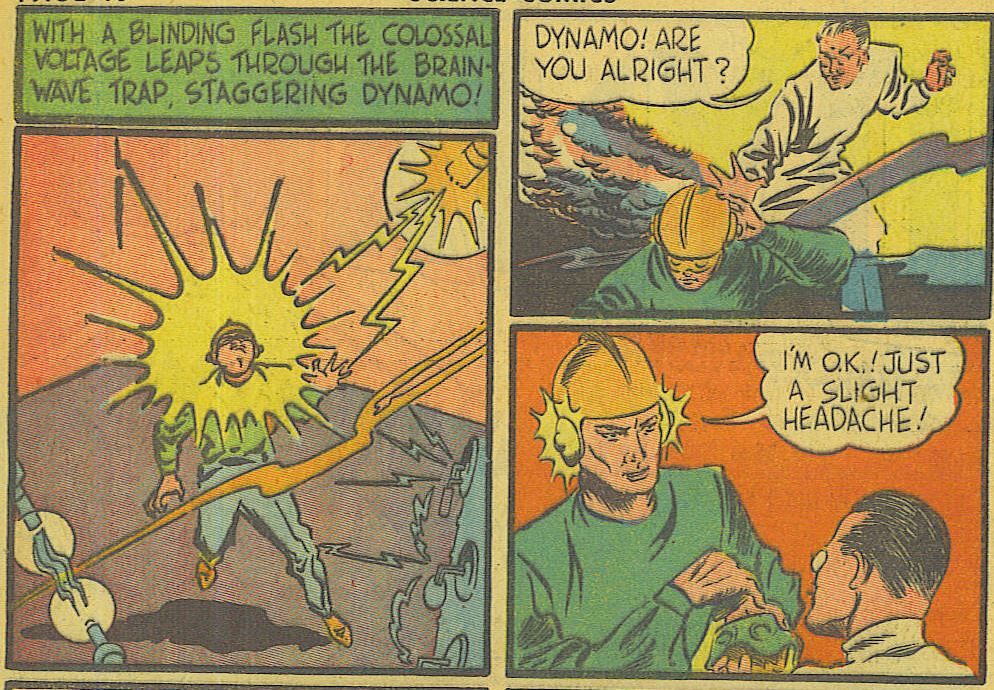
    ADDENDUM: In Science Comics 005, Dynamo, already wildly powerful, invents a device with the fairly ominous name the Brain-Wave Trap which allows him to read the minds of everyone on Earth and indeed for hundreds of light years around. Ir’s a significant power boost for something that is mainly used to keep the plot chugging along.

    UPDATE: Weird Comics 1940

    the Eagle:

    The Eagle is Bill Powers, a wealthy young gadabout who has developed an “anti-gravitation fluid” which allows him to fly when applied to his wing/flaps.


    The Eagle might just have the greatest number of costume variations before finding his groove, though I suppose a number of them can be ascribed to the whims of the colourist on any given day. While the flying squirrel style flaps are fun for their uniqueness and that fourth version has far nicer-looking wings than Hawkman was sporting at the same time I can absolutely understand the impulse to move toward a more traditional super-hero costume without a bunch of fiddly little feathers all over it. BUT! the Eagle’s costume has not reached its final form – something to look forward to once we get to Fox Features’ 1941 offerings. Or just look up on your own, I suppose.

    I don’t think that it’s intentional so much as a product of many busy hands being involved in making most if not all Fox Features comics, but Bill Powers is one of the better realizations of the “wealthy young playboy” super-hero alter ego. He really and truly comes off as someone who is just kind of doing things, including fighting crime, to keep himself occupied and the greatest example of that is all the little projects such as his “crime cartoons” or his “book on crime” that he keeps mentioning once and then never ever returning to. Plus he has a butler named Jason, whom I love.

    Finally, the Eagle might just have the most mysterious of all calling cards, an unseen “mark like that done by an eagle.” (Science Comics 001, 1940) 

    UPDATE: Weird Comics 1940

    Marga the Panther Woman:

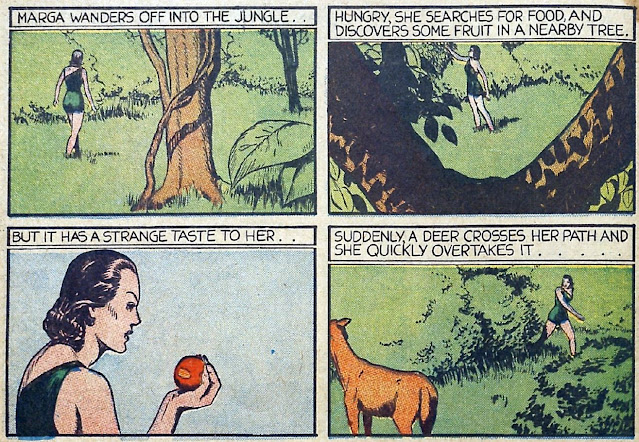
    Marga, formerly a nurse at the asylum housing the mad physiologist von Dorf, finds herself kidnapped and made into a panther/ human hybrid. Is there just a hint of weird race science in the way that Marga going from blonde to black haired is a sign of her primitive nature being brought forward? Maybe just a skosh.

    Marga adapts fairly well to her new situation, even when it means that she is now an obligate carnivore. She just kind of accepts that her life is no longer that of a nurse but that of a jungle predator.

    Marga’s first few adventures take place in what is pretty clearly the future but a series of comics with different creative teams ends with her being a contemporary 1940 figure. (Science Comics 001, 1940)

    Navy Jones:

    Navy Jones (and let me tell you I groaned audibly about two hours after I fist read that name, when I figured out that it was a pun on Davy Jones) is a submarine commander of the future who meets with disaster when his submarine hits a free-floating mine and everyone on board but him is killed. Lucky for Jones, he is picked up by some passing Fish-Men and taken to their city, where he befriends their king.

    Things take a turn when the evil Prime Minister uses the presence of this outsider in the halls of power as a catalyst for rebellion, and Navy Jones is almost killed. In another stroke of fortune, the king happens to be a skilled surgeon and saves Jones’ life at the cost of his ability to breathe air. Jones rescues the kidnapped Princess Coral from the Prime Minister and puts down the rebellion, becoming the city’s champion (and in a final stroke of luck, the Fish-Men are the kind of comic book species where the more aristocratic you are, the more human you look, so Jones’ new Princess love interest is barely a fish at all!). (Science Comics 001, 1940)

  • MINOR SUPER-HERO ROUND-UP 038

    MINOR SUPER-HERO ROUND-UP 038

    Second- and third-tier Fox Features heroes: ACTIVATE

    Dynamo:

    Jim Andrews is an electrical scientist who heroically risks his own life by using his own body as a conductor to prevent some crazy bit of machinery from blowing the whole laboratory he works at to high heaven. And since he lives in a comic book world, the reward for his bravery is some super powers! He can now emit electricity, create an electrical forcefield, kind of fly by throwing a lightning bolt and then riding it through the air and even be super strong, with the minor caveat that he has to charge himself up from time to time (over time and for narrative convenience he also develops the powers to freeze water, to repair smashed up items by shooting electricity at them and to travel interstellar distances under his own power).

    Andrews originally calls himself Electro but swaps that name out for Dynamo in his second appearance. There is some speculation that the name change comes about because there was already an extant Electro over at Marvel.

    Dynamo’s costume choices over his two years of adventuring range from “generic” to “kind of dumb-looking,” and the real kicker is that the Fox Features cover artist consistently puts him in this incredible red number. (Science Comics 001, 1940)

    ADDENDUM: In Science Comics 005, Dynamo, already wildly powerful, invents a device with the fairly ominous name the Brain-Wave Trap which allows him to read the minds of everyone on Earth and indeed for hundreds of light years around. Ir’s a significant power boost for something that is mainly used to keep the plot chugging along.

    UPDATE: Weird Comics 1940

    the Eagle:

    The Eagle is Bill Powers, a wealthy young gadabout who has developed an “anti-gravitation fluid” which allows him to fly when applied to his wing/flaps.


    The Eagle might just have the greatest number of costume variations before finding his groove, though I suppose a number of them can be ascribed to the whims of the colourist on any given day. While the flying squirrel style flaps are fun for their uniqueness and that fourth version has far nicer-looking wings than Hawkman was sporting at the same time I can absolutely understand the impulse to move toward a more traditional super-hero costume without a bunch of fiddly little feathers all over it. BUT! the Eagle’s costume has not reached its final form – something to look forward to once we get to Fox Features’ 1941 offerings. Or just look up on your own, I suppose.

    I don’t think that it’s intentional so much as a product of many busy hands being involved in making most if not all Fox Features comics, but Bill Powers is one of the better realizations of the “wealthy young playboy” super-hero alter ego. He really and truly comes off as someone who is just kind of doing things, including fighting crime, to keep himself occupied and the greatest example of that is all the little projects such as his “crime cartoons” or his “book on crime” that he keeps mentioning once and then never ever returning to. Plus he has a butler named Jason, whom I love.

    Finally, the Eagle might just have the most mysterious of all calling cards, an unseen “mark like that done by an eagle.” (Science Comics 001, 1940) 

    UPDATE: Weird Comics 1940

    Marga the Panther Woman:

    Marga, formerly a nurse at the asylum housing the mad physiologist von Dorf, finds herself kidnapped and made into a panther/ human hybrid. Is there just a hint of weird race science in the way that Marga going from blonde to black haired is a sign of her primitive nature being brought forward? Maybe just a skosh.

    Marga adapts fairly well to her new situation, even when it means that she is now an obligate carnivore. She just kind of accepts that her life is no longer that of a nurse but that of a jungle predator.

    Marga’s first few adventures take place in what is pretty clearly the future but a series of comics with different creative teams ends with her being a contemporary 1940 figure. (Science Comics 001, 1940)

    Navy Jones:

    Navy Jones (and let me tell you I groaned audibly about two hours after I fist read that name, when I figured out that it was a pun on Davy Jones) is a submarine commander of the future who meets with disaster when his submarine hits a free-floating mine and everyone on board but him is killed. Lucky for Jones, he is picked up by some passing Fish-Men and taken to their city, where he befriends their king.

    Things take a turn when the evil Prime Minister uses the presence of this outsider in the halls of power as a catalyst for rebellion, and Navy Jones is almost killed. In another stroke of fortune, the king happens to be a skilled surgeon and saves Jones’ life at the cost of his ability to breathe air. Jones rescues the kidnapped Princess Coral from the Prime Minister and puts down the rebellion, becoming the city’s champion (and in a final stroke of luck, the Fish-Men are the kind of comic book species where the more aristocratic you are, the more human you look, so Jones’ new Princess love interest is barely a fish at all!). (Science Comics 001, 1940)

  • MINOR SUPER-HERO ROUND-UP 036

    Prize Comics time, bay-bee.

    Power Nelson:

    Power Nelson is from the far-off future year of 1982 CE, in which the world has been conquered by the Mongols, but the wink, wink, nudge, nudge kind of Mongols from 1940-1941 where they’re actually supposed to be the Japanese (and for some reason the nation of Mongolia is fair game as far as Explicit Villain Status goes while Japan is still off the table). He has been given super strength by some surprisingly beefy scientists so that he might save civilization from oppression. Three things about Power Nelson:

    1) I think that his first name might actually be Power. So futuristic!

    2) I kind of want to give this series credit for not being too racist but the truth is that it is fairly racist but my senses have been dulled by exposure to the excesses of post Pearl Harbor depictions of the Japanese. 

    3) Power Nelson is very bad at his job? Every issue sees him within striking distance of Emperor Seng I and while assassinating the top man isn’t a guaranteed way to end a regime, it absolutely cannot hurt. Just punch him, man! (Prize Comics 001, 1940)

    Jupiter:

    Jupiter represents two distinct super-hero archetypes: the alien lawman sent to Earth to dispense justice and the magic-user, and as those are two of the more omnipotent origins that a character can have he goes through crooks like a hot knife through butter. The most important question about Jupiter is: was he called Jupiter back on the planet Jupiter or is he adopting a cool new name like a kid at camp? (Prize Comics 001, 1940)

    K the Unknown:

    Douglas Danville, wealthy playboy, takes to the crime-ridden ski slopes as K the Unknown, feared and hunted by ski crooks and ski cops alike. And presumably regular cops and crooks too, but he only had one recorded outing and it took place entirely within the bounds of a ski resort.

    K the Unknown’s one adventure involves embezzlement and murder among the officers of a college alumni group, possibly the perfect case for a wealthy playboy type hero.

    K the Unknown is a great name but perhaps not a great super-hero name, so I can see why he only had on outing. Still, it must be handy to have a calling card that you can piss into the snow. (Prize Comics 001, 1940)

    the Black Owl: 

    It’s hardly unusual for a Golden Age character to make one appearance and then disappear forever, but much more unusually while K the Unknown never had a second adventure his alter ego Doug Danville just kept on trucking under another identity. It’s never explored in the text of the story, so any explanation for why he made the change is an equally valid bit of speculation, from “he wanted a less generic super-hero identity” to “it’s completely different guy named Doug Danville who hangs around with a completely different private eye named Terry Dane.” It turns out that I wrote that last bit prematurely, as in the Black Owl’s second outing his foe is Sigmund Rathko, the crook who was also behind the alumni association shenanigans in the K the Unknown story. I suppose that it could be three completely different people but no, at that point we’re getting silly.

    One thing that you can say for certain is that he didn’t change identities to get the cops off of his back, because they want to get the Black Owl just as much as they did K the Unknown. Moreso, honestly, because K the Unknown was safely carving powder and never even saw a cop. (Prize Comics 002, 1940)