The Curse of Skeleton Munroe

Category: calling card

  • MINOR SUPER-HERO ROUND-UP 036

    Prize Comics time, bay-bee.

    Power Nelson:

    Power Nelson is from the far-off future year of 1982 CE, in which the world has been conquered by the Mongols, but the wink, wink, nudge, nudge kind of Mongols from 1940-1941 where they’re actually supposed to be the Japanese (and for some reason the nation of Mongolia is fair game as far as Explicit Villain Status goes while Japan is still off the table). He has been given super strength by some surprisingly beefy scientists so that he might save civilization from oppression. Three things about Power Nelson:

    1) I think that his first name might actually be Power. So futuristic!

    2) I kind of want to give this series credit for not being too racist but the truth is that it is fairly racist but my senses have been dulled by exposure to the excesses of post Pearl Harbor depictions of the Japanese. 

    3) Power Nelson is very bad at his job? Every issue sees him within striking distance of Emperor Seng I and while assassinating the top man isn’t a guaranteed way to end a regime, it absolutely cannot hurt. Just punch him, man! (Prize Comics 001, 1940)

    Jupiter:

    Jupiter represents two distinct super-hero archetypes: the alien lawman sent to Earth to dispense justice and the magic-user, and as those are two of the more omnipotent origins that a character can have he goes through crooks like a hot knife through butter. The most important question about Jupiter is: was he called Jupiter back on the planet Jupiter or is he adopting a cool new name like a kid at camp? (Prize Comics 001, 1940)

    K the Unknown:

    Douglas Danville, wealthy playboy, takes to the crime-ridden ski slopes as K the Unknown, feared and hunted by ski crooks and ski cops alike. And presumably regular cops and crooks too, but he only had one recorded outing and it took place entirely within the bounds of a ski resort.

    K the Unknown’s one adventure involves embezzlement and murder among the officers of a college alumni group, possibly the perfect case for a wealthy playboy type hero.

    K the Unknown is a great name but perhaps not a great super-hero name, so I can see why he only had on outing. Still, it must be handy to have a calling card that you can piss into the snow. (Prize Comics 001, 1940)

    the Black Owl: 

    It’s hardly unusual for a Golden Age character to make one appearance and then disappear forever, but much more unusually while K the Unknown never had a second adventure his alter ego Doug Danville just kept on trucking under another identity. It’s never explored in the text of the story, so any explanation for why he made the change is an equally valid bit of speculation, from “he wanted a less generic super-hero identity” to “it’s completely different guy named Doug Danville who hangs around with a completely different private eye named Terry Dane.” It turns out that I wrote that last bit prematurely, as in the Black Owl’s second outing his foe is Sigmund Rathko, the crook who was also behind the alumni association shenanigans in the K the Unknown story. I suppose that it could be three completely different people but no, at that point we’re getting silly.

    One thing that you can say for certain is that he didn’t change identities to get the cops off of his back, because they want to get the Black Owl just as much as they did K the Unknown. Moreso, honestly, because K the Unknown was safely carving powder and never even saw a cop. (Prize Comics 002, 1940)

  • MINOR SUPER-VILLAIN 693: THE TARANTULA

    (Pep Comics 010, 1940)

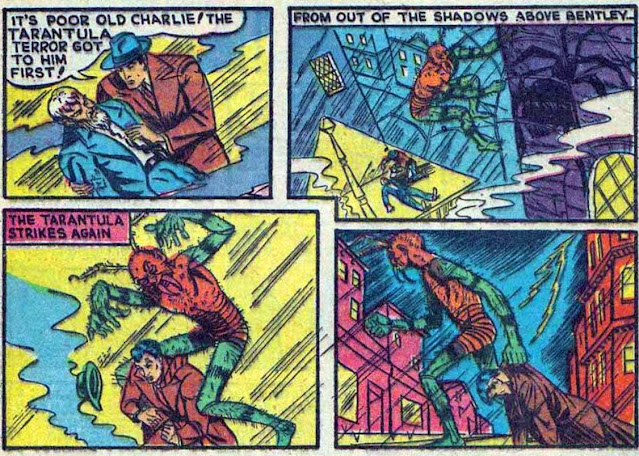
    A vile villain known as the Tarantula is extorting the young wealthy women of London and then murdering the ones who don’t pay up, and Inspector Bentley is on the case after two significant pieces of evidence fall into his lap: the latest body is left on the steps of Scotland Yard and then the latest extortion attempt is made against Deborah Morgan, whose father went to school with Bentley’s boss and you can’t beat the old boys’ club when it comes to swinging the forces of law into action.

    The usual parade of suspects that fills the pages of an Inspector Bentley story is a bit thin on the ground in this one. Don’t get me wrong, the numbers are there, but at least two of them are clearly padding – they don’t even say anything. The only credible suspects are BJ Morgan, his daughter Deborah (assuming some real 4D chess moves on her part), her fiance Bill Barnes and, in a big reach that the comic is not afraid to make, Bentley’s boss. I’ll say right now that the boss is a complete red herring set up by a walking stick.

    (please take note of the Tarantula’s little spider signature, which I love)

    Bentley goes to meet a potential witness, at which point w get the most important revelation of the episode: the Tarantula is not just some murderer but a proper super-villain, with a proper costume and everything! Sure, some spider fans might quibble about the inclusion of antennae (not to mention the use of fairly mild tarantula venom as the murder vehicle) but it’s been so long since I’ve seen a villain who wasn’t just wearing a mask that I literally cheered when I saw this dude.

    The Tarantula turns out to have about the right constitution for a basement dwelling spider breeder and goes down under the attacks of a heavily tied up Bentley. He’s smashed into his case of tarantula containment orbs in a way that would usually signal a villain’s ironic end via their own murder method, but I’ve reread the ending of this story a couple of times now and I have no clue whether the Tarantula is dead or alive at the end.

    The Tarantula turns out to be Deborah’s fiance Bill Barnes, who did it all because he was insecure about marrying a wealthy woman while not having much money himself. Moderately sweet, until you remember that he expressed this insecurity by extorting and murdering other young women. Wotta creep, am I right?

    More importantly is the question of exactly why Bentley was suspicious of Deborah’s circle: because when he went to interview his acquaintance Charlie about a possible Tarantula sighting he found him murdered and the only ones who knew about the potential witness were Deborah and her intimates. But did Bentley set a trap using the life of an innocent beggar or is he just so bad at infosec that he got a man murdered by accident?

  • MINOR SUPER-VILLAIN 674: THE SCALENE ANGLES

    (Miracle Comics 001, 1940)

    “Police athlete” Dash Dixon’s first super-heroic adventure involves him travelling to the small European Republic of Scalene in search of the murderers of several US exporters. Turns out that they were killed to prevent arms and other supplies from being brought into the country, because the Scalene Angles, a group of wealthy jerks, were looking to conquer it.

    The most important thing about the Scalene Angles is of course their name. It’s fun, but it also depends on their country being named Scalene and once you consider that you have to imagine the whole nation being lousy with places like Triangle Square and Three Sides of Different Lengths Locksmithing and the Pythagoras Doesn’t Know Us Bakery (and maybe a few places talking about the neck in some way). It’s still a great name but it’s also probably the name of a triangleball team that one of their kids plays on so no points for originality here.

    (they do leave a note with a little triangle signature and I always like that, so one point to them there. But Dash Dixon does find and destroy them because of that note so the point is a treacherous one)

  • MINOR SUPER-HERO ROUND-UP 023

    The most minor bunch so far!

    Don Rance and the Mysticape: 

    Don Rance saves an old man from a tiger in the Indian jungle and is given a mystic cape as a reward. In his single documented adventure he runs into spy trouble while ferrying some papers from the American embassy in London to Washington DC and must use the cape’s powers (generic physical enhancement and slow falling or some other way to jump from a plane and land safely on the ground. Also possibly teleportation? The art was unclear) to complete his mission safely.

    So: an utterly generic character who barely qualifies as a super-hero, but I just can’t help but be tickled that he calls his mystic cape the Mysticape and dream of a world in which Don Rance was such a popular character that he continued appearing for long enough that some bored writer had him battle the Mystic Ape. (Detective Eye 002, 1940)

    Ken Traymore and the Invisobox:

    Really really enjoy these guys. Properly this strip should be called Ken Traymore and His Dad and Their Invisoboxes because that’s what it is: a guy and his dad and their invisibility girdles palling around and investigating mysteries. It’s very wholesome! Particularly as your standard Golden Age comic would have featured the murder of Traymore Sr on page 1 as a bit of motivation for Ken in his neverending quest for justice.

    Aside from the delightful father/son dynamics, the best part of the Traymores’ single adventure is the fact that they spend the entire time investigating three suspects in the murder of their friend and do not catch the killer. Rather, he accidentally sees one of them turn invisible and freaks out because he thinks that he’s being haunted by his victim’s ghost. They don’t even know who he is – it’s great! 10/10 no notes, BRING BACK the Traymores and their Invisoboxes immediately. (Detective Eye 002, 1940)

    the Mask:

    The Mask is an adaptation of pulp character the Black Bat, but without the bat part due to some sort of gentleman’s agreement with DC after a squabble over who ripped who off, bat-wise. What he does share with his predecessor is an origin: District Attorney Tom Colby is blinded when gangsters working for crimelord Olly Snate splash acid on some key evidence during Snate’s trial. When Colby’s sight is restored via an experimental operation he decides to continue working as a supposedly-blind DA while also punching crooks as the Mask.

    (Also like the Black Bat he has enhanced night vision as a result of the operation but it never really comes up)

    Colby also inherits the Black Bat’s stable of assistants: Silk Davis (crook turned butler), Carol Smith (the one who lined up the eye operation for him) and Butch O’Leary (former boxer). As with all heroic associates they spend about half the time helping out and half the time captured by crooks, with the added twist that since there are three of them they often end up rescuing each other or getting serially captured while trying to rescue one another.

    The Mask was also quite clearly going to be the Owl in his first couple of appearances – presumably someone at Exciting Comics noticed that 1940 was a big year for owl-themed comic book characters and decided to skip the potential drama. By Exciting issue 3 he had traded in his owl-cowl for a beakless version and replaced his owl calling cards with a frankly hilarious version featuring a picture of his own face, clearly labelled. 

    One thing that always springs to mind when reading comics from the Nedor (etcetera – these people could not settle on a name for their publishing company) stable: did Alan Moore include them in Terra Incognito? The answer is of course no – the Mask is utterly middle-of-the-road and would have added nothing to the proceedings. (Exciting Comics 001, 1940)

    Major Mars:

    Major Mars, hero of 3964 AC, is another retooled version of an older pulp character, in this case the still-occasionally-name-checked-to-this-day Captain Future. Some basic research into the character indicates that the broad details are the same: brought up on the Moon (i.e., he should be called Major Moon), Major Mars battles injustice across the Solar System with the help of his robot pal Grag and love interest Joan. My major (ha) beef with this is that they left out Captain Future’s other two associates, a sassy shapechanging android and a brain in a jar! 

    Why Captain Future became Major Mars and why all of the best companions were left out of this adaptation are a question for the ages. (Exciting Comics 001, 1940)

  • MINOR SUPER-VILLAIN 538: THE WHISP

    (Funny Pages v3 008, 1939)

    There’s not much to the Whisp, which I suppose is appropriate. A bloodthirsty jewel thief, the Whisp makes off with some star sapphire bracelets and pulls a switcheroo by using a garage’s loaner car to make their initial getaway before swapping back to their own car for the long haul.

    The final trick is that the Whisp is not, in fact, a fresh-faced young man but a woman! And unlike some of our other cross-dressing characters this seems to be purely for the purpose of disguise rather than some sort of gender non-conformity. And it works! The dumb local cops are seemingly about to jail the poor garage owner based on the fact that he claims that two men borrowed his car even though it contained some long blonde hairs and thus… I can’t actually even begin to piece together why that would implicate him, honestly.

    Of course while the cops are being dummies our hero the Arrow is on the case. It’s a bit uncharacteristically gentle but he merely runs the Whisp and her companion off the road into a gorge and partially drowns one of them – as opposed to his usual methods, of course, which involve a lot of arrows impaling people. It’s probably because the Whisp is a woman?

    In conclusion, the extra ‘h’ in Whisp is very annoying.

  • MINOR SUPER-HERO ROUND-UP 012

    They just keep on coming.

    the Champ:

    The Champ is Captain America if Dr Erskine was a nutritionist rather than a… biologist? Biochemist? Whatever Dr Erskine was a doctor of. A sickly, bullied boy, the Champ (no other name given) was so-called by his bullies because he won at nothing. Scientist Dr Marlin, pitying the Champ, provides him with an experimental food supplement that over a period of seven years transforms him into a physical and mental paragon, the Champ of everything. (I really appreciate the writing on the description of the supplement – one could almost suspect that someone behind the scenes was considering a merchandising spin-off)

    Though the Champ tangles with spies and the like he is at his essence a college athlete character and so a lot of his stories are concerned with the surprisingly high-stakes world of betting on and rigging varsity level athletics, which is… not the most exciting subject matter for a comic. (Champion Comics 002, 1939)

    the Golden Knight:

    The Golden Knight is a heroic Crusader, a fairly popular genre of historical hero in the Golden Age and one that is very much out of favour now. He’ll probably come up again because he operates in an even more heightened comic book reality version of the Crusades than most of his peers, as evidenced by his first adventure, in which he stumbles upon what amounts to a group of Saracen Fifth Columnists lurking in an underground fortress in the English countryside.

    The Golden Knight (aka Sir Richard of Warwick) is also notable for the nonchalance with which he receives a vision of a sword-bearing lady in a one-piece swimsuit telling him to go to war. Unflappable, we call it. (Fantastic Comics 001, 1939)

    UPDATE 1940

    the Arrow:

    The Arrow, a very early costumed hero indeed, is simply an enormous guy in a hoodie (I mean, it’s basically a hoodie) who alternately kills criminals with a bow and arrow and threatens to do so to get what he wants. I have a slightly outsized level of affection for him because he approaches superheroics like I do an open world game like Skyrim.

    The Arrow does eventually get a more super-heroic look (roman sandal style lacing on his shins, a belt) and about the same time he gets shunk down to more average human proportions, possibly because the idea of a roughly seven foot guy with a carefully guarded secret identity was getting hard to write around. (Funny Pages v2 010, 1938)

    UPDATE 1940 

    UPDATE 1941 

    Mister Midnite:

    mister midnite

    Mister Midnite is Neal Carruthers III, a wealthy sportsman who dresses up in a tuxedo and domino mask to fight crime, with a watch face set to midnight as his calling card and the police on his tail. The only thing that really sets him apart from the horde of other besuited vigilantes is his weirdo power, which is that he can shout “stop, time!” and cause clocks to stop. Although in rereading the first Mister Midnite story again… he might just be able to stop that one clock in that one clock tower? It’s a dumb and bizarrely specific power and Mister Midnite is just lucky that I find that kind of thing charming. (Silver Streak Comics 001, 1939)

    UPDATE 1940 (Silver Streak Comics 002, 1940)

  • MINOR SUPER-HERO ROUND-UP 008

    MINOR SUPER-HERO ROUND-UP 008

    Some real highs and lows in this one.

    the Twister: 

    The Twister is a quite minor Golden Age super-hero – he managed more than one appearance but not more than seven – who has the distinction of having one of the most well-designed costumes of the era. Not my favourite costume, mind you, but boy oh boy, you can really tell that his creators (Ray Gill and Paul Gustavson as it happens) really sat down for a good think about how to evoke “tornado” via the medium of clothing.

    The Twister turns out to be Bob Sanders, and he turns out to be a descendant of perennial fave Greek hero Odysseus. It turns out that the story of Aeolus gifting Odysseus two bags of wind and his men opening the bag of storm winds thinking that it was full of treasure was more than just another delay in Odysseus’ Bad Voyage, it was akin to the opening of Pandora’s Box and Aeolus had charged Odysseus or his descendants to round up all of the evil violent winds and return the to captivity. 

    Evidently over the years the charge to gather up evil winds has expanded to fighting all evil, and the Twister’s power set allows him to run roughshod over just about anyone using wind control, a tornado form and invulnerability to anything that couldn’t harm actual wind. There is some attempt to establish that he is vulnerable to being locked up somewhere with no airflow but that proves even easier to defeat than all the times that Silver Age Aquaman is locked up and forced to source water from unexpected places.

    The Twister’s other claim to fame is that he was introduced as a mysterious tornado that appeared in the Blue Bolt, Sub-Zero and Dick Cole stories in the issue he first appears in, which is enough to be counted as a rare Golden Age crossover even though none of them shared words. (Blue Bolt v2 001, 1941)

    Freezum:

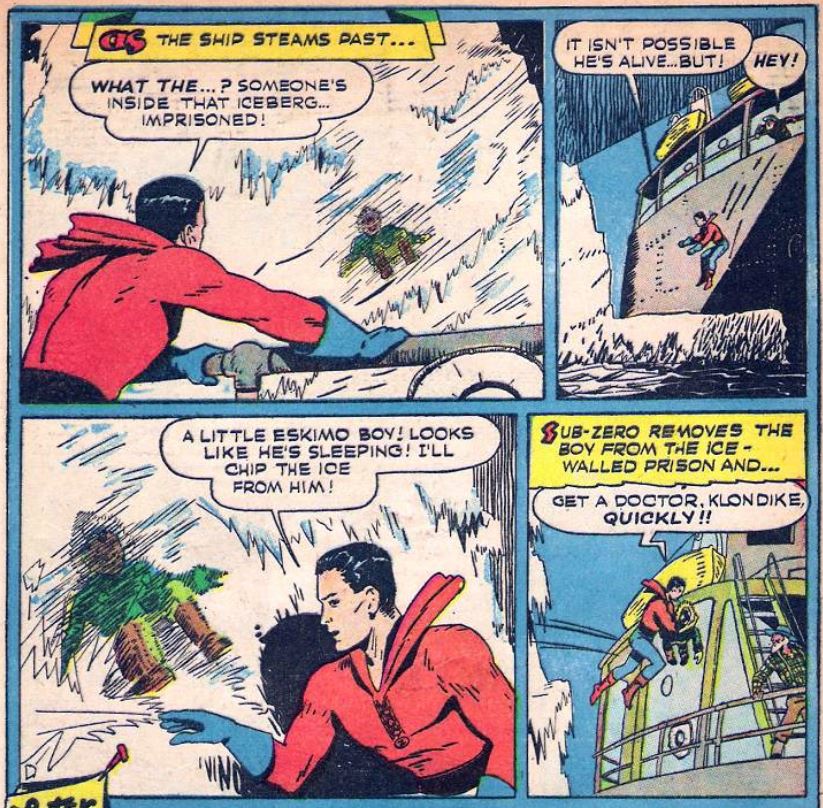
    On an adventure that takes him to Alaska, Sub-Zero happens upon a little Inuit or Aleut boy frozen in a glacier.

    Thawing the kid out and finding him to miraculously be alive, Sub-Zero (as well as an unfortunate doctor) is further astounded to discover that they share the same sort of cold-based powers due to their similar near-death freezing experiences. The kid names himself Freezum, and that’s just the first salvo of a barrage of tired comic relief sidekick shenanigans. Yes, we’ll be sighing and rolling our eyes for the remainder of Sub-Zero’s run – the joys of the Golden Age, friends! (Blue Bolt v2 005, 1941)

    Lois Blake:

    Lois Blake is a woman who Blue Bolt meets while attempting to take down a gang that was swindling immigrants using fake citizenship papers and decides to team up with. At some point when the gang is being particularly elusive he remembers that his pal Dr Bertoff down in the underground Kirby world has a viewscreen that can see virtually any location and so they head down there to use it. Bertoff then very helpfully offers to transfer some of Blue Bolt’s power to Lois and a new crimefighting team is born! (small aside: Golden Age comics don’t get a lot of praise for their art but I really enjoy both the small detail of Lois gripping Blue Bolt’s arm for comfort in the first panel above and her delighted expression in the third).

    Lois never gets a super-hero name and only really makes a handful of appearances before Blue Bolt ditches his costume and powers to become a regular if oddly-named soldier, but he’s such a nonentity post Simon and Kirby that I can’t help but love her for adding some life to the strip.(Blue Bolt v2 007, 1941)

    the Marvel:

    The Marvel is your classic mask-and-tuxedo vigilante, who specializes in showing up to bail reporter Scoop Cody out of the kind of jams you can get in when you’ve cracked a juicy crime story but not accounted for the possibility that the criminals involved might want to stop you from reporting on it.

    Three things about the Marvel: 

    1. The nose cutout never looks as cool as the full-face cowl does but I reckon it’s a heck of a lot more comfortable, so you have to give him some credit for choosing function over form.

    2. Scoop Cody and thus the Marvel only had two appearances and both of them had a teaser at the end promising that the Marvel’s identity would be revealed in the next issue. It’s always possible that they were planning on making the Marvel a completely new, never-before-seen guy but if they weren’t then literally the only suspect is this guy, Scoop Cody’s crusty old unnamed editor.

    3. Love a super-hero calling card, even in the rare cases when it’s a literal calling card.

    Also here is the Marvel’s second appearance in its entirety. (Blue Ribbon Coimcs 002, 1939)

  • MINOR SUPER-HERO ROUND-UP 008

    MINOR SUPER-HERO ROUND-UP 008

    Some real highs and lows in this one.

    the Twister: 

    The Twister is a quite minor Golden Age super-hero – he managed more than one appearance but not more than seven – who has the distinction of having one of the most well-designed costumes of the era. Not my favourite costume, mind you, but boy oh boy, you can really tell that his creators (Ray Gill and Paul Gustavson as it happens) really sat down for a good think about how to evoke “tornado” via the medium of clothing.

    The Twister turns out to be Bob Sanders, and he turns out to be a descendant of perennial fave Greek hero Odysseus. It turns out that the story of Aeolus gifting Odysseus two bags of wind and his men opening the bag of storm winds thinking that it was full of treasure was more than just another delay in Odysseus’ Bad Voyage, it was akin to the opening of Pandora’s Box and Aeolus had charged Odysseus or his descendants to round up all of the evil violent winds and return the to captivity. 

    Evidently over the years the charge to gather up evil winds has expanded to fighting all evil, and the Twister’s power set allows him to run roughshod over just about anyone using wind control, a tornado form and invulnerability to anything that couldn’t harm actual wind. There is some attempt to establish that he is vulnerable to being locked up somewhere with no airflow but that proves even easier to defeat than all the times that Silver Age Aquaman is locked up and forced to source water from unexpected places.

    The Twister’s other claim to fame is that he was introduced as a mysterious tornado that appeared in the Blue Bolt, Sub-Zero and Dick Cole stories in the issue he first appears in, which is enough to be counted as a rare Golden Age crossover even though none of them shared words. (Blue Bolt v2 001, 1941)

    Freezum:

    On an adventure that takes him to Alaska, Sub-Zero happens upon a little Inuit or Aleut boy frozen in a glacier.

    Thawing the kid out and finding him to miraculously be alive, Sub-Zero (as well as an unfortunate doctor) is further astounded to discover that they share the same sort of cold-based powers due to their similar near-death freezing experiences. The kid names himself Freezum, and that’s just the first salvo of a barrage of tired comic relief sidekick shenanigans. Yes, we’ll be sighing and rolling our eyes for the remainder of Sub-Zero’s run – the joys of the Golden Age, friends! (Blue Bolt v2 005, 1941)

    Lois Blake:

    Lois Blake is a woman who Blue Bolt meets while attempting to take down a gang that was swindling immigrants using fake citizenship papers and decides to team up with. At some point when the gang is being particularly elusive he remembers that his pal Dr Bertoff down in the underground Kirby world has a viewscreen that can see virtually any location and so they head down there to use it. Bertoff then very helpfully offers to transfer some of Blue Bolt’s power to Lois and a new crimefighting team is born! (small aside: Golden Age comics don’t get a lot of praise for their art but I really enjoy both the small detail of Lois gripping Blue Bolt’s arm for comfort in the first panel above and her delighted expression in the third).

    Lois never gets a super-hero name and only really makes a handful of appearances before Blue Bolt ditches his costume and powers to become a regular if oddly-named soldier, but he’s such a nonentity post Simon and Kirby that I can’t help but love her for adding some life to the strip.(Blue Bolt v2 007, 1941)

    the Marvel:

    The Marvel is your classic mask-and-tuxedo vigilante, who specializes in showing up to bail reporter Scoop Cody out of the kind of jams you can get in when you’ve cracked a juicy crime story but not accounted for the possibility that the criminals involved might want to stop you from reporting on it.

    Three things about the Marvel: 

    1. The nose cutout never looks as cool as the full-face cowl does but I reckon it’s a heck of a lot more comfortable, so you have to give him some credit for choosing function over form.

    2. Scoop Cody and thus the Marvel only had two appearances and both of them had a teaser at the end promising that the Marvel’s identity would be revealed in the next issue. It’s always possible that they were planning on making the Marvel a completely new, never-before-seen guy but if they weren’t then literally the only suspect is this guy, Scoop Cody’s crusty old unnamed editor.

    3. Love a super-hero calling card, even in the rare cases when it’s a literal calling card.

    Also here is the Marvel’s second appearance in its entirety. (Blue Ribbon Coimcs 002, 1939)

  • SUPER-VILLAIN YEARBOOK: RED SKULL 1941

    (Captain America Comics 007, 1941)

    What was the Red Skull up to in 1941?

    As mentioned in the Red Skull II entry, this here is the real deal bad guy we all know and love to hate, still running around being a total stinker to this day. In-comic there is of course no indication of this, as the decision to differentiate the two was made years later when someone figured that the top Nazi villain worked better as a German guy than an American fascist. Consequently this is a pretty scant Yearbook entry, as most of the Red Skulling for the year was done by another guy.

    Intended or not, this Red Skull has it a bit more together than his semi-predecessor: for one, he has a much creepier mask and has supplemented the red skull calling card with an audible element: Chopin’s Funeral March. AND! He engages with that finest of comic book traditions by wearing a rubberoid mask over his regular mask! Batman eat your heart out.

    As far as actual crimes go… he kills a couple of guys and briefly frames Captain America for kidnapping a General. Mediocre.

    SKULL SCORE: 3/5, just like the other guy. It ain’t gonna change until he melts his face off in… I want to say the early 80s?

    RED SKULL 1941

    BODY COUNT: 2

    END-OF-YEAR STATUS: Presumed dead

  • SUPER-VILLAIN YEARBOOK: RED SKULL 1941

    (Captain America Comics 007, 1941)

    What was the Red Skull up to in 1941?

    As mentioned in the Red Skull II entry, this here is the real deal bad guy we all know and love to hate, still running around being a total stinker to this day. In-comic there is of course no indication of this, as the decision to differentiate the two was made years later when someone figured that the top Nazi villain worked better as a German guy than an American fascist. Consequently this is a pretty scant Yearbook entry, as most of the Red Skulling for the year was done by another guy.

    Intended or not, this Red Skull has it a bit more together than his semi-predecessor: for one, he has a much creepier mask and has supplemented the red skull calling card with an audible element: Chopin’s Funeral March. AND! He engages with that finest of comic book traditions by wearing a rubberoid mask over his regular mask! Batman eat your heart out.

    As far as actual crimes go… he kills a couple of guys and briefly frames Captain America for kidnapping a General. Mediocre.

    SKULL SCORE: 3/5, just like the other guy. It ain’t gonna change until he melts his face off in… I want to say the early 80s?

    RED SKULL 1941

    BODY COUNT: 2

    END-OF-YEAR STATUS: Presumed dead