The Curse of Skeleton Munroe

Category: calling card

  • MINOR SUPER-VILLAIN 295: RED SKULL II

    (Captain America Comics 001 & 003, 1941)

    When I started this here blog I tried to put a little bit of thought into the tagging system, and specifically tried to work out how to deal with the fact that a lot of super-villain types have the same names. The solution I came up with is that everyone named, say, the Skull gets the same tag but legacy characters who are adopting a specific persona that another has used get appended with Roman numerals (skull II, Skull III, etc). And here I am breaking that rule the very first time I have the chance.

    Well, kind of. See, this is the original Red Skull so far as appearance in print is concerned. About 4 issues after he dies in his second appearance, the Red Skull returns, but a different Red Skull. This second Skull is the one that continues to appear to this day and the fellow I’m writing about here has been retroactively relegated to the status of Regional Franchise Red Skull. It’s all about not having to bother typing that extra ‘II’ in the tags for the next 80 years worth of appearances, honestly.

    So: the Red Skull (II)! Pretty much the perfect Nazi creep villain complete with a red skull calling card, taunting notes and a gimmick wherein he convinces his victims that he is killing them with his stare when in fact he is sneakily injecting them with poison. Why does he do this? For his own Nazi creep pleasure I guess.

    And just who is this retroactive knockoff? Why, it’s none other than George Maxon, aircraft manufacturer, who sold out the US to Hitler for the promise of high office. Boo this man!

    Maxon seemingly kills himself with his own syringe at the end of his first appearance and his body is shown being examined by the FBI afterward, they evidently just… left him to rot in his secret lair? Which works out pretty well for him, to be honest, since like any good poison-user he is immune to his own weapon.

    This time around, the Skull goes for a touch of death rather than a gaze, which involves a) an electrified costume and b) getting punched in the face a bunch. He seems to enjoy it, so I guess winning is worth a sock in the jaw to him.

    This second adventure sees this Red Skull’s greatest triumph as he steals the designs for a drilling vehicle and uses it to smash up part of NYC in one of those huge cataclysms that happened so often in the 40s. Marvel Universe New York must be simply awash in commemorative plaques detailing them all.

    Unfortunately for George Maxon and his super-villain legacy, this issue also sees his lowest moment, as he mistakes a couple of con artists for the real Captain America and Bucky despite one million signs that they aren’t. Frankly getting blown up with a round bomb a few pages later must have been a bit of a relief from the embarrassment of it all.

    (Maxon also shows up in Young Allies 001 the same year but it’s a weird appearance that has since been retconned pretty thoroughly for good reasons but in a way that has caused me a lot of annoyance when reading fan wikis. An ignominious end to be sure)

    SKULL SCORE: It’s just the eyes, which merits a healthy score of 4! Minus one point for being a mask makes the total come to 3.

  • MINOR SUPER-VILLAIN 288: THE KING

    (Marvel Mystery Comics v1 025, 1941)

    The King is your regular old gang boss who decides to pivot from running a numbers racket to selling counterfeit pharmaceuticals, and if that was it he wouldn’t be listed here. The dang guy just wasn’t content to be regular, though. Some salient features of his crime time:

    -he made the fake drugs in a sprawling underground lab using kidnapped doctors

    -recalcitrant doctors ended up in a giant vat of boiling acid

    -he has a full suite of gadgets including acid, gas and regular bombs and a remote controlled exploding car for blowing up excess henchmen

    -he leaves a king playing card at the scene of his crimes

    -he uses a cigar holder, which isn’t villainous per se but always stands out so much to me that I must make note of it.

    He’s also very dumb? Like, the calling cards tie together various crimes in a way that they might not otherwise have been, and he leaves a license plate that’s registered in his name on the bomb-car. Plus he does a lot of unnecessary murdering and kidnapping that does a lot less to make people respect him and more to make them want to stop him, or, as in the case of the henchman he fails to fully blow up, kill him.

  • MINOR SUPER-VILLAIN 275: THE HAG

    (Marvel  Mystery Comics v1 019, 1941)

    I don’t have to go into how wild it is that this woman is called a Hag, right? The wild misogyny of it all? Great, thanks.

    Aside from her name, the Hag is a gang boss, and one who dreams big. Her plan involves causing a citywide power outage in NYC so that her men could  tamper with the Stock Exchange and then clean up the next day while everyone panics about a nonexistent stock crash that she engineered. And also for some reason she takes over a radio station to get access to incoming news? The motivation behind that one is weird to me.

    The real flaw in the Hag’s plan is that while she accounts for the presence of the Human Torch and Toro, she doesn’t really deal with them. Her men are equipped with flame-resistant clothing and fire-suppressing chemicals, but they just serve to help in avoiding the Torch. Ultimately, he catches up, there is an explosion (inevitable), and the Hag is no more.

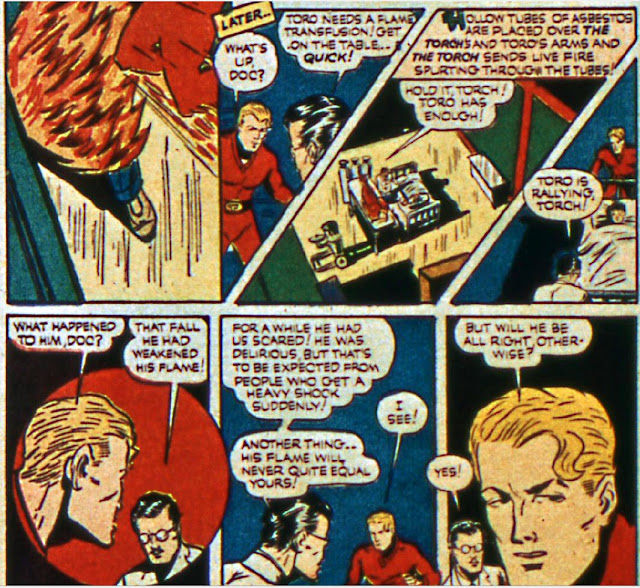
    This adventure also features the concept of Toro needing a “flame transfusion” after being severely hurt, which is very terrific, and which seems to be a convoluted way for Carl Burgos to canonically establish that Toro’s powers are a little weaker than the Torch’s? For some reason? It’ll be interesting to see if this is ever referenced again, frankly.

    ADDENDUM: forgot to mention the Hag’s sweet calling card:

    ADDENDUM II: Toro’s reduced fire-power actually came up in the subsequent issue, so I’m going to go ahead and try to note every issue it came up in right here:

    Marvel Mystery Comics v1 019
    Marvel Mystery Comics v1 020
    Human Torch v1 004
  • MINOR SUPER-VILLAIN 275: THE HAG

    (Marvel  Mystery Comics v1 019, 1941)

    I don’t have to go into how wild it is that this woman is called a Hag, right? The wild misogyny of it all? Great, thanks.

    Aside from her name, the Hag is a gang boss, and one who dreams big. Her plan involves causing a citywide power outage in NYC so that her men could  tamper with the Stock Exchange and then clean up the next day while everyone panics about a nonexistent stock crash that she engineered. And also for some reason she takes over a radio station to get access to incoming news? The motivation behind that one is weird to me.

    The real flaw in the Hag’s plan is that while she accounts for the presence of the Human Torch and Toro, she doesn’t really deal with them. Her men are equipped with flame-resistant clothing and fire-suppressing chemicals, but they just serve to help in avoiding the Torch. Ultimately, he catches up, there is an explosion (inevitable), and the Hag is no more.

    This adventure also features the concept of Toro needing a “flame transfusion” after being severely hurt, which is very terrific, and which seems to be a convoluted way for Carl Burgos to canonically establish that Toro’s powers are a little weaker than the Torch’s? For some reason? It’ll be interesting to see if this is ever referenced again, frankly.

    ADDENDUM: forgot to mention the Hag’s sweet calling card:

    ADDENDUM II: Toro’s reduced fire-power actually came up in the subsequent issue, so I’m going to go ahead and try to note every issue it came up in right here:

    Marvel Mystery Comics v1 019
    Marvel Mystery Comics v1 020
    Human Torch v1 004
  • MINOR SUPER-HERO 033: THE GHOST OF FLANDERS

    (Hit Comics 018-025, 1941-1942)

    I know I talk about how wild the origins of various characters are a lot on here, and I don’t think that I can justify declaring one or another “the most wild” anymore, but the Ghost of Flanders would absolutely have to appear on any reasonably comprehensive Top Ten Characters Who Will Amaze and Befuddle You With Their Wild Origins list.

    The Ghost of Flanders is in reality Rip Graves, who enlisted in the US Army during WWI and was basically immediately captured (as the Battle of the Marne took place in July 1918) and spent the rest of the war in a prison camp. This is not especially wild, although it does allow us to know that Graves is 37, a bit older than your typical super-hero (and of course if some enterprising comics writer decides to bring back the Ghost of Flanders for some reason he will automatically be the oldest living WWI veteran)

    The first really wild thing about Rip Graves is this: he is the Unknow Soldier, as in Tomb of the. Now, I looked up the Tomb of the Unknown Soldier the first time I read this story, and checked again just now, and not only is there, you know, a human corpse buried in it but it’s one that they went to reasonable lengths to make sure was, you know, unknown (in short, they located six unidentified US casualties and then had someone choose one at random). “This guy who we know the identity of but don’t have a body for” is almost exactly the opposite of that, in fact.

    Wanting to serve his country but not wanting to own up to being alive because for some reason he believes that the powerful symbolism of the Unknown Soldier will be ruined if it isn’t him specifically, Rip does a normal comics thing and decides to become a costumed vigilante. And what does every costumed vigilante need?

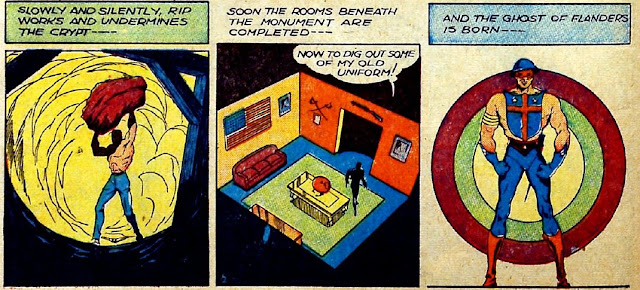
    A secret HQ under a solemn national war monument! Yes, the first thing that Rip Graves does is dig himself out a little man cave underneath the Tomb of the Unknown Soldier, because it’s his.

    Other things about the Ghost of Flanders include:

    -he is the only WWI-themed super-hero that I know of

    -his calling card is a red poppy (natch)

    -he uses WWI-era equipment including bayonets and a biplane, in a kind of natural extrapolation of something like the archer-hero and other users of archaic weaponry

    -I can’t say why he chose the unwieldy Ghost of Flanders name over the excellent Unknown Soldier, but it would take nearly thirty years for someone to take advantage of the excelent name that was just laying there.

    In conclusion: the Ghost of Flanders, a bog-standard 1940s super-hero boom character in most ways, but one that makes me feel crazy to think about too much.

  • NOTES: JANUARY 2023

    Names:


    Bulldog Teeters. (Feature Comics 044, 1941)


    Zero the Ghost Detective getting straight-up punched by a ghost. (Feature Comics 051, 1941)

    Dates: Johnny Thunder born 7th July, 1917 (Flash Comics v1 001, 1940)

    Calling Cards:


    He only ever used ’em a couple of times but the Flash had metal lightning bolt dart calling cards.

    Costumes:


    Absolutely the best Hawkman costume variant is the brief period in which he wore a big hat in the shape of a sassy hawk’s head (Flash Comics v1 003, 1940)