The Curse of Skeleton Munroe

Category: good henchmen

  • MINOR SUPER-VILLAIN 439: THE SKY-RULER

    MINOR SUPER-VILLAIN 439: THE SKY-RULER

    (Mystery Men Comics 019, 1941)

    I’m not sure what the Sky-Ruler’s deal is. 

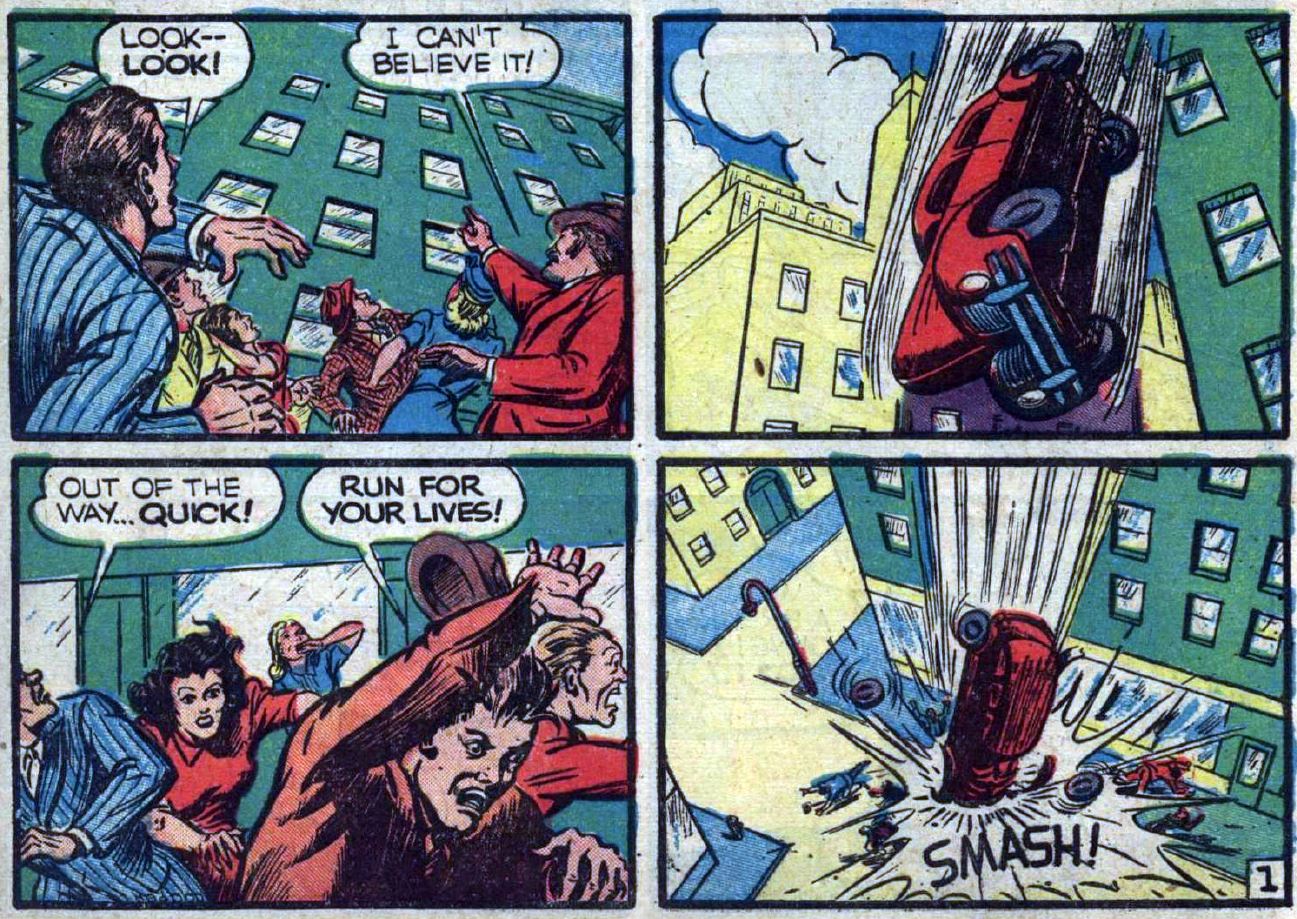
    Scratch that – I know what his deal is. He rules the sky. He flies around in a big bomber plane and uses it to drop cars containing his enemies on the streets of New York City (he also tries to throw off the scent of the police by calling these the “Skyscraper Murders” in his notes but I have to imagine that this would only work as long as nobody noticed the enormous plane circling the city every time one happened).

    I also know what the Sky-Ruler is doing: he’s extorting inventors with the threat of being fatally deplaned in order to get ahold of their various formulae. But why does he want them? He claims that “now the city will be at my mercy,” which could mean looting, destruction, ransom or conquest in equal measure. Serves him right that the Blue Beetle captures him by causing his lowly, ground-based car to crash.

    Two more things about the Sky-Ruler: his henchmen are called the Sky-Raiders and I always appreciate a nominative flourish even when applied to no-name thugs, and also I appreciate that his character design seemingly involved giving him as many distinctive facial features as possible.

    But what was his deal?

  • MINOR SUPER-VILLAIN 436: THE HEAD

    (Shadow Comics v1 004, 1940)

    Yo, it’s the Head! The Head is a mystic oracle that takes the form of a spooky head in a box and uses his position as a popular upper crust medium to gather info on crime targets, then sends out gangsters (named things like Squint, Chipmunk and Beak Thungle) to plunder them.

    The Head is also Zovex, a bulletproof cube-man who is supposedly just a servant of the Head but is mostly just a pile of armour plating.

    The way the Head operates both as Zovex and as the head-in-a-box oracle is that he is in actuality just a tiny little guy who probably didn’t pose enough of a threat for the Shadow to have to gun him down like he does, even if he was wearing tiny little curly shoes.

    This is all pretty standard fare as far as the comic book fake medium racket goes, but I appreciate a villain in a traditionally hands-off role getting out there in a suit of armour and mixing it up, you know?

  • MINOR SUPER-VILLAIN 436: THE HEAD

    (Shadow Comics v1 004, 1940)

    Yo, it’s the Head! The Head is a mystic oracle that takes the form of a spooky head in a box and uses his position as a popular upper crust medium to gather info on crime targets, then sends out gangsters (named things like Squint, Chipmunk and Beak Thungle) to plunder them.

    The Head is also Zovex, a bulletproof cube-man who is supposedly just a servant of the Head but is mostly just a pile of armour plating.

    The way the Head operates both as Zovex and as the head-in-a-box oracle is that he is in actuality just a tiny little guy who probably didn’t pose enough of a threat for the Shadow to have to gun him down like he does, even if he was wearing tiny little curly shoes.

    This is all pretty standard fare as far as the comic book fake medium racket goes, but I appreciate a villain in a traditionally hands-off role getting out there in a suit of armour and mixing it up, you know?

  • MINOR SUPER-VILLAIN 370: THE GREEN HOOD

    (Minute-Man 002, 1941)

    As mentioned in our last entry, the Green Hood was retroactively revealed to be the boss of Illyria, Queen of Spies in her final appearance (probably for the best as it’s hard maintain queenly authority when people know that you have a supervisor). He’s your standard hooded mastermind/ spymaster, albeit with a much more dramatically draped hood than most.

    He is also A Bad Boss, as shown by his demonstration of managerial style above. Having tasked Illyria with the daunting task of capturing Minute-Man, he condemns her to death (the super-villain equivalent of a very harsh write-up on her file) for capturing General Milton as bait/ in order to extract Minute-Man’s secret identity from him.

    For comparison, this is like hiring a team of scientists to travel to the centre of he Earth and then firing them when you find that they’re building a giant drill. Or, for that matter, setting someone the task of killing Batman and then getting mad when they show up with Alfred. The Green Hood’s uncle probably runs this spy business, is what I’m saying.

    Having ruined his chances of getting Minute-Man and squandered his best agent on a fit of middle-management pique, the Green Hood determines that he should make a grand gesture by attacking an unnamed New York-like city in the name of his unspecified Germany-like county using a tank that dispenses poison gas. He makes some headway but is ultimately felled by cop with a hand grenade.

    The issue ends with a hint that the Green Hood and Illyria might just be back someday and I’m sure that he would have been if the US had not entered WWII – hooded spymasters and femmes fatale were just too subtle and nuanced to be representatives of Nazi Germany in the comics. Sorry Green Hood but you are D E A D.

  • MINOR SUPER-VILLAIN 369: ILLYRIA, QUEEN OF SPIES

    (Master Comics 012-014, 016-017, 019-020; Minute-Man Comics 001-002, 1941)

    Illyria, Queen of Spies! (AKA Queen Spy, Spy Queen, Queen of All Spies, Queen of Foreign Spies, etc) Definitely in the running for my favourite of the “recurring femme fatale spymaster” subgenre of super-villain, particularly as she is a foe to Minute-Man, one of the most bland piles of wallpaper paste ever to wear a patriotic costume.

    Beyond merely distracting me from how bored I am by Minute-Man, Illyria provides interest via a fairly wide range of plots and schemes and thus is kind of hard to boil down into a pithy summary. So: a numbered list:

    1. In her first appearance Illyria wears a snazzy orange robe, the better to whip off when captured so as to take advantage of Minute-Man’s “won’t hit girls” policy and get away. She and her three distinctive henchmen spend the issue shooting down US Army aircraft on behalf of their unspecified nation using a special blindingly-bright plane (Master Comics 012, 1941)

    2.In her second outing, Illyria engages in the already-old gag of using war games as a cover to massacre soldiers with real bullets. The interesting aspect of the story is that she is established as an explicit Axis agent (though of a never-specified power) and recruits spies from the other Axis powers to aid her in her schemes (Master Comics 014, 1941)

    3. This one’s just an attempt to kidnap a scientist who has developed a new explosive. It is the origin of the “Queen of Spies” part of her moniker, though. This adventure also marks the first time that Illyria is actually captured, as she is just as slippery as any recurring femme fatale  (Master Comics 014, 1941)

    4. After precisely one issue in the hoosegow, Illyria breaks out (that poor nurse) and attempts to blow up a Fourth of July celebration. (Master Comics 016, 1941)

    5. In service to a pretty rote kidnapping, Illyria deploys both a remote-controlled bomber and X-33, an extremely cool robot soldier who is sadly (for him) not at all waterproof. (Master Comics 017, 1941)

    6. Master Comics 019 & 020 are concerned with boring old espionage focused on stealing bombers and bomber plans: ho hum. Illyria does step up the villainy to include slavery in the latter appearance, though.

    7. Minute-Man 001 features Illyria and her drum-playing chum in a scheme to cause a native uprising on the US-held island of Barracoon in the Gulf of Mexico. The main draw of the story is Illyria’s keen voodoo dance hat but if you want to read a comic that inadvertently highlights the evils of colonialism then this is the one for you, along with about 90% of all Golden Age comics set outside of Europe or North America. And some of the ones set in North America, too.

    8. Illyria’s final appearance in Minute-Man 002 retroactively establishes that the Queen of Spies has been working for the heretofore unmentioned Green Hood, who is tired of her getting foiled all of the time. It’s a bit of an anticlimax for her, as the story is much more concerned with the Green Hood than her. Still, she manages to get away at the end, joining the ranks of the surprisingly populous “recurring femme fatale spies who don’t end up getting caught by dint of not recurring that extra time.”

    (at least I reckon that was her last appearance. She was captured at the end of Master Comics 020, dated November 1941, while Minute-Man 002 was the Winter Issue, dated September to December 1941)
  • MINOR SUPER-VILLAIN 358: THE BLACK HOOD

    (Master Comics 018, 1941) 

    Okay, I am a big fan of the Black Hood. Let’s count down the reasons:

    One: very exciting to see the classic super-suit being worn in the early days of suits and robes. This look won’t take long to become ubiquitous once it catches on but it’s still pretty rare in 1941.

    Two: not only is he a fashion pioneer but he is a thought leader in the field of henchman couture. Dressing your guys in a slightly worse version of your own costume (in this case bright rather than dark blue) is a surefire move in the villain game and it’s going to be a while before we see it with any kind of regularity.

    Three: The Black Hood is introduced as El Carim’s arch-enemy, despite never having appeared before’ and there are allusions to El Carim having broken up “four of his best rackets” etc. Implied lore is admittedly an easy way to build up a story’s interest but I guess I’m a sucker for it.

    About the only real criticism I have for the Black Hood is for all that he has experience battling El Carim (potentially years of experience, depending on the rate at which he sets up rackets) he is entirely unprepared to deal with Carim’s dank majiks. His approach is a completely straightforward trap and kill attempt and it goes very badly. A real shame.

    Nonetheless. regular costumed crooks like the Black Hood are the backbone any supercrime economy and he or his heirs should be BRUNG BACK post haste.

  • MINOR SUPER-VILLAIN 336: ADAM ADDAMS

    (All-Flash 003, 1941)

    Like the Threat before him, Adam Addams is a revenge guy. Unlike the Threat, Addams is… I won’t say more petty, but perhaps less focused – they include the woman who didn’t marry him, the man she married instead, the man who refused to give him a medical license because he talked about glands too much, and anyone who contributed to one of his prior revenge schemes going wrong. If he has a particular focus, it’s Dr French, the man what married the woman. About half of the issue involves attempts by Addams to ruin French’s life and the other half is all about killing as many of his enemies as possible.

    Contrary to Addams’ big talk about changing your face with glandular treatments, he actually uses bog-standard rubberoid masks. Maybe they’re just easier than mutating your head every time you want to put on a disguise, because he does turn out to have the goods, gland-manipulation-wise…

    To whit, he posts up on a tropical island and mutates a herd of horses into beefcake centaurs! Centaurs who he then flies back to NYC and parachutes into Dr French’s hospital for a good old fashioned rampage, because nothing ruins a medical reputation like a centaur attack.

    Special shout out to Oats, the doofus centaur who ruins the whole operation by being too horny.

    Extra special shoutout to the unnamed and very professional centaur pilot in his little hat.

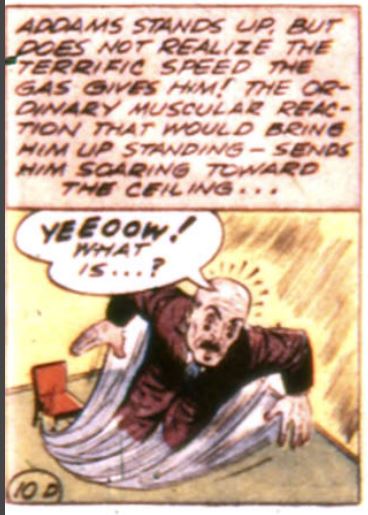
    Aside from Addams’ revenge schemes his other major interest is in recreating the hard water formula that gave the Flash his powers (because the Flash has very poor infosec and it’s trivially easy to find out where and how he did so). To that end, he kidnaps Jay Garrick’s old chemistry professor and forces him to work on finding the formula. And he finds it! Adam Addams acquires Flash-style super-speed! He gets beat up by the actual Flash because he has no fine control yet, but surely this marks a dark new day in the annals of crime!

    Not a chance. In a move that smacks of “we have to wrap up the issue now”, Addams takes his own life after the Flash foils what is frankly a medium-sized plot. It’s fairly unsatisfying, to say the least. Thankfully, I have a solution: Addams didn’t blow up, he entered the Speed Force. He can come back at any time!And I want that! I want him to be brung back! Because as uninteresting as the Speed Force and its related heroes and villains have become through proliferation it can only be improved through the application of a guy who can whip up a pack of centaurs on a month’s notice.

    ADDENDUM: I was wrong! He does change some of his henchmen’s faces via glandular treatments!

  • MINOR SUPER-VILLAIN 332: THE HAND

    (Leading Comics 001, 1941)

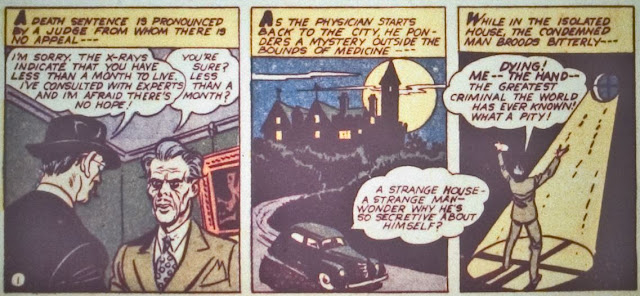
    The Hand holds the distinction of being both the first foe of the Seven Soldiers of Victory (all 9 or 10 of them) and the person who organized them as a team in the first place, and all as a way to get attention, essentially. As first presented, he is a master criminal so successful that he is unknown to the world at large who has just received word that he is dying with no hope of a reprieve.

    Somewhat understandably, the Hand decides to go out with a bang rather than a whimper, by recruiting five other super-villains to act as his “fingers” and carry out his most audacious crimes.

    We’ll get into the nitty gritty of the Five Fingers of the Hand in the next entry (because I have a system and I need to stick to it, okay?) but the long and the short of it is that the Hand gathers together pre-established supercrooks the Needle, Professor Merlin and the Red Dragon, never-before-seen supercrook the Dummy and lucky-to-be-considered schnook Big Caesar, outfits them with crime plans and sets them up in a classic Justice Society style “everyone split up and have a little adventure” adventure with what will become the Seven Soldiers of Victory.

    Though this might be the most reasonable reason for sending a taunting note to the forces of Law I have yet seen (after all, how greater the crime if it is actively opposed?), it remains a bad idea to do so, categorically, as evidenced by the fact that every one of the Five Fingers is summarily captured (or in the case of Professor Merlin, exploded) mid-caper, leading to the traditional final act of the JSA-style story wherein everyone comes together to beat up the mastermind.

    Who knows if the Hand could have handled them if he hadn’t been informed that his condition was, in fact, treatable just before the fight. Could he have taken on seven super-heroes if he still thought he was going to die? We will never know. Instead, he almost gets them with a lightning cannon but ends up being electrocuted by it, ironically dying just as he learned that he might have a chance to live.

    Or did he? No he didn’t, it turns out, because years later Len Wein wanted to bring back the Seven Soldiers of Victory and concocted a story wherein they were blasted through time, and who better to be responsible than their very first foe? And since that caper involved the Nebula Man, one of Grant Morrison’s favourite creeps, the Hand showed up in Seven Soldiers, too. He seems to have about a 30-year refractory period, so look for him on comic shelves sometime in 2036!

  • MINOR SUPER-VILLAIN 318: DORK

    (Daring Mystery Comics 005, 1940)

    There’s a great temptation when dealing with an evil scientist named Dork to focus on easy, puerile humour rather than appreciating the other things that make him a good super-villain.

    I had a whole bit about how his big plan was to flood the city with white goo (hur hur) and kidnap women to experiment on their bodies but it wasn’t sustainable. Ironically, I would have had to jump through more hoops to obliquely reference his monster looking like jizz than if, as here, I just said it.

    Good costumes on the henchmen!

    This is where the joke fell apart, by the way. There was no good way to link this guy with the jizz jokes that wasn’t a huge stretch. Appreciate the cool monster, I guess.

    And then he was killed by his own jizz!

    Excuse me. He was dissolved by his own blob-monster in a classic example of irony.

  • MINOR SUPER-VILLAIN 293: RATHCONE

    (Captain America Comics 001, 1941)

    I’ll be honest: Rathcone doesn’t have too much going on. He’s your regular style Nazi spy with enough extra sauce to make him stand out. To whit:

    -a maxed-out “Jack Kirby draws a weird creep” stat, complete with fangs and talonlike fingernails

    -an oblique gimmick whereby he plays out his strategy on a chessboard while his men listen in over an intercom. The custom chess set is of course one of the great super-villain accessories

    -most importantly, his henchmen are all called things like Herr Kamelon and Herr Strangler and Number 15 and at this point Rathcone could be removed from the equation entirely because all the villainous side dishes are there for my delectation.

    Rathcone’s final claim to fame is simply the fact that he makes it through the adventure alive, which I would not have put money on given the survival rate of the other Marvel super-villains on our list.