The Curse of Skeleton Munroe

Category: good henchmen

  • MINOR SUPER-VILLAIN 813: YAGOR

    (The Spirit, “The Death Dolls”, 4 August, 1940)

    In terms of villainy, Yagor ain’t much. Formerly chief engineer at the Battle Arms Co, Yagor murdered the inventor Kalin and stole his inventions and is trying to sell them on when the Spirit tracks him down in a small New England town. Though he gets the drop on the Spirit and captures him when he shows up to take him in, Yagor is undone by his own poor salesmanship and the crucial lack of imagination possessed by munitions buyer Emil Kampf, who dismisses a working robot soldier as a useless toy without, for instance, considering the possibility inherent in a bit of armour plating.

    Among Yagor’s many shortcomings is dismal salesmanship and specifically his failure to present Kampf with the other invention that he stole from Kalin, a smaller automaton capable of tracking a person across tens if not hundreds of kilometres, navigating such obstacles as sheer walls and subway systems, in order to kill them via explosion. Instead, he sends one, charmingly named Jepetto, to kill Kampf.

    (perhaps the oddest thing about this assassination is that as Jepetto is tracking down and killing Kampf Yagor and the Spirit are in New England listening for news of the explosion on the radio, and while this is in the days when the Spirit’s adventures were still set in New York City, the whole process must have taken hours if not days to complete, even if the “dark. mysterious fishing village” of Cape Haven were somehow both at the Southern border of Connecticut and “out of the tourist route.” Just standing around at gunpoint for three days while a small robot walks down the East Coast)

    But perhaps I am giving Yagor too much grief. After all, he was the chief engineer at that munitions company, not the chief salesman. Surely after bungling two whole opportunities to sell his robots (I’m counting the assassination because I think that loading that little robot up with a couple of water balloons or the like would have been a very good proof of concept indeed) he will rally and hike up his pants and really put in a good effort in his next black market arms presentation. What’s that? He just loaded all of his remaining Death Dolls (which is what the little assassin-bots are called) into a big robot soldier and sent them to attack New York for no good reason? Yagor, no. You’re going to get caught by the Spirit!

    Yagor got caught by the Spirit, you guys. 

  • MINOR SUPER-VILLAIN 806: THE SCOURGE

    (The Funnies 050, 1940)

    The Scourge is a bandit chief operating in the nonspecific Medieval-pastiche England of the Black Knight, and let me tell you, he is a terrific villain. His amazing look is one thing – just how many Golden Age villains have the confidence to use eye makeup to accentuate their air of menace? – but on top of that I have seldom seen a villain so eager and joyful to torture a peasant woman. Just an amazingly hateable guy, with a really top-notch crew of evil oafs to boot.

    Though the poor woman’s husband and sons set out to avenge her, they prove no match for the Scourge and his band of ruffians, and it falls to the Black Knight and a local hunk to get the job done. 

    It does of course turn out that a good look and a bad attitude will only take you so far, particularly when your follow-up to a a successful heist is to get drunk in the woods for a week straight. The Black Knight and his unnamed and shirtless assistant make quick work of the lot of them once they are able to approach them on equal footing, and the Scourge meets his end by the Black Knight’s Blade.

  • MINOR SUPER-VILLAIN 801: GENERAL Z

    MINOR SUPER-VILLAIN 801: GENERAL Z

    (Target Comics v1 007, 1940)

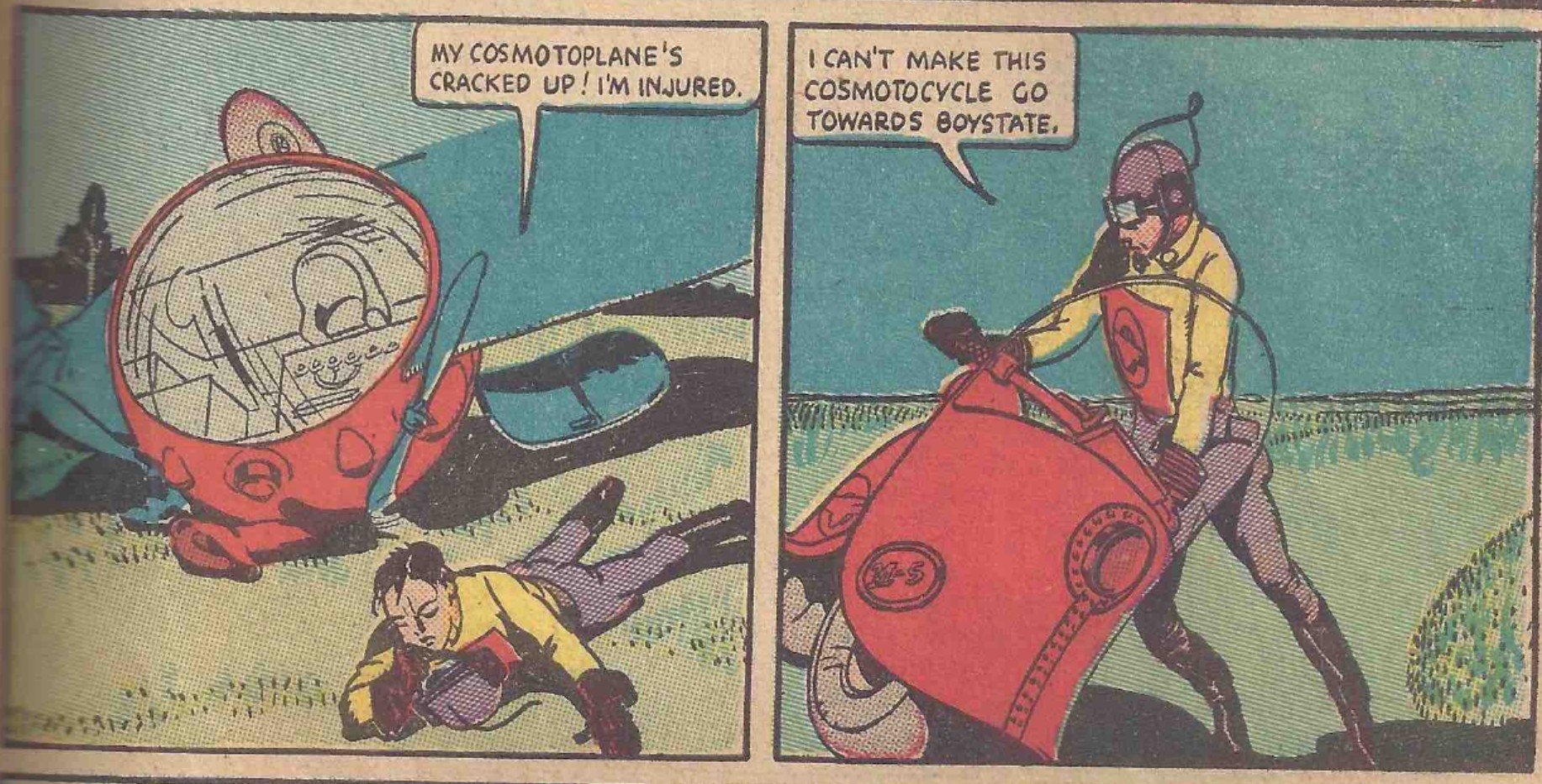
    Boystate is under attack! At first, it’s a relatively innocuous disruption of the power supply, which from what I’ve been able to glean is broadcast power derived from cosmic rays, but it swiftly escalates until all contact with the rangers operating outside of the Boystate boyborders is lost.

    And just in case there’s any confusion, this disruption attack is swiftly followed by a barrage of poison gas missiles, and the Boystate child army must be rolled out to deal with them using flamethrowers.

    The culprit behind these dastardly attacks turns out to be General Z, who in turn is revealed to be the former Captain of Boystate, who was dismissed from his post for selling the Skipper’s inventions on to ne’er-do-wells and is now back for revenge. This is one of those times that something seems like a hoary old trope (the new villain is actually a disgraced former holder of a heroic position) is probably still fairly fresh.

    General Z’s minions are called the Z-Men and I must say that they’re terrific: they have a great name, they are dressed in a kind of junior version of Z’s own outfit, they seem like they’re a little dumb, they’re roughly equivalent to the Boystate Rangers… it’s like a checklist of all the things I want to see in a group of henchmen, plus they have death ray guns. All that’s really missing to really make the experience complete are one or more lieutenants with code names and/or slightly distinctive uniforms.

    I said that the Z-Men are roughly equivalent to the Boystate Rangers, but there is one missed opportunity here: though they do have a kind of slouchy adolescent look the Z-Men appear to be adults, and it would be much more symmetrical and satisfying if they were also troubled youths but instead of the benevolent arms of Boystate they had been taken in by General Z and turned to a life of crime.

    Perhaps the reason for this is that the Skipper’s first plan is to simply blow up General Z’s whole compound, Z-Men and all, and it might not reflect well on him as a saviour of the at-risk youth were he seen to be okay with murdering them en masse. In any case, he is prevented from doing so when General Z kidnaps Jerry, the grandson of the Skipper’s old friend Colonel Richey. Instead, while the Z-Men and the Boystate Rangers engage in deadly hand-to-hand combat, the Captain and M-4 (formerly Pretty Boy, and one of the few Rangers to make even a second appearance) infiltrate Z’s compound in order to rescue Jerry and shut down the signal-damping device that is keeping the Boystate air force grounded.

    Jerry is found in this absolutely awesome looking cryogenic chamber in which General Z freezes his enemies and then sticks them in little oubliettes. Not particularly important to the plot but certainly sick as hell.

    The Captain also manages to trash the power plant, and once the Boystate bugplanes start joining the fight, General Z legs it (knocking his subordinate to the ground in the process just to underscore what a wretch he is).

    Also please note that young Jerry is completely traumatized by the experience, which is a real change of pace from the usual plucky kids in these kinds of stories. 

    General Z returns in Target Comics v1 011, but as the real meat of that story takes place in issue 012, in 1941, I’m going to cover both together once we get to that batch of issues.

  • MINOR SUPER-VILLAIN 790: DR HORTON

    MINOR SUPER-VILLAIN 790: DR HORTON

    (Sure-Fire Comics 003a, 1940)

    The town of Branton, no state specified, has been struck by a mysterious plague, and X, the Phantom Fed, is suspicious. He infiltrates the quarantine zone around the town in the guise of a doctor and starts investigating the various odd facts of the plague, beginning with 1) the fact that is is being spread by a troop of escaped gorillas that were being used in medical testing and are now apparently just wandering the town and attacking people at random.

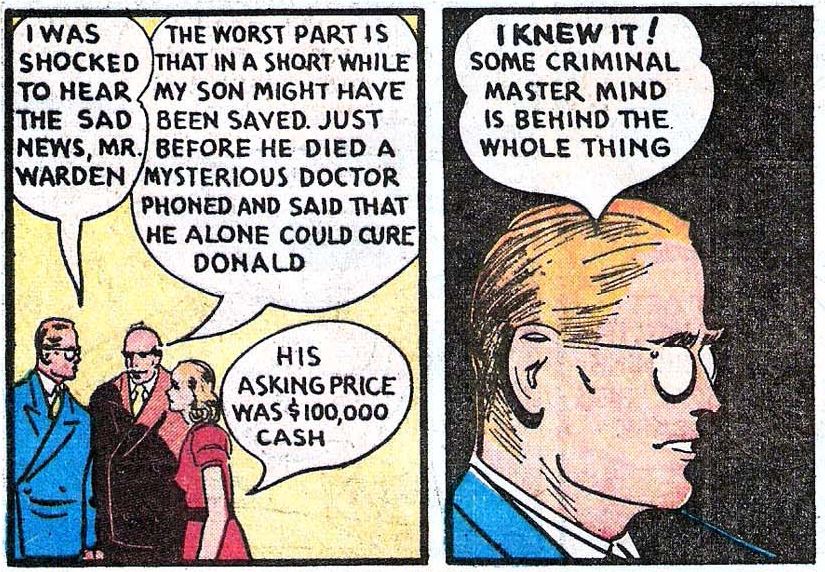
    Or are these attacks actually random? They are not, and weird thing number 2) is the fact that the gorillas seem to only be attacking the wealthiest inhabitants of Branton, such as young Donald Warden here.

    3) Speaking of amazing coincidences, a mysterious doctor just happens to have an antidote to the disease spread by the gorillas, and is willing to provide it for a hundred grand a pop, which is again an amazing coincidence since all of the victims just happen to have that kind of money.

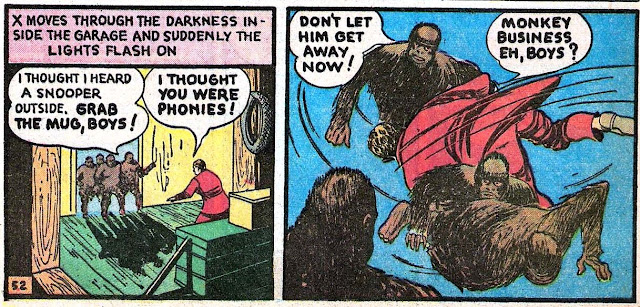
    X disguises himself as the deceased Donald Warden and arranges to get the antidote so that he can trail the agents of the mysterious doctor back to their headquarters. There, he makes an amazing discovery: the gorillas are actually men in gorilla outfits, administering fake diseased bites using a weird fork. Let me tell you: it has been too long since we have had some gorillas, real or not, in this online space.

    The thing about a gang made up of a bunch of guys in gorilla suits is that it is pretty easy to infiltrate, and X does just that, tagging along as Dr Horton, the supposed researcher who supposedly accidentally lost the gorillas, orchestrates an all-out attack on City Hall to loot the town treasury before presumably wrapping up the entire operation and skipping town. Horton’s luck has run out, however, and he is corralled with relative ease by the Man of a Million Faces.

  • MINOR SUPER-VILLAIN 787: THE TERROR TRUST

    (Sure-Fire Comics 002, 1940)

    The Terror Trust is a group with a very simple money-making scheme: demand money from millionaires and then throw acid in the faces of the one who refuse to pay up. X, the Phantom Fed infiltrates this group by breaking captured member Horton out of prison and then impersonating him.

     
    X’s scheme falls apart when the Trust’s members realize that Horton was simply not clever enough to effect his own escape, leading him to capture one of the ringleaders, prominent psychologist Professor Parks, and extract the names of the remaining two from him using some legally suspect truth serum.

    Does X then complete the roundup of the Terror Trust in disguise as Parks? Nothing so simple for the Phantom Fed. First off, he disguises himself as the local Police Commissioner, then enlists the aid of the Trust’s next victim, Sir Anthony, and then poses as Parks. Or rather as the Commissioner posing as Parks. Does he do this as a way to gain Sir Anthony’s trust, perhaps? A good guess, but no, he immediately tells Sir Anthony that he is actually X in disguise. It might be in an effort to make the local police look good but honestly I reckon that it’s merely for the challenge of the thing, that by his second appearance X is getting a bit tired of the regular master of disguise schtick and looking to up the difficulty a bit. Real adrenaline junkie stuff.

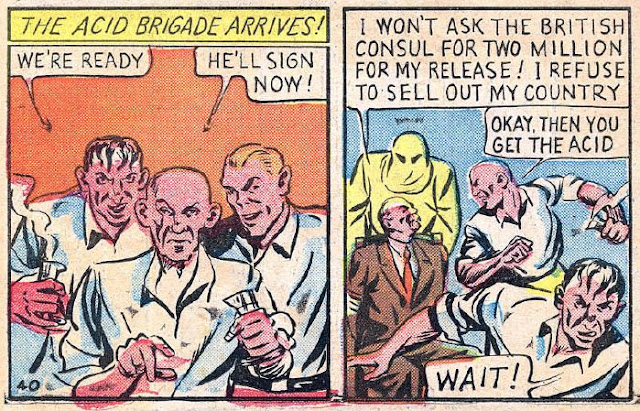
    As is customary we must take a moment to recognize the little people who make the true super-villainy happen, and this time our focus is on this bunch of absolute creeps, the Acid Brigade. Just something to keep in mind when you create a business that revolves around the act of throwing acid in people’s faces: you’re going to have to work with people willing to do that. It’s an HR nightmare, I can only assume.

  • MINOR SUPER-VILLAIN 784: THE GREEN MASK

    (Sure-Fire Comics 001, 1940)

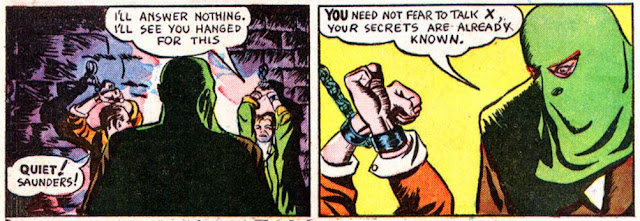
    The Green Mask is after one thing: world domination, and he’s looking to achieve it by capturing the Shock Ray, a weapon capable of paralyzing hundreds of people at a time, and which has been deemed too terrible to use by the US government (just why this is it unclear – my only idea is that it is either a fatal paralysis or a permanent one).

    The thing about the Green Mask that is very compelling is his hood – I’m always harping on about those characters who make the choice to have a nose cutout in their evil villain hood, and how that choice is a perfect one if you want comfort and also don’t mind looking bad, and while the Green Mask has chosen to have ear cutouts – very similar – he has also gone with nostril holes instead of the full nose, and I have to say that that strikes me as both bad-looking and immensely impractical/uncomfortable. His minions all look terrific in their Halloween demon masks, though.

    Another thing I’m always yapping on about is the long stretches of pointless action in the middles of Golden Age stories, and in no story is that more evident than this one. The Green Mask gets ahold of the Shock Ray plans on the first panel of the second page, and the much of the rest of the fifteen-page story involves his attempts to kill or capture various people tangentially involved in the theft for no stated reason, while X gathers more and more evidence toward his eventual capture.

    And speaking of that capture, once it happens the Green Mask is revealed to be… Sam Barkley! And let me tell you that when I first read this story I was a little tired and so I figured that the fact that I had no idea who Sam Barkley was meant that I hadn’t been paying enough attention, but no, Sam Barley is a “famous sportsman” who made a one-panel, non-speaking appearance, six pages earlier and that was it. It’s the most out-of nowhere reveal in comics history.

    Anyway, much beloved ancillary character Sam Barkley turned to a life of crime because he was mixed-race, and his American father abandoned his probably-Malaysian mother (based mostly on the fact that his henchmen are all or mostly Malaysian), leading him to hate all Americans and ultimately embark on a life of costumed crime. If his motivations were more nuanced than that then they will sadly go unexplored, as once captured he immediately chugs some prussic acid rather than be taken alive.

  • MINOR SUPER-VILLAIN 782: ERIC MACFADDEN

    (Superworld Comics 001, 1940*)

    Eric MacFadden is a criminal scientist who has some sort of longstanding beef with Hip Knox, the Super Hypnotist, that was presumably covered in Superworld Comics 001, a comics I have yet to encounter for the simple reason that it would cost me at least $ 2000 US.

    MacFadden’s signature technology is the extremely stylish mesh anti-hypnosis mask that he wears to protect him from Hip Knox’s super-hypnotism, and he even has extras made to shield his men from the same (not a guarantee from your typical self-obsessed super-villain), making them the Mask Gang.

    As Superworld Comics represents Hugo Gernsback’s sole foray into comic book publishing, people more familiar with the politics and personalities of the sci-fi pulps than I am have speculated that Eric MacFadden is in some way based on Bernarr Macfadden, an enemy of Gernsback’s, and I gotta say that he’s a plausible guy to base a super-villain on. Like, obviously a man’s whole life cannot be summed up by his Wikipedia article, but an anti-medicine physical culture weirdo who gave himself the name “Bernarr” because he thought it sounded like a lion’s roar is at the very least super-villain adjacent.

    If MacFadden is indeed based on Macfadden (he also changed his last name from “McFadden” to “Macfadden” because he thought that it was “a more masculine spelling!) due to a deep Gernsback/Macfadden beef then it would go a long way toward explaining the dynamic between the two, wherein MacFadden attempts to destroy Hip Knox and then Knox turns around and ritually humiliates MacFadden rather than seeking more traditional forms of justice, and for that reason Eric MacFadden joins the ranks of super-villains who are still at large as of their final appearance.

    I would also like to make a special note of the fact that despite Hip Knox developing anti-mask technology in Superworld Comics 002, MacFadden does not then abandon the masks entirely, as is so frequently the case with science villains when their tech is countered. MacFadden is savvy – he knows that Knox isn’t going to wear that big-ass backpack every time he leaves the house.

    *Still haven’t read Superworld Comics 001 but I am assured that he was in it.

  • MINOR SUPER-VILLAIN 776: THE BLUE SPARK

    (Super-Mystery Comics v1 002, 1940)

    In terms of crime, the Blue Spark is ambitious but not extraordinary: a little corporate extortion, some bank robbery, a few kidnappings. Nothing we haven’t seen a few hundred times by now.  When it comes to the trappings of super-villainy, however, the Blue Spark is on the cutting edge.

    Just look at that costume – it’s not quite the standardized super-villain getup we will eventually see on so many one-shot Batman villains but it’s pretty damn close, and particularly in an era in which most villains are still pairing a mask with a suit and tie or a robe. Even more impressive and ahead of its time is the Blue Spark’s choice to dress his henchmen in a simplified version of his own uniform. Just really impressive stuff.

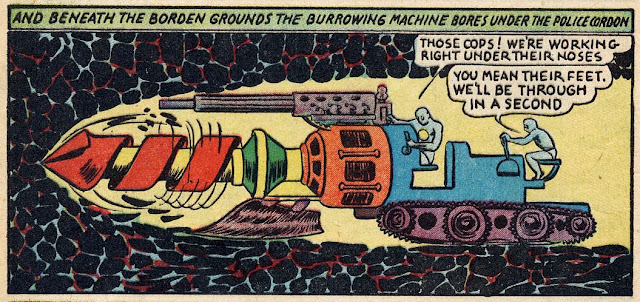
    The Blue Spark’s main gimmick, a heat ray cannon mounted on a truck, isn’t quite as remarkable but it is a pretty sweet bit of gear. Plus he has another one mounted on a cool-ass drilling machine!

    (it is somewhat unclear if the Blue Spark has a second ray that allows him to mind control people or if his heat ray doubles as a mind control ray, and determining this is not helped by the fact that he clearly has an aesthetic fondness for that particular style of scientific greebling on the outside of the rays. It’s a good clean visual on the mind control ray, I will say that)

    The Blue Spark’s henchmen (called the Blue Rubber Men at one point, btw) are not just well-dressed:  their costumes have  little nozzles in the chest that lets them be inflated like a balloon to render them immune to fisticuffs  – another idea that sounds like something out of a Silver Age comic, twenty years early.

    Technology or no, inflation fetish suits or no, the Blue Spark vs Magno is your classic case of a villain who is so little of an even match for the hero that the plotter’s concern must lie in keeping them apart for as long as possible because the instant they meet up, something like the above happens. Magno didn’t even give him a chance to blow up his suit, the poor guy.
  • MINOR SUPER-VILLAIN 776: THE BLUE SPARK

    (Super-Mystery Comics v1 002, 1940)

    In terms of crime, the Blue Spark is ambitious but not extraordinary: a little corporate extortion, some bank robbery, a few kidnappings. Nothing we haven’t seen a few hundred times by now.  When it comes to the trappings of super-villainy, however, the Blue Spark is on the cutting edge.

    Just look at that costume – it’s not quite the standardized super-villain getup we will eventually see on so many one-shot Batman villains but it’s pretty damn close, and particularly in an era in which most villains are still pairing a mask with a suit and tie or a robe. Even more impressive and ahead of its time is the Blue Spark’s choice to dress his henchmen in a simplified version of his own uniform. Just really impressive stuff.

    The Blue Spark’s main gimmick, a heat ray cannon mounted on a truck, isn’t quite as remarkable but it is a pretty sweet bit of gear. Plus he has another one mounted on a cool-ass drilling machine!

    (it is somewhat unclear if the Blue Spark has a second ray that allows him to mind control people or if his heat ray doubles as a mind control ray, and determining this is not helped by the fact that he clearly has an aesthetic fondness for that particular style of scientific greebling on the outside of the rays. It’s a good clean visual on the mind control ray, I will say that)

    The Blue Spark’s henchmen (called the Blue Rubber Men at one point, btw) are not just well-dressed:  their costumes have  little nozzles in the chest that lets them be inflated like a balloon to render them immune to fisticuffs  – another idea that sounds like something out of a Silver Age comic, twenty years early.

    Technology or no, inflation fetish suits or no, the Blue Spark vs Magno is your classic case of a villain who is so little of an even match for the hero that the plotter’s concern must lie in keeping them apart for as long as possible because the instant they meet up, something like the above happens. Magno didn’t even give him a chance to blow up his suit, the poor guy.

  • MINOR SUPER-VILLAIN 769: DR SLADE

    (Startling Comics 001, 1940)

    “Dr
    Slade is one of those rare and unfortunate villains who are a part of a
    super-hero’s origin story but who also die as a part of that origin, so that
    they don’t even have the dignity of actually properly being a part of
    that hero’s rogues gallery. That’s sad! On the other hand, Slade did
    develop his resurrection technology in order to build an army of the
    formerly-dead in aid of a fascist takeover of the United States, so
    maybe he got everything he deserved.”

    That right there is what I wrote about Dr Slade in what will be the next Mad and Criminal Scientist Round-Up, and it’s all true. That’s a wrap on Dr Slade, I thought, and took a big gulp of coffee as I turned to the Mystico story in Startling Comics 002. 

    What I’m trying to convey here is that I was shocked, nay, ultrashocked to find out that Dr Slade had not in fact died when his lab exploded but was back to properly vex Mystico as a villain and not a hapless facilitator of his resurrection. And he looks great! As a villain, I mean. It’s the only profession where having your face blown off has a lot of positives to it.

    Slade is presumably still working for the unnamed fascist country that was behind the Green Shirts and their attempt to take over the US with an army of the dead, and on their behalf he has created the hydrophage, a device that can split water into hydrogen and oxygen at a rate of a billion gallons per hour (that’s nearly 3.8 billion litres for all my fellow metric heads out there)! An impressive device with a cool name, but Slade’s proposal for how to use it in war – to lower the ocean level to such an extent that Allied ships run aground and become easy targets for Slade-aligned forces – is one of the stupidest plans in comics history.

    I mean, sure: it’s going to be effective. You’re absolutely going to catch some ships off guard with this one. But significantly reducing the amount of liquid water on Earth is going to have some wild knock-on effects for everyone, including fascist dictatorships, and that’s without mentioning that they’re just releasing the oxygen into the atmosphere (they’re saving the hydrogen for presumably nefarious purposes)! And what’s going on with the salt, I just realized! I was already concerned about the effects on the world’s ocean life, but now it’s going to have to contend with a supersaturated salt ocean as well? Yikes.

    Luckily for the fishes and the rest of us, Mystico is on the case. He dives into the hydrophage-created bubble that houses Slade’s sub-sea base (a cool use of water-destroying technology, I must admit) and though he is captured by some costumed henchmen that is not enough to prevent him from blowing the whole place to smithereens using the stored hydrogen. 

    Despite all of my hopes for a progressively more blown-up Dr Slade to keep coming back as Mystico’s major recurring foe, this is the last we’ll see of him.