The Curse of Skeleton Munroe

Category: magic item

  • MINOR SUPER-HERO ROUND-UP 074

    Some more of those “minor super-heroes” you like so much. 

    the Cat-Man **Update**:

    Hey, it’s the Cat-Man! As you may or may not recall, the Cat Man (sans hyphen) debuted in Crash Comics Adventures in 1940 and was the only survivor of that comics short run. The most obvious change to his character is his costume, which goes from its former jungle chic look through a blue-and-orange phase  before settling on the orange-and-darker orange look that he will stick with for the rest of his career.

    In addition to the costumes and the hyphen, Cat-Man got a slight tweak to his origin: rather than being orphaned by a hostile tribe in India, David Merrywether’s parents are now said to have been killed by bandits in Burma. David also has a job now: he’s a private detective for the first four issues of Cat-Man Comics, after which he enlists and becomes a lieutenant in the US Army.

    The Cat-Man also gets a couple of new powers in 1941: he is able to see otherwise-invisible radiation and displays some degree of super strength.

    Finally: his nine lives. Though he still has this power, David manages to only die once during the whole of 1941, bringing his total remaining lives down to six.

    the Kitten: 

    Actually, not quite finally, as this is also the year that the Cat-Man gets a sidekick. While en route to investigate a series of train explosions, Lt David “the Cat-Man” Merrywether picks up a hitchhiking man and his niece. The man turns out to be a real scumbag, but the girl, named Katie Conn, turns on her uncle rather than see him rob and possibly murder Merrywether. Once the uncle is tossed in the hoosegow it’s a classic case of a child just entering a super-hero’s orbit and getting auto-adopted.

    Katie turns out to be the orphaned child of a pair of circus acrobats, which as we know is a perfect background for a potential super-hero’s sidekick to have. She also appears to be a few years younger than your typical kid sidekick – if they average in at about 13-15 I’d call her 11 or 12, though as usual the limitations of Golden Age art make estimating the age of kids difficult at best.

    Merrywether does his best to conceal his dual identity from his new ward but doesn’t quite manage it, and her self-assigned new role as the Cat-Man’s sidekick is announced in the final panel of the last Cat-Man story of 1941. More specifics on her in action as a sidekick in 1942. I will say that it’s nice to see a kid sidekick with both a costume and a code name. (Cat-Man Comics 005, 1941)

    Blaze Baylor: 

    Blaze Baylor is the son of the famous fire chief Smoky Baylor, who was killed by arsonists, and who is now a very specific anti-arson crimefighter. Though the name of the strip is “‘Blaze’ Baylor and the Arson Ring,” there is no indication in any of his adventures that the arsonists he battles are connected to one another in any way. (Cat-Man Comics 001 1941)

    Dr Diamond: 

    Dr Drake Gorden is bound for the South Seas when the freighter he is travelling on is sunk by a waterspout. He passes out after washing up on a beach at the base of an unscaleable cliff and is carried off by an eagle that takes him to the home of a frankly weird guy who has dressed him in a generic super-hero costume.

    This never-named man explains that thirty years prior he had come into possession of a legendary black diamond that conferred great physical power to its wielder, and that he had retired to the island to await the arrival of someone worthy enough to receive it. Dr Gorden, a man who he just met and who has spoken all of thirty-three words to him, several of which were to refer to a pair of brown pants as his “American clothes,” is his pick.

    Whatever the opposite of the Refusal of the Call part of the Hero’s Journey is, that’s what Dr Gorden has. He immediately renames himself Dr Diamond and launches into a monologue about just how hard he’s going to bust up crime that is so over the top that it would make me personally reconsider giving him any sort of power whatsoever. Despite my misgivings, Dr Diamond does an adequate job of using the powers conferred by the gem (super strength, enhanced speed, some degree of invincibility) to battle crime for four issues before fading into the mists of obscurity. (Cat-Man Comics 001, 1941) 

  • MINOR SUPER-HERO ROUND-UP 072

    Extremely minor super-heroes? Don’t mind if I do!

    the Flag-Man:

    The Flag-Man is one standard unit of patriotic American super-hero: he loves the United States and is willing to put on a costume and punch guys until it is safe. And speaking of costumes: the Flag-Man and his pal Rusty are prime examples of how piggybacking off of the iconography of the American flag can really paper over some pretty bad costume design. I mean, tank-top and cape and flared gloves? Give me a break.

    The Flag-Man’s alter ego is Captain Hornet (occasionally Major Hornet), trouble-shooter for the President, who presumably knows about the whole Flag-Man thing.

    Since Captain Hornet/the Flag-Man seems the be dedicated to solving problems exclusively via the medium of hand-to-hand combat, he is in effect a fist that FDR can send to punch anyone he wants. Mostly Nazis, to his credit. (Captain Aero Comics 001, 1941)

    Rusty:

    Just as the Flag-Man is the elemental patriotic hero, his sidekick Rusty is the basic unit of kid sidekick: no last name, no alter-ego, just a scrappy teen who tags along on adventures. I do find him the most irritating of all the Golden Age sidekicks we have yet encountered, so that’s at least one distinction. (Captain Aero Comics 001, 1941)

    Solar, Master of Magic: 

    Solar, Master of Magic is as you might have guessed another of Golden Age comics’ many, many magic guys, which in practical terms means that he can do basically anything he wants to. In contrast to a lot of his peers, he chooses to use his fists as much or more than his magic. 

    Although Solar presents as a pure magic guy, he is in fact a magic item guy, with a magic cape of invisibility and a magic ring of doing everything else. It’s a minor distinction but it introduces the possibility of the source of his powers being stolen from him, which does in fact happen during the final of his four appearances. (Captain Aero Comics 001, 1941)

    Captain Fearless:

    Comics love to tie their characters to history, usually by making them the descendant of someone famous but often by inserting their ancestors into real events, as can be seen in the case of the Wizard. This might be the first time I’ve seen it done to this extent, however, as John Fearless here is not only the instigator of the Boston Tea Party, but a member of the First and probably Second Continental Congresses and could reasonably be expected to be a signatory of the Declaration of Independence. In other words, he’s a whole-ass made-up Founding Father!

    John Fearless goes on to die in one of the opening battles of the Revolutionary War, upon which… well, the speech balloon placement is annoying, but either he ascends into heaven as an otherworldly voice tells him that his patriotism will live on in his family line or an angelic being from the newly-formed United States of Heaven descends in full uniform to collect his soul and tell him the same. I prefer the latter, but who can tell.

    Regardless of the otherworldly voice’s source, its words prove true, as evidenced when young John Fearless VI, latest member of a family of patriots, visits his ancestor’s grave and then gets to meet that very ancestor.

    The ghost of John Fearless I relates the glorious history of the other four Captains John Fearless, fighting to protect the American values of justice and liberty for all (and also in the Mexican- and Spanish-American Wars) and gasses on for a while about patriotism and so forth.

    In contrast to his forebears, John Fearless VI’s assignment is not military but vigilante in nature, as the ghost of John Fearless I is concerned about the threat of fifth columnists and is of the opinion that a costumed crimefighter is the best way to root them out. To that end, his great-great-great grandson is outfitted with a not-great costume and sent off to battle.

    He also gets an antique powder horn that doubles as a musical one, and annoyingly does not blow it during his first case. Once he finally gets around to trying it out, it summons the ghost of the original Captain Fearless to help him out by invisibly beating people up and flying him around in his ghost arms.  (Captain Fearless Comics 001, 1941)

  • MINOR SUPER-HERO ROUND-UP 072

    Extremely minor super-heroes? Don’t mind if I do!

    the Flag-Man:

    The Flag-Man is one standard unit of patriotic American super-hero: he loves the United States and is willing to put on a costume and punch guys until it is safe. And speaking of costumes: the Flag-Man and his pal Rusty are prime examples of how piggybacking off of the iconography of the American flag can really paper over some pretty bad costume design. I mean, tank-top and cape and flared gloves? Give me a break.

    The Flag-Man’s alter ego is Captain Hornet (occasionally Major Hornet), trouble-shooter for the President, who presumably knows about the whole Flag-Man thing.

    Since Captain Hornet/the Flag-Man seems the be dedicated to solving problems exclusively via the medium of hand-to-hand combat, he is in effect a fist that FDR can send to punch anyone he wants. Mostly Nazis, to his credit. (Captain Aero Comics 001, 1941)

    Rusty:

    Just as the Flag-Man is the elemental patriotic hero, his sidekick Rusty is the basic unit of kid sidekick: no last name, no alter-ego, just a scrappy teen who tags along on adventures. I do find him the most irritating of all the Golden Age sidekicks we have yet encountered, so that’s at least one distinction. (Captain Aero Comics 001, 1941)

    Solar, Master of Magic: 

    Solar, Master of Magic is as you might have guessed another of Golden Age comics’ many, many magic guys, which in practical terms means that he can do basically anything he wants to. In contrast to a lot of his peers, he chooses to use his fists as much or more than his magic. 

    Although Solar presents as a pure magic guy, he is in fact a magic item guy, with a magic cape of invisibility and a magic ring of doing everything else. It’s a minor distinction but it introduces the possibility of the source of his powers being stolen from him, which does in fact happen during the final of his four appearances. (Captain Aero Comics 001, 1941)

    Captain Fearless:

    Comics love to tie their characters to history, usually by making them the descendant of someone famous but often by inserting their ancestors into real events, as can be seen in the case of the Wizard. This might be the first time I’ve seen it done to this extent, however, as John Fearless here is not only the instigator of the Boston Tea Party, but a member of the First and probably Second Continental Congresses and could reasonably be expected to be a signatory of the Declaration of Independence. In other words, he’s a whole-ass made-up Founding Father!

    John Fearless goes on to die in one of the opening battles of the Revolutionary War, upon which… well, the speech balloon placement is annoying, but either he ascends into heaven as an otherworldly voice tells him that his patriotism will live on in his family line or an angelic being from the newly-formed United States of Heaven descends in full uniform to collect his soul and tell him the same. I prefer the latter, but who can tell.

    Regardless of the otherworldly voice’s source, its words prove true, as evidenced when young John Fearless VI, latest member of a family of patriots, visits his ancestor’s grave and then gets to meet that very ancestor.

    The ghost of John Fearless I relates the glorious history of the other four Captains John Fearless, fighting to protect the American values of justice and liberty for all (and also in the Mexican- and Spanish-American Wars) and gasses on for a while about patriotism and so forth.

    In contrast to his forebears, John Fearless VI’s assignment is not military but vigilante in nature, as the ghost of John Fearless I is concerned about the threat of fifth columnists and is of the opinion that a costumed crimefighter is the best way to root them out. To that end, his great-great-great grandson is outfitted with a not-great costume and sent off to battle.

    He also gets an antique powder horn that doubles as a musical one, and annoyingly does not blow it during his first case. Once he finally gets around to trying it out, it summons the ghost of the original Captain Fearless to help him out by invisibly beating people up and flying him around in his ghost arms.  (Captain Fearless Comics 001, 1941)

  • GENERIC COSTUMED VILLAIN ROUND-UP 034

    Since we’re currently reading Whiz Comics for 1941, it’s time yet again for another load of unscrupulous people to get their hands on the Ibistick and then kill themselves with it. And here they are:

    the Widow Zorn:

    Ibis lends the Ibistick to old Professor Grubb  for scientific study after Grubb finds it outside of an exploded building and uses its magic to restore the building and everyone inside – which included both Ibis and Taia, along with their their young ward Tommy – to wholeness and life. This isn’t a bad idea per se, as Grubb is an honest man, but he is also in love with the scheming Widow Zorn, who vamps it away from him in about two seconds flat.

    Zorn’s main interest is in conjuring up hunks to fight for her attention, so the damage potential in her having the Ibistick is a bit lower than some (although she does vaporize poor old Prof Grubb when he kicks off about it). She does of course try to kill Ibis with his own wand and ends up on the Moon for her trouble, but fortunately for her the reconstituted Grubb advocates for not letting her explode or whatever and she ends up falling for him after all. (Whiz Comics 012, 1941)

    Trug: 

    Trug gets his own super-villain entry, the jerk. 

    the Chief: 

    The Chief isn’t a villainous figure per se, but his role in the comic is close enough that I’ll say that he counts. The leader of an Inuit group subjugated by Trug, the Chief recovers the Ibistick after Trug loses it in a magical air raid and turns the tables on the villain by imprisoning him in his own palace.

    The Chief lives through the process of confronting Ibis by simply being a fair fighter and not deigning to use magic where fists will suffice. Fair-ish, at least – he is nine or ten feet tall at the time. Still, Ibis manages to win their fight and reclaims his wand. The Chief and his people are returned to their original sizes (as the latter had been shrunk by Trug to ensure obedience) and get to keep Trug’s palace to boot. (Whiz Comics 014, 1941)

    A Spider: 

    When Ibis and Taia leave the Chief and his people they are given a stone as a gift, and after having it appraised and finding out that it is an enormous and valuable ruby Ibis decides to give it back. Rimson, the appraiser, objects to this and attempts to claim the ruby for himself, and to that end he shoots out the couple’s car tire, causing them to crash into a gorge.

    Ibis and Taia survive thanks to the magic of the Ibistick, but the wand is dropped in the shuffle and chanced upon by a colourful and anatomically dubious spider that manages to envision its desires well enough to become both enormous and intelligent. 

    The arch-cad Rimson soon falls to the spider’s fangs, and Ibis is forced to battle it lest he and Taia likewise be eaten. He manages to mortally wound it with an improvised spear and then it finishes itself off by wishing for Ibis to fade to nothingness. It’s a sad end for what I reckon might be our very first animal villain. (Whiz Comics 015, 1941)

    Mudge: 

    Mudge was already wanted for murder, minus a soul thanks to a deal with Satan (actually the villain Trug in disguise – not sure if that affects the validity of the soul sale) and afflicted with a donkeys ears thanks to Ibis when he acquires the Ibistick after it has been dropped in a a struggle. If any villain could use a break like this it’s him, but he immediately screws up his chance by trying to afflict Ibis with chains. (Whiz Comics 020, 1941)

    Unnamed Fascist:

    This unnamed officer in the army of the War Lord not only speed-runs the process of reckless Ibistick use leading to disaster but manages to take down an entire invasion force with him thanks to his grandstanding, as he tries to wipe out Ibis and the entire army he’s with all in one go.

    Please also note Ibis foe Half-Man in the above panels, who is remarkable for being the only villain to date to avoid this kind of thing by not using the Ibistick at all. Presumably he is wise enough to keep tabs on how other villains have met their downfalls. (Whiz Comics 024, 1941) 

  • GENERIC COSTUMED VILLAIN ROUND-UP 034

    Since we’re currently reading Whiz Comics for 1941, it’s time yet again for another load of unscrupulous people to get their hands on the Ibistick and then kill themselves with it. And here they are:

    the Widow Zorn:

    Ibis lends the Ibistick to old Professor Grubb  for scientific study after Grubb finds it outside of an exploded building and uses its magic to restore the building and everyone inside – which included both Ibis and Taia, along with their their young ward Tommy – to wholeness and life. This isn’t a bad idea per se, as Grubb is an honest man, but he is also in love with the scheming Widow Zorn, who vamps it away from him in about two seconds flat.

    Zorn’s main interest is in conjuring up hunks to fight for her attention, so the damage potential in her having the Ibistick is a bit lower than some (although she does vaporize poor old Prof Grubb when he kicks off about it). She does of course try to kill Ibis with his own wand and ends up on the Moon for her trouble, but fortunately for her the reconstituted Grubb advocates for not letting her explode or whatever and she ends up falling for him after all. (Whiz Comics 012, 1941)

    Trug: 

    Trug gets his own super-villain entry, the jerk. 

    the Chief: 

    The Chief isn’t a villainous figure per se, but his role in the comic is close enough that I’ll say that he counts. The leader of an Inuit group subjugated by Trug, the Chief recovers the Ibistick after Trug loses it in a magical air raid and turns the tables on the villain by imprisoning him in his own palace.

    The Chief lives through the process of confronting Ibis by simply being a fair fighter and not deigning to use magic where fists will suffice. Fair-ish, at least – he is nine or ten feet tall at the time. Still, Ibis manages to win their fight and reclaims his wand. The Chief and his people are returned to their original sizes (as the latter had been shrunk by Trug to ensure obedience) and get to keep Trug’s palace to boot. (Whiz Comics 014, 1941)

    A Spider: 

    When Ibis and Taia leave the Chief and his people they are given a stone as a gift, and after having it appraised and finding out that it is an enormous and valuable ruby Ibis decides to give it back. Rimson, the appraiser, objects to this and attempts to claim the ruby for himself, and to that end he shoots out the couple’s car tire, causing them to crash into a gorge.

    Ibis and Taia survive thanks to the magic of the Ibistick, but the wand is dropped in the shuffle and chanced upon by a colourful and anatomically dubious spider that manages to envision its desires well enough to become both enormous and intelligent. 

    The arch-cad Rimson soon falls to the spider’s fangs, and Ibis is forced to battle it lest he and Taia likewise be eaten. He manages to mortally wound it with an improvised spear and then it finishes itself off by wishing for Ibis to fade to nothingness. It’s a sad end for what I reckon might be our very first animal villain. (Whiz Comics 015, 1941)

    Mudge: 

    Mudge was already wanted for murder, minus a soul thanks to a deal with Satan (actually the villain Trug in disguise – not sure if that affects the validity of the soul sale) and afflicted with a donkeys ears thanks to Ibis when he acquires the Ibistick after it has been dropped in a a struggle. If any villain could use a break like this it’s him, but he immediately screws up his chance by trying to afflict Ibis with chains. (Whiz Comics 020, 1941)

    Unnamed Fascist:

    This unnamed officer in the army of the War Lord not only speed-runs the process of reckless Ibistick use leading to disaster but manages to take down an entire invasion force with him thanks to his grandstanding, as he tries to wipe out Ibis and the entire army he’s with all in one go.

    Please also note Ibis foe Half-Man in the above panels, who is remarkable for being the only villain to date to avoid this kind of thing by not using the Ibistick at all. Presumably he is wise enough to keep tabs on how other villains have met their downfalls. (Whiz Comics 024, 1941) 

  • MINOR SUPER-VILLAIN 907: HALF-MAN

    (Whiz Comics 021, 1941)

    Due to Allied concerns about the Nazis generic Axis use of black magic to ensure victory, Ibis the Invincible is recruited and sent to the front as a counter-sorcerer. His foe: the mysterious Half-Man, occultist and rumoured worshipper of an ancient evil god called the Dark Spirit.

    The Half-Man served with distinction in WWI, until an artillery shell cost him a leg, an arm and an eye and he was no longer able to lead troops in battle. He then turned to the study of black magic to make himself powerful and potentially whole again, and with the advent of WWII he has offered his services to the War Lord, Fawcett’s all-purpose late-1941 Hitler stand-in.

    Some further particulars: 

    In his first appearance, Half-Man has these pseudo-Gestapo occultist minions who are masterpieces to design. They could not more obviously be weird creep villains. They also receive planchette-writing intel from “the watchful ones,” which could be flowery language describing another set of occultist creeps in a lookout post somewhere but which I prefer to think is some sore of class of spirit. 

    Perhaps it’s the Ancient Egyptian in him coming through, but Ibis is unable to treat Half-Man with anything but pity and contempt, no matter how often he is proven to be a legitimate threat, as above when he completely is completely trounced by the guy.  

    Like I said, the first issue that Half-Man appears in contains a lot of talk of the ancient god called the Dark Spirit helping to ensure the Axis victories, and I had initially thought that his magical power was also derived from this being, like a D&D warlock, but Whiz Comics 023 includes a segment in which Ibis is almost sacrificed to the Dark Spirit, here called the Angry God, and manages to turn the tables and kill the god’s one remaining priest instead. This seems to kill the Angry God as well without noticeably diminishing Half-Man’s power, so I guess it’s more of a Hellboy situation in which all of the Evil Magic Guys are lumped together into a unit.

    Speaking of the military applications of mystical power, the final act of Half-Man’s villainous career takes place on the battlefield between the War Lord’s forces and those of an unnamed Allied nation that starts out on a back foot because someone is scrying their troop deployments with a crystal ball. 

    Once Ibis joins the fighting on the small nation’s side, Half-Man too is obligated to take the field, and while no mortal army is a mach for the power of the Ibistick, he manages to capture Taia and get away. The back-and-forth between them might have gone on indefinitely, but for the fact that the War Lord himself shows up and treats Half-Man with a sneering condescension instead of acknowledging his clear need for validation. This gives Ibis the chance to step up and be nice to the guy by restoring his lost body parts. Having finally achieved a feeling of wholeness again, from being literally whole rather than from magical accomplishment, the former Half-Man reforms. Hopefully he had some sort of plan in place to get to a neutral country, since he renounced his magics and presumably fascism at the end there and I doubt that the War Lord would be too understanding of that. 

  • MINOR SUPER-VILLAIN 904: THE BLACK MAGICIAN

    (Whiz Comics 019, 1941)

    This story’s conflict is precipitated by Billy Batson dedicating his radio time one day to the subject of black magic and the nonexistence thereof, and while this dovetails nicely with the 40s and 50s US cultural project of promoting the supremacy of both scientific rationality and Protestant Christianity over superstition (which includes all other world religion, natch), it’s a bit rich coming from someone who got super powers from a wizard who lives in a magic cave.

    Billy’s broadcast also has an unintended consequence: it is heard by an actual black magician living in the hill country near New York Fawcett City, who gets a bit upset on behalf of his profession. This fellow and his son/apprentice Nip are of course examples of the pop culture hillbilly that we continue to encounter to this day but was really in full flower in the 1930s and 40s.

    The Black Magician is so insulted by Billy’s disrespectful comments about magic, in fact, that he and  Nip make two separate attempts to murder him, the first on their own and the second with the help of thugs paid for with magically-created money. These attempts fail thanks to Billy’s timely transformations into Captain Marvel, and also provide a fine illustration of that poor opsec that I always accuse Billy of having. Surely you could make it a little less clear that you and Captain Marvel are one and the same, Billy!

    Undeterred, the Black Magician next turns to sympathetic magic to strike down his enemy, fashioning a wax likeness of Billy and disabling his limbs and, crucially, his mouth and thus allowing Nip to capture him. Note, however, that the mouth thing is accidental and that despite all my complaining the majority of Captain Marvel’s enemies fail to put two and two together re: the relationship between him and Billy Batson.

    The Black Magician then learns one of those life lessons that are very situationally important, even though they don’t have a lot of day-to-day applicability, and that lesson is: don’t use cheese in your great work of magic if you have a cat or you will suffer Consequences, in this case in the form of Captain Marvel. I suppose the more universally useful version of this lesson would be If You Value Your Cheese, Don’t Leave It Out or the Cat Will Get It.

    In a fun twist on the idea of sympathetic magic, the link between Billy and his effigy is strong enough that the wax figure is transformed into a miniature Captain Marvel at the same time as Billy becomes the real thing, and both proceed to lay into the father-son duo.

    Once the pair are subdued, Captain Marvel consigns their book of magic to the flames, and this has the (presumably) unintended consequence of rendering both the Black Magician and Nip completely insane, in your classic 1940s “thinks he’s Napoleon” kind of way. We can only theorize at the dark pacts they must have signed to gain power and the terrible toll that breaking them must have taken. Sadly, they appear to have never recovered or at least were uncommonly willing to forego the traditional attempt at revenge if they did.

    TROPHY ROOM ADDENDUM: Captain Marvel keeps the effigy, still transformed but no longer animate after the burning of the book, as a souvenir.

  • MINOR SUPER-VILLAIN 900: TRUG

    MINOR SUPER-VILLAIN 900: TRUG

    (Whiz Comics 013, 1941) 

    Trug is a student of magic and of Ibis the Invincible specifically who creeps out of the shadows after Ibis and Taia’s ward Tommy has defeated his school’s boxing champion and tempts the despondent youth into stealing the Ibistick for him (the sad boy is then turned into a tree and then never mentioned again – very sad).

    Trug’s Ibis scholarship extends beyond kind of dressing like him and knowing where his extended family hang out into important topics like how not to kill yourself while using the Ibistick. Unlike every poor chump who has gotten their hands on it before him, Trug is aware that it will visit any harm intended for Ibis back on its wielder and so deals exclusively in barriers, crevasses and other nonlethal means of keeping his rival at bay.

    Where Trug fails is in not being a creep and kidnapping Taia as he leaves to enjoy his newfound power. Quite aside from any moral implications, this is a sure way to make Ibis just that much more determined in his quest to defeat his foe.

    Fore reasons of his own, Trug heads north, subjugates the local peoples and builds a palace, and here I notice that he has kidnapped Taia not as a creepy “I will make you my queen” kind of thing but as a hostage, which I would still not call a good idea but which at least has a bit of logic to it.

    One thing that Trug has clearly not considered is that Ibis still has access to magical items that he used the Ibistick to create and that using two of these – the crystal ball and super-plane, specifically – he is able to locate and travel to Trug’s new kingdom in swift order. Trug thus makes the mistake of summoning an air force to deal with whoever might be encroaching on his airspace, only for them to turn on him and cause a piece of his own palace to fall and bonk him unconscious.

    Trug ends his days as a decorative statue as part of the compensation offered by Ibis to his former subjects. (Whiz Comics 014, 1941) 

    Trug isn’t a statue for very long before he is carried off by slavers and worshipped as an idol. When Ibis is then asked for help, he restores Trug to human form as part of a scheme to show that he is a mere mortal.

    Turning Trug back and forth from statue to man to show that he is in fact powerless swiftly convinces his erstwhile worshippers to abandon him, and somehow also that they should give up their warlike ways and make peace with their former enemies. Trug, meanwhile, is left at liberty and feeling vengeful, though he is under-dressed in the Arctic. (Whiz Comics 015, 1941)

    Undaunted by his circumstances, Trug hops on a log and starts paddling his way South, and has the good fortune to encounter a helpful man with a magic bag of wind, who he promptly robs and murders. He makes an opportunistic and unsuccessful attempt to kill Ibis and Taia by summoning a storm demon, then composes himself and… (Whiz Comics 016, 1941)

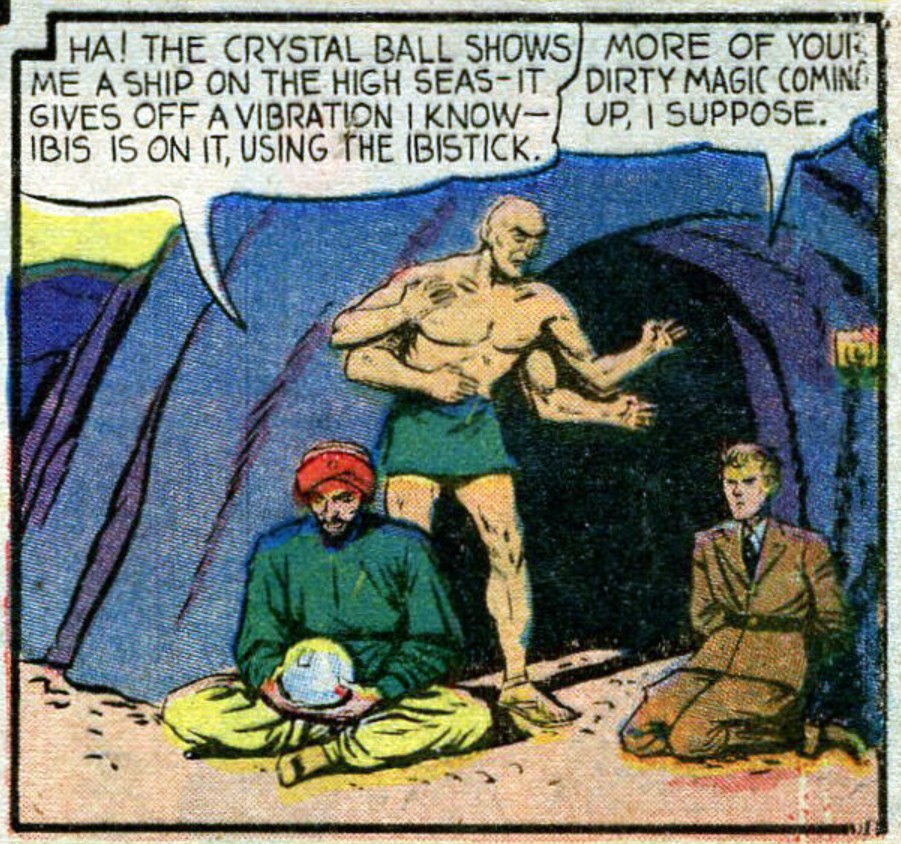
    … kidnaps Ibis and Taia’s ward Tommy and uses him as bait in yet another attempt to kill Ibis, and while the first part of that plan works like a charm, his trapping game is pretty haphazard. His ace in the hole is clearly the god-monster the Man of the Mountain (the four-armed guy above) but he also blows up the ship that Ibis is crossing the Pacific on (ineffective) and places fairly obvious traps like a clearly-carnivorous tree and a demon disguised as a pretty lady on the path leading to his cave hideout. (Whiz Comics 017, 1941) 

    The Man of the Mountain, though imposing, is not too bright and is lured off of a cliff with relative ease, after which Trug just kind of gives up. There is a small amount of tension as the ambient magical energies of the area render the Ibistick powerless and thus Ibis and Taia are trapped on the side of a mountain, but that barely counts as a deathtrap. (Whiz Comics 018, 1941)

    We now enter that phase of any recurring villain’s career in which they go from being a legitimate threat to a bit of a joke, and in Trug’s case this begins when he is rejected by a loser named Mudge who himself is looking to get revenge on Ibis for foiling his plans. Trug might have fallen on hard times but he knows how to size up a fool, and Mudge is exactly the kind of guy to fall for the old Fake Satan trick. Where he was unwilling to team up with an unsuccessful magician he is more than happy to sell his soul for a chance at revenge, the dope.

    Mudge and Satan/Trug attempt to kill Ibis and Taia with a magic bomb, but fail as Ibis saw them coming a mile away and substituted a couple of magical duplicates for them. He afflicts Mudge with donkey ears for his trouble, which only redoubles his commitment to revenge.

    The duo next attempt to harm Ibis by killing Taia and are fooled by the same magical duplicate trick, upon which Ibis reveals that he was not only on to them but that he know that “Satan” was actually Trug the whole time. Mudge and Trug are then sealed up in a wall to die, which is pretty tough justice, but we must remember that Ibis is from another time.

    Though Mudge’s fate is sealed, Trug will return in 1942. (Whiz Comics 020, 1941)

  • MINOR SUPER-VILLAIN 900: TRUG

    (Whiz Comics 013, 1941) 

    Trug is a student of magic and of Ibis the Invincible specifically who creeps out of the shadows after Ibis and Taia’s ward Tommy has defeated his school’s boxing champion and tempts the despondent youth into stealing the Ibistick for him (the sad boy is then turned into a tree and then never mentioned again – very sad).

    Trug’s Ibis scholarship extends beyond kind of dressing like him and knowing where his extended family hang out into important topics like how not to kill yourself while using the Ibistick. Unlike every poor chump who has gotten their hands on it before him, Trug is aware that it will visit any harm intended for Ibis back on its wielder and so deals exclusively in barriers, crevasses and other nonlethal means of keeping his rival at bay.

    Where Trug fails is in not being a creep and kidnapping Taia as he leaves to enjoy his newfound power. Quite aside from any moral implications, this is a sure way to make Ibis just that much more determined in his quest to defeat his foe.

    Fore reasons of his own, Trug heads north, subjugates the local peoples and builds a palace, and here I notice that he has kidnapped Taia not as a creepy “I will make you my queen” kind of thing but as a hostage, which I would still not call a good idea but which at least has a bit of logic to it.

    One thing that Trug has clearly not considered is that Ibis still has access to magical items that he used the Ibistick to create and that using two of these – the crystal ball and super-plane, specifically – he is able to locate and travel to Trug’s new kingdom in swift order. Trug thus makes the mistake of summoning an air force to deal with whoever might be encroaching on his airspace, only for them to turn on him and cause a piece of his own palace to fall and bonk him unconscious.

    Trug ends his days as a decorative statue as part of the compensation offered by Ibis to his former subjects. (Whiz Comics 014, 1941) 

    Trug isn’t a statue for very long before he is carried off by slavers and worshipped as an idol. When Ibis is then asked for help, he restores Trug to human form as part of a scheme to show that he is a mere mortal.

    Turning Trug back and forth from statue to man to show that he is in fact powerless swiftly convinces his erstwhile worshippers to abandon him, and somehow also that they should give up their warlike ways and make peace with their former enemies. Trug, meanwhile, is left at liberty and feeling vengeful, though he is under-dressed in the Arctic. (Whiz Comics 015, 1941)

    Undaunted by his circumstances, Trug hops on a log and starts paddling his way South, and has the good fortune to encounter a helpful man with a magic bag of wind, who he promptly robs and murders. He makes an opportunistic and unsuccessful attempt to kill Ibis and Taia by summoning a storm demon, then composes himself and… (Whiz Comics 016, 1941)

    … kidnaps Ibis and Taia’s ward Tommy and uses him as bait in yet another attempt to kill Ibis, and while the first part of that plan works like a charm, his trapping game is pretty haphazard. His ace in the hole is clearly the god-monster the Man of the Mountain (the four-armed guy above) but he also blows up the ship that Ibis is crossing the Pacific on (ineffective) and places fairly obvious traps like a clearly-carnivorous tree and a demon disguised as a pretty lady on the path leading to his cave hideout. (Whiz Comics 017, 1941) 

    The Man of the Mountain, though imposing, is not too bright and is lured off of a cliff with relative ease, after which Trug just kind of gives up. There is a small amount of tension as the ambient magical energies of the area render the Ibistick powerless and thus Ibis and Taia are trapped on the side of a mountain, but that barely counts as a deathtrap. (Whiz Comics 018, 1941)

    We now enter that phase of any recurring villain’s career in which they go from being a legitimate threat to a bit of a joke, and in Trug’s case this begins when he is rejected by a loser named Mudge who himself is looking to get revenge on Ibis for foiling his plans. Trug might have fallen on hard times but he knows how to size up a fool, and Mudge is exactly the kind of guy to fall for the old Fake Satan trick. Where he was unwilling to team up with an unsuccessful magician he is more than happy to sell his soul for a chance at revenge, the dope.

    Mudge and Satan/Trug attempt to kill Ibis and Taia with a magic bomb, but fail as Ibis saw them coming a mile away and substituted a couple of magical duplicates for them. He afflicts Mudge with donkey ears for his trouble, which only redoubles his commitment to revenge.

    The duo next attempt to harm Ibis by killing Taia and are fooled by the same magical duplicate trick, upon which Ibis reveals that he was not only on to them but that he know that “Satan” was actually Trug the whole time. Mudge and Trug are then sealed up in a wall to die, which is pretty tough justice, but we must remember that Ibis is from another time.

    Though Mudge’s fate is sealed, Trug will return in 1942. (Whiz Comics 020, 1941)

  • MINOR SUPER-HERO ROUND-UP 067

    Something for everyone* in this one.

    *not really. 

    Zambini the Miracle Man: 

    Zambini the Miracle Man, aka Zambini the Great, is your fairly typical comic book magic man, albeit a bit more flamboyantly dressed than even that crowd normally are.

    Though Zambini has a lot of the regular magic abilities of his peer group his signature trick involves his magical Boomerang Amulet, which causes evil to rebound on its sender. This takes forms as diverse as a cobra returning to the one who released it to bombs flying back up to the plane that dropped them to magic spells rebounding on their casters. 

    (please also note the final panel above, in which Zambini is being made a Knight of Ritania, which I here recognize as an honour)

    Finally, while I generally do enjoy when a magic user has a weakness to counter their nigh-omnipotence, Zambini might just have the worst one in comics: the touch of a human hand renders him completely powerless and unable to resist, to the point that this Hundanian spy is able to gently lead him to their headquarters and he is only saved when her boss gets jealous – thank heavens that Hundania doesn’t have a robust anti-workplace romance policy. This weakness kind of falls by the roadside as time goes on but does occasionally crop up now and then in horrible ways. (Zip Comics 001, 1940)

    Perhaps the most interesting thing about Zambini is his magical system: for his first two appearances he casts spells by spouting nonsense words (as far as I can tell), but from Zip Comics 003 onward, he uses a version of Ubbi Dubbi that involves inserting the syllable “ab” instead of “ub”. I don’t know if it’s strictly better than speaking backward, Zatara style, but it certainly is unique.

    Atom Blake, Boy Wizard **UPDATE**:

    I had read the 1940-1941 issues of Wow Comics before embarking on my great comics-reading project, so I already knew going in that Atom Blake would essentially speed-run the process of getting tired of living among mere mortals and heading off into space, Dr Manhattan style, but I had forgotten that he is doing so in order to look for his long-lost father. Also, while I did remember that Blake duplicated himself before setting out I had misremembered it as him leaving behind a non-super version of himself on Earth while the superhuman part set off for adventure. What I’m saying here is that the version of Atom Blake that I had remembered is way more interesting than the actual character. (Wow Comics 002, 1941) 

    the Hunchback: 

    The Hunchback is in actuality wealthy playboy Allan Lanier, who became obsessed with the figure of Quasimodo after seeing the 1939 film version of the Hunchback of Notre Dame (or possibly a literal picture of the character – the text box isn’t 100% clear) and combined that with his interest in wiping out crime to become a weird spectre of the night, Batman-style.

    Lanier is refreshingly up-front about his interest in criminology, to the extent that he is seen droning on and on about it before a date with his fiance Betty Brenton. I don’t know if I’d like every fellow with a secret identity to abandon the “disaffected socialite” act, but it is nice to see the odd one do without it and just be a weird eccentric.

    The Hunchback really leans into two specific aspects of his inspiration: he is absurdly acrobatic, and he metes out insane and terrifying violence to his foes. The latter has git to be one of the better justifications for the dread a masked figure of the night inspires among the criminal fraternity.

    We’re on a bit of a run of characters who share their secret identity with their love interest and Alan Lanier is one of them: his fiance Betty has to be told before she will let the Hunchback help her (this might be the downside of the whole “reputation for insane violence” thing). (Wow Comics 002, 1941)

    In the Hunchback’s second adventure, in Wow Comics 003, Lanier switches to a slightly more conventional super-hero outfit. It’s a generic but not terrible design, and I always appreciate a character making a bold hat choice, but I think that it is perhaps a bit too twee for a character who is supposed to be some sort of rampaging engine of madness and destruction. The old uniform came back out of the closet for the Hunchback’s remaining appearances.

    Pinky the Whiz Kid: 

    Pinky the future Whiz Kid (not technically called that until 1942, but whatever, we’re loose and goosey around here) is already a fan of Mr Scarlet before he is rendered a crime orphan by the villainous Mr Hyde (upcoming), who seemingly randomly murders his mother.

    Pinky ends up at Oaklawn Orphanage, which just so happens to be run by Mr Hyde’s alter ego, Dr Jelke. When Hyde/Jelke and Mr Scarlet inevitably clash, Pinky is right there in his homemade sidekick costume to help out.

    Pinky is adopted by District Attorney Brian Butler, ostensibly to keep him out of trouble, but since Pinky has worked out that Brian is secretly Mr Scarlet he is able to blackmail him into becoming his sidekick. It sounds more sinister than it reads, honestly.

    The real downside to Mr Scarlet getting a sidekick is that Miss Wade, formerly a romantic sparring partner for Brian and occasional daring assistant in her own right, is relegated to the role of scolding caretaker as she sensibly attempts to prevent a teenager from flinging himself into danger. It’s a real loss to the comic.(Wow Comics 004, 1941)