The Curse of Skeleton Munroe

Category: magic item

  • MINOR SUPER-VILLAIN 876: THE CULT OF ANKKAMAN

    (Zip Comics 006, 1940)

    Zambini the Miracle man is visiting his old friend the archaeologist Professor Lorenz when he learns that Lorenz is potentially filled with curse-energy thanks to an ancient tomb he violated. The Professor is dismissive of these concerns, even though both his daughter Greta and Zambini himself reckon that there might be something to them.

    Sure enough, the very instant that Zambini has left the Lorenz house, two members of the Cult of Ankkaman show up and kidnap Professor Lorenz, making use of the magical Doorway of King Ankkaman (one of the items that he brought back from his travels/ that the cult are angry about him making off with) to spirit him away. 

    Sensing trouble, Zambini returns and finds Greta Lorenz in a state of hypnotic paralysis thanks to the cultists’ magics. He frees her and they use the Doorway to follow.

    Now. There are exactly two things that got me excited about this particular entry, which is otherwise a pretty standard tale of a group objecting to the theft of their cultural objects from back when that was seen as unreasonable and villainous thing to do. The first of these is the fact that the Cult of Ankkaman comes from the country of Egyptasia, which I am 90% certain based on context clues is a country exactly like Egypt, only in Asia. Why set a story that could so very easily take place in regular old Egypt in this unnecessary new country you ask? Beats me, but it’s exactly the sort of weird comics thing that I love.

    The second thing is simply that Saki, the Cult’s magic user, does his spells Zatara-style, by speaking backward, and that the close proximity of this to Zambini’s “abbi dabbi” style of spellcasting really highlight just how silly both of these affectations are.

    Prof Lorenz is weirdly calm about being sacrificed to Ankkaman, which he rationalizes as some sort of extremely visceral research. Fortunately for the field of anthropology, Zambini shows up in time to ensure that he is able to publish this experience rather than perish due to it.

    Zambini, the Professor and Greta make their way back through the Doorway of Ankkaman, which Zambini then seals by the simple expedient of adding a door to the frame. The Professor is saved! Unless the cultists make their way back to his house via conventional travel, of course. 

  • PROBLEMATIC ROUND-UP 006

    Every time I relax, another one emerges from the shrubbery. And what’s depressing is the fact that they will continue emerging at a more or less steady rate for the entire history of comics. Here’s the latest batch of Problematic Characters.

    the Voodoo Man: 

    When Dr Bob Warren heads to Haiti to practice medicine and “investigate voodoo”, he comes into conflict with the Voodoo Man, a zombie-raising, curse-spouting, doll-pinning collection of every voodoo trope and stereotype. As compared to other headlining super-villains, the Voodoo Man’s exploits are pretty one-note: he’s trying to exert control over part or all of Haiti using zombies and other magics, while Warren foils him at every turn.

    The Voodoo Man’s finest moment is probably the time he turns an old woman into a pig to vex his enemies, but as always serving a super-villain is a dicey prospect, OSHA-wise, and the pig-woman gets a knife in the back for her efforts. (Weird Comics 001, 1940) 

    For a couple of issues (Weird Comics 004 and 005, specifically), Bob Warren seems to be pilling a Thin Man and becoming the Voodoo Man, as in a man who battles voodoo practitioners. Rather than the original titular Voodoo Man, Warren takes on a very similar fellow named Boanga (above) and the Grand Zombie (below), but after that the one and only original returns for the rest of the feature’s annoyingly long run.

    the Grand Zombie: 

    The Grand Zombie’s appearance coincides with a change in the “Voodoo Man” creative team, as evidenced by Bob Warren suddenly becoming a clean-shaven blonde instead of a mustachioed brunette. There is a chance that he is meant to in fact *be* the Voodoo Man, as his modus operandi – turn people into zombies for his own enrichment – is the same, but given that he looks completely different, operates at a site on the other side of the island and is called something else I’m willing to call the Grand Zombie a different character. 

    The Grand Zombie name, in addition to being a far better one than the Voodoo Man, reflects a linguistic quirk that might have been widespread but which I have only encountered in old comics, in which both the unquiet dead and their creators are referred to as zombies. Better name or not, the Grand Zombies is unceremoniously shot at the end of the story and the feature then reverts back to the Voodoo Man.

    This issue also feature perhaps the least empathetic missionary character in Golden Age comics. (Weird Comics 004, 1940)

    the Magic Mandarin: 

    The Magic Mandarin, aka Lee Ching, importer, is an extremely typical Yellow Peril villain. Perhaps the only moment of joy I found in his entire first appearance was when he met up with his fellows in the Brothers of the Bloody Blade (above) and they kept screaming “Allegiance!” at one another.

    The thing that puts the magic in the Magic Mandarin is an artifact called the Stone or Lodestone of the Dragon which is capable of such feats as paralyzing others, creating a force field, changing someone’s clothing and telekinesis, but which is unable to function if swaddled in silk or affect someone who is wearing silk, which comes in very handy for the Mandarin’s foes Smash Dawson and his team.

    The Magic Mandarin is one of your classic “seems to die at the end of every adventure but turns out to have survived in the next” villains, and like so many of those his final appearance must be assumed to be the one that finally killed him, as he was sucked into a dam in Whirlwind Comics 003 and there was no Whirlwind Comics 004. (Whirlwind Comics 001, 1940) 

    Fu Chu: 

    Fu Chu is a recurring villain of Yarko the Great, and while he is so patently a Fu Manchu knockoff that he even has most of his name, his major offence is in how boring he is. Like, I don’t find Yellow Peril comic book plots particularly fun to read, but at least they are usually rich with incident. Fu Chu’s debut involves him kidnapping the inventor of a death ray and then completely failing to prevent Yarko from waltzing in and taking him back.

    Fu Chu’s second appearance, in Wonderworld Comics 016, features him as the head of a cult of the Mayan Plumed Serpent Kukulkan, for reasons that are never quite explained, as the main thrust of the episode involves Fu Chu attempting to kill explorer Doctor Mayo and his daughter and Yarko the Great intervening to save them. The whole farce ends with an earthquake destroying all or part of Chichen Itza, which is wild.

    Fu Chu goes on to return at least a couple of times in 1941 but don’t hold your breath – he’ll have to really up his game to get an update, (Wonderworld Comics 013, 1940) 

  • GENERIC COSTUMED VILLAIN ROUND-UP 028

    GENERIC COSTUMED VILLAIN ROUND-UP 028

    Scoundrels! Mid-tier scoundrels! 

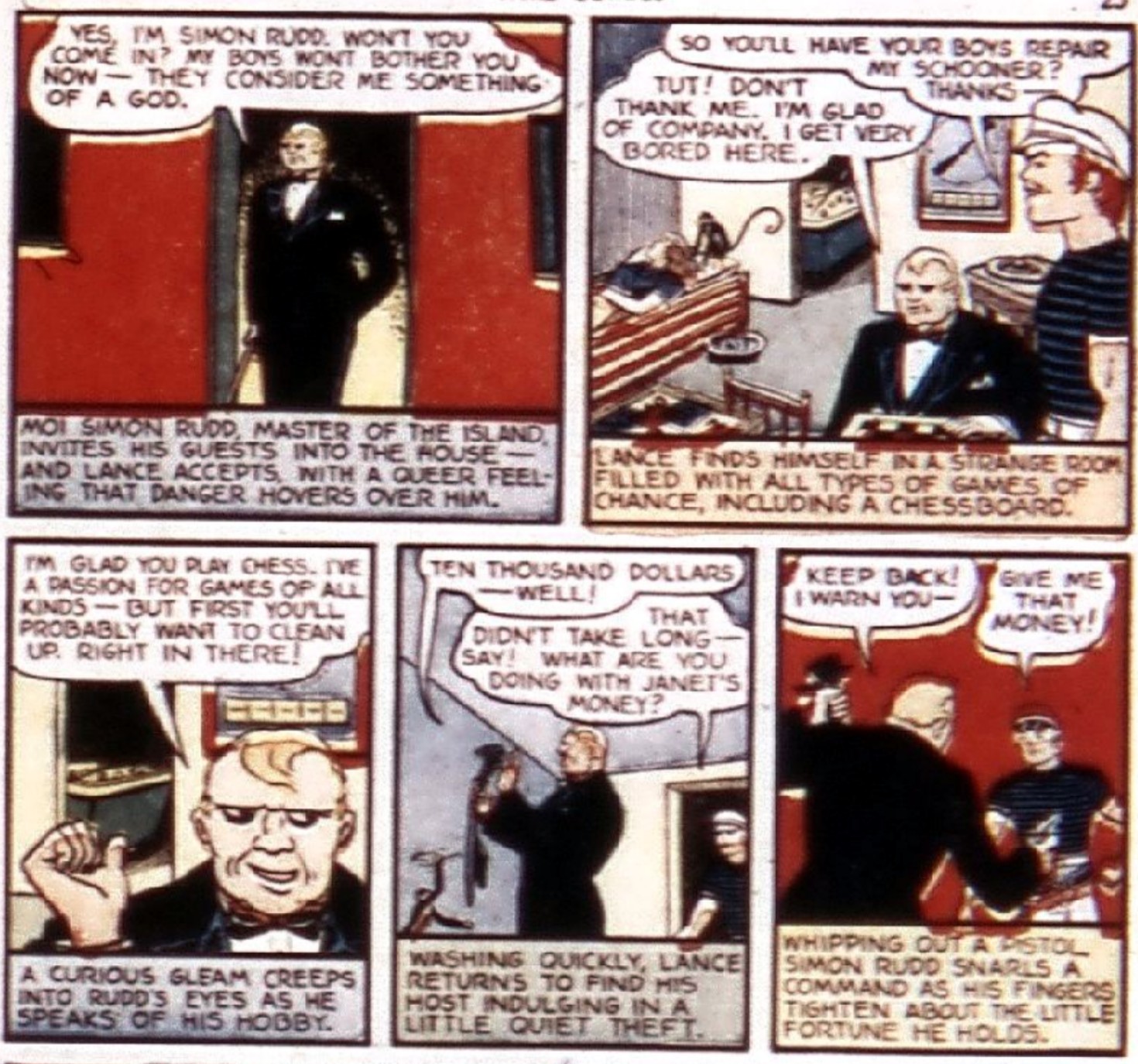
    Simon Rudd loves games and gambling and taking chances, and somehow that has led him to a South Pacific island where he wears a full tuxedo and bosses around a local tribe all day. When ocean adventurer Lance O’Casey and his companions wash up on his shores, Rudd engages in a little Most Dangerous Game action with them, presumably out of sheer boredom. This being a Lance O’Casey story, his ultimate fate is to be socked in the nose. (Whiz Comics 010, 1940)

    Ordinarily these round-ups have four characters in them, but I’m breaking tradition today and making it either two or seven, depending on how you look at it, because today we look at all of the crooks and ne’er-do-wells who have gotten their hands on Ibis the Invincible’s Ibistick.

    The Ibistick is first stolen by an unnamed thief as Ibis searches for Taia’s mummy in a likewise-unnamed European city. His role in the story is mainly to provide an object lesson of just how the Ibistick works: anyone can use it to, for example, make so many gold coins that they start falling out the window and make you easier to track down, but just try to harm Ibis, the wand’s true owner, and your magic will rebound back on you. In this case, the thief is turned to gold. (Whiz Comics 002, 1940)

    Murder Malone is a pretty rotten character whom Ibis and Taia first encounter while investigating trouble at a town of orphan boys – the trouble turns out to be that Malone’s gang has enslaved all of the boys and is forcing them to manufacture weapons. The experience leaves Malone with a desire to own the magic wand that played such a major role in his undoing, but once he gets ahold of it he makes the classic mistake and ends up turning himself into a toad. (Whiz Comics 005, 1940)

    The very next issue features our old pal the Hobo-Millionaire getting all the power in the world and turning himself into ice with it.


    In Whiz Comics 007, Ibis and Taia travel to Hollywood to see the stars, whereupon they fall in with unscrupulous movie producer Carl Brand, who initially offers to buy the Ibistick and then manages to steal it. He then of course tries to turn Ibis into a rabbit and is made one himself, but unlike the rest of those who have made the same mistake, Brand is given a second chance by Ibis and turned back.

    He of course repays this mercy by kidnapping Taia in another bid to get his hands on the wand, only to ultimately be murdered by Piang the Terrible as part of his bid to acquire it.

    Piang finally gets ahold of the Ibistick in Whiz Comics 010, only to immediately screw it up by attempting to remove “all magical powers” from Ibis, which of course rebounds on him, leaving him open to be “accidentally” tossed off of a cliff by the hero.

    When Piang is stripped of all magical power, the Ibistick flies out of his hand and ends up in a nearby river. From there, it finds its way into the hands of an escaped convict with the unlikely name of Grom Deeters, who weirdly is the only alternate wielder of the Ibistick to almost get away with it, thanks to his initial impulse to merely imprison Ibis and Taia upon meeting them, rather than devising some gruesome magical death for them.

    Deeters makes his way to Egypt, where he is undone by his own impulse to be a horny creep: since Taia was the last woman he saw, he summons her to him to try and put the moves on her, then inadvertently animates the Sphinx, then has to summon Ibis in order to calm it down (this incidentally means that in  the Fawcett universe the Sphinx is located a few hundred feet away from where it would normally be found).

    The longer that Deeters has the wand, the longer it becomes clear that his initial successes were the merest flukes, as after attempting to bribe Ibis into convincing his wife to “go for” him he commands Taia to stab Ibis to death, only to of course be the one to taste her blade. 

    That’s all of the Ibistick thieves of 1940 – stay tuned for more in 1941. 

  • MINOR SUPER-HERO ROUND-UP 061

    Superfolk galore! 

    the Buzzard: 

    In an unnamed New-York-alike city, the gadgeteering mayor equips a young man with a suite of devices to help him engage in a vigilante crusade against crime. Chief among these gadgets is a gas that makes whomever it touches resemble a balding, big-nosed man in thick glasses and a tailcoat – the perfect disguise! Armed with this gas, plus some clawed gloves and a heat ray, the Buzzard begins tearing his way through the city’s underworld. 

    The gas also seems to allow the Buzzard to make his shadow resemble his namesake bird, an ability that is very useful for vexing the city’s Buzzard-hating police chief who, it turns out, is also the father of the Buzzard’s secret identity. 

    I unironically love the Buzzard and his whole weird setup, and while I find most modern revivals of public domain Golden Age characters to be a pretty mixed bag, I’m pretty bummed that none of them have elevated him out of his single issue obscurity – he’s got a real weirdo charm that the fiftieth version of the Nedor characters can’t approach. (Wham Comics 002, 1940) 

    the Cyclone: 

    The Cyclone is really Peter Grant, a young man who has a fairly unique version of the Batman origin, which of course is when a tragedy inspires an obsessive dedication to training and working toward some related goal, i.e., in Batman’s case the murder of his parents inspiring his eternal war against crime. The real twist in the Cyclone’s case seems to be the total absence of a motivation: Grant just woke up one day and decided to turn his body into a living weapon to aim at evil.

    The Cyclone is presented as being a regular human and so I had been assuming that the whirlwind patterns around his lower body when he jumps around were a stylistic choice meant to represent his fantastic leaping ability. They really are some enormous jumps, however, so it’s also possible that the Cyclone is meant to have some sort of wind-assisted jumping power. He only had three adventures, alas, so we shall never know. (Whirlwind Comics 001, 1940)

    Ibis the Invincible: 

    Ibis the Invincible, aka Prince Amentep, is a 12th Dynasty Egyptian who just kind of spontaneously comes back to life after 4000 years as a mummy. Why? Well, it’s not spelled out until the 1942 Ibis the Invincible series, but spoilers: his true love had been shot with an arrow that put her to sleep for those four millennia and he put himself in a magical sleep of his own in order to be with her again. 

    Ibis achieves this state of mystic sleep with the aid of the Ibistick, a magical wand capable of very nearly anything. Much like his fellow Golden Age magical super-heroes, Ibis’ near-omnipotence can occasionally seem plot-obliteratingly powerful. 

    The key difference between Ibis and his contemporaries, however, is that the Ibistick is a small object that is constantly being lost or stolen. Further, it requires absolutely no special knowledge to be used and can be operated by both children and animals with ease. More than a few of Ibis’ greatest foes (e.g., the Hobo-Millionaire) are simply regular humans armed with his own magic wand. The caveat to all this is the fact that the Ibistick will never harm its true owner, and will in fact inflict any baleful magic cast from it at him back on its wielder. This means that Ibis is able to defeat an evil wielder of the Ibistick by merely being annoying enough that they try to turn him into a toad or gold or ice or on on memorable occasion to mind control Taia into stabbing him to death and then wait for it to backfire on them. (Whiz Comics 002, 1940)

    UPDATE 1941 

    Taia: 

    Taia is the 4000-year-sleeping love for whom Ibis the Invincible made his way to the future. After a bit of moping around the globe he manages to track down her mummy and revive her, upon which they kind of implicitly are a married couple. While I very much enjoy Taia and the dynamic she has with Ibis, she does get a pretty raw deal – being your own husband’s de facto sidekick is bad enough, but Taia very rarely gets to be anything more than a kidnap victim/bargaining chip. The few modern versions of Ibis the Invincible try to do more with her, but they still don’t do much.

    Taia is said to be cousin to “Senwosri III” who is probably meant to be Pharaoh Senusret III, given that Taia and Ibis are said to be from the 12th Dynasty. So that’s something. (Whiz Comics 002, 1940)


  • MINOR SUPER-HERO ROUND-UP 060

    Some of those reeeeal obscure guys today. 

    Craig Carter:

    Archaeologist Craig Carter wants to give up all the stuffy academia and become a crime fighter, and since he lives in a comic book universe, the very day he tells his girlfriend about this objectively bad decision he receives a magical ring in the mail from an old colleague whose life he had saved. This ring grants its wearer the ability to summon the gods of antiquity to aid them – in Carter’s two adventures he summons Zeus, Mercury, Thor and Pluto, plus he gets Zeus to summon Pegasus for him, so presumably a whole world of magical beasts was also at his fingertips. Carter’s second adventure ends with Pluto deciding not to return to the ring, which presumably would have set him up as a long-term antagonist. Alas this was not to be, as his second appearance was also his final appearance.

    The ring is also hilariously sensitive with regards to its touch-activation, as seen here when a simple hand-pat causes Zeus to blow up the club. (Wham Comics 001, 1940)

    Detecto:

    Jack Strand is a radio scientist who has invented Detecto, a “wonder beam” that has “four unlimited powers”: the ability to send and receive short wave radio, an engine killing effect, a force field and the ability to paralyze living things. As in a few other cases that we have encountered, the line between Detecto as a beam and Detecto as a kind of ambient energy field is a bit blurry, but whatever it is, Strand installs a transmitter in his car, making it into what is essentially a magical object. Would he be better off with a more portable version of Detecto, particularly as at least one of the powers, the radio, is commonly possessed by many cars already? Maybe. Am I sad that this was the only story about Detecto? Certainly, particularly as this was very much a tale of highway-based crime and I would love to see Detecto go up against someone in an airplane or maybe a building. (Wham Comics 001, 1940)

    Blue Fire:

    Blue Fire is actually scientist Jack Knapp, who acquired his powers through the ever-popular method of an unexpected explosion in his chemistry laboratory. Please note also that he was about to drink an unspecified formula just before this explosion occurred – is it the same as the explosive chemical that gave him his powers or was he about to unlock an entirely different suite of abilities?

    Blue Fire takes his name from the halo of blue flames that surrounds him when his powers are active, Contrary to this external signifier, however, he does not have any kind of heat or flame based abilities but rather is an intangibility guy. This is by far the best thing about Blue Fire, by the way, and not just because of the name/power fakeout but because Blue Fire creator Louis Glanzman has effortlessly answered all of the nitpicky questions about intangibility (why can they still breathe? why don’t they fall through the floor? why can they pick things up?) by establishing that Jack Knapp is effectively the opposite of ooblek: he functions as if tangible until enough force is exerted by or on his body, so that he can pick up a book but that same book will pass right through him if thrown. It’s very neat and tidy!* 

    Blue Fire has to drink some of the chemical created in the initial explosion to activate his powers, after which he has them for two whole hours. This is an interesting twist to the whole question of a secret identity, lying somewhere between the Hulk’s “uncontrollable change for an indeterminate amount of time and the usual Archie Andrews-style running around in different hats that Superman and co. get up to. I’m surprised that I can’t think of another character with this kind of life-complicating power setup. (Wham Comics 002, 1940)

    *I am of course immediately imagining horror scenarios in which Blue Fire cannot breathe in a high wind or a high pressure atmosphere, where he jumps down from a small platform and then falls to the centre of the Earth, etc 

    Solarman: 

    Solarman and his mentor, the bat-eared Quino, are aliens from the enlightened planet Saturn who have been observing Earth for some time. Quino is so depressed over the crime and evil that is rampant on our planet that he almost heat-rays the entire thing before his Saturnian enlightenment kicks in and he reconsiders. Instead, the two hit upon a plan wherein Solarman will be blasted to Earth to fight crimes that the two have spotted via their viscopes and x-rayscopes.

    Though Solarman is said to have “many powers” by Quino, the only one he displays while on his sole recorded mission to Earth is some moderate super strength. Still, this is more than enough to beat up gangster Al Ravoni’s entire suite of henchmen and bring the fugitive himself to justice. Hopefully this kind of thing is enough to satisfy Quino’s righteous bloodlust. (Wham Comics 002, 1940)

  • MINOR SUPER-HERO ROUND-UP 060

    Some of those reeeeal obscure guys today. 

    Craig Carter:

    Archaeologist Craig Carter wants to give up all the stuffy academia and become a crime fighter, and since he lives in a comic book universe, the very day he tells his girlfriend about this objectively bad decision he receives a magical ring in the mail from an old colleague whose life he had saved. This ring grants its wearer the ability to summon the gods of antiquity to aid them – in Carter’s two adventures he summons Zeus, Mercury, Thor and Pluto, plus he gets Zeus to summon Pegasus for him, so presumably a whole world of magical beasts was also at his fingertips. Carter’s second adventure ends with Pluto deciding not to return to the ring, which presumably would have set him up as a long-term antagonist. Alas this was not to be, as his second appearance was also his final appearance.

    The ring is also hilariously sensitive with regards to its touch-activation, as seen here when a simple hand-pat causes Zeus to blow up the club. (Wham Comics 001, 1940)

    Detecto:

    Jack Strand is a radio scientist who has invented Detecto, a “wonder beam” that has “four unlimited powers”: the ability to send and receive short wave radio, an engine killing effect, a force field and the ability to paralyze living things. As in a few other cases that we have encountered, the line between Detecto as a beam and Detecto as a kind of ambient energy field is a bit blurry, but whatever it is, Strand installs a transmitter in his car, making it into what is essentially a magical object. Would he be better off with a more portable version of Detecto, particularly as at least one of the powers, the radio, is commonly possessed by many cars already? Maybe. Am I sad that this was the only story about Detecto? Certainly, particularly as this was very much a tale of highway-based crime and I would love to see Detecto go up against someone in an airplane or maybe a building. (Wham Comics 001, 1940)

    Blue Fire:

    Blue Fire is actually scientist Jack Knapp, who acquired his powers through the ever-popular method of an unexpected explosion in his chemistry laboratory. Please note also that he was about to drink an unspecified formula just before this explosion occurred – is it the same as the explosive chemical that gave him his powers or was he about to unlock an entirely different suite of abilities?

    Blue Fire takes his name from the halo of blue flames that surrounds him when his powers are active, Contrary to this external signifier, however, he does not have any kind of heat or flame based abilities but rather is an intangibility guy. This is by far the best thing about Blue Fire, by the way, and not just because of the name/power fakeout but because Blue Fire creator Louis Glanzman has effortlessly answered all of the nitpicky questions about intangibility (why can they still breathe? why don’t they fall through the floor? why can they pick things up?) by establishing that Jack Knapp is effectively the opposite of ooblek: he functions as if tangible until enough force is exerted by or on his body, so that he can pick up a book but that same book will pass right through him if thrown. It’s very neat and tidy!* 

    Blue Fire has to drink some of the chemical created in the initial explosion to activate his powers, after which he has them for two whole hours. This is an interesting twist to the whole question of a secret identity, lying somewhere between the Hulk’s “uncontrollable change for an indeterminate amount of time and the usual Archie Andrews-style running around in different hats that Superman and co. get up to. I’m surprised that I can’t think of another character with this kind of life-complicating power setup. (Wham Comics 002, 1940)

    *I am of course immediately imagining horror scenarios in which Blue Fire cannot breathe in a high wind or a high pressure atmosphere, where he jumps down from a small platform and then falls to the centre of the Earth, etc 

    Solarman: 

    Solarman and his mentor, the bat-eared Quino, are aliens from the enlightened planet Saturn who have been observing Earth for some time. Quino is so depressed over the crime and evil that is rampant on our planet that he almost heat-rays the entire thing before his Saturnian enlightenment kicks in and he reconsiders. Instead, the two hit upon a plan wherein Solarman will be blasted to Earth to fight crimes that the two have spotted via their viscopes and x-rayscopes.

    Though Solarman is said to have “many powers” by Quino, the only one he displays while on his sole recorded mission to Earth is some moderate super strength. Still, this is more than enough to beat up gangster Al Ravoni’s entire suite of henchmen and bring the fugitive himself to justice. Hopefully this kind of thing is enough to satisfy Quino’s righteous bloodlust. (Wham Comics 002, 1940)

  • MINOR SUPER-HERO ROUND-UP 058

    A number of minor Fox Features characters for your perusal and delight.

    the Bird Man: 

    The Bird Man, descendant of “an ancient Indian god” (no further detail provided) uses his weird demigod wing-flaps to fly around the American Southwest and render aid to people. (Weird Comics 001, 1940)

    In Bird Man’s final appearance, in Weird Comics 004, he has conformed to the heroic norm a bit more by moving to a penthouse apartment in what might be NYC (please note that he keeps a little statue of his divine ancestor on top of his TV). He also has slightly more conventional wings in this appearance, but I have to say that I prefer the flaps.

    Typhon: 

    Typhon is a near-future undersea adventurer who not only has access to various super-submarines and ray guns and so forth but also sometimes has a magic ring that allows him to combat the various supernatural threats of the deep ocean. (Weird Comics 001, 1940)

    Thor, God of Thunder: 

    Thor, God of Thunder (the Norse god) gets restless one day in 1940 and decides to invest a mortal man with some of his power, making him Thor, God of Thunder (the super-hero). This is a not-uncommon origin story for a super-hero to have, but the really important thing to note is that the human, Grant Farrel, is not some paragon of virtue or descendant of Thor, and that he isn’t being sent out into the world to combat injustice on Thor’s behalf. No, he’s just kind of a sad sack who just got dumped and Thor hands him the power with a kind of “have fun with it” attitude. Grant seems like he might be the type to get into super-heroics of his own accord but he doesn’t really have any choice because Glenda, the girl who dumped him, is a real magnet for spy rings and secret invasions of France and so forth. They do eventually get back together, don’t worry.

    Like many of his contemporaries, Grant/Thor goes through a lot of different costume variants over the course of a short career, but the thing I really want to highlight is this very weird style of Viking helmet that both he and Original Thor wear in hist first three or four appearances. I mean, what’s with the discs? 

    Thor is of course wildly over-powered, as shown in this pretty awesome sequence in which he lassos an entire Luftwaffe attack on Paris and throws it at Berlin. He can also throw both his hammer and thunderbolts to devastating effect, and kind of alternates between flying under his own power and cartoonishly riding around on a big jagged bolt of lightning.

    In his final appearance, in Weird Comics 005, Thor is sans hammer for no particular reason. This doesn’t really slow him down but even so he gets a bit of divine aid via the gift of Thor’s strength-boosting gauntlet. (Weird Comics 001, 1940)

    Dynamite Thor:

    Dynamite Thor, the Explosion Man, is actually Peter Thor, wealthy mine owner and explosives expert. I was all ready to roast him for including his surname as part of his superhero identity, but on review of his five appearances it appears that the actual name he goes my is merely Dynamite. This also leaves me with no material with which to roast Thor’s fiance Glenda (same as our last Thor – what is it with Thors and Glendas?) for not realizing just who the mysterious man she so idolizes is.

    In his initial appearance, Dynamite Thor is merely a man with a belt-full of explosives and a pretty hammer-and nail approach to problem-solving. Crooks holed up in an old shack? Blow up the shack. Crooks getting away in a vehicle? A controlled explosion will bring a nearby object down and stop their flight. A big fire? Blow it up.

    By his second appearance in Weird Comics 007, someone had evidently decided that Dynamite Thor needed more of a hook or perhaps they just couldn’t figure out a good explosion-themed vehicle for him to fly around, because he gets his signature move which is absolutely the only reason that he is still talked about: he flies by the simple expedient of setting off a series of explosions under his ass. Finally, by his next appearance in Blue Beetle Comics 006, 1941, he is explicitly mentioned to be immune to these explosions, something that must have come as a great relief to him (edit to add: I was mistaken and they do make sure to mention that he is immune to explosions at the same time as he starts flying around on a column of them). (Weird Comics 006, 1940)

  • MINOR SUPER-VILLAIN 811: QUEEN RANA

    MINOR SUPER-VILLAIN 811: QUEEN RANA

    (The Spirit Section, 14 July, 1940)

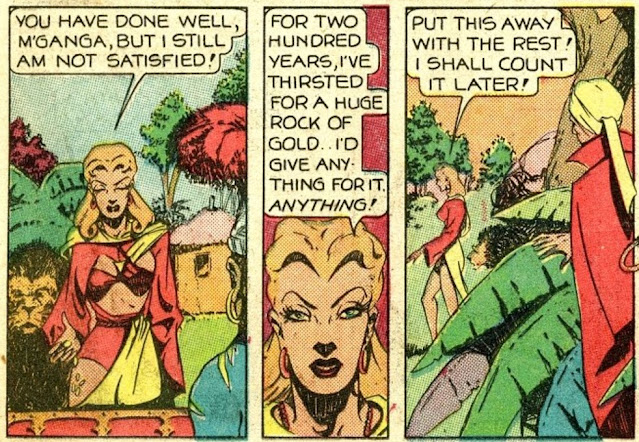
    Queen Rana is the bearer of the Amulet of Ra, a mystic artifact that grants immortality and invulnerability to the one who wears it. Rana’s one ambition in her immortal life is to have a “huge rock of gold” and to that end she has established herself as the ruler of a jungle tribe and turned them to banditry. Is this a good use of eternal life? No it is not. Is it likely to result in her getting a huge rock of gold? Almost certainly not. Is this the sort of ambition that, when achieved, is going to leave her feeling kind of hollow inside? Absolutely.

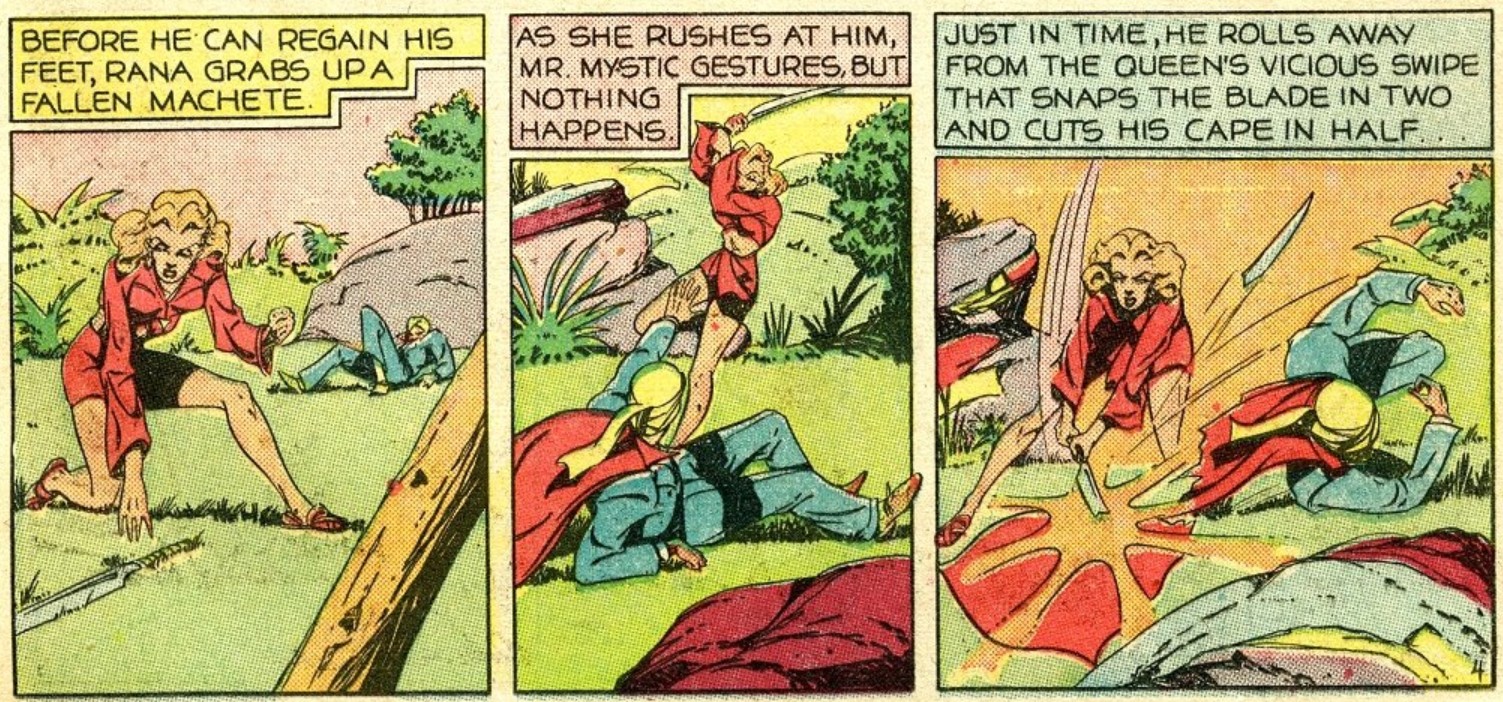
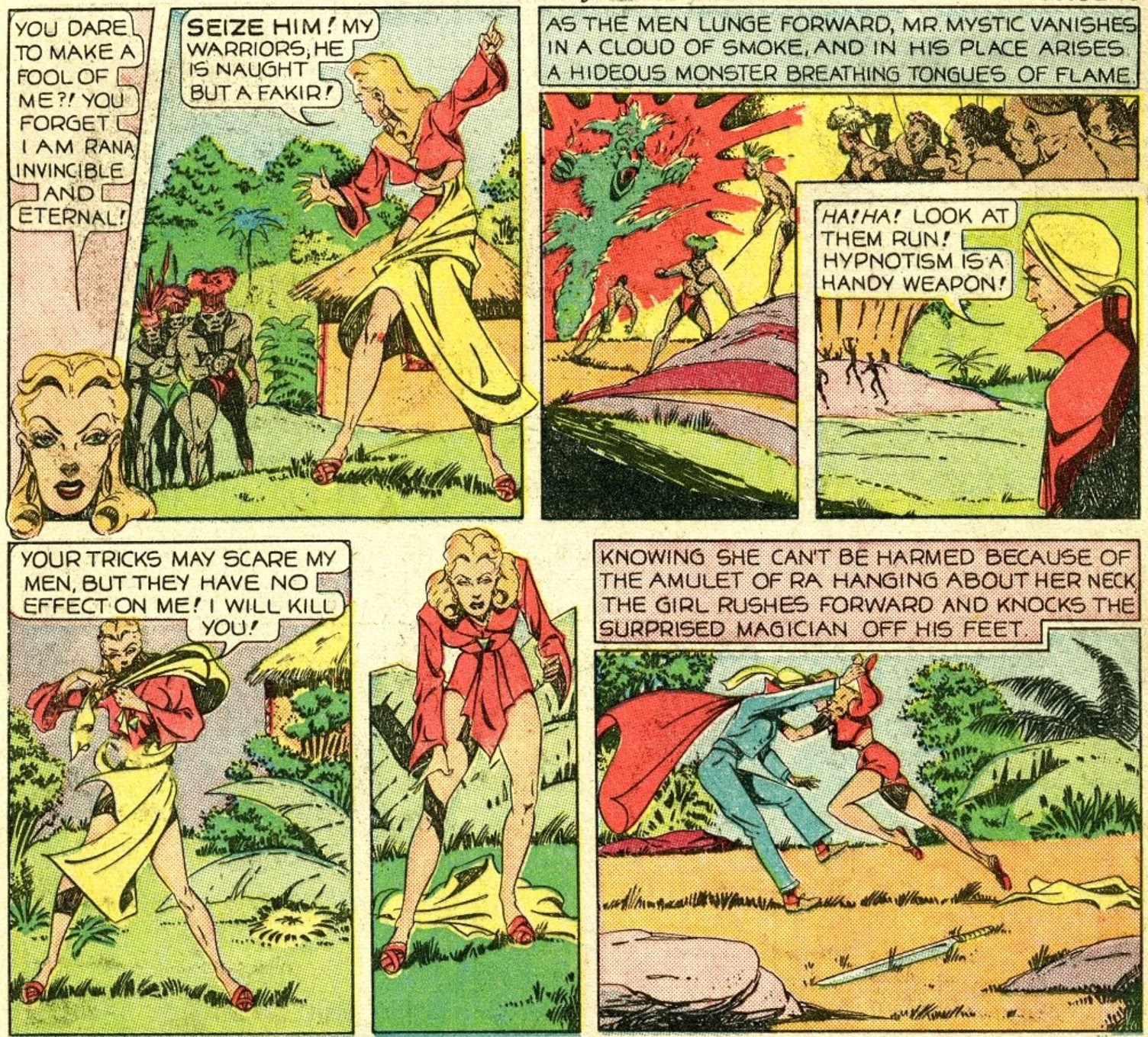
    Mr Mystic, at the behest of the council of Lamas who empowered him, sets off into the jungle to put a stop to Queen Rana and to destroy the Amulet of Ra, and here is where I personally developed a deep affection for Rana as a villain, because she approaches being immortal, invulnerable and, it turns out, immune to Mr Mystic’s magic as license to be just a complete roughneck brawler. She tackles Mystic and nearly cuts him in two while your typical comic book immortal would still be delivering their opening monologue about how lonely they get. It’s frankly the sort of behaviour we should see more in the immortal community.

    Unfortunately for me and my love of fun characters, the fact that Rana viewed immortality merely as an increased chance to get ahold of that big gold she coveted so much really did point to her being a dummy. Mr Mystic has basically no trouble at all in getting her to trade the Amulet of Ra for a big pile of gold that he, a man who she has seen create illusions mere minutes before has created out of thin air, and after that it’s all over, as Queen Rana’s two centuries of unaging catch up to her all at once. A sad end to a real scrapper of a character.

  • MINOR SUPER-VILLAIN 811: QUEEN RANA

    MINOR SUPER-VILLAIN 811: QUEEN RANA

    (The Spirit Section, 14 July, 1940)

    Queen Rana is the bearer of the Amulet of Ra, a mystic artifact that grants immortality and invulnerability to the one who wears it. Rana’s one ambition in her immortal life is to have a “huge rock of gold” and to that end she has established herself as the ruler of a jungle tribe and turned them to banditry. Is this a good use of eternal life? No it is not. Is it likely to result in her getting a huge rock of gold? Almost certainly not. Is this the sort of ambition that, when achieved, is going to leave her feeling kind of hollow inside? Absolutely.

    Mr Mystic, at the behest of the council of Lamas who empowered him, sets off into the jungle to put a stop to Queen Rana and to destroy the Amulet of Ra, and here is where I personally developed a deep affection for Rana as a villain, because she approaches being immortal, invulnerable and, it turns out, immune to Mr Mystic’s magic as license to be just a complete roughneck brawler. She tackles Mystic and nearly cuts him in two while your typical comic book immortal would still be delivering their opening monologue about how lonely they get. It’s frankly the sort of behaviour we should see more in the immortal community.

    Unfortunately for me and my love of fun characters, the fact that Rana viewed immortality merely as an increased chance to get ahold of that big gold she coveted so much really did point to her being a dummy. Mr Mystic has basically no trouble at all in getting her to trade the Amulet of Ra for a big pile of gold that he, a man who she has seen create illusions mere minutes before has created out of thin air, and after that it’s all over, as Queen Rana’s two centuries of unaging catch up to her all at once. A sad end to a real scrapper of a character.

  • MAD AND CRIMINAL SCIENTIST ROUND-UP 017

    The science is flying fast and loose in here.

    Professor Krauss’ theories about a method for passing matter through matter were scorned and laughed at, so he turned them to crime, killing three and robbing the New York subtreasury*. Unfortunately for him he also gave an interview about his theories, which really helped research-savvy reporter Chic Carter track down and capture him. (Smash Comics 011, 1940)

    *A Note on Subtreasuries: A frequent target for theft in the Golden Age or at least one that I’ve encountered 3-6 times, the New York Subtreasury was part of a US financial management system that distributed the storage of US gold reserves, but, critically, was phased out in 1920. I don’t know what all these guys were after in there but there sure wasn’t any gold.

    Professor Abbot, disgraced former physics instructor at Stamton College, has developed a machine capable of paralyzing the population of a small city long enough for his men to rob it blind, but since the device also disrupts electrical signals this draws the attention of lineman Tom Dalton, aka Magno, the Magnetic Man. Abbot proves to be unusually well-prepared for the appearance of the local super-hero at his hideout and disables Magno with a prepared dose of knockout gas, which is really, really impressive, I have to say. 

    Abbot’s downfall comes in the form of every villain’s worst enemy, the deathtrap. Sure, slinging Magno down a well to slowly drown is satisfying, in an evil kind of way, but it introduces the possibility of him escaping from the trap, and if he does that then you are screwed. Just stab him with a wooden stake or something if you need to avoid using metal!

    Anyway, Magno of course escapes from the trap and ends up blowing Abbot, his machine, his hideout and his gang to high heaven by the medium of some hastily smashed up mad science equipment. (Smash Comics 014, 1940)

    This unnamed scientist does a bit of old-fashioned grave robbing in order to get only the finest parts for his frankenstein (though the fact that he made sure to include the brain of a scholar doesn’t seem to have played out in the mentality of the creature) which he then uses a growth hormone on and makes huge, super strong and bulletproof. Dubbed Brutus and deemed unstoppable, this creation is sent out to loot and plunder.

    I always appreciate it when a character has to contend with a foe who is their rough equivalent from time to time – this is part of the appeal of Hellboy, for example – and Brutus offers just that opportunity for Bozo the Iron Man, being essentially a Bozo-shaped and-sized human of equivalent strength. Brutus manages to win the day in their first encounter by hitting Bozo over the head hard enough that Hugh Hazzard is knocked out through the armour of his robo-suit, but their second bout results in the deaths of both Brutus and his unnamed creator. (Smash Comics 014, 1940)

    Across the US, buildings, trains, planes and ships begin sailing off into the sky, accompanied by a totally radical visual effect of a giant green mummy that I’m not 100% certain is actually visible to regular non-comic-reading witnesses – it’s never commented on in any case, and if I saw a giant mummy carry a train off into the void I assure you that you would hear me speak of little else.

    The culprit turns out to be one Doctor Robb, an unscrupulous archaeologist who murdered his colleague Professor Hill in order to steal an ancient artifact called the Power of Tutkamen (named after original owner Ra Tutkamen, natch).

    Robb presumably refines his control over the power, as he seems to be using it to plunder passing shipping from his island base and that’s hard to do if you’re just blasting ships and planes into orbit. The party comes to an end once the Invisible Hood gets involved, as Robb discovers to his chagrin that having the power to levitate anything you see doesn’t help you very much in a confrontation with an invisible guy. Rather than be captured, Robb does a header out the window of his lighthouse HQ. (Smash Comics 016, 1940)