The Curse of Skeleton Munroe

Category: magic item

  • MINOR SUPER-HERO ROUND-UP 042

    Boys! Boys! Boys! Super powered boys!

    Magno: 

    Magno, aka the Miracle Man, aka the Magnetic Man, aka Tom Dalton, was a power line worker who died when he was shocked with 10 000 volts DC and then revived when he was shocked again with 10 000 volts AC. As a result, Dalton developed electromagnetic powers that he used to fly, simulate super strength when dealing with metal and create magnetic force fields. Not a bad deal.

    Magno’s Golden Age career was short and fairly undistinguished, and his main claim to fame is being the only one of the old Quality heroes to be killed off by Roy Thomas in All-Star Squadron to never be brought back (Magno’s look also reminds me of Jericho of the Teen Titans for some reason, but that’s hardly another claim to fame). (Smash Comics 013, 1940)

    the Ray: 

    I had a couple of issues of The Ray comics from the early 90s when I was younger and so have a tendency to think of the Ray as being a far more prominent character than he actually is – he’s got to be fourth-tier at best, really (assuming that top-tier characters are the ones that everyone knows, your Batmans and Supermans, and second-tier are the ones that even a casual comics reader would consider essential. Third-tier and below is where you get into debating territory).

    Regardless of his level of prominence, the Ray is actually Happy Terrill, a devil-may-care young reporter who signs on as crew in a balloon trip to the upper atmosphere and is… empowered? When he ventures out into a cosmic storm to secure some essential safety equipment. Honestly, as presented on the page Terrill could be assumed to have been replaced with some sort of cosmic entity but maybe I’m the only one who thinks that because it certainly isn’t reflected in subsequent Ray lore.

    Cosmic entity posing as human or no, the Ray is endowed with a startling array of powers, including at least partial invulnerability, the ability to become and travel along light, giant growth, a healing touch, light projection and telekinetic rays. At first, anyway – after a couple of issues he adopts more of a two-fisted adventurer persona whose main power is the ability to change between Happy Terrill and Ray identities and who occasionally remembers that he can fly and shoot rays of light at people.

    A fairly consistent thing that I’ve noticed in depictions of the Ray post-Golden Age is a tendency to portray him as a very dour and serious guy, which seems a disservice to someone with the nickname “Happy.” I suppose I must give it to those later scribes in that the Ray himself almost discards his Happy Terrill identity in his first adventure before eventually coming to his senses. Neither the reason for resuming life as Happy nor the process by which he explained how he made his way back from the upper atmosphere is shown on-panel, but I have to assume that being a super-hero 24/7 just gets boring after a while and he wanted to have a bit of a break. (Smash Comics 014, 1940)

    Master Man: 

    Master Man starts out as a weedy little kid, too small to play, who is gifted a magic vitamin pill by a kindly doctor and becomes incredibly powerful adult man. It’s all there on his one-page introduction, but what’s missing is one important detail: is this a gradual process like the Champ’s origin, where he takes the vitamin every day and grows up big and strong, or did this little kid instantly transmogrify into a grown man, like a permanent Captain Marvel? I suppose that if Master Man really is a little kid in a man’s body it would explain why his first act is to build a cool clubhouse on top of a mountain, presumably containing lots of slides and fireman poles instead of stairs. 

    Being a Fawcett Comics character, Master Man is technically owned by DC Comics now, though they haven’t yet bothered to trot him out of retirement, possibly because of his name, which sounds fascist enough that Marvel Comics has several full-fledged Nazi characters that use it. He would be an interesting character to use as a foil for Superman, since his powers are magic-based, but Captain Marvel does usually fill that role so we’re unlikely to get a Master Man revival any time soon. (Master Comics 001, 1940)

    El Carim:

    One more crime-fighting-stage-magician-with-actual-magical-powers for the pile, El Carim (“miracle” backwards, as the caption box is at some pains to inform you at the start of every story) also subscribes to the same tuxedo and thin black mustache school of fashion as his contemporary Zatara, though the turban does make it easy to tell the two apart.

    What sets El Carim apart from his contemporaries early on is the fact that his crime fighting is done with a series of magical items rather than with magical spells. He has a magical monocle that can deflect bullets (in what must be a very alarming manner, visually) and project illusions and which can be combined with a device called the Spectograph to scry distant locations. In addition, he has a super powerful magnet capable of plucking bullets from the air (useful for when he already has a headache from bouncing a few off of his eye, perhaps) and the Arrestor, which is able to freeze others in place, even against the pull of gravity.

    Over time, El Carim starts slinging spells in a way more in line with the other magic men of comics, and I personally reckon that that’s why he has languished in relative obscurity since the 1940s (other than an appearance in a 2016 issue of Scooby-Doo Team-Up, that is), as without that hook he is not appreciably different from any of his peers. (Master Comics 001, 1940)

  • MINOR SUPER-HERO ROUND-UP 042

    Boys! Boys! Boys! Super powered boys!

    Magno: 

    Magno, aka the Miracle Man, aka the Magnetic Man, aka Tom Dalton, was a power line worker who died when he was shocked with 10 000 volts DC and then revived when he was shocked again with 10 000 volts AC. As a result, Dalton developed electromagnetic powers that he used to fly, simulate super strength when dealing with metal and create magnetic force fields. Not a bad deal.

    Magno’s Golden Age career was short and fairly undistinguished, and his main claim to fame is being the only one of the old Quality heroes to be killed off by Roy Thomas in All-Star Squadron to never be brought back (Magno’s look also reminds me of Jericho of the Teen Titans for some reason, but that’s hardly another claim to fame). (Smash Comics 013, 1940)

    the Ray: 

    I had a couple of issues of The Ray comics from the early 90s when I was younger and so have a tendency to think of the Ray as being a far more prominent character than he actually is – he’s got to be fourth-tier at best, really (assuming that top-tier characters are the ones that everyone knows, your Batmans and Supermans, and second-tier are the ones that even a casual comics reader would consider essential. Third-tier and below is where you get into debating territory).

    Regardless of his level of prominence, the Ray is actually Happy Terrill, a devil-may-care young reporter who signs on as crew in a balloon trip to the upper atmosphere and is… empowered? When he ventures out into a cosmic storm to secure some essential safety equipment. Honestly, as presented on the page Terrill could be assumed to have been replaced with some sort of cosmic entity but maybe I’m the only one who thinks that because it certainly isn’t reflected in subsequent Ray lore.

    Cosmic entity posing as human or no, the Ray is endowed with a startling array of powers, including at least partial invulnerability, the ability to become and travel along light, giant growth, a healing touch, light projection and telekinetic rays. At first, anyway – after a couple of issues he adopts more of a two-fisted adventurer persona whose main power is the ability to change between Happy Terrill and Ray identities and who occasionally remembers that he can fly and shoot rays of light at people.

    A fairly consistent thing that I’ve noticed in depictions of the Ray post-Golden Age is a tendency to portray him as a very dour and serious guy, which seems a disservice to someone with the nickname “Happy.” I suppose I must give it to those later scribes in that the Ray himself almost discards his Happy Terrill identity in his first adventure before eventually coming to his senses. Neither the reason for resuming life as Happy nor the process by which he explained how he made his way back from the upper atmosphere is shown on-panel, but I have to assume that being a super-hero 24/7 just gets boring after a while and he wanted to have a bit of a break. (Smash Comics 014, 1940)

    Master Man: 

    Master Man starts out as a weedy little kid, too small to play, who is gifted a magic vitamin pill by a kindly doctor and becomes incredibly powerful adult man. It’s all there on his one-page introduction, but what’s missing is one important detail: is this a gradual process like the Champ’s origin, where he takes the vitamin every day and grows up big and strong, or did this little kid instantly transmogrify into a grown man, like a permanent Captain Marvel? I suppose that if Master Man really is a little kid in a man’s body it would explain why his first act is to build a cool clubhouse on top of a mountain, presumably containing lots of slides and fireman poles instead of stairs. 

    Being a Fawcett Comics character, Master Man is technically owned by DC Comics now, though they haven’t yet bothered to trot him out of retirement, possibly because of his name, which sounds fascist enough that Marvel Comics has several full-fledged Nazi characters that use it. He would be an interesting character to use as a foil for Superman, since his powers are magic-based, but Captain Marvel does usually fill that role so we’re unlikely to get a Master Man revival any time soon. (Master Comics 001, 1940)

    El Carim:

    One more crime-fighting-stage-magician-with-actual-magical-powers for the pile, El Carim (“miracle” backwards, as the caption box is at some pains to inform you at the start of every story) also subscribes to the same tuxedo and thin black mustache school of fashion as his contemporary Zatara, though the turban does make it easy to tell the two apart.

    What sets El Carim apart from his contemporaries early on is the fact that his crime fighting is done with a series of magical items rather than with magical spells. He has a magical monocle that can deflect bullets (in what must be a very alarming manner, visually) and project illusions and which can be combined with a device called the Spectograph to scry distant locations. In addition, he has a super powerful magnet capable of plucking bullets from the air (useful for when he already has a headache from bouncing a few off of his eye, perhaps) and the Arrestor, which is able to freeze others in place, even against the pull of gravity.

    Over time, El Carim starts slinging spells in a way more in line with the other magic men of comics, and I personally reckon that that’s why he has languished in relative obscurity since the 1940s (other than an appearance in a 2016 issue of Scooby-Doo Team-Up, that is), as without that hook he is not appreciably different from any of his peers. (Master Comics 001, 1940)

  • MINOR SUPER-VILLAIN 736: LURIDA

    (Silver Streak Comics 005, 1940)

    I was just about to type that this was “a simple, straightforward super-hero comic story” and then immediately had to grapple with how to summarize the following: in the previous issue of Silver Streak Comics, adventurer Lance Hale set out to recover a treasure left by his uncle in an old mine in Rhodesia (now Zimbabwe). After helping the immortal Queen of the Underground Empire Aldia and her caveman subjects fight off a lizard man invasion (and incidentally becoming immortal himself, though this is never brought up again), Lance took the treasure with the stated intention of using it to help the needy back in America. Simple!

    This issue, we learn that this treasure includes an artifact known as the Gem of Evil and that a femme fatale named Lurida (very on-the-nose name) not only knows about it but somehow knows that Lance Hale has it. She steals the treasure with the help of some more-competent-than-usual henchmen and voila, summons herself the Shadow Monster.

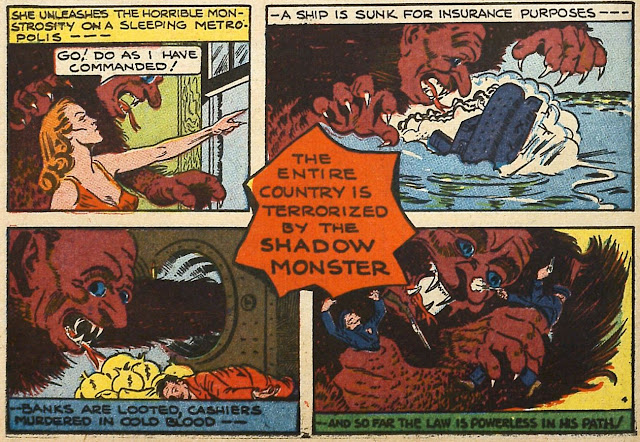
    We don’t get a real run-down of the Shadow Monster’s abilities but on-panel it is at least physically invulnerable and able to grow to giant size, and so I must admit that I find Lurida’s use of it to commit bank robberies and insurance fraud to be a bit limited, imagination-wise. Not that I have any sort of Grand Scheme for what I would do with such a beast, mind, I just have a knee jerk sense that if you’re using magic or super science or mutant powers or whatever to do something as banal as insurance fraud then you’re Doing It Wrong.

    As a femme fatale, Lurida is obligated to make a stab at seducing Lance over to her side, just as Lance as a stalwart hero is obliged to insultingly turn her down, and after some monkey business with a fire-based deathtrap Lance manages to destroy both the Gem of Evil and the Shadow Monster, and Lurida completes the set by flinging herself into the same flame she had set for Lance. It’s not a great decision considering that no court in the land is equipped to prosecute somebody for shadow demon summoning, but it does tie up the episode in a real neat bow.

  • MINOR SUPER-VILLAIN 736: LURIDA

    (Silver Streak Comics 005, 1940)

    I was just about to type that this was “a simple, straightforward super-hero comic story” and then immediately had to grapple with how to summarize the following: in the previous issue of Silver Streak Comics, adventurer Lance Hale set out to recover a treasure left by his uncle in an old mine in Rhodesia (now Zimbabwe). After helping the immortal Queen of the Underground Empire Aldia and her caveman subjects fight off a lizard man invasion (and incidentally becoming immortal himself, though this is never brought up again), Lance took the treasure with the stated intention of using it to help the needy back in America. Simple!

    This issue, we learn that this treasure includes an artifact known as the Gem of Evil and that a femme fatale named Lurida (very on-the-nose name) not only knows about it but somehow knows that Lance Hale has it. She steals the treasure with the help of some more-competent-than-usual henchmen and voila, summons herself the Shadow Monster.

    We don’t get a real run-down of the Shadow Monster’s abilities but on-panel it is at least physically invulnerable and able to grow to giant size, and so I must admit that I find Lurida’s use of it to commit bank robberies and insurance fraud to be a bit limited, imagination-wise. Not that I have any sort of Grand Scheme for what I would do with such a beast, mind, I just have a knee jerk sense that if you’re using magic or super science or mutant powers or whatever to do something as banal as insurance fraud then you’re Doing It Wrong.

    As a femme fatale, Lurida is obligated to make a stab at seducing Lance over to her side, just as Lance as a stalwart hero is obliged to insultingly turn her down, and after some monkey business with a fire-based deathtrap Lance manages to destroy both the Gem of Evil and the Shadow Monster, and Lurida completes the set by flinging herself into the same flame she had set for Lance. It’s not a great decision considering that no court in the land is equipped to prosecute somebody for shadow demon summoning, but it does tie up the episode in a real neat bow.

  • MINOR SUPER-HERO ROUND-UP 036

    Prize Comics time, bay-bee.

    Power Nelson:

    Power Nelson is from the far-off future year of 1982 CE, in which the world has been conquered by the Mongols, but the wink, wink, nudge, nudge kind of Mongols from 1940-1941 where they’re actually supposed to be the Japanese (and for some reason the nation of Mongolia is fair game as far as Explicit Villain Status goes while Japan is still off the table). He has been given super strength by some surprisingly beefy scientists so that he might save civilization from oppression. Three things about Power Nelson:

    1) I think that his first name might actually be Power. So futuristic!

    2) I kind of want to give this series credit for not being too racist but the truth is that it is fairly racist but my senses have been dulled by exposure to the excesses of post Pearl Harbor depictions of the Japanese. 

    3) Power Nelson is very bad at his job? Every issue sees him within striking distance of Emperor Seng I and while assassinating the top man isn’t a guaranteed way to end a regime, it absolutely cannot hurt. Just punch him, man! (Prize Comics 001, 1940)

    Jupiter:

    Jupiter represents two distinct super-hero archetypes: the alien lawman sent to Earth to dispense justice and the magic-user, and as those are two of the more omnipotent origins that a character can have he goes through crooks like a hot knife through butter. The most important question about Jupiter is: was he called Jupiter back on the planet Jupiter or is he adopting a cool new name like a kid at camp? (Prize Comics 001, 1940)

    K the Unknown:

    Douglas Danville, wealthy playboy, takes to the crime-ridden ski slopes as K the Unknown, feared and hunted by ski crooks and ski cops alike. And presumably regular cops and crooks too, but he only had one recorded outing and it took place entirely within the bounds of a ski resort.

    K the Unknown’s one adventure involves embezzlement and murder among the officers of a college alumni group, possibly the perfect case for a wealthy playboy type hero.

    K the Unknown is a great name but perhaps not a great super-hero name, so I can see why he only had on outing. Still, it must be handy to have a calling card that you can piss into the snow. (Prize Comics 001, 1940)

    the Black Owl: 

    It’s hardly unusual for a Golden Age character to make one appearance and then disappear forever, but much more unusually while K the Unknown never had a second adventure his alter ego Doug Danville just kept on trucking under another identity. It’s never explored in the text of the story, so any explanation for why he made the change is an equally valid bit of speculation, from “he wanted a less generic super-hero identity” to “it’s completely different guy named Doug Danville who hangs around with a completely different private eye named Terry Dane.” It turns out that I wrote that last bit prematurely, as in the Black Owl’s second outing his foe is Sigmund Rathko, the crook who was also behind the alumni association shenanigans in the K the Unknown story. I suppose that it could be three completely different people but no, at that point we’re getting silly.

    One thing that you can say for certain is that he didn’t change identities to get the cops off of his back, because they want to get the Black Owl just as much as they did K the Unknown. Moreso, honestly, because K the Unknown was safely carving powder and never even saw a cop. (Prize Comics 002, 1940)

  • MINOR SUPER-HERO ROUND-UP 036

    Prize Comics time, bay-bee.

    Power Nelson:

    Power Nelson is from the far-off future year of 1982 CE, in which the world has been conquered by the Mongols, but the wink, wink, nudge, nudge kind of Mongols from 1940-1941 where they’re actually supposed to be the Japanese (and for some reason the nation of Mongolia is fair game as far as Explicit Villain Status goes while Japan is still off the table). He has been given super strength by some surprisingly beefy scientists so that he might save civilization from oppression. Three things about Power Nelson:

    1) I think that his first name might actually be Power. So futuristic!

    2) I kind of want to give this series credit for not being too racist but the truth is that it is fairly racist but my senses have been dulled by exposure to the excesses of post Pearl Harbor depictions of the Japanese. 

    3) Power Nelson is very bad at his job? Every issue sees him within striking distance of Emperor Seng I and while assassinating the top man isn’t a guaranteed way to end a regime, it absolutely cannot hurt. Just punch him, man! (Prize Comics 001, 1940)

    Jupiter:

    Jupiter represents two distinct super-hero archetypes: the alien lawman sent to Earth to dispense justice and the magic-user, and as those are two of the more omnipotent origins that a character can have he goes through crooks like a hot knife through butter. The most important question about Jupiter is: was he called Jupiter back on the planet Jupiter or is he adopting a cool new name like a kid at camp? (Prize Comics 001, 1940)

    K the Unknown:

    Douglas Danville, wealthy playboy, takes to the crime-ridden ski slopes as K the Unknown, feared and hunted by ski crooks and ski cops alike. And presumably regular cops and crooks too, but he only had one recorded outing and it took place entirely within the bounds of a ski resort.

    K the Unknown’s one adventure involves embezzlement and murder among the officers of a college alumni group, possibly the perfect case for a wealthy playboy type hero.

    K the Unknown is a great name but perhaps not a great super-hero name, so I can see why he only had on outing. Still, it must be handy to have a calling card that you can piss into the snow. (Prize Comics 001, 1940)

    the Black Owl: 

    It’s hardly unusual for a Golden Age character to make one appearance and then disappear forever, but much more unusually while K the Unknown never had a second adventure his alter ego Doug Danville just kept on trucking under another identity. It’s never explored in the text of the story, so any explanation for why he made the change is an equally valid bit of speculation, from “he wanted a less generic super-hero identity” to “it’s completely different guy named Doug Danville who hangs around with a completely different private eye named Terry Dane.” It turns out that I wrote that last bit prematurely, as in the Black Owl’s second outing his foe is Sigmund Rathko, the crook who was also behind the alumni association shenanigans in the K the Unknown story. I suppose that it could be three completely different people but no, at that point we’re getting silly.

    One thing that you can say for certain is that he didn’t change identities to get the cops off of his back, because they want to get the Black Owl just as much as they did K the Unknown. Moreso, honestly, because K the Unknown was safely carving powder and never even saw a cop. (Prize Comics 002, 1940)

  • MINOR SUPER-HERO ROUND-UP 035

    MINOR SUPER-HERO ROUND-UP 035

    Planet Comics how I love you, cobbled-together pile of scraps that you are.

    Torro:

    In an adventure that I can only assume was concocted in order to use up some extraneous art, Captain Nelson Cole of the Solar Force travels to the distant planet Zog and ends up taking up the mantle (and magic whip) of the hero Torro in order to help recover the planet’s treasures from an evil giant.

    As befits a personality that is probably just, again, repurposed art from an unused fantasy comic, Cole adopts the Torro identity completely. Using his magic clothes, boots, belt and whip, he battles and ultimately kills the two-headed giant and his one-headed wife and then goes back to being a spaceman. (Planet Comics 002, 1940)

    Amazona the Mighty Woman:

    Amazona belongs to a pre-Ice Age civilization that is not advanced so much as stubborn in that as the ice advanced on them they just toughed it out until the only ones left were super strong and immune to cold.

    Amazona is understandably bored of the endless expanses of ice and snow afforded her and decides to tag along when reporter Blake Manners passes through following a shipwreck. In their one adventure together back in the US, Amazona gets to beat the tar out of a bunch of gangsters while wearing a party dress and I’m pretty sad that there wasn’t more of this. (Planet Comics 003, 1940)

    Jim Giant:

    Jim Giant, billed as both the Strongest Man in the Universe and the Mightiest Man on Earth (both can be correct, in the right order), is super strong and super tough and in his single recorded adventure he beats the stuffing out of an entire invasion force that sweeps down from the Arctic. (Planet Comics 004, 1940)

    Fero, Planet Detective:

    I’m going to call it: Fero, Planet Detective started life as an unused Zero, Ghost Detective story that found its way from Quality Comics to Fiction House and was altered just enough to be distinct. Scrub out the Z and add an F, swap “Ghost” for “Planet” and most importantly slap an extra line on the text box about how all the werewolves and vampires are actually from Pluto. It’s seamless!

    I actually unironically love the first Fero adventure. It’s a great example of how restriction and constraint can make for the most weird and creative choices. “Occult Detective” is after all an entertaining and rich subgenre, but “Occult Detective But All of the Monsters Are Also Space Aliens” is the sort of wild and wacky stuff you come up with while trying to pad out the pagecount of your science fiction comic book and all you have is a second-hand story about vampires and goblins. It’s great stuff!

    Sadly, though Fero continued to appear in Planet Comics for three more issues the occult aspects of his adventures fell by the wayside in favour of more traditional space detective cases – space theft, space kidnappings, etc. It’s a real blow for fans of occult sci fi.

    Fero’s remaining adventures are all right, but nothing to write home about. He does have a fun futuristic high-collared shirt, so that’s something, but the most interesting thing about his latter adventures is his selection of transformation pills that he uses to get out of  scrapes, including one that turns you into a toddler and the amazing one that he is taking above to turn into a rampaging anthropoid. (Planet Comics 005, 1940)

  • MINOR SUPER-HERO ROUND-UP 035

    MINOR SUPER-HERO ROUND-UP 035

    Planet Comics how I love you, cobbled-together pile of scraps that you are.

    Torro:

    In an adventure that I can only assume was concocted in order to use up some extraneous art, Captain Nelson Cole of the Solar Force travels to the distant planet Zog and ends up taking up the mantle (and magic whip) of the hero Torro in order to help recover the planet’s treasures from an evil giant.

    As befits a personality that is probably just, again, repurposed art from an unused fantasy comic, Cole adopts the Torro identity completely. Using his magic clothes, boots, belt and whip, he battles and ultimately kills the two-headed giant and his one-headed wife and then goes back to being a spaceman. (Planet Comics 002, 1940)

    Amazona the Mighty Woman:

    Amazona belongs to a pre-Ice Age civilization that is not advanced so much as stubborn in that as the ice advanced on them they just toughed it out until the only ones left were super strong and immune to cold.

    Amazona is understandably bored of the endless expanses of ice and snow afforded her and decides to tag along when reporter Blake Manners passes through following a shipwreck. In their one adventure together back in the US, Amazona gets to beat the tar out of a bunch of gangsters while wearing a party dress and I’m pretty sad that there wasn’t more of this. (Planet Comics 003, 1940)

    Jim Giant:

    Jim Giant, billed as both the Strongest Man in the Universe and the Mightiest Man on Earth (both can be correct, in the right order), is super strong and super tough and in his single recorded adventure he beats the stuffing out of an entire invasion force that sweeps down from the Arctic. (Planet Comics 004, 1940)

    Fero, Planet Detective:

    I’m going to call it: Fero, Planet Detective started life as an unused Zero, Ghost Detective story that found its way from Quality Comics to Fiction House and was altered just enough to be distinct. Scrub out the Z and add an F, swap “Ghost” for “Planet” and most importantly slap an extra line on the text box about how all the werewolves and vampires are actually from Pluto. It’s seamless!

    I actually unironically love the first Fero adventure. It’s a great example of how restriction and constraint can make for the most weird and creative choices. “Occult Detective” is after all an entertaining and rich subgenre, but “Occult Detective But All of the Monsters Are Also Space Aliens” is the sort of wild and wacky stuff you come up with while trying to pad out the pagecount of your science fiction comic book and all you have is a second-hand story about vampires and goblins. It’s great stuff!

    Sadly, though Fero continued to appear in Planet Comics for three more issues the occult aspects of his adventures fell by the wayside in favour of more traditional space detective cases – space theft, space kidnappings, etc. It’s a real blow for fans of occult sci fi.

    Fero’s remaining adventures are all right, but nothing to write home about. He does have a fun futuristic high-collared shirt, so that’s something, but the most interesting thing about his latter adventures is his selection of transformation pills that he uses to get out of  scrapes, including one that turns you into a toddler and the amazing one that he is taking above to turn into a rampaging anthropoid. (Planet Comics 005, 1940)

  • PROBLEMATIC ROUND-UP 003

    This edition of the Problematic Round-Up is devoted to minor MLJ character Fu Chang and his foes.

    Fu Chang:

    Reading Charlie Chan comics has absolutely messed my head up in a specific way: because Charlie Chan is so clearly a project with the set goal of having a Chinese character who is not an overt racist Yellow Peril stereotype (while, yes, being pretty racist in a bunch of other ways) I give it more of the benefit of the doubt than I otherwise would. For instance, I just kind of skim most of what Charlie Chan says because actually parsing it is very painful. 

    The problem is, I keep automatically giving various other series featuring Chinese American detectives the benefit of the doubt, and very few of them are also earnest-but-flawed attempts to avoid the overtly racist tropes of the day. This is all to say Fu Chang and his adventures are pretty racist and it caught me off guard and I had to work through it here.

    So: Fu Chang is an American educated Chinese man (with a more Caucasian skin tone than the bright yellow Evil Chinese such as the Dragon, below) who is very dedicated to his (personal? family?) god and as a result has been gifted a chess set with “all the magic powers of Aladdin’s Lamp” (and this smearing of everything East of the Mediterranean into one big exotic mess is classic Orientalism) which in effect means that he has a bunch of little guys at hand to do his bidding.

    If there’s one fun thing about Fu Chang, it’s trying to figure out exactly what the heck kind of game this chess set could be used for. Here are the known pieces:

    – the Warrior – just a little guy, used to spy on folks

    – unnamed stage magician – has ESP or other way of locating hidden objects

    – the Little Man of Magic – a magician in the Indian mystic vein. More talkative and proactive than many others. Able to paralyze humans via magic 

    – the Doctor – healing plus some hand-to hand. Also has wings in one story

    – the Mermaid – amphibious

    – the Woodsman – tree-chopping action

    – a pilot – can fly a plane but the plane is sold separately

    – group of men in suits plus military officer and a jodhpured adventurer – engage in combat with the Tiger-Devil

    – Seen but never used: the shirtless guy, the blonde lady in the red dress, the policeman, the crook, the fat bald guy

    – winged people – obviously they can fly. As the series goes on the winged figures show up more and more until the last few adventures feature nothing but up to a couple of dozen of them.

    I suppose it’s possible that you could cobble together a complete chess set out of those. Obviously the winged guys would be the pawns, but where would the mermaid come in? Even more concerning than the fact that there might not have been a complete Fu Chang lore bible with detailed breakdowns of all the chess pieces and their powers is the constant slander of Aladdin’s lamp. Unless Fu Chang and his god have a chronic lack of imagination, this is a pretty weak showing from a fabled object. (Pep Comics 001, 1940)

    the Dragon:

    The Dragon is really notable only for his fantastic name as well as to illustrate the weird vibes-based skin-colouring in the Fu Chang comic – the more good and Westernized you are, the pinker your skin. Otherwise he’s a creep and a low-level Yellow Peril gangster. (Pep Comics 001, 1940)

    the Cult of the Tiger-Devil: 

    While I love the Tiger-Devil itself, the Tiger-Devil Cult that serves and has summoned him is some pan-Asian degeneracy nonsense straight out of Lovecraft. Serves them right for summoning a demon to conquer the world with that it gets beaten up by a bunch of little chessmen – though the Tiger-Devil has dominion over all men, the chess pieces are no men. 

    If the MLJ Universe hadn’t stopped being a continuous continuity in the early 90s it might be more significant that the Tiger-Devil ends up sealed in a jar and dropped into San Francisco Bay. Alas. (Pep Comics 002, 1940)

    the Drug-Master:

    It’s a Fu Chang sweep for this instalment of the Problematic Round-Up with Ghor here, aka the Drug-Master, a very hard-core name that I wish I could celebrate a bit more but no: he’s yet another Yellow Peril type with a bit of added spice in that he is also involved in the sinister Asian Drug Trade. Specifically, he’s bringing a powerful new drug into San Francisco’s Chinatown, one so addictive that it makes anyone his slave rather than do without it, even Fu Chang’s fiance Tay Ming. It’s so potent, in fact, that withdrawal induces a suicidal/homicidal frenzy and since the Drug-Master does not seem to be a particularly good boss, he’s letting his drug slaves go into withdrawal all over town. As is usually the case, the skills that make a criminal successful in human circles are of little use against a bunch of Fu Chang’s tiny guys and the Drug-Master ends up blowing himself to kingdom come. (Pep Comics 003, 1940)

  • MINOR SUPER-VILLAIN 682: CLEA

    (OK Comics 001, 1940) 

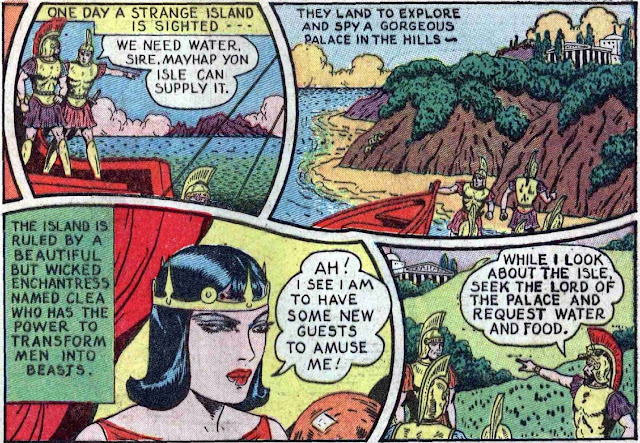
    “The Further Adventures of Ulysses” is a feature that posits that Ulysses/ Odysseus, after a gruelling twenty year journey home from Troy to Ithaca, immediately got bored and left again upon hearing a rumour that one of his men had been left behind on the island of the Cyclopes and still lived. This is a fun idea and very in keeping with both the lifestyles of the Greek heroes and a particular 1940s idea of manly disdain for settled domesticity. The only problem is that the one extant TFAOU story is all retellings of the greatest hits, from the return to Cyclops Island to Clea here, who is Circe in all but name.

    Specifically, Clea lives on an island and uses her magic wand to turn humans into beasts – Ulysses’ crew here all end up as tigers, so they must have had better table manners than the last bunch who all turned into pigs – and does not either provide Ulysses with information on how to enter the underworld or have between 2 and 5 children with him.

    Clea almost gets away with it too, but that meddling Mercury gives Ulysses a sprig of protective ivy and her weirdly long wand has no effect on him. Frankly embarrassing, Clea.

    BONUS: Just want to highlight this giant two-headed monster lady as the only novel concept in the adventure.