The Curse of Skeleton Munroe

Category: magic item

  • MINOR SUPER-HERO ROUND-UP 031

    MINOR SUPER-HERO ROUND-UP 031

    Great guns! More of them?

    the Masked Angel:

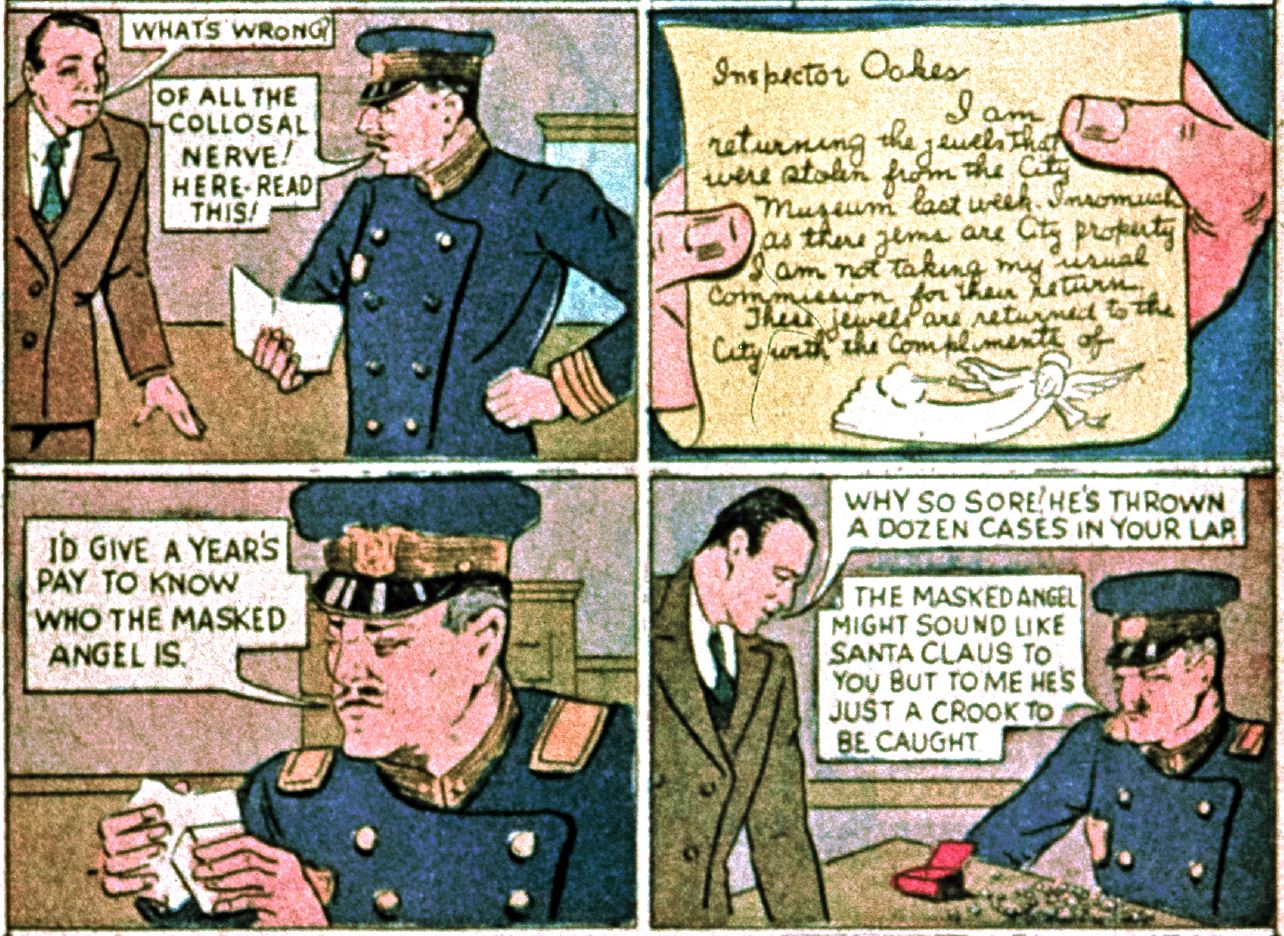
    Steve Oakes, wealthy playboy just so happens to also be the Masked Angel, vigilante feared by the underworld and wanted by the police.

    Steve’s father Detective Inspector John Oakes was murdered by crooks, so the Masked Angel act is his way of getting back at the criminal fraternity. It also seems to be a way to troll his brother, Detective Inspector John Oakes II, who is an asshole and who hates the Masked Angel in your classic way that a police officer does when they’re part of a vigilante’s supporting cast. Also please note the fun “angel shooting a gun” signature on the Masked Angel’s taunting note. (Miracle Comics 001 1940)

    Uncle Sam:

    We’re skirting the edge of what might be considered “minor” here, at least to DC Comics fans, but I have no Median Super-Hero category and however you slice it your parents almost certainly have not heard of him so here goes:

    Uncle Sam is the physical embodiment of the patriotic ideal of the United States: good, kind, powerful and just. He emerges to lend a physical hand in times of turmoil by inhabiting of reshaping the body of a recently slain patriot.

    This time around, Uncle Sam is (implicitly, all of this isn’t really spelled out until later) reborn from the death of Ezra Smith, who stands up to fascist agitators the Purple Shirts and gets a bullet in the back for his trouble. He sticks around to beat Axis ass for the duration of the war and then is not seen again until DC integrates the Quality characters into Earth-2 continuity in the 1970s. (National Comics 001, 1940)

    National Comics 005 expands the Uncle Sam lore slightly, firstly by making it a bit more explicit that he incorporates the spirits of dying patriots into himself with what is perhaps the initial time he did so, when a man named Sam sacrifices his own life to advance the cause during the American Revolution.

    Secondly, Sam is seen merging with a living patriot named Samuel in order to help drive the fascist Black Legion out of Glen Valley. Is this a common event? Does Uncle Sam roam the land absorbing patriots? Who can say, but it certainly would put a new spin on the character.

    Buddy Smith:

    When Ezra Smith is murdered by the Purple Shirts, his grandson Buddy is left alone, presumably some sort of double-orphan. He is almost immediately found, shamed for crying, and adopted by Uncle Sam (and hopefully the near immediate recovery Buddy has from the grief of seeing his grandfather gunned down in front of his eyes is a function of Uncle Sam being partially Ezra Smith and not some sort of deep traumatic repression left to fester in his soul).

    Buddy fills a pretty standard kid sidekick role: getting into trouble, getting Uncle Sam out of trouble, inventing things, befriending people, spotting clues, etc. He is unusual in that he is one of the few kid sidekicks who is a proper kid as opposed to being a young teenager (I know the common wisdom is that Dick Grayson was eight when he became Robin but that’s mostly because Golden Age artists – and particularly Bob Kane – were mostly very bad at drawing kids. Robin was absolutely supposed to be somewhere in the 12-15 range when he debuted). He’s also notable for – as far as I know – never ever showing up again post-Quality, not even in that event earlier this year that was specifically focused on bringing back all the old (and new) Golden Age kid sidekicks. Maybe Uncle Sam ate absorbed him once he got old/patriotic enough. (National Comics 001, 1940)

    Merlin the Magician:
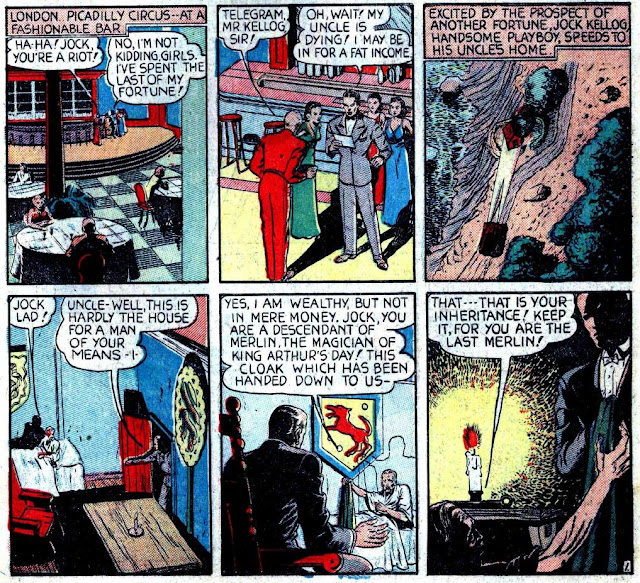
    Jock Kellog, a wealthy playboy in the classic mold, spends the last of his family fortune on the same day he is summoned to the bedside of his sole relative, an unnamed uncle. Instead of the fat stacks of cash that he is hoping for, Kellog comes away with a cloak and the knowledge that he is supposedly the last descendant of Merlin of Arthuriana fame.

    It turns out that he is in fact the last descendant of Merlin, of course, and that the cloak is a source of unlimited magical power in the grand tradition of mystic super-heroes like Zatara. Lucky for the world at large, the application of vast power has the opposite of its usual effect on the young wastrel and Jock devotes his newfound power to the defense and betterment of humanity. (National Comics 001, 1940)

  • MINOR SUPER-VILLAIN 645: SNEELY

    (Fight Comics 004, 1940)

    Kinks Mason is deep sea fishing with some friend when one of them lands a swordfish that is covered in gold and jewels! Just where did these riches come from? The answer is unguessable!

    Upon reaching the ocean floor, Kinks discovers that the swordfish was covered in pirate gold, and furthermore, he finds the pirate! Sneely (Pirate Terror of the Seven Seas, the Great, the Magnificent) is an old-time pirate who claims that he drank a magic potion that allowed him to live seemingly indefinitely underwater and who guards his ill-gotten treasure both personally and with a school of trained swordfish. Is attaining near-immortality and then spending it guarding a pile of shiny metal that only has value if you actually spend it on something a huge waste? Indeed it is! It’s absolute dragon behaviour is what it is.

    Sneely is exactly the kind of weird wild completely un-fleshed-out villain that you get for a character like Kinks Mason who a) isn’t one of the real top-tier guys in the book he appears in and b) has a niche role. Every issue, Kinks dives into the ocean for 5 to 8 pages and he has to find a challenge to overcome down there and sometimes it’s a, immortal amphibious pirate with the world’s most Xtreme Hoarding Problem. 

    Probably the best thing about Sneely is the one that never got capitalized on: that he’s seemingly still alive at the end of the story, as Kinks Mason just konks him on the head with a thighbone before making off with the treasure. And while an immortal amphibious pirate squatting on a pile of gold at the bottom of the ocean is a bit of an underwhelming idea for a comic book, an immortal amphibious pirate who Wants His Treasure Back is a cool recurring enemy. I say BRING BACK Sneely, in concept if not as an actual character.

  • MINOR SUPER-VILLAIN 597: NEGUS

    (Fantastic Comics 003, 1940)

    An evil African witch doctor with a magical orb, a cool tree house and a real commitment to being Chaotic Evil, Negus meets a swift end once Captain Kidd comes looking for his imprisoned and mind controlled pal Arndt Barrows Colonel Bennet (as with a surprising number of Golden Age comics, the writer seems to have lost track of the name of this secondary character over the course of a 5 page story).

  • MINOR SUPER-HERO ROUND-UP 024

    Buncha fresh heroes here!

    Son of the Gods: 

    Dr John Thesson, big tall archaeologist and 1940s arch-skeptic, has the misfortune to find himself on an expedition to Crete with true believer Professor Craig who can’t stop running his mouth about how great Theseus was and how he totally existed and maybe Thesson and Craig can find Theseus’ mystic Ring of Poseidon if they look hard enough. It is a very annoying expedition for Thesson.

    Just kidding: this is a comic book and Professor Craig is completely right – it’s John “We’re Scientists” Thesson who has to get with the picture.

    The expedition is rich with incident: on the way there the duo ore attacked by a wild boar and Thesson kills it…

    … and then once they start the dig in earnest it is plagued by sabotage that is eventually traced back to their host Procostous and his manservant Cercion. This is the point at which the back of Professor Craig’s head blows clean off and he starts talking about how Thesson is the reincarnation of Theseus and is reliving his famed Six Labours (he actually does half: Periphetes the Club Bearer and Sinis the Tree Bender appear only as recounted myths and Sciron is not mentioned at all. And to be honest Cercion = Cercyon is a bit flimsy. It’s lucky for Professor Craig that he turns out to be correct. Again).

    Surprising nobody, Thesson does indeed find the Ring of Poseidon after one last sabotage attempt that leaves Procrustous dead. This is enough for the local mystery cult to acclaim him the Reincarnation of Theseus and he vows to use the powers granted by the ring (super strength and a degree of invulnerability, mostly) to battle crime and injustice. I initially hoped that Theseus would have fun mythology-inspired adventures like the MLJ Hercules but no, it’s all super-scientists and fascists – not even a hint of poor neglected Sciron and his giant turtle.

    (later issues cast Thesson as a mere descendant of Theseus but whether this is because reincarnation was a but too mystical or due to simple sloppy record keeping I cannot say)

    (the Minotaur only appears as one of Professor Craig’s stories but I just wanted to highlight the rare bull-bodied version here) (Exciting Comics 002, 1940)

    the Masked Rider:

    Geologist Jim Sanford becomes the Masked Rider in order to catch crooks (including the Specter) operating a covert gold min under the Diamond D Ranch without them knowing he was onto them with specific geological knowledge. Unlike most of his peers, he has no trouble hanging up his mask once the job is done. (Exciting Comics 002, 1940)

    the Sphinx:

    The Sphinx is a tuxedo-clad, domino-masked vigilante (real name Ellsworth Forrester!), a perhaps over represented group in early comics but generally a solid one (I initially forgot the name of the Scarab from Terra Obscura and thought that he was this guy – imagine my confusion). The main difference between the Sphinx and his peers like the Clock or the Mouthpiece or Just n’ Right is that the Sphinx is loosely affiliated with the police rather than being hunted by them.

    The other main difference is the fact that the Sphinx is one of the few suit-and-mask heroes with legitimate super powers, specifically super strength and at least partial invulnerability.

    Why is he called the Sphinx? As far as I can tell it’s just because he’s mysterious. (Exciting Comics 002, 1940)

    UPDATE – the Golden Knight:

    The Golden Knight
    stops off on his way to the Crusades to do a mission for Kara the
    Magician, who gifts him a magic ring that emits light in order to help
    him overcome the many dangers along the way and then a magic cloak of
    protection once he gets back – it’s a very Dungeons & Dragons style quest, honestly.

    The
    Golden Knight also takes a dip in a magic lake that triples his
    strength, which is handy for a warrior type. Does this strength persist? No idea. (Fantastic
    Comics 003, 1940)

     A couple of issues later, the Golden Knight meets the love of his life, Alice. Alice fell down a well as a child and was raised by (and eventually made queen of) a race of winged people in an underground city. Alice rules – in her first proper appearance she stabs two people to death which is way, way more than your typical female Golden Age adventurer. (Fantastic Comics 005, 1940)

  • MINOR SUPER-HERO ROUND-UP 024

    Buncha fresh heroes here!

    Son of the Gods: 

    Dr John Thesson, big tall archaeologist and 1940s arch-skeptic, has the misfortune to find himself on an expedition to Crete with true believer Professor Craig who can’t stop running his mouth about how great Theseus was and how he totally existed and maybe Thesson and Craig can find Theseus’ mystic Ring of Poseidon if they look hard enough. It is a very annoying expedition for Thesson.

    Just kidding: this is a comic book and Professor Craig is completely right – it’s John “We’re Scientists” Thesson who has to get with the picture.

    The expedition is rich with incident: on the way there the duo ore attacked by a wild boar and Thesson kills it…

    … and then once they start the dig in earnest it is plagued by sabotage that is eventually traced back to their host Procostous and his manservant Cercion. This is the point at which the back of Professor Craig’s head blows clean off and he starts talking about how Thesson is the reincarnation of Theseus and is reliving his famed Six Labours (he actually does half: Periphetes the Club Bearer and Sinis the Tree Bender appear only as recounted myths and Sciron is not mentioned at all. And to be honest Cercion = Cercyon is a bit flimsy. It’s lucky for Professor Craig that he turns out to be correct. Again).

    Surprising nobody, Thesson does indeed find the Ring of Poseidon after one last sabotage attempt that leaves Procrustous dead. This is enough for the local mystery cult to acclaim him the Reincarnation of Theseus and he vows to use the powers granted by the ring (super strength and a degree of invulnerability, mostly) to battle crime and injustice. I initially hoped that Theseus would have fun mythology-inspired adventures like the MLJ Hercules but no, it’s all super-scientists and fascists – not even a hint of poor neglected Sciron and his giant turtle.

    (later issues cast Thesson as a mere descendant of Theseus but whether this is because reincarnation was a but too mystical or due to simple sloppy record keeping I cannot say)

    (the Minotaur only appears as one of Professor Craig’s stories but I just wanted to highlight the rare bull-bodied version here) (Exciting Comics 002, 1940)

    the Masked Rider:

    Geologist Jim Sanford becomes the Masked Rider in order to catch crooks (including the Specter) operating a covert gold min under the Diamond D Ranch without them knowing he was onto them with specific geological knowledge. Unlike most of his peers, he has no trouble hanging up his mask once the job is done. (Exciting Comics 002, 1940)

    the Sphinx:

    The Sphinx is a tuxedo-clad, domino-masked vigilante (real name Ellsworth Forrester!), a perhaps over represented group in early comics but generally a solid one (I initially forgot the name of the Scarab from Terra Obscura and thought that he was this guy – imagine my confusion). The main difference between the Sphinx and his peers like the Clock or the Mouthpiece or Just n’ Right is that the Sphinx is loosely affiliated with the police rather than being hunted by them.

    The other main difference is the fact that the Sphinx is one of the few suit-and-mask heroes with legitimate super powers, specifically super strength and at least partial invulnerability.

    Why is he called the Sphinx? As far as I can tell it’s just because he’s mysterious. (Exciting Comics 002, 1940)

    UPDATE – the Golden Knight:

    The Golden Knight
    stops off on his way to the Crusades to do a mission for Kara the
    Magician, who gifts him a magic ring that emits light in order to help
    him overcome the many dangers along the way and then a magic cloak of
    protection once he gets back – it’s a very Dungeons & Dragons style quest, honestly.

    The
    Golden Knight also takes a dip in a magic lake that triples his
    strength, which is handy for a warrior type. Does this strength persist? No idea. (Fantastic
    Comics 003, 1940)

     A couple of issues later, the Golden Knight meets the love of his life, Alice. Alice fell down a well as a child and was raised by (and eventually made queen of) a race of winged people in an underground city. Alice rules – in her first proper appearance she stabs two people to death which is way, way more than your typical female Golden Age adventurer. (Fantastic Comics 005, 1940)

  • MINOR SUPER-HERO ROUND-UP 015

    Once again we take you to the world of the minor super-hero. See them dance for your amusement. 

    the Mystic: 

    Later known as Kardak the Mystic, the Mystic is a stage magician who uses stage magic to battle crime, specializing in fraudulent mediums etc. His stage magic eventually gets rounded up to real magic, of course. (Top-Notch Comics 001, 1939)

    the Phantom o’ the Hills:

    The Phantom o’ the Hills is an otherwise unnamed masked cowboy who rights wrongs in the Old West. In his first adventure he avenges the death of his younger brother but whether that’s what got him into the vigilante game is not elaborated on. The only real thing that sets him apart from the ranks of other similar characters is his better-than-average name. (Western Picture Stories 001, 1937)

    Wonder Man:

    For all that (by some accounts) Will Eisner was explicitly told to make a Superman clone when he made him for Fox Features (and that DC successfully sued Fox into canning him), Wonder Man is only kind of like Superman. Maybe it’s my modern image of what Superman is like but he’s just a strong guy who jumps around catching artillery shells and beating up warmongers. Plus he gets his powers from a magic Tibetan ring! Plus he’s blonde! (Wonder Comics 001, 1939)

    Yarko the Great:

    There are three major things to know about Yarko the Great: 

    1. He’s a magic-slinging hero in the classic mold, i.e., an American who has learned the secrets of the Far East and turned them to a career in stage magic/ crimefighting.

    2. Like a lot of early Fox Features characters he was created by Will Eisner so his adventures tend to look pretty great.

    3. “Yarko the Great” is – and this is an informed opinion – categorically the worst name that any magic-using Golden Age hero was saddled with. 

    (Wonder Comics 002, 1939)

    Yarko UPDATE 1940

    *UPDATE* the Flame *UPDATE*:

    Just wish to draw everyone’s attentions to the really boss custom-painted boat that the Flame was tooling around in during his first adventure. Plus he had a butler named Jarvis! (Wonderworld Comics 003, 1939)

    **DOUBLE UPDATE**

    And he has a plane! (Wonderworld Comics 004, 1939)

  • MINOR SUPER-VILLAIN 475: THE WITCH

    (Amazing-Man Comics 019, 1941)

    Mighty Man was always a lot for crooks to deal with even when he was just a 12 foot tall guy with super strength but after he gained complete control over his physical form he really gave them a run for their money. I assume that’s why he was assigned an actual, factual magic-using witch as a recurring enemy. At least, at first.

    In her first appearance, the Witch had a magic broom that allowed her to fly, changer her shape, pass through walls and paralyze others (plus more, presumably). She came into conflict with Mighty Man over a munitions company executive who had the formula for a mind control gas and was understandably reluctant to reveal it to a gang of crooks. The Witch made her getaway, swearing revenge.

    The Witch returns in Amazing-Man Comics 020 without her broom (no reason is given). She is now equipped with a potion that allows her to changer her appearance, which she uses first in an attempt to kill Mighty Man by claiming to herself be the targeted for assassination. This of course does not work, so in issue 21 she captures Mighty Man and declares that she will keep him prisoner until she discovers the secret of his powers.

    This is where things get weird, dynamic-wise. The Witch’s sedatives turn out not to work on Mighty Man, but he realizes that as her prisoner he is in a prime position to learn of and foil her various schemes. So for the next couple of issues (plus an issue of Stars and Stripes Comics), Mighty Man is theoretically paralyzed in a cell back at the Witch’s hideout while actually sneaking around and shapechanging his way through the massed ranks of her criminal army.

    The best thing to come out of all of this is this little kid super-hero identity that Mighty Man adopts and who I, like the Witch, like to call “Little Squirt”, even though he technically never has a name. Mighty Man’s writers eventually solved the problem of him being too powerful by having him assign himself the task of following Super-Ann around and helping her out without being seen by her, which is pretty fun but I kind of wish he’d leaned into this idea of fighting under different identities.

    The Witch, meanwhile, eventually drowned in a flood during one of her many schemes. I’m sure she wished she still had that broom.

  • MINOR SUPER-VILLAIN 475: THE WITCH

    (Amazing-Man Comics 019, 1941)

    Mighty Man was always a lot for crooks to deal with even when he was just a 12 foot tall guy with super strength but after he gained complete control over his physical form he really gave them a run for their money. I assume that’s why he was assigned an actual, factual magic-using witch as a recurring enemy. At least, at first.

    In her first appearance, the Witch had a magic broom that allowed her to fly, changer her shape, pass through walls and paralyze others (plus more, presumably). She came into conflict with Mighty Man over a munitions company executive who had the formula for a mind control gas and was understandably reluctant to reveal it to a gang of crooks. The Witch made her getaway, swearing revenge.

    The Witch returns in Amazing-Man Comics 020 without her broom (no reason is given). She is now equipped with a potion that allows her to changer her appearance, which she uses first in an attempt to kill Mighty Man by claiming to herself be the targeted for assassination. This of course does not work, so in issue 21 she captures Mighty Man and declares that she will keep him prisoner until she discovers the secret of his powers.

    This is where things get weird, dynamic-wise. The Witch’s sedatives turn out not to work on Mighty Man, but he realizes that as her prisoner he is in a prime position to learn of and foil her various schemes. So for the next couple of issues (plus an issue of Stars and Stripes Comics), Mighty Man is theoretically paralyzed in a cell back at the Witch’s hideout while actually sneaking around and shapechanging his way through the massed ranks of her criminal army.

    The best thing to come out of all of this is this little kid super-hero identity that Mighty Man adopts and who I, like the Witch, like to call “Little Squirt”, even though he technically never has a name. Mighty Man’s writers eventually solved the problem of him being too powerful by having him assign himself the task of following Super-Ann around and helping her out without being seen by her, which is pretty fun but I kind of wish he’d leaned into this idea of fighting under different identities.

    The Witch, meanwhile, eventually drowned in a flood during one of her many schemes. I’m sure she wished she still had that broom.

  • MINOR SUPER-HERO 052: ZARDI, THE ETERNAL MAN

    MINOR SUPER-HERO 052: ZARDI, THE ETERNAL MAN

    (Amazing-Man Comics 011, 1940)

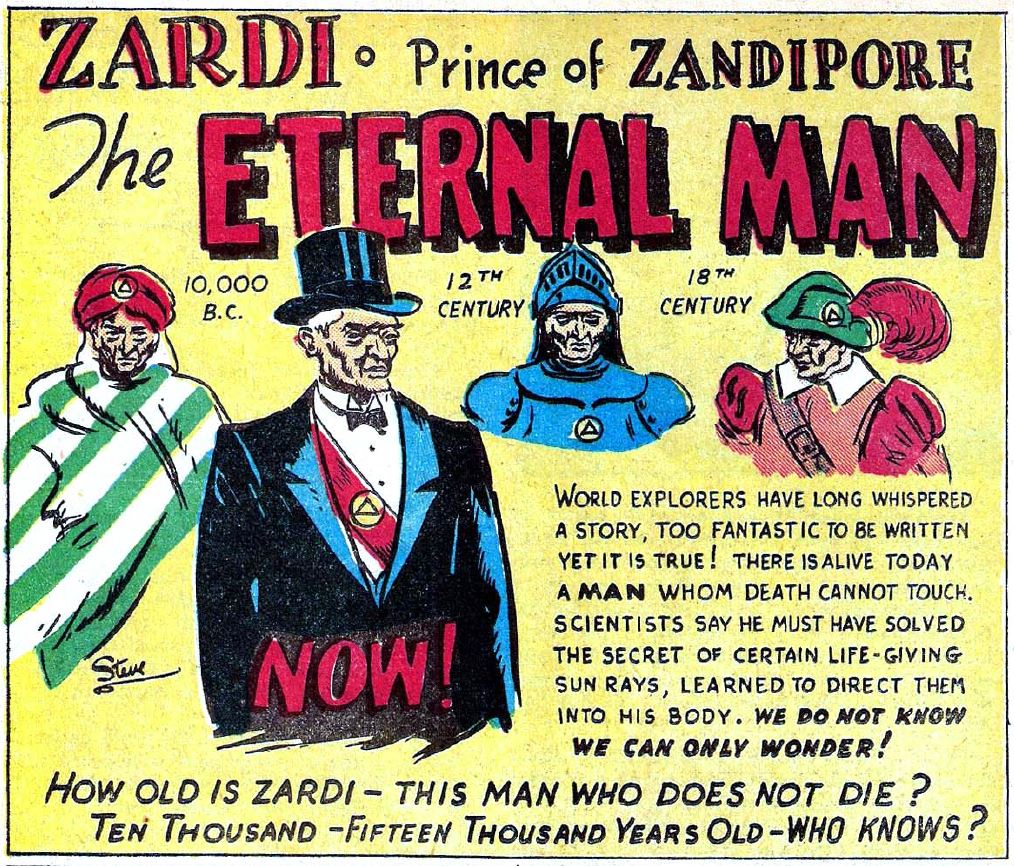
    Zardi, Prince of Zandipore, the Eternal Man. The immortal guy is a fun character type that is usually assigned to villains, presumably because someone with endless knowledge and resources will prove a challenge to even the most seasoned of heroes. Plus they can have inscrutable long-range goals! In Zardi’s case, he just wants to have a good rest (reasonable as he is upwards of 15 000 years old) but will rouse himself to combat evil using his magic cape (restores Zardi’s youth, invisibility, flight), magic cane (magical multitool and focus for spellcasting) and array of magics (including illusions, sleep, tlekinesis, etc). He also has an implied network of agents around the world but we only meet his manservant Nogi and a young woman named Janni Bayless.

    All that is by way of setting the scene: the thing I really want to look at is the series of vignettes used to highlight Zardi’s immortal nature.

    We’re going to tally everything up down at the bottom. See you there!

    Grand totals!

    Concrete events:

    – Knows the secret of the Sphinx: |

    – Saw the Egyptian kings buried: |

    – Saw the Flood: |

    – Saw the Fountain of Youth hidden away forever: |

    – Saw the parting of the Red Sea: ||

    – Saw the Pyramids built: |||

    – Witnessed the fall of Babylon: |

    and the more ephemeral:

    – Knows every form of magic: |

    – Knows the locations of various riches: ||

    – Learned the secret of Chaldean magic: |

    – Saw Hindu magic created: |

    What does this tell us? Well, for starters the Bible is real, at least up to Exodus (was Zardi on the Ark or was he just immortal enough to float around for a month plus? no clue). Zardi really likes Egypt and the Middle East. 

    Magic? Real, and Zardi knows all of it. The Fountain of Youth? Real, and Zardi was there to see it. I imagine that “we found a whole new continent” is a very exciting thing to hear when you’re an immortal. Even one who doesn’t travel much.

    In conclusion, there’s not as much meat on this bit as I imagined! Oh, and Zardi the Eternal Man is pretty okay.

  • MINOR SUPER-VILLAIN 375: HALDANE THE SORCERER

    (More Fun Comics 063, 1941)

    Haldane the Sorcerer has no backstory in-comic, so I’m going to be making some assumptions here. Assumption Number 1: since he first comes to light at society party that is also attended by Dr Fate pal Inza Cramer I am going to assume that he is part of the same New York/ New England social set as her, as opposed to some sort of party crasher. 

    Assumption Number 2: Haldane is a hobbyist. He is a rich guy who has managed to buy his way into learning, artifacts and power. He obviously has the magic skills to, for instance, turn someone to stone or rig up a voodoo doll to kill them in three days, but he lacks all sense of the practical. As an example: why the heck does he deploy his scheme in the middle of a party attended by none other than Dr Fate’s main squeeze? Because he’s never done anything like this before.

    Let me elaborate on his scheme to underline my point: Haldane is after the hidden treasure of the Jeromes, hidden deep in secret passages below their manor and thought by all to be a mere legend. He has discovered the location of the treasure via scrying. All of his spells seem to be status effect curses – surely the best way to go about things would be to sneak in, maybe curse someone to send them to the hospital? Not running into the middle of a party throwing curses left and right – amateur move.

    To cap it all off, when things start going off the rails Haldane decides to summon a cosmic horror (that, yes, looks a lot like a big bald lug). It’s a wild overreaction that doesn’t even solve his problems – it just scares that poor lady!

    Anyway, Dr Fate socks him one and he flies into the sea. An ignominious end for a mighty sorcerer.