The Curse of Skeleton Munroe

Category: minor super-hero

  • MINOR SUPER-HERO ROUND-UP 035

    MINOR SUPER-HERO ROUND-UP 035

    Planet Comics how I love you, cobbled-together pile of scraps that you are.

    Torro:

    In an adventure that I can only assume was concocted in order to use up some extraneous art, Captain Nelson Cole of the Solar Force travels to the distant planet Zog and ends up taking up the mantle (and magic whip) of the hero Torro in order to help recover the planet’s treasures from an evil giant.

    As befits a personality that is probably just, again, repurposed art from an unused fantasy comic, Cole adopts the Torro identity completely. Using his magic clothes, boots, belt and whip, he battles and ultimately kills the two-headed giant and his one-headed wife and then goes back to being a spaceman. (Planet Comics 002, 1940)

    Amazona the Mighty Woman:

    Amazona belongs to a pre-Ice Age civilization that is not advanced so much as stubborn in that as the ice advanced on them they just toughed it out until the only ones left were super strong and immune to cold.

    Amazona is understandably bored of the endless expanses of ice and snow afforded her and decides to tag along when reporter Blake Manners passes through following a shipwreck. In their one adventure together back in the US, Amazona gets to beat the tar out of a bunch of gangsters while wearing a party dress and I’m pretty sad that there wasn’t more of this. (Planet Comics 003, 1940)

    Jim Giant:

    Jim Giant, billed as both the Strongest Man in the Universe and the Mightiest Man on Earth (both can be correct, in the right order), is super strong and super tough and in his single recorded adventure he beats the stuffing out of an entire invasion force that sweeps down from the Arctic. (Planet Comics 004, 1940)

    Fero, Planet Detective:

    I’m going to call it: Fero, Planet Detective started life as an unused Zero, Ghost Detective story that found its way from Quality Comics to Fiction House and was altered just enough to be distinct. Scrub out the Z and add an F, swap “Ghost” for “Planet” and most importantly slap an extra line on the text box about how all the werewolves and vampires are actually from Pluto. It’s seamless!

    I actually unironically love the first Fero adventure. It’s a great example of how restriction and constraint can make for the most weird and creative choices. “Occult Detective” is after all an entertaining and rich subgenre, but “Occult Detective But All of the Monsters Are Also Space Aliens” is the sort of wild and wacky stuff you come up with while trying to pad out the pagecount of your science fiction comic book and all you have is a second-hand story about vampires and goblins. It’s great stuff!

    Sadly, though Fero continued to appear in Planet Comics for three more issues the occult aspects of his adventures fell by the wayside in favour of more traditional space detective cases – space theft, space kidnappings, etc. It’s a real blow for fans of occult sci fi.

    Fero’s remaining adventures are all right, but nothing to write home about. He does have a fun futuristic high-collared shirt, so that’s something, but the most interesting thing about his latter adventures is his selection of transformation pills that he uses to get out of  scrapes, including one that turns you into a toddler and the amazing one that he is taking above to turn into a rampaging anthropoid. (Planet Comics 005, 1940)

  • MINOR SUPER-HERO ROUND-UP 034

    Here they are! Some guys you’ve never heard of!

    the Press Guardian: 

    In the Press Guardian’s first outing he is known as the Falcon, but he has the same core mission as he will throughout his career: to clean up crime in Central City via the free press, even if he must do so in a pretty bad costume. A fair few places online list reporter Flash Calvert as the Falcon’s secret identity but this is one of your classic reading comprehension/ research tests: it certainly seems like Calvert is the Falcon right up to the last third of the story, in which they start appearing in the same panels as one another. Thus, a claim that Calvert is the Falcon means that the claimant either skimmed the story in question or is taking the word of another who did so.

    By Pep Comics 002, the Falcon has officially changed his name to the Press Guardian and traded in his Victorian daredevil costume for a classic suit-and-mask combo. His identity is also revealed as Perry Chase, society columnist and universally derided failson of the publisher of the Daily Express. As with a lot of Golden Age heroes the necessity for your secret identity to be the subject of scorn is not really explained – surely the same effect could be achieved by faking a limp or something and then people wouldn’t constantly be insulting you to your face.

    But the papes must go through, and the majority of the Press Guardians adventures have a hand in ensuring that they do, if only tangentially. (Pep Comics 001, 1940)

    Auro, Lord of Jupiter:

    Before Auro was lord of anything he was just some kid with the last name Hardwich who was out on a Sunday space drive with his family when all of a sudden things went wrong and the family space car crashed into the solid, non-gaseous, habitable surface of the planet Jupiter. There, the now-orphaned boy is raised by a Jovian tiger, becomes extra beefy in the high gravity environment, and rises to a position of leadership in the nearby tribe of “Jupiter Brutes,” who name him Auro, meaning “Unconquerable”.

    All this is pretty standard jungle orphan, white guy exceptionalism stuff and I’m sure that one could make a pretty good case for it being just as unpleasant a series of tropes even when divorced from any real-world peoples etc, but what I must focus on is the fact that when you put a jungle guy in space he becomes a space barbarian and is actually pretty entertaining to read. (Planet Comics 001, 1940)

    the Red Comet:

    Speaking of taking character tropes from one comic genre and putting them in another, here’s the Red Comet! Like his fellow Fiction House hero the Red Panther, the Red Comet brings super-hero style to a non-super-heroic world, or worlds in this case, as he beetles around the cosmos righting wrongs.

    The Red Comet’s main trick involves shrinking and growing at will, but over time he demonstrates a wide range of situationally useful abilities including but not limited to: a crime-in-progress sense, insect communication, invisibility, super strength, the ability to survive in space without PPE, flight and the ability to change the size of others.

    The Red Comet’s ability to change size is initially attributed to advanced technology (an “intra-atomic space adjuster,” natch), while his expanded ability set is generally described as “magic.” Then, in Planet Comics 009, he is on a dinner date and explains that he got his size control abilities when he was struck by “some outer space force,” which gives him a more traditional super-hero origin. No word on whether his ability to talk to termites is still magic or as a result of another jolt of cosmic energy. (Planet Comics 001, 1940)

    Tiger Hart of Crossbone Castle:

    Tiger Hart is one of the more obscure Fletcher Hanks characters, a medieval warrior who spends his sole recorded adventure seeking the Great Solinoor Diamond (time for a Real Folk entry for the Koh-i-noor, I suppose) in order to free Queen Hilda from the clutches of the bandit chieftain Turk-the-Terrible. 

    All pretty standard sword and sorcery stuff but, presumably in deference to the fact that the story was being published in Planet Comics, it all takes place on the planet Saturn. This raises many questions! Are Tiger Hart et al Saturnians? Are they from a far enough future that humans have colonized Saturn (and the habitability of Saturn must be taken as a given, alas) and then gone through a societal collapse of some kind, a Dark Age and now a medieval-style era? Or, as the only real reference to Saturn is that the Solinoor is from Saturn, is the story set on a far-future retromedieval Earth? Many things to ponder. (Planet Comics 002, 1940)

  • MINOR SUPER-HERO ROUND-UP 033

    Minor super-heroes, we got ’em.

    Little Giant: 

    Professor Rednow has some inventions to test and he has secured an orphan boy named Rusty for that purpose. Rusty is first given a serum that is supposed to turn him into a big hunk of beefcake but instead he becomes a kid with super strength. He then gets an outfit with anti-gravity properties that allow him to leap around like a small Hulk and finally is coated in “impurvogen,” a high-tech chemical that renders him invulnerable.

    In case you were having some doubts about Professor Rednow’s devotion to scientific ethics: I don’t think that he has any. It’s just lucky for young Rusty that all of this stuff works or he might end up buried in the Professor’s back yard alongside half a dozen other orphan boys.

    Rusty and the Professor end up moving to NYC and becoming special deputies in the NYPD but, as with the Phantom Knight before him, the Little Giant only really had a couple of adventures and the second one continues to be out of my price range. (OK Comics 001, 1940)

    the Shield:

    The Shield is Joe Higgins, “G-Man Extraordinary,” an FBI agent who battles threats to the US using a super-suit of his own design (a design that supposedly was the reason for Captain America switching from his original shield to the round one so as not to look too much like his patriotic counterpart, by the way). 

    Over the years the Shield’s status is subject to the usual comic drift: his powers go from being solely derived from his suit to involving some sort of super serum or ray or two of those, or all three. We’re talking about the 1940 version of the character, though, and he was all suit, baby. The suit itself did slim down considerably from the first issue to the second, but we can chalk that up to a refinement of the technology (and to the more form-fitting top being a bit more flattering than the big chunky breastplate look).

    One thing about the Shield that I had never known prior to reading his first appearance was that his motivation for becoming a costumed crimefighter was that his father died in the Black Tom Explosion as a result of German sabotage during WWI. Thus, the Shield has the Batman origin but for espionage!  (Pep Comics 001, 1940)

    UPDATE (Shield-Wizard Comics 001, 1940)

    the Comet:

    John Dickering is a scientist who invents a gas that when injected gives him super jumping abilities. Too late he learns the reason that so many scientists do extensive testing before trying out serums etc on themselves, as the gas also gives him disintegrating ray vision that can only be held in check by a glass visor, Cyclops-style. Thus, he becomes the Comet.

    There are a number of remarkable things about the Comet over the years but the only ones relevant to the 1940 version of the character are 1. the fact that he has one of the truly great Golden Age costumes and 2. just how very willing he is to kill his foes. I guess when all you have is a disintegrating ray every problem looks like a disintegratable nail. (Pep Comics 001, 1940)

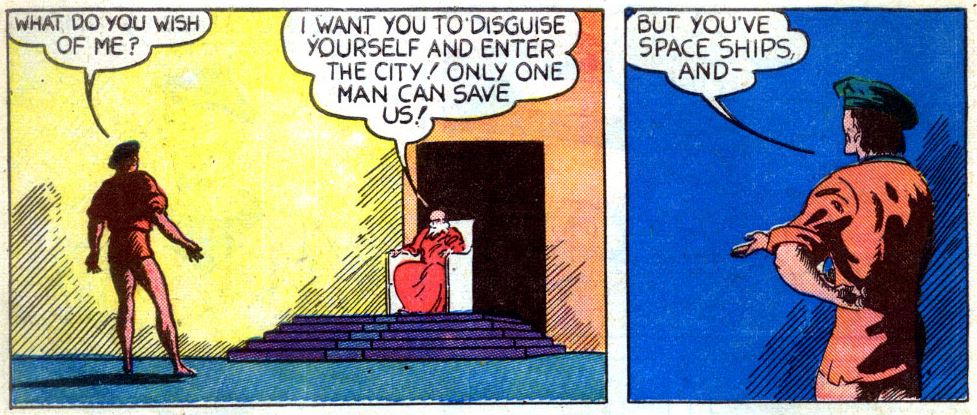
    the Rocket:

    The Rocket is your classic example of an explorer coming to a lost/hidden/alien world and becoming its greatest champion. The most common example of this is your garden-variety jungle adventurer, with “modern man transported into an effete future” and “guy falls through hole into underground world” being other common examples.

    The Rocket’s adventures, on the other hand, happen… somewhere. He
    arrives via his namesake rocket ship – is the Diamond Empire located in
    the future? on an alien world? on a lost mesa or in a hidden valley? No
    idea, never addressed. He just shows up because he heard there was a hot
    queen running the joint and that’s all we get.

    After a rocky start, the Rocket manages to win over the titular Queen of Diamonds, going from her slave to her bodyguard to eventually becoming her lover/ adventuring companion. And if you read the above panels you might have noticed how very racist the Queen’s origin story is, another thing that is extremely in keeping with this man-in-a-strange-land style comic: white guy exceptionalism. (Pep Comics 001, 1940)

  • MINOR SUPER-HERO ROUND-UP 032

    Just a few more minor super-heroes.

    Paul Bunyan: 

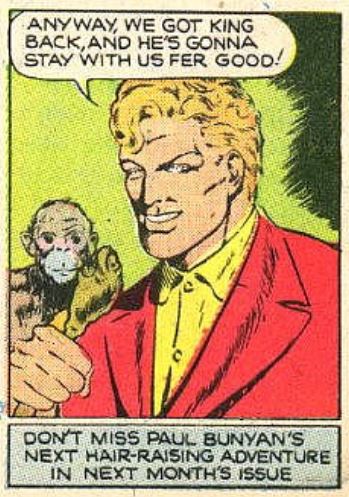
    What’s better than a regular two-fisted lumberjack protagonist? Paul Bunyan himself, that’s who. This version of Bunyan works in a modern-day lumber camp and has been toned down a bit with the suggestion that he’s just some guy who was born in Maine and grew to a mere ten feet tall. His adventures aren’t that much different than those of other lumberjack heroes, but there is something about an enormous man with a giant blue ox that add a bit of spice to the proceedings. (National Comics 001, 1940)

    (Bunyan gets an ape-man sidekick named King for a couple of issues and this is the best place I could think of to note that (National Comics 006, 1940))

    Wonder Boy:

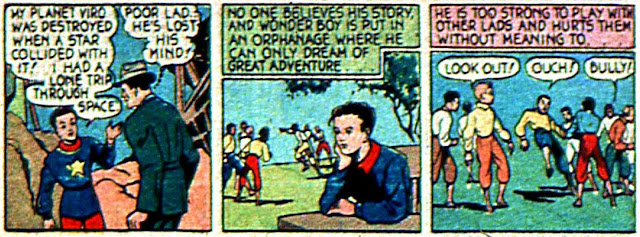
    Wonder Boy is an alien from the planet Viro who is a take on the Superman origin (last survivor of a destroyed planet rocketed to Earth where he is superhuman in comparison to the locals) while simultaneously being a prototype of Superboy (special super-powered boy who can only do good and is loved by all the world). DC Comics bought the rights to him along with all of the other Quality characters but has never seen fit to use him for anything, which I suppose is reasonable. (National Comics 001, 1940)

    Quicksilver:

    He’s got a lot of personality, that Quicksilver. Like other Golden Age super speedsters he handily outclasses most of his opponents and so the main draw is watching just how stylishly he beats them up. Much much later, Quicksilver will be brought back under the name Max Mercury and incorporated into the Flash family but that’s more than a few years out yet. (National Comics 005, 1940)
    the Phantom Knight:

    The Phantom Knight, aka Prince Philip of Kyle, is a very fun concept! As presented in his initial appearance, Philip is a real jerk, a man who cares about nobody and nothing but his horse Lightning.

    Philip is mean, vengeful, faithless and murderous. He kills two men in what were supposed to be bloodless contests because he felt that they insulted them. He joins and then deserts what is presumably the First Crusade, which could be a good act except that he deserts because there isn’t enough slaughtering and he gets bored.

    Philip eventually meets his end at the tusks of a wild boar and finds himself denied access to the afterlife until he makes up for his life of extreme dickishness, so he returns to Earth to do good as the Phantom Knight!.

    Now, here’s the problem: the Phantom Knight appeared twice, in OK Comics 001 and 002, and OK Comics 002 is not available to read anywhere that I know to look (well, there is a copy on ebay right now but I’m not prepared to pay $500 Canadian for the privilege). Thus, all that we really know about the Phantom Knight is that he was a colossal ass in life and now roams the mortal realm as a tormented spirit doomed to do good deeds. Is he still an ass? Is he operating in his home time period or has he been brought to the present – the location of Kyle is never established beyond being in Central Europe, so if he is operating in the modern day there’s a decent chance he fought some Nazis. (OK Comics 001, 1940)

  • MINOR SUPER-HERO ROUND-UP 031

    MINOR SUPER-HERO ROUND-UP 031

    Great guns! More of them?

    the Masked Angel:

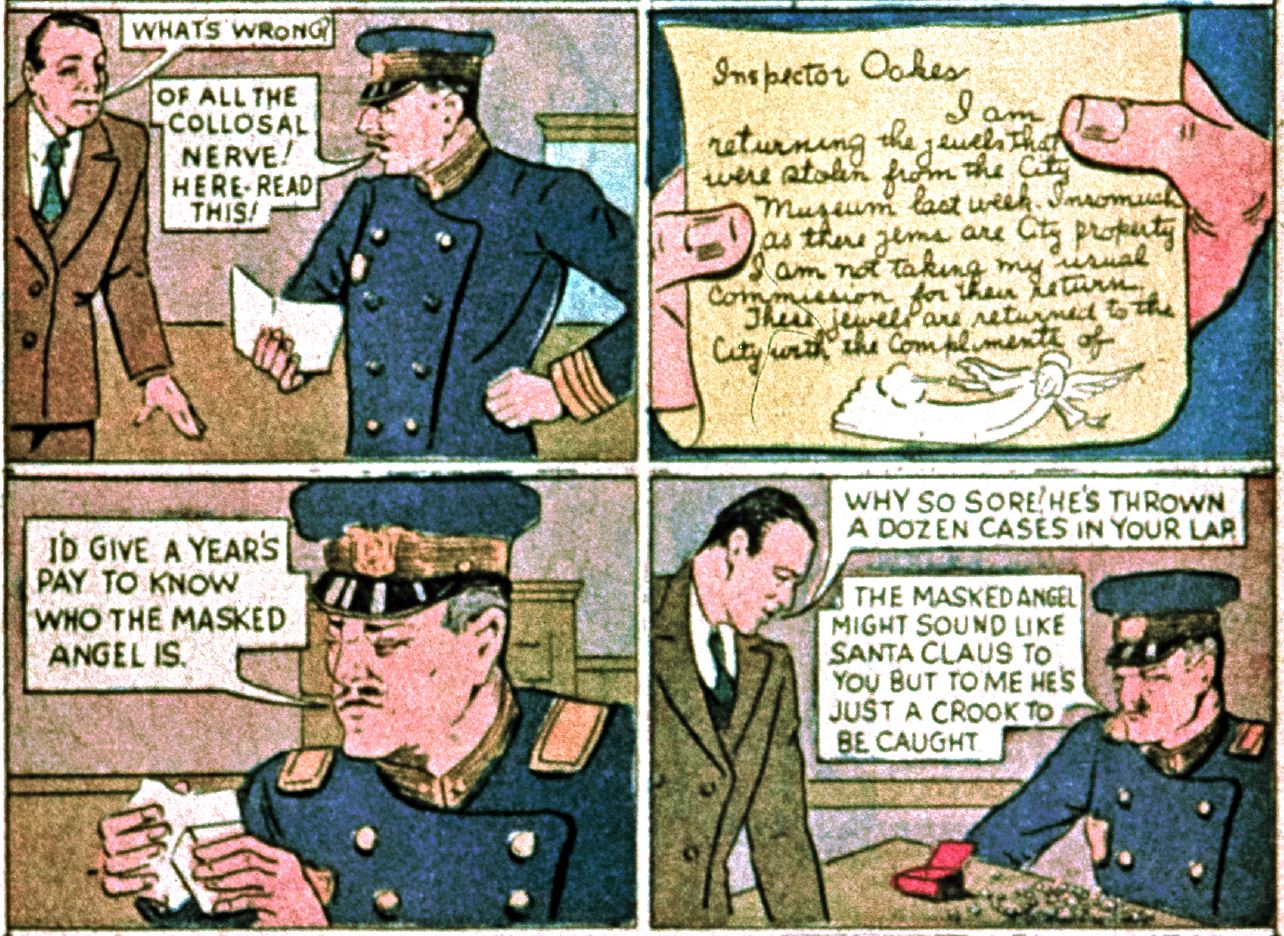
    Steve Oakes, wealthy playboy just so happens to also be the Masked Angel, vigilante feared by the underworld and wanted by the police.

    Steve’s father Detective Inspector John Oakes was murdered by crooks, so the Masked Angel act is his way of getting back at the criminal fraternity. It also seems to be a way to troll his brother, Detective Inspector John Oakes II, who is an asshole and who hates the Masked Angel in your classic way that a police officer does when they’re part of a vigilante’s supporting cast. Also please note the fun “angel shooting a gun” signature on the Masked Angel’s taunting note. (Miracle Comics 001 1940)

    Uncle Sam:

    We’re skirting the edge of what might be considered “minor” here, at least to DC Comics fans, but I have no Median Super-Hero category and however you slice it your parents almost certainly have not heard of him so here goes:

    Uncle Sam is the physical embodiment of the patriotic ideal of the United States: good, kind, powerful and just. He emerges to lend a physical hand in times of turmoil by inhabiting of reshaping the body of a recently slain patriot.

    This time around, Uncle Sam is (implicitly, all of this isn’t really spelled out until later) reborn from the death of Ezra Smith, who stands up to fascist agitators the Purple Shirts and gets a bullet in the back for his trouble. He sticks around to beat Axis ass for the duration of the war and then is not seen again until DC integrates the Quality characters into Earth-2 continuity in the 1970s. (National Comics 001, 1940)

    National Comics 005 expands the Uncle Sam lore slightly, firstly by making it a bit more explicit that he incorporates the spirits of dying patriots into himself with what is perhaps the initial time he did so, when a man named Sam sacrifices his own life to advance the cause during the American Revolution.

    Secondly, Sam is seen merging with a living patriot named Samuel in order to help drive the fascist Black Legion out of Glen Valley. Is this a common event? Does Uncle Sam roam the land absorbing patriots? Who can say, but it certainly would put a new spin on the character.

    Buddy Smith:

    When Ezra Smith is murdered by the Purple Shirts, his grandson Buddy is left alone, presumably some sort of double-orphan. He is almost immediately found, shamed for crying, and adopted by Uncle Sam (and hopefully the near immediate recovery Buddy has from the grief of seeing his grandfather gunned down in front of his eyes is a function of Uncle Sam being partially Ezra Smith and not some sort of deep traumatic repression left to fester in his soul).

    Buddy fills a pretty standard kid sidekick role: getting into trouble, getting Uncle Sam out of trouble, inventing things, befriending people, spotting clues, etc. He is unusual in that he is one of the few kid sidekicks who is a proper kid as opposed to being a young teenager (I know the common wisdom is that Dick Grayson was eight when he became Robin but that’s mostly because Golden Age artists – and particularly Bob Kane – were mostly very bad at drawing kids. Robin was absolutely supposed to be somewhere in the 12-15 range when he debuted). He’s also notable for – as far as I know – never ever showing up again post-Quality, not even in that event earlier this year that was specifically focused on bringing back all the old (and new) Golden Age kid sidekicks. Maybe Uncle Sam ate absorbed him once he got old/patriotic enough. (National Comics 001, 1940)
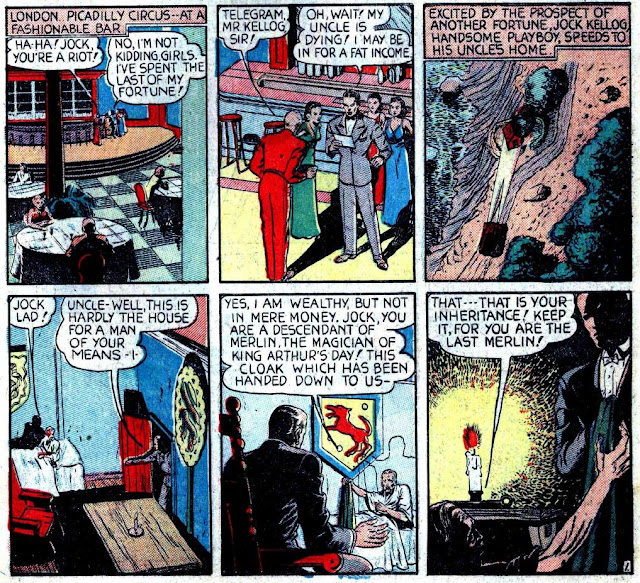
    Merlin the Magician:

    Jock Kellog, a wealthy playboy in the classic mold, spends the last of his family fortune on the same day he is summoned to the bedside of his sole relative, an unnamed uncle. Instead of the fat stacks of cash that he is hoping for, Kellog comes away with a cloak and the knowledge that he is supposedly the last descendant of Merlin of Arthuriana fame.

    It turns out that he is in fact the last descendant of Merlin, of course, and that the cloak is a source of unlimited magical power in the grand tradition of mystic super-heroes like Zatara. Lucky for the world at large, the application of vast power has the opposite of its usual effect on the young wastrel and Jock devotes his newfound power to the defense and betterment of humanity. (National Comics 001, 1940)

  • MINOR SUPER-HERO ROUND-UP 030

    Some real obscurities from the Hillman House of Ideas:

    the Sky Wizard:

    The Sky Wizard is an otherwise-unnamed super-scientist who seemingly dresses in his futuristic super suit 24/7. There’s not too much else to him other than that because he’s one of those characters who has so many gadgets and gizmos that all the narrative focus goes to them rather than him. A partial list: wing suits, super planes, super strength serum (the amazingly named “powerstrength formula”), a paralyzing Q-Ray gun…

    … and by far the coolest of the Sky Wizard’s accessories, his laboratory base, the grounds of which are composed of the elastic metal rubberium and which can be filled with helium so that the entire estate becomes a mobile floating island. (Miracle Comics 001, 1940)

    Dash Dixon:

    Dash Dixon works for an unnamed police department in an unnamed city in an undefined role (he is described only as a “top athlete with the police force” in his first appearance), Assigned to protect one Dr Lorenz and succeeding in doing so, Dixon is rewarded with a chance to be the subject of an experiment in which he is injected with “perpetual life rays” which render him super strong, at least partially invulnerable and presumably immortal.

    To counter the fact that the ray would seep out of Dixon’s body within 24 hours, Lorenz equips him with a suit of pliable metal that he will presumably have to wear for the rest of his presumably immortal existence. Two things about this suit:

    1. Dr Lorenz has a fantastic look with his lab getup and green dome helmet. Why Dixon’s suit is charitably Very Bad Looking is beyond me.

    2. It might not be clear from this picture but the suit includes a haircut-shaped black helmet held on by a strap. It can thus be implied that the ray will leak out of Dash Dixon’s scalp but will not do so from his face and hands.

    Frankly the whole suit thing gives me mild anxiety. If I were Dash Dixon I might just opt to receive my immortality treatment daily.

    One last thing about Dash Dixon is that the first issue seems to imply that he exists in a near future world with air taxis and commuter rockets but it doesn’t really come up otherwise. A mystery for the ages. (Miracle Comics 001, 1940)

    the Scorpion:

    A regular-style two-fisted vigilante, hated and feared by the underworld, occasionally wanted by the police, etc. The real thing that makes the Scorpion (aka Hal Ward) stand out is that he doesn’t really bother with a mask or any other way to not be immediately recognized by all of his mortal enemies. (Miracle Comics 001, 1940)

    Blanda the Jungle Queen:

    Blanda the Jungle Queen really lives up to her name by being the most by-the-book version of the White Goddess style of jungle adventurer, right down to the fact that she immediately abandons her adoptive people and their ways in a wave of horniness the second that a mediocre white guy hoves into view. (Miracle Comics 001 1940)

  • MINOR SUPER-HERO ROUND-UP 029

    They’re trying, bless ’em.

    Hydroman:

    I was going to say that much levity has been mined from Hydroman’s origin over the years, but realistically this guy is obscure at best. Some levity has been mined from Hydroman’s origin over the years. Is it deserved? Certainly.

    Scientist Harry Thurston is having fun mixing up chemicals (specifically water, alcohol and sulphuric acid, though there is some speculation that there might have been some mystery residue in the glassware used) and manages to get some on his hand, which promptly turns to water. In a panic, he calls his friend Bob Blake over to help, and when Bob arrives, fellow scientist Tom Kinsman dumps an entire bucket of the mixture over him like they’re all in a dang slapstick comedy.

    They manage to counteract the formula, at which point Bob agrees to have the formula injected into him, and while this works as comic book science (if a big splash turned me to water, surely an injection will allow me to control the process! Because it’s deliberate and thus more scientific!), surely by all other metrics it is an insane decision. What’s to say, for instance, that an injection won’t merely turn all of your blood or veins to water, killing you?

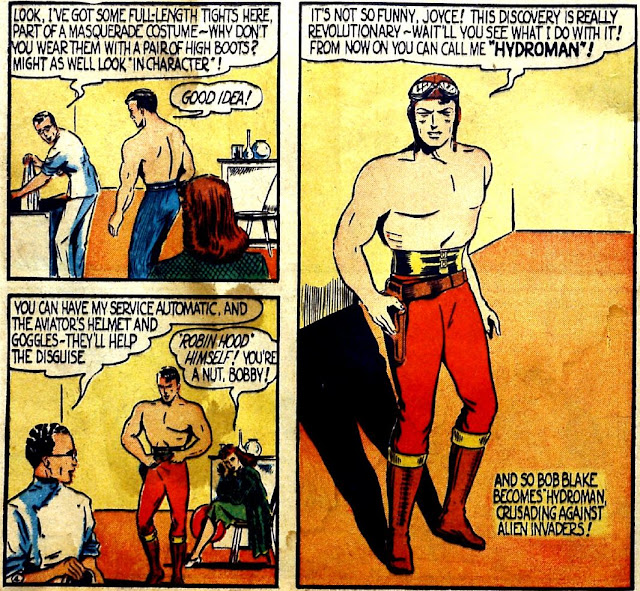
    Against all odd, the injection works and Bob Blake decides to use his newfound power to fight the wave of crime that is plaguing NYC. To go with his new role, Blake adopts a new moniker – Hydroman – and makes a super-hero costume in perhaps my favourite way, by scraping up all of the random crap in Harry Thurston’s lab.

    By issue 2, Hydroman gets what only I think of as his iconic look, a baggy suit of bulletproof Translite. It’s objectively kind of dumb looking but also… kind of great? It might be the combination of the leather pilot’s helmet and the riveted brass collar but the overall effect is very cool and retrofuturistic. Plus the transparent effect really plays well with Hydroman’s whole water theme. Finally, note that Hydroman’s assistant/ girlfriend Joyce Church is also wearing a bulletproof suit under her coat and I must commend him for being the rare Golden Age super-hero who thinks to distribute such protective super equipment to his civilian aides. (Reg’lar Fellers Heroic Comics 001, 1940)

    Update 1941 

    the Purple Zombie:

    Doctors Hale and Malinsky are partners, but while Hale was working to prolong human life, Malinsky was taking his research and using it to create an army of the undead in order to take over the world. His prototype is Zoro, the Purple Zombie, and once his zombification tech is proven to work (and once Hale starts mouthing off a bit to much), Malinsky decides that things might run a bit smoother if it was just him and the zombie and bumps off Hale.

    Unfortunately for Malinsky, some quirk of the zombie technology has made Zoro 1) amoral 2) bulletproof and super strong, and 3) loyal only to Hale, and so he makes short work of not only his erstwhile master but also his three foreign investors.

    Zoro is captured by the police and scheduled for an execution that hits a slight hitch when it turns out that in addition to bullets the Purple Zombie is immune to electricity (he also turns a more purpley purple when electrocuted!). Stymied, the authorities agree to release Zoro into the stewardship of Dr Hale (who survived the murder attempt, by the way). The Purple Zombie is not so much a hero as a gun that Hale points at people and situations, but as a pair they basically fit the brief. (Reg’lar Fellers Heroic Comics 001, 1940)

    Hyper the Phenomenal:

    Visually, Hyper the Phenomenal is great. I really like the… well “retrofuturistic” is the best description of it but of course at the time it was just futuristic. I really like his look, particularly what I assume is a breastplate since it seems to be separate to the shirt – there aren’t enough non-aquatic super-heroes with the courage to wear a big scallop shell as armour.

    Hyper is really the oddly-named Don-Vin, a scientist who has some sort of affiliation with the US Secret Service, either as an official agent or just a helpful pal. His main tools in the fight against evil are his Neogas Helmet that allows him to fly (plus is has a nifty two-way radio inside) and his Magno-Hydro Gauntlets, capable of both magnetic attraction and repulsion and with which he can both perform feats of superhuman strength (equivalent) and deflect incoming bullets.

    I chose the cover image above because it’s probably the most dynamic and interesting view available, due to the unfortunate fact that in Hyper the Phenomenal’s sole outing he does very, very little of note. His adventure on the Isle of Arunta was serialized over two issues and for fully half of that time (and somewhere between 1 and 2 days in-story), Hyper stands in front of a steel wall using his gauntlets to prevent a crushing room deathtrap from killing his ally Agent 2Y. A heroic act, to be sure, but not a visually interesting one. And since the first quarter of the story was devoted to setting up the action, Hyper only gets the final quarter to really strut his stuff, and even then he probably only gets the job done because the villains had oppressed the island’s inhabitants enough to start a rebellion. A poor showing indeed, Don-Vin. (Hyper Mystery Comics 001, 1940)

    Kaänga:

    Run-of-the-mill Tarzan clone who was orphaned in the jungle at a young age and whose Jane equivalent is named Ann Morgan. Kaänga’s only real point of interest is the umlaut on his second a, but he has close to 200 appearances over the years so I’m sure we’ll be seeing more from him. (Jungle Comics 001, 1940)

  • MINOR SUPER-VILLAIN 655: CAMILLA, QUEEN OF THE LOST EMPIRE

    (Jungle Comics 001, 1940)

    Camilla, Queen of the Lost Empire! I love a lost ancient kingdom, especially in a jungle comic as it cuts down on the constant flow of racism. This particular ancient lost kingdom was founded by Norsemen, probably some time between 900 and 1100 CE going by the random dates thrown out at various points in the series.

    We encounter the Lost Empire through the eyes of explorer Jon Dale, who I will tell you now I do not like. Having made his way to an isolated society with different ways and customs, Dale immediately begins judging and decrying them like a jerk. (aside: I just noticed that the Temple of Thor in the above image has a Thor face on its onion dome and that’s just great)

    I suppose I must give Dale some credit for mostly objecting to the human sacrifice aspect of Lost Empire culture (and like me he must have been pretty stuck on working out just how long the rainy season might be in the Lost Empire. A human sacrifice per day for two, maybe three months per year? That’s gotta be a strain on the population, although given that they have access to a fountain of youth perhaps the major purpose is to prevent overpopulation).

    Queen Camilla of course cannot resist the sheer sex appeal of this pasty man in his short and knee-high socks, and when her advances are rebuffed she attempts to make Dale’s love interest (his female equivalent Ruth Birch) the next sacrifice to Thor he springs into action and:

    a) sabotages the sacrifice chamber so that Ruth is spared

    b) I want to say that he causes Camilla’s extended lifespan to catch up with her but really he just stands by and watches her die of old age

    c) blows up the entire damn city in order to effect his and his companions’ escapes

    And after wreaking this untold destruction on the Lost Empire and its people he decides to destroy their secret of eternal life because his pedestrian understanding of the world tell him that God would want him to.

    I know that I just said that Camilla died of old age, but Jungle Comics 003 features her triumphant and inexplicable return, and with the help of an old seer she successfully enlists the aid of the god Bal to restore her city and people to existence and life, respectively.

    When Jon and Ruth have the unmitigated gall to come back to the ruins of the Lost Empire to pick over its shattered remains they are understandably surprised to find it and Camilla alive and un-blown-up, and while the first time Camilla attempted to kill them both was a bit out of order I can completely understand wanting to do so this second time.

    Things go poorly for Camilla once again, though it’s just the Spring of Eternal Youth and not the entire city that gets it this time. Jon Dale, shitty as ever, determines to come back and pillage the place after the march of time kills her off for him.

    Despite the fact that this second lack of access to the waters of eternal life seemed to be causing her to age at regular rather than super-advanced speed, Camilla takes things very poorly and becomes a tyrant (a proper tyrant too! Flayed alive in the torture pit!) and then gets banished. Luckily for her, among the things that Jon thinks that God has an opinion on is the Divine Right of Kings, and he and Ruth help Camilla restore the Spring of Eternal Life and see her welcomed back to her kingdom with open arms once she promises not to have anyone else flayed.

    From this point on, Camilla is a heroic figure who deals with a series of threats to the Lost Empire and her rule thereof from both internal sources and an increasingly unlikely series of other lost kingdoms.

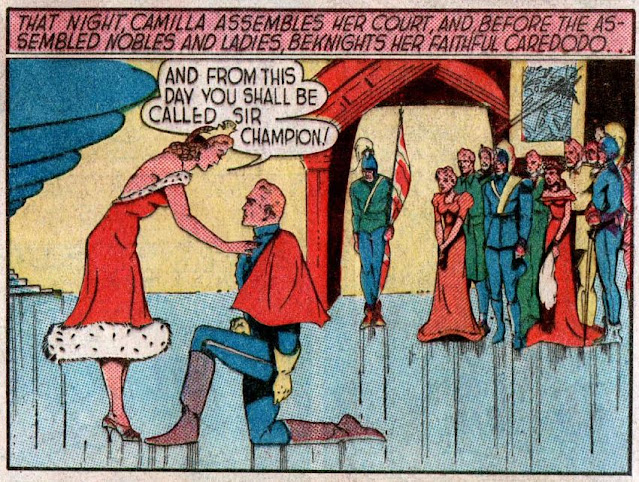
    In one of these adventures, Camilla befriends hunchbacked assassin Caredodo and he becomes her champion/companion, and then about an issue later the comic book “no uggoes on the protagonist’s side” clause comes into effect and the benevolent Angel of Faith transforms him into the handsome Sir Champion. Camilla has a long tenure in Jungle Comics and eventually virtually every aspect of her will change but for now this is the status quo.

    Update 1941

  • MINOR SUPER-HERO ROUND-UP 028

    Panther-heavy haul this time.

    the White Panther: 

    The White Panther is (along with his ancient father) the last survivor of some sort of lost jungle civilization that seems to have based their fashion sense along Jack Kirby lines, not that I’m complaining. He only has one appearance, in which he uses his supposed precognitive abilities to help a scientist and his daughter get ahold of some healing gemstones before a crook does.

    Since he never appeared again, by far the most interesting thing about the White Panther is his outfit, in which the lower portion seems to be pants and the upper to be his unclothed, chalk-white torso. Also, he appears to be using an unsheathed dagger as a belt buckle and while wildly impractical you can’t deny that that is very cool. (Jungle Comics 001, 1940)

    the Red Panther:

    The White Panther never returned, but the next issue of Jungle Comics featured the first appearance of the Red Panther (no relation), a fairly standard jungle hero and also a fairly standard costumed vigilante, a combination that I have a lot of affection for. Don’t get me wrong, the broader structural problems of the jungle adventure comic are still front and centre but at least the protagonist has a fun look so you can distract yourself occasionally with a chuckle. (Jungle Comics 002, 1940)

    Update 1941

    Tabu, Wizard of the Jungle:

    Tabu, the Wizard of the Jungle! He saved a witch-doctor’s life and was blessed with a “sixth sense” in turn unlocked a very wide range of powers and abilities that he uses to keep the peace in his jungle home! These powers include: physical abilities that outstrip those of the various jungle animals around him, including flight; the ability to communicate with and compel the actions of the animals and plants of the jungle; the ability to control the elements of the jungle to cause weather events (mist, wind) or disasters (earthquakes, plagues of insects); and his most spectacularly realized power, to change shape into animals or plants:

    Yes, this is the power that Tabu uses to dispose of a group of “slave raiders” in his first appearance by transforming into a carnivorous tree and… eating them? It’s possible that Tabu ate those guys, you guys.

    At the end of that first appearance the witch-doctor (who implicitly loved the way that Tabu ate those guys) grants him a seventh sense to allow him to “be in touch with the invisible spirits of the jungle.” Who knows what might have come of this new well of power if Fletcher Hanks had ever returned to the character but he had better things to do (see below) but sadly he never did. Tabu kept on appearing in Jungle Comics basically for the entirety of its run and the things he could or could not do varied wildly depending on who was on Tabu-duty that issue. (As far as I know he never ate any more guys) (Jungle Comics 001, 1940)

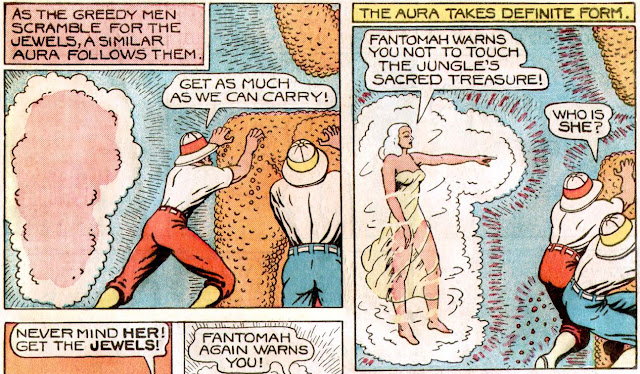
    Fantomah:

    The reason that Fletcher Hanks never went back for another pass at Tabu was presumably because he was too preoccupied with what is perhaps his finest creation: Fantomah!

    I won’t spend too much time attempting to write the definitive Fantomah biography a) because many people have already written a lot about her and what can I add and b) because there isn’t really too much to write about. Like Stardust the Super Wizard she is just this omnipotent, all-seeing justice force who unleashes variably-proportional retribution on various Chaotic Evil criminals, only Fantomah confines her activities to either a jungle or all jungles – it’s hard to tell if Hanks was depicting different cultures and areas on purpose or just didn’t care about, eg, whether tigers lived in Africa or not.

    Fantomah continues after Fletcher Hanks stops making comics, so watch out for her wild new look when we cover the 1941 issues of Jungle Comics! (Jungle Comics 002, 1940)

    Update 1941

  • MINOR SUPER-HERO ROUND-UP 027

    Guess what? More minor super-heroes, that’s what.

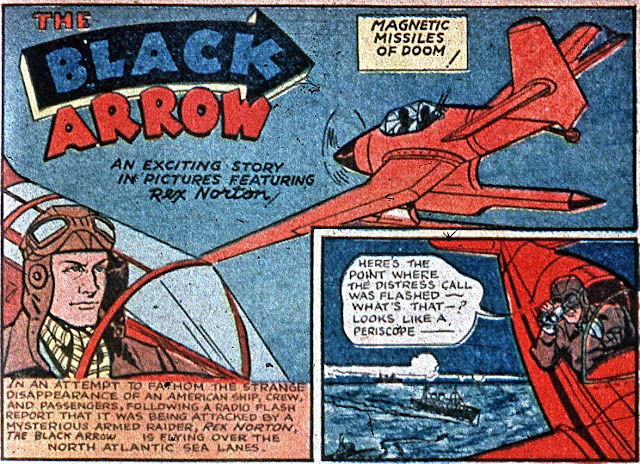
    the Black Arrow:

    Black Arrow, aka Rex Norton, is a detective/pilot, ho-hum. As per standard he has a great codename. (Green Giant Comics 001, 1940)

    the Researcher:

    A dapper super-scientist armed with x-ray flashlights, paralysis-inducing walking sticks and mind-reading rays. Perhaps the most charming thing about him is that everyone from his enemies to his friends to his lab assistant/love interest refer to him solely as “the Researcher.” (Green Giant Comics 001, 1940)

    the Green Mask:

    The Green Mask started out in Mystery Men Comics as your standard Green Hornet or Crimson Avenger style masked vigilante: capable with his fists and with a gun but otherwise an ordinary if unnamed human man, believed by the police and the underworld to actually be a crook and thus hunted by both, the works. 

    After about a year and a half, he got a bit of a revamp: the Green Mask is now Michael Shelby, son of Senator Shelby, enemy of crime. In an attempt to prevent the Senator from introducing a law that would make crime illegal, gangsters gun him down and shoot up Michael in the process. Lucky for him, family friend Professor Lascomb is present and has a healing vita-ray machine at his disposal – Michael’s life is saved and as happy side effect he is given the power of flight and some ill-defined enhanced physical abilities. His crimefighting career is much the same as before but without the ire of the police. 

    (Like Fox Features’ other big non-Blue Beetle heroes Samson and the Flame, in 1941 the Green Mask gets a bit more of a supporting cast, in his case wealthy socialite Olivia Tracy and her bumbling chauffeur Peters. Like Samson and the Flame this didn’t save him from oblivion when Fox had its troubles in 1942-1943 but unlike them he did return eventually. Kind of) (Mystery Men Comics 001, 1939/ Green Mask v1 001, 1940)

    Domino the Miracle Boy:

    In the same story in which the Green Mask becomes super-powered Michael Shelby (and also Michael Shelby becomes the Green Mask) an unnamed youngster is blown up by a grenade and must be healed by Professor Lascomb’s vita-ray. This youth was called Don (no last name forthcoming) and wasn’t just a blown-up teen but a blown-up teen orphan and so was summarily adopted by Michael Shelby. Domino’s powers are a little less extensive than the Green Masks, as Prof Lascomb foolishly fixed the vita-ray machine’s short circuit in between the two being treated, the main upshot of which is that Domino doesn’t seem to be able to fly but rather gets around on a rope tied to a boomerang. (Green Mask Comics v1 001, 1940)

    Update 1941