The Curse of Skeleton Munroe

Category: minor super-hero

  • MINOR SUPER-VILLAIN 650: RANGO OF SLAVONIA/ MINOR SUPER-HERO: THE MASTER MYSTIC

    (Green Giant Comics 001, 1940)

    We join Rango, a science villain of some description, after he has failed to conquer Europe. His next move: total destruction.

    After absolutely devastating a city in what is probably Slavonia, Rango heads for the United States by the simple expedient of swimming across the Atlantic.

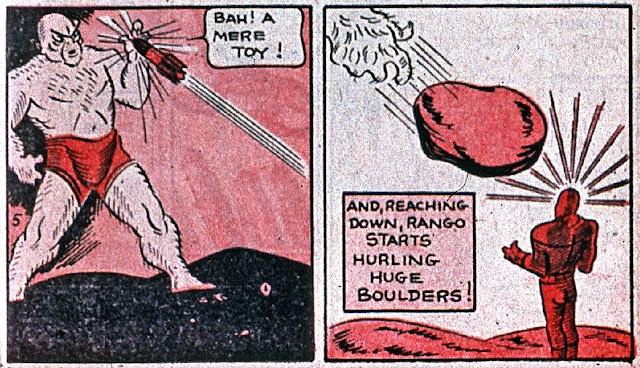
    And now we encounter the main attraction, Master Mystic! What a character! Master Mystic is very much ahead of his time, both in his art style and degree of superhuman omnipotence.

    Master Mystic’s entire battle with Rango feels like something out of a 60s underground comic, slightly unreal and rubbery and full of visual excess. Appropriately, Master Mystic was created by Victor E. Pazmino, whose other credits tended more toward the funny animal content that informed so much of the underground comix scene.

    (see also Pazmino’s other super-heroic creation, TNT Todd, for some fun costume compare-and-contrast)

    It really is a shame that Pazmino didn’t do more work along these lines, assuming that he wanted to. Stuff like this visualization of the Master Mystic’s telekinesis stands out as innovative by any era’s standards.

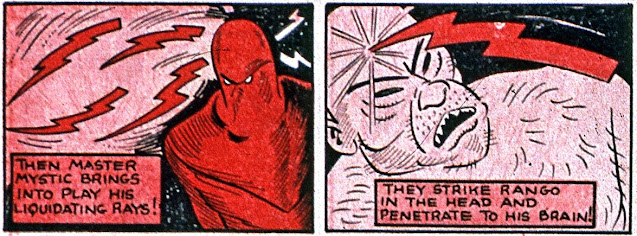
    Master Mystic eventually melts Rango into horrible goo and then returns to his Arctic stronghold to resume his protective watch over humanity North America, and if the super-powered one-upsmanship of their battle felt like something out of 60s counterculture comics then this detached, omnipotent man routine feels very 1980s post-Watchmen, or at least one step away from that. Should some entrepeneur BRING BACK the Master Mystic the next time metatextual super-hero analysis characters like Miracleman come into vogue? It’s worth a shot!

  • MINOR SUPER-HERO ROUND-UP 026

    Just look at all these guys.

    Power-Man:

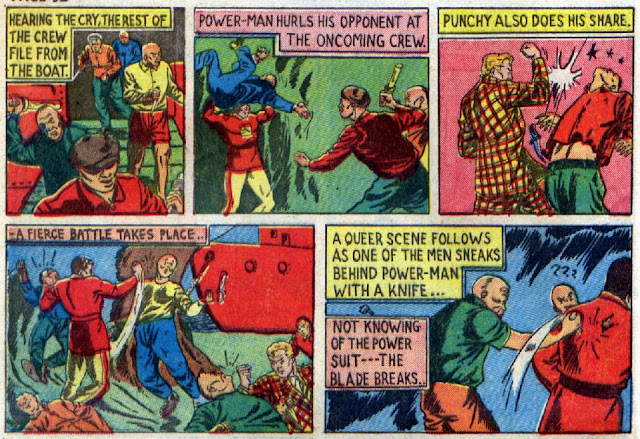
    Power-Man, aka Rip Regan, private detective or possibly just nosy guy, gets his powers in one of the classic ways: his friend Dr Austin gives him a special suit. It’s the simplest of origins and also one that puts a lot of weight on Austin’s assessment of Regan’s character.

    The Power-Man suit is one of the more hand-wavy bits of comic book super-science I have encountered, when you get down to it. Billed as chemically-treated metal woven into cloth, the suit simultaneously makes the wearer light enough to perform superhuman feats of jumping, grants super strength, provides total protection against penetrating weapons like bullets and knives but also crushing damage from a collapsing building and also somehow protects the wearer’s head despite it not being covered. It truly is a miracle of science. (Fight Comics 003, 1940)

    Mantoka, Maker of Indian Magic:

    Mantoka is a comic book magic user, with all of the nigh-omnipotent power that that entails: manipulating the elements, transforming humans to animals, giving himself superhuman attributes like flight, intangibility, size control, etc. It is slightly unclear if he receives his powers from being bitten by a magic snake or if the snakebite is merely a part of a ritual to transfer his father’s powers to him. Either way, it’s an extremely radical and cool as hell way to become a magic man.

    I keep wanting to give the Mantoka strip credit for being a not-racist comic starring a Native American character but then I look at it again and it is in fact built on racist tropes. After a few cycles of this I realized that I was thinking this way because it doesn’t go out of its way to be extra racist – the characters are being portrayed at about the racism level of a comical Cockney or a Chinese American c. 1943. Still not great but not as bad as it could be*. (Funny Pages v4 001, 1940)

    *only one out of three Mantoka adventures is actually easily available, so all of this applies to that comic only. 

    the Owl:

    The Owl is a man named Jack (no surname given) who is on a quest for revenge against the gangsters who cost his father his legs and by extension against crime in general. To that end, the never-named father has invented an owl-themed flying suit capable of speed of up to 200 mph. Also, he invented himself what I can only describe as the most unstable looking motorized wheelchair I have ever seen.

    The Owl and his dad live in a swamp near an unnamed city in the Southern US, and Jack spends his days working at a library under an assumed name and sweeps up any dirt that falls off of anyone’s shoes so that he can take it home to be analyzed in their swamp shack/laboratory. Presumably this is part of some sort of organized plan relating to the leg-revenge quest but the Owl only ever had one adventure and so in effect it’s just the weirdest version of Clark Kent working at the Daily Planet or Bruce Wayne palling around with Commissioner Gordon to hear about crime. It does work in this issue though. (Funny Pages v4 001, 1940)

    the Green Giant:

    The Green Giant! Cover model and namesake for the one and only comic put out by Pelican Productions! Thanks to me spending my formative years with my nose buried in a copy of Jeff Rovin’s Encyclopedia of Superheroes that image of him bounding over those buildings was forever seared into my brain as the definitive non-Marvel/DC Golden Age comic book cover, despite the fact that the actual comic probably wasn’t really distributed.

    I’ve never really found any information on the Green Giant beyond people
    pointing out that he wears pants on the cover but not in the actual
    story, so I kind of went in assuming that he was so bare bones as to be
    unremarkable but no, the Green Giant is as fleshed out as any single
    appearance character of the time.

    The Green Giant’s real name is Brentwood (no first name given), the owner of both a Wall Street Hall Street brokerage firm and a presumably high-tech belt, the latter of which allows him to grow to various enormous heights. I had kind of assumed that the fact of his sheer size and the problems it might cause was not really explored in-comic but there is a mention of the belt having anti-gravity properties as well. That’s why he isn’t, for example, crushing that building on the cover! How great and more well thought-out than I had assumed! This anti-gravity also explains how the Green Giant hops around like an off-brand Hulk even when at regular size.

    One thing that really stands out about the Green Giant’s sole appearance is that the problem he is dealing with is a targeted attack on his own brokerage firm. I reckon that an ongoing comic might have featured him acting in a more selfless light but as it stands all the evidence is of him being solely motivated by his own self interest. Do better, Green Giant, sheesh. (Green Giant Comics 001, 1940)

  • MINOR SUPER-HERO ROUND-UP 025

    Just a great bunch of guys.

    David:

    I read the Samson stories in Big 3 before those in his home comic Fantastic, so while I knew about his sidekick David I didn’t really know what his whole deal was. I had read that Samson just found him sitting around somewhere and assumed that that was hyperbole but no, it’s not: Samson is investigating some mysterious plane crashes in the Rockies when he just finds a kid, who turns out to be the only survivor of the latest crash, and just… brings him along. There’s no real attempt to address the fact that he must be an orphan now (or if not and he was travelling alone for some reason, that his family now thinks he is dead) or to find him a familial guardian – heck, his name isn’t even David. It’s low-key one of the weirdest sidekick origins in comics and that’s before he gets his own pair of fur briefs. (Fantastic Comics 010, 1940)

    UPDATES: Even in the updated Samson origin, David is still a hanger-on (Samson 001, 1940)

    UPDATE – the Fantom of the Fair:

    The Fantom of the Fair gets his own short-lived book that sees him spending more and more time fighting crime outside the New York World’s Fair, if you can believe it. To that end he adopts the more generic name of the Fantoman. The costume changes (blue instead of black, uncovered lower face) happened at the end of 1939 and technically I’ve read more Fantom stories in which he had the new one than the old but it never feels right to me. At least you can still see his hair through the cowl.

    Though he has a new name and a not-so-new look, Fantoman retains one of his most iconic properties: every time you start thinking of him as just another masked adventurer he busts out another heretofore-unseen superpower or bit of lore suggesting he is a thousand year old demigod or something. See above as he either teleports or passes through matter for the first and last time. (Fantoman 003, 1940)

    the Spy Fighter:

    It kind of says something about the mood of America in 1940 that there are multiple comic book series that take place in the 1990s after what we know as World War II has stretched on for fifty years (Marvel’s Breeze Barton is the other one that I can recall off the top of my head, while MLJ’s Doc Strong is from a future ravaged by a whole century of WWII). In this version of that, the war has resulted in an amalgamation of the world into three rival nations: Russmany (Europe and Africa), Mongo (Asia) and Greater America (the Americas), and in this world of super nations, a super spy is required to ensure the sanctity of the Greater American way of life.

    That man is Saber, the Spy Fighter! Who does eventually put on a shirt. Saber starts out as physically gifted telepath who roots out enemy agents by reading their ill intent in their own minds and then beats them up for it. Over time, the challenges he faces get larger and less specifically espionage related, and he develops new abilities to meet them, including that of changing his own size at will, to the point that he is eventually able to travel through space on his own power to fight planet-sized enemies. And what can Mongo do to challenge that? (Fight Comics 001, 1940)

    Update 1941

    the Skull Squadron:

    Chip Collins’ Skull Squadron is extremely unremarkable but at this point I have to make note of every skull-adjacent comic book thing. They operate somewhere in between a commando group and the Suicide Squad and barely even have skulls painted on their planes. SKULL SCORE: 1/2 and only for the name. (Fight Comics 001, 1940)

  • MINOR SUPER-HERO ROUND-UP 024

    Buncha fresh heroes here!

    Son of the Gods: 

    Dr John Thesson, big tall archaeologist and 1940s arch-skeptic, has the misfortune to find himself on an expedition to Crete with true believer Professor Craig who can’t stop running his mouth about how great Theseus was and how he totally existed and maybe Thesson and Craig can find Theseus’ mystic Ring of Poseidon if they look hard enough. It is a very annoying expedition for Thesson.

    Just kidding: this is a comic book and Professor Craig is completely right – it’s John “We’re Scientists” Thesson who has to get with the picture.

    The expedition is rich with incident: on the way there the duo ore attacked by a wild boar and Thesson kills it…

    … and then once they start the dig in earnest it is plagued by sabotage that is eventually traced back to their host Procostous and his manservant Cercion. This is the point at which the back of Professor Craig’s head blows clean off and he starts talking about how Thesson is the reincarnation of Theseus and is reliving his famed Six Labours (he actually does half: Periphetes the Club Bearer and Sinis the Tree Bender appear only as recounted myths and Sciron is not mentioned at all. And to be honest Cercion = Cercyon is a bit flimsy. It’s lucky for Professor Craig that he turns out to be correct. Again).

    Surprising nobody, Thesson does indeed find the Ring of Poseidon after one last sabotage attempt that leaves Procrustous dead. This is enough for the local mystery cult to acclaim him the Reincarnation of Theseus and he vows to use the powers granted by the ring (super strength and a degree of invulnerability, mostly) to battle crime and injustice. I initially hoped that Theseus would have fun mythology-inspired adventures like the MLJ Hercules but no, it’s all super-scientists and fascists – not even a hint of poor neglected Sciron and his giant turtle.

    (later issues cast Thesson as a mere descendant of Theseus but whether this is because reincarnation was a but too mystical or due to simple sloppy record keeping I cannot say)

    (the Minotaur only appears as one of Professor Craig’s stories but I just wanted to highlight the rare bull-bodied version here) (Exciting Comics 002, 1940)

    the Masked Rider:

    Geologist Jim Sanford becomes the Masked Rider in order to catch crooks (including the Specter) operating a covert gold min under the Diamond D Ranch without them knowing he was onto them with specific geological knowledge. Unlike most of his peers, he has no trouble hanging up his mask once the job is done. (Exciting Comics 002, 1940)

    the Sphinx:

    The Sphinx is a tuxedo-clad, domino-masked vigilante (real name Ellsworth Forrester!), a perhaps over represented group in early comics but generally a solid one (I initially forgot the name of the Scarab from Terra Obscura and thought that he was this guy – imagine my confusion). The main difference between the Sphinx and his peers like the Clock or the Mouthpiece or Just n’ Right is that the Sphinx is loosely affiliated with the police rather than being hunted by them.

    The other main difference is the fact that the Sphinx is one of the few suit-and-mask heroes with legitimate super powers, specifically super strength and at least partial invulnerability.

    Why is he called the Sphinx? As far as I can tell it’s just because he’s mysterious. (Exciting Comics 002, 1940)

    UPDATE – the Golden Knight:

    The Golden Knight
    stops off on his way to the Crusades to do a mission for Kara the
    Magician, who gifts him a magic ring that emits light in order to help
    him overcome the many dangers along the way and then a magic cloak of
    protection once he gets back – it’s a very Dungeons & Dragons style quest, honestly.

    The
    Golden Knight also takes a dip in a magic lake that triples his
    strength, which is handy for a warrior type. Does this strength persist? No idea. (Fantastic
    Comics 003, 1940)

     A couple of issues later, the Golden Knight meets the love of his life, Alice. Alice fell down a well as a child and was raised by (and eventually made queen of) a race of winged people in an underground city. Alice rules – in her first proper appearance she stabs two people to death which is way, way more than your typical female Golden Age adventurer. (Fantastic Comics 005, 1940)

  • MINOR SUPER-HERO ROUND-UP 024

    Buncha fresh heroes here!

    Son of the Gods: 

    Dr John Thesson, big tall archaeologist and 1940s arch-skeptic, has the misfortune to find himself on an expedition to Crete with true believer Professor Craig who can’t stop running his mouth about how great Theseus was and how he totally existed and maybe Thesson and Craig can find Theseus’ mystic Ring of Poseidon if they look hard enough. It is a very annoying expedition for Thesson.

    Just kidding: this is a comic book and Professor Craig is completely right – it’s John “We’re Scientists” Thesson who has to get with the picture.

    The expedition is rich with incident: on the way there the duo ore attacked by a wild boar and Thesson kills it…

    … and then once they start the dig in earnest it is plagued by sabotage that is eventually traced back to their host Procostous and his manservant Cercion. This is the point at which the back of Professor Craig’s head blows clean off and he starts talking about how Thesson is the reincarnation of Theseus and is reliving his famed Six Labours (he actually does half: Periphetes the Club Bearer and Sinis the Tree Bender appear only as recounted myths and Sciron is not mentioned at all. And to be honest Cercion = Cercyon is a bit flimsy. It’s lucky for Professor Craig that he turns out to be correct. Again).

    Surprising nobody, Thesson does indeed find the Ring of Poseidon after one last sabotage attempt that leaves Procrustous dead. This is enough for the local mystery cult to acclaim him the Reincarnation of Theseus and he vows to use the powers granted by the ring (super strength and a degree of invulnerability, mostly) to battle crime and injustice. I initially hoped that Theseus would have fun mythology-inspired adventures like the MLJ Hercules but no, it’s all super-scientists and fascists – not even a hint of poor neglected Sciron and his giant turtle.

    (later issues cast Thesson as a mere descendant of Theseus but whether this is because reincarnation was a but too mystical or due to simple sloppy record keeping I cannot say)

    (the Minotaur only appears as one of Professor Craig’s stories but I just wanted to highlight the rare bull-bodied version here) (Exciting Comics 002, 1940)

    the Masked Rider:

    Geologist Jim Sanford becomes the Masked Rider in order to catch crooks (including the Specter) operating a covert gold min under the Diamond D Ranch without them knowing he was onto them with specific geological knowledge. Unlike most of his peers, he has no trouble hanging up his mask once the job is done. (Exciting Comics 002, 1940)

    the Sphinx:

    The Sphinx is a tuxedo-clad, domino-masked vigilante (real name Ellsworth Forrester!), a perhaps over represented group in early comics but generally a solid one (I initially forgot the name of the Scarab from Terra Obscura and thought that he was this guy – imagine my confusion). The main difference between the Sphinx and his peers like the Clock or the Mouthpiece or Just n’ Right is that the Sphinx is loosely affiliated with the police rather than being hunted by them.

    The other main difference is the fact that the Sphinx is one of the few suit-and-mask heroes with legitimate super powers, specifically super strength and at least partial invulnerability.

    Why is he called the Sphinx? As far as I can tell it’s just because he’s mysterious. (Exciting Comics 002, 1940)

    UPDATE – the Golden Knight:

    The Golden Knight
    stops off on his way to the Crusades to do a mission for Kara the
    Magician, who gifts him a magic ring that emits light in order to help
    him overcome the many dangers along the way and then a magic cloak of
    protection once he gets back – it’s a very Dungeons & Dragons style quest, honestly.

    The
    Golden Knight also takes a dip in a magic lake that triples his
    strength, which is handy for a warrior type. Does this strength persist? No idea. (Fantastic
    Comics 003, 1940)

     A couple of issues later, the Golden Knight meets the love of his life, Alice. Alice fell down a well as a child and was raised by (and eventually made queen of) a race of winged people in an underground city. Alice rules – in her first proper appearance she stabs two people to death which is way, way more than your typical female Golden Age adventurer. (Fantastic Comics 005, 1940)

  • MINOR SUPER-HERO ROUND-UP 023

    The most minor bunch so far!

    Don Rance and the Mysticape: 

    Don Rance saves an old man from a tiger in the Indian jungle and is given a mystic cape as a reward. In his single documented adventure he runs into spy trouble while ferrying some papers from the American embassy in London to Washington DC and must use the cape’s powers (generic physical enhancement and slow falling or some other way to jump from a plane and land safely on the ground. Also possibly teleportation? The art was unclear) to complete his mission safely.

    So: an utterly generic character who barely qualifies as a super-hero, but I just can’t help but be tickled that he calls his mystic cape the Mysticape and dream of a world in which Don Rance was such a popular character that he continued appearing for long enough that some bored writer had him battle the Mystic Ape. (Detective Eye 002, 1940)

    Ken Traymore and the Invisobox:

    Really really enjoy these guys. Properly this strip should be called Ken Traymore and His Dad and Their Invisoboxes because that’s what it is: a guy and his dad and their invisibility girdles palling around and investigating mysteries. It’s very wholesome! Particularly as your standard Golden Age comic would have featured the murder of Traymore Sr on page 1 as a bit of motivation for Ken in his neverending quest for justice.

    Aside from the delightful father/son dynamics, the best part of the Traymores’ single adventure is the fact that they spend the entire time investigating three suspects in the murder of their friend and do not catch the killer. Rather, he accidentally sees one of them turn invisible and freaks out because he thinks that he’s being haunted by his victim’s ghost. They don’t even know who he is – it’s great! 10/10 no notes, BRING BACK the Traymores and their Invisoboxes immediately. (Detective Eye 002, 1940)

    the Mask:

    The Mask is an adaptation of pulp character the Black Bat, but without the bat part due to some sort of gentleman’s agreement with DC after a squabble over who ripped who off, bat-wise. What he does share with his predecessor is an origin: District Attorney Tom Colby is blinded when gangsters working for crimelord Olly Snate splash acid on some key evidence during Snate’s trial. When Colby’s sight is restored via an experimental operation he decides to continue working as a supposedly-blind DA while also punching crooks as the Mask.

    (Also like the Black Bat he has enhanced night vision as a result of the operation but it never really comes up)

    Colby also inherits the Black Bat’s stable of assistants: Silk Davis (crook turned butler), Carol Smith (the one who lined up the eye operation for him) and Butch O’Leary (former boxer). As with all heroic associates they spend about half the time helping out and half the time captured by crooks, with the added twist that since there are three of them they often end up rescuing each other or getting serially captured while trying to rescue one another.

    The Mask was also quite clearly going to be the Owl in his first couple of appearances – presumably someone at Exciting Comics noticed that 1940 was a big year for owl-themed comic book characters and decided to skip the potential drama. By Exciting issue 3 he had traded in his owl-cowl for a beakless version and replaced his owl calling cards with a frankly hilarious version featuring a picture of his own face, clearly labelled. 

    One thing that always springs to mind when reading comics from the Nedor (etcetera – these people could not settle on a name for their publishing company) stable: did Alan Moore include them in Terra Incognito? The answer is of course no – the Mask is utterly middle-of-the-road and would have added nothing to the proceedings. (Exciting Comics 001, 1940)

    Major Mars:

    Major Mars, hero of 3964 AC, is another retooled version of an older pulp character, in this case the still-occasionally-name-checked-to-this-day Captain Future. Some basic research into the character indicates that the broad details are the same: brought up on the Moon (i.e., he should be called Major Moon), Major Mars battles injustice across the Solar System with the help of his robot pal Grag and love interest Joan. My major (ha) beef with this is that they left out Captain Future’s other two associates, a sassy shapechanging android and a brain in a jar! 

    Why Captain Future became Major Mars and why all of the best companions were left out of this adaptation are a question for the ages. (Exciting Comics 001, 1940)

  • MINOR SUPER-HERO ROUND-UP 022

    There’s a little super-hero in all of us, I reckon.

    Volton: 

    Volton comes on strong. I mean, look at the guy: crotch-forward, power device on a chain welded around his waist, moisturized, in his lane. The very second he figured out how to have super-powers he was in his element.

    And because Volton (aka Guy Newton) HATES CRIME and HATES CRIMINALS he heads on down to the local police station in his only-the-most-confident-heroes-wear-them sweater vest and beats up cops until they let him be a semi-official vigilante. And he is much more qualified than the pack of ding dongs the Commissioner here has working for him – do any of them have electrically powered super strength or an electrical forcefield or the ability to suck the electricity out of a person to stun them? They do not. 

    Volton does such a good job beating up crooks that not only does the Commissioner come around on him but lets Volton date his daughter. This is the workaround for those fathers who ostentatiously display a shotgun when the new beau comes around, fellows: vigilante justice. (Cyclone Comics 001, 1940)

    Volton is our second encounter with a future member of Marvel’s team of public domain super-heroes-turned-Nazis the Battle-Axis, and it’s hard to say if Roy Thomas did him the most dirty or the least. His stated reasons for the heel turn are certainly the flimsiest of all the Battle-Axis members but just like his revised origin of having been struck by lightning they aren’t actually true, as this version of Volton is a prototype of the same kind of android as the Human Torch, taken along when Dr Nemesis Death split from Phineas Horton after helping him create android life but before turning to fascism.

    All this is interesting in a universe-building kind of way (the Human Torch has a little brother who hasn’t showed up in decades! What’s up with that?) but a bit of a missed opportunity in that the original version of Volton is more than a bit fascist. Why bother making the Human Meteor go Nazi for Ireland when you could have him be the android and simply let Volton follow his heart?

    the Red Knight:

    What can I say: I like super-hero-adjacent characters and stories of knightly adventure are full of those. The Red Knight, for example, is Sir Miles of Lorraine and he has special red chain mail! and that’s about it. Even worse, his adventures are set during the First Crusade, so there are likely to be fewer dragons and evil warlocks and more historic war crimes heinous enough to still come up in international relations. Lucky for me, the Red Knight series only had two installments and the second one (the one more likely to have war crimes in it) is missing! As it stands, the Red Knight spends most of his energy dealing with his evil uncle rather than in slaughtering all and sundry. (Cyclone Comics 001, 1940)

    Robo of the Little People:

    Like Electro before him, Robo here is actually a super-powered robot piloted remotely by a scientist (in this case a guy named Vedik). The gimmick in Robo’s case is that he was constructed as a giant robot by the inhabitants of an isolated Antarctic valley but once he started to explore the outside world for them it quickly became clear that his creators were in fact very small and Robo was the size of a regular human. 

    Robo probably would have transitioned into regular super-heroing at some point but since he only has a handful of appearances most of his adventures are concerned with day-to-day survival in our wacky world. (Cyclone Comics 002, 1940)

    The Eye:

    The Eye is just that: a huge, disembodied eye with associated lid, lashes, etc, that appears with or without a halo of flame to serve the cause of justice throughout the world. It is, without a doubt, an outlier in the group of beings that can be labelled “super-hero”.

    About the only thing that we know about the Eye is that it is a well-known figure world-wide. It’s been operating for long enough that legends of its deed are present in a number of different cultures and whispered of by the criminal fraternity. Other than that: nothing. The Eye sees injustice and metes out justice and that’s all.

    Actually, there is one other thing we can infer about the Eye: either its power levels or its willingness to act directly varies over time. Sometimes, as above, it takes the shortest route to justice, employing heat rays and knocking planes out of the air willy nilly. Other times (and particularly by its last few appearances), the Eye contents itself with passing off information to human agents such as lawyer Jack Barrister. Is the Eye periodically short on power? Is it bored of the lack of challenge inherent in eye-beam based justice?

    The Eye’s eye also flips from left to right sometimes. This is actually quite eerie! (Keen Detective Funnies v2 012, 1939)

  • MINOR SUPER-HERO ROUND-UP 021

    They’re just these guys, you know?

    the Solar Legion:

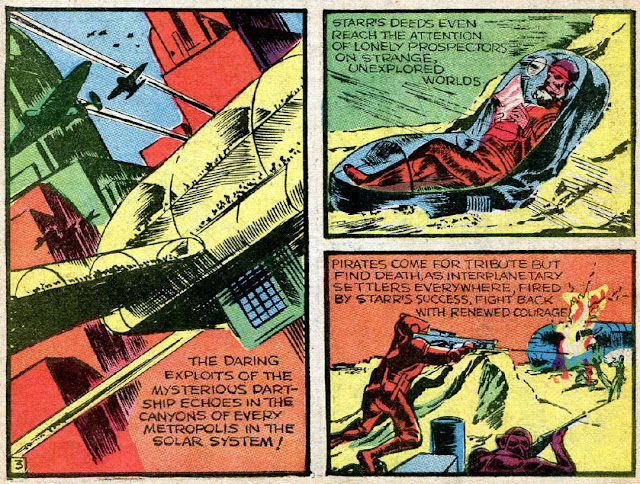
    The Solar Legion is the brainchild of Adam Starr, a 23rd Century man about whom very little is ever revealed. Emerging from a concealed base on Io, he sets out to rid the Solar System of the scourge of space piracy via the most direct route possible: blowing up all of the space pirates.

    Starr’s exploits have their intended effects: 1. many pirates are blown up and 2. the authorities are convinced of the need for an interplanetary peacekeeping force, aka the Solar Legion, with Starr as the head.

    Despite his new position of authority, the remaining four Solar Legion stories feature Adam Starr as a solo operator, hunting down pirates and settling factional disputes with his ray gun and two-fisted attitude. (Crash Comics Adventures 001, 1940)

    the Cat Man:

    The Cat Man is David Merrywether, who is orphaned in India after his father William brings his entire family along on a scientific expedition to collect butterflies and they run afoul of a hostile tribe (no word on whether William did something to draw their ire or if they were universally hostile to intruders – in either case the question of just why he would have his wife and two young children along on such a dangerous endeavour remains unaddressed). David, the only survivor, ends up being adopted by a tiger and spends his youth with her in an expository caption.

    (I really appreciate this “yadda yadda yadda” version of the Raised by Animals origin story. You’ve heard it all before, folks: he lived among the tigers and now he has tiger powers. He’s back in civilization because he saved a tiger’s life and that tiger’s mother owed him a favour. Now let’s get to the costumed antics!)

    Cat Man has all of the expected cat-related superpowers – enhanced dexterity, strength, speed and jumping ability – plus a few less common ones like the ability to speak to tigers and the ability to fall any distance and land on his feet without harm. He also has a cat’s enhanced night vision, which takes the form of literal beams of light that emit from his eyes. Fun!

    The Cat Man’s most striking power is that of having nine lives, bestowed on him by his adoptive tiger mama when he saved her cub. The problem with the “multiple lives” superpower has always been that it’s not interesting if it’s not used, with the result being that after two 1940 appearances Cat Man is down to seven lives. Surely this cannot be sustained going forward.

    Speaking of going forward, we will be hearing more out of Cat Man, one of the minor successes of the Golden Age. Changes are afoot once he has his own title in 1941, starting with a revisions to his much-derided original costume (personally, I like this costume. It very much feels like the sort of thing that someone who had spent their youth alone in a jungle might put together). See you then! (Crash Comics Adventures 004, 1940)

    UPDATE 1941

    Tornado Tom:

    Like the word-box says: Tornado Tom is just some guy who was sucked up by a tornado one day and when he came down again he was inhumanly strong, fast and durable. He also had amnesia, so even though he shares the name Tom Kenny with the famous voice actor of such characters as Spongebob Squarepants, he himself did not know that.

    Tornado Tom’s origin is never really explored and the two hints we get about the nature of his powers are a bit contradictory:

    Possible Mystical Origin: in Cyclone Comics 002, Tom battles some thugs in a stuffy apartment and is drained of vitality by the lack of fresh breezes. In a moment of desperation he calls out to Boreas, “God of Wind” and is revived and re-energized by a gust of air that blasts through the window. Talking points: was it a mystic tornado sent by the gods? Is Tom Kenny a descendant of Boreas or another Greco-Roman figure?

    Possible Biological Origin: In Cyclone Comics 005* Tornado Tom’s blood is asserted to have miraculous healing properties, possibly as  a result of his being some sort of mutant or mutate. Talking points: was it a radioactive tornado?

    This is all ultimately clutching at straws because Tornado Tom is a classic Golden Age cipher, much as I would like to know otherwise. (Cyclone Comics 001, 1940)

    * his blood is reportedly transfused into a dying man in Cyclone Comics 004 but that issue is currently unavailable.

    Mister Q:

    Your typical master of disguise style hero, with a manservant named Ying and a dog named Satan. I quite like Mister Q because I’m pretty sure that his name is derived from the idea of wartime Q-Ships, ie, warships disguised as harmless merchant vessels. It’s a neat name for a disguise-based crimefighter! (Cyclone Comics 001, 1940)

  • MINOR SUPER-HERO ROUND-UP 020

    Super-heroes! Minor ones. 

    the Tulpa:

    The Tulpa and its originator Tsang had the misfortune to appear only once, in Sun Publications’ only proper comic, Colossus Comics 001. This is… a shame? No, it’s probably not. As it stands, the Tulpa is an interesting idea: a Tibetan hermit Lama named Tsang manifests a superhuman thoughtform to battle a bandit/Nazi alliance who are preying on nearby monasteries, and as far as 1940s comics set in Asia go, the whole thing isn’t even that racist!*

    The Tulpa itself is a fairly generic bulletproof muscleman with a pretty great look – I tried to see if that sort of draped hood/cloak was an actual thing that people in Tibet wore at some point (it’s just plausible enough looking that it might be inspired by actual clothing) but with the current state of image searching I think it’s once again a case of me giving up once it becomes clear that I would have to do Actual Research to find the answer. I also really like the very subtle eyeliner/ domino mask.

    *it’s still racist, though. Just in comparison.

    Perhaps the most interesting aspect of the Tulpa is the fact that it has to be actively maintained by Tsang at a fairly high physical and mental cost. At one point he almost drops his ally down a cliff because a concerned member of the temple staff brings him some food and breaks his trance and later on that poor berated person is proven right because Tsang has to slither over to eat it cold lest he miss the climax of the story. I just think it’s neat when a super-character doesn’t have unlimited energy. (Colossus Comics 001, 1940)

    Icarion:

    What could meet the definition of a minor super-hero more than one who never actually appeared in a published story? Yes, poor Icarion (Child of the Sun) here was advertised on the back cover of Colossus Comics 001 as a feature in the second, never-produced issue. All we can say about him is that he could probably fly, but as a long-time comic-book thinker-abouter I have a few well-informed theories as to what his deal might have been:

    -descendant or reincarnation of Icarus

    -adventurer or archaeologist who has found Icarus’ (or more plausibly Daedalus’) wings

    -winged alien or other nonhuman with a very coincidental name

    -scientist or inventor who has created wing tech and chosen an allusive name

    -non-flying adventurer with winglike cape (least likely but still possible)

    Outside of an amazing lore dump from a long-lost journal or something, we shall never know. (Colossus Comics 001, 1940)

    Strongman:

    Strongman! Of course there was a Superman knockoff named Strongman, how could there not be? 

    Rather than being rocketed to Earth from a doomed planet, Strongman here has been doing yoga (secret yoga) for years and now has super strength and speed as well as invulnerability to small arms etc, super breath and even telescopic vision. Pretty good yoga! He’s also wearing a costume that today reads either “1930s sci-fi” or “WWII Nazi character created in the 1980s” (foreshadowing).

    As far as secret identities go, Strongman is Percy van Norton, bored playboy complete with monocle, cigarette holder and coterie of socialites who sail around the world on his yacht with him, simultaneously giving him a reason to be in conflict zones and complicating his attempts to intervene in those conflicts. He also has one of the snottiest expressions ever depicted on a playboy – Bruce Wayne could only dream.

    Strongman is the second character we have encountered to later be drafted into Roy Thomas’ Battle-Axis of public domain super-heroes-turned Nazis and I have to say that he’s the one I can actually see doing it, whether because I find his snotty expression so unlikable or because early on he’s very against the US entering WWII and doesn’t last long enough to get on board with the war effort, so I associate him with the kind of nativist/nationalist/fascist-adjacent types who kept on with those beliefs. I also appreciate that his revised serum-based origin also made him dumber. (Crash Comics Adventures 001, 1940)

    the Blue Streak:

    The Blue Streak (aka the Defender of the People) is an otherwise-unnamed man with a simple charter: protect the weak and persecuted from the strong. He’s got an aide named Tago and together they fly all over the world righting wrongs and toppling a series of vaguely fascist dictators and generals. Technically he’s just a guy in a costume but due to the nature of comic book storytelling he accomplishes several feats that could be called lightly superhuman. He’s the kind of character who would be referred to as being in “peak physical condition” in a handbook or a who’s who. I like him! He’s got a simple charter and he sticks to it and most importantly if he showed up in a comic as a Nazi I’d figure that something was up. (Crash Comics Adventures 001, 1940)

  • MINOR SUPER-HERO ROUND-UP 019

    Look at all these dang guys

    Lobo, the Flying Sleuth: 

    Lobo, the Flying Sleuth, aka the Lobo, had a pretty short run. But! He’s a cowboy and a pilot and a detective. That’s a lot of things! (Champion Comics 006, 1940)

    Doctor Miracle:

    We’ve seen guys like Dr Miracle before: the nigh-omnipotent magician with so much power at his fingertips that his only real challenge is in finding a foe tough enough that he doesn’t defeat them instantly. He’s even got the obligatory Huge Asian Manservant, a Nepalese man named Akim depicted with all of the racial sensitivity that one might expect from 1940s comics.

    Dr Miracle’s real mark of distinction is that he is also a scientific hero, as likely to be blasting a foe with disintegration rays as to be slinging spells. 

    It’s a neat bit of variation in his adventures and of course it gets dropped almost immediately, as his second appearance establishes him as a student of the Elders of the aptly-named City of the Elders in Tibet. After passing a test to show his magical aptitude, Dr Miracle is sent out into the world to battle injustice, with Akim coming along as a… gift? Unsettling. (Champion Comics 009, 1940)

    Doctor Hormone:

    Doctor Hormone exemplifies a particular sort of cultural ingestion/ regurgitation of scientific ideas that permeates all fiction but really found a home in the medium of comic books. Any sufficiently impressive scientific discovery can be reinterpreted as being tantamount to magic, the major example of which is of course the part that radiation would play as a catch-all origin in the Silver Age (and nanotech and genetic engineering in turn as time marched on) but as in any field there are many also-rans for every big hit: vitamins and radio waves and transistors (in the case of Silver Age Iron Man) as science-magic that can accomplish any task. With Doctor Hormone it’s hormones. Obviously.

    As we join the Doctor and his destined-to-be-bullied granddaughter Jane Hormone, he has just been saved from age-related death by a youthening hormone. He and Jane subsequently set out to help the beleaguered nation of Novoslavia defend themselves from the depredations of Germany/Russia analog Eurasia.

    Hormone’s first major antagonist is Rassinoff, aka Assinoff, a Novoslavian official secretly working for Eurasia and dosed with donkey hormones by Jane due to his initial bad vibes. Assinoff is exactly the jackass that his form reflects and is a very satisfying villain to see be repeatedly defeated and humiliated.

    Highlighting some of the more noteworthy hormone effects: the youth hormone (calibrated to make anyone who takes it 25 years old) is cool and fun when used on the elderly but the implications of using it on the young swiftly become horrific. At least the baby was turned into an adult man to save his life – these poor boy scouts are signing up to be adult child soldiers.

    It’s not particularly visually interesting but Hormones second appearance concerns his deploying a gas-based hormone that turns Eurasians into Novoslavians, which raises the question of just what they thought a hormone was over at Popular Comics.

    In Popular Comics 056, Assinoff tries to destroy Hormone’s credibility by injecting Novoslavian citizens with random samples from a captured selection of Hormone’s work, which completely backfires when it turns out that the Novoslavian national character is extremely okay with being turned into some random animal. It’s a nation of furries! 

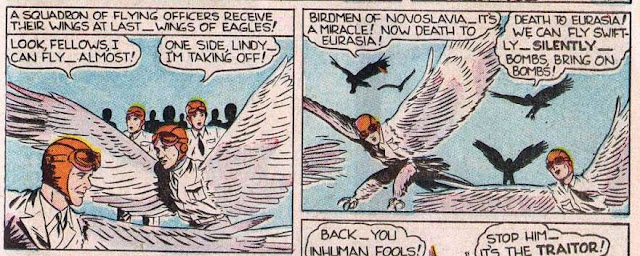
    These eagle-men pilots are the first of many Novoslavian animal-man hybrids, btw.

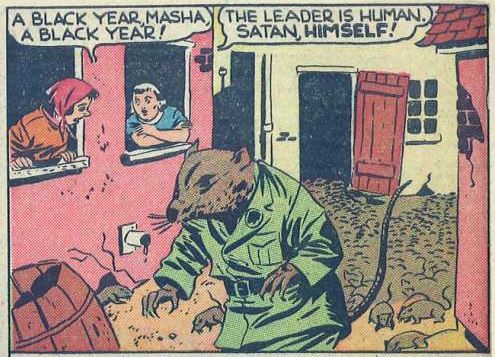
    Issue 57 of Popular Comics involves Novoslavian locust, wasp, termite and rat hybrids going out into the world to gather up plagues of their respective animals to unleash on Eurasia. Pictured here is the rat-man, my personal fave.

    The ultimate expression of Hormone’s hybridization efforts are these five Novoslavian volunteers who were turned into fleas and then restored to human form. Though they no longer look like fleas, they retain proportional jumping, flea-strength, etc, Spider-Man style. And the transformation is very gross-looking!

    So that’s Doctor Hormone in a nutshell: a bit light, plotwise, but full of charming characters and a cavalcade of new and interesting concepts in body horror. (Popular Comics 054, 1940)

    Martan the Marvel Man:

     I feel a bit bad making Martan follow Dr Hormone, honestly, because his adventures are at least as wild, but they aren’t as unique. In brief: Martan and his wife Vana are Antacleans, aliens from a super-advanced race a few million light years off. They kind of accidentally land on Earth and almost immediately get mixed up in the affairs of primitive humans. At first it’s regular old “they war amongst themselves, how foolish!” stuff but eventually they discover in incipient invasion by Antaclea’s ancient enemy the Martians and really throw their weight behind the Earth cause: supplying technology, setting up a world government etc. – Martan and Vana’s impact on the world is much greater than your typical comic book characters’. (Popular Comics 046, 1939)