The Curse of Skeleton Munroe

Category: minor super-hero

  • MINOR SUPER-HERO ROUND-UP 017

    Another fresh hot basket of also-rans, just for you.

    the Mask:

    Scoop Cody, society reporter, is secretly vigilante crimefighter the Mask. He’s not terrific at concealing this fact – both love interest Elaine and villain Carlos figure it out during the course of the one extant Mask story – but he gets the job done. Of mild interest is that Scoop Cody is also the name of the Marvel’s reporter pal. (Star Comics v1 013, 1938*)

    the Phantom Rider: 

    The Phantom Rider is your standard masked cowboy, identity unknown. Given their similar names and that they are both Centaur Comics characters it is equally likely that he is a renamed Phantom o’ the Hills as it is that he is a separate creation. His horse is named Thunder. (Star Comics 016, 1938*)

    Air Man:

    Air Man is Drake Stevens, an ornithologist who embarks on a vigilante career after his father is murdered in an insurance scam on the high seas. He only makes a handful of appearances before Centaur folds, and here are the salient things about him:

    -Air Man is a “realistic” version of Hawkman, i.e., not realistic but in a slightly more plausible way than an antigravity belt. His wings are filled with helium and he has a little jet engine for propulsion (at least, as of his second appearance. Maybe he’s just very slowly gliding around in his first). He also has egg-shaped bombs, which isn’t relevant to the flying but is fun.

    -Air Man is not a generic bird-themed hero but in fact an albatross-themed protector of the seas, which is a niche that I have not encountered before and the closest that I can think of is the Marvel hero Stingray, and that’s just because they both fly and are ocean-based.

     -Air Man believes in protecting the high seas so much that he breaks up with his fiance rather than just… living in a lighthouse with her or whatever. Super-heroes love breaking up with people and then feeling noble about it. (Keen Detective Funnies 023, 1940)

    TNT Todd:

    TNT Todd had been a regular FBI agent having FBI agent adventures in Keen Detective Funnies for about a year when he became if not the earliest then certainly our first example of a non-super character getting a super-heroic makeover to fit comic trends (I tell a lie Tex Thomson/ Mr America has come up before but he made the switch in 1941). While overshadowed by fellow explosion-based hero the Human Bomb a year or so later I must admit to enjoying TNT Todd more on a conceptual level. Just a guy careening through a city via a series of explosions, theoretically helping people. (Keen Detective Funnies 021, 1940)

    *there are several issues of Star Comics from this time that are not readily available, including issues 012, 014 and 015. This means that both the Mask and the Phantom Rider could have earlier first appearances.

  • MINOR SUPER-HERO ROUND-UP 016

    A pretty motley collection this time.

    the Ermine:

    A frontier vigilante who wears a reversible ermine skin outfit (white for winter wear, brown for regular), leaves an ermine tail as his calling card and can communicate/ is friends with with all the creatures of the forest (except for the ermine, presumably). The Ermine would be an interesting character if he wasn’t explicitly and murderously racist against Native peoples. He’s classed as a minor hero here because all of his recorded adventures involve him acting as the protector of two youths but I assume that he has a lot of hate crimes under his belt. (Star Ranger Funnies v1 015, 1938)

    the Lone Marshal:

    I have a strong suspicion that the Lone Marshal is a Lone Ranger knockoff. Obviously there’s no way to peer into the past and be sure, and admittedly the name was a really big influence on my opinion, but I’m sticking with it. He’s got a Sioux companion named Vajo and a horse named Lobo, so he’s just as not-technically-Lone as the Ranger is. (The Comics 001, 1937)

    Doctor Doom:

    Doctor Doom, “the Robin Hood of International Spies,” is some sort of freelance spy chief who we join as he works for the small Balkan nation of Returia as they fend off invasion plans by their rival, the similarly-small, not-as-Balkan Kingdom of Merovia. Doctor Doom and his double handful of associates are on the back foot for the entirety of their time battling the Falcon and never really manage to get the upper hand before the feature is cancelled but I assume that they would have come out on top eventually. (The Comics 001, 1937)

    Jungleman:

    Jungleman is your typical white-kid-raised-by-beasts jungle hero, in this case based out of Cambodia. He lives in a temple and collects treasure and repeatedly kidnaps a young woman named Louise until she falls in love with him – like I said, typical stuff. 

    The real thing that sets Jungleman apart from his peers is both the sheer number and variety of his animal companions and their tremendous attrition rate – he goes through two tigers in his first three appearances when most jungle heroes have to make one big cat last their entire career! 

    Eventually, Louise and her dad convince Jungleman to relocate to the US under the more civilized alias of “Mister Jay” and I was all set for a lot of the same kind of fish-out-of-water stuff that Ty-Gor spent a lot of his time on but no! Their ship gets wrecked and they just end up in a different jungle! It’s the old jungle switcherooo and I never saw it coming! (Champion Comics 002, 1939)

    **UPDATE** Bob Phantom **UPDATE**

    Star Comics 001, 1938 features a different guy named Bob Phantom, which only reinforces my paranoia vis-a-vis there being a joke or a reference that I’m missing about the last name Phantom. Also, given the slapdash nature of early comics and their record keeping, nobody actually knows who created this guy and so it’s entirely possible that he’s the same Bob Phantom and Harry Shorten and/or Irv Novick just took him from Centaur to MLJ and upgraded him from stage magician to super-hero.

  • MINOR SUPER-HERO ROUND-UP 015

    Once again we take you to the world of the minor super-hero. See them dance for your amusement. 

    the Mystic: 

    Later known as Kardak the Mystic, the Mystic is a stage magician who uses stage magic to battle crime, specializing in fraudulent mediums etc. His stage magic eventually gets rounded up to real magic, of course. (Top-Notch Comics 001, 1939)

    the Phantom o’ the Hills:

    The Phantom o’ the Hills is an otherwise unnamed masked cowboy who rights wrongs in the Old West. In his first adventure he avenges the death of his younger brother but whether that’s what got him into the vigilante game is not elaborated on. The only real thing that sets him apart from the ranks of other similar characters is his better-than-average name. (Western Picture Stories 001, 1937)

    Wonder Man:

    For all that (by some accounts) Will Eisner was explicitly told to make a Superman clone when he made him for Fox Features (and that DC successfully sued Fox into canning him), Wonder Man is only kind of like Superman. Maybe it’s my modern image of what Superman is like but he’s just a strong guy who jumps around catching artillery shells and beating up warmongers. Plus he gets his powers from a magic Tibetan ring! Plus he’s blonde! (Wonder Comics 001, 1939)

    Yarko the Great:

    There are three major things to know about Yarko the Great: 

    1. He’s a magic-slinging hero in the classic mold, i.e., an American who has learned the secrets of the Far East and turned them to a career in stage magic/ crimefighting.

    2. Like a lot of early Fox Features characters he was created by Will Eisner so his adventures tend to look pretty great.

    3. “Yarko the Great” is – and this is an informed opinion – categorically the worst name that any magic-using Golden Age hero was saddled with. 

    (Wonder Comics 002, 1939)

    Yarko UPDATE 1940

    *UPDATE* the Flame *UPDATE*:

    Just wish to draw everyone’s attentions to the really boss custom-painted boat that the Flame was tooling around in during his first adventure. Plus he had a butler named Jarvis! (Wonderworld Comics 003, 1939)

    **DOUBLE UPDATE**

    And he has a plane! (Wonderworld Comics 004, 1939)

  • MINOR SUPER-HERO ROUND-UP 014

    Some real niche characters this time.

    the Lone Star Rider:

    An Old West hero so generic he only appeared once and never even got to track down the owlhoots who killed his parents in order to steal their land. Good gloves. (Smash Comics 002, 1939)

    Shock Gibson:

    Like Barry Allen after him, Charles (later Robert) Gibson is a young scientist working late into a stormy night when he is simultaneously struck by lightning and bathed in chemicals. Though he is called the Human Dynamo, for the first chunk of his career he functions as more of a Human Battery who stores an electrical charge that can be used to fuel various superhuman feats – super-strength, super-jumping (later full-on flight), and a shocking grasp.

    Shock Gibson goes through more than a few costume changes over the years – sadly this goofy helmet is axed during the first one – but one consistent element in his design is lotsa cool electricity crackle when he uses his powers. (Speed Comics 001, 1939)

    Shock Gibson UPDATE 1940: He loses the hat.

    the Man With 1000 Faces:

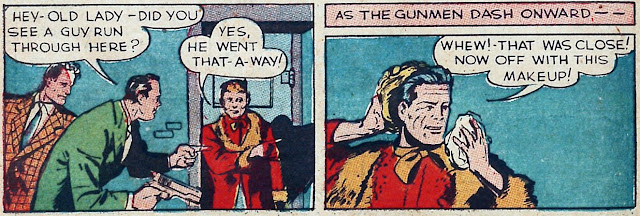
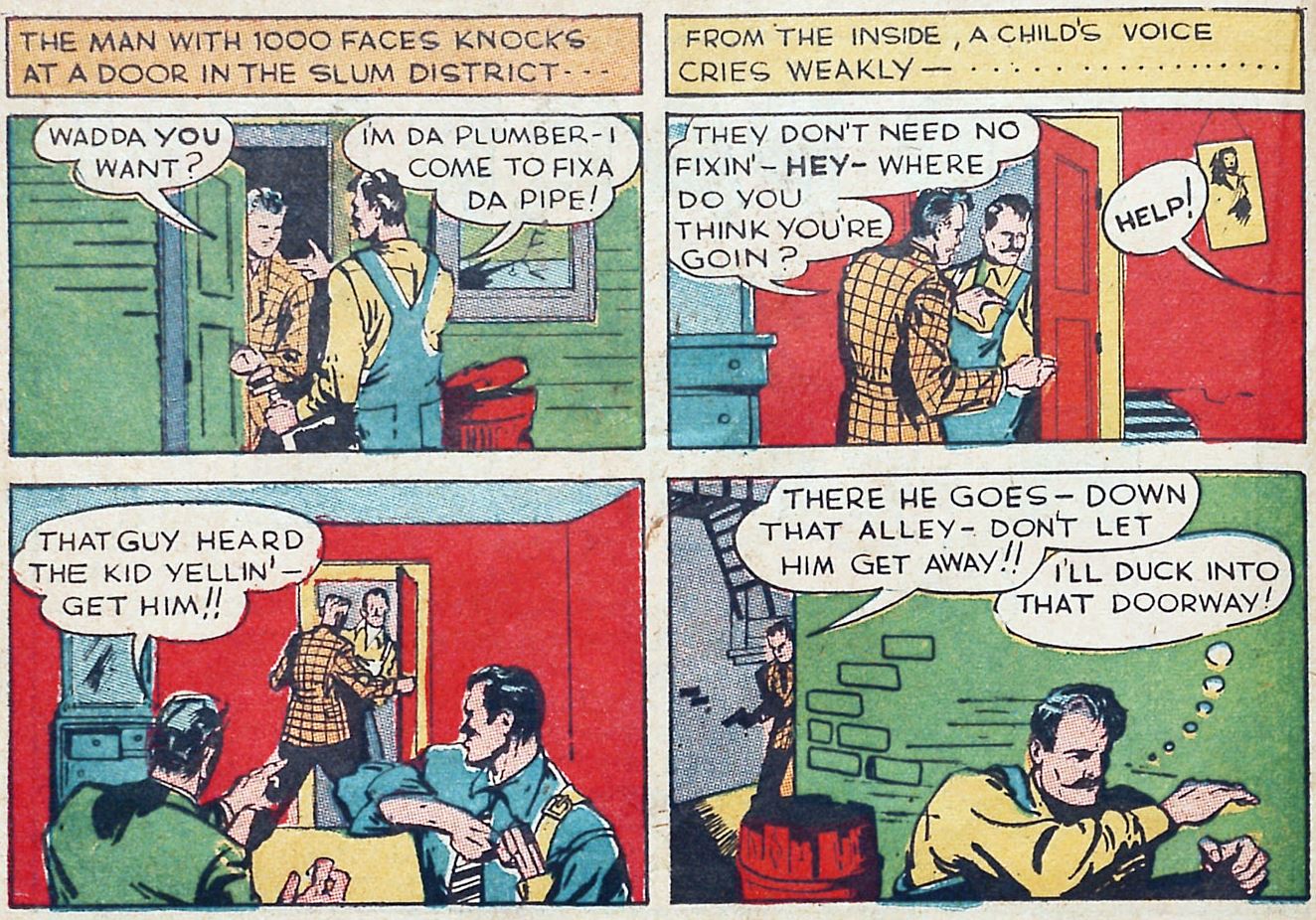
    Ted Parrish, famous film star, is bored with his humdrum life and so turns his considerable talent for quickchange artistry and disguise to the task of crimefighting. Just where he gets all of his accessories from is not elaborated on, so it’s equally likely that he scavenges them from the environment as it is that he just hauls around an enormous hockey bag full of clothing etc everywhere he goes.

    Parrish’s mission is obviously hampered somewhat by the fact that Los Angeles’ criminal fraternity knows that the Man With 1000 Faces exists and they should be on the lookout for him. How did they find out? Did Parrish blab to up the challenge and excitement of it all? (Speed Comics 001, 1939)

    the Wizard:

    Blane Whitney, AKA the Wizard, is the latest in seven generations of Whitneys (some of whom were also called the Wizard) to dedicate their lives in patriotic service to the USA. Plus he was a child prodigy who was charged to use his abilities to better mankind by Woodrow Wilson. Plus he’s an inventive genius in virtually all fields, particularly various forms of engineering. Plus he has nearly superhuman physical abilities and a mind so highly developed that it is superhuman in that he can employ remote viewing to locate dangers and clues.

    The Wizard was a pretty big player at MLJ in the 40s but has largely been abandoned in the various attempts to revive the MLJ characters at Archie and elsewhere – his biggest post-Golden Age appearance that I am aware of was as a super-villain fighting the Mighty Crusaders in the 60s. What does this say about the character – that he’s perfectly serviceable but not very conceptually exciting? Yes, I reckon that sums him up. (Top-Notch Comics 001, 1939)

    UPDATE 1940a

    UPDATE 1940b 

  • MINOR SUPER-HERO ROUND-UP 014

    MINOR SUPER-HERO ROUND-UP 014

    Some real niche characters this time.

    the Lone Star Rider:

    An Old West hero so generic he only appeared once and never even got to track down the owlhoots who killed his parents in order to steal their land. Good gloves. (Smash Comics 002, 1939)

    Shock Gibson:

    Like Barry Allen after him, Charles (later Robert) Gibson is a young scientist working late into a stormy night when he is simultaneously struck by lightning and bathed in chemicals. Though he is called the Human Dynamo, for the first chunk of his career he functions as more of a Human Battery who stores an electrical charge that can be used to fuel various superhuman feats – super-strength, super-jumping (later full-on flight), and a shocking grasp.

    Shock Gibson goes through more than a few costume changes over the years – sadly this goofy helmet is axed during the first one – but one consistent element in his design is lotsa cool electricity crackle when he uses his powers. (Speed Comics 001, 1939)

    Shock Gibson UPDATE 1940: He loses the hat.

    the Man With 1000 Faces:

    Ted Parrish, famous film star, is bored with his humdrum life and so turns his considerable talent for quickchange artistry and disguise to the task of crimefighting. Just where he gets all of his accessories from is not elaborated on, so it’s equally likely that he scavenges them from the environment as it is that he just hauls around an enormous hockey bag full of clothing etc everywhere he goes.

    Parrish’s mission is obviously hampered somewhat by the fact that Los Angeles’ criminal fraternity knows that the Man With 1000 Faces exists and they should be on the lookout for him. How did they find out? Did Parrish blab to up the challenge and excitement of it all? (Speed Comics 001, 1939)

    the Wizard:

    Blane Whitney, AKA the Wizard, is the latest in seven generations of Whitneys (some of whom were also called the Wizard) to dedicate their lives in patriotic service to the USA. Plus he was a child prodigy who was charged to use his abilities to better mankind by Woodrow Wilson. Plus he’s an inventive genius in virtually all fields, particularly various forms of engineering. Plus he has nearly superhuman physical abilities and a mind so highly developed that it is superhuman in that he can employ remote viewing to locate dangers and clues.

    The Wizard was a pretty big player at MLJ in the 40s but has largely been abandoned in the various attempts to revive the MLJ characters at Archie and elsewhere – his biggest post-Golden Age appearance that I am aware of was as a super-villain fighting the Mighty Crusaders in the 60s. What does this say about the character – that he’s perfectly serviceable but not very conceptually exciting? Yes, I reckon that sums him up. (Top-Notch Comics 001, 1939)

    UPDATE 1940a

    UPDATE 1940b 

  • MINOR SUPER-VILLAIN 544: DR VON THORP & THE IRON MONSTER / MINOR SUPER HERO: HUGH HAZZARD & BOZO THE IRON MAN

    (Smash Comics 001, 1939)

    We open on a city (later established as almost certainly NYC) in the grip of terror. A robot known as the Iron Monster is wantonly robbing and murdering and also stealing one or more babies for reasons that are never made clear. Seriously, we never find out what the deal was with those babies.

    The Iron Monster is the creation of Dr von Thorp, your classic scientist rejected from society for his outre beliefs, though considering the man and his work he may have been ostracized for something other than believing that he might someday build a robot. Regardless of why he was rejected, he has expressed himself in the traditional way, by turning his invention back on society as revenge.

    The police have no hope of dealing with the Iron Monster or his boss, so Police Commissioner Hunt calls in private detective par excellence Hugh Hazzard, whose job is made considerably easier by the fact that von Thorp subscribes to the surprisingly common school of robot design that dictates that the robot contain a large, easily accessible space that a human can get inside and also take control of the robot from. Von Thorp’s capture is almost anticlimactic, in fact.

    The reason for this anticlimax is that this is not, in fact, the story of Dr von Thorp and his Iron Monster but the origin of Hugh Hazzard and the renamed Bozo the Iron Man. As introduced Hazzard is already one of those superhuman-adjacent comic book adventurers complete with a special method for the police commissioner to contact him and a love interest gamely resigned to spending most of her evenings alone. Bozo, despite eventually taking over the name of the strip entirely, is never more than a tool of Hazzard’s with no actual personality or volition (though Hazzard does eventually switch to mostly travelling around inside the robot like the other, later Iron Man and Bozo gets a considerable boost in personality once it seems to be spouting quips from its fixed grimace).

    In Smash Comics 002 Hazzard upgrades Bozo with both a considerably miniaturized controller (cellphone sized vs the old one’s desktop PC) and a weird disc on top of his head that allows him to fly, so I guess that also makes him one of those hobbyist polymath types you get in old comics

    Dr von Thorp returns exactly one more time in Smash Comics 018, wherein he and Hazzard battle for control of Bozo by blasting radio waves at him like two people trying to see who a puppy loves more. No surprise that Hugh Hazzard wins but killing von Thorp off-panel at the very end seems a bit mean.

    Like I said, Bozo’s role in the title of the strip if not as a character continued to grow until the end of their run in 1943. Since then Bozo occasionally turns up in a collection of DC Comics junk that some character has collected. Of Hugh Hazzard there has been no further sign.

  • MINOR SUPER-HERO ROUND-UP 013

    More. MORE!

    Spiritman: 

    It’s impossible to say if Spiritman’s real name is Spirit Malcolm or if Spirit is just a nickname. The Golden Age is definitely a time in which nicknames are clearly signposted with quotation marks (including names like “Hank” half the time) but they’re also an age of inconsistent editorial standards. Let’s assume it is his given name, because then it’s another fun case of comic book nominative determinism.

    Spiritman is a scientific hero: armed with a Rayodine Pistol, he uses his Futurscope remote viewing device to hunt out evildoers and then – and this is where the “Spirit” part comes in – employs his Mistodine device to teleport to their location, or possibly to astrally project to their location. Either way, the effects are the same: the projected Spiritman can fly and is selectively invisible and intangible, allowing him to really just do whatever he wants. In his sole recorded adventure, this means killing about a dozen men for stealing US gold reserves. (Silver Streak Comics 001, 1939)

    the Wasp:

    Daily Free Press reporter Burton Slade is also masked vigilante the Wasp, so named because his weird cape looks a bit like insect wings if you squint. He also makes a buzzing sound sometimes. (Silver Streak Comics 001, 1939)

    Black X:

    Black X is Richard Spencer, a US espionage agent who travels around with his Indian manservant Batu (who of course is gifted with assorted mental powers). His stories are interesting enough to read but Black X himself is, appropriately enough, a bit of a cipher. Probably the most interesting thing about him is that the monocle he always wears is in fact more of an eye patch to cover his gouged-out eye. He also briefly went by the moniker Black Ace but that failed to stick. (Feature Funnies 013, 1938)

    the Invisible Hood:

    The fun thing about the Invisible Hood is that he doesn’t get his signature invisibility cloak until his second appearance, which means that for an unknown number of adventures he was just a Sandman-style two-fisted gas gun jockey in a very impractical full length form-fitting robe. Perhaps he was simply looking for a challenge. (Smash Comics 001, 1939)

  • MINOR SUPER-HERO ROUND-UP 012

    They just keep on coming.

    the Champ:

    The Champ is Captain America if Dr Erskine was a nutritionist rather than a… biologist? Biochemist? Whatever Dr Erskine was a doctor of. A sickly, bullied boy, the Champ (no other name given) was so-called by his bullies because he won at nothing. Scientist Dr Marlin, pitying the Champ, provides him with an experimental food supplement that over a period of seven years transforms him into a physical and mental paragon, the Champ of everything. (I really appreciate the writing on the description of the supplement – one could almost suspect that someone behind the scenes was considering a merchandising spin-off)

    Though the Champ tangles with spies and the like he is at his essence a college athlete character and so a lot of his stories are concerned with the surprisingly high-stakes world of betting on and rigging varsity level athletics, which is… not the most exciting subject matter for a comic. (Champion Comics 002, 1939)

    the Golden Knight:

    The Golden Knight is a heroic Crusader, a fairly popular genre of historical hero in the Golden Age and one that is very much out of favour now. He’ll probably come up again because he operates in an even more heightened comic book reality version of the Crusades than most of his peers, as evidenced by his first adventure, in which he stumbles upon what amounts to a group of Saracen Fifth Columnists lurking in an underground fortress in the English countryside.

    The Golden Knight (aka Sir Richard of Warwick) is also notable for the nonchalance with which he receives a vision of a sword-bearing lady in a one-piece swimsuit telling him to go to war. Unflappable, we call it. (Fantastic Comics 001, 1939)

    UPDATE 1940

    the Arrow:

    The Arrow, a very early costumed hero indeed, is simply an enormous guy in a hoodie (I mean, it’s basically a hoodie) who alternately kills criminals with a bow and arrow and threatens to do so to get what he wants. I have a slightly outsized level of affection for him because he approaches superheroics like I do an open world game like Skyrim.

    The Arrow does eventually get a more super-heroic look (roman sandal style lacing on his shins, a belt) and about the same time he gets shunk down to more average human proportions, possibly because the idea of a roughly seven foot guy with a carefully guarded secret identity was getting hard to write around. (Funny Pages v2 010, 1938)

    UPDATE 1940 

    UPDATE 1941 

    Mister Midnite:

    mister midnite

    Mister Midnite is Neal Carruthers III, a wealthy sportsman who dresses up in a tuxedo and domino mask to fight crime, with a watch face set to midnight as his calling card and the police on his tail. The only thing that really sets him apart from the horde of other besuited vigilantes is his weirdo power, which is that he can shout “stop, time!” and cause clocks to stop. Although in rereading the first Mister Midnite story again… he might just be able to stop that one clock in that one clock tower? It’s a dumb and bizarrely specific power and Mister Midnite is just lucky that I find that kind of thing charming. (Silver Streak Comics 001, 1939)

    UPDATE 1940 (Silver Streak Comics 002, 1940)

  • MINOR SUPER-HERO ROUND-UP 011

    Lotsa lil guys.

    Mr Justice: 

    Like the Spectre or the Wraith (or Sergeant Spook or the Gay Ghost or the Ghost Patrol…), Mr Justice is your classic restless spirit who remains on Earth to mete out justice to the wicked. Specifically, Mr Justice is the 200 year old ghost of the fictional English Prince James, cruelly slain by followers of Prince Richard during the Rogers Rebellion of the 1740s. Astute readers and students of history might have noticed a few things about the preceding sentence that all boil down to the fact that the 1740s were actually recent enough that we know a whole lot about what was going on then, including that people weren’t running around in Medieval armour even if they were sometimes still using swords and shields during the Jacobite Rebellion of 1745. Also, this is what the crown prince of England looked like in 1741. (they change it to the 11th Century later on, because that makes a lot more sense).
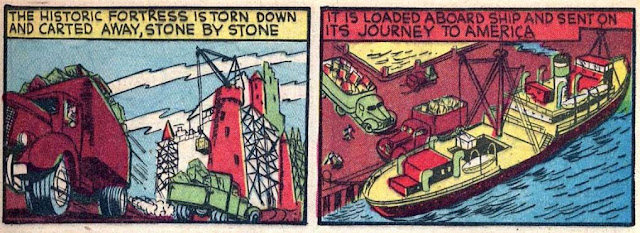
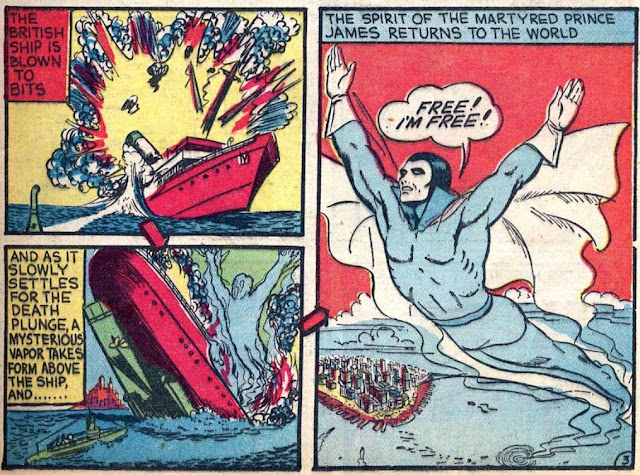
    Prince James’ ghost is tethered to the place of his death per the usual ghost rules but he manages to get around that in a fairly unprecedented way: due the the war, the British government decides to move the castle to America and it is sunk by the Nazis on the way there. And since a pile of stone on the bottom of the Atlantic is not a castle, James is free to go become Mr Justice, the ghost super-hero frequently compared to the Spectre but who doesn’t really get up to the sames sort of divine judgment stuff. He does fight the Devil/Satan a lot, though.
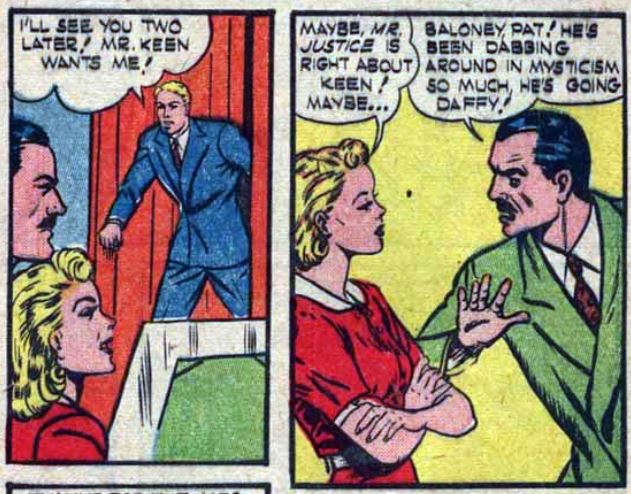
    Possibly my favourite thing about Mr Justice is the fact that his secret identity is a fellow named Mr Justice and nobody really calls any attention to that fact. Mr Justice (secret identity of Mr Justice) is attached to the office of Mayor Clark (city unnamed but very NYC-esque) as a sort of troubleshooter. He kind of has a love interest in mayor’s daughter Pat Clark and a rival in District Attorney Roy Winkler, above, but neither is explored very thoroughly. (Blue Ribbon Comics 009, 1941)

    Inferno:

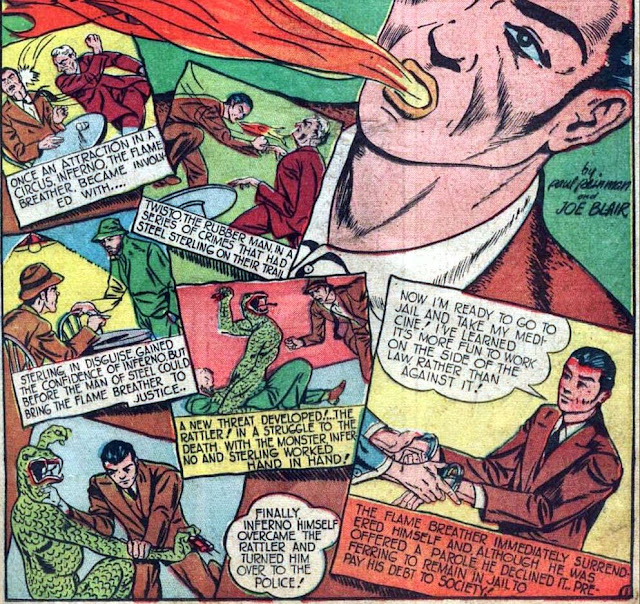
    Above is an abridged account of Inferno’s time as a super-villain, which we will treat separately because… well, because when you’re reading a lot of old comics in a somewhat systematic manner you have to have some sort of organizational method and I chose alphabetical by year, and Inferno’s time on the lists of crime happened in Zip Comics. I simply haven’t gotten there yet. Suffice to say that he was a crook who changed his ways due to the influence of Steel Sterling and opted to do his time.

    Despite his best efforts, Inferno is compelled to break jail to stop a group of prison escapees from murdering a judge and then is encouraged by that same judge to go on the lam because the authorities are going to try to murder Inferno. It’s a real reciprocal life-saving situation! Although I am tempted to think that that judge could possibly have just called someone and arranged for a stay of summary execution for Inferno.

    The rest of Inferno’s career as a Golden Age super-hero is kind of a fun twist on the old trope of the super-hero that everyone thinks is a crook, in that he doesn’t really have a secret identity per se so just travels around doing itinerant labour until he sees a crime go and changes outfits. The idea of this hobo existence kind of goes by the wayside after a couple of issues when Secret Service Agent Virginia Ames enters the picture, as Inferno’s stories were on the shorter side and just didn’t have the real estate for both a love interest and workplace drama.

    Inferno only managed seven adventures before trotting off to limbo to wait for Archie’s 1960s super-hero revival but don’t worry! He got a full pardon in his last adventure so the other heroes won’t be hassling him. (Blue Ribbon Comics 013, 1941)

    Captain Flag:

    On the one hand, Captain Flag is a regular-style patriotic hero but on a different, more entertaining hand he is a patriotic hero with a very fun origin. To whit: one day super-villain the Black Hand is attempting to wrest scientific secrets from inventor John Townsend when his playboy son Tom stumbles in half lit. The Black Hand is about to dispose of Tom using his horrible hand when a huge eagle just kind of… flaps into the room and ends up leaving with Tom Townsend in its talons.

    Thus saved, Tom just kind of lives with the eagle for a while and transforms from a dissipated youth to a lean, athletic man full of fish protein. And then the eagle comes back one day with an American flag! It’s a veritable sign from the heavens it what it is!

    And so, Tom Townsend becomes Captain Flag, who mostly fights the Black Hand. Which makes sense. Something else that would make a lot of sense: adding a belt to that costume. (Blue Ribbon Comics 016, 1941)

    The Red Mask:

    The Red Mask is very minor indeed! He appeared in four issues of Best Comics from Better Publications, of which only issue 2 appears to be available, which in turn was reprinting newspaper strips, of which only a handful are available. 

    What we have on the guy is this: he leads a tribe on the island of Kaukura, which is probably but not definitely in Oceania somewhere. Kaukura is chockablock with things like sacred grottoes, immortal monsters and hostile tribes and the Red Mask has assigned himself the task of protecting a bunch of clueless outsiders like Nina and Danny here who have blundered in looking for their friend and found themselves up to their neck in trouble.

    The most interesting thing about the Red Mask is that he is by a fair margin the first nonwhite super-hero, though thanks to colouring limitations and some inexact geography it’s a bit difficult to get more exact than that. (Best Comics 002, 1939)

  • MINOR SUPER-HERO ROUND-UP 011

    Lotsa lil guys.

    Mr Justice: 

    Like the Spectre or the Wraith (or Sergeant Spook or the Gay Ghost or the Ghost Patrol…), Mr Justice is your classic restless spirit who remains on Earth to mete out justice to the wicked. Specifically, Mr Justice is the 200 year old ghost of the fictional English Prince James, cruelly slain by followers of Prince Richard during the Rogers Rebellion of the 1740s. Astute readers and students of history might have noticed a few things about the preceding sentence that all boil down to the fact that the 1740s were actually recent enough that we know a whole lot about what was going on then, including that people weren’t running around in Medieval armour even if they were sometimes still using swords and shields during the Jacobite Rebellion of 1745. Also, this is what the crown prince of England looked like in 1741. (they change it to the 11th Century later on, because that makes a lot more sense).

    Prince James’ ghost is tethered to the place of his death per the usual ghost rules but he manages to get around that in a fairly unprecedented way: due the the war, the British government decides to move the castle to America and it is sunk by the Nazis on the way there. And since a pile of stone on the bottom of the Atlantic is not a castle, James is free to go become Mr Justice, the ghost super-hero frequently compared to the Spectre but who doesn’t really get up to the sames sort of divine judgment stuff. He does fight the Devil/Satan a lot, though.

    Possibly my favourite thing about Mr Justice is the fact that his secret identity is a fellow named Mr Justice and nobody really calls any attention to that fact. Mr Justice (secret identity of Mr Justice) is attached to the office of Mayor Clark (city unnamed but very NYC-esque) as a sort of troubleshooter. He kind of has a love interest in mayor’s daughter Pat Clark and a rival in District Attorney Roy Winkler, above, but neither is explored very thoroughly. (Blue Ribbon Comics 009, 1941)

    Inferno:

    Above is an abridged account of Inferno’s time as a super-villain, which we will treat separately because… well, because when you’re reading a lot of old comics in a somewhat systematic manner you have to have some sort of organizational method and I chose alphabetical by year, and Inferno’s time on the lists of crime happened in Zip Comics. I simply haven’t gotten there yet. Suffice to say that he was a crook who changed his ways due to the influence of Steel Sterling and opted to do his time.

    Despite his best efforts, Inferno is compelled to break jail to stop a group of prison escapees from murdering a judge and then is encouraged by that same judge to go on the lam because the authorities are going to try to murder Inferno. It’s a real reciprocal life-saving situation! Although I am tempted to think that that judge could possibly have just called someone and arranged for a stay of summary execution for Inferno.

    The rest of Inferno’s career as a Golden Age super-hero is kind of a fun twist on the old trope of the super-hero that everyone thinks is a crook, in that he doesn’t really have a secret identity per se so just travels around doing itinerant labour until he sees a crime go and changes outfits. The idea of this hobo existence kind of goes by the wayside after a couple of issues when Secret Service Agent Virginia Ames enters the picture, as Inferno’s stories were on the shorter side and just didn’t have the real estate for both a love interest and workplace drama.

    Inferno only managed seven adventures before trotting off to limbo to wait for Archie’s 1960s super-hero revival but don’t worry! He got a full pardon in his last adventure so the other heroes won’t be hassling him. (Blue Ribbon Comics 013, 1941)

    Captain Flag:

    On the one hand, Captain Flag is a regular-style patriotic hero but on a different, more entertaining hand he is a patriotic hero with a very fun origin. To whit: one day super-villain the Black Hand is attempting to wrest scientific secrets from inventor John Townsend when his playboy son Tom stumbles in half lit. The Black Hand is about to dispose of Tom using his horrible hand when a huge eagle just kind of… flaps into the room and ends up leaving with Tom Townsend in its talons.

    Thus saved, Tom just kind of lives with the eagle for a while and transforms from a dissipated youth to a lean, athletic man full of fish protein. And then the eagle comes back one day with an American flag! It’s a veritable sign from the heavens it what it is!

    And so, Tom Townsend becomes Captain Flag, who mostly fights the Black Hand. Which makes sense. Something else that would make a lot of sense: adding a belt to that costume. (Blue Ribbon Comics 016, 1941)

    The Red Mask:

    The Red Mask is very minor indeed! He appeared in four issues of Best Comics from Better Publications, of which only issue 2 appears to be available, which in turn was reprinting newspaper strips, of which only a handful are available. 

    What we have on the guy is this: he leads a tribe on the island of Kaukura, which is probably but not definitely in Oceania somewhere. Kaukura is chockablock with things like sacred grottoes, immortal monsters and hostile tribes and the Red Mask has assigned himself the task of protecting a bunch of clueless outsiders like Nina and Danny here who have blundered in looking for their friend and found themselves up to their neck in trouble.

    The most interesting thing about the Red Mask is that he is by a fair margin the first nonwhite super-hero, though thanks to colouring limitations and some inexact geography it’s a bit difficult to get more exact than that. (Best Comics 002, 1939)