The Curse of Skeleton Munroe

Category: minor super-hero

  • MINOR SUPER-HERO ROUND-UP 010

    MINOR SUPER-HERO ROUND-UP 010

    MORE MLJ ACTION

    Doc Strong:

    Doc Strong is a famous scientist living in the year 2041, in a world where WWII dragged on for an entire century and a new Mongol Horde has swept in and conquered the battered remnants of civilization. The strangely Doc Savage-like Doc Strong gathers a group of like-minded scientists and starts a new civilization called the Isle of Right from which to strike back at the invaders with such inventions as a ray gun that solidifies shadows. (Blue Ribbon Comics 004, 1940)

    the Fox:

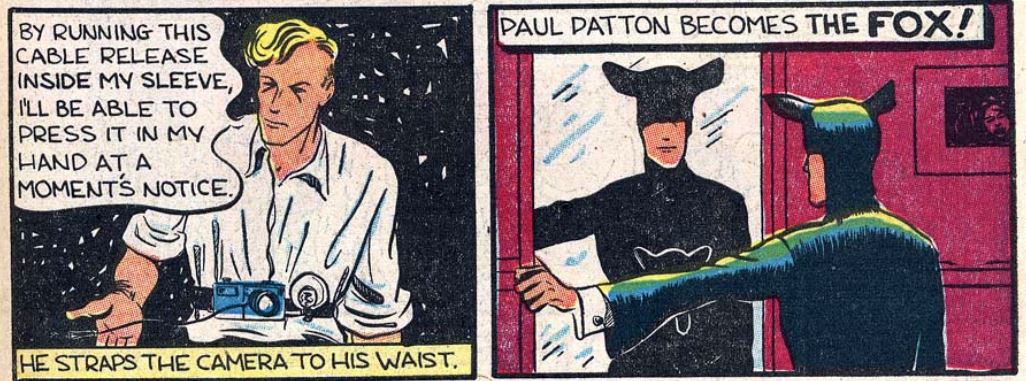
    Paul Patton, photographer for the Daily Globe, gets the tar beaten out of him by some fellows called the Night Riders and comes up with a plan:

    That’s right, he’s about halfway between Spider-Man and Batman. Okay, he’s mostly Batman but his wearable camera scheme anticipates Perter Parker’s epic work hack by about twenty years. The Fox’s first attempt at a costume is a bit rough, but eventually…

    … he adopts one of the top costumes of the Golden Age! His adventures may be a bit regular but he looks great doing it.

    BONUS FOX FACT: his “bat flies through the window” moment comes when he hears a song on the radio. (Blue Ribbon Comics 004, 1940)

    the Green Falcon: 

    The Green Falcon feature is essentially a Robin Hood Elseworlds story in which Robin is a knight instead of a forest outlaw and his pals Tiny Tuck and Jolly Roundfellow kind of encapsulate a few Merry Men each. Prince John is still there, and Maid Marion, but there are more swordfights than arrow tricks. Hey, I never said it was a particularly compelling Elseworlds story. It is more high concept than you usually get in a Golden Age comic, though. (Blue Ribbon Comics 004-015, 1940-1941)

    Ty-Gor:

    Ty-Gor is MLJ’s answer to Mowgli: a British child orphaned in the jungles of Malaysia and raised by tigers. Ty-Gor is a shortened form of his birth name, Tyrone Gorman, which he learns thanks to an absurd series of events pictured above.

    I don’t usually have a lot of time for jungle adventures but Ty-Gor does have a pretty fun twist in that after a half dozen issues he is brought to New York by explorer Dr Davis and his daughter Joan and Does Not Adapt. He’s just a wild kid who knows about five word maximum thrust into the public school system and causing havoc. It’s fun! (Blue Ribbon Comics 004, 1940)

    BONUS TY-GOR AS A BABY EATING GRAPES

  • MINOR SUPER-HERO ROUND-UP 009

    All Archie/MLJ edition!

    Rang-a-Tang the Wonder Dog:

    The Wonder Dog is an uncommon but distinct type of comic book hero and Rang-a-Tang here is typical of the breed: essentially a dog with human intelligence. Rang-a-Tang escaped from a cruel but evidently very talented circus dog trainer and almost immediately teamed up with police Detective Hy Speed, who was perhaps lashing out at the world for his own moniker when he gave his new dog one of the all-time worst names. I mean, I get that it’s a knockoff of Rin-Tin-Tin but he also had a very bad name. 

    By issue seven of Blue Ribbon Comics Rang and Hy had moved to Hollywood and acquired a third companion in Richy Waters, aka Richy the Amazing Boy, and apparently free-range child actor with no adult supervision to speak of. Richy gradually usurps Rang-a-Tang’s place as the strip’s protagonist over the next year or so, which is disappointing to those of us who enjoy dogs more than child actors. (Blue Ribbon Comics 001-022, 1939-1942)

    Bob Phantom:

    As far as his super-hero identity goes, Bob Phantom is fairly regular: he shares with many other Golden Age heroes the power to suddenly appear – in a cloud of smoke in his case (though crucially he is generating the smoke as opposed to appearing in a preexisting cloud like the Vision. Or preexisting fire like the Flame, preexisting water like the Shark, etc. You get it) – and also has some degree of intangibility – definitely enough that bullets don’t affect him. Per his name, he’s very into spooking crooks out via psychological torment.

    Bob Phantom’s civilian identity is that of Walt Whitney, writer of the newspaper gossip column “On Broadway” which he uses to taunt both criminals and the New York District Attorney for some reason. Possibly just to be a scamp. (Blue Ribbon Comics 002, 1939)

    (between Bob Phantom, Top Ten character Jack Phantom and cartoon character Danny Phantom there are just enough characters with “Phantom” as a last name to make me think I’m missing some sort of very obvious pun)

    UPDATE

    UPDATE 1940 

    Corporal Collins, Infantryman:

    An American serving in the French Army (and later the British Army after the Nazis conquer France), Corporal Collins is for no apparent reason a super soldier with crack reflexes,  a danger sense that allows him to dodge enemy bullets and a “fabri-steel flexible repeller” that allows him to effectively deflect incoming bullets back to their source. The more overtly super-heroic aspects of  Collins get toned down after a couple of issues and he becomes just another comic book military paragon with a comic relief sidekick named Slapsie and a rivalry with fellow MLJ military hero Sergeant Boyle and his sidekick Twerp. (Blue Ribbon Comics 002, 1939)

    Hercules:

    It’s time for another Hercules! This Hercules is the real deal Olympian, sent to Earth by Zeus to combat evil (and possibly also as a prank? He seems to be completely unprepared when he pops up in the middle of a New York City analog). Functionally, he’s exactly the same as the other two Herculeses we’ve seen so far: a great big shirtless blonde guy with super strength. He even gets a job as a sideshow strongman like the both of them.

    The real innovation in this version of Hercules is the assertion that his famous Twelve Labours were in fact “wiping out the evils of Ancient Greece” and then drawing parallels between them and his adventures in the modern day, including:

    – the Slaying of the Nemean Lion -> killing gang boss Leo Nymia, the Lion of the Underworld (Hercules also steals Nymia’s suit as a version of wearing the lion’s hide)

    – the Slaying of the Lernean Hydra ->  deposing political fixer Hy Dralerny and his “Nameless Nine” organization

    – the Cleaning of the Augean Stables -> cleaning up crooked gambling at the local racetrack – very tortured and involves both a gambler named Augie King, and two jockeys named Tom and Dick Rivers who had to be “set in the right channels”

    – the Capture of the Erymanthian Boar -> very disappointing. Hercules captures a fat pseudo-Nazi General (who isn’t even named Hairy Man Ian) and because he shoots down a bunch of planes while doing it shoehorns in the Slaying of the Stymphalian Birds. Absolutely the worst of the bunch.

    – Stealing the girdle of Hippolyta -> Contending with the villainess Natch, about whom we shall speak anon.

    Sadly for the mythological completionists out there, Hercules stopped appearing after just six labours, so we’ll never get to see him take on Mary Diomedes the Cannibal Equestrian or twin cattle rustlers Gary and Gerry Young. (Blue Ribbon Comics 004, 1940)

  • MINOR SUPER-HERO ROUND-UP 009

    All Archie/MLJ edition!

    Rang-a-Tang the Wonder Dog:

    The Wonder Dog is an uncommon but distinct type of comic book hero and Rang-a-Tang here is typical of the breed: essentially a dog with human intelligence. Rang-a-Tang escaped from a cruel but evidently very talented circus dog trainer and almost immediately teamed up with police Detective Hy Speed, who was perhaps lashing out at the world for his own moniker when he gave his new dog one of the all-time worst names. I mean, I get that it’s a knockoff of Rin-Tin-Tin but he also had a very bad name. 

    By issue seven of Blue Ribbon Comics Rang and Hy had moved to Hollywood and acquired a third companion in Richy Waters, aka Richy the Amazing Boy, and apparently free-range child actor with no adult supervision to speak of. Richy gradually usurps Rang-a-Tang’s place as the strip’s protagonist over the next year or so, which is disappointing to those of us who enjoy dogs more than child actors. (Blue Ribbon Comics 001-022, 1939-1942)

    Bob Phantom:

    As far as his super-hero identity goes, Bob Phantom is fairly regular: he shares with many other Golden Age heroes the power to suddenly appear – in a cloud of smoke in his case (though crucially he is generating the smoke as opposed to appearing in a preexisting cloud like the Vision. Or preexisting fire like the Flame, preexisting water like the Shark, etc. You get it) – and also has some degree of intangibility – definitely enough that bullets don’t affect him. Per his name, he’s very into spooking crooks out via psychological torment.

    Bob Phantom’s civilian identity is that of Walt Whitney, writer of the newspaper gossip column “On Broadway” which he uses to taunt both criminals and the New York District Attorney for some reason. Possibly just to be a scamp. (Blue Ribbon Comics 002, 1939)

    (between Bob Phantom, Top Ten character Jack Phantom and cartoon character Danny Phantom there are just enough characters with “Phantom” as a last name to make me think I’m missing some sort of very obvious pun)

    UPDATE

    UPDATE 1940 

    Corporal Collins, Infantryman:

    An American serving in the French Army (and later the British Army after the Nazis conquer France), Corporal Collins is for no apparent reason a super soldier with crack reflexes,  a danger sense that allows him to dodge enemy bullets and a “fabri-steel flexible repeller” that allows him to effectively deflect incoming bullets back to their source. The more overtly super-heroic aspects of  Collins get toned down after a couple of issues and he becomes just another comic book military paragon with a comic relief sidekick named Slapsie and a rivalry with fellow MLJ military hero Sergeant Boyle and his sidekick Twerp. (Blue Ribbon Comics 002, 1939)

    Hercules:

    It’s time for another Hercules! This Hercules is the real deal Olympian, sent to Earth by Zeus to combat evil (and possibly also as a prank? He seems to be completely unprepared when he pops up in the middle of a New York City analog). Functionally, he’s exactly the same as the other two Herculeses we’ve seen so far: a great big shirtless blonde guy with super strength. He even gets a job as a sideshow strongman like the both of them.

    The real innovation in this version of Hercules is the assertion that his famous Twelve Labours were in fact “wiping out the evils of Ancient Greece” and then drawing parallels between them and his adventures in the modern day, including:

    – the Slaying of the Nemean Lion -> killing gang boss Leo Nymia, the Lion of the Underworld (Hercules also steals Nymia’s suit as a version of wearing the lion’s hide)

    – the Slaying of the Lernean Hydra ->  deposing political fixer Hy Dralerny and his “Nameless Nine” organization

    – the Cleaning of the Augean Stables -> cleaning up crooked gambling at the local racetrack – very tortured and involves both a gambler named Augie King, and two jockeys named Tom and Dick Rivers who had to be “set in the right channels”

    – the Capture of the Erymanthian Boar -> very disappointing. Hercules captures a fat pseudo-Nazi General (who isn’t even named Hairy Man Ian) and because he shoots down a bunch of planes while doing it shoehorns in the Slaying of the Stymphalian Birds. Absolutely the worst of the bunch.

    – Stealing the girdle of Hippolyta -> Contending with the villainess Natch, about whom we shall speak anon.

    Sadly for the mythological completionists out there, Hercules stopped appearing after just six labours, so we’ll never get to see him take on Mary Diomedes the Cannibal Equestrian or twin cattle rustlers Gary and Gerry Young. (Blue Ribbon Comics 004, 1940)

  • MINOR SUPER-HERO ROUND-UP 008

    MINOR SUPER-HERO ROUND-UP 008

    Some real highs and lows in this one.

    the Twister: 

    The Twister is a quite minor Golden Age super-hero – he managed more than one appearance but not more than seven – who has the distinction of having one of the most well-designed costumes of the era. Not my favourite costume, mind you, but boy oh boy, you can really tell that his creators (Ray Gill and Paul Gustavson as it happens) really sat down for a good think about how to evoke “tornado” via the medium of clothing.

    The Twister turns out to be Bob Sanders, and he turns out to be a descendant of perennial fave Greek hero Odysseus. It turns out that the story of Aeolus gifting Odysseus two bags of wind and his men opening the bag of storm winds thinking that it was full of treasure was more than just another delay in Odysseus’ Bad Voyage, it was akin to the opening of Pandora’s Box and Aeolus had charged Odysseus or his descendants to round up all of the evil violent winds and return the to captivity. 

    Evidently over the years the charge to gather up evil winds has expanded to fighting all evil, and the Twister’s power set allows him to run roughshod over just about anyone using wind control, a tornado form and invulnerability to anything that couldn’t harm actual wind. There is some attempt to establish that he is vulnerable to being locked up somewhere with no airflow but that proves even easier to defeat than all the times that Silver Age Aquaman is locked up and forced to source water from unexpected places.

    The Twister’s other claim to fame is that he was introduced as a mysterious tornado that appeared in the Blue Bolt, Sub-Zero and Dick Cole stories in the issue he first appears in, which is enough to be counted as a rare Golden Age crossover even though none of them shared words. (Blue Bolt v2 001, 1941)

    Freezum:

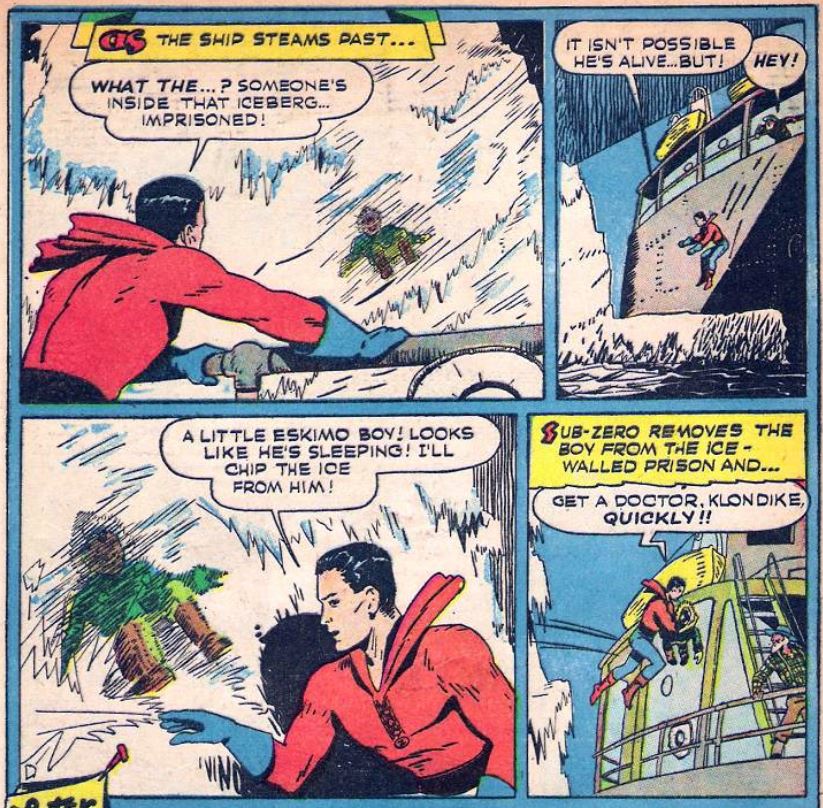
    On an adventure that takes him to Alaska, Sub-Zero happens upon a little Inuit or Aleut boy frozen in a glacier.

    Thawing the kid out and finding him to miraculously be alive, Sub-Zero (as well as an unfortunate doctor) is further astounded to discover that they share the same sort of cold-based powers due to their similar near-death freezing experiences. The kid names himself Freezum, and that’s just the first salvo of a barrage of tired comic relief sidekick shenanigans. Yes, we’ll be sighing and rolling our eyes for the remainder of Sub-Zero’s run – the joys of the Golden Age, friends! (Blue Bolt v2 005, 1941)

    Lois Blake:

    Lois Blake is a woman who Blue Bolt meets while attempting to take down a gang that was swindling immigrants using fake citizenship papers and decides to team up with. At some point when the gang is being particularly elusive he remembers that his pal Dr Bertoff down in the underground Kirby world has a viewscreen that can see virtually any location and so they head down there to use it. Bertoff then very helpfully offers to transfer some of Blue Bolt’s power to Lois and a new crimefighting team is born! (small aside: Golden Age comics don’t get a lot of praise for their art but I really enjoy both the small detail of Lois gripping Blue Bolt’s arm for comfort in the first panel above and her delighted expression in the third).

    Lois never gets a super-hero name and only really makes a handful of appearances before Blue Bolt ditches his costume and powers to become a regular if oddly-named soldier, but he’s such a nonentity post Simon and Kirby that I can’t help but love her for adding some life to the strip.(Blue Bolt v2 007, 1941)

    the Marvel:

    The Marvel is your classic mask-and-tuxedo vigilante, who specializes in showing up to bail reporter Scoop Cody out of the kind of jams you can get in when you’ve cracked a juicy crime story but not accounted for the possibility that the criminals involved might want to stop you from reporting on it.

    Three things about the Marvel: 

    1. The nose cutout never looks as cool as the full-face cowl does but I reckon it’s a heck of a lot more comfortable, so you have to give him some credit for choosing function over form.

    2. Scoop Cody and thus the Marvel only had two appearances and both of them had a teaser at the end promising that the Marvel’s identity would be revealed in the next issue. It’s always possible that they were planning on making the Marvel a completely new, never-before-seen guy but if they weren’t then literally the only suspect is this guy, Scoop Cody’s crusty old unnamed editor.

    3. Love a super-hero calling card, even in the rare cases when it’s a literal calling card.

    Also here is the Marvel’s second appearance in its entirety. (Blue Ribbon Coimcs 002, 1939)

  • MINOR SUPER-HERO ROUND-UP 008

    MINOR SUPER-HERO ROUND-UP 008

    Some real highs and lows in this one.

    the Twister: 

    The Twister is a quite minor Golden Age super-hero – he managed more than one appearance but not more than seven – who has the distinction of having one of the most well-designed costumes of the era. Not my favourite costume, mind you, but boy oh boy, you can really tell that his creators (Ray Gill and Paul Gustavson as it happens) really sat down for a good think about how to evoke “tornado” via the medium of clothing.

    The Twister turns out to be Bob Sanders, and he turns out to be a descendant of perennial fave Greek hero Odysseus. It turns out that the story of Aeolus gifting Odysseus two bags of wind and his men opening the bag of storm winds thinking that it was full of treasure was more than just another delay in Odysseus’ Bad Voyage, it was akin to the opening of Pandora’s Box and Aeolus had charged Odysseus or his descendants to round up all of the evil violent winds and return the to captivity. 

    Evidently over the years the charge to gather up evil winds has expanded to fighting all evil, and the Twister’s power set allows him to run roughshod over just about anyone using wind control, a tornado form and invulnerability to anything that couldn’t harm actual wind. There is some attempt to establish that he is vulnerable to being locked up somewhere with no airflow but that proves even easier to defeat than all the times that Silver Age Aquaman is locked up and forced to source water from unexpected places.

    The Twister’s other claim to fame is that he was introduced as a mysterious tornado that appeared in the Blue Bolt, Sub-Zero and Dick Cole stories in the issue he first appears in, which is enough to be counted as a rare Golden Age crossover even though none of them shared words. (Blue Bolt v2 001, 1941)

    Freezum:

    On an adventure that takes him to Alaska, Sub-Zero happens upon a little Inuit or Aleut boy frozen in a glacier.

    Thawing the kid out and finding him to miraculously be alive, Sub-Zero (as well as an unfortunate doctor) is further astounded to discover that they share the same sort of cold-based powers due to their similar near-death freezing experiences. The kid names himself Freezum, and that’s just the first salvo of a barrage of tired comic relief sidekick shenanigans. Yes, we’ll be sighing and rolling our eyes for the remainder of Sub-Zero’s run – the joys of the Golden Age, friends! (Blue Bolt v2 005, 1941)

    Lois Blake:

    Lois Blake is a woman who Blue Bolt meets while attempting to take down a gang that was swindling immigrants using fake citizenship papers and decides to team up with. At some point when the gang is being particularly elusive he remembers that his pal Dr Bertoff down in the underground Kirby world has a viewscreen that can see virtually any location and so they head down there to use it. Bertoff then very helpfully offers to transfer some of Blue Bolt’s power to Lois and a new crimefighting team is born! (small aside: Golden Age comics don’t get a lot of praise for their art but I really enjoy both the small detail of Lois gripping Blue Bolt’s arm for comfort in the first panel above and her delighted expression in the third).

    Lois never gets a super-hero name and only really makes a handful of appearances before Blue Bolt ditches his costume and powers to become a regular if oddly-named soldier, but he’s such a nonentity post Simon and Kirby that I can’t help but love her for adding some life to the strip.(Blue Bolt v2 007, 1941)

    the Marvel:

    The Marvel is your classic mask-and-tuxedo vigilante, who specializes in showing up to bail reporter Scoop Cody out of the kind of jams you can get in when you’ve cracked a juicy crime story but not accounted for the possibility that the criminals involved might want to stop you from reporting on it.

    Three things about the Marvel: 

    1. The nose cutout never looks as cool as the full-face cowl does but I reckon it’s a heck of a lot more comfortable, so you have to give him some credit for choosing function over form.

    2. Scoop Cody and thus the Marvel only had two appearances and both of them had a teaser at the end promising that the Marvel’s identity would be revealed in the next issue. It’s always possible that they were planning on making the Marvel a completely new, never-before-seen guy but if they weren’t then literally the only suspect is this guy, Scoop Cody’s crusty old unnamed editor.

    3. Love a super-hero calling card, even in the rare cases when it’s a literal calling card.

    Also here is the Marvel’s second appearance in its entirety. (Blue Ribbon Coimcs 002, 1939)

  • MINOR SUPER-HERO ROUND-UP 007

    All Novelty Press edition!

    Dick Cole, Wonder-Boy: 

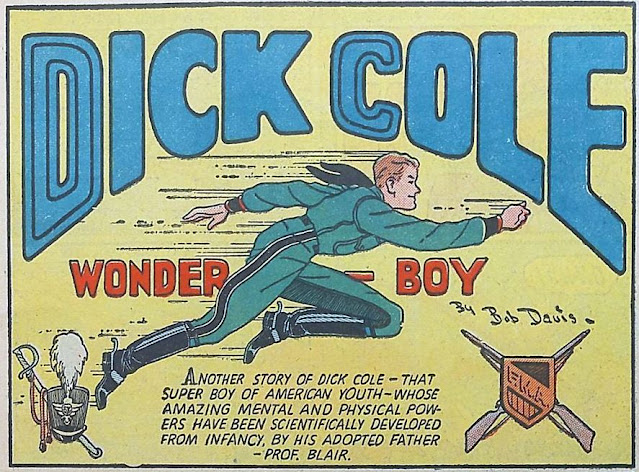
    Dick Cole was left on the front steps of scientist Professor Blair as a baby, and according to him there was an accompanying note requesting that he use his hitherto-untested experimental child-rearing techniques to bring the kid up to be superhuman. And it works! Dick Cole is stronger and faster and smarter than everyone else, and works to help those around him in whatever way he can.

    Sadly for me the Dick Cole series is set at a military academy, a surprisingly popular location in early comics. I think that the weird pseudo-military class structure that such places had/have was popular for the easy drama inherent in the noble protagonists being forced to kowtow to undeserving upperclassmen but reading comics about teenagers being assholes to each other for imaginary reasons palls quickly. (ADDENDUM: I wrote this at the beginning of my Dick Cole reading and am pleased to say that the military academy stuff isn’t as bad as it is in other comics of the time) (Blue Bolt v1 001, 1940)

    BONUS: here’s Dick Cole as a very cool baby.

    Sub-Zero:

    AKA Sub-Zero Man. Part of a Venusian expedition to Earth whose extremely awesome looking spaceship crashed through a frozen gas ball en route, killing everyone but Our Hero, who instead becomes uncontrollably and destructively super-cold.

    After a couple of issues of misunderstood wandering and being hunted, Sub-Zero endears himself to the city of Centro… Oregon? by saving it from a volcano. (highway signs place Centro somewhere between Los Angeles and Topeka, so it’s probably either Oregon or Northern California, and Oregon is closer to volcano country). There, he settles down to a regular super-hero life, albeit one with no secret identity, Centro slowly becomes NYC like so many other comic book cities and people basically forget the fact that he’s an alien. (Blue Bolt v1 001, 1940)

    the Phantom Sub: 

    A bunch of young men led by Jack Damon and Slim Dugan construct an advanced submarine in secret, as you do, and end up as wanted fugitives dispensing justice on the high seas via an electrified water cannon and some plucky attitudes. (Blue Bolt v1 001, 1940)

    Near the end of 1941 the Phantom Sub added the power of flight to its many features, and shortly after that the Phantom Sub crew were able to come in from the cold and begin aiding the US war effort. (Blue Bolt v2 006, 1941)

    the White Rider and Super Horse:

    During a stagecoach holdup, a youngster named Peter (no last name given) is orphaned and flung into a river that eventually flows into the mysterious Lost Valley, where he befriends and is raised by an old hermit named Jeb and a cool horse named Cloud. Eventually, the hermit dies of puma and Peter and Cloud make their way to the outside world where it turns out that due to the valley’s depth it somehow had more gravity and thus the two are super strong. Anyhow, Peter immediately hunts down and kills the bandit who orphaned him and resolves to stamp out crime as the White Rider and Super Horse. 

    Despite the superpowers the White Rider is a bit of a dud, hero-wise and Super Horse does most of the heavy lifting, both literally and metaphorically. (Blue Bolt v1 001)

  • MINOR SUPER-HERO ROUND-UP 006

    MINOR SUPER-HERO ROUND-UP 006

    Minor super-heroes need to be rounded up now and then.

    Blackstone the Magician: 

    There are a fair number of comic versions of real life people: movie cowboys by the dozen, big game tracker Clyde Beatty a couple of times, etc. Not too many of them quite cross over into the super-hero side of things, but here we have magician Harry Blackstone Sr, who absolutely did (Blackstone is also a great example of someone who was at one point wildly famous and has now receded far enough from the public consciousness that you might not have heard of him unless you’re really into the Dresden Files).

    Blackstone’s adventures fall more into the Action-Packed World Travel to Places Where Ethnics Live category of comics, with the gimmick that he uses stage magic to overcome various obstacles. But stage magic in a controlled environment using your own props and ad hoc stage magic using random items out in the world are different things, comic! (Super-Magic Comics 001, 1941)

    Black Fury:

    Rex King is an adventurer who spares the life of a panther in the jungles of Borneo because it has a white star marking on its throat. Later, that same panther saves Rex from a leopard attack and he takes this as a some grand life lesson about how animals can be full of humanity while men are bestial – long story short, he dresses up like something halfway between Black Condor and Wildcat and teams up with the panther (now named Kato) to beat up evil. (Super-Magic Comics 001, 1941)

    the Blue Bolt:

    Harvard University student Fred Parrish had the misfortune to be struck by lightning twice in the same storm, the second time while he was attempting to fly his light aircraft for help. Lucky for him, he crashed near the underground lair of Doctor Bertoff, a scientist looking for just such a lightning-charged person to experiment on and empower to fight in his ongoing war of Bertoff’s land of Deltos with the Green Sorceress and her kingdom of Voltor (later sumply “Bertoff’s Scientific City” vs “the Green Kingdom”).

    Blue Bolt was a willing conscript in this war, although he tempered Bertoff’s bloodthirstiness somewhat by seeking to reform the Green Sorceress rather than kill her outright, destroy her kingdom and salt the earth. This could be traced to a “don’t hit girls 1940s sense of fair play and also because he had the hots for her.

    Up to Blue Bolt v1 010 the Blue Bolt comic was written by Joe Simon and drawn by Jack Kirby and it was full of all kinds of crazy fun sci-fi malarky. Sadly, the instant they left to create Captain America it all went out the window and Blue Bolt became a regular-syle super-hero fighting Nazis on the boring old surface of the planet.

    For a few issues, Blue Bolt follows his kid brother Kip Parrish around as he serves with the RAF but this gets boring after a while and he heads back to the States. Once the US enters the war he ditches the costume entirely and seemingly forgets that he has super-powers and becomes a regular-style soldier with the unusual name Blue Bolt. Ho hum.

    This, by the way, is part of a pattern with the good folks at Novelty Press. They had it in their heads that their readers didn’t want stories that were “too fantastic” and this was reinforced by their letters page which every month featured missives from little killjoys asking for more boy inventors and fewer giant robots. I assume that these kids grew up to be the people hectoring DC every time Batman cracked a joke in the 60s and 70s and that their children form the vanguard of the “gritty realism” movement.

    Sergeant Spook:

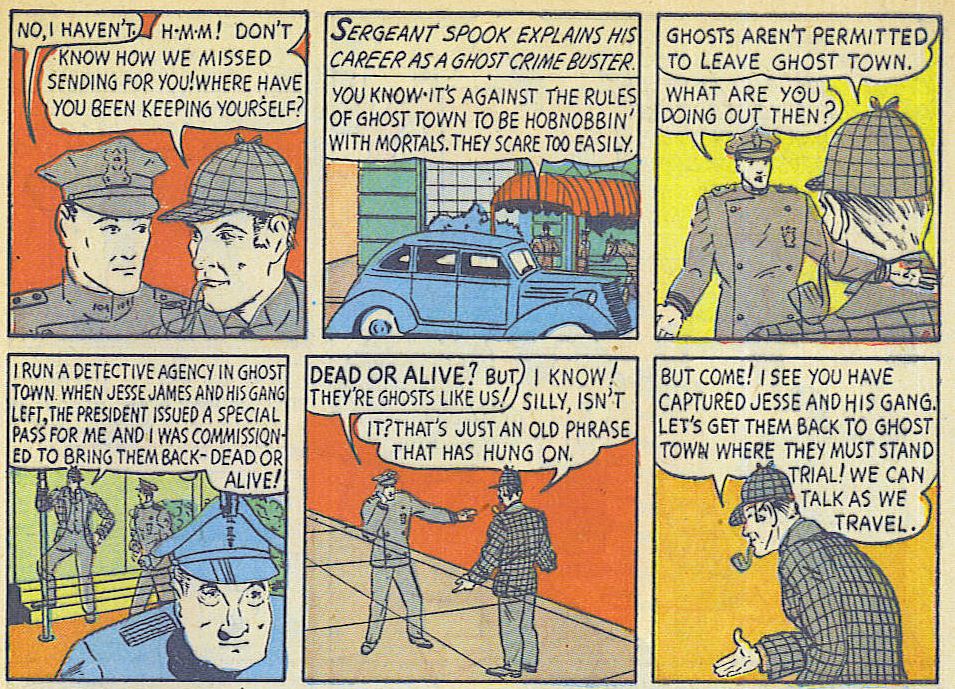
    Sergeant Spook here started out as a cop already named Sergeant Spook in a clear case of nominative determinism. After blowing himself up with a carelessly placed pipe in perhaps the least dramatic origin of any of the surprisingly large number of dead police officers to return as undead super-heroes, he basically just carries on as normal. He’s intangible and invisible, per regular ghost rule, but can interact with the material world just fine. (Blue Bolt v1 001)

    Then, in Blue Bolt v1 006 Sergeant Spook meets legally-distinct-from-Sherlock-Holmes ghost detective Dr Sherlock, who informs him that not only is he not unique but that there is a large community of ghosts that he is flouting the rules of by for instance beating the tar out of gangsters who can neither see nor touch him. He relocates to Ghost Town and becomes the de facto troubleshooter of its President, George Washington until rounding up the ghosts of dead troublemakers begins to get stale, at which point Spook heads back to the mortal world to deal with human/ghost conflicts.

  • MINOR SUPER-HERO ROUND-UP 005

    All Columbia Comic Corporation edition!

    Skyman: 

    Skyman (properly the Skyman but it just doesn’t scan for me) is a pilot hero, normally a ho-hum sort of character for me. But between his sci-fi super plane (the Wing), his blood-freezing stun ray (the Stasimatic) and his cool on-the-edge-of-being-too-busy costume there’s just enough super-hero peanut butter mixed in with the pilot chocolate to make it appealing (bonus running list of Skyman’s super science: atomic explosives, invisible glass phonograph, disitegrator ray, explosives-detonating ray and a ray that fuses gun barrels shut)

    After a few issues we learn that the Skyman is actually Allan Turner, wealthy good-for-nothing playboy who lost his parents to a plane crash when he was a child. If the Bruce Wayne parallel was 1:1 he would have grown up to become a noted slayer of planes, but that’s a villain’s origin. Instead, Allan Turner dresses up as a plane to fight criminals. It doesn’t make quite as much narrative sense as Batman does but it’s probably more fun to read than the other way around.

    Early Skyman also might just hold the record for the most overinflated torso in comics outside of parody characters. He gets a bit more proportional eventually but for a while there you’re concerned for his ability to live a normal life.

    the Face:

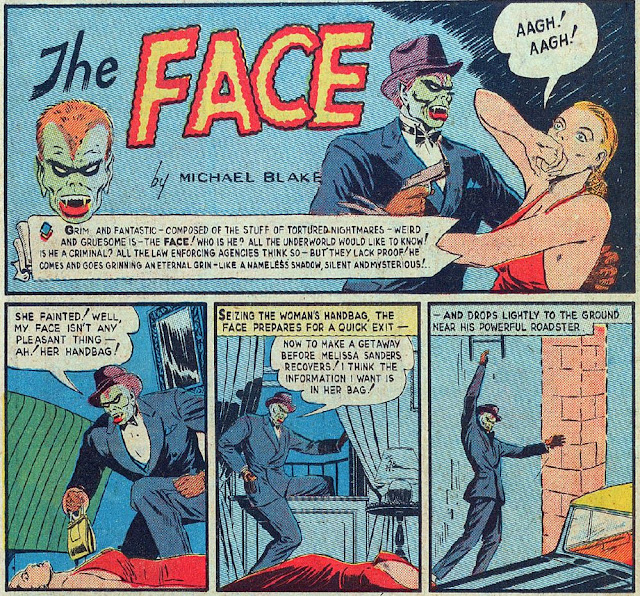
    The Face, like a lot of early comics heroes, draws a lot of elements from the pulps: a tuxedo-clad hero drives around in a souped up roadster fighting crime with his fists and an automatic – a pretty regular early super-guy. Even his secret identity of Tony Trent, radio station owner/ radio announcer is in the pulp-adjacent character wheelhouse.

    It was very exciting to me when I realized that the Face’s face is frequently referred to as a rubberoid mask, my favourite term for the kind of masks that only exist in comic books – perfectly realistic and naturalistic but also very easy to don and doff. This particular mask was made specially for Tony Trent by someone whose other major characteristic is being dead, which is apparently a combination that makes Trent feel quite jolly.

    Weirdly, in Big Shot Comics 006, the Face has a new, slightly less grotesque mask. No word on where he got this one but he goes back to the original pretty quickly.

    Marvelo, Monarch of Magicians:

    Created by Fred Guardineer, who also created Zatara over at DC Comics, Marvelo is… extremely similar to Zatara. Aside from their different approaches to dressing like a stage magician, I’d say that there are two slight differences between the characters: 

    1. Rather than speaking backward to cast spells, Marvelo shouts “Kalora!” as an all-purpose magic word.

    2. Marvelo’s manservant Zee is just a hair more racist than Zatara’s manservant Tong. It’s pretty close but I reckon Zee takes it.

    Big Shot Comics 017 reveals that Marvelo is the son of the ruler of the generically foreign South Pacific island of Brahama (hell on autocorrect). This doesn’t seem to have anything to do with him being a magic man but it’s nice to know. (Big Shot Comics 001, 1940)

    the Cloak:

    Jeff Cardiff, Spy Chief was a feature in Big Shot Comics from issue 1 (well, it was Jeff Cardiff, Spy-Master for the first issue or two but the point stands) with all kinds of foiled plots and plans and spies of both the vaguely fascist and vaguely communist varieties. In Issue 15, however, the spies adopt the reasonable policy of attempting to shoot on sight the man who has foiled so many of their plans and a wounded Jeff Cardiff goes to recuperate at his brother’s house.

    Long story short, Jed Cardiff is a coal magnate with a collection of “adventure curios”, including the namesake cloak of Revolutionary War-era costumed spy the Cloak and it being 1941 and a comic book, Jeff immediately adopts the Cloak identity as his own. It’s a fairly basic costumed hero shtick but I appreciate the effort and it’s always nice to see a more elaborate cape and cowl getup now and then. (Big Shot Comics 015, 1941)

    The original Cloak eventually shows up in a flashback and it turns out that his impact on the history of the American Revolution is only slightly less impactful than Superboy’s in the 1949 story in which he goes back in time and takes part in about half the major events of the war. I must say that I do love a retcon of a historical event. (Big Shot Comics 021, 1942)

  • MINOR SUPER-HERO ROUND-UP 005

    All Columbia Comic Corporation edition!

    Skyman: 

    Skyman (properly the Skyman but it just doesn’t scan for me) is a pilot hero, normally a ho-hum sort of character for me. But between his sci-fi super plane (the Wing), his blood-freezing stun ray (the Stasimatic) and his cool on-the-edge-of-being-too-busy costume there’s just enough super-hero peanut butter mixed in with the pilot chocolate to make it appealing (bonus running list of Skyman’s super science: atomic explosives, invisible glass phonograph, disitegrator ray, explosives-detonating ray and a ray that fuses gun barrels shut)

    After a few issues we learn that the Skyman is actually Allan Turner, wealthy good-for-nothing playboy who lost his parents to a plane crash when he was a child. If the Bruce Wayne parallel was 1:1 he would have grown up to become a noted slayer of planes, but that’s a villain’s origin. Instead, Allan Turner dresses up as a plane to fight criminals. It doesn’t make quite as much narrative sense as Batman does but it’s probably more fun to read than the other way around.

    Early Skyman also might just hold the record for the most overinflated torso in comics outside of parody characters. He gets a bit more proportional eventually but for a while there you’re concerned for his ability to live a normal life.

    the Face:

    The Face, like a lot of early comics heroes, draws a lot of elements from the pulps: a tuxedo-clad hero drives around in a souped up roadster fighting crime with his fists and an automatic – a pretty regular early super-guy. Even his secret identity of Tony Trent, radio station owner/ radio announcer is in the pulp-adjacent character wheelhouse.

    It was very exciting to me when I realized that the Face’s face is frequently referred to as a rubberoid mask, my favourite term for the kind of masks that only exist in comic books – perfectly realistic and naturalistic but also very easy to don and doff. This particular mask was made specially for Tony Trent by someone whose other major characteristic is being dead, which is apparently a combination that makes Trent feel quite jolly.

    Weirdly, in Big Shot Comics 006, the Face has a new, slightly less grotesque mask. No word on where he got this one but he goes back to the original pretty quickly.

    Marvelo, Monarch of Magicians:

    Created by Fred Guardineer, who also created Zatara over at DC Comics, Marvelo is… extremely similar to Zatara. Aside from their different approaches to dressing like a stage magician, I’d say that there are two slight differences between the characters: 

    1. Rather than speaking backward to cast spells, Marvelo shouts “Kalora!” as an all-purpose magic word.

    2. Marvelo’s manservant Zee is just a hair more racist than Zatara’s manservant Tong. It’s pretty close but I reckon Zee takes it.

    Big Shot Comics 017 reveals that Marvelo is the son of the ruler of the generically foreign South Pacific island of Brahama (hell on autocorrect). This doesn’t seem to have anything to do with him being a magic man but it’s nice to know. (Big Shot Comics 001, 1940)

    the Cloak:

    Jeff Cardiff, Spy Chief was a feature in Big Shot Comics from issue 1 (well, it was Jeff Cardiff, Spy-Master for the first issue or two but the point stands) with all kinds of foiled plots and plans and spies of both the vaguely fascist and vaguely communist varieties. In Issue 15, however, the spies adopt the reasonable policy of attempting to shoot on sight the man who has foiled so many of their plans and a wounded Jeff Cardiff goes to recuperate at his brother’s house.

    Long story short, Jed Cardiff is a coal magnate with a collection of “adventure curios”, including the namesake cloak of Revolutionary War-era costumed spy the Cloak and it being 1941 and a comic book, Jeff immediately adopts the Cloak identity as his own. It’s a fairly basic costumed hero shtick but I appreciate the effort and it’s always nice to see a more elaborate cape and cowl getup now and then. (Big Shot Comics 015, 1941)

    The original Cloak eventually shows up in a flashback and it turns out that his impact on the history of the American Revolution is only slightly less impactful than Superboy’s in the 1949 story in which he goes back in time and takes part in about half the major events of the war. I must say that I do love a retcon of a historical event. (Big Shot Comics 021, 1942)

  • MINOR SUPER-HERO ROUND-UP 004

    the Lone Warrior (and Dicky): 

    The Lone Warrior and Dicky are Stan and Dicky Carter, son of the now-deceased “world’s greatest scientist” and recipients of his Power Elixir injections, leaving them generically physically enhanced and well-equipped to battle pseudo-Nazi forces seeking to wreck America’s military. Plus he made them a land/ air/ sea plane/tank called the Wonder Ship which is very useful.

    There is of course a knee-jerk impulse to snidely point out that a guy called the Lone Warrior is never seen without his sidekick, but… I think it’s on purpose? They don’t explore it well but I reckon that it’s meant to be a joke: big tough dude calls himself the Lone Warrior and can’t avoid being tailed everywhere by his little brother? It’s not a bad joke! Too bad they only had 4 or so appearances and never really explored it. (Banner Comics 003, 1941)

    Samson:

    Samson from the comics is, unsurprisingly, based off of Samson from the Bible. In fact, he’s a descendant of the Biblical Samson, which seems hard to prove. Like his supposed ancestor, Samson possesses superhuman strength as long as his hair remains uncut, which in his case means that he must maintain a sort of shoulder-length mullet. His hair of course frequently gets cut for dramatic effect but luckily for Samson his other super power is that it will grow back preternaturally fast and always into the same style, like Wolverine’s.

    At some point in a comic I have not yet read Samson finds and adopts a boy named David. David has no super-powers and is in constant peril. He also has a scientist pal named Professor Brun who acts as a sort of Samson dispatcher using advanced surveillance tech to find trouble and a teleporter with the fun nmae of the “demoleculing ray” to send Samson and David to the scene.

    Finally, Samson is a stone cold killer. He wipes out crooks by the dozen with a frankly concerning lack of care for the legal process. (Fantastic Comics 001, 1939)

    Late in 1941, Samson got a bit of sprucing up. I don’t know if this was a deliberate attempt on the part of Fox Features to rectify the formulaic nature of Samson comics or it was a simple case of a new artist/ writer shaking things up but suddenly Samson had a supporting cast beyond David: namely a gal pal with the incredibly on-the-nose name of Lila Dee and a comic relief artist named J. Rembrandt Speedball. 

    The best addition, however, was… not exactly a secret identity for Samson but an Incognito Mode in which he dressed in street clothes, but since he was an enormous, long-haired guy what this entails is his wearing a huge overcoat buttoned to the neck with the collar flipped up over his mullet. Truly great. Sadly, this revamped Samson only appeared in a handful of issues before Fox Features had the troubles that lead to them halting production for a few years. Like most of their characters, he was never seen again.

    UPDATES: He really is the descendant of the Biblical Samson (Samson 001, 1940)

    Update 1941 

    the Flame:

    Found by Tibetan lamas as a baby and taught their mystic secrets, the Flame has a lot of the standard flame powers – immunity to fire and heat (and explosions), control over flame, a high enough body temperature that bullets melt on contact with him – a few more unusual ones – the ability to walk and climb on sheets of flame as if they were solid, the weirdly common Golden Age super power of appearing suddenly in the element that they embody, in this case any size flame down to a match – and surprisingly no actual ability to produce flame. Instead, he carries a pistol-sized flamethrower (over time, the amount of heat and flame produced by his body does increase, but he’s never at Human Torch level). The Flame’s enemies of course frequently attempt to set fire to him.

    While I appreciate the Flame’s classic costume stylings, he is ultimately a pretty generic guy. Plus he’s at least as bloodthirsty as his fellow Fox Features alum Samson. (Wonderworld Comics 003, 1939)

    (the Flame also has a very cool car, as seen in Big 3 002, 1940)

    Like Samson, the Flame eventually gets a more fleshed out world just in time for Fox Features to go to heck for a few years and then fail to bring him back. In the Flame’s case he does adopt a secret identity: as Gary Preston, private investigator. He is joined by former boxer and general goofball Pug and future Flame Girl (watch for future round-ups, I guess) Linda Dale.

    Flame UPDATE 1

    Flame UPDATE 2 

    Flame UPDATE 3

    Flame UPDATE 4 

    Stardust the Super Wizard:

    Stardust the Super Wizard is an enormous, nigh-omnipotent fellow who lives in a star and deals out bizarre and ironic punishments to a cartoonishly evil rogues gallery with incredible ease – the only real obstacle that he faces in an average adventure is the travel time between him and his villains. The second-greatest creation of outsider comics artist Fletcher Hanks (after Fantomah, of course), Stardust is well-known enough that I don’t really need to go into much detail on him here but it seemed weird to leave him out. (Fantastic Comics 001, 1939)